
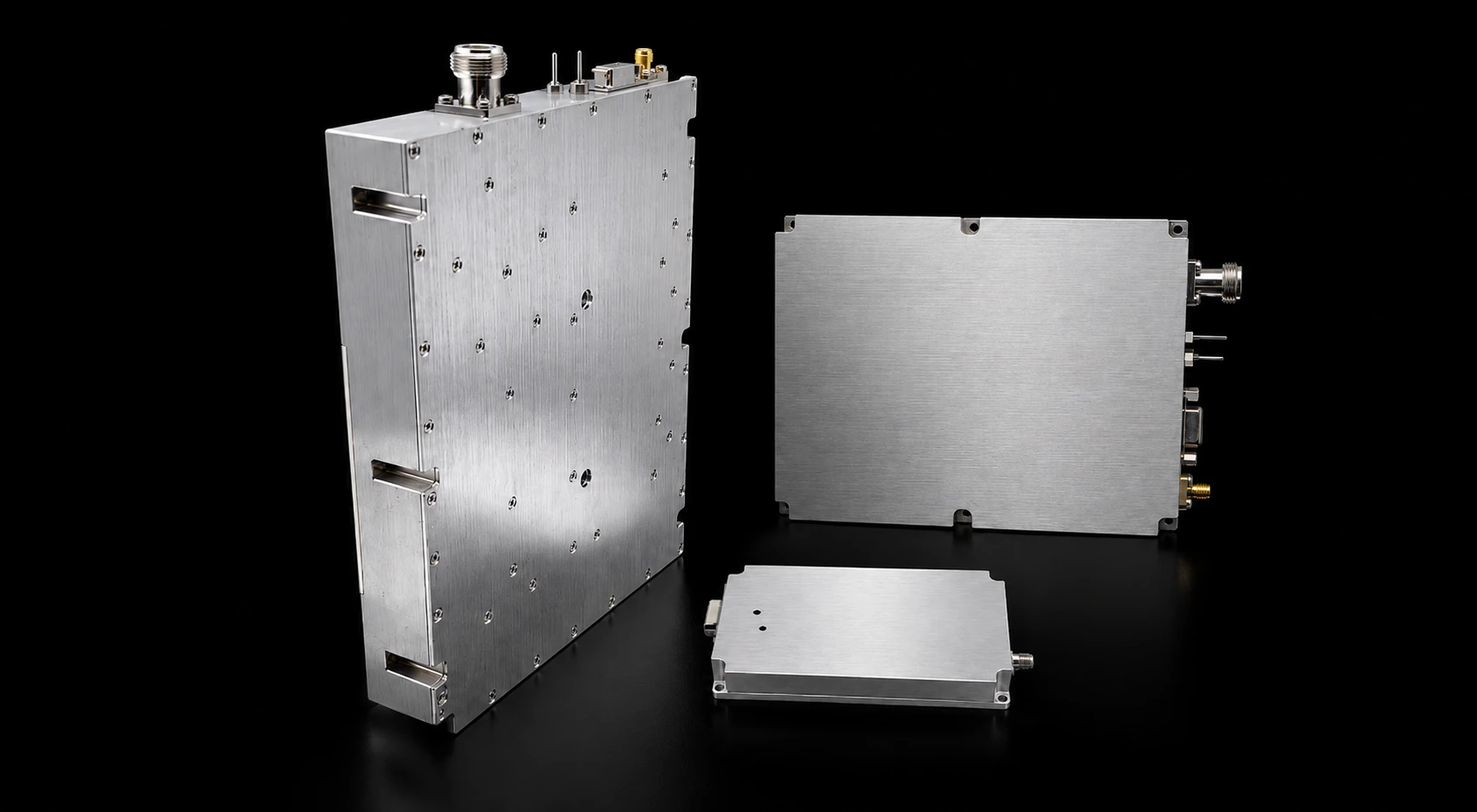
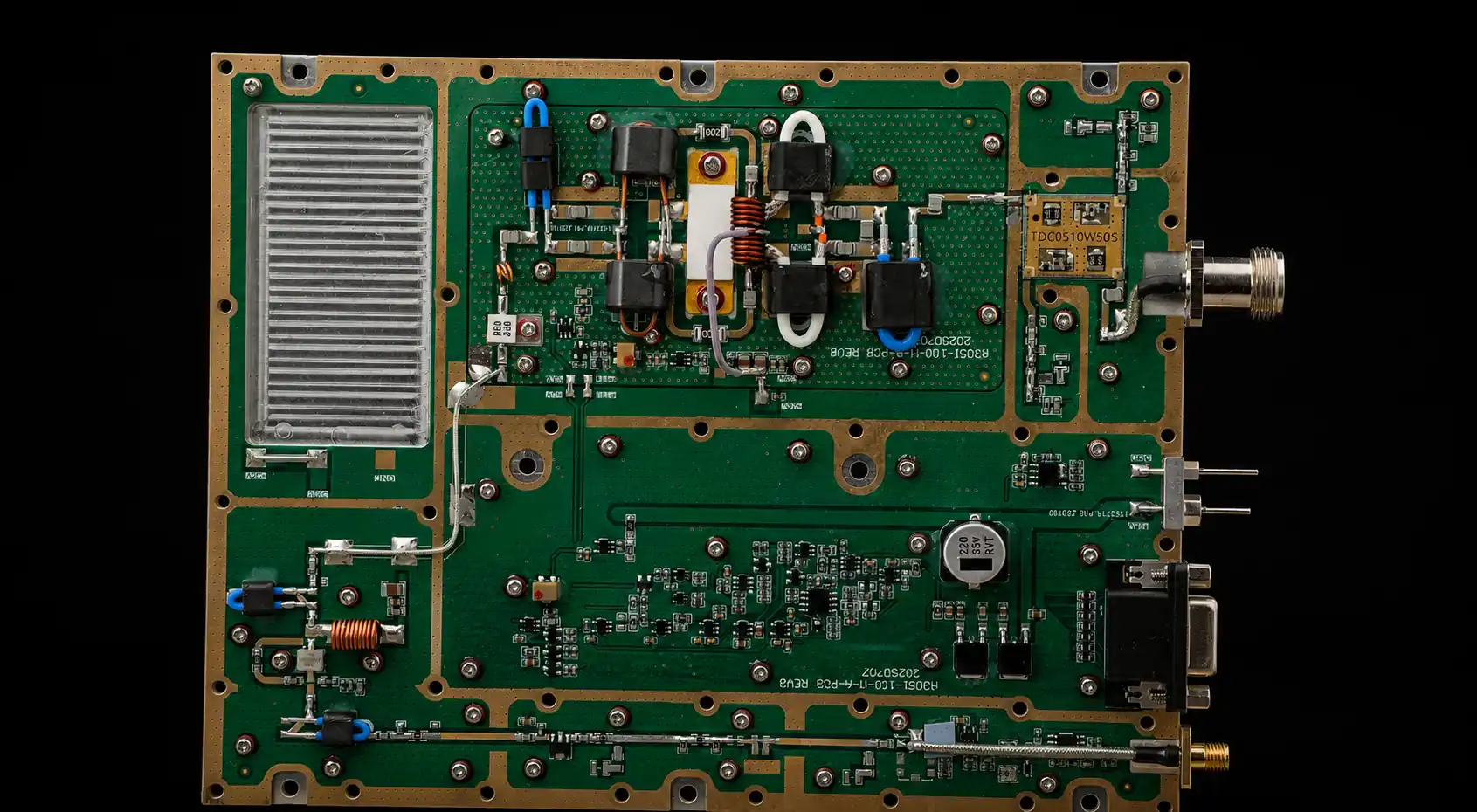
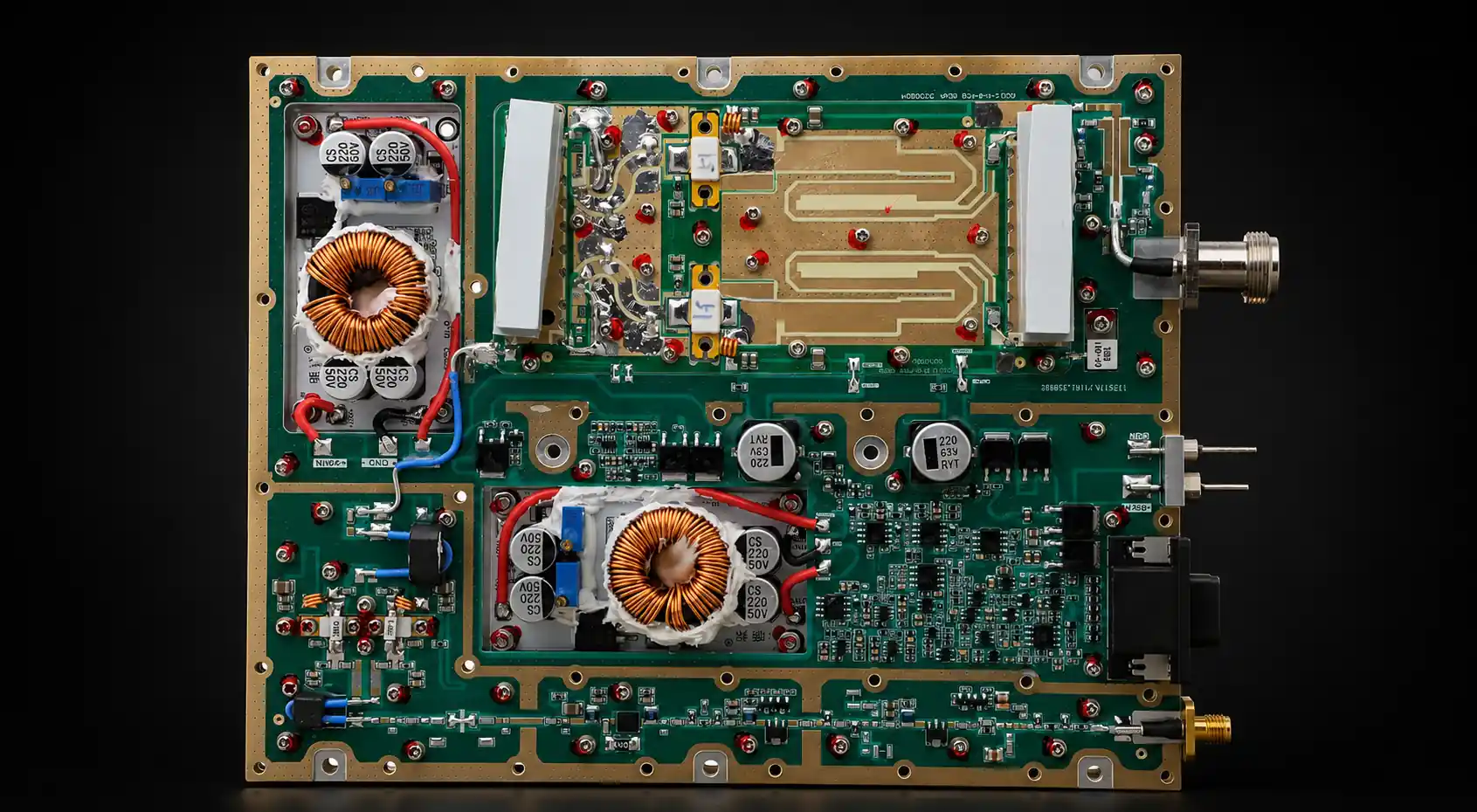
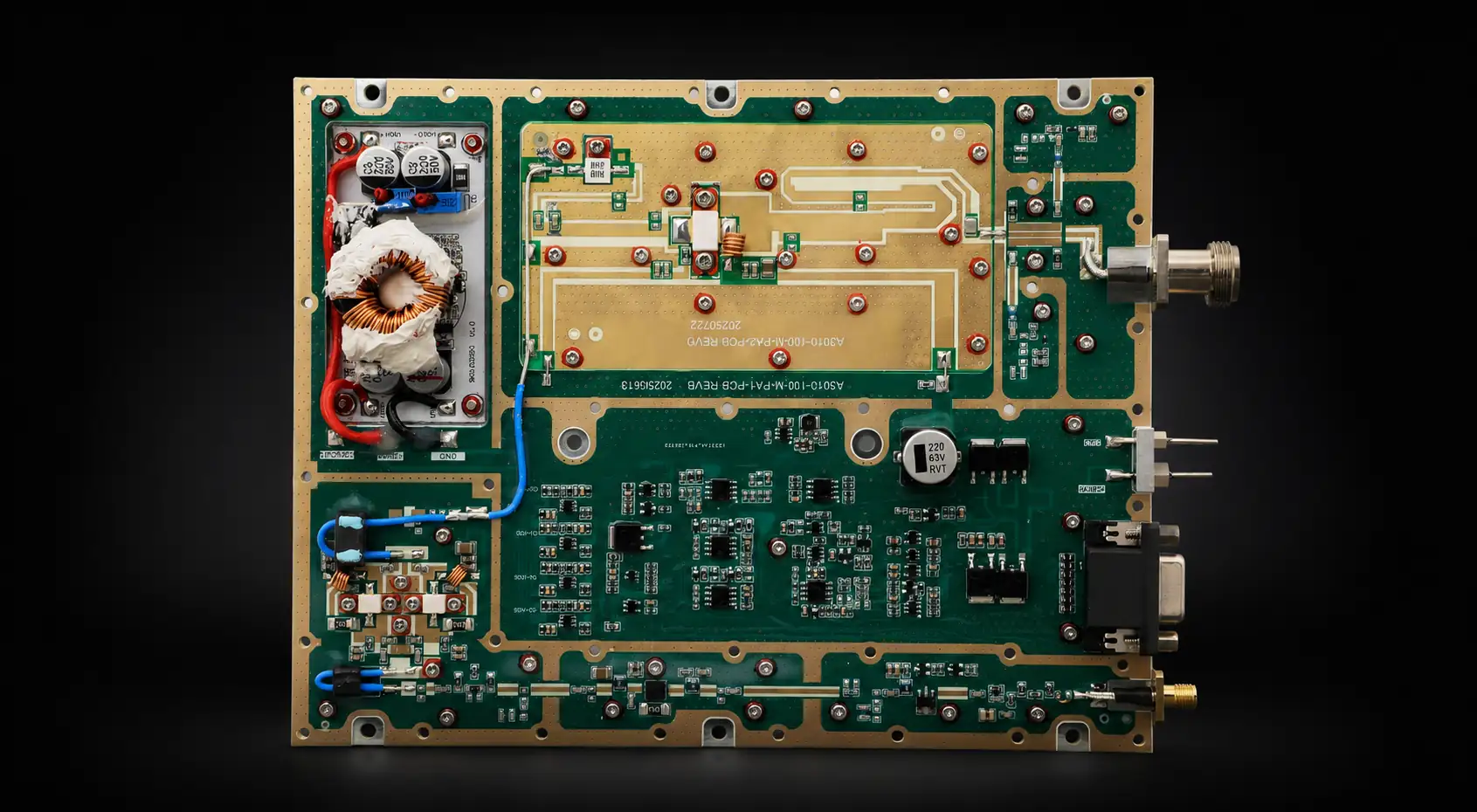

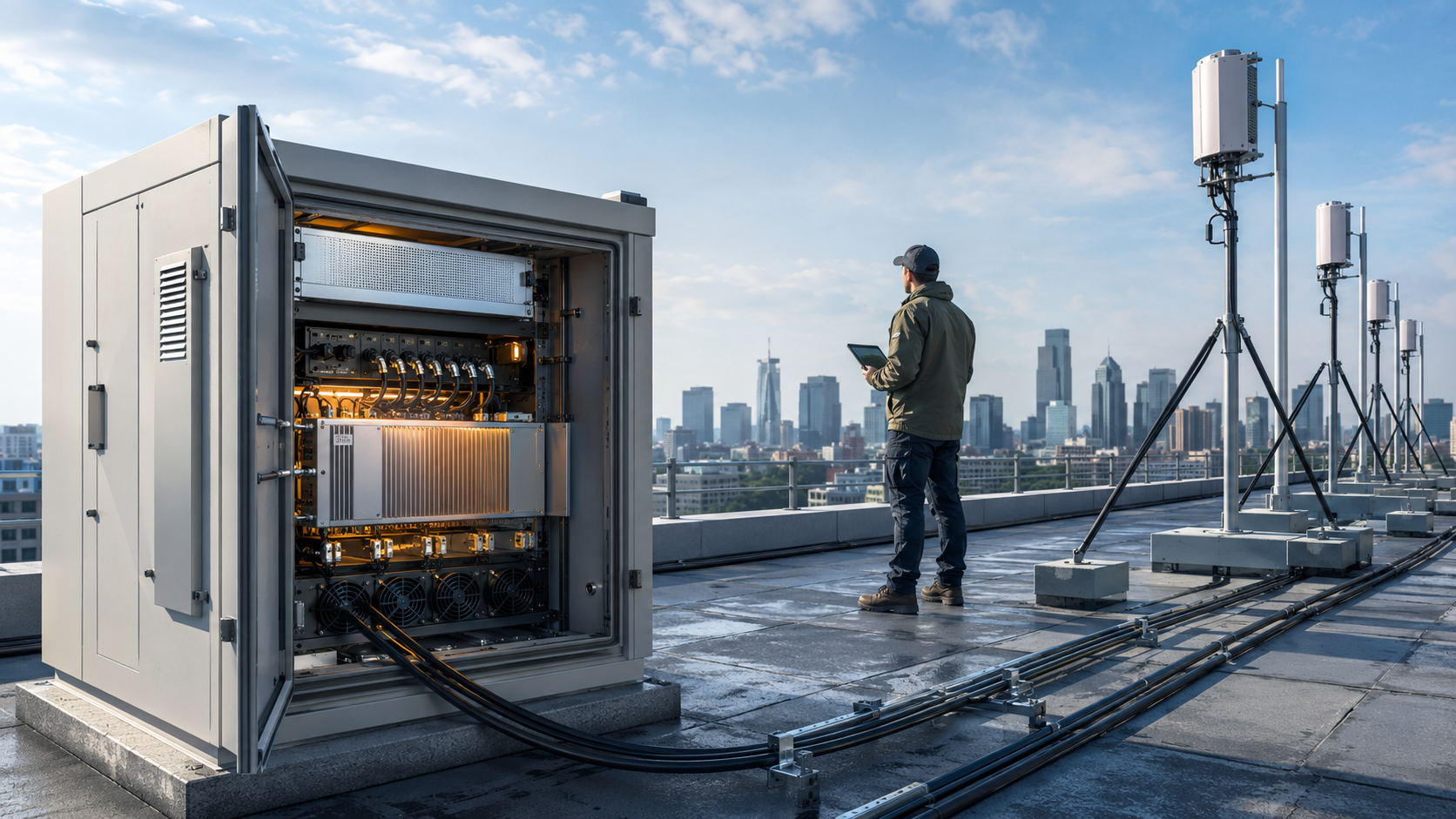
A rooftop C-UAS system may reach its target power during a short test and still fail to maintain the required continuous RF output after the complete RF chain reaches sustained thermal, electrical, and load conditions.
This risk must be evaluated when selecting RF Power Amplifier Modules for unattended rooftop installations. The approval question is not whether the PA reaches 100 W or 200 W once. It is whether the installed system can hold the required PA-port or antenna-port output throughout the defined operating period.
Continuous-output approval therefore needs more than a peak-power screenshot. The test must define the signal waveform, frequency, output reference plane, minimum uninterrupted run time, cabinet condition, cooling method, module-terminal voltage, RF load, permitted output drift, and protection behavior.
1. Why Short-Burst Output Does Not Prove Rooftop Stability
A short RF test can confirm that the amplifier starts correctly and reaches its initial output target. It may also confirm basic gain, drive level, control response, and RF-path continuity.
However, the test may finish before the system reaches its real operating boundary.
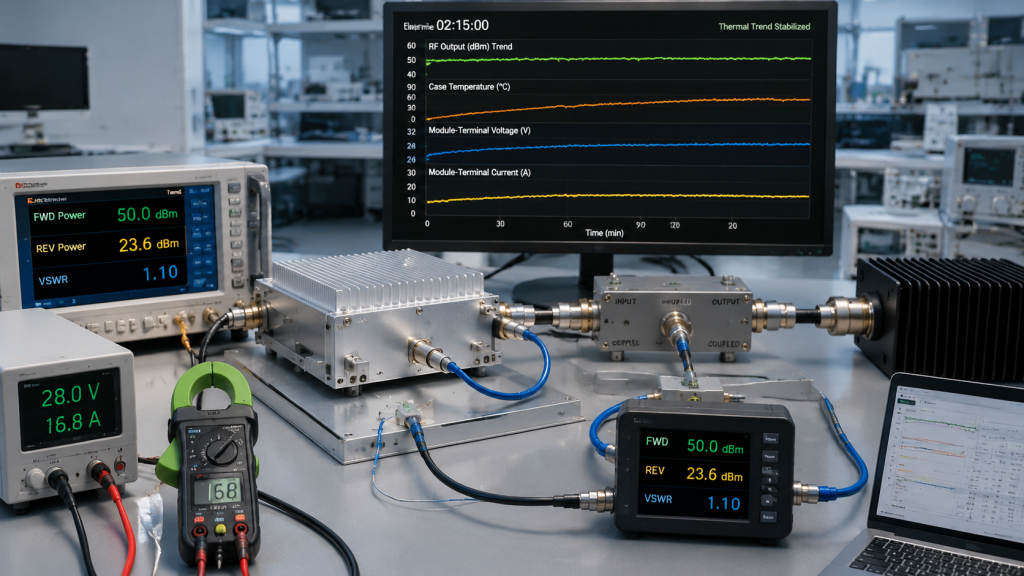
During continuous operation, heat must move from the RF device through the PCB, thermal interface, housing, heatsink, cabinet air, and outdoor environment. At the same time, the 28 V power path must maintain sufficient voltage under sustained current.
The feeder, connectors, antenna load, control system, and protection logic must also remain within their approved limits.
A short test may therefore miss:
- Output drift after warm-up
- Continuing cabinet temperature rise
- Module-terminal voltage drop
- Current changes at hot state
- Reflected-power events under the installed antenna path
- Protection foldback, meaning an automatic reduction in RF output
- Alarm or shutdown activity
- Recovery that occurs only after cooling or reset
A clean startup result is useful, but it proves only that the amplifier can reach the required output under the initial conditions. It does not prove that the system can maintain that output throughout the required run.
Short-Burst Evidence vs Continuous-Output Evidence
| Evidence Item | Short Burst Can Show | Continuous Test Must Show |
|---|---|---|
| RF output | Initial target power | Hot-state output throughout the defined run |
| Test duration | Startup or brief operation | Documented minimum uninterrupted operating time |
| Signal condition | One initial drive condition | Defined CW or modulated waveform and power basis |
| DC supply | Initial input voltage | Module-terminal voltage and current trends |
| Temperature | Cold-state or early-state behavior | Case, baseplate, or cabinet temperature trend |
| RF load | Controlled-load snapshot | Sustained load and reflected-power behavior |
| Protection | Initial normal status | Alarm, foldback, shutdown, and recovery status |
| Frequency | One convenient test point | Project-defined critical frequency or frequencies |
| Traceability | One measured result | S/N-linked conditions and unit-specific records |
The difference is simple: a short test shows that the PA can reach the target output. A continuous test shows whether it can hold the approved output after warm-up and throughout the required operating time.
2. What Continuous Output Must Mean in the Project
The same nominal output rating may be quoted under three different operating conditions:
- Burst output: Short triggered transmission with limited thermal accumulation
- Duty-limited output: A defined work-and-rest cycle with planned cooling intervals
- Continuous output: Sustained operation without depending on regular cooling pauses or manual resets
All three operating modes can be valid. The risk appears when a burst-oriented or duty-limited result is presented as continuous capability.
When uninterrupted transmission is not required, the buyer should still define the RF PA duty cycle before comparing wattage ratings. Otherwise, the supplier and customer may approve different operating modes under the same output specification.
Continuous Operation Does Not Always Mean a CW Signal
The operating duration and the RF waveform are separate conditions.
A PA may operate continuously while amplifying:
- A CW signal
- A modulated signal
- A wideband waveform
- A project-defined switching sequence
The test must therefore state:
- CW or modulation type
- Occupied bandwidth
- Peak-to-average power ratio when relevant
- Whether the required output is average power, peak power, or peak envelope power
- RF input level and drive waveform
- Required uninterrupted run time
- Duty cycle, if the signal is not continuously active
Average RF power largely determines sustained thermal load, while waveform peaks may affect compression and linearity. A “100 W” result is incomplete unless the power definition and signal condition are stated.
The Output Reference Plane Must Also Be Defined
“100 W continuous” does not explain where the power is measured.
The requirement may apply at:
- The PA output port
- The cabinet RF output
- The feeder end
- The antenna input
These are not interchangeable reference planes.
A 100 W result at the PA port under a 50 Ω dummy load does not mean that 100 W reaches the antenna after feeder, connector, adapter, and lightning-protection losses.
The RFQ and test report must use the same reference plane.
3. Why Rooftop Installations Expose Output Drops
Rooftop installations combine thermal, electrical, and RF-path conditions that may not appear together during a short bench test.
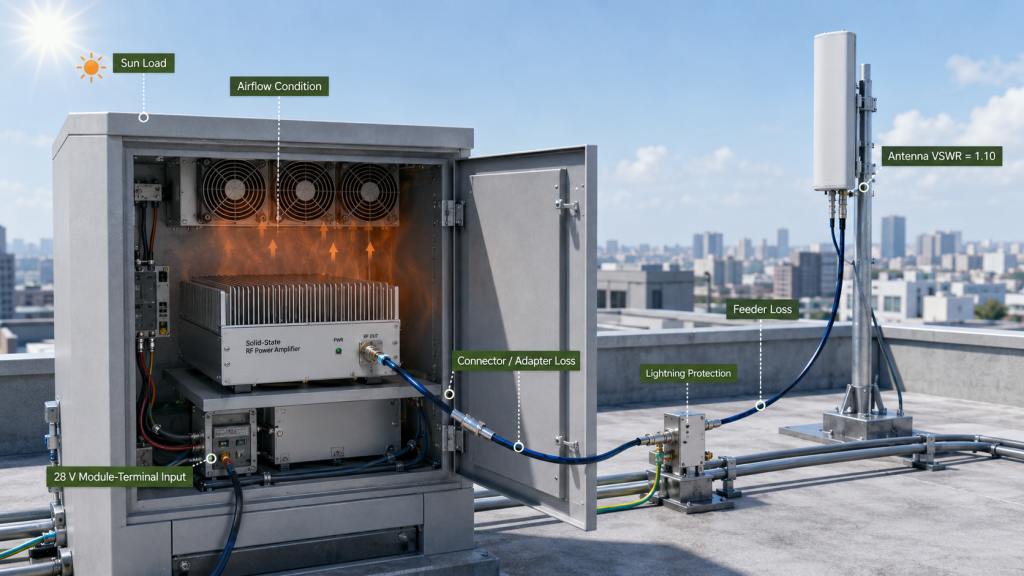
Cabinet Heat and Sun Exposure
The amplifier normally operates inside a cabinet rather than in unrestricted outdoor air. Wind around the building may cool the enclosure surface, but it does not prove that the PA housing, heatsink, cabinet air, and internal airflow remain within the approved operating boundary.
Direct sunlight can also raise the enclosure temperature above the reported outdoor ambient temperature.
If heat cannot leave the system as quickly as it is generated, the result may include:
- Gradual output reduction
- Changing current after warm-up
- Temperature alarms
- Protection foldback
- Recovery only after the system cools
The complete RF PA heat and cabinet cooling boundary should therefore be reviewed together with the continuous-output requirement.
Outdoor airflow alone is not an acceptance condition.
Sustained 28 V Load
A 28 V supply may appear stable before the amplifier reaches full current or hot-state operation. Voltage can then fall across the supply cable, connector, fuse, relay, or cabinet distribution path.
The relevant value is the voltage measured at the PA input while the amplifier is producing the required RF output.
A power-supply display at the cabinet entrance does not prove that the same voltage reaches the PA terminals.
Installed Antenna Path
A dummy load provides a controlled RF baseline. The installed path introduces feeder loss, connectors, adapters, lightning protection, weatherproof joints, bends, and real antenna mismatch.
These conditions can affect:
- Delivered antenna-port power
- Reflected power
- VSWR
- Cable and connector heating
- Protection response
A difference between the dummy-load result and the installed-path result does not automatically prove a PA defect. The team must first separate PA behavior from feeder loss, antenna mismatch, module-terminal voltage drop, and controlled protection activity.
When several PA channels operate simultaneously, the continuous-output test should reproduce the project-defined combined DC and thermal load. The operating combination, total current, cooling arrangement, and control sequence must be stated in the test plan.
4. How to Test Continuous RF Output at Hot State
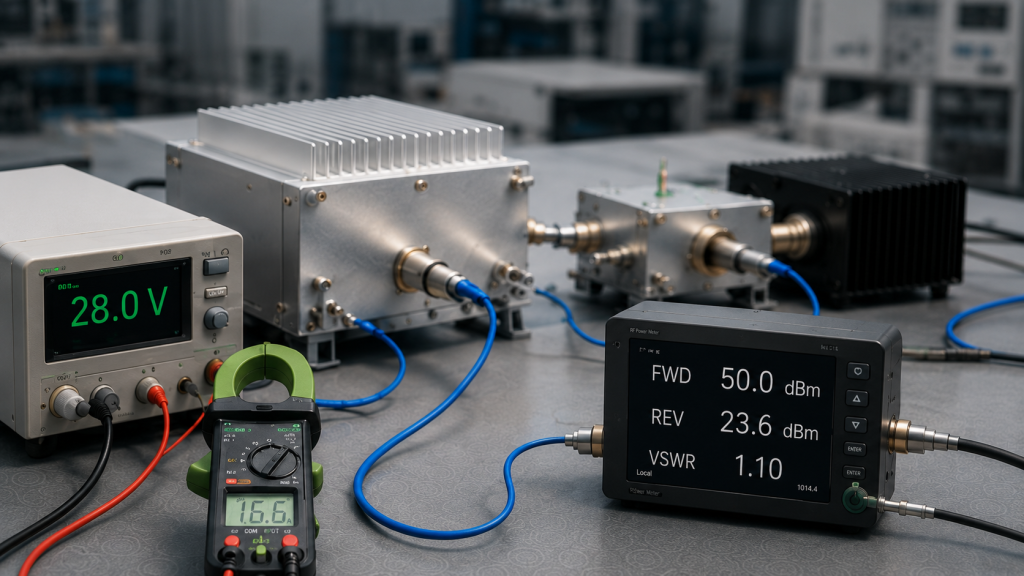
The test should reproduce the conditions that can cause output to change. Every result must also be documented clearly enough for another engineer to repeat the test.
Step 1: Define the Output Reference Plane
Choose the reference point before testing:
- PA output port
- Cabinet RF output
- Feeder end
- Antenna input
Do not mix readings from different reference planes in the same acceptance statement.
When the requirement applies at the antenna port, record the known path loss or directly measure the power at the required reference point. Do not approve an antenna-port target using only a PA-port reading.
Step 2: Define the Signal Condition
Record the exact RF condition used for the test:
- CW or modulation type
- Occupied bandwidth
- Peak-to-average power ratio when applicable
- Average, peak, or peak envelope output definition
- RF input level
- Input waveform or signal source
- Required operating sequence
The production test and the project requirement must use compatible power definitions. A 100 W CW result cannot automatically approve a 100 W peak modulated requirement, and a 100 W peak result cannot prove 100 W average continuous output.
Step 3: Establish the Frequency-Domain Baseline
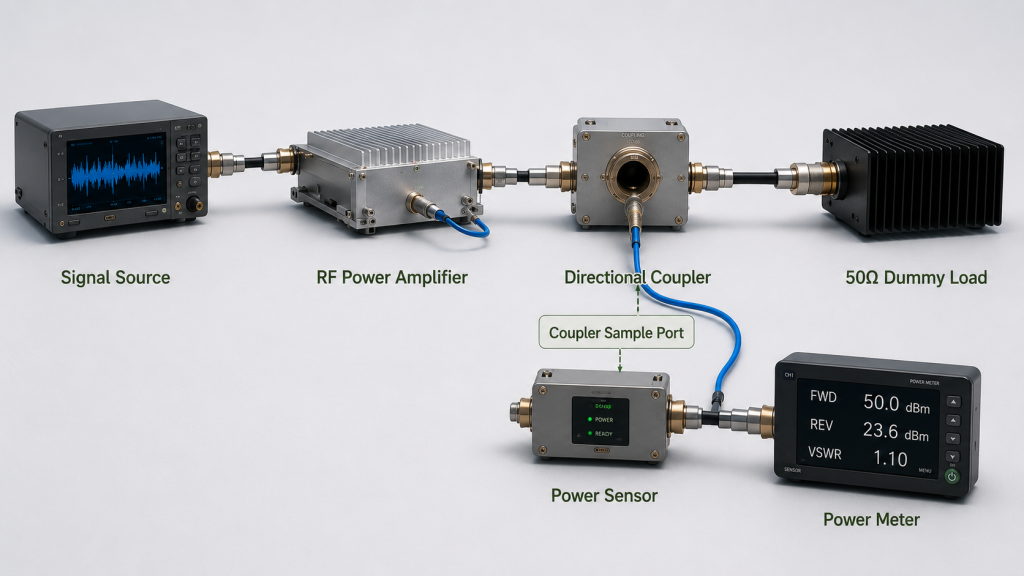
Connect the PA to a calibrated measurement path and a suitable 50 Ω dummy load.
Record:
- Frequency
- RF input level
- Signal condition
- PA output
- Forward and reflected power
- VSWR
- 28 V module-terminal voltage
- DC current
- Initial case or baseplate temperature
- Cooling configuration
- Control and alarm status
A full-power swept RF PA test establishes the output baseline across the required frequency range.
However, swept-frequency testing and continuous dwell testing answer different questions.
A frequency sweep shows whether the amplifier reaches the required output at the tested frequencies. A continuous dwell test shows whether it can hold the approved output at a project-defined critical frequency after thermal stabilization.
A sweep alone does not prove continuous RF output.
Step 4: Select the Continuous Dwell Condition
The dwell frequency should be selected from engineering evidence rather than convenience.
It may include:
- A normal operating frequency
- A band-edge frequency
- A known high-current condition
- A frequency identified during baseline testing as producing lower efficiency or greater thermal load
- A frequency previously associated with output drift
When several critical frequencies must be verified, define whether:
- Each frequency receives a separate continuous dwell run, or
- The test follows a project-representative switching sequence
A rapidly switched sequence should not be treated as equivalent to a complete continuous dwell test at each frequency unless that sequence represents the actual operating requirement.
Step 5: Run for the Required Duration
The test must run for at least the project-defined minimum uninterrupted duration.
It must also continue long enough to determine whether the output and temperature trends stabilize within their approved limits or show continuing drift.
Reaching apparent thermal stability does not replace the required operating duration.
Record data from startup through the end of the run. The trend is more useful than a single final screenshot.
The test should show:
- Whether output remains above the minimum accepted value
- Whether output drift stays within the approved limit
- Whether temperature stabilizes or continues to rise
- Whether current changes after warm-up
- Whether module-terminal voltage remains within range
- Whether alarms, foldback, or shutdown occur
- Whether output returns only after cooling or reset
A stable result does not mean that every measured value remains perfectly unchanged. It means that the required values remain within the agreed acceptance boundaries throughout the defined run.
Step 6: Check the 28 V Path Under RF Load
Measure voltage at the PA input while the amplifier is producing the required RF output.
When output falls, compare the output trend with:
- Module-terminal voltage
- DC current
- Case or baseplate temperature
- Protection status
A power drop that follows module-terminal voltage may indicate a supply-path problem rather than an RF-stage problem.
The power supply, cable length, conductor size, connector, relay, fuse, and distribution path should be reviewed together. Practical checks for RF PA output drops caused by DC power issues help separate electrical loss from thermal or RF-load behavior.
Step 7: Compare Dummy-Load and Antenna-Path Results
After the controlled dummy-load result is established, compare it with the installed or representative antenna path.
Record:
- PA-port forward power
- Reflected power
- VSWR
- Feeder-end or antenna-port power
- Connector and adapter configuration
- Antenna condition
- Protection feedback
- Output and temperature trends
The dummy-load and real-antenna testing boundary should remain clear throughout the approval process.
A dummy-load test proves the PA baseline under a controlled 50 Ω load. It does not prove the final antenna-port output.
If the output change appears only after the real antenna path is connected, review the load and feeder path before judging the PA alone.
5. What Evidence Should Be Accepted Before Shipment
A continuous-output report should allow the customer to identify:
- What was tested
- Under which conditions
- At which reference plane
- For how long
- On which unit
- Against which acceptance limits
A single peak-power screenshot is weak evidence because it does not show duration, signal condition, thermal behavior, voltage behavior, RF load, or protection status.
Minimum Report Content
The report should include:
- Product model and unit serial number
- Test date
- Frequency and selected dwell condition
- CW or modulation type
- Occupied bandwidth and peak-to-average ratio when relevant
- Average, peak, or peak envelope power definition
- RF input level
- Minimum required run time and actual test duration
- Duty cycle or operating sequence
- Output reference plane
- Measurement equipment and total path correction
- RF load and VSWR condition
- Environmental, cabinet, and cooling conditions
- Temperature measurement location and sensor method
- Module-terminal voltage and DC current
- Output and temperature trends
- Protection events and recovery behavior
- Final pass or fail result
Define the Pass/Fail Boundary Before Testing
“Stable output” should not be accepted as a general description.
| Acceptance Field | Project Definition Required |
|---|---|
| Minimum RF output | Minimum accepted output at the defined reference plane |
| Signal condition | CW or modulation type, occupied bandwidth, and power definition |
| Continuous run time | Minimum uninterrupted operating duration |
| Output drift | Maximum permitted change relative to the defined hot-state reference or minimum output |
| Terminal voltage | Approved voltage range at the PA input |
| Temperature | Maximum approved value and exact measurement location |
| RF load | Dummy-load or antenna-path condition and approved VSWR boundary |
| Protection status | Whether alarm, foldback, shutdown, reset, or recovery is permitted |
| Frequency condition | Single dwell frequency, separate dwell runs, or representative switching sequence |
| Traceability | Unit serial number and required report format |
These limits do not need to be identical for every project. They do need to be written clearly enough for the supplier and customer to reach the same pass or fail decision.
Diagnose an Output Drop in the Correct Sequence
When output changes during the test:
- Confirm the reference plane and output trend.
- Compare output with temperature, module-terminal voltage, and current.
- Review forward power, reflected power, VSWR, and protection status.
- Compare dummy-load and antenna-path behavior.
- Record whether the result changes after cooling, reset, or load removal.
This sequence prevents the team from blaming the PA before checking the cabinet, DC path, feeder, antenna, and protection response.
S/N-linked trend data ties the test conditions and measured results to the specific unit being delivered.
What to Define in a Rooftop Continuous-Output RFQ
A strong RFQ defines continuous output as a complete operating condition rather than a wattage label.
RF Requirement
Provide:
- Frequency range
- Required PA-port or antenna-port output
- Output reference plane
- CW or modulation type
- Occupied bandwidth
- Average, peak, or peak envelope power definition
- Required channel operating combination
Operating Requirement
Define:
- Burst, duty-limited, or continuous operation
- Minimum uninterrupted run time
- Daily operating schedule
- Duty cycle
- Permitted cooling interval
- Frequency dwell or switching sequence
Rooftop Installation Conditions
Provide:
- Minimum and maximum ambient temperature
- Expected internal cabinet temperature
- Direct sun exposure
- Cabinet dimensions
- Sealed or ventilated enclosure
- Available airflow
- Heatsink or cold-plate arrangement
- Installation altitude when relevant
Power and RF Path
Provide:
- Nominal 28 V supply
- Power-cable length and conductor size
- Connector, fuse, relay, and distribution arrangement
- Available current under combined operation
- Feeder type and length
- Connector and adapter count
- Lightning-protection devices
- Expected antenna VSWR
Acceptance Evidence
Define:
- Dwell frequency or frequencies
- Minimum test duration
- Output-drift limit and reference
- Temperature limit and measurement location
- Module-terminal voltage range
- Required FWD, REV, and VSWR data
- Permitted protection behavior
- Required S/N-linked report format
FAQ
How Long Should a Continuous-Output Test Run?
The project should define a minimum uninterrupted run time before testing begins.
The test must also be long enough to determine whether output and temperature remain within the approved limits. Apparent thermal stability alone does not replace the required duration.
Does a Continuous Dummy-Load Test Prove Rooftop Antenna-Path Output?
No.
A continuous dummy-load test proves the PA baseline under a controlled 50 Ω load. It does not prove the final output after feeder loss, connectors, adapters, lightning protection, and real antenna mismatch are added.
When antenna-port output is part of the project requirement, the installed or representative RF path should be tested separately.
Should Continuous Output Be Accepted at the PA Port or Antenna Port?
The reference plane must be defined in the RFQ before testing.
A PA-port requirement verifies the output delivered directly by the amplifier. An antenna-port requirement includes the effect of the feeder and other components between the PA and antenna.
The two results cannot be used interchangeably. When antenna-port power is required, the report should identify the RF path and record its loss or directly measured output.
Conclusion
Continuous RF output is not defined by the highest wattage reached during a short test. It is defined by whether the installed RF chain maintains the required output throughout the agreed signal, time, temperature, supply, cooling, load, and measurement conditions.
A swept-frequency test establishes the output baseline across the required band. A continuous dwell test verifies whether hot-state output remains within the approved limits at the project-defined critical frequency or operating sequence.
A dummy-load test proves the PA under a controlled RF load. A representative antenna-path test shows how the feeder, connectors, antenna, and protection system affect installed output.
RF SKYPOWER can support early engineering review for rooftop C-UAS continuous-output requirements. Send the required frequency and output reference plane, signal waveform, uninterrupted run time, duty cycle, rooftop thermal condition, 28 V supply path, feeder and antenna conditions, protection requirements, and S/N-linked acceptance-report format.