
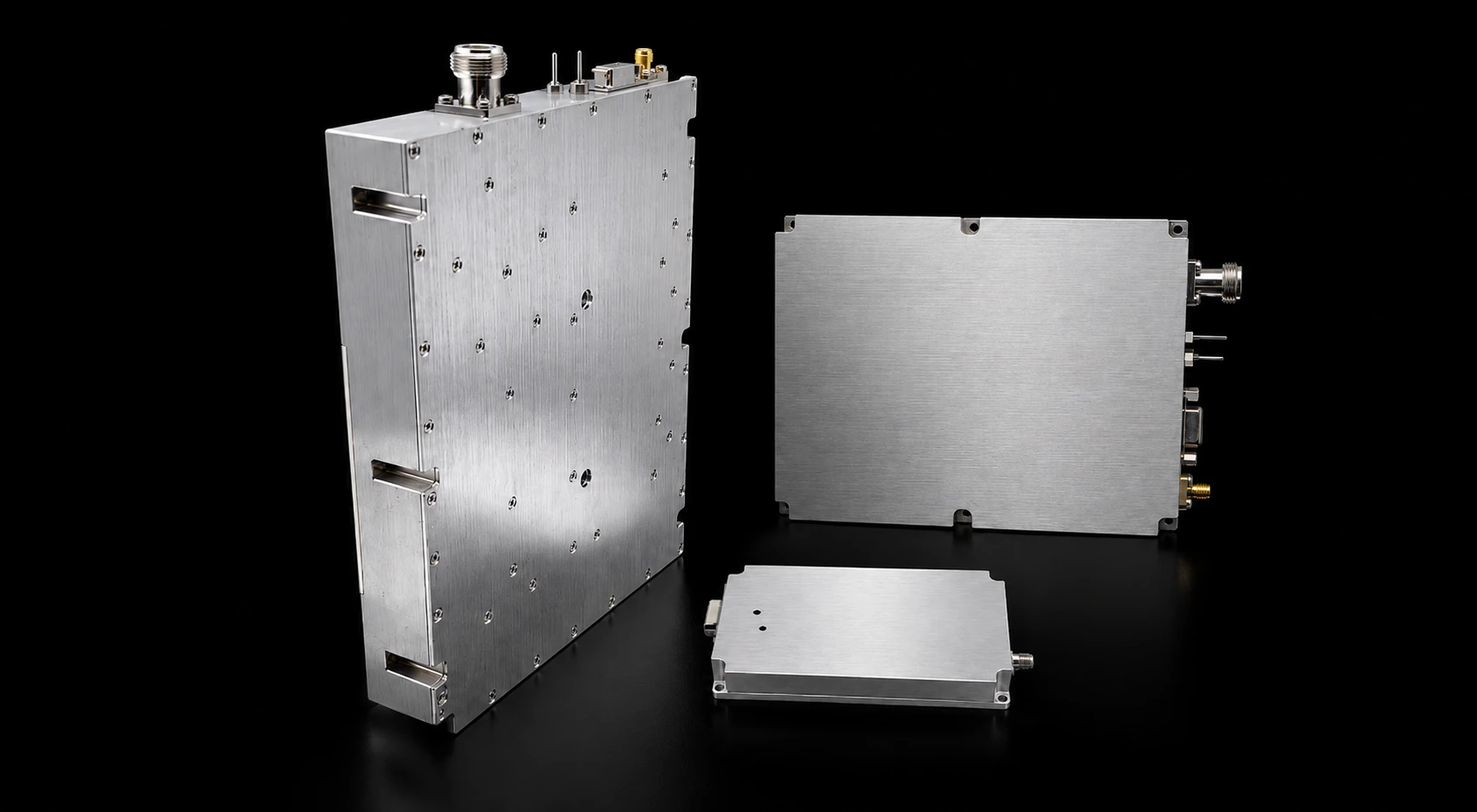
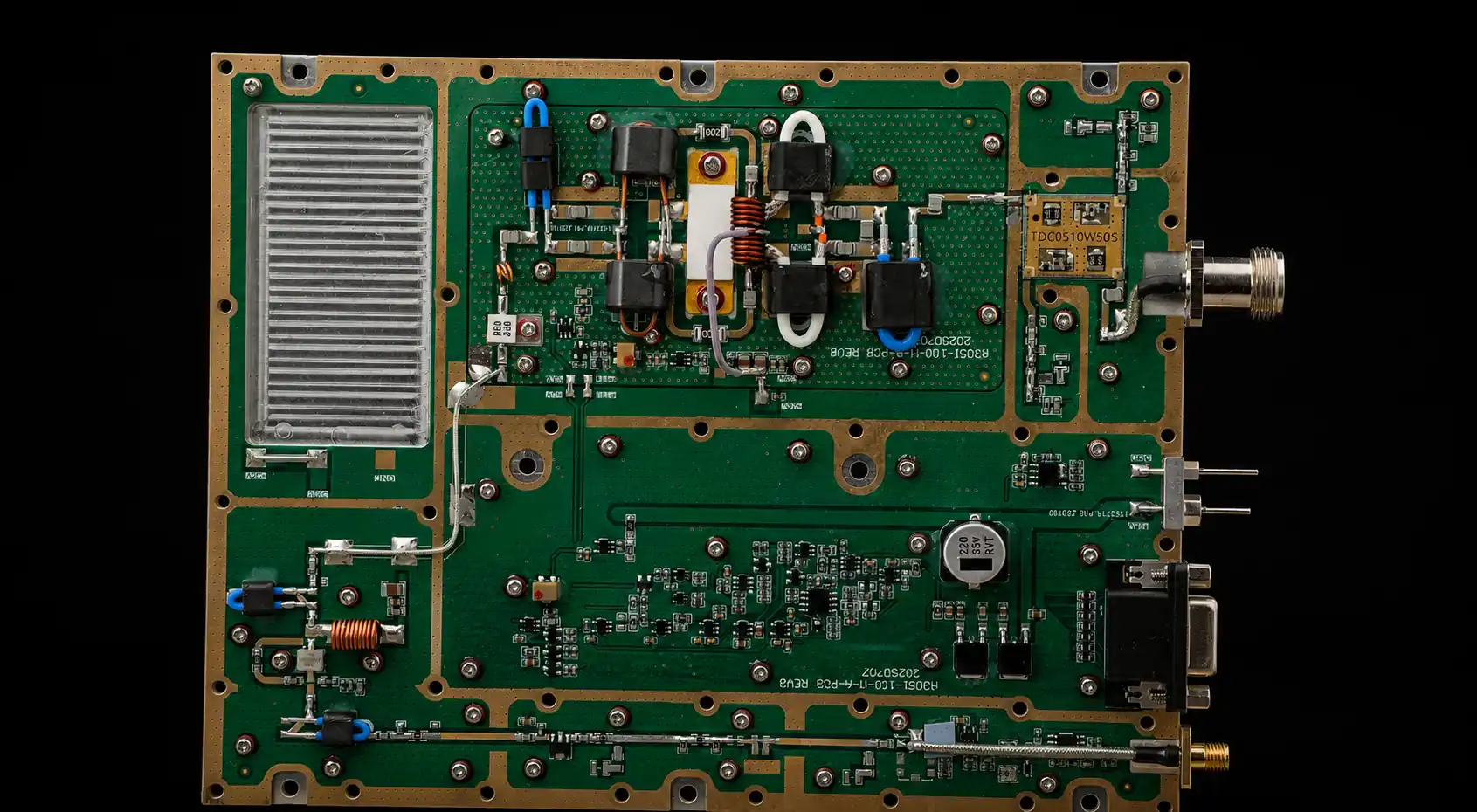
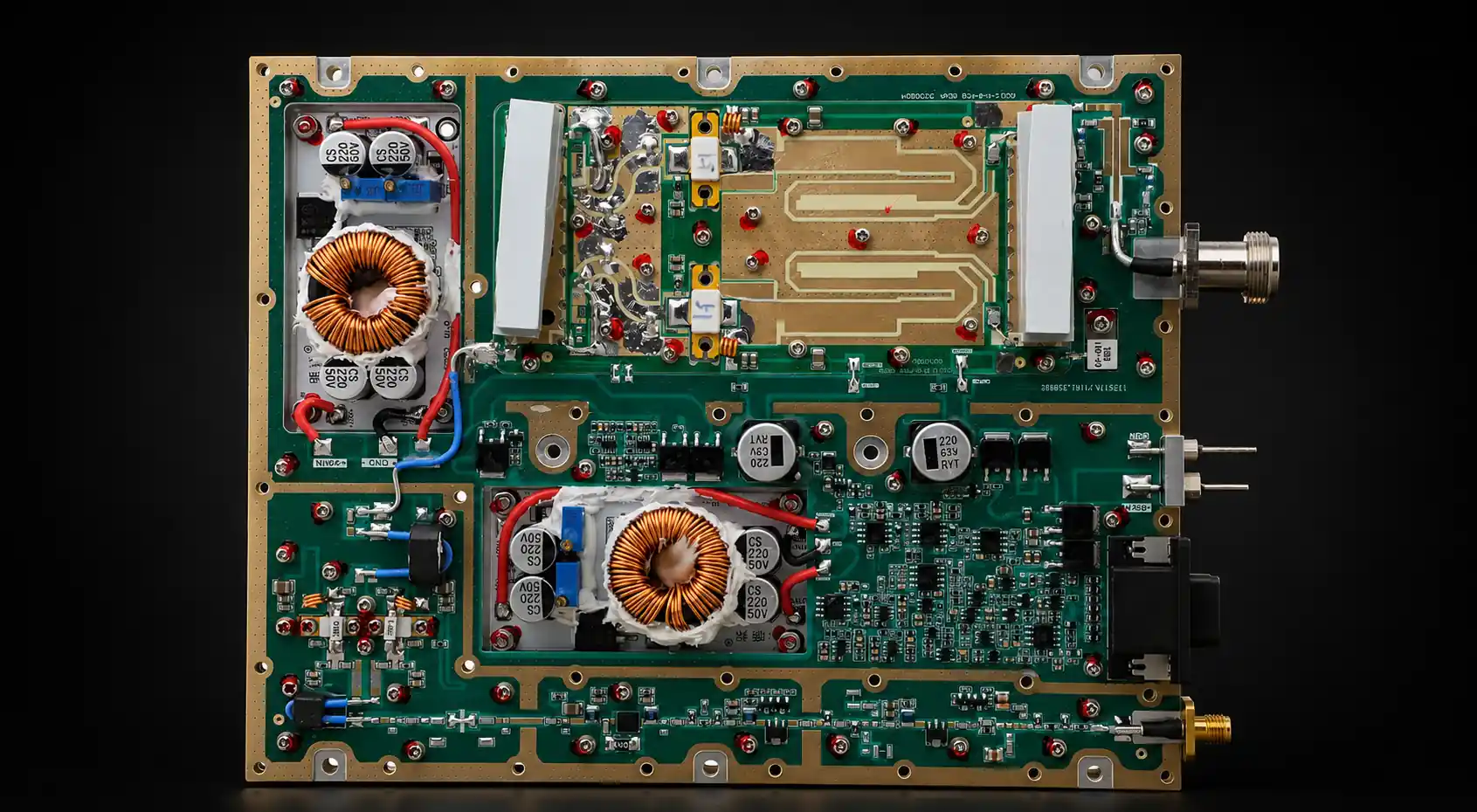
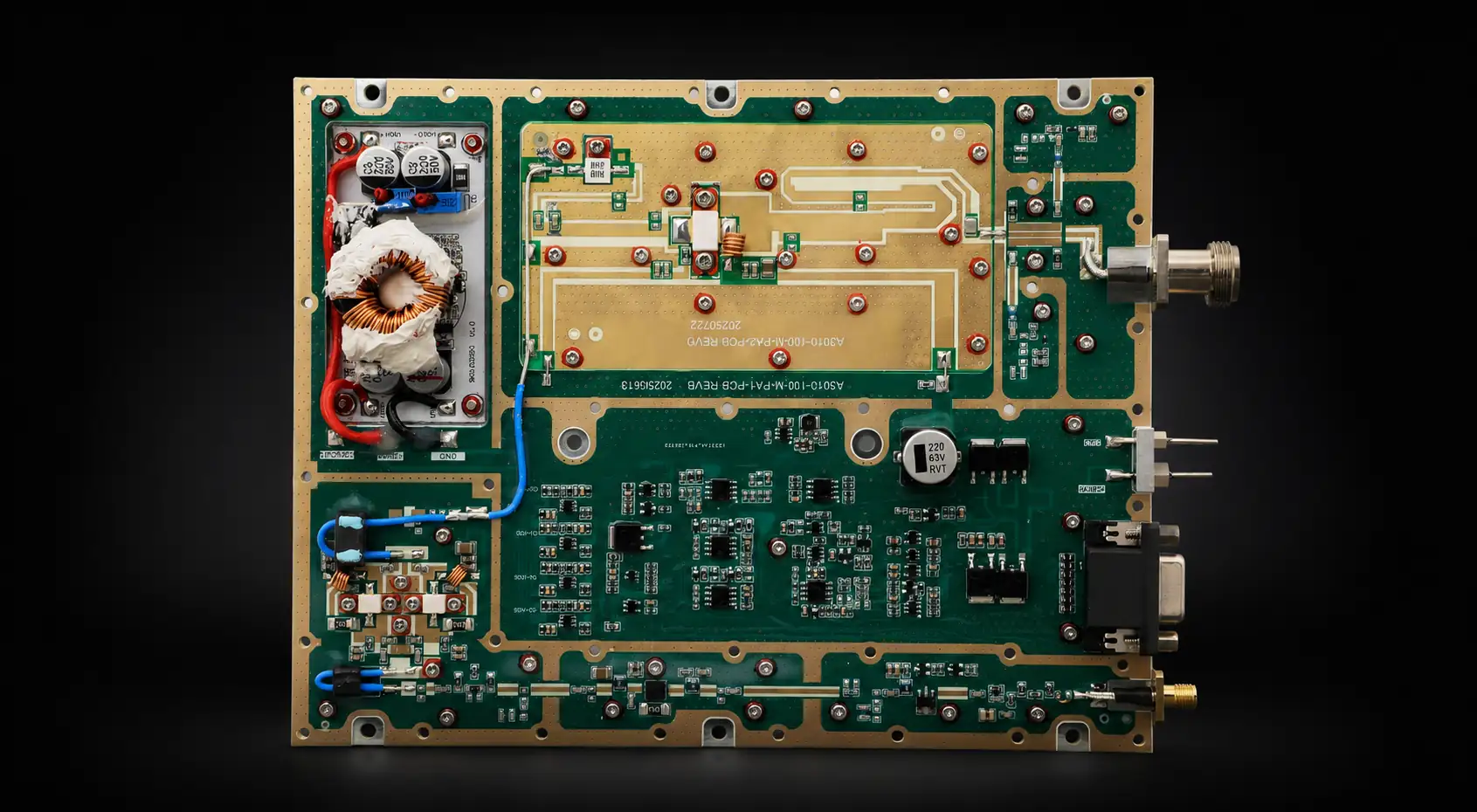
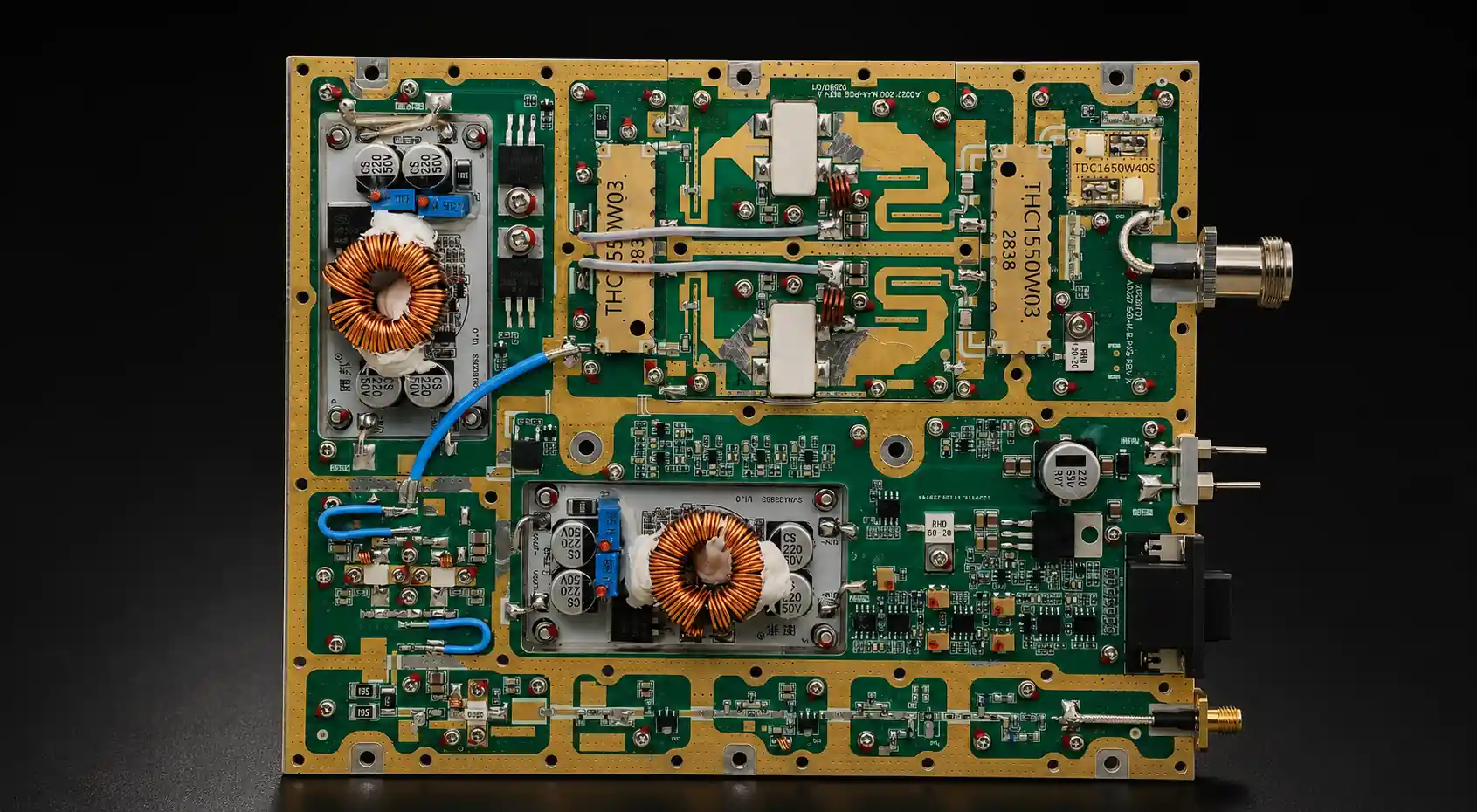
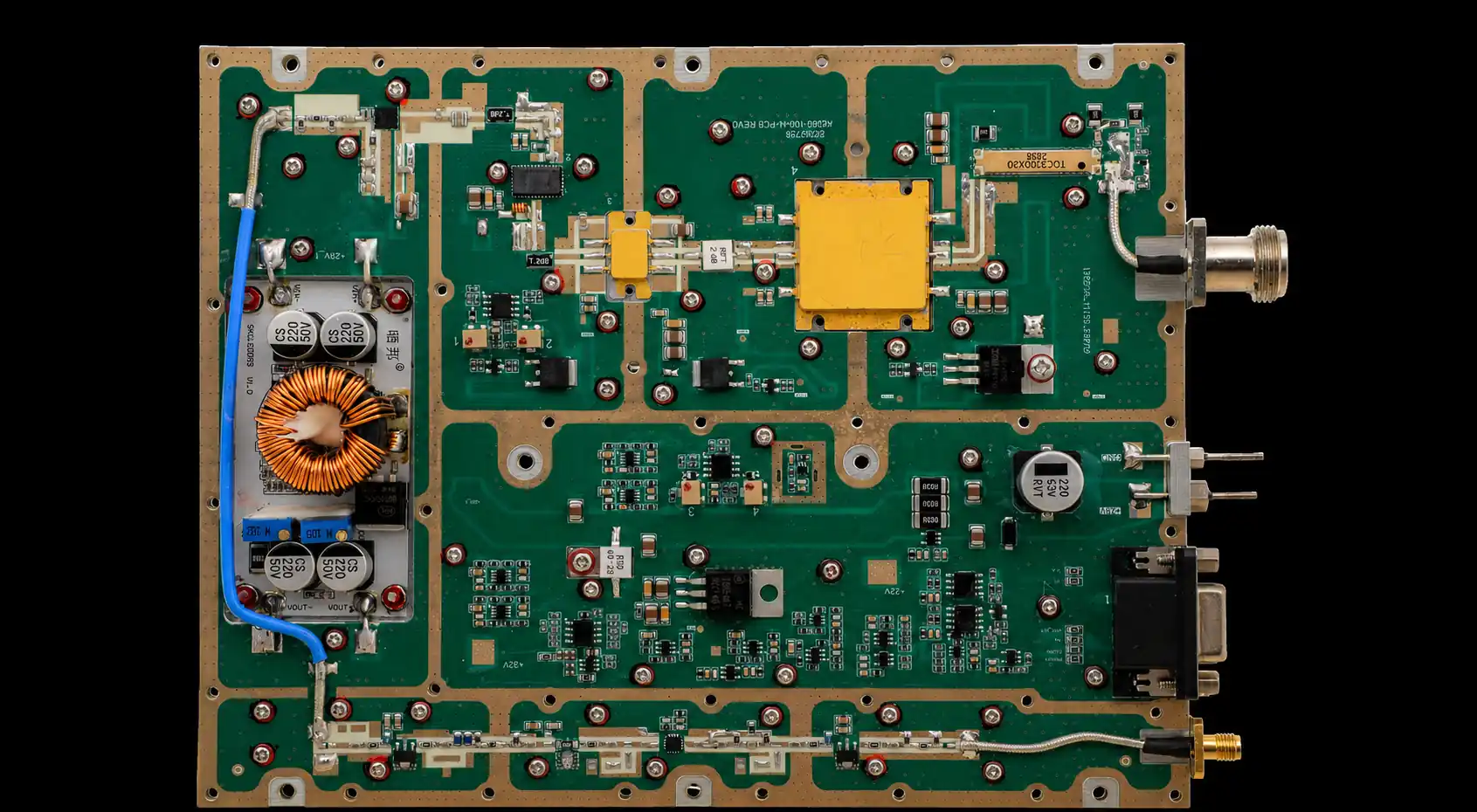
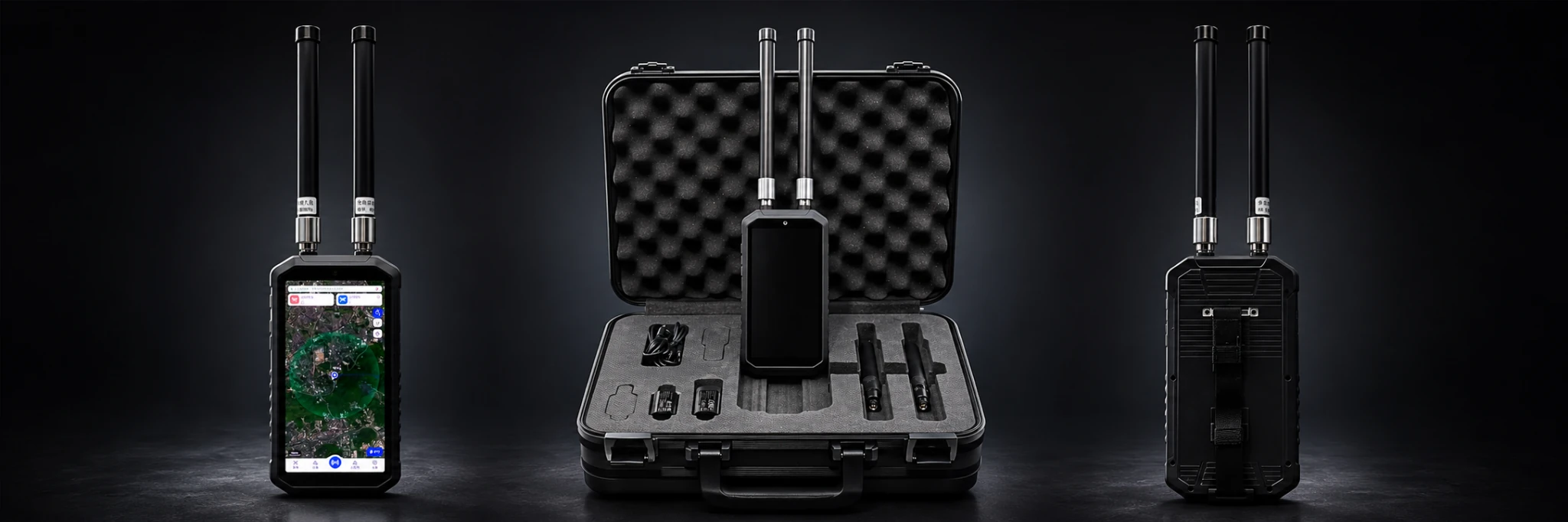


RF power consistency does not mean every C-UAS channel must produce the same wattage. It means each channel meets its own specified output target, while any difference between channels remains controlled, explainable, and repeatable under the required operating conditions.
900 MHz, 2.4 GHz, and 5.8 GHz channels may use different PA modules, input-drive levels, filters, feeders, connectors, antennas, and output requirements. Their raw watt values should not be compared until the measurement boundary, correction method, thermal state, PA-terminal voltage, load condition, and operating mode are defined.
For integrators reviewing RF Power Amplifier Modules, the useful comparison is between each channel’s specified target, single-channel baseline, simultaneous-operation result, and stabilized hot-state output. This shows whether a difference is an approved engineering condition or an unexplained system imbalance.
1. What RF Power Consistency Actually Means
RF power consistency has two separate meanings.

Within-Channel Consistency
Within-channel consistency asks whether one channel remains stable when its operating condition changes.
The same channel should be compared during:
- Initial and stabilized thermal states
- Single-channel and simultaneous operation
- Repeated test runs
- Defined duty cycles
- Approved load or antenna-path conditions
A channel that reaches the required output during a brief cold test but falls below the target after thermal stabilization does not have acceptable within-channel consistency.
The same applies when a channel passes by itself but falls during all-channel operation.
Channel-to-Channel Consistency
Channel-to-channel consistency asks whether different channels meet their own specified targets and remain within the project-defined comparison tolerance.
This does not require identical output.
For example:
- A 900 MHz channel may have a 50 dBm target.
- A 2.4 GHz channel may have a different output target.
- A 5.8 GHz channel may use another PA architecture and antenna path.
The correct question is not:
Do all channels produce the same wattage?
It is:
Does each channel meet its specified output at the defined measurement point, and does that result remain stable under the required operating condition?
Normalize Each Channel to Its Own Target
Before comparing channels, calculate how far each measured result is above or below its own specified target.
Use:
Channel deviation = measured output at the defined boundary minus the specified target, expressed in dB.
When the values are recorded in dBm, subtract the target directly from the measured result. When values are recorded in watts, convert them to dBm or calculate the ratio in dB before comparing them.
For example:
- A 900 MHz channel has a 50.0 dBm target and measures 50.4 dBm. Its deviation is +0.4 dB.
- A 5.8 GHz channel has a 47.0 dBm target and measures 47.2 dBm. Its deviation is +0.2 dB.
Their absolute output powers are different, but both channels exceed their own targets. If these deviations remain stable and fall within the approved tolerance, the channels may be considered consistent.
A lower absolute watt value is not automatically a failure. It becomes a concern when:
- It falls below that channel’s specified target.
- Its normalized deviation exceeds the approved limit.
- The result changes unpredictably.
- The difference appears only during simultaneous or hot-state operation.
- The measurement boundary or correction cannot explain it.
- Reflected power, temperature, voltage, or protection behavior changes during the test.
Rated output alone cannot answer these questions.
A nominal PA wattage normally refers to a defined module-level condition. It does not prove cabinet-output power, feeder-end power, antenna-input power, or multi-channel stability.
2. Which Conditions Must Match Before Channels Are Compared
Do not compare raw output values until the essential test conditions are defined.
Record:
- Channel and PA identification
- Exact test frequency
- Required Pin
- Specified output target
- Measurement point
- Frequency-specific correction
- PA-terminal voltage
- Operating and thermal state
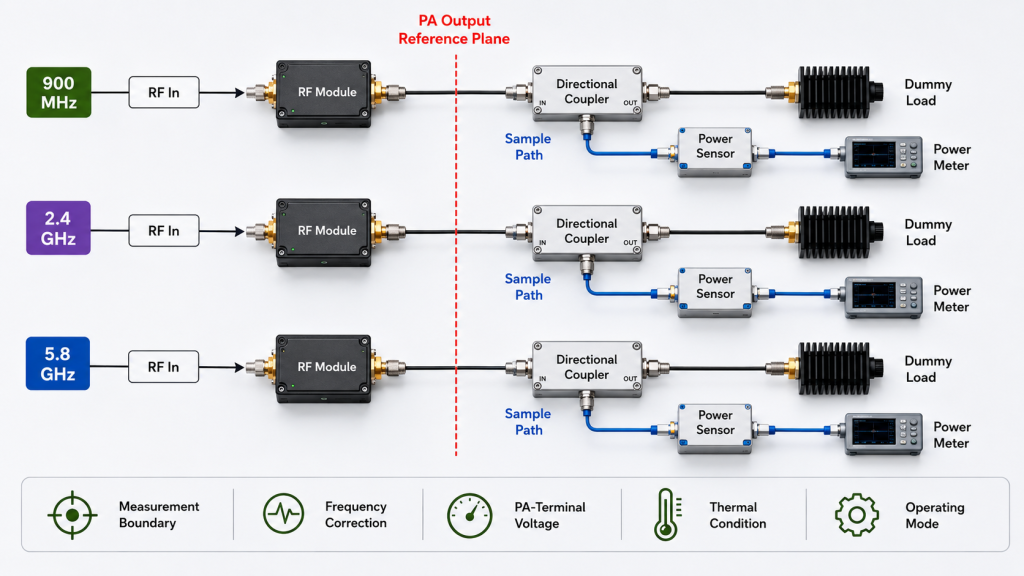
Define the Measurement Boundary
Power may be measured at:
- PA-port output
- Cabinet-output interface
- Feeder end
- Antenna input
These values are not interchangeable.
If one channel is measured at the PA connector and another at the antenna input, the results cannot be used as a direct consistency comparison.
The installed path may include internal RF jumpers, filters, combiners, bulkhead connectors, external feeders, adapters, lightning-protection devices, and antenna-side transitions.
Every included component changes the meaning of the recorded output.
A fair comparison should use equivalent measurement boundaries or clearly document why different boundaries are required.
Confirm Frequency-Specific Correction
Cable, connector, filter, and adapter loss can change with frequency.
Do not apply one correction value to every channel unless it has been verified across the relevant frequency range.
A lower high-band result may come from:
- Higher test-cable loss
- Different internal path loss
- Filter insertion loss
- Additional adapters
- Longer feeder length
- Incorrect correction data
A dedicated RF PA feeder cable loss check is appropriate when PA-port or cabinet-output power passes but feeder-end or antenna-input power does not.
Confirm Pin at Each PA Connector
The same signal-source setting does not guarantee the same RF input power at each PA.
Different channels may use different driver stages, input cables, attenuators, filters, and required Pin values.
Confirm the required and measured Pin at each PA input connector before judging Pout.
Define the Channel Architecture
A multi-band system may use separate narrowband channels, high-band and low-band PA groups, wideband modules, modular PA matrices, distributed RF cabinets, or independent antenna paths.
These architectures require different channel maps and output targets, but the verification sequence remains the same:
- Define the target for each channel.
- Define the measurement boundary.
- Establish the single-channel baseline.
- Repeat the test during simultaneous operation.
- Verify the stabilized hot-state result.
3. When Channel-to-Channel Variation Is Acceptable
There is no universal channel-to-channel tolerance for every C-UAS system.
An arbitrary rule such as “all channels must remain within 1 dB” should not be applied unless the project specification, measurement uncertainty, system reserve, and acceptance method support it.
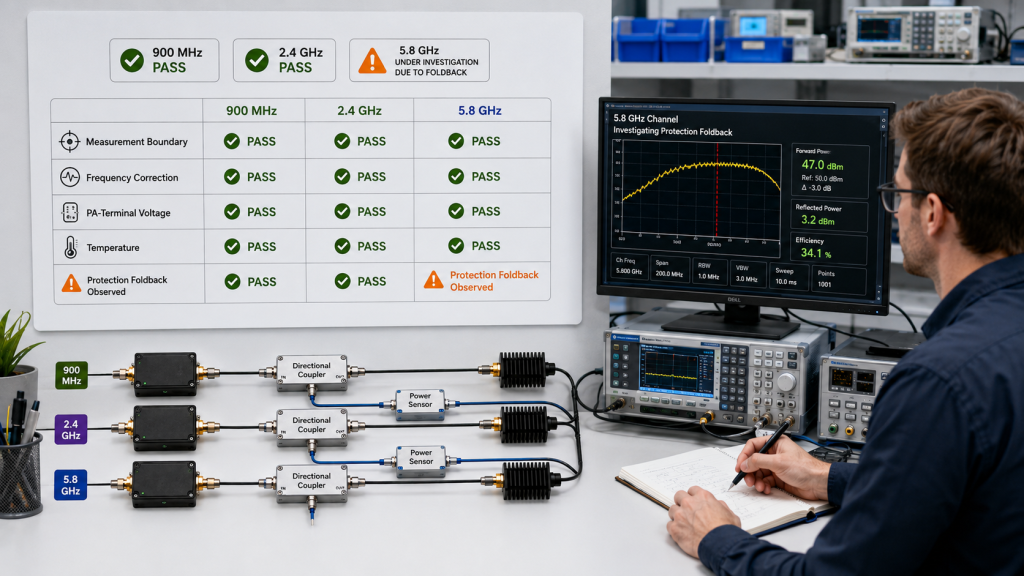
The acceptable difference should be based on:
- Output target for each channel
- Allowed deviation from each target
- Measurement uncertainty
- Module architecture
- Frequency-specific path loss
- Antenna-input requirement
- Available engineering reserve
- Simultaneous operating condition
- Project acceptance boundary
A Defined Difference May Be Acceptable
A channel-to-channel difference may be acceptable when:
- Every channel meets its own target.
- The measurement boundary is defined.
- Frequency-specific correction is applied.
- The difference is expected from the approved architecture.
- The normalized deviation is within the project limit.
- The result is repeatable.
- Hot-state output remains compliant.
- Simultaneous operation does not create additional loss.
- Forward and reflected power remain within the project limits.
- No unexplained protection activity occurs.
Two channels may therefore have different absolute output powers while both remain acceptable.
An Unexplained Difference Requires Investigation
A difference should not be accepted when:
- One channel misses its specified target.
- The normalized deviation exceeds the approved limit.
- The result changes between repeated tests.
- The channel passes alone but fails during simultaneous operation.
- Output falls after thermal stabilization.
- PA-terminal voltage drops below the defined boundary.
- Reflected power or VSWR changes significantly.
- The comparison uses different or undefined measurement points.
- Frequency-specific correction is missing.
- Factory and field results cannot be reconciled.
- The reason for the difference cannot be documented.
Channel Consistency Acceptance Matrix
| Observed result | Consistency judgment | Required action |
|---|---|---|
| Each channel meets its own target and remains stable | Acceptable | Record the approved deviation and test conditions |
| Channels differ, but normalized deviations are defined and repeatable | Potentially acceptable | Compare with the project-defined tolerance |
| One channel passes alone but drops during simultaneous operation | Not accepted yet | Review shared supply, thermal load, current, and protection status |
| Results use different measurement boundaries | Invalid comparison | Repeat at equivalent or clearly documented boundaries |
| One channel changes after thermal stabilization | Unstable | Investigate temperature, PA-terminal voltage, and protection behavior |
| One channel misses its specified antenna-input target | Not acceptable | Separate PA output from feeder and antenna-path loss |
| A difference cannot be explained or repeated | Not acceptable | Isolate the module, input path, correction, load, and operating condition |
A lower channel result may reduce engineering reserve or create an installed-system risk, but it should not automatically be described as a coverage weak zone.
Operational effect must be evaluated at the defined antenna and system boundary.
4. How Simultaneous Operation Exposes Hidden Imbalance
A channel that passes by itself may fall below its target when all required PAs operate together.
This is one of the main reasons multi-band RF power consistency must be verified at the system level.
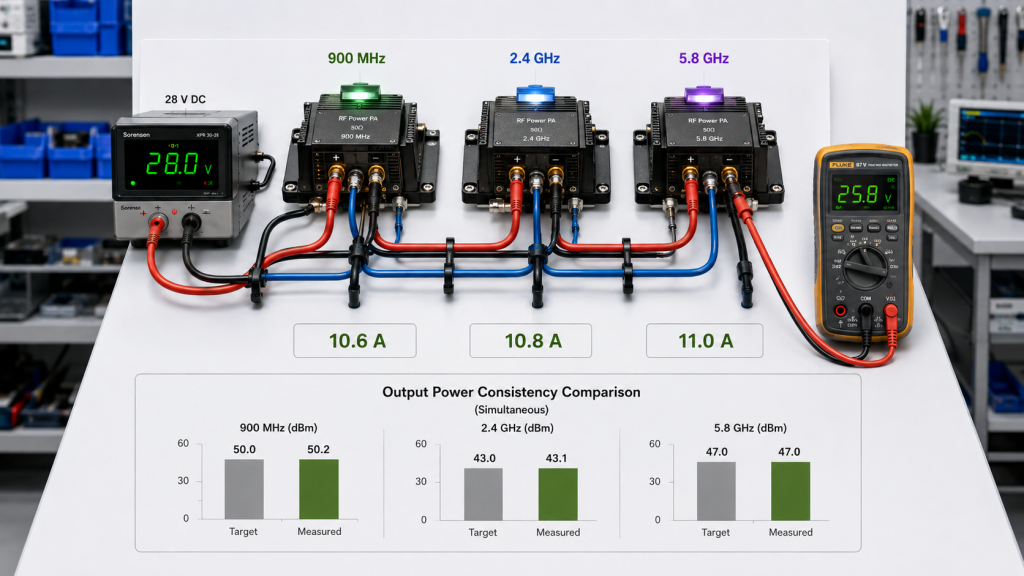
Establish the Single-Channel Baseline
Test each channel separately under its required conditions.
Record:
- Frequency and Pin
- Output at the defined boundary
- PA-terminal voltage
- DC current
- Temperature
- Forward and reflected power
- Protection status
- Warm-up duration
This baseline shows how the channel behaves before the shared supply and thermal load from other PAs is added.
Repeat with All Required Channels Active
Activate the required channel combination and repeat the measurements.
Compare:
- Per-channel output
- PA-terminal voltage at each branch
- Total and branch current
- Temperature by channel
- Reflected-power changes when all required channels are active
- Alarm and protection status
A full-power swept RF PA test should include the project’s target frequencies and required operating mode rather than relying on one favorable center-frequency result.
Check Shared System Conditions
When a channel falls only during simultaneous operation, review whether the drop coincides with:
- Lower PA-terminal voltage
- Higher cabinet temperature
- Increased current demand
- Changed reflected power
- Protection foldback
- Control or enable-state changes
The main power supply may still display 28V while one PA branch receives a lower voltage under combined RF load.
The relevant value is the voltage measured at the PA terminals during transmission.
Compare Stabilized Hot-State Results
Short cold tests may hide multi-channel imbalance.
Operate the required channel combination for the specified duration and record the stabilized results.
The test should determine whether:
- Each channel remains above its target.
- Normalized deviations remain within tolerance.
- PA-terminal voltage remains compliant.
- Temperatures remain stable.
- Reflected power remains acceptable.
- No unexplained alarm or foldback occurs.
If one channel drops only during simultaneous hot-state operation, investigate shared system conditions before rejecting the PA.
5. What Evidence Should Prove Multi-Band RF Power Consistency
A valid consistency report should prove what each channel was required to deliver and how it behaved under the approved operating conditions.
The report should include:
- PA, cabinet, and channel identification
- Exact frequency and specified output target
- Required and measured Pin
- Measured output at the defined boundary
- Normalized deviation from the channel target
- Frequency-specific correction
- PA-terminal voltage and DC current
- Temperature and warm-up duration
- Active-channel combination
- Forward power, reflected power, or VSWR
- Alarm and protection status
- Approved tolerance
- Pass/fail result
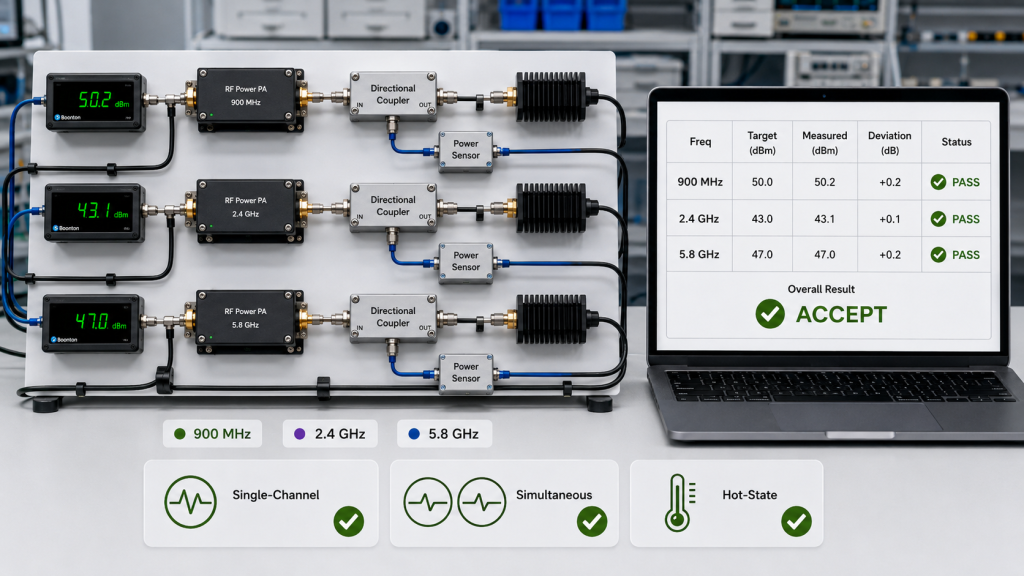
A formal C-UAS RF PA acceptance record should make the measurement boundary, operating condition, and delivered-unit traceability clear.
Gain Flatness Is Supporting Evidence
Gain variation across a module band may contribute to frequency-point differences, but gain flatness alone does not prove multi-band RF power consistency.
A gain-flatness check before RFQ can identify weak regions. Final acceptance should still use full-power output, normalized deviation, hot-state behavior, voltage, current, RF-path condition, and simultaneous-operation evidence.
The Report Should Answer Three Questions
- Does each channel meet its specified target?
- Does each channel remain stable during simultaneous hot-state operation?
- Can every observed difference be explained by the approved channel map, measurement boundary, correction method, and system condition?
If any answer is unclear, RF power consistency has not yet been proven.
What RFQ Data Should Define Channel Consistency?
An RFQ should define the required comparison method before quotation and acceptance.
Avoid a request that only states:
Need equal power across all bands.
That statement does not define the channel targets, measurement boundary, allowed deviation, or operating condition.
A stronger RFQ should include:
- Channel map and frequency for each channel
- Output target for each channel
- Required Pin
- Defined measurement boundary
- Allowed deviation from each channel’s specified target
- Approved channel-to-channel delta, if the project requires one
- Single-channel and simultaneous operating conditions
- Duty cycle and thermal stabilization requirement
- 28V supply boundary and minimum PA-terminal voltage
- Feeder and antenna configuration
- Forward-power, reflected-power, or VSWR limits
- Required S/N-linked evidence
Example:
Channels: 900 MHz, 2.4 GHz, and 5.8 GHz.
Output targets: _ W, W, and W at the measurement boundary.
Required Pin: dBm at each PA connector. Allowed deviation from each channel target: dB.
Approved cross-channel delta, if applicable: dB under the defined comparison method. Operation: single-channel baseline followed by simultaneous operation for minutes.
Supply: 28V DC with V minimum at each PA terminal. RF path: _ feeder, connector, filter, and antenna configuration.
Evidence: Pin, output, normalized deviation, Vdc, Idc, temperature, FWD, REV, VSWR, protection status, and S/N.
RF SKYPOWER can support early engineering review for multi-band RF power consistency. Submit the channel map, per-channel output targets, measurement boundary, allowed deviation, single-channel and simultaneous test conditions, minimum PA-terminal voltage, installed RF paths, and S/N-linked evidence requirement.
The review should determine whether every channel meets its own target and whether any difference remains controlled, explainable, and repeatable under simultaneous hot-state operation.
Submit your multi-band RF power consistency requirements.
Conclusion
RF power consistency does not require every C-UAS channel to produce identical wattage.
It requires each channel to meet its own specified target at a defined measurement boundary. The result must remain stable during repeated, simultaneous, and hot-state operation.
Compare normalized deviation from each channel target—not raw watt values alone. Confirm Pin, correction, PA-terminal voltage, RF path, thermal state, reflected power, active-channel combination, and project-defined tolerance.
A channel difference is acceptable only when it is defined, repeatable, supported by evidence, and within the approved system boundary. An unexplained or unstable difference should not be accepted.