
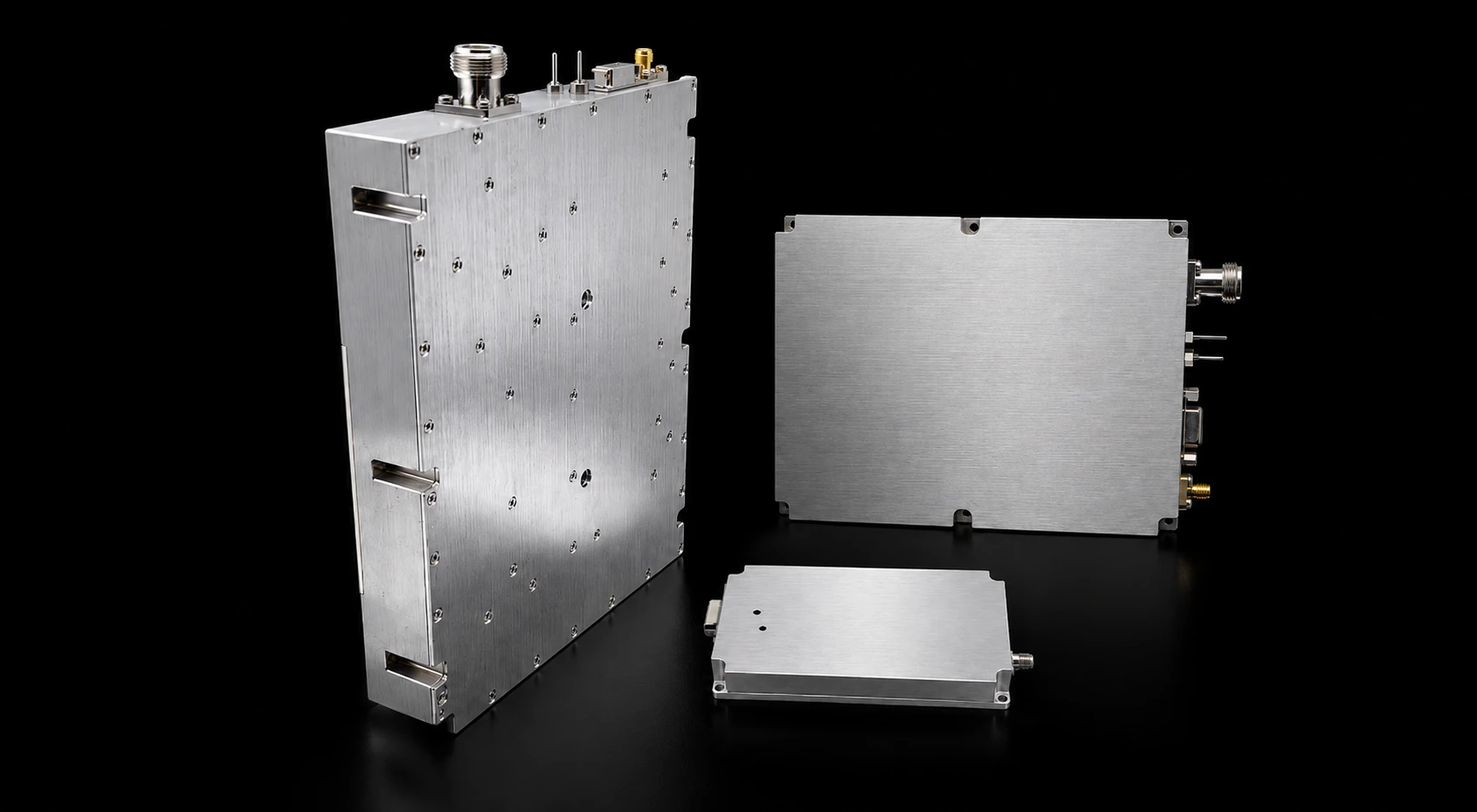
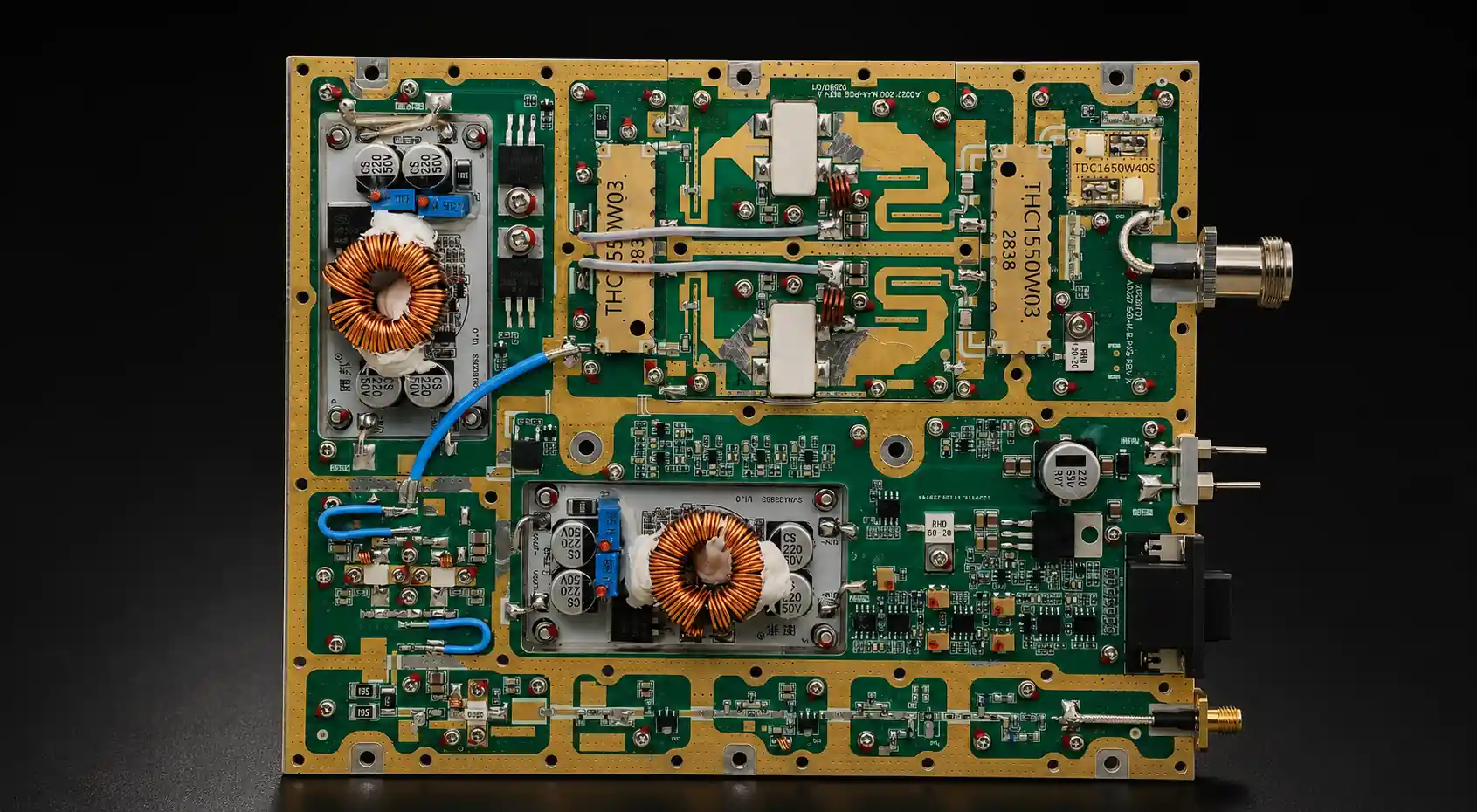
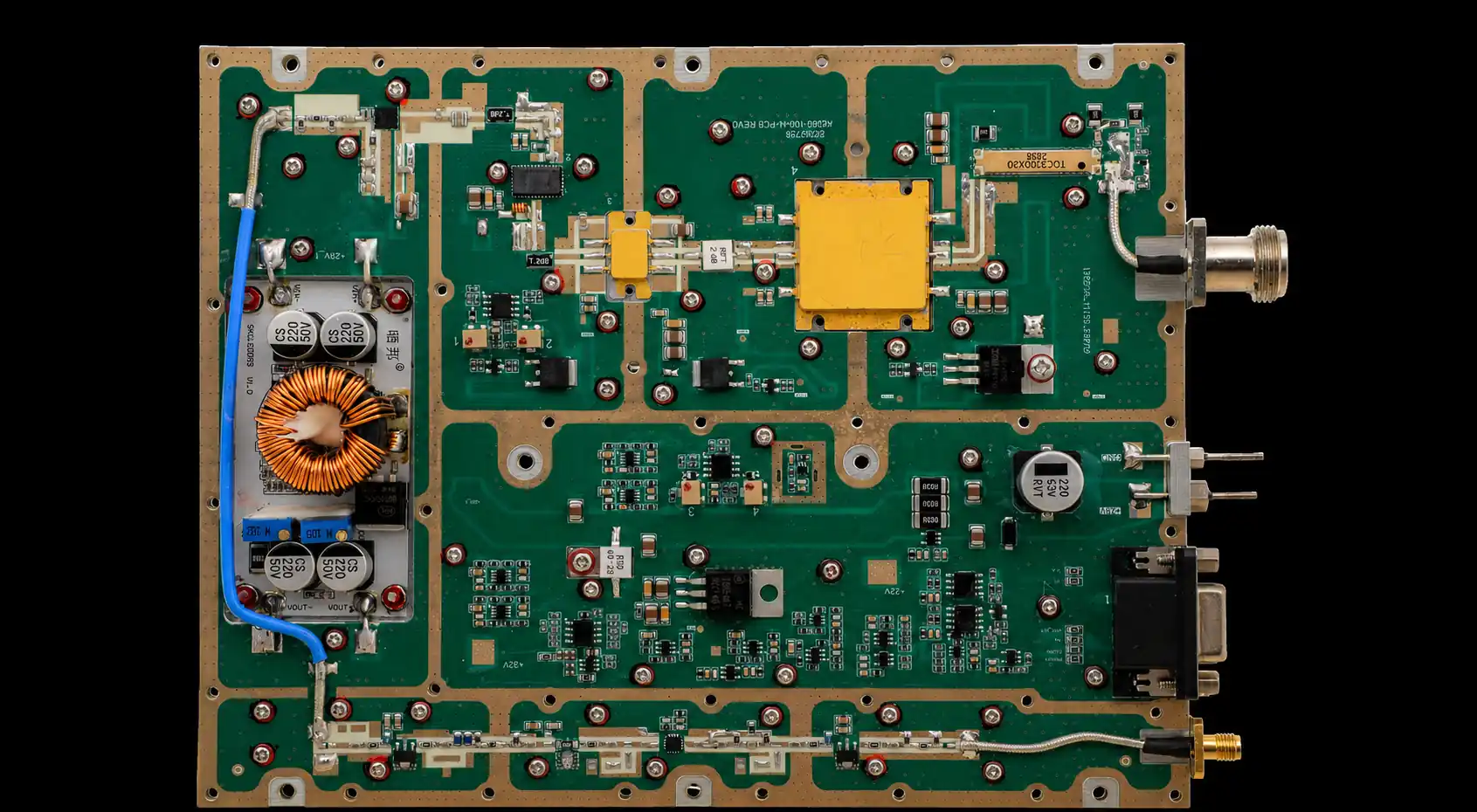
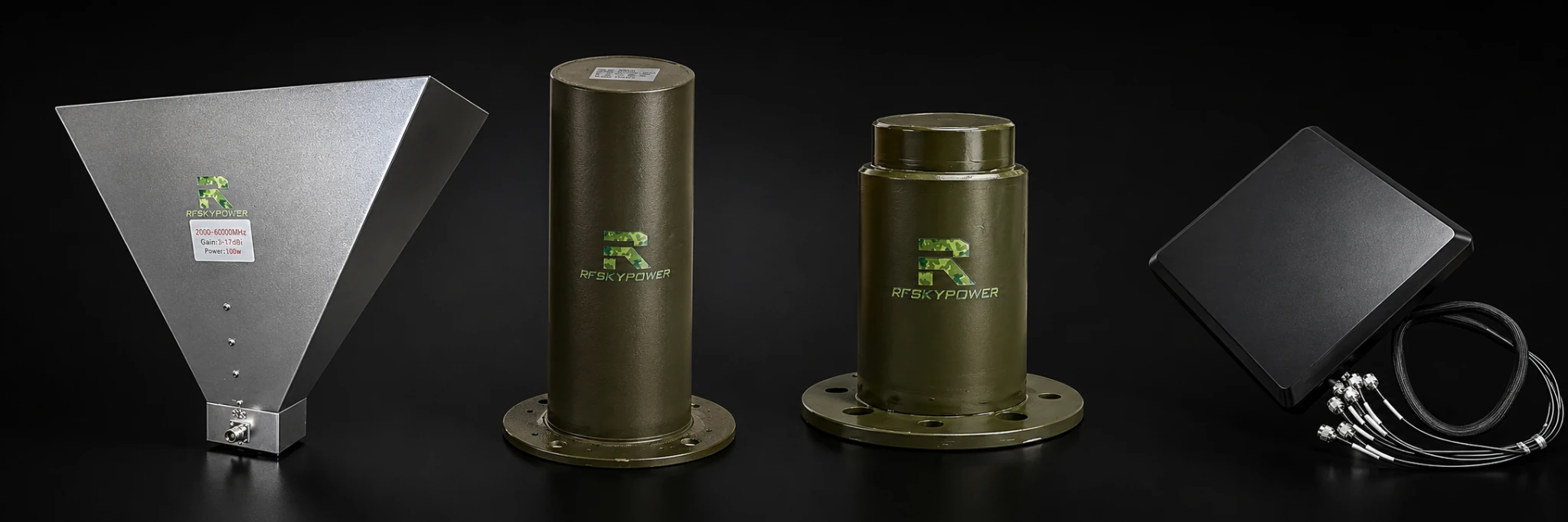
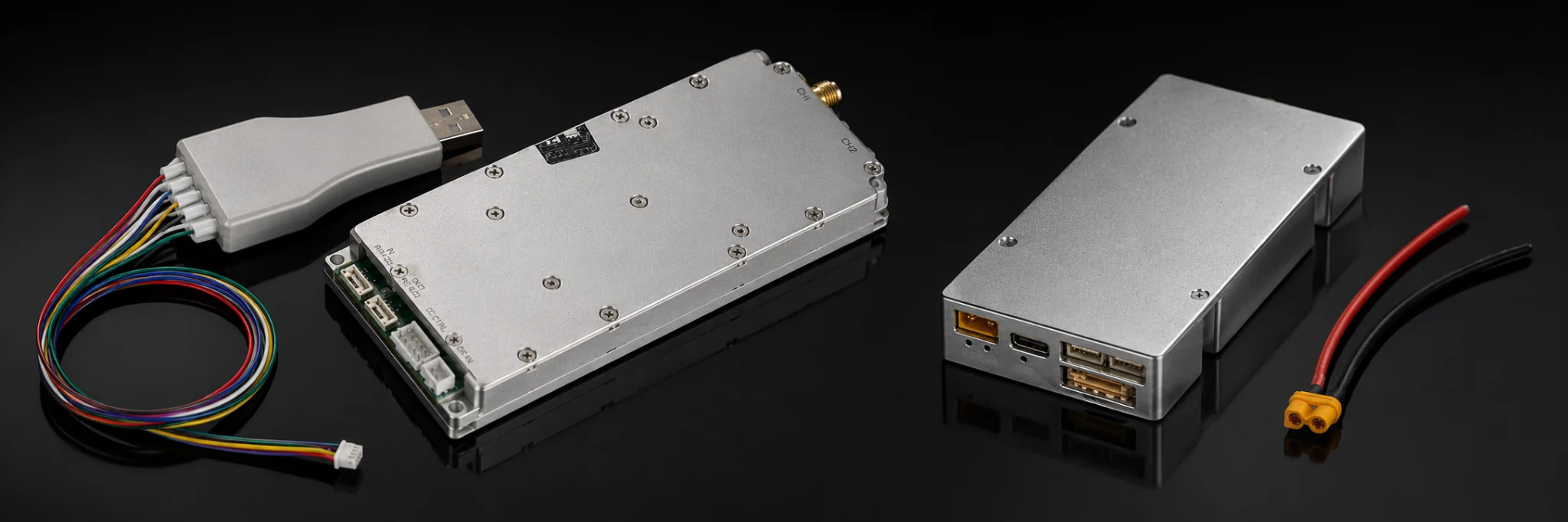
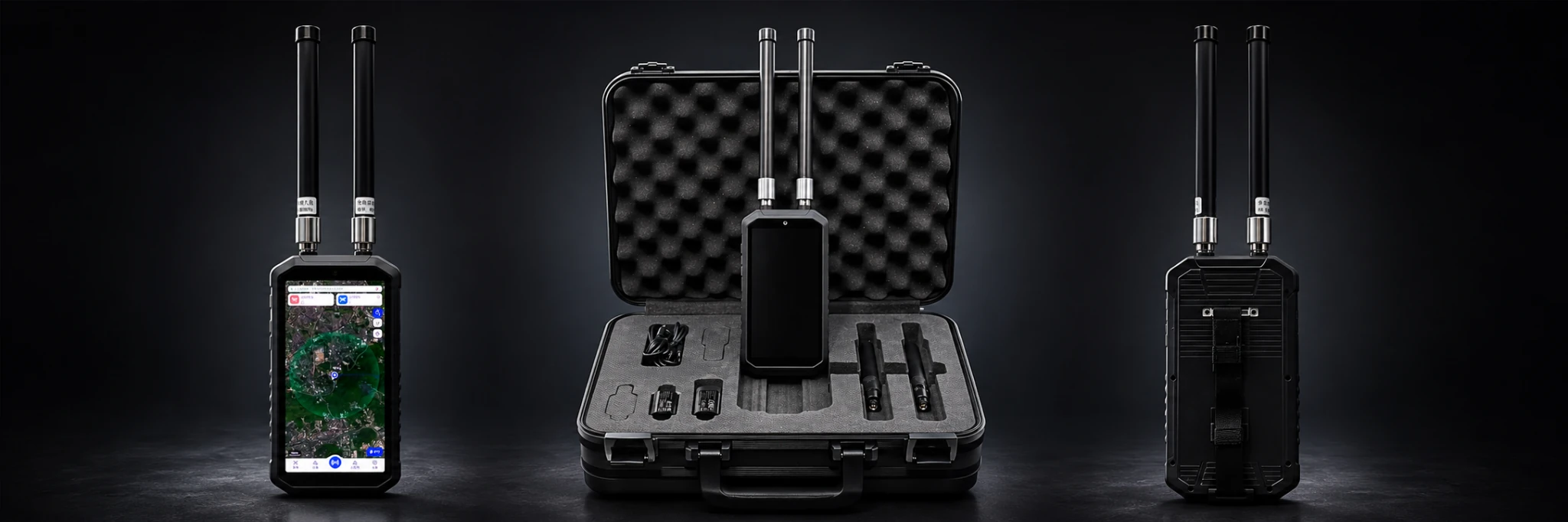


A remote antenna does not automatically require a larger RF PA. Physical distance may create a longer feeder route, but the real selection input is the total installed RF loss at each required frequency.
A module can deliver its rated output at the PA connector and still miss the required antenna-input power after the feeder, internal cabinet path, connectors, feedthroughs, lightning protection, and field routing are included. Increasing PA wattage may help, but it can also increase 28V current demand, heat, connector stress, and installation cost without correcting an inefficient RF path.
Before approving RF Power Amplifier Modules, define the required power reference plane, calculate the one-way installed path loss, and compare three options: increase PA output, improve the feeder path, or move the RF unit closer to the antenna.
1. Why Antenna Distance Alone Cannot Size an RF PA
Antenna distance is a mechanical layout input. It is not a direct RF loss value.
A cabinet may be 10 meters from an antenna in a straight line, while the installed feeder route becomes 15 meters because it must pass through cable trays, cabinet walls, service loops, weatherproof transitions, and minimum bend-radius sections.
The calculation should therefore use the final installed one-way feeder length, not only the straight-line distance between the cabinet and antenna.
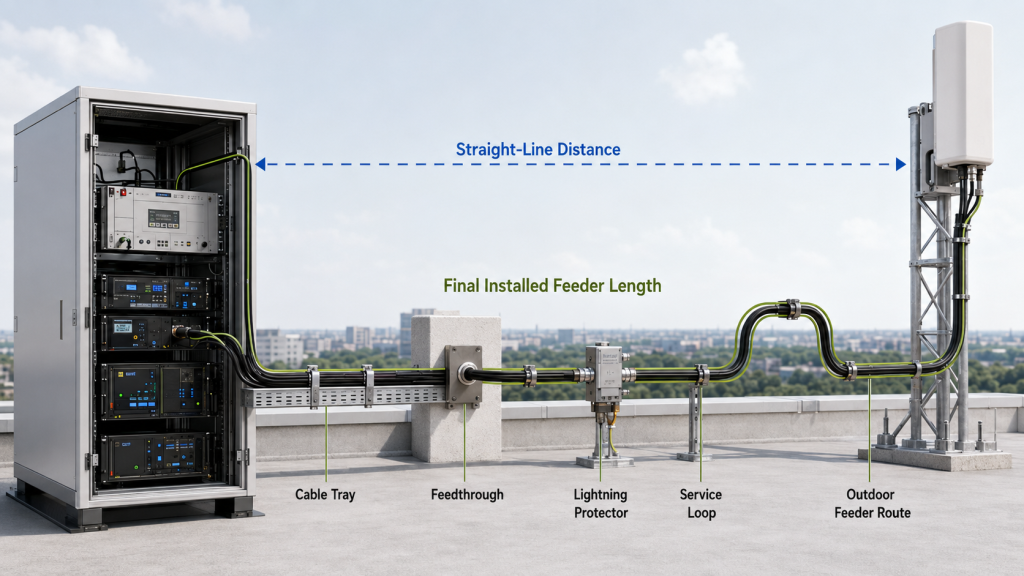
What actually changes path loss?
Installed RF loss depends on:
- Operating frequency
- Cable type
- Final cable length
- Connector and adapter count
- Cabinet feedthroughs
- Lightning protectors
- RF switches or filters
- Cable bends
- Assembly quality
- Temperature
- Environmental exposure
Two antenna routes with the same physical distance may produce different losses because they use different cable grades, connector stacks, and installation methods.
For outdoor paths, preliminary calculations should also include the approved temperature condition or loss tolerance rather than assuming that a room-temperature catalog value remains unchanged.
Record distance and feeder length separately
| Layout Item | Meaning |
|---|---|
| Straight-line distance | Physical separation between equipment and antenna |
| Estimated route length | Planned cable length before installation |
| Final installed length | Actual one-way feeder length after routing |
| Cable assembly length | Finished cable length including service allowance |
| Complete RF path | Every RF component between PA output and antenna input |
This prevents a common sizing error:
The antenna is 20 meters away, so calculate 20 meters of cable loss.
The correct method is:
The final installed path is 27 meters and includes cabinet transitions, connectors, and lightning protection. Calculate the complete loss at every required frequency.
Catalog cable-loss data is suitable for preliminary sizing. Final acceptance should use the measured insertion loss of the installed feeder assembly, including connectors, protectors, feedthroughs, and approved transitions.
For detailed installed-path acceptance, use an RF PA feeder cable loss test rather than relying only on a catalog loss-per-meter value.
2. How to Define the Required Power Reference Plane
A power value is incomplete unless the reference plane is defined.
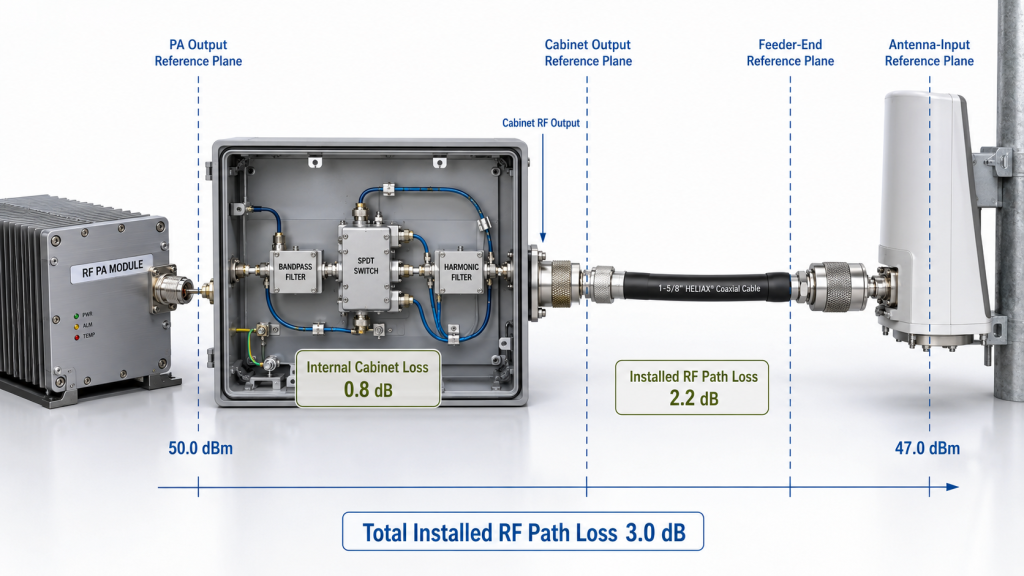
“100 W output” may refer to:
- The PA output connector
- The cabinet RF output
- The feeder end
- The antenna input
- The final radiated system result
These values are not interchangeable.
Power Reference Plane Map
| Reference Plane | What It Proves | Common Acceptance Error |
|---|---|---|
| PA output connector | Standalone module output capability | Treated as delivered antenna power |
| Cabinet RF output | Output after internal jumpers, filters, RF switches, couplers, and cabinet connectors | Internal cabinet loss ignored |
| Feeder end | Power delivered through the external cable path | Final antenna interface ignored |
| Antenna input | Installed power delivered to the antenna connector | Compared directly with the PA datasheet |
| Radiated system result | Complete antenna and installation performance | Used to judge the PA alone |
For remote antenna RF PA sizing, the most useful starting point is usually:
Required antenna-input power at each target frequency.
The required PA-port power can then be calculated backward from that reference plane.
Do not mix PA-port and antenna-input results
Assume a PA produces 50 dBm at its output connector.
If the complete installed path has 3 dB of loss:
50 dBm − 3 dB = 47 dBm
That is approximately:
- 100 W at the PA output connector
- 50 W at the antenna input
Both statements may be correct, but they describe different reference planes.
A procurement document that says only “100 W required” leaves a major ambiguity. The RFQ should state whether the requirement applies at:
- Module output
- Cabinet output
- Feeder end
- Antenna input
Without this definition, different suppliers may quote different architectures against the same nominal wattage.
3. How to Convert Feeder Loss into Required PA-Port Power
Remote antenna sizing should begin at the antenna and work backward toward the PA.
Use:
Required PA-Port Power (dBm)
=
Required Antenna-Input Power (dBm)
+ Total Installed RF Path Loss (dB)
+ Approved Engineering Margin (dB)
The complete path loss may include:
Total Installed RF Path Loss
=
Internal Cabinet Loss
+ Feeder Loss
+ Connector Loss
+ Adapter Loss
+ Feedthrough Loss
+ Lightning Protector Loss
+ Filter or Switch Loss
+ Other Approved RF Transitions
Use dB and dBm correctly
Path loss is expressed in dB. Power may be expressed in dBm.
This means loss can be added directly to a dBm power target.
Do not calculate:
100 W − 3 dB
Convert the power to dBm, apply the loss, and then convert the result back to watts when required.
Worked example
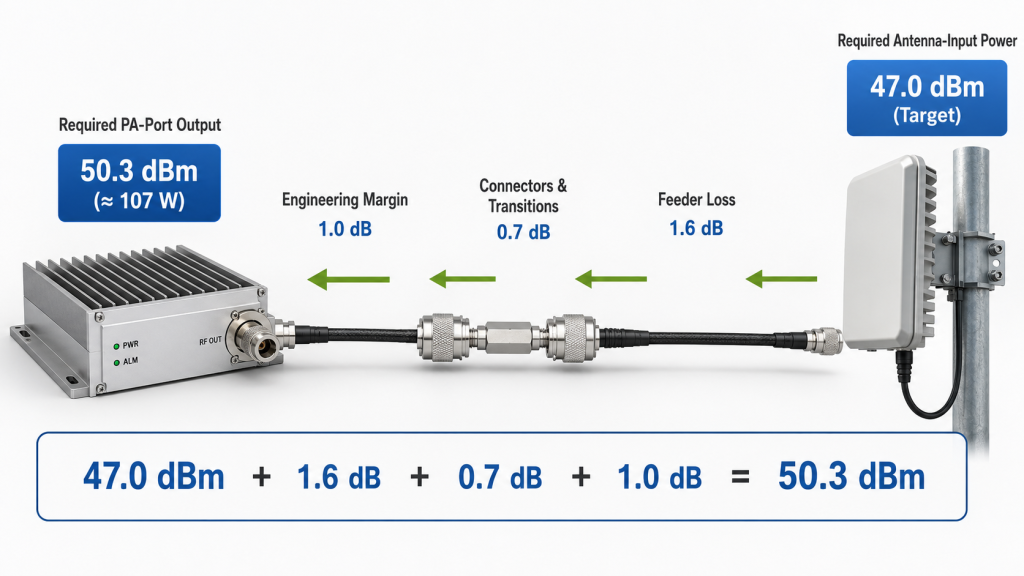
Assume the project requires:
- Antenna-input power: 47 dBm
- Feeder loss: 1.6 dB
- Connectors and transitions: 0.7 dB
- Engineering margin: 1.0 dB
The required PA-port output is:
47 dBm + 1.6 dB + 0.7 dB + 1.0 dB
= 50.3 dBm
50.3 dBm is approximately 107 W.
A PA that delivers exactly 50 dBm, or 100 W, at the required frequency would therefore not satisfy the calculated condition.
Engineering margin should cover only the approved residual uncertainties. Do not use it to add feeder, connector, temperature, or batch losses that have already been included elsewhere in the calculation.
The correct conclusion is not automatically:
Select a larger PA.
The engineering team should compare:
- A higher PA output class
- A lower-loss feeder
- Fewer RF transitions
- A shorter cable route
- A remote RF unit closer to the antenna
This example is illustrative. Final values must come from the selected cable, actual frequency, installed route, connector stack, temperature condition, and acceptance reference plane.
Calculate every required frequency
Cable loss normally increases with frequency. A single path-loss value should not be applied across a wide operating range unless the cable data and acceptance method support it.
For each required frequency, calculate:
| Frequency | Required Antenna Input | Installed Path Loss | Margin | Required PA-Port Output |
|---|---|---|---|---|
| Low-band point | Project value | Calculated or measured value | Approved value | Result |
| Center-band point | Project value | Calculated or measured value | Approved value | Result |
| High-band point | Project value | Calculated or measured value | Approved value | Result |
Wideband and multi-channel systems should use the weakest required frequency-path combination, not only the center frequency.
The PA must also support the required RF PA frequency range with sufficient output across the complete operating band.
General reserve calculations should remain consistent with the approved RF PA power margin method. Remote-path loss should not be counted twice if it is already included in the system margin.
4. When to Add PA Power, Improve the Feeder, or Move the RF Unit
A larger RF PA is only one solution to remote antenna loss.
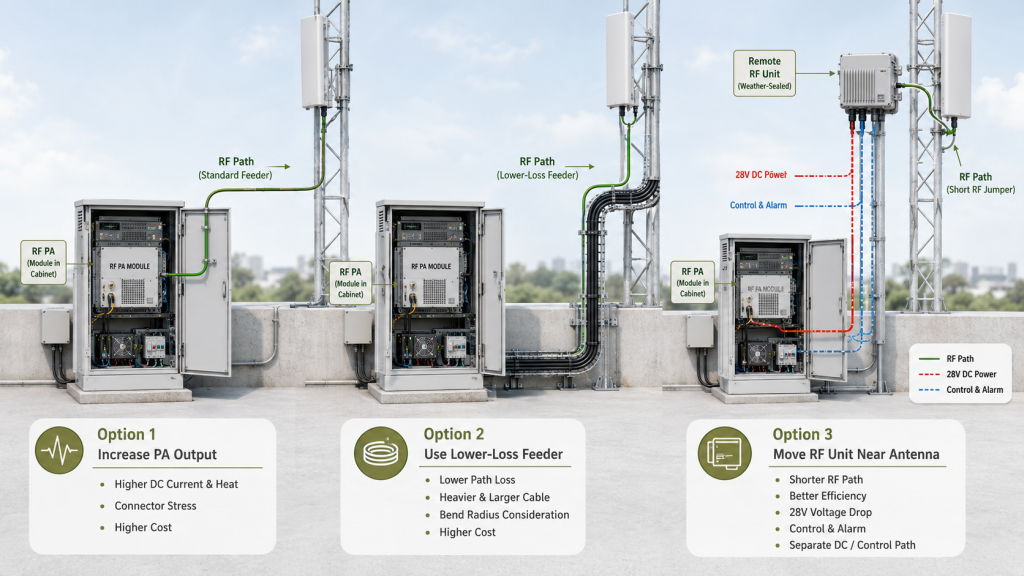
The better option depends on:
- Required antenna-input power
- Frequency
- Route length
- Available cable diameter
- Cabinet location
- 28V supply capacity
- Cooling
- Weight
- Outdoor installation limits
- Maintenance access
- Number of antenna sectors
Remote Antenna Architecture Decision Matrix
| Option | When It Helps | Main Trade-Off |
|---|---|---|
| Increase PA output | The path is already qualified but delivered power remains insufficient | More DC current, heat, and RF stress |
| Use lower-loss feeder | A long route cannot be avoided | Higher cost, weight, diameter, and bend stiffness |
| Shorten the RF path | Cabinet or antenna position can still change | Mechanical and maintenance redesign |
| Reduce RF interfaces | Extra adapters and transitions are avoidable | Connector compatibility review |
| Move the RF unit near the antenna | High-frequency feeder loss is excessive | Outdoor DC, control, sealing, cooling, and service access |
| Add distributed RF units | Several remote antenna sectors require separate RF paths | More modules, power branches, control channels, and records |
When a larger PA is reasonable
Increasing PA output may be suitable when:
- The cable route is fixed
- Feeder grade is already appropriate
- Connector and transition loss is controlled
- The calculated deficit is moderate
- 28V current capacity is available
- Cooling can reject the additional heat
- Downstream components support the higher RF power
- Full-band hot-state output is verified
The required output should be based on measured or approved path loss, not on physical distance alone.
When a lower-loss feeder is better
A lower-loss cable may be the better solution when:
- The route is long
- Frequency is high
- Existing loss consumes most of the available margin
- The required PA-port output becomes impractical
- DC and thermal capacity are limited
- Antenna-input power must remain stable across several bands
The trade-off is mechanical. Lower-loss feeder may be thicker, heavier, more expensive, and harder to bend or route.
When to move the RF unit closer to the antenna
Remote RF placement can reduce high-frequency feeder loss by replacing a long high-power RF path with a shorter RF jumper and longer DC and control paths.
This architecture is useful only when the remote DC path can maintain the required voltage at the module terminals under full RF load.
It also creates new requirements for:
- Outdoor sealing
- Lightning protection
- Grounding
- Cooling
- DC voltage drop
- Control timing
- Alarm feedback
- Local disconnect
- Replacement access
- Module identification
- Field connector protection
Moving the RF unit solves feeder-loss problems by changing the complete system architecture. It should not be treated as a simple cable substitution.
When distributed RF units make sense
Distributed RF units may be suitable when several antenna sectors are far apart, operate on different bands, or would otherwise require multiple long feeder runs from one central cabinet.
Distributed layouts also require per-unit power, control, alarm, and S/N-linked acceptance records.
5. What Must Be Verified Across Frequency and Real Antenna Load
A remote-path calculation is only a design estimate. Acceptance must confirm the result under the approved operating conditions.
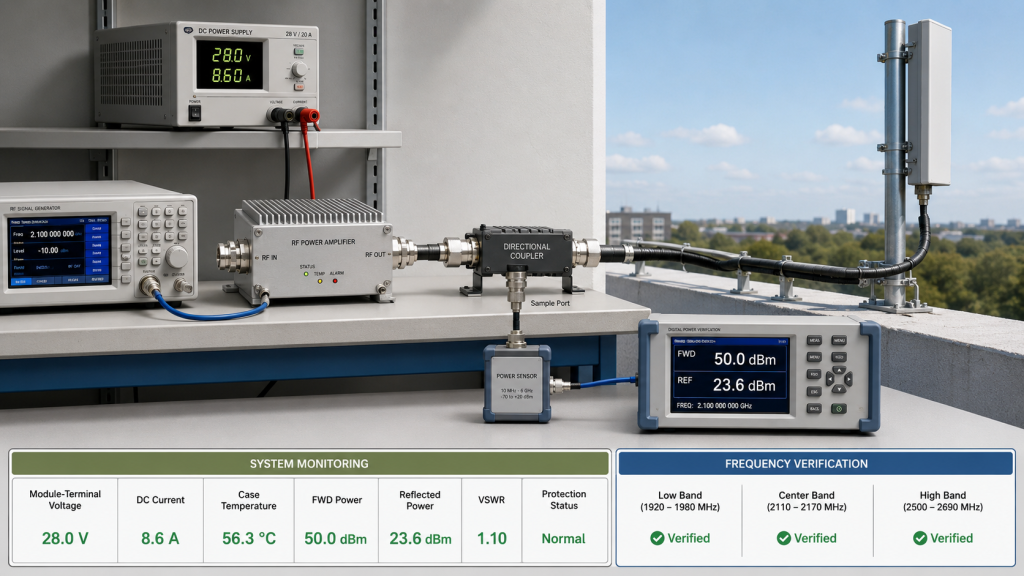
Possible verification points include:
- PA-port output
- Cabinet RF output
- Installed path insertion loss
- Antenna-input power
- Forward and reflected power
- VSWR or Return Loss
- Module-terminal Vdc and Idc
- Temperature
- Protection status
Select the reference planes required by the project rather than measuring every possible plane by default.
Verify the complete frequency range
At each required frequency, record the approved combination of:
- Input drive
- PA-port output
- Installed path loss
- Antenna-input power
- Forward and reflected power
- Vdc and Idc
- Temperature
- Alarm or protection state
A path that meets the target at a lower frequency may fail at the high-frequency edge.
Likewise, a PA that meets output at room temperature may fall below the required level after:
- Long-duty operation
- Cabinet heat rise
- Shared 28V rail loading
- Multi-channel operation
- Protection foldback
Check the installed antenna load
A dummy load can establish the PA baseline, but final approval should also include the installed antenna path when required by the project.
A route that delivers enough forward power may still create:
- Excessive reflected power
- Higher current
- Temperature rise
- Output foldback
- Protection alarms
- Unstable recovery
The final review should therefore compare the calculated path with real antenna load behavior.
Separate path loss from PA weakness
When antenna-input power is below target, check the result in this order:
Confirm input drive
→ Confirm PA-port output
→ Confirm reference plane
→ Measure installed path loss
→ Check connectors and transitions
→ Check antenna match
→ Check Vdc and Idc
→ Check temperature and protection status
This sequence prevents a feeder or installation problem from being misclassified as insufficient PA output.
6. What to Put in the RFQ and Acceptance Plan
A useful RFQ should not state only:
Antenna distance: 30 meters
Required PA: 200 W
That request skips the information needed to decide whether 200 W is appropriate.
Remote Antenna RF PA RFQ Checklist
Frequency and Output
- Target frequency points
- Required operating bandwidth
- Required power reference plane
- Required antenna-input power
- Allowed output variation
- Approved engineering margin
Antenna and Feeder Layout
- Straight-line antenna distance
- Estimated one-way route length
- Final installed feeder length
- Cable type
- Loss by frequency
- Connector and adapter count
- Cabinet feedthrough
- Lightning protector
- RF switch or filter
- Indoor or outdoor route
- Minimum bend-radius conditions
Antenna Load
- Antenna type
- Connector interface
- VSWR or Return Loss requirement
- Operating frequency range
- Power rating
- Installation location
- Mounting and grounding condition
Electrical and Thermal Conditions
- 28V supply capacity
- Allowed module-terminal voltage drop
- Full-load current
- Duty cycle
- Simultaneous-channel condition
- Cooling method
- Cabinet air temperature
- Maximum operating temperature
Acceptance Evidence
- PA-port output by frequency
- Installed path loss by frequency
- Antenna-input power
- FWD and REV results
- VSWR or Return Loss
- Module-terminal Vdc and Idc
- Temperature
- Protection status
- Hot-state result
- S/N-linked test report
- Pass, Review, or Fail criteria
Final decision rule
The PA should not be selected from distance alone.
Approve the architecture only after confirming:
Required Antenna-Input Power
+ Installed RF Path Loss
+ Approved Engineering Margin
≤ Verified PA-Port Output
This condition must remain valid across:
- Required frequencies
- Approved duty cycle
- Hot-state operation
- Real antenna load
- 28V supply conditions
- Simultaneous-channel operation
FAQ
Does a more distant antenna always require a higher-power PA?
No. The correct PA output depends on installed feeder loss, frequency, connector stack, required antenna-input power, and approved margin. A lower-loss cable or shorter RF path may be more effective than increasing PA power.
Can a larger PA compensate for feeder loss?
A larger PA can compensate for a quantified passive loss only when every downstream component remains within its RF power, temperature, and mismatch limits. It does not correct poor connectors, excessive transitions, an incorrect reference plane, or antenna mismatch.
Should acceptance use PA-port power or antenna-input power?
Both may be required, but they prove different things. PA-port power verifies the module. Antenna-input power verifies the installed RF path. The RFQ must state which reference plane controls final acceptance.
Conclusion
Remote antenna RF PA sizing should begin with the required antenna-input power, not with physical distance or a preferred wattage class.
Define the reference plane, calculate the complete installed path loss by frequency, avoid double-counting margin, and then compare larger PA output with lower-loss feeder, shorter routing, or distributed RF placement.
RF SKYPOWER can review remote-antenna RF PA sizing before module approval. Submit the target frequency points, required power reference plane, antenna-input power target, estimated one-way feeder length, cable type, connector and adapter count, cabinet feedthrough, lightning protection, antenna VSWR, duty cycle, 28V supply capacity, cooling condition, and required test boundary.
Contact RF Engineering Team to compare higher PA output, lower-loss feeder, shorter RF routing, or distributed RF-unit placement before the cabinet and antenna layout are locked.