


RF power margin is not the difference between a target wattage and the larger number printed on an amplifier datasheet. It is the verified output headroom that remains after the target reference plane, RF path loss, weakest frequency, hot-state operation, duty cycle, module-terminal voltage, load condition, and signal-linearity requirement are defined.
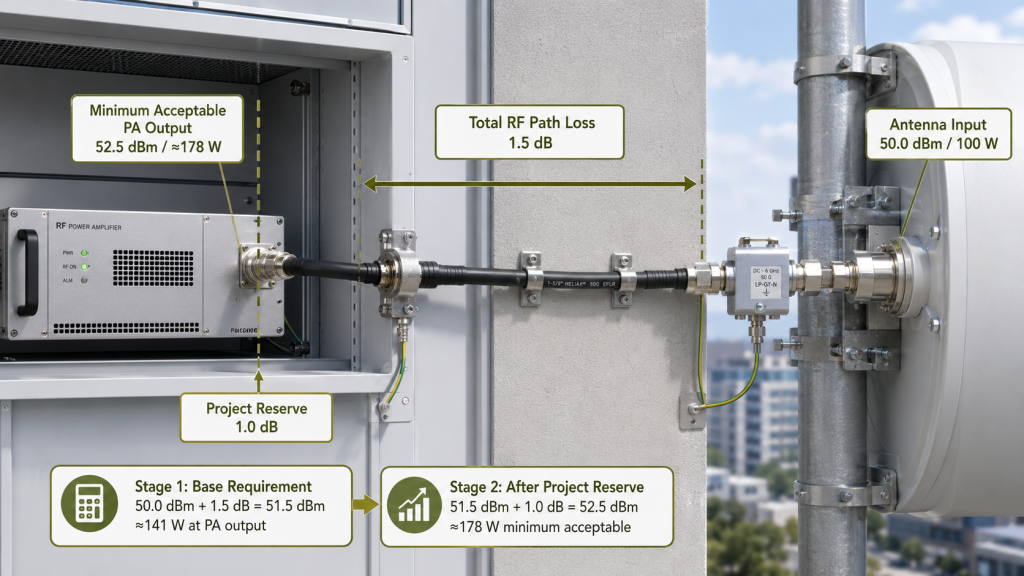
A 100 W requirement may mean 100 W at the PA output connector, cabinet output, feeder end, or antenna input. Those are not equivalent requirements. If a project needs 100 W at the antenna input after 1.5 dB of RF path loss, the base PA-port requirement is approximately 141 W. If the project also requires 1.0 dB of reserve, the minimum acceptable PA output rises to approximately 178 W under the defined worst-case condition.
For RF Power Amplifier Modules, the correct power class should be selected from a documented dB budget and verified minimum compliant output—not from nominal wattage alone.
1. What RF PA Power Margin Actually Means
A reliable power-margin calculation separates four values.
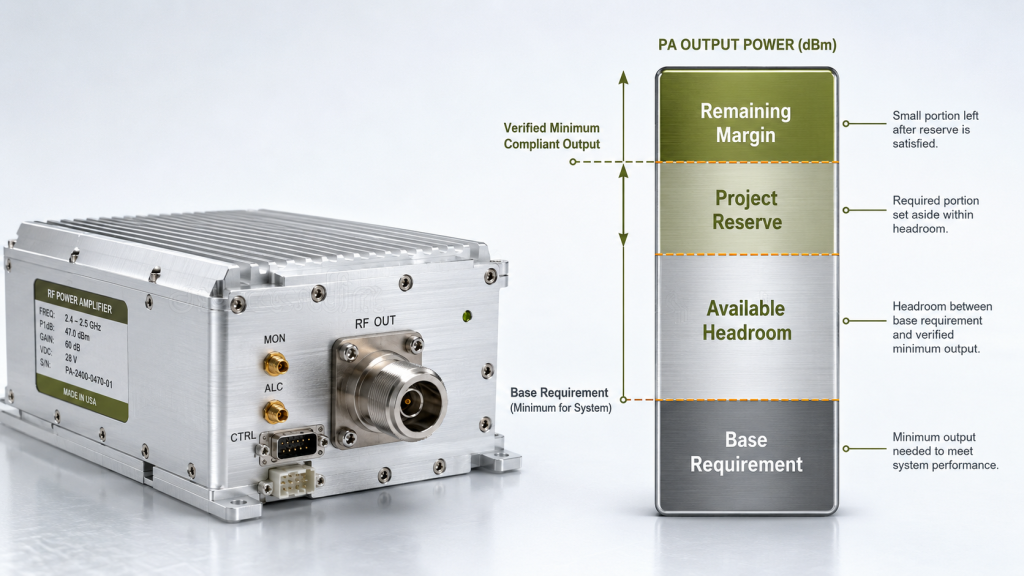
Base required PA-port output
This is the output needed at the PA connector before adding project reserve.
Base required PA-port output
= Required target-plane output
- Deterministic RF path loss
Available headroom
This is the difference between the PA’s verified minimum compliant output and the base requirement.
Available headroom
= Verified minimum compliant PA output
− Base required PA-port output
Defined project reserve
This is the intentional headroom the project requires after known path losses have already been covered.
The selection passes only when:
Available headroom ≥ Defined project reserve
Remaining margin after reserve
This is the additional headroom left after the required reserve has been satisfied.
Remaining margin after reserve
= Available headroom
− Defined project reserve
These values must use the same:
- Reference plane
- Frequency
- Duty cycle
- Thermal condition
- Module-terminal voltage
- Load condition
- Signal type
- Measurement method
A catalog maximum, short peak, saturated output, or room-temperature center-frequency result is not automatically a valid available-output value.
Power margin is not the same as other design margins
| Term | What it means |
|---|---|
| System power margin | RF output headroom remaining after the system requirement and deterministic losses are covered |
| Linearity backoff | Operation below compression to meet EVM, ACLR, spectral-mask, or distortion requirements |
| Gain margin | Allowance for RF drive and gain variation |
| Thermal margin | Remaining cooling capability before a temperature limit is reached |
| DC power margin | Remaining voltage and current capability in the supply path |
| Protection threshold | The point where the PA limits, alarms, or shuts down to prevent damage |
For CW or near-constant-envelope operation, the available-output boundary may be based on sustainable CW output.
For modulated signals, the available-output value must be the minimum sustainable linear output that still meets the required:
- EVM
- ACLR
- Spectral mask
- Adjacent-channel performance
- Distortion limit
Maximum CW output, saturated output, or output near compression should not be used as available power when linearity backoff is required.
Protection is also not usable margin. If the PA reduces output because of temperature, voltage, load mismatch, or reflected-power protection, the reduced compliant output is the value available for the calculation.
Why a fixed percentage is unreliable
There is no universal rule that every RF PA should have 10%, 20%, or 30% extra wattage.
The same percentage cannot represent:
- 0.5 dB versus 2.5 dB RF path loss
- Short bursts versus continuous operation
- 25°C versus 50°C ambient temperature
- Center-frequency versus band-edge output
- Stable 50 Ω load versus elevated VSWR
- PA-port target versus antenna-input target
- CW versus high-crest-factor modulation
- One active channel versus simultaneous channels
A documented dB budget is more reliable than a fixed percentage.
2. Where Must the Required RF Power Be Delivered?
Before selecting the PA, define where the required power must exist.
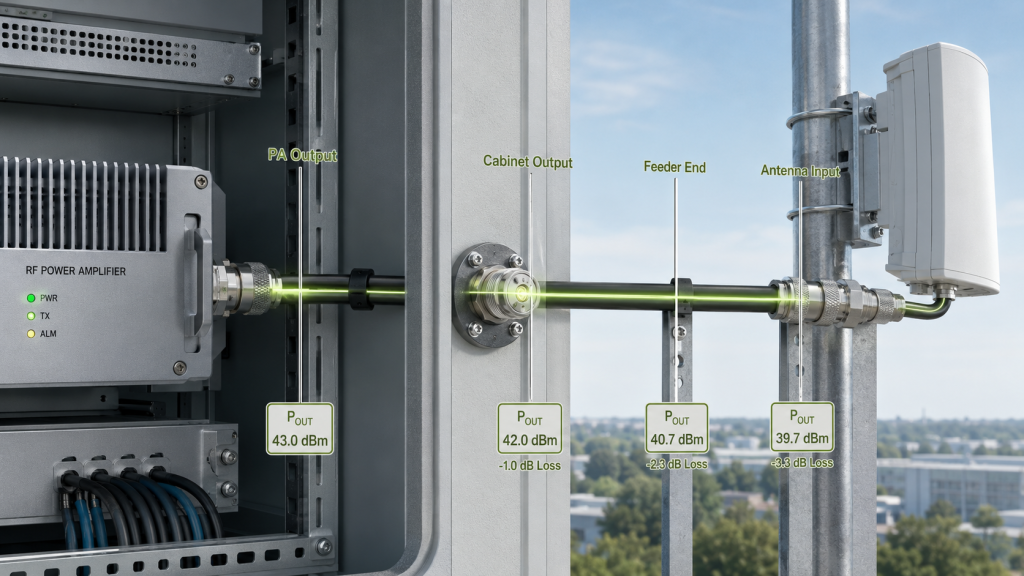
Possible target reference planes include:
- PA output connector
- Cabinet RF output
- Feeder input
- Feeder output
- Antenna input
- Combiner output
- Another defined system interface
A statement such as “the system needs 100 W” is incomplete without a reference plane.
PA output requirement
If the requirement is 100 W at the PA output connector, the base requirement is 50 dBm at that connector.
Downstream feeder, connector, filter, switch, and antenna-feed losses do not change this PA-port requirement. They do, however, reduce the power available farther along the system.
Antenna-input requirement
If the requirement is 100 W at the antenna input, all deterministic losses between the PA and antenna must be added to the base PA-port requirement.
These losses may include:
- Internal cabinet cable
- Bulkhead connector
- External feeder
- Adapters
- Lightning protector
- RF switch
- Filter
- Combiner
- Waterproof transition
- Antenna-feed connector
The complete path should be measured or specified by frequency. The detailed method is covered in power margin after feeder and connector loss.
Why reference-plane errors cause wrong PA selection
Two suppliers may both state that a system provides 100 W while referring to different locations.
One may mean:
100 W at the PA output connector
Another may mean:
100 W at the antenna input after feeder loss
The second requirement may need a much higher PA-port output.
Every RFQ, test report, and acceptance table should therefore state:
- Required output value
- Unit in W or dBm
- Target reference plane
- Frequency
- Signal type
- Duty cycle
- Thermal condition
- DC condition
- Load condition
3. How to Calculate Required PA Output from RF Path Loss
The base PA-port requirement is:
Base required PA-port output in dBm
= Required target-plane output in dBm
- Deterministic RF path loss in dB
Deterministic losses are added in dB.
For example:
| RF path item | Loss |
|---|---|
| Internal cabinet cable and bulkhead | 0.3 dB |
| External feeder | 0.8 dB |
| Connector and weatherproof transition | 0.2 dB |
| Filter or switch | 0.2 dB |
| Total deterministic path loss | 1.5 dB |
Example: 100 W required at the antenna input
100 W equals 50.0 dBm.
The installed RF path loss is 1.5 dB.
Base required PA-port output
= 50.0 dBm + 1.5 dB
= 51.5 dBm
51.5 dBm is approximately 141 W.
If the project requires an additional 1.0 dB reserve:
Minimum acceptable PA output
= 51.5 dBm + 1.0 dB
= 52.5 dBm
52.5 dBm is approximately 178 W.
The project should therefore not automatically select a nominal 100 W PA.
A 200 W-class PA may satisfy the requirement only if its verified minimum compliant output remains above 52.5 dBm under the required:
- Frequency
- Signal type
- Linearity requirement
- Duty cycle
- Ambient temperature
- Cooling condition
- Module-terminal voltage
- Load condition
- Operating duration
A catalog statement of 200 W at one frequency and room temperature is not sufficient evidence.
For the distinction between nominal, rated, measured, and field-usable output, review rated and usable RF output power.
RF PA Power-Margin Budget
| Budget line | Reference plane | Example value | Treatment |
|---|---|---|---|
| Required usable output | Antenna input | 50.0 dBm / 100 W | Project requirement |
| Deterministic path loss | PA to antenna | 1.5 dB | Add to base PA-port requirement |
| Base required PA output | PA output | 51.5 dBm / ≈141 W | Target plus path loss |
| Defined project reserve | PA output boundary | 1.0 dB | Required headroom |
| Minimum acceptable PA output | PA output | 52.5 dBm / ≈178 W | Base requirement plus reserve |
| Verified minimum compliant output | PA output | Project test result | Worst-case evidence |
| Available headroom | PA output | Verified output − 51.5 dBm | Compare with reserve |
| Remaining margin after reserve | PA output | Available headroom − 1.0 dB | Final result |
The final three rows must use actual project and test data, not assumed catalog values.
4. How to Define Minimum Available Output Under Worst-Case Conditions
The verified minimum compliant output must represent the weakest credible operating condition.
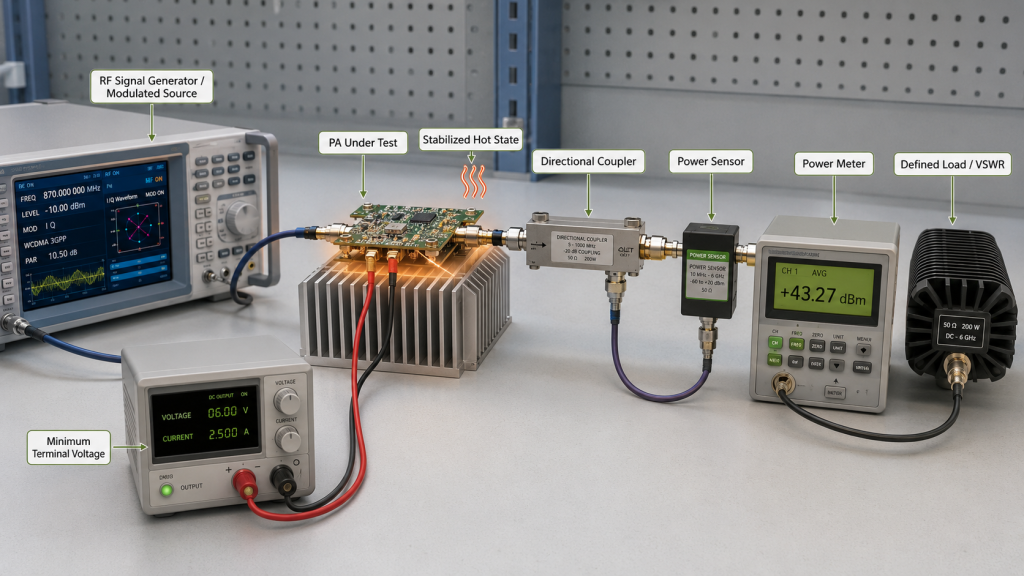
That condition should include:
- Weakest required frequency
- Required signal type
- Required linearity
- Required duty cycle
- Longest operating duration
- Highest specified ambient temperature
- Final heatsink or cabinet cooling
- Minimum allowed module-terminal voltage
- Defined load and VSWR condition
- Required simultaneous-channel operation
- Final protection behavior
Frequency
A wideband PA may not produce identical output across its complete frequency range.
Power-margin approval should use the weakest required frequency, not only the center frequency or best test point.
Test:
- Low end
- Mid-band
- High end
- Required band edges
- Project-critical frequencies
- Any known weak-output point
Hot-state operation
A PA may reach the required output during a short cold test and then drift after the module, heatsink, cabinet air, cables, and power components reach thermal stability.
The minimum compliant output should therefore be verified with the final:
- Thermal interface
- Heatsink
- Airflow
- Cabinet condition
- Duty cycle
- Test duration
For high-ambient projects, use the detailed hot-site RF PA selection boundary.
DC supply condition
The voltage at the power-supply terminals is not necessarily the voltage at the PA module terminals.
Available output should be checked at the minimum allowed module-terminal voltage after accounting for:
- DC cable drop
- Connector resistance
- Fuse and protection-device drop
- Distribution-panel loss
- Current transients
- Simultaneous-channel loading
A PA that meets the target at 28.0 V on a laboratory bench may not meet it when the module receives a lower voltage in the final system.
The detailed supply-path boundary is covered in RF PA output drops from DC power issues.
Load and protection behavior
The project must define whether the required output applies under:
- Verified 50 Ω dummy-load condition
- Installed feeder and antenna condition
- A specified VSWR boundary
- A defined reflected-power level
If the PA reduces output under a stated load, voltage, or temperature condition, the reduced compliant output is the available value for the budget.
Do not use the protection threshold as reserve.
Integrated worst-case testing
The preferred method is to use one result that already combines the required conditions.
Example:
Minimum compliant output: 185 W at the weakest frequency, required signal quality, stabilized hot state, specified duty cycle, minimum module-terminal voltage, and defined load condition.
In this case, the effects of frequency, temperature, voltage, duty cycle, load, and linearity are already represented.
Do not subtract them again.
Separate allowances
When integrated test data is unavailable, separate allowances may be estimated for:
- Frequency variation
- Hot-state output reduction
- Low-voltage output reduction
- Load-related derating
- Linearity backoff
Each allowance must have a documented source. Final acceptance testing should replace estimates with measured evidence.
5. How to Avoid Double Counting Margin and Uncertainty
A power budget becomes misleading when the same effect is deducted more than once.
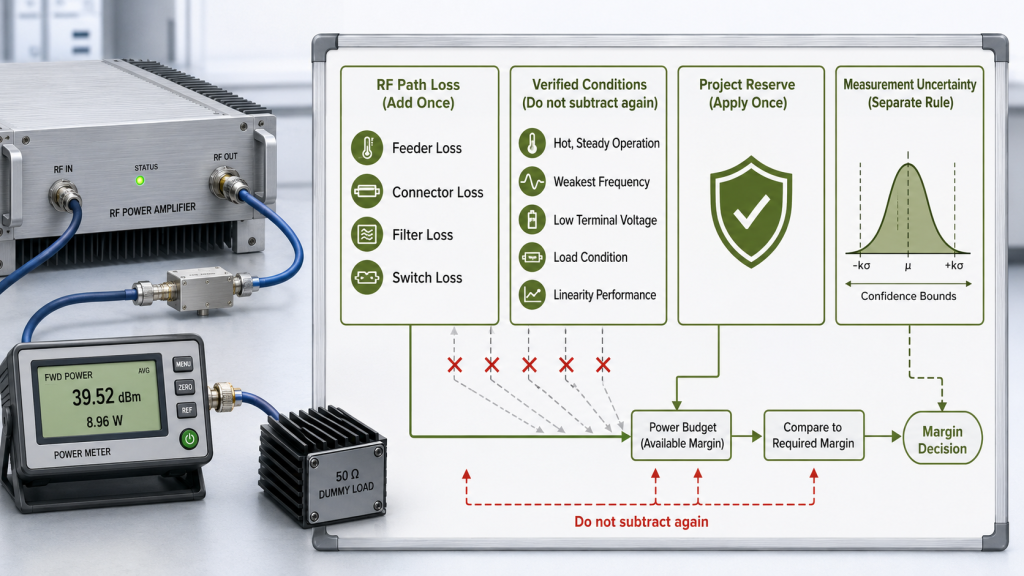
Common errors include:
- Adding measured feeder loss and then adding another generic cable margin
- Using verified hot-state output and subtracting thermal derating again
- Using the weakest measured frequency and adding a second band-edge allowance
- Using low-voltage test output and subtracting another DC allowance
- Including connector loss in both the feeder total and a separate connector allowance
- Using guaranteed minimum output and adding another reserve for the same production spread
- Treating measurement uncertainty as RF path loss
What Belongs in the Power-Margin Decision?
| Factor | Add to base PA-port requirement? | Include in verified minimum output? | Record separately? |
|---|---|---|---|
| Feeder insertion loss | Yes | No | Yes |
| Connector and transition loss | Yes | No | Yes |
| Filter, switch, or combiner loss | Yes | No | Yes |
| Hot-state output reduction | No, if tested | Yes | Yes |
| Weakest-frequency output | No, if tested | Yes | Yes |
| Low module-terminal voltage | No, if tested | Yes | Yes |
| Load or protection derating | No, if tested | Yes | Yes |
| Linearity backoff | No, if compliant output is tested | Yes | Yes |
| Defined project reserve | Add after base requirement | No | Yes |
| Measurement uncertainty | No | No | Yes, with decision rule |
Project reserve
Project reserve should be intentional and applied only once.
It may cover defined normal variation such as:
- Production spread not already included in a guaranteed minimum
- Approved cable-length tolerance not already included in the maximum path loss
- Connector replacement within the approved configuration
- Normal installation variation
- Expected aging within the maintenance interval
- Minor environmental variation within the specification
Do not use project reserve to cover variation already included in:
- Guaranteed minimum PA output
- Maximum path-loss specification
- Tested worst-case condition
- Required linearity backoff
- Specified component tolerance
Reserve should not hide unknown engineering data.
Measurement uncertainty
Measurement uncertainty does not consume RF power. It affects confidence in the reported result.
Possible contributors include:
- Directional coupler
- Power sensor
- Attenuator
- Cable correction
- Calibration
- Connector repeatability
- Instrument accuracy
The RFQ should define how uncertainty affects pass or fail.
For example, a project may require a guard band so the lower confidence boundary remains above the minimum acceptable PA output.
A decision rule may be expressed as:
Lower acceptance boundary
= Measured compliant output
− Defined uncertainty guard band
The result passes only when the lower acceptance boundary remains above the minimum acceptable PA output.
Other shared-risk or project-specific decision rules may be used, but the rule must be agreed before testing.
6. How to Select and Verify the PA Power Class
The correct PA is not automatically the largest available model.
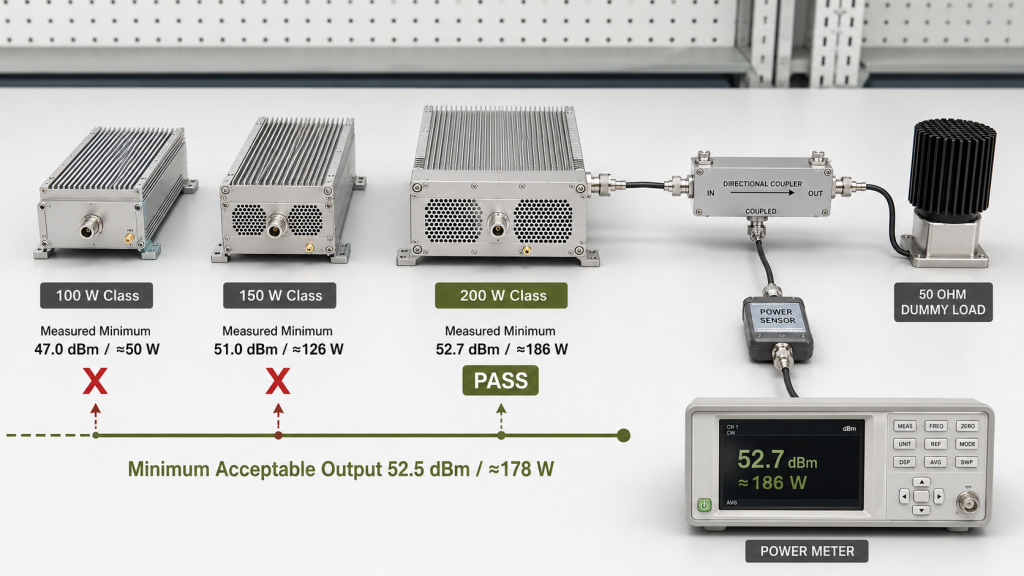
The objective is:
Select the smallest practical PA class that can maintain the minimum acceptable output under the project’s worst credible operating condition.
An unnecessarily large PA may increase:
- DC current
- Heat rejection
- Cabinet size
- Cable and connector stress
- Dummy-load test requirements
- Protection-event energy
- Cost
- Integration complexity
A larger PA can still fail when the system has:
- Insufficient DC capacity
- Poor thermal design
- Excessive feeder loss
- Weak band-edge output
- Incorrect load condition
- Inadequate cable or connector ratings
- Insufficient linear output for the required modulation
Selection sequence
- Define the required output reference plane.
- Convert the required output to dBm.
- Add deterministic RF path losses by frequency.
- Calculate the base PA-port requirement.
- Define the required project reserve.
- Calculate the minimum acceptable PA output.
- Obtain the PA’s verified minimum compliant output.
- Calculate available headroom.
- Confirm that available headroom meets the required reserve.
- Apply the agreed measurement-uncertainty decision rule.
- Reject any selection with negative or undefined remaining margin.
- Link the final result to the tested unit by model and serial number.
Signs that the margin is too small
Insufficient margin may appear as:
- Output passes cold but falls after warm-up
- Center frequency passes while a band edge fails
- Factory bench test passes but final cabinet test fails
- Output drops at the minimum module-terminal voltage
- Protection activates during normal operation
- A longer feeder causes antenna-input power to miss the target
- Minor connector variation changes the pass/fail result
- Simultaneous-channel operation reduces output below the requirement
- Modulated output meets wattage but fails EVM, ACLR, or spectral limits
Verification conditions
The final test should record:
- Frequency
- Signal type
- RF drive condition
- Required linearity limit
- PA output reference plane
- Forward and reflected power
- Required and measured output
- Module-terminal voltage
- DC current
- Duty cycle
- Test duration
- Module and heatsink temperature
- Ambient or inlet-air temperature
- Load or VSWR condition
- Protection behavior
- Calibration and correction data
- Measurement-uncertainty decision rule
The acceptance test must use the same boundary as the original power-margin calculation.
7. What Evidence Proves the Power Margin Is Real?
The final delivery package should show the actual calculation and test result for the identified PA.
Include:
- Approved power-budget calculation
- Required output and reference plane
- Measured RF path loss by frequency
- Defined project reserve
- Calculated base PA-port requirement
- Calculated minimum acceptable output
- Tested PA model and serial number
- Actual weakest-frequency result
- Actual hot-state compliant output
- Actual module-terminal voltage
- Actual load and VSWR condition
- Raw and corrected test data
- Measurement uncertainty and decision rule
- Available headroom
- Remaining margin after reserve
- Calibration record
- Protection status
- Signed acceptance report
A suitable acceptance statement is:
With the specified target reference plane, measured RF path loss, project reserve, frequency, signal type, linearity requirement, duty cycle, operating duration, thermal condition, module-terminal voltage, load condition, and simultaneous-channel state, the identified RF PA maintained a verified minimum compliant output above the minimum acceptable output with the documented remaining margin after reserve.
The following statements are not sufficient:
- The module is rated at 100 W
- The next larger model was selected
- The PA passed at center frequency
- The test passed for a few seconds
- The power supply is rated correctly
- Protection did not trip
- The amplifier has 20% extra power
- The same model worked in another cabinet
The approved margin must be calculated and tested at matching boundaries.
What Power-Margin Data Should Be Defined Before RFQ?
Before selecting the PA power class, define:
- Required usable RF output
- Target reference plane
- Required frequencies
- Estimated or specified path loss by frequency
- Feeder and connector configuration
- Filter, switch, combiner, and adapter losses
- Defined project reserve
- Signal type
- Required EVM, ACLR, spectral-mask, or distortion boundary
- Required linearity backoff
- Duty cycle
- Operating duration
- Ambient-temperature range
- Cooling condition
- Minimum module-terminal voltage
- Maximum available DC current
- Load and VSWR boundary
- Simultaneous-channel condition
- Protection and recovery requirement
- Measurement uncertainty
- Acceptance decision rule
- Minimum acceptable PA output
- Required report format
- Responsibility boundary for each budget item
RF PA Power-Margin RFQ Inputs
| RFQ item | Why it matters |
|---|---|
| Output reference plane | Defines where the required wattage must exist |
| Path loss by frequency | Converts target output into the base PA-port requirement |
| Defined reserve | Establishes the required headroom after known losses |
| Signal and linearity requirement | Defines the compliant available-output boundary |
| Weakest-frequency condition | Prevents center-frequency-only selection |
| Duty cycle and duration | Separates short peak output from sustainable output |
| Thermal condition | Defines the required hot-state capability |
| Module-terminal voltage | Defines the actual DC operating boundary |
| Load and VSWR condition | Defines output before protection or derating |
| Simultaneous-channel state | Captures shared DC and thermal loading |
| Uncertainty decision rule | Defines how measurement confidence affects acceptance |
| Report format | Makes the final calculation and test evidence reviewable |
Projects should define whether the PA supplier, system integrator, cable supplier, antenna supplier, cabinet supplier, or customer owns each part of the power budget and acceptance evidence.
Conclusion
RF PA power margin should not be selected from nominal wattage or a fixed percentage.
A reliable selection requires:
- A defined output reference plane
- A frequency-specific RF path-loss budget
- A calculated base PA-port requirement
- One clearly stated project reserve
- A calculated minimum acceptable PA output
- Verified minimum compliant PA output
- Weakest-frequency testing
- Hot-state and duty-cycle verification
- Module-terminal voltage confirmation
- Defined load and VSWR conditions
- Correct linearity treatment
- A measurement-uncertainty decision rule
- S/N-linked acceptance evidence
Start with the power required where the system actually needs it. Add deterministic RF path losses to calculate the base PA-port requirement. Then define the required reserve and determine the minimum acceptable PA output.
Compare that threshold with the PA’s verified minimum compliant output under the worst credible operating condition. Approval requires enough available headroom to satisfy the reserve and any agreed measurement decision rule.
Do not approve a PA because its nominal wattage is larger than the target. Approve it only when the calculation, compliant output, test boundaries, and remaining margin after reserve are documented and verified.
Send our RF engineering team your frequency range, required usable output, target reference plane, feeder and connector loss, signal type, linearity requirement, duty cycle, operating duration, ambient temperature, cooling condition, minimum module-terminal voltage, antenna or load condition, required reserve, simultaneous-channel plan, measurement decision rule, and acceptance-report requirements.
RF SKYPOWER will review the base PA-port requirement, minimum acceptable output, weakest-frequency performance, hot-state capability, DC boundary, load condition, and remaining verified power margin before the final RF PA power class is approved.