



Prevent DC-related RF PA output drops by verifying the DC source, distribution path, and PA-terminal condition under the RF operating states that matter before approval.
A supply voltage shown at the source does not automatically represent the electrical condition available at the amplifier. Cable and distribution loss, changing current demand, simultaneous loads, transient events, and controlled protection responses can all affect the relationship between the DC source and RF output.
The prevention task is therefore to define the electrical boundaries that must remain valid before the PA is accepted:
- source-side DC condition;
- PA-terminal DC condition;
- relevant current measurement boundary;
- RF operating state;
- simultaneous load state where applicable;
- protection or alarm state;
- evidence timing and traceability.
If an output drop still occurs after those conditions are defined, synchronized measurements can then help determine whether the DC power chain should remain the primary investigation path.
This page focuses on that prevention and attribution boundary. Detailed cable sizing, startup-current diagnosis, shared-bus interaction, grounding architecture, protection logic, and controller-status mapping should be handled separately when the evidence points to those specialist tasks.
1. Define the DC Acceptance Boundary Before RF PA Approval
A DC power system should not be approved from one source-voltage number.
RF amplifier power supply requirements should be defined under the electrical and RF operating states that matter to the intended use.

Depending on the project, the acceptance boundary may need to define:
- source voltage;
- PA-terminal voltage;
- module or branch current;
- frequency;
- RF input condition;
- RF output condition;
- duty or operating state;
- number of simultaneous loads;
- startup or steady-state condition;
- relevant protection state.
The purpose is not to prescribe one universal DC design.
It is to make sure the electrical evidence represents the operating condition in which stable RF output is required.
For example, a DC system that appears stable with the PA in standby does not automatically prove the condition at higher RF output.
Likewise, a single-module result does not automatically prove a shared supply when several high-current loads can change state together.
The prevention question is:
Have the DC source, distribution path, and PA-terminal condition been verified under the RF states that actually matter to acceptance?
If not, the system still has an unresolved DC evidence gap even if the source rating appears sufficient on paper.
2. Check Source Voltage, DC Path, and PA-Terminal Voltage Separately
The DC power chain contains multiple measurement boundaries.
For output stability, three should be distinguished.
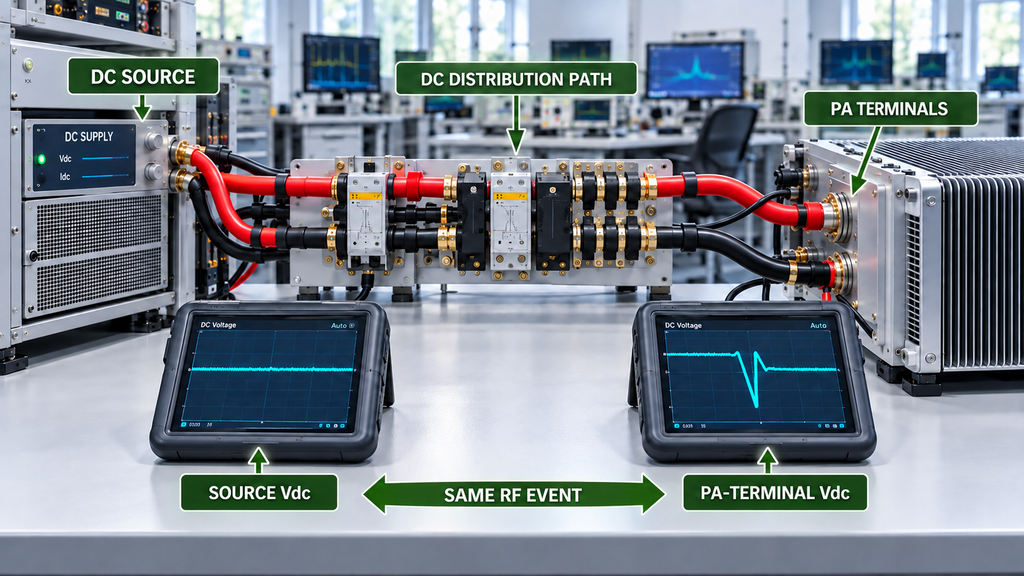
DC source
This is the upstream supply or source output.
It shows what the power source is delivering at its own measurement point.
DC distribution path
This is the electrical path between the source and the amplifier.
It may include:
- cables;
- connectors;
- fuses;
- relays;
- switches;
- distribution blocks;
- cabinet wiring;
- intermediate terminals.
The current page does not need to calculate the loss of each component.
The prevention requirement is to determine whether the distribution path can preserve the required PA-terminal condition under load, and to use an RF PA DC cable voltage-drop check when source voltage remains stable but PA-terminal voltage falls.
PA terminals
This is the electrical condition available to the amplifier at the defined DC input measurement point.
For RF output stability, PA-terminal voltage is more directly relevant than a source display because the two measurements represent different locations in the DC chain.
A useful acceptance record should therefore avoid statements such as:
“The PA was tested at 28 V.”
unless the measurement point is clear.
A stronger record identifies where the voltage was measured and under which RF and load condition it applies.
| Evidence Pattern | Engineering Meaning | Next Decision |
|---|---|---|
| Source and PA-terminal voltage remain stable under the required RF state | Voltage evidence does not show an obvious DC sag | Continue checking current, protection, RF, thermal, or other relevant boundaries |
| Source voltage changes under the required load | Upstream source or total-load behavior may require review | Evaluate source-side capacity and load interaction |
| Source remains stable but PA-terminal voltage changes | Local DC distribution path becomes a stronger investigation path | Evaluate the affected branch or connection path |
| Condition changes only when other loads transition | Shared distribution behavior may be involved | Evaluate shared-bus or branch interaction |
| Average voltage looks stable but short instability remains | Slow average readings may not capture the event | Use measurement time resolution appropriate to the event |
These patterns support engineering decisions.
They do not, by themselves, identify a failed component.
3. Verify the DC Boundary Under the Operating States That Matter
Preventing output drops requires checking RF amplifier current consumption at a defined module or branch boundary under the RF state that can create the electrical demand.
A PA may experience different DC conditions during:
- startup;
- standby-to-active transition;
- lower RF output;
- higher RF output;
- different duty states;
- multi-module operation;
- protection or recovery events.
The required evidence should match the state that the project intends to approve.

Steady-state operation
If the acceptance decision applies to sustained RF operation, record the relevant source, PA-terminal, current, and RF conditions after the system reaches the intended operating state.
Startup or enable transition
If output instability or alarms are concentrated around startup or enable, use an RF PA startup current alarm check because steady-state measurements alone may not represent the event.
The measurement time resolution should be appropriate for the transient being investigated.
A slow reading that looks normal before and after the event may miss a short electrical change.
Shared-load operation
If several PAs or system loads share the DC infrastructure and the symptom changes with simultaneous loading, use a shared DC bus interaction check to verify the operating combinations that matter to the project.
A source and branch that remain stable with one load enabled do not automatically prove the same condition when other loads transition.
Higher RF demand
If the PA requires more DC current at the operating point being approved, low-output measurements should not be extended to that condition without supporting evidence.
The prevention rule is simple:
Verify the DC boundary under the RF and load states that can materially change the acceptance decision.
Do not use an easier operating state as automatic proof of a more demanding one.
4. If Output Still Drops, Match the Symptom to the Right DC Specialist Check
Even with a defined acceptance boundary, unexpected behavior can still occur.
At that point, the current page should help identify the next evidence path rather than reproduce every specialist procedure.

| Observed Symptom | Synchronized Evidence Needed | Decision | Next Investigation |
|---|---|---|---|
| RF output falls while PA-terminal Vdc falls | Source Vdc, PA-terminal Vdc, relevant current, RF state | Separate upstream behavior from local path loss | Source, voltage-margin, or DC-path review |
| Alarm or output change occurs mainly during startup | Transient V/I evidence, timestamp, alarm state | Treat as a startup event | Startup-current diagnosis |
| Problem appears mainly when multiple loads operate together | Bus/branch Vdc, load transitions, module states | Check shared-load interaction | Shared-DC-bus diagnosis |
| Average Vdc looks normal but instability remains | Faster transient/ripple evidence and return/reference condition | Average voltage alone is insufficient | Power-quality or grounding review |
| RF output changes with a protection state | Vdc, current boundary, RF output, protection identity, timestamp | Determine whether reduction is controlled | Protection-logic verification |
| Controller reports a fault but electrical meaning is unclear | Status source, timestamp, module identity, electrical evidence | Confirm what the reported status represents | Status-feedback verification |
| DC evidence remains stable during the RF drop | RF drive, RF load, thermal state, protection state, RF reference plane | Stop prioritizing DC without new evidence | Move to the relevant non-DC investigation |
If RF output changes with a protection event, use RF PA protection logic validation to separate the trigger, RF response, reported state, and recovery behavior.
A startup event should not automatically become a continuous-current sizing problem.
A multi-module interaction should not automatically become a single-branch cable problem.
And stable DC evidence should not be ignored merely because the system uses long cables or a high-current supply.
5. What Evidence Is Needed Before Prioritizing the DC Power Chain?
One isolated measurement is not enough to justify a strong DC attribution.
A useful evidence set connects the RF symptom with the electrical condition under the same or a defensibly comparable event.
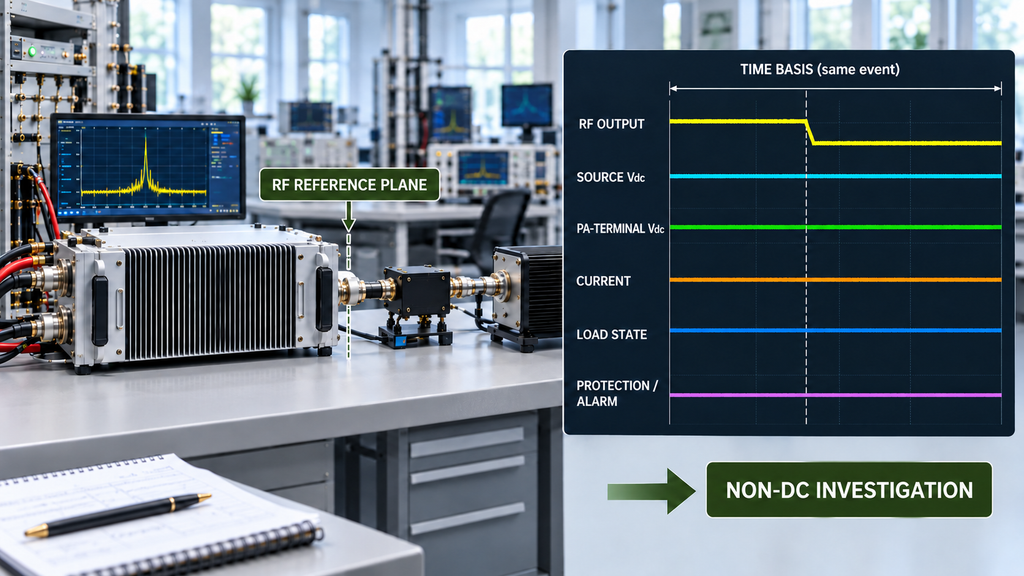
| Evidence | Required Boundary | Why It Matters |
|---|---|---|
| RF output | Defined RF output reference plane | Confirms what output actually changed |
| RF input / operating state | Same frequency, drive, load, and duty condition where relevant | Prevents unlike RF states from being compared |
| PA-terminal Vdc | Defined PA DC input measurement point | Shows the electrical condition available to the module |
| Source-side Vdc | Defined upstream source point | Separates source behavior from local path behavior |
| Relevant current | Defined module, branch, or bus current measurement boundary | Shows which electrical load is represented |
| Simultaneous load state | Same event window | Shows whether other loads can explain the condition change |
| Protection / alarm state | Same module and event | Shows whether RF reduction may be a controlled response |
| Time basis | Resolution appropriate to the event being investigated | Prevents a slow reading from being treated as proof of a transient condition |
Timing correlation strengthens the DC hypothesis.
It does not by itself identify the failing component.
For example, PA-terminal voltage and RF output may fall together. That supports further investigation of the DC path, but it does not automatically prove whether the source, cable, connector, relay, branch, or another shared load caused the change.
Likewise, RF power amplifier alarm monitoring can show when a protection state coincides with RF output reduction without proving why the protection condition was reached.
Evidence strength should match claim strength.
When to stop prioritizing the DC hypothesis
The DC power chain should not remain the preferred explanation only because the installation uses high current, long cables, or a shared source.
If RF output changes while:
- source voltage remains stable;
- PA-terminal voltage remains stable;
- the relevant current/load state does not show a corresponding change;
- no relevant protection state changes;
then the available DC evidence does not yet support continued prioritization of the DC power chain.
Investigate the next relevant RF, load, thermal, control, or measurement boundary instead.
This stopping condition is part of good diagnosis because it prevents unnecessary changes to an electrical system that the available evidence does not implicate.
6. What DC Evidence Should Be Recorded Before RF PA Acceptance?
The acceptance record should preserve enough information to determine whether later RF output behavior occurred under the same electrical boundary that was approved.
It does not need to document every internal power-system design detail.
It should record the evidence fields that can materially change the RF decision.
| Evidence Field | Measurement Boundary | When It Should Be Recorded | Decision Use |
|---|---|---|---|
| Source-side Vdc | Defined DC source point | Under the relevant RF/load state | Shows upstream source behavior |
| PA-terminal Vdc | Defined PA DC input point | Under the same acceptance state | Shows voltage available to the amplifier |
| Relevant current | Defined module, branch, or bus point | Under the applicable RF/load state | Defines the electrical load represented by the test |
| RF output | Defined RF reference plane | Same acceptance condition | Links DC evidence to the RF result |
| RF operating condition | Frequency, drive, load, duty/control state | Same evidence set | Keeps electrical and RF data comparable |
| Simultaneous load state | Defined active modules or system loads | When shared loading can affect the result | Shows whether the evidence represents the intended system condition |
| Protection / alarm state | Identified module and event | When output can be controlled by protection | Prevents controlled reduction from appearing unexplained |
| Time basis | Timestamp or synchronized trace with suitable resolution | Especially for transient events | Establishes whether observations represent the same event |
| Evidence identity | Sample, specific S/N, branch, cabinet, or other defined scope | As required by the acceptance plan | Prevents one record from representing hardware or conditions it did not test |
The exact evidence scope depends on the decision.
Early engineering evaluation may only require enough data to determine the next RF power amplifier testing step.
Final acceptance may require stronger traceability and repeatability.
The important requirement is that the project can later answer:
What electrical condition was actually approved when the RF performance was accepted?
Without that evidence, a later output drop can be difficult to distinguish from a changed source, path, load state, protection condition, or unrelated RF problem.
FAQ
Why can RF output drop when the source voltage still looks normal?
Because source voltage and PA-terminal voltage represent different electrical boundaries. The distribution path and operating current can create a different condition at the amplifier, especially under higher or changing load states.
How do I distinguish a source problem from a local DC-path problem?
Compare source-side and PA-terminal voltage under the same RF event. If both change, the upstream source or total-load condition deserves review. If the source remains stable while the PA-terminal condition changes, the local path becomes the stronger next investigation.
When should startup current or a shared DC bus be investigated separately?
Use startup-current diagnosis when the symptom is concentrated around startup or enable transitions. Use shared-bus diagnosis when the problem appears mainly as other modules or loads change state.
Does synchronized voltage and RF output prove the DC root cause?
No. Timing correlation strengthens the DC hypothesis but does not identify the failed component by itself. Additional evidence is needed to localize the electrical cause.
Conclusion
Prevent DC-related RF PA output drops by verifying the DC source, distribution path, and PA-terminal condition under the RF operating states required for acceptance.
Do not rely on one source-voltage number. Record where voltage and current are measured, which RF condition they represent, which other loads are active, whether protection changes state, and whether the measurement timing is appropriate for the event.
If an output drop still occurs, compare synchronized source, PA-terminal, current, RF-output, load-state, and protection evidence to decide whether the DC power chain should remain the primary investigation path.
Correlation can support that decision, but it does not automatically identify the failed component.
And when the relevant DC evidence remains stable during the RF output change, stop forcing a DC explanation and investigate the next applicable RF, thermal, load, control, or measurement boundary.
For an RFQ or engineering review of Custom RF Power Amplifier Modules, provide the target frequency and RF output condition, required PA-terminal DC condition, relevant current boundary, source and distribution configuration, simultaneous load state where applicable, startup or duty condition, protection or alarm requirements, and the evidence scope required for acceptance.
Those inputs provide a clearer basis for preventing DC-related output instability and for determining the next engineering step if an output drop still occurs.