


Preventing RF PA VSWR field failures requires control of the approved installed RF-path configuration and clear retest rules for changes that can alter the load seen by the amplifier.
A clean dummy-load result remains useful PA-side evidence, but it does not permanently approve every feeder, connector, adapter, filter, lightning protector, antenna, mounting position, or cable route connected later. Once the installed path has been accepted, the project needs configuration control: what physical RF path was approved, which acceptance boundary applied to it, what changed afterward, and whether that change requires new evidence before field release.
This page focuses on that deployment-prevention task. Use a pre-integration RF PA load check to establish the baseline and installed-path measurement boundary first. If a reflected-power alarm after installation has already occurred, fault isolation becomes a separate diagnostic task.
Protection behavior also needs careful interpretation. A warning, power reduction, or shutdown can be an expected protective response to a defined mismatch condition; it is not automatically proof that the PA hardware has failed.
1. What Counts as a Risk for VSWR Field Failures?
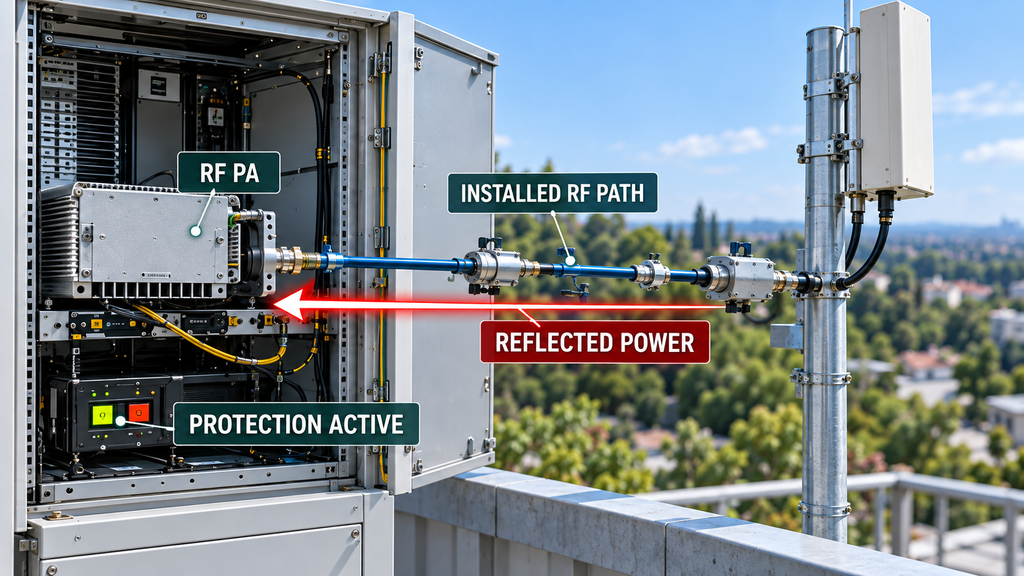
A VSWR-related field-failure risk exists when the installed RF configuration can expose the PA to a load condition, reflected-power level, or protection state that has not been accepted for the intended operating condition.
The risk is not limited to permanent hardware damage.
A deployment can also fail operationally when the installed path causes:
- unexpected reflected-power alarms;
- repeated protection activity;
- unintended output back-off;
- shutdown during required operation;
- recovery behavior that does not match the expected system response;
- an installation that cannot be released because its mismatch boundary is unclear.
These outcomes should not automatically be interpreted as a defective PA.
A protection response may be functioning as intended while the downstream RF path remains outside the approved condition.
Field-failure prevention therefore needs four controls:
- an identifiable approved installed RF-path configuration;
- a defined mismatch boundary for field release;
- an understood system response when that boundary is exceeded;
- a change-control rule that reopens the affected acceptance boundary when the installation changes.
The goal is not to claim that every future field event can be prevented.
The goal is to prevent an earlier bench or installation result from being reused after the RF boundary has materially changed.
2. Record the Approved RF Path Before Field Release
Once the PA and installed path have passed the required integration checks, the accepted physical RF configuration should be identifiable.
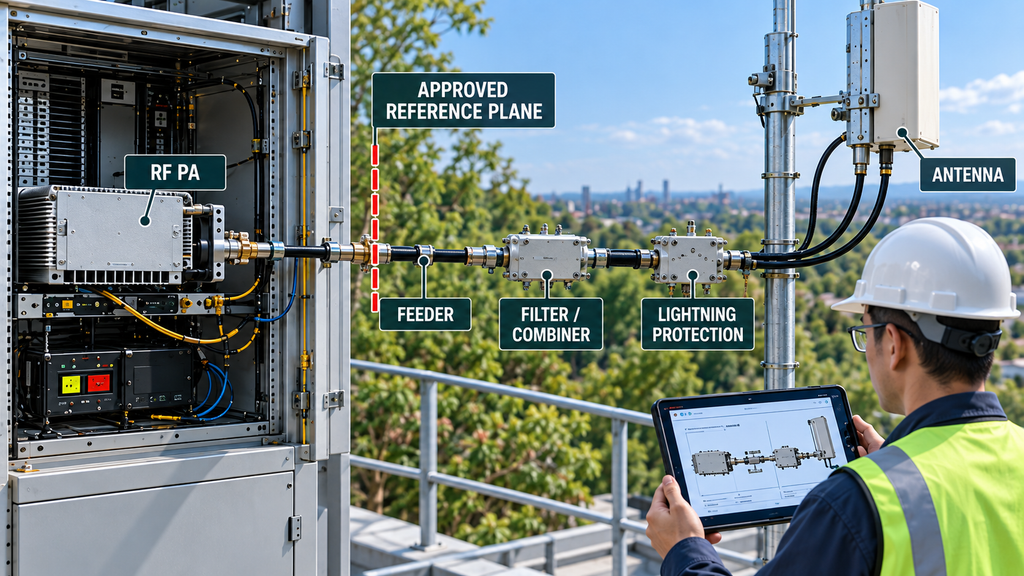
That physical configuration may include:
- feeder type and length;
- connector types and terminations;
- adapters;
- filters or combiners;
- lightning-protection devices;
- cabinet feedthroughs;
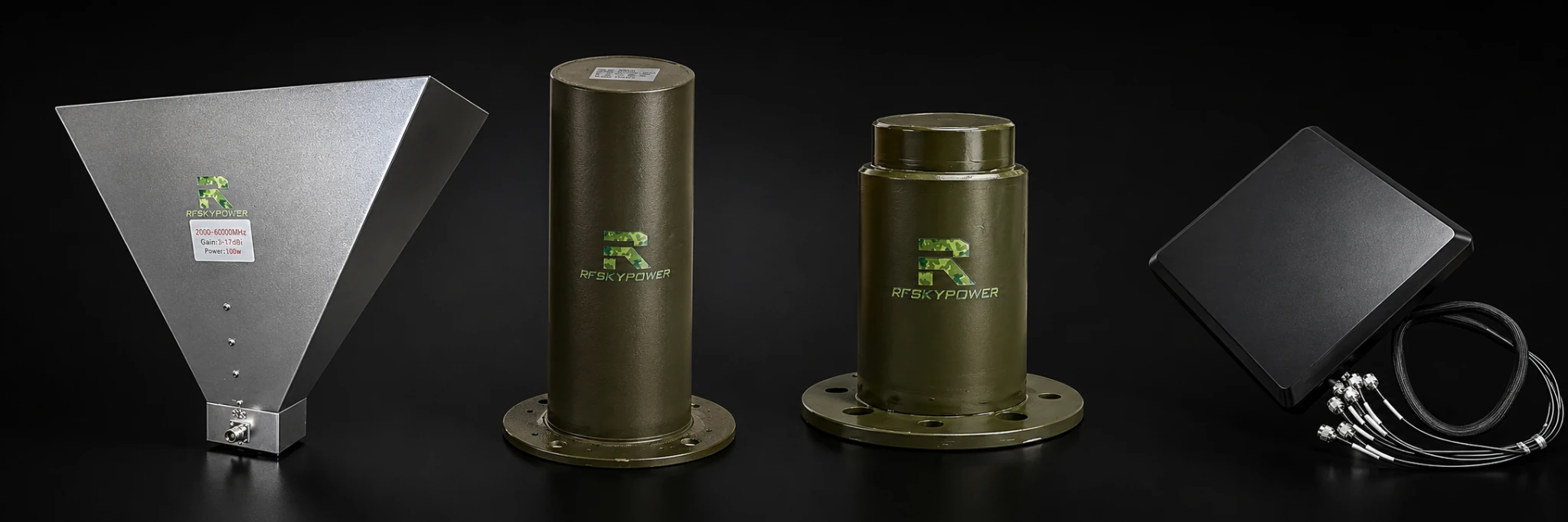
- antenna type;
- antenna mounting position;
- cable routing;
- waterproofed RF joints where relevant.
Not every project requires the same level of physical configuration detail.
The principle is that a later field team should be able to determine whether the RF path still matches the installation that was actually accepted.
The field-release record should separately identify the acceptance boundary attached to that physical configuration, including as applicable:
- required operating frequencies;
- operating-power condition;
- RF measurement reference plane;
- mismatch criterion;
- relevant evidence scope.
Physical configuration and acceptance boundary are related, but they are not the same thing.
A feeder replacement changes the physical path.
A change in the approved operating frequency, measurement reference plane, or mismatch criterion changes the acceptance boundary.
Either type of change can make an earlier release decision unsafe to reuse without review.
| Field-Failure Risk | Prevention Control | Required Evidence |
|---|---|---|
| An old test is reused after the physical RF path changes | Identify the approved installed configuration | Configuration record linked to applicable acceptance evidence |
| A mismatch result cannot be tied to a measurement location | Record the accepted reference plane | Test record identifying where the mismatch evidence applies |
| One operating point is treated as approval of the whole deployment | Record the approved frequencies and operating condition | Evidence covering the project-defined release points |
| Different installation revisions reuse one acceptance record | Link evidence to the relevant configuration revision | Configuration identity or equivalent traceability |
| A field modification occurs without reopening the affected acceptance item | Define change-review rules | Change record plus retest or confirmation appropriate to the affected boundary |
The key field question becomes:
Is this still the physical RF configuration and acceptance boundary that were previously approved?
If not, identify what changed before relying on the previous release result.
3. Which Installation Changes Reopen the VSWR Acceptance Boundary
A field change does not automatically require repeating every RF test.
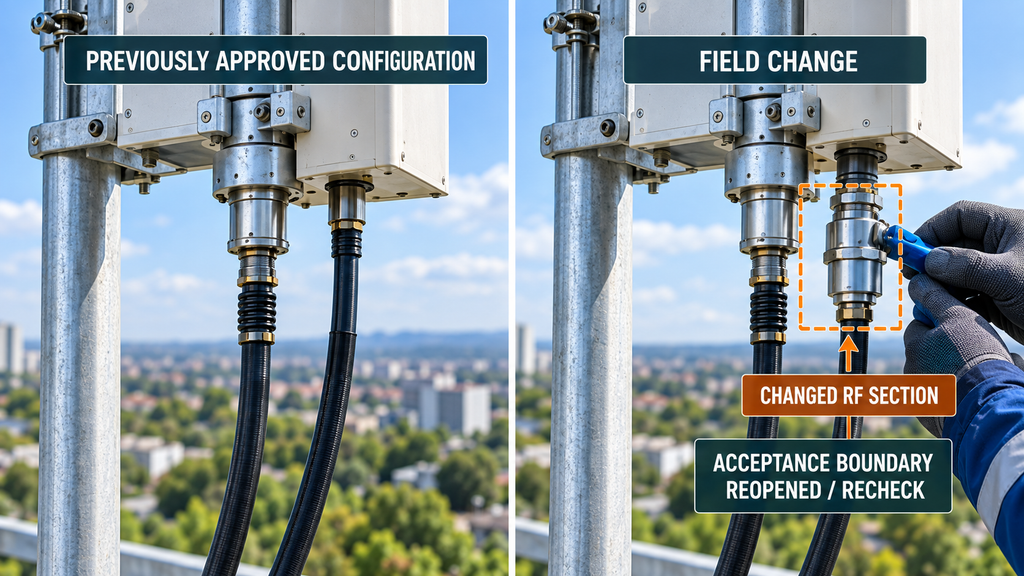
It should, however, reopen the relevant acceptance boundary when the change can alter impedance, RF loss, connection quality, mechanical loading, environmental exposure, or another condition that affects the load presented to the PA.
The correct decision is therefore not:
“Did something change?”
It is:
“Which accepted RF boundary can this change affect?”
| Change Category | Why Previous Evidence May No Longer Apply | Field-Release Action |
|---|---|---|
| RF-path component change | Impedance, insertion loss, or load transformation may differ from the approved path | Reopen the affected mismatch and operating-point boundary |
| Connector or termination work | Connection repeatability and local discontinuity may change | Recheck the affected RF section and applicable mismatch evidence |
| Antenna or mounting change | Terminal load and installation interaction may differ | Re-establish evidence for the affected installed-path condition |
| Routing or mechanical change | Cable stress, bend condition, or physical coupling may change | Review whether the accepted RF-path evidence still applies |
| Environmental repair | Moisture sealing, corrosion repair, or disturbed joints may change the RF path | Recheck the affected boundary before release |
| Measurement-boundary change | Reference plane or evaluation condition has changed | Do not compare directly with the previous result until the boundary is aligned |
This approach avoids two common mistakes.
The first is repeating an entire qualification program after every minor service action.
The second is assuming that no retest is necessary because the PA itself was not replaced.
The retest scope should follow the affected engineering boundary.
For example, connector re-termination may require renewed mismatch evidence for the affected RF section without requiring unrelated thermal or control tests to be repeated.
A change review should answer four questions:
What changed?
Which previously accepted boundary can that change affect?
Which earlier evidence may no longer be safe to reuse?
What confirmation or retest is required before release?
That sequence keeps field change control separate from broad RF power amplifier testing and avoids treating every modification as a reason to repeat the same test.
4. Define the Allowed Mismatch and System Response
Field release requires a defined mismatch boundary, but the current page does not need to reproduce a complete VSWR-protection qualification procedure.
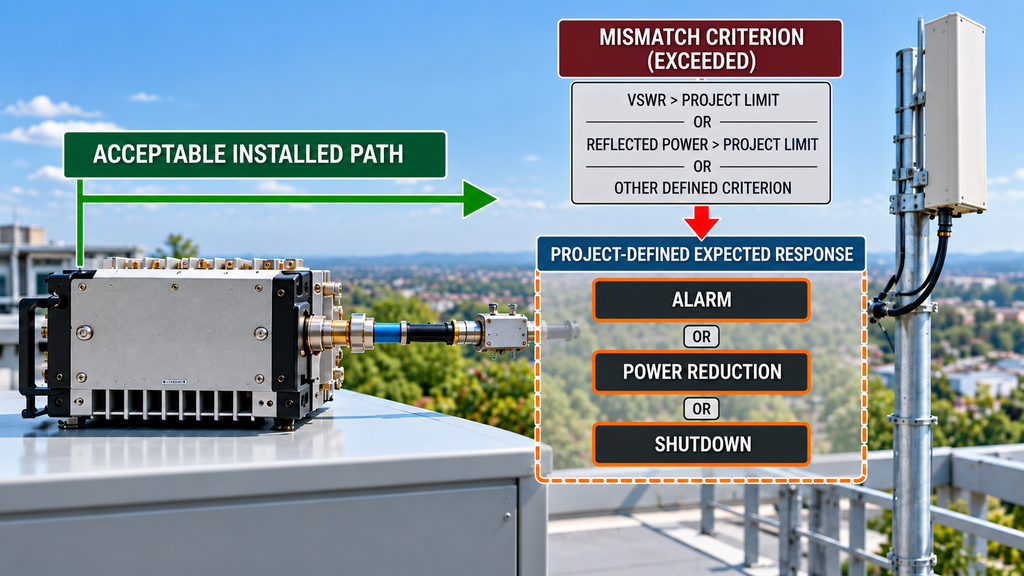
For deployment purposes, the project should know:
- which mismatch indicator is used for release;
- where that result is referenced;
- which frequencies and operating conditions it applies to;
- which boundary requires correction or engineering review;
- which system response is expected if that condition is exceeded.
The mismatch criterion may be expressed through VSWR, return loss, reflected power, or another project-defined measure.
The important point is that the criterion and its reference plane are known before the release decision.
Where RF power amplifier alarm monitoring is part of field release, its status should be treated as response evidence rather than proof that the installed RF path is acceptable.
A protection action can reduce the consequence of a mismatch, but it does not make an otherwise unacceptable antenna path acceptable.
Likewise, a protection event does not automatically prove hardware failure.
The field-release record should therefore distinguish:
acceptable installed-path condition
from:
expected system response outside that condition
from:
actual evidence of PA damage or malfunction.
Those are different engineering conclusions.
Where protection behavior is relevant to field release, verify the approved condition and expected system response against RF power amplifier load mismatch protection evidence rather than inferring performance from a generic “VSWR protected” statement.
5. Build the Field-Release Record
The final release package should show what was approved and what would cause that approval to be reopened.
It does not need to repeat every underlying integration test.
It should identify the boundaries that make the previous acceptance evidence reusable.

Configuration identity
Record the physical RF-path configuration represented by the release.
This may include the feeder, connectors, adapters, filters, lightning protection, antenna, mounting arrangement, and other components that materially define the accepted path.
Applicable operating points
Identify the frequencies and operating-power condition represented by the release decision.
Do not extend one tested point to other conditions without supporting evidence.
Measurement boundary
State where the mismatch evidence applies.
PA-port, feeder-end, and antenna-input results represent different reference planes.
Accepted mismatch condition
Record the project-defined VSWR, return-loss, reflected-power, or other mismatch criterion used for release.
Do not infer a universal safe limit when the project or product evidence does not provide one.
Expected system response
Where mismatch-related protection behavior is relevant, record the approved response boundary used by the deployment decision.
The response should not be treated as evidence that an otherwise unacceptable RF path is acceptable.
Evidence identity
Identify what hardware, installation revision, and evidence scope the release record represents.
Where unit-level traceability is required, link the evidence to the applicable unit. Where configuration-level or another evidence scope is sufficient, define that scope explicitly.
Change-review rule
Record which types of installed RF-path or acceptance-boundary changes require the previous release decision to be reopened.
The field team should then determine the required retest or confirmation from the affected boundary rather than applying one universal retest scope.
The final release question is:
Can the project identify the approved configuration, the applicable acceptance boundary, the supporting evidence, and the changes that would require that evidence to be reconsidered?
If not, the installation is not yet under effective VSWR field-failure prevention control.
6. Who Owns Each Control Before RFQ and Deployment
VSWR-related deployment risk often crosses organizational boundaries.
The PA supplier may define module-level behavior. The integrator controls how the module is connected into the system. The installation team can change the physical path in the field. The buyer or project owner defines what evidence is required for release.

These responsibilities should be explicit.
| Role | Field-Failure Prevention Responsibility |
|---|---|
| PA supplier | Define the applicable module evidence and conditions attached to relevant mismatch or protection claims |
| System integrator | Define the installed RF-path configuration and the field boundary that must be accepted |
| Installation team | Preserve the approved installed RF-path configuration and document field changes that can affect it |
| Buyer / project owner | Define release criteria, evidence scope, change-review requirements, and required retest decisions |
One organization may perform several of these roles.
The important requirement is that responsibility does not disappear between them.
Before RFQ or final deployment planning, the project should therefore define:
- required operating frequencies;
- target operating-power condition;
- intended antenna and feeder configuration;
- relevant connectors and RF-path components;
- mismatch criterion and reference plane;
- required system-response information;
- field evidence scope;
- configuration identity;
- change categories that reopen the acceptance boundary.
These inputs create a stronger engineering handoff than a generic request for “good VSWR” or “VSWR protection.”
They also reduce a common field problem: one party assumes the PA supplier approved the complete antenna installation while another assumes the integrator verified the PA against every possible field mismatch.
Neither assumption should replace a defined acceptance boundary.
FAQ
Does a dummy-load pass prevent VSWR field failure?
No. It can support the PA baseline under a controlled load, but it does not permanently approve the final feeder, connector, antenna, or other installed RF-path configuration.
Does a protection shutdown mean the RF PA has failed?
Not necessarily. Shutdown can be an expected protection response to a defined mismatch or fault condition. The installed-path condition and applicable protection boundary should be checked before concluding that the PA hardware failed.
When should the installed RF path be retested?
A change should reopen the affected acceptance boundary when it can alter the load, RF path, or measurement boundary represented by the previous release. The required retest or confirmation scope should then match the affected engineering path.
Does VSWR protection make a mismatched antenna path acceptable?
No. Protection can manage the PA response to a mismatch, but it does not convert an unacceptable installed RF path into an acceptable one.
What should be recorded before field release?
Record the approved physical RF-path configuration, applicable frequencies and operating condition, mismatch criterion, measurement reference plane, supporting evidence scope, expected system response where relevant, and the change-review rules that govern future modifications.
Conclusion
RF PA VSWR field failures are best prevented by controlling the relationship between the approved installed RF path, the acceptance boundary attached to it, and any later field change.
A dummy-load pass remains useful evidence, but it does not permanently approve every later feeder, connector, antenna, adapter, or mounting configuration. A protection event can also be an expected system response rather than proof of hardware failure.
When the installed RF path changes, reopen the acceptance boundary that the change can affect. Then determine the necessary confirmation or retest from that engineering boundary instead of automatically repeating every test or automatically reusing the old result.
The final field-release question is simple:
Is the system still represented by the physical RF configuration, measurement boundary, operating condition, and evidence that were actually approved?
If not, identify the affected boundary and obtain the evidence needed to support the new release decision.
For an RFQ or engineering review of Custom RF Power Amplifier Modules, provide the target frequencies, operating-power condition, intended feeder and antenna configuration, relevant connectors and RF-path components, mismatch criterion and reference plane, required system-response information, configuration-change rules, and required evidence scope. These inputs support a clearer deployment review without assuming that a standard module, a previous bench result, or a generic protection claim automatically proves the final field installation.