

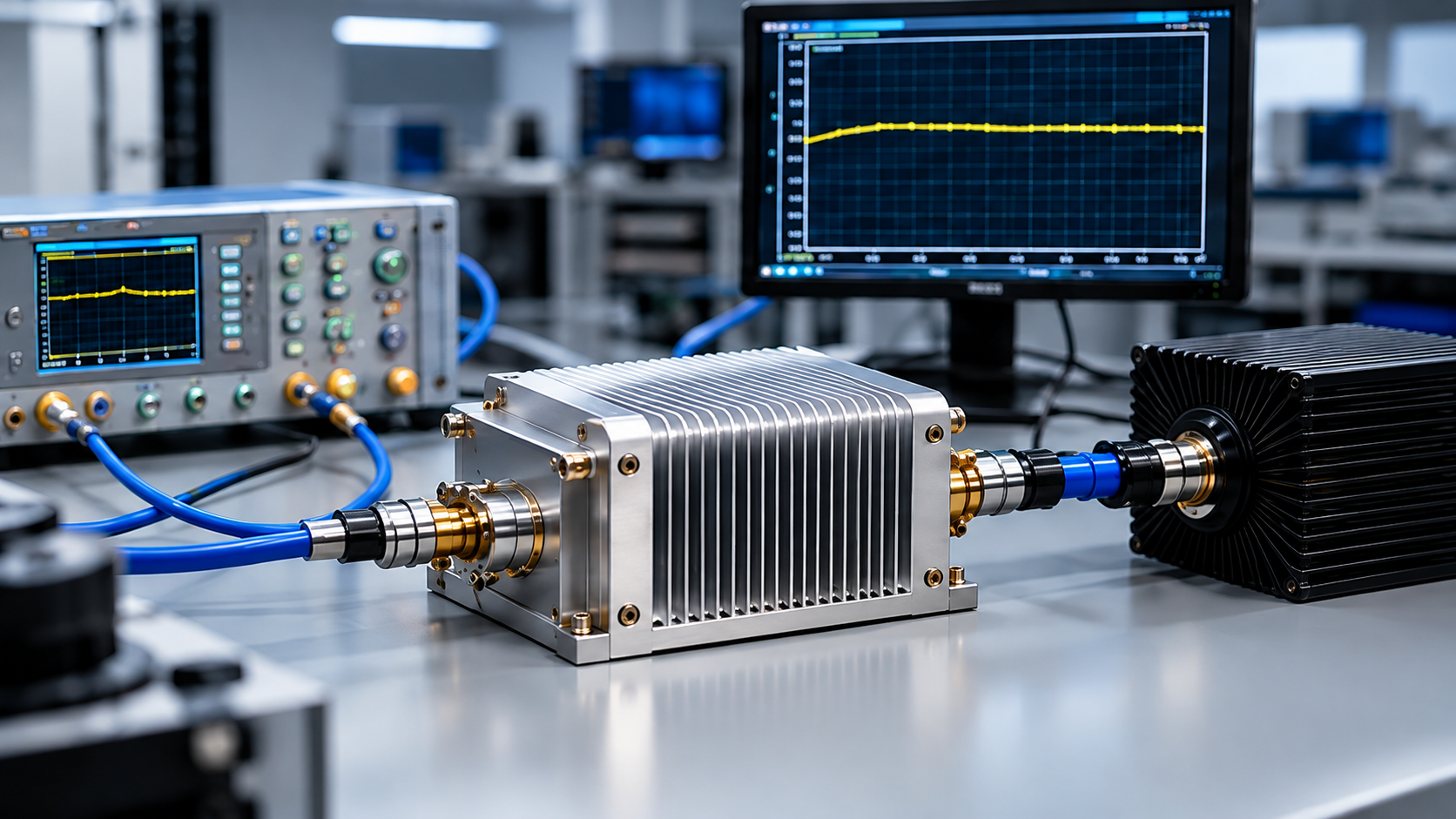
RF power amplifier gain flatness should be checked from a comparable set of gain measurements across the frequency points that matter to the project—not from one center-frequency number or an unqualified “flat” curve.
For operating-power measurements, determine gain from actual input power and corrected output power at defined RF PA reference planes. Then calculate the gain variation across the approved frequency set using the same reporting method that will be used in the RFQ.
The result is only meaningful when the compared data represents a sufficiently consistent measurement condition. A small-signal S21 sweep, an operating-power gain sweep, cold-state data, hot-state data, PA-port measurements, and installed RF-path results should not be treated as interchangeable evidence.
Before asking whether a curve is flat enough, first ask:
Are the measurements comparable enough to support that decision?
1. What RF PA Gain Flatness Means Under a Defined Test Condition
RF PA gain flatness describes how much amplifier gain changes across a defined set of frequencies under a defined measurement condition.
For operating-power data, gain at frequency can be expressed as:
G(f) = Pout(f) − Pin(f)
when Pin and Pout are expressed in dBm and refer to the intended RF PA input and output reference planes.
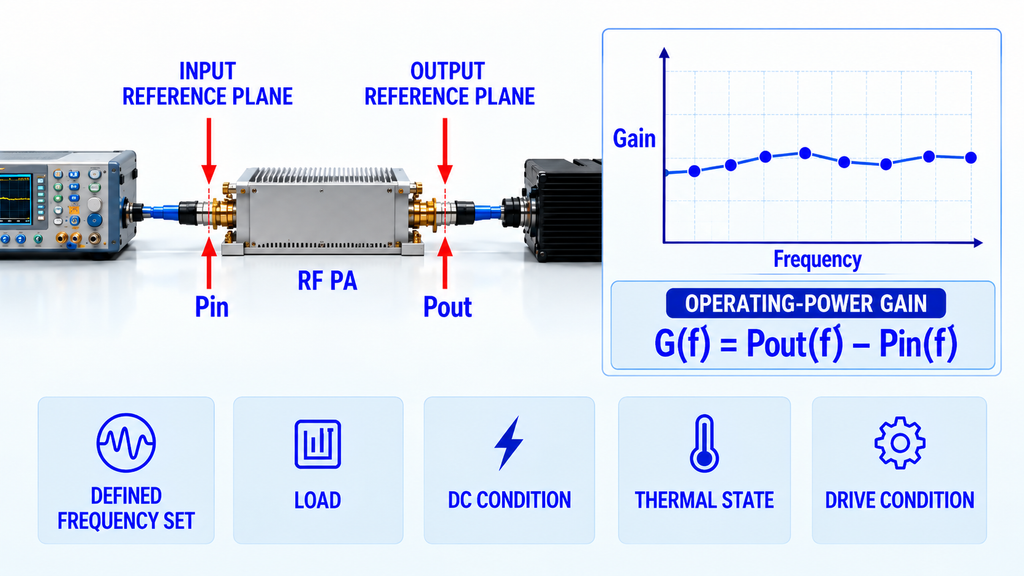
The calculation is simple. The measurement boundary is what gives the result engineering meaning.
A useful gain-flatness dataset should make clear:
- which frequency points were measured;
- whether the result is small-signal or operating-power gain;
- how input power was defined or measured;
- where output power was referenced;
- what cable, fixture, attenuator, or path corrections were applied;
- the relevant waveform or drive condition;
- DC supply condition;
- load condition;
- thermal state;
- the flatness reporting method and acceptance limit.
These conditions matter because gain can change with operating state.
A PA measured well below compression may not show the same gain behavior as the same PA operating close to its intended output level. A small-signal S21 sweep can characterize frequency response, but it does not automatically prove operating-power gain flatness.
Reference planes also matter. If one dataset reports power at the PA output connector while another includes external cable or fixture loss, the curves should not be compared until the measurement boundary and corrections are understood.
Gain flatness therefore proves a limited but useful result:
how much measured gain varies across the approved frequency set under the stated test condition.
It does not by itself prove output-power flatness, hot-state stability, installed antenna performance, batch consistency, or final system acceptance.
2. How to Calculate RF PA Gain Flatness from a Comparable Sweep
Once the frequency points and measurement condition are defined, the flatness calculation is straightforward.
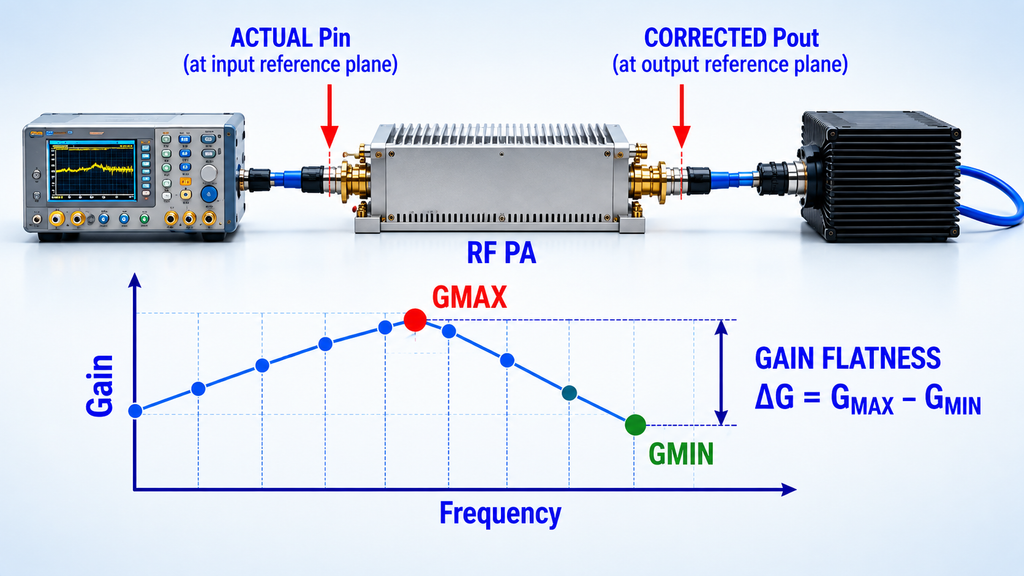
Step 1: Use the approved frequency set
Calculate flatness from the frequencies that actually belong to the RFQ or engineering review.
Do not substitute a convenient supplier sweep if it omits project-critical points.
Step 2: Confirm that the sweep represents one comparable condition
Before combining the gain values into one flatness result, confirm that no material change in gain method, actual Pin, reference planes, correction basis, load, or relevant operating state makes the points non-comparable.
If a material condition changes, resolve that difference before treating the data as one valid sweep.
Step 3: Determine gain at each frequency
For operating-power measurements:
Gain in dB = Pout in dBm − actual Pin in dBm
Actual Pin matters.
A source setting is not always identical to the RF power reaching the defined PA input reference plane. Frequency-dependent input-path loss or deliberate drive adjustment can create an apparent gain trend if actual Pin is not known.
Consider a model-neutral example with comparable gain values of:
- 49.6 dB;
- 50.2 dB;
- 49.1 dB.
If the RFQ defines gain flatness as the maximum-to-minimum variation across those points:
Gain flatness = Gmax − Gmin
= 50.2 dB − 49.1 dB
= 1.1 dB peak-to-peak
This example only illustrates the calculation. It is not an RF SKYPOWER product specification or a recommended acceptance limit.
Step 4: Apply the RFQ reporting convention
Gain flatness can be reported in different ways, including:
- maximum-to-minimum variation;
- deviation around a defined nominal gain;
- deviation relative to a reference frequency;
- another project-specific convention.
These formats are not automatically equivalent.
A result reported as 1.0 dB peak-to-peak does not mean the same thing as ±1.0 dB around a specified nominal value.
The RFQ should therefore define both:
how gain flatness is calculated and what limit will be used for acceptance or engineering review.
3. Define the Frequency Points Before You Judge Flatness
A gain-flatness result is only useful inside the frequency window the project actually needs.
Before requesting “wideband gain flatness,” confirm the project’s RF amplifier frequency range selection and define any frequency points that can change the decision.
These may include the lower and upper band edges, center-region points, and specific frequencies that are operationally important.
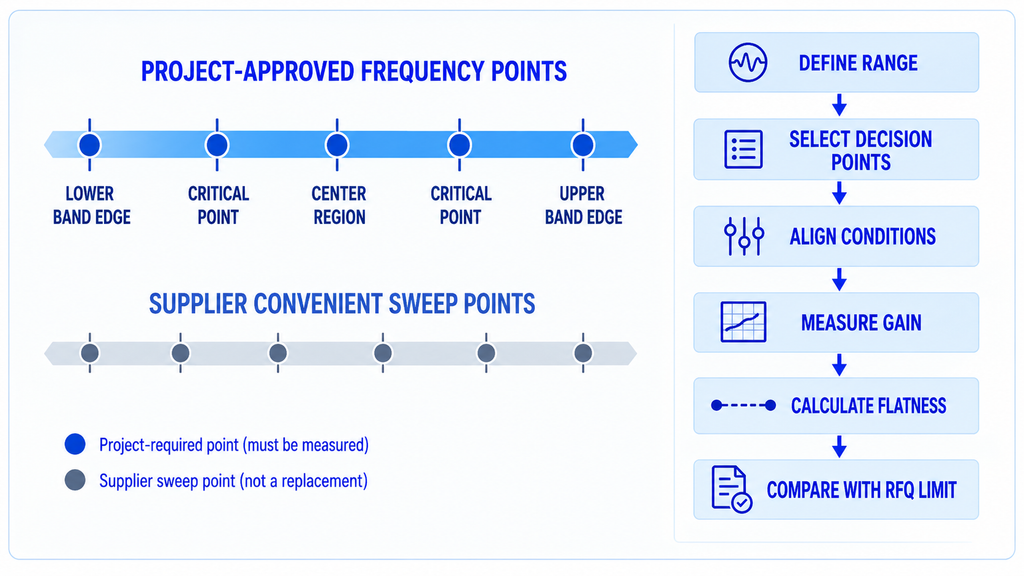
The principle is simple:
the required measurement points should come from the application requirement, not from whichever supplier graph happens to be available.
A practical sequence is:
- define the operating frequency range;
- identify the points that matter to the decision;
- align the measurement condition;
- obtain comparable gain data;
- calculate the required flatness metric;
- compare the result with the RFQ limit.
Frequency coverage and gain flatness are related but separate decisions.
A PA may nominally cover the required band while still showing unacceptable gain variation inside that band. A smooth curve over a wider range also does not prove performance at project-critical points that were never measured.
4. Check Whether Supplier Sweep Data Is Actually Comparable
One of the easiest RFQ mistakes is comparing curve shape before checking how each curve was produced.
Two technically valid datasets can still be unsuitable for direct comparison.
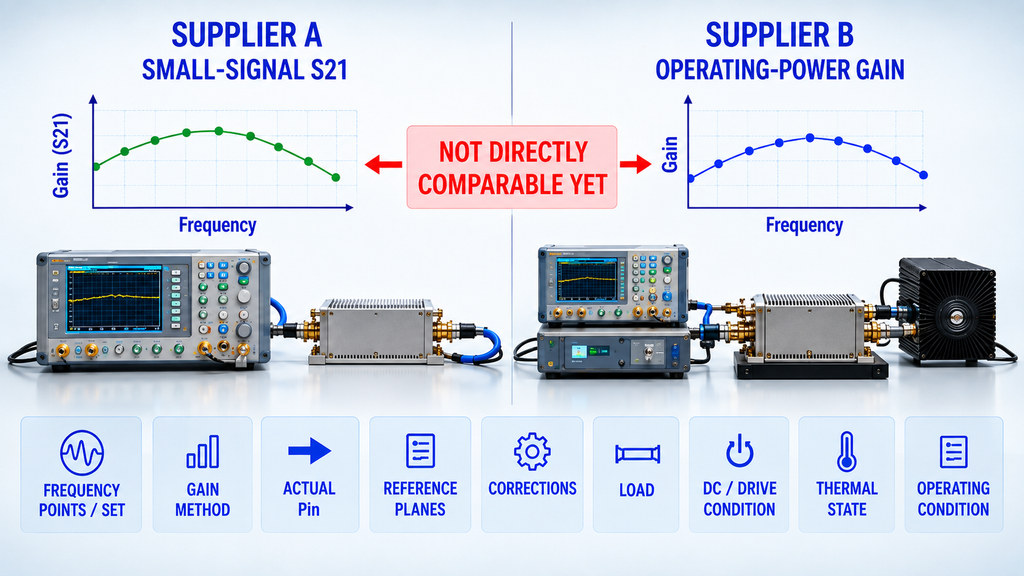
Small-signal and operating-power gain answer different questions
A VNA-based small-signal S21 sweep can be useful for frequency-response characterization.
Operating-power gain is measured under a different RF condition and may be affected by compression, drive level, DC behavior, or thermal state.
If one supplier provides small-signal S21 while another provides gain calculated from operating Pin and Pout, do not rank the two curves as though they represent the same measurement.
Actual input power must be understood
If a test system changes drive power with frequency to maintain a target output, the resulting output curve may be useful for another purpose, but it does not directly show natural gain variation.
Actual Pin is required if operating-power gain is to be calculated.
Similarly, a nominal generator setting should not automatically be assumed to equal the power delivered to the defined PA input reference plane.
Thermal state can change the result
A cold sweep and a thermally stabilized sweep represent different operating states.
Neither is automatically invalid. The issue is whether the state matches the engineering question.
If one supplier presents immediate cold-start data and another presents stabilized operating data, a difference between the curves may partly reflect test state rather than product-to-product gain-flatness performance.
Load and reference planes must remain clear
Module-level gain flatness should be evaluated against a defined load and clearly stated PA input/output reference planes.
External cables, filters, combiners, connectors, and mismatch can change power elsewhere in the RF path. Those effects may matter to the system, but they should not be silently folded into a module-level gain comparison.
If the frequency points, gain method, actual Pin, reference planes, correction method, load, or relevant thermal state are materially undefined or inconsistent, the curves are not directly comparable yet.
Request the missing conditions before using them for supplier ranking or pass/fail approval.
5. What Gain Flatness Does Not Prove by Itself
Gain flatness is one layer of RF PA evidence. It should not be extended beyond the scope of the measurement.
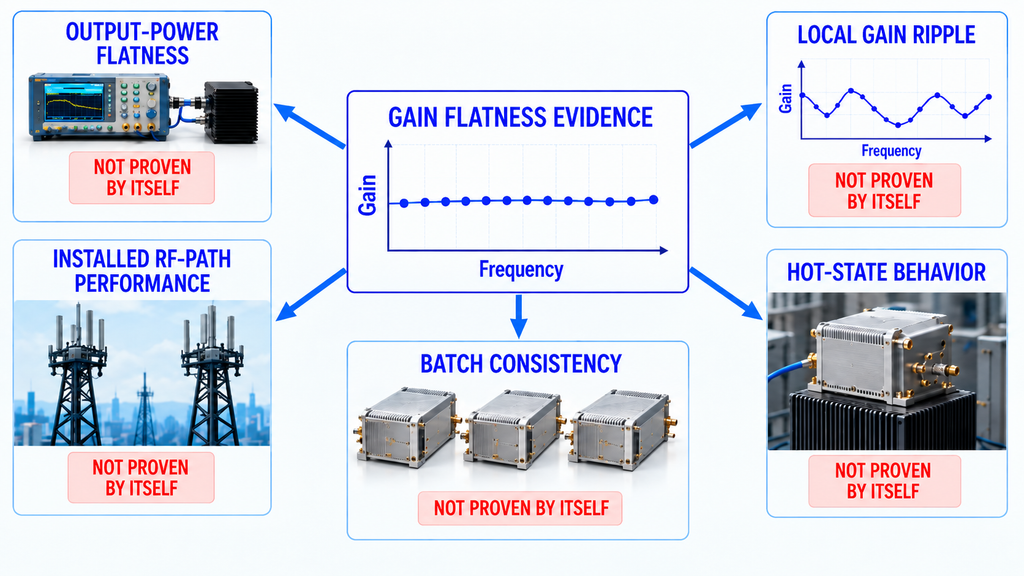
Gain flatness is not output-power flatness
Gain describes the relationship between input and output.
Output-power flatness describes how RF output itself changes across frequency.
The two can be related, but compression, available drive, DC behavior, thermal effects, or protection margin can cause output power to change even when gain remains relatively consistent.
Broad flatness is not the same as local gain ripple
A peak-to-peak flatness number summarizes variation across a frequency set.
It does not show exactly where a local peak or dip occurs. If a narrow weak point or critical frequency can change system performance, examine RF PA gain ripple separately from broad gain flatness.Module gain does not prove antenna-end performance
A result measured at defined PA reference planes describes module behavior under that test boundary.
It does not automatically prove the power available after external RF-path losses, filters, connectors, combiners, feeders, or mismatch are included.
One unit does not prove batch consistency
A gain-flatness curve only supports the sample, specific unit, or other scope represented by the evidence.
It should not automatically be generalized to an entire production batch or repeat delivery.
Room-temperature data does not prove hot-state behavior
Cold-state or room-temperature data can be useful characterization evidence.
It should not be treated as proof of thermally stabilized gain behavior when temperature can change the project decision.
6. When Warm-State or Full-Power Evidence Becomes Necessary
Not every gain-flatness review requires a full thermal or full-power qualification exercise.
Additional evidence is appropriate when the intended operating state can materially change the gain conclusion.
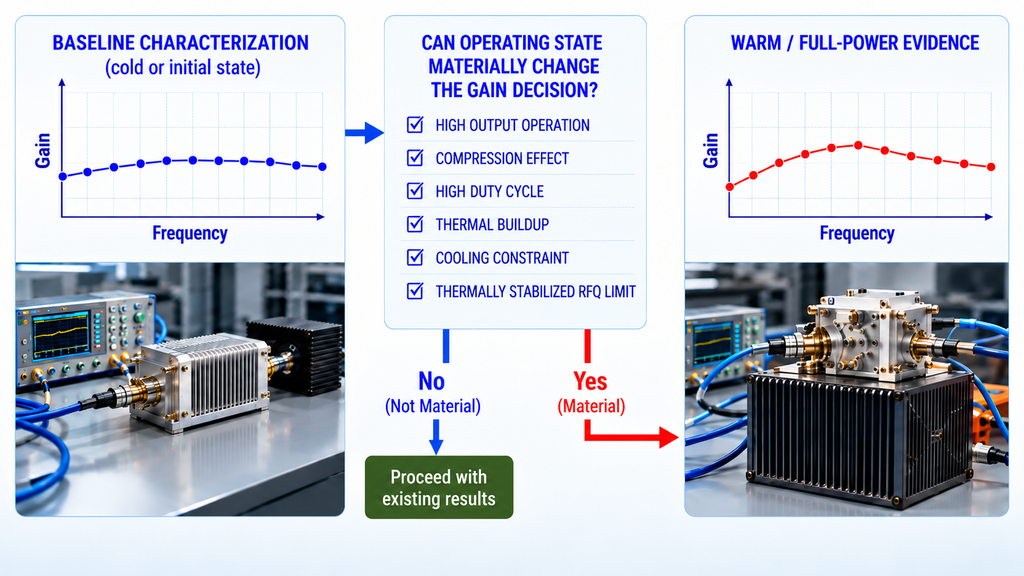
Typical triggers include:
- operation near the intended high-output level;
- compression affecting the gain result;
- high duty cycle or continuous operation;
- substantial thermal buildup;
- cooling conditions that affect PA temperature;
- an RFQ limit that explicitly applies after thermal stabilization;
- weak frequency points where output behavior is part of the approval decision.
In these cases, a cold small-signal curve may still be useful baseline characterization, but it should not be used as the only evidence for a hot or high-power operating decision.
If full-power behavior can change the approval result, evaluate it with a swept-frequency full-power RF PA test rather than extending the flatness result beyond its measured state.
If thermal stabilization can change the gain conclusion, document the relevant thermal conditions and request hot-state RF PA gain evidence under a defined stabilized operating state.
For the gain-flatness RFQ itself, the key requirement is simply to define the operating state under which the flatness result must remain valid.
7. What Gain-Flatness Evidence Buyers Should Request
A useful supplier graph is not only visually smooth. Its measurement boundary must be clear enough to support the intended decision.
| Buyer Requirement | Required Evidence | Required Condition | Evidence Scope | Decision Use |
|---|---|---|---|---|
| Required frequency coverage | Gain values at the approved frequency points | Same defined sweep scope | Characterization sample, specific S/N, or defined batch scope | Confirms that project-relevant frequencies were measured |
| Gain calculation | Pin and Pout data, or a clearly defined gain-measurement method | Defined input/output reference planes and correction basis | Same hardware and dataset under review | Shows how each gain value was obtained |
| Gain-flatness result | Calculated peak-to-peak variation or another RFQ-defined metric | Same reporting convention across the comparison | Same dataset | Supports comparison with the specified flatness boundary |
| Operating condition | Gain data with relevant drive, waveform, Vdc, load, and thermal state identified | Conditions aligned with the intended decision | Stated test scope | Determines whether the curve applies to the RFQ |
| Output cross-check | Output trend at required frequency points when operating-power approval depends on it | Same or clearly related operating condition | Stated sample or unit | Prevents acceptable gain from being mistaken for acceptable output |
| Acceptance traceability | Report identity and required unit or batch traceability | Scope defined by the purchase and acceptance plan | Characterization sample, specific S/N, or defined batch | Shows what hardware the evidence can legitimately represent |
Evidence scope is especially important.
A typical characterization curve can be useful during early supplier evaluation. It is not automatically equivalent to a test record for hardware that will actually be shipped.
Likewise, data from one measured unit does not prove batch behavior unless the acceptance plan explicitly defines how that evidence applies to the batch.
If shipment approval requires unit-level evidence, verify the RF PA test report against the delivered S/N and recorded test condition. If a defined batch or sampling plan is sufficient, state that scope instead.
The evidence request should match the decision being made.
For C-UAS shipment-release decisions, connect gain-flatness evidence to the C-UAS RF PA acceptance checklist so per-unit, batch-level, configuration-level, and project-level evidence remain separated.
8. Build an RFQ Requirement That Two Suppliers Can Answer the Same Way
“Good gain flatness” is not a usable RFQ requirement.
A supplier should be able to understand what will be measured, under which condition, and how the result will be judged.
| RFQ Item | What the Buyer Should Define | Why It Changes the Decision |
|---|---|---|
| Frequency set | Exact operating range and required target points | Prevents a smooth curve from being shown over the wrong frequencies |
| Gain method | Small-signal S21 or operating-power gain | Prevents unlike measurements from being ranked together |
| Flatness format | Peak-to-peak, deviation from nominal, reference-frequency method, or another defined convention | Makes results interpretable on the same basis |
| Flatness limit | Project acceptance or engineering-review boundary | Defines pass, review, or evidence-gap status |
| Input condition | Actual or controlled Pin basis | Makes operating-power gain calculations comparable |
| Reference planes | Where Pin and Pout are defined and which corrections are applied | Prevents fixture or cable loss from becoming hidden gain error |
| Load condition | Defined test load and any mismatch condition relevant to the decision | Separates module evidence from installed-path effects |
| Thermal state | Cold, stabilized room-temperature, or defined hot-state condition | Prevents thermal-state differences from being mistaken for product differences |
| Operating condition | Waveform, duty condition, output target, and Vdc where relevant | Connects the gain result to the intended use |
| Evidence scope | Characterization sample, specific delivered unit, or defined batch | Prevents evidence from being generalized beyond what was tested |
Before releasing an RFQ, ask:
If two suppliers returned data tomorrow, would these definitions allow their gain-flatness results to be compared without guessing how either curve was produced?
If not, the requirement still contains an evidence gap.
Do not force a supplier ranking or pass/fail decision when a missing test condition could materially change the result. Request the missing information or repeat the comparison under aligned conditions before applying the flatness limit.
For broadband or multi-band projects, use the Wideband RF Power Amplifier Modules page as an initial discovery path once the required frequency range and evidence boundary are defined.
Product-family availability does not, by itself, prove that a specific module meets the project’s gain-flatness, output-power, thermal, load, or acceptance requirements.
If a standard family does not align with the required frequency or evidence conditions, define the unresolved engineering inputs before moving into a custom RF power amplifier module engineering review.
FAQ
Is gain flatness the same as output-power flatness?
No. Gain flatness describes how gain changes across frequency under a defined condition. Output-power flatness describes how RF output power changes. One should not be used as automatic proof of the other.
Is gain flatness the same as gain tolerance?
No. Gain flatness normally describes variation across frequency for a defined measurement set. Gain tolerance may instead define allowed deviation from nominal, unit-to-unit variation, batch variation, or another acceptance boundary.
Can gain-flatness curves from two suppliers be compared directly?
Only when their frequency points, gain method, Pin basis, reference planes, corrections, load, thermal state, and reporting convention are sufficiently aligned for the intended decision.
When is warm-state gain-flatness evidence needed?
When thermal stabilization can materially change the RFQ decision, especially during sustained, high-duty, high-output, or thermally constrained operation.
Conclusion
RF PA gain flatness should be evaluated from comparable gain measurements across the project-approved frequency points under a clearly defined measurement condition.
For operating-power data, verify actual Pin and the input/output reference planes, determine gain at each frequency, calculate flatness using the RFQ-defined method, and compare the result with the stated engineering or acceptance boundary.
Do not treat small-signal, cold-state, hot-state, PA-port, and installed RF-path measurements as interchangeable when those differences can change the decision.
A smooth-looking gain curve is therefore not an automatic supplier pass.
Before comparing RF PA suppliers, align the frequency set, gain method, Pin/Pout reference planes, reporting format, load, thermal state, operating condition, and evidence scope. If one of those items is missing and could materially affect the result, request the missing evidence before approving the module.
For an RFQ review with RF SKYPOWER, provide the target frequency points, required gain-flatness limit and reporting format, available Pin, output reference plane, load condition, relevant waveform or duty condition, thermal-state requirement, target operating output, and required report or traceability scope. These inputs provide a clearer basis for deciding whether a standard wideband RF PA family is worth reviewing or whether the project requires a custom engineering discussion.