


To check RF PA feeder cable loss before acceptance, compare RF power at two defined reference planes under sufficiently comparable operating conditions, then calculate the path drop only after the measurement corrections and mismatch state are understood. A low antenna-end reading by itself does not prove weak RF PA output.
The acceptance question is whether the measured difference is consistent with the documented installed path, indicates an abnormal path condition, or cannot yet be attributed because the measurement boundary is incomplete. Cable-grade selection, RF power-margin sizing, test-path compensation, and detailed mismatch troubleshooting are related decisions, but they should not be mixed into the feeder-loss result.
1. What RF PA Feeder Cable Loss Actually Measures
RF PA feeder cable loss is the RF power lost between a defined PA-side reference plane and a defined downstream point in the installed RF path.
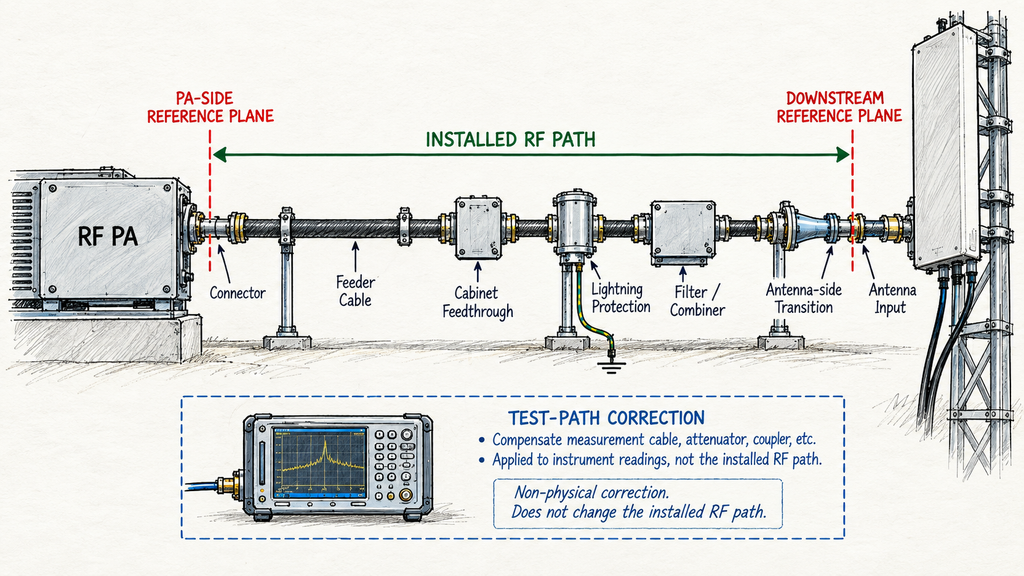
Depending on the installation, that path can include:
- feeder cable;
- connectors;
- adapters or transitions;
- cabinet feedthroughs;
- lightning-protection devices;
- filters or combiners;
- antenna-side transitions.
This loss is different from weak PA output. A module can meet its required output at the PA port while a lower value is measured farther downstream because the installed path consumes part of the available RF power.
It is also different from test-path correction. A correction applied to a measurement cable, attenuator, coupler, or sampled test chain is intended to translate a raw instrument reading to a declared reference plane. Installed feeder loss belongs to the real RF delivery path.
If the acceptance concern is whether the reported Pout was corrected properly, verify the test cable loss compensation separately before assigning the remaining difference to the installed feeder.
The first acceptance rule is therefore:
Do not call a power difference “feeder loss” until both reference planes, the included RF path, and the measurement state are known.
2. Define the PA-Port and Antenna-End Reference Planes
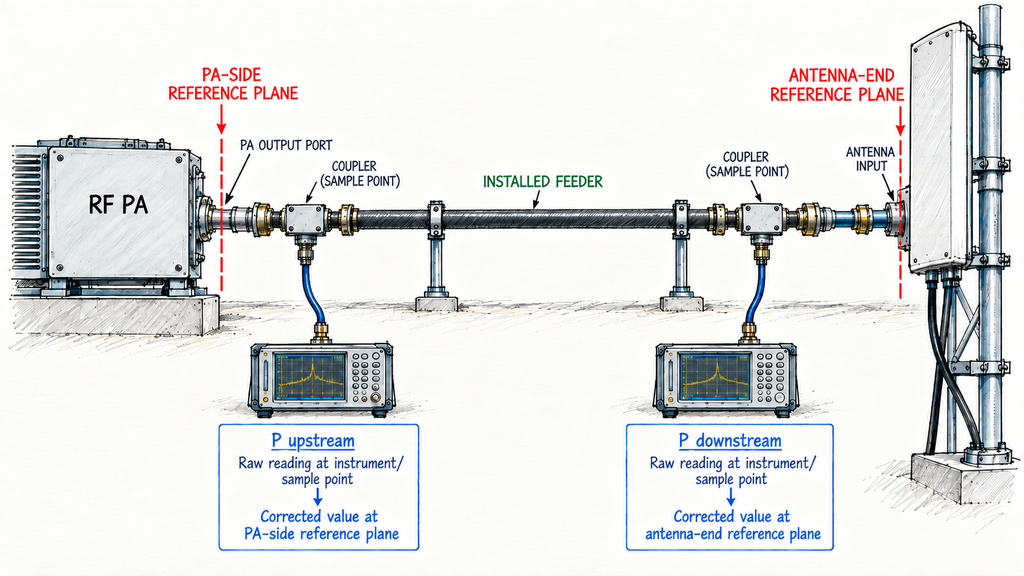
PA-port power and antenna-end power describe different physical locations. They can be compared only when the path between those locations is defined and the measurements represent sufficiently comparable operating conditions.
| Measurement Point | What It Can Show | What It Cannot Prove by Itself |
|---|---|---|
| PA output port | RF power delivered by the PA at the declared output reference plane under the stated test condition | Power available after the installed feeder path |
| After a short reference path | Delivery through a known local measurement path | Loss through the complete installed feeder |
| Installed feeder end | Power remaining after the defined feeder path | Antenna match or the exact cause of an abnormal result |
| Antenna input | RF power delivered to the antenna-side reference plane | That any shortfall was caused by the PA alone |
A report should state both where the instrument measured and what reference plane the reported value represents.
Raw readings and corrected values should also remain separate. If a correction is applied, the record should identify the correction basis and the reference plane represented by the corrected result.
For example, a factory PA-port result and a field antenna-input result can both be technically valid while still being unsuitable for direct subtraction if the frequency, drive, DC state, thermal state, correction method, load condition, or included RF path differs.
If the real decision is whether enough system margin remains after feeder and connector loss, treat that as a separate sizing problem and review the RF power margin after feeder loss rather than increasing PA wattage from one downstream reading.
3. How to Measure Installed Feeder Loss Under Comparable Conditions
A useful feeder-loss check starts with a defined upstream baseline and then measures the downstream result without silently changing the conditions that affect RF output.
A practical sequence is:
- Define the test frequency.
Use the same applicable frequency for the upstream and downstream comparison. For multi-band systems, do not assume one spot result represents the complete operating range. - Define the upstream reference plane.
State exactly where the PA-side Pout applies and whether the value is raw or corrected. - Establish the PA-side baseline.
Record the applicable RF input or drive rule, Vdc, Idc, load condition, and relevant thermal state. - Define the downstream reference plane.
State whether the second result represents the feeder end, cabinet output, or antenna input. - Document the installed path between the two planes.
Record cable type and length plus the connectors, adapters, feedthroughs, protection devices, filters, combiners, or other transitions actually included. - Measure the downstream power.
Keep the relevant frequency, drive rule, DC condition, operating state, and measurement definition sufficiently comparable to the upstream result. - Preserve raw and corrected values separately.
If a correction is used, record its value or method, frequency applicability, and represented reference plane. - Calculate the measured path drop.
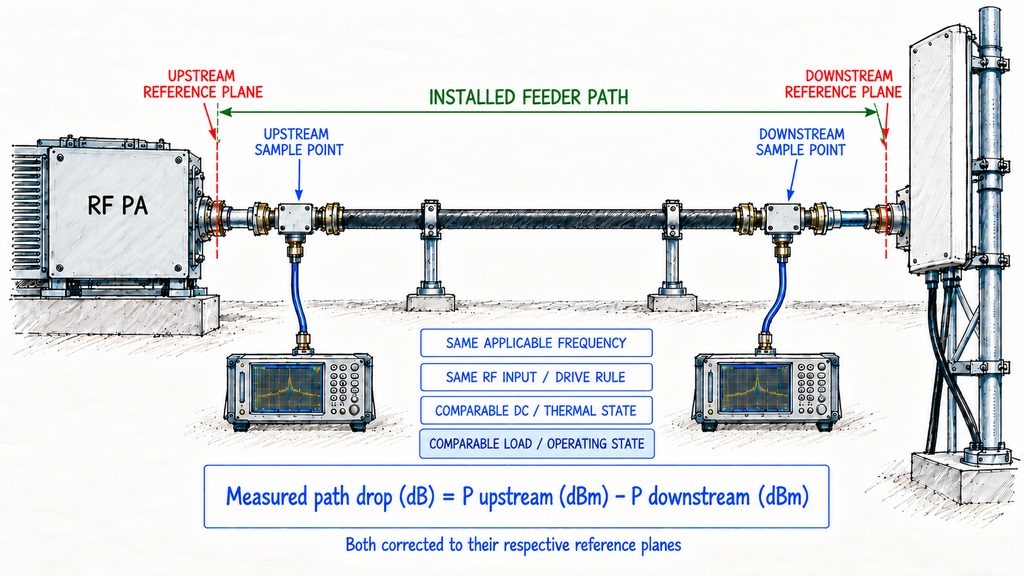
For two power readings expressed in dBm:
Measured path drop (dB) = P upstream (dBm) − P downstream (dBm)
If both readings are expressed in watts:
Measured path drop (dB) = 10 log10(P upstream / P downstream)
These equations calculate the scalar power difference between the two declared readings. That difference should be treated as installed-path loss only when the measurement boundaries, correction state, operating conditions, and mismatch state support that interpretation.
A scalar power difference is not automatically equivalent to a calibrated insertion-loss measurement when mismatch materially affects the measurement.
- Compare the result with the applicable path expectation.
Use cable and passive-component data that apply to the actual frequency and installed configuration, or the project-defined path-loss allowance. Do not substitute a generic “typical cable loss” for the documented path. - Check mismatch indicators before assigning the full drop to path loss.
A material change in reflected power, VSWR, protection state, or load behavior changes what the power difference can prove. - Classify the evidence before making the acceptance decision.
The result may support normal installed-path loss, abnormal path loss, non-comparable evidence, or a return to the PA-side test.
Cable length, frequency, connector count, and installation condition all affect the path. If cable construction is still a design-selection question rather than an installed-path acceptance question, route that decision to RF PA cable grade selection.
4. When the Difference Is Path Loss, Mismatch, or Non-Comparable Evidence
The numerical power difference is only one part of the acceptance decision. The team must also decide whether the difference can legitimately be attributed to the installed path.
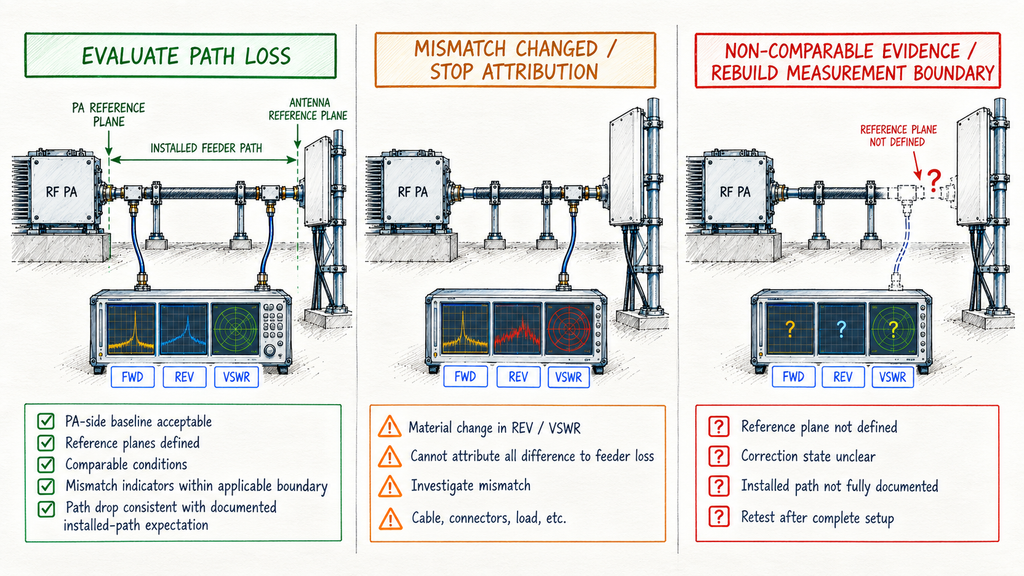
| Observation | What the Evidence Supports | What It Does Not Prove | Next Action |
|---|---|---|---|
| PA-side baseline is acceptable; upstream and downstream planes are defined; conditions are comparable; mismatch indicators remain within the applicable boundary | The measured drop can be evaluated against the installed-path loss expectation | Which individual cable, connector, or transition caused any excess loss | Compare measured drop with the documented path expectation |
| Downstream power is low, but the reference plane, raw/corrected state, path inventory, or operating condition is incomplete | The evidence is not yet comparable | Feeder failure, PA failure, or final acceptance | Stop and rebuild the measurement boundary |
| Downstream power is low and reflected-power or VSWR behavior changes materially after the installed path is connected | The installed path or load condition requires further investigation | That the complete power difference is pure insertion loss | Stop feeder-loss attribution and isolate the mismatch condition |
| PA-port output is below its applicable requirement under a valid PA-side test boundary | Feeder loss cannot explain the entire shortfall | That the installed path is the only problem | Return to the PA-side acceptance test |
| Measured path drop is higher than the applicable documented expectation under sufficiently comparable conditions | An abnormal installed-path condition is plausible | The specific root cause from the power difference alone | Isolate the relevant cable, connector, adapter, or other passive path element |
The most important Decision Stop is therefore not a universal dB threshold.
Stop the feeder-loss conclusion when the reference plane is unclear, raw and corrected values cannot be reconstructed, relevant operating conditions are not sufficiently comparable, the installed path is unknown, or mismatch materially changes the interpretation.
A controlled dummy-load result can establish a useful PA baseline, but it does not prove the complete installed RF path. The dummy-load and real-antenna chain check covers that broader boundary.
5. What Data the Acceptance Record Must Preserve
For an acceptance decision, a final wattage value is not enough. The record should connect each buyer requirement with the evidence, test condition, evidence scope, and decision it supports.
| Buyer Requirement | Required Evidence | Required Condition | Evidence Scope | Decision Use |
|---|---|---|---|---|
| Establish a valid PA-side baseline | Frequency, RF input or drive rule, PA-port Pout, Vdc, Idc, load condition, relevant thermal state, and raw/corrected status | Defined PA-side reference plane and applicable operating condition | Tested PA or delivered unit when unit-level acceptance requires it | Determine whether downstream analysis begins from a valid PA baseline |
| Quantify the installed path drop | Upstream and downstream power readings, both reference planes, raw/corrected state, and calculation basis | Same applicable frequency and sufficiently comparable operating and measurement conditions | The specific installed path represented by the two measurements | Calculate the scalar path drop and determine whether it can enter feeder-loss evaluation |
| Define what the measured drop belongs to | Cable model and length plus connectors, adapters, feedthroughs, protection devices, filters/combiners, and other included transitions | Actual path configuration used during the measurement | Current installed RF path | Prevent an undefined or modified path from being assigned one loss value |
| Determine whether mismatch changes the interpretation | FWD/REV power, VSWR or return-loss evidence where applicable, load state, protection or alarm status | Relevant measurements taken for the same path and operating state | Current installed-path configuration | Decide whether the scalar power difference can still be treated as path-loss evidence |
| Compare measured loss with the applicable expectation | Frequency-applicable cable/component data or project-defined path-loss allowance | Data must correspond to the actual cable, length, frequency, and included passive path | Defined design or acceptance boundary | Decide whether the measured path is consistent with expectation or requires investigation |
| Preserve final acceptance traceability | Instrument record, correction basis, test date where required, path configuration, final decision, and S/N when unit-level traceability is required | Measurement boundary must be reconstructable | Scope defined by the project acceptance plan | Support Pass, Retest, Investigate, or Return-to-PA decision without overstating evidence scope |
If the installed RF path changes after measurement, repeat the relevant check and relink the result to the new path configuration. Replacing a cable, connector, adapter, antenna-side transition, load, or measurement point changes the evidence boundary.
A representative or sample result should also remain a representative or sample result. It should not be presented as evidence for every delivered unit unless the agreed acceptance plan explicitly allows that scope.
Where feeder-path evidence forms part of shipment or field approval, connect it with the broader C-UAS RF PA acceptance checklist rather than treating this feeder-loss check as the entire release decision.
6. How to Decide Pass, Retest, or Investigate the Installed Path
The acceptance result should follow the evidence state rather than an isolated downstream power number.
Pass the installed path when:
- the PA-side baseline is acceptable;
- both reference planes are defined;
- the installed path is documented;
- the relevant measurements are sufficiently comparable;
- corrections are traceable;
- the measured path drop is consistent with the applicable project expectation;
- mismatch indicators do not invalidate the interpretation.
Retest when the measurement may be usable but the comparison basis is incomplete. Examples include:
- different or undocumented frequency points;
- an inconsistent drive rule;
- unclear raw versus corrected values;
- correction data that cannot be reconstructed;
- materially different DC or thermal states;
- an undefined measurement plane.
Investigate the installed path when the PA-side baseline is acceptable but the measured path drop is higher than the applicable expectation, or when the documented path contains plausible loss contributors that require isolation.
The power difference can justify investigation. It does not, by itself, identify the failed component.
Stop feeder-loss attribution and investigate the load or mismatch boundary when reflected-power or VSWR behavior changes materially; if a reflected-power alarm appears after installation, use the post-installation reflected-power diagnostic to isolate the PA-side, installed-path, and protection-condition boundaries before assigning the drop to cable loss.
Return to the PA-side test when the PA-port baseline itself does not meet the applicable requirement under a valid test boundary. Installed feeder loss cannot explain a shortfall that already exists upstream.
Before changing PA power or replacing hardware, the independent next action is therefore:
reconstruct the measurement boundary, calculate the path drop from comparable readings, verify that mismatch does not invalidate the attribution, and compare the result with the applicable documented path expectation.
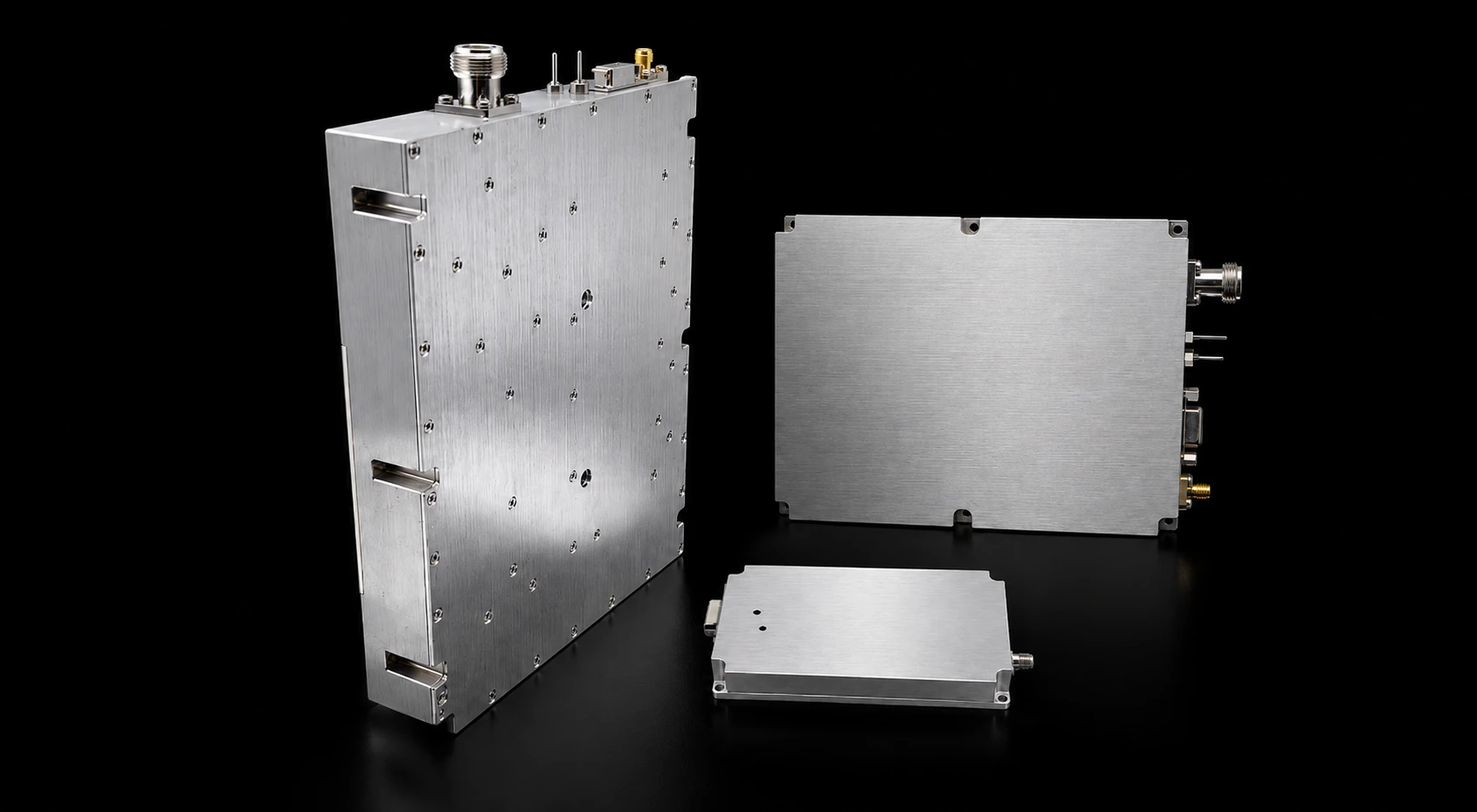
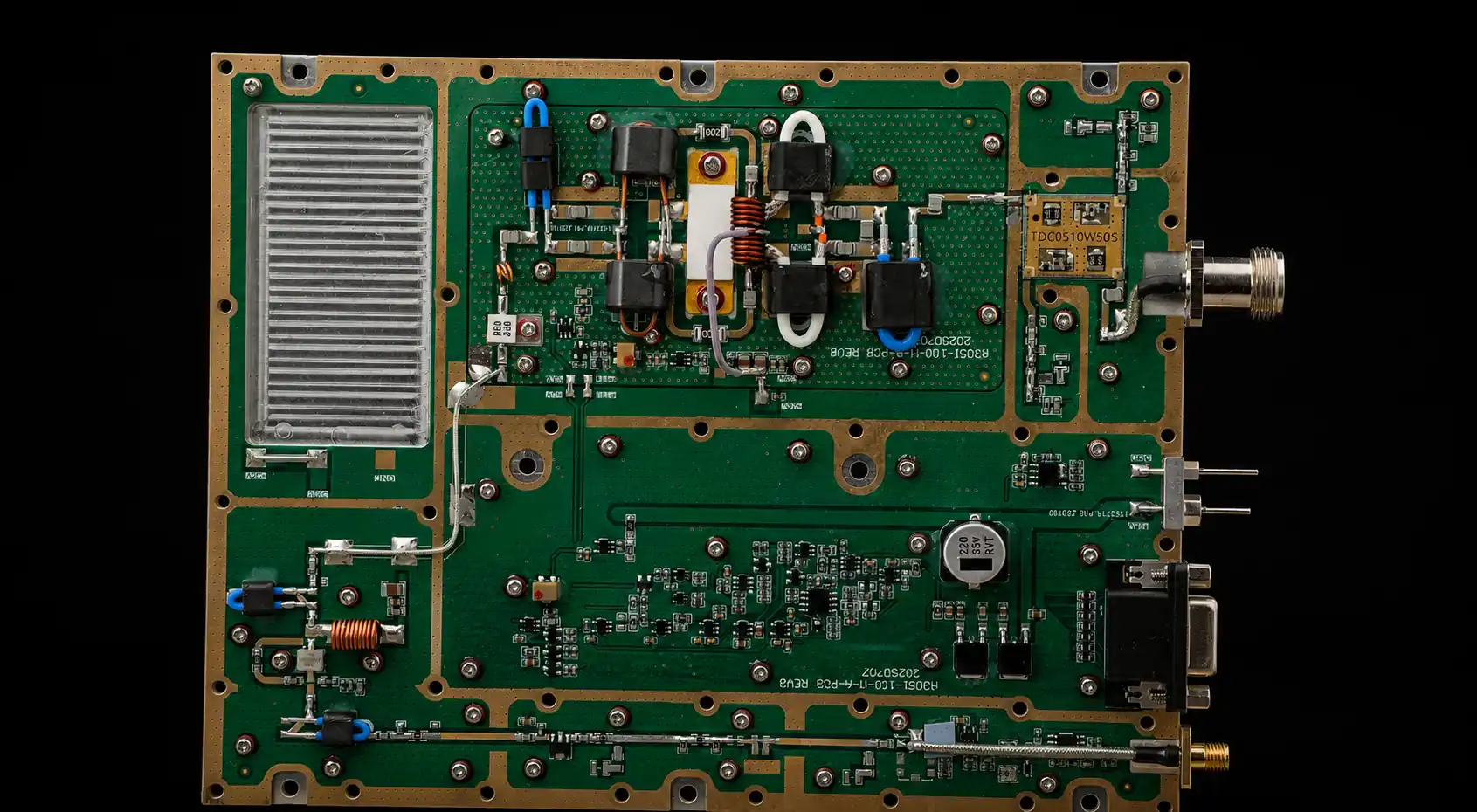
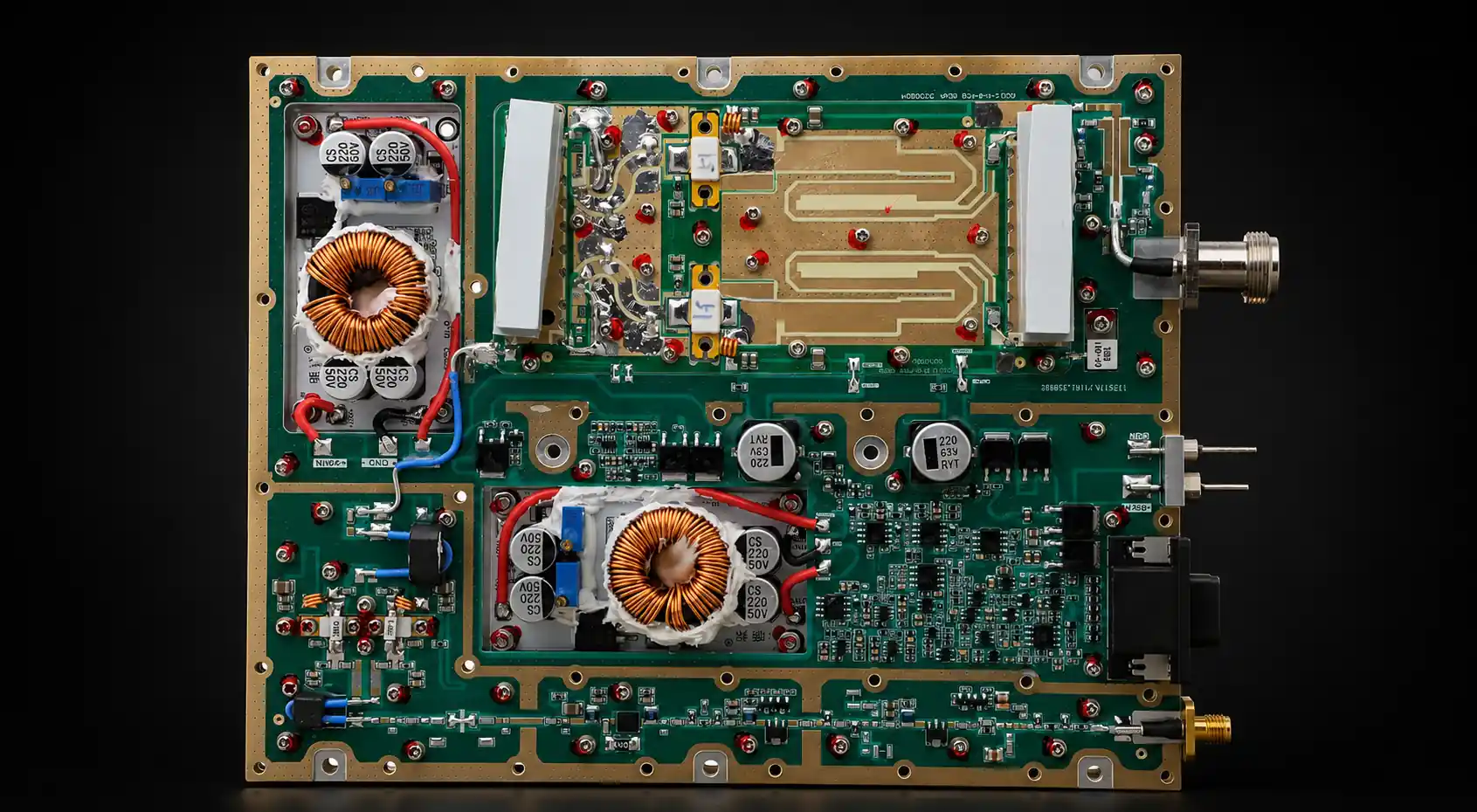
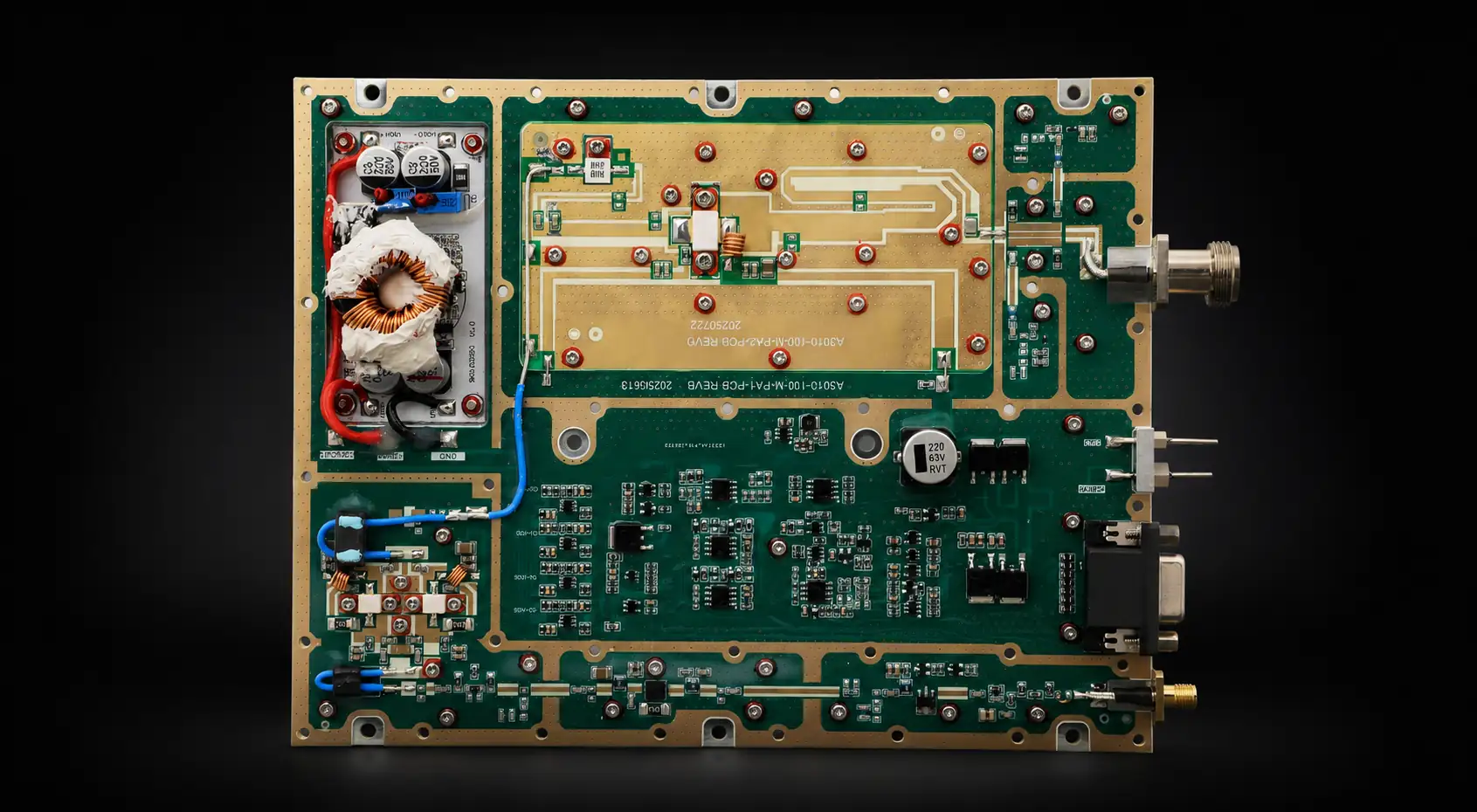
Only after those boundaries are defined should module selection or RFQ review use the downstream power requirement. RF SKYPOWER’s RF Power Amplifier Modules can serve as a product-discovery route once the required frequencies, PA-port or antenna-input power target, RF input condition, feeder path, load boundary, DC condition, duty cycle, and acceptance evidence are defined. A product family page does not prove suitability for a specific installed path.
FAQ
Can low antenna-end power prove the RF PA is weak?
No. A low antenna-end reading can result from the installed feeder path, connectors, adapters, mismatch, a different measurement plane, or a different operating condition. Establish the PA-port baseline under a defined test boundary before assigning the shortfall to the amplifier.
When can the PA-port to antenna-end difference be treated as feeder loss?
The difference can enter feeder-loss evaluation when both reference planes are defined, the included path is known, raw and corrected values are traceable, and the relevant frequency and operating conditions are sufficiently comparable. If mismatch materially changes the measurement, the complete scalar difference should not automatically be treated as pure insertion loss.
What evidence should be recorded before accepting the installed RF path?
Record the upstream and downstream reference planes, frequency, RF input or drive rule, PA-port and downstream power, installed path components, raw/corrected state, correction basis, relevant FWD/REV or VSWR evidence, Vdc/Idc and thermal condition where applicable, instrument information, evidence scope, and the final acceptance action. Include S/N when the acceptance decision requires unit-level traceability.
Conclusion
RF PA feeder cable loss should be checked by comparing power at defined upstream and downstream reference planes under sufficiently comparable conditions and calculating the resulting path drop. That numerical difference becomes usable installed-path loss evidence only when the included path, correction state, operating conditions, and mismatch boundary support the attribution.
A low antenna-end reading alone should therefore neither fail the PA nor automatically fail the feeder. If the measurement boundary is incomplete or mismatch materially changes the result, stop the conclusion, rebuild the test boundary, and repeat or isolate the relevant path condition.
Before changing module power or hardware, first determine whether the measured drop is consistent with the documented installed path. If an engineering review or RFQ is then required, provide the target frequencies, required PA-port and antenna-input power where applicable, feeder length and cable type, connector or transition path, RF input condition, DC and duty-cycle boundary, measurement reference planes, load or VSWR boundary, and required acceptance evidence.