
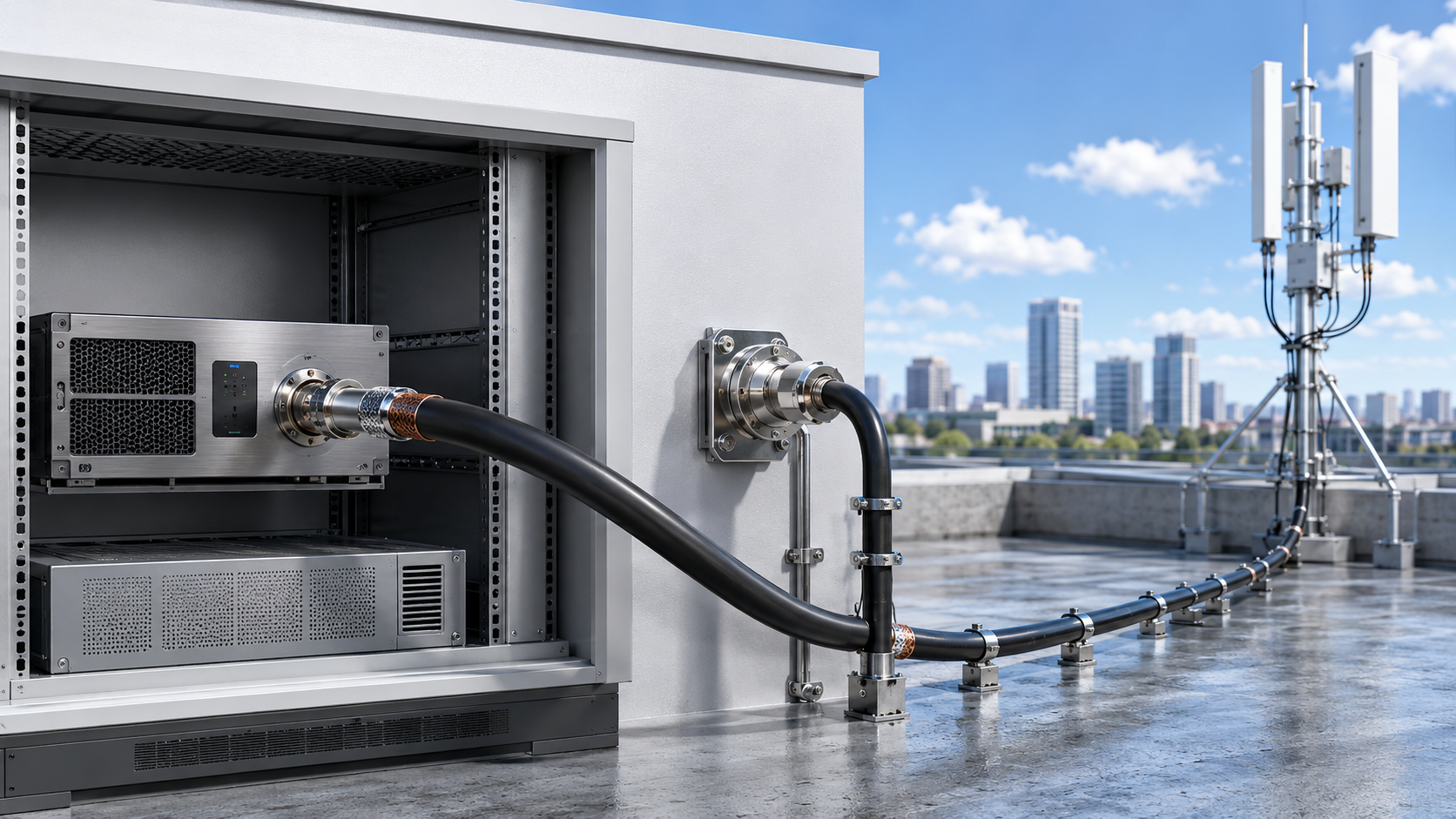
To qualify an RF feeder cable before RFQ or installation, buyers should verify the proposed cable model against project-specific frequency loss, installed length, RF power and duty cycle, connector interfaces, routing and environmental limits, and the evidence required for approval.
Labels such as “low-loss,” “high-power,” or “outdoor” are not enough by themselves. A cable may look suitable on a short bench setup yet become unsuitable when the actual feeder is longer, the operating frequency is higher, the duty cycle changes, or the installed connector and routing conditions are added.
This page focuses on pre-installation feeder-cable qualification. If the system is already installed and the question is how much RF power the path actually loses, use the existing RF PA feeder cable loss check instead.
1. What an RF PA Feeder Cable Must Prove Before Selection
An RF feeder cable should not be approved simply because its general description looks suitable. Before it enters an RFQ or installation plan, the proposed cable needs evidence that it can satisfy the defined project boundary.
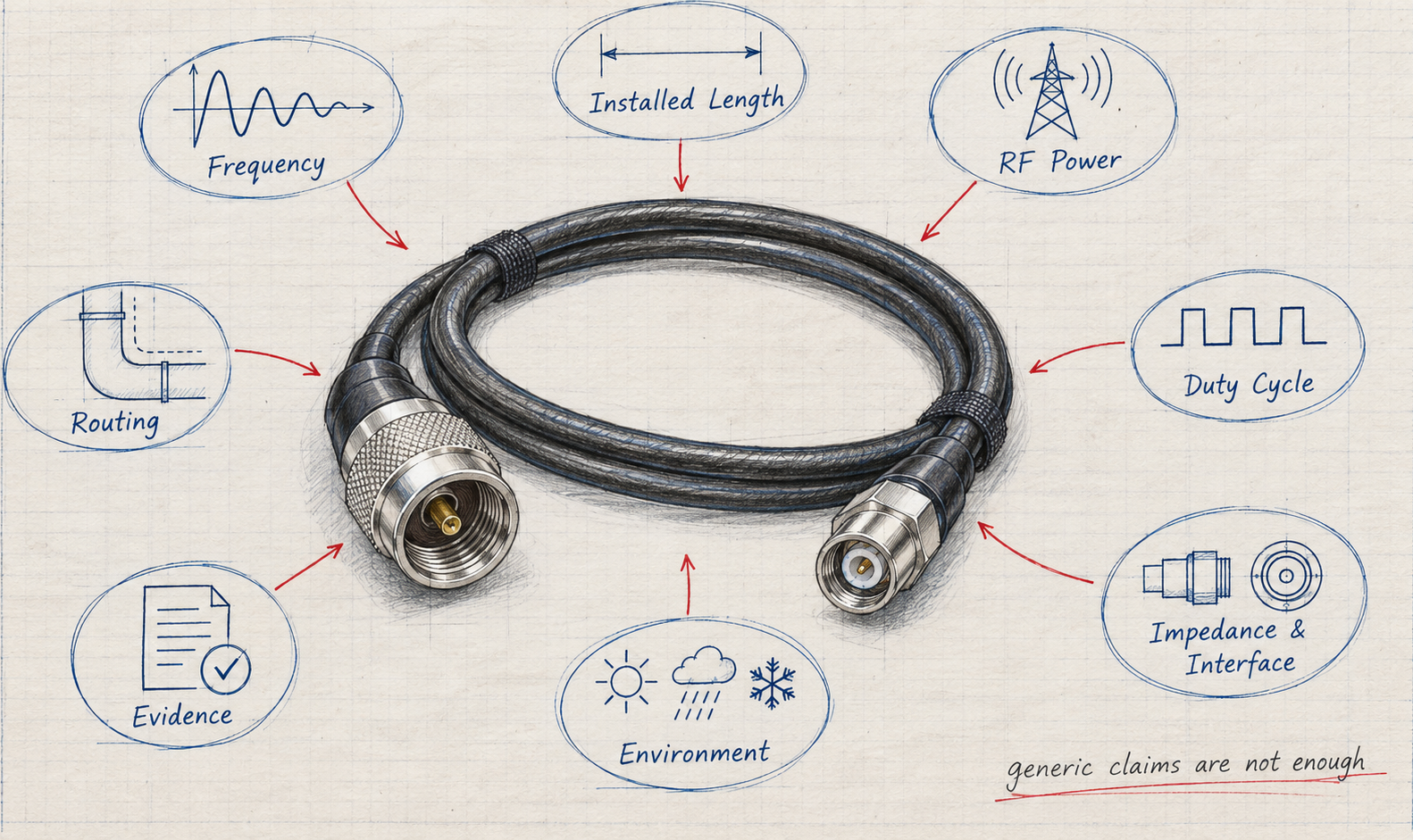
The qualification should answer these questions:
| Qualification Gate | What Buyers Should Verify | Weak Evidence |
|---|---|---|
| Frequency | Loss and applicable ratings at the actual project frequency points | “Works for RF” |
| Installed length | Planned route length and the loss associated with that length | “Standard length” |
| RF power | Applicable power-handling evidence for the proposed cable or assembly | “High-power cable” |
| Duty cycle | Whether the applicable rating supports the expected CW, pulsed, burst, or long-duration condition | “Normal operation” |
| Impedance and interface | Cable impedance, connector family, ratings, and interface compatibility | “Connector included” |
| Routing | Bend, movement, strain relief, feedthroughs, and installation restrictions | “Easy to install” |
| Environment | Temperature, moisture, outdoor exposure, vibration, or other relevant conditions | “Outdoor cable” |
| Evidence | Cable-model-specific datasheet, rating, test evidence, or project requirement | Generic family claim |
The decision does not require the “best” or most expensive cable. It requires a cable whose documented limits match the actual RF path.
A cable can therefore be electrically attractive but still fail qualification because its connector interface, installation route, environmental boundary, or another verified requirement does not match the project.
If the evidence is simply incomplete, however, the correct action is not to assume failure. The cable should remain unapproved until the missing evidence is obtained.
2. How Frequency, Length, and Path Loss Set the Cable Requirement
Frequency and installed length are the first two filters in feeder-cable qualification.
Cable attenuation is frequency dependent, so complete RF amplifier frequency range selection first when the project frequency set is not yet fixed, then compare cable loss at the approved frequency points. A value quoted at one convenient reference frequency should not automatically be treated as representative of a wideband or multi-band system.
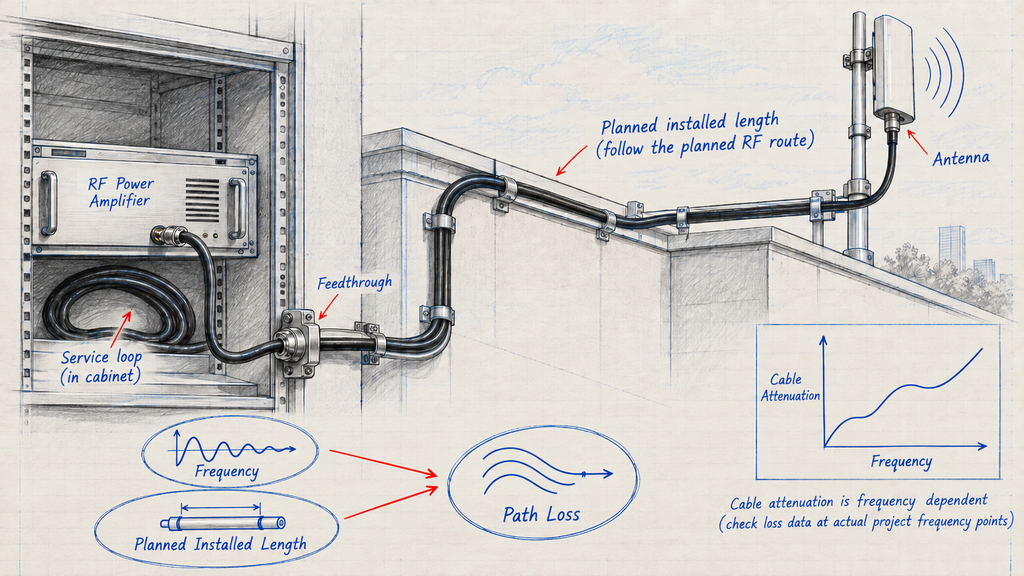
Installed length matters because the complete route may be longer than the straight-line distance between the PA and antenna. The route can include:
- cabinet service loops;
- feedthrough positions;
- roof or mast exits;
- lightning-protection placement;
- equipment separation;
- installation slack;
- antenna mounting position.
The buyer should therefore define the planned RF route, not only a nominal cable length.
For a first cable-only estimate, the comparison should use the proposed cable model’s applicable loss data and the planned length. That estimate is useful for selection, but it is not the same as the measured loss of the complete installed RF path.
Connectors, adapters, feedthroughs, protection devices, filters, combiners, assembly quality, and mismatch can change the final downstream result.
If the project question has already changed from “Which cable should we qualify?” to “How much antenna-end power margin remains after this feeder and connector path?”, review the RF power margin after feeder loss as a separate system-sizing decision.
The feeder-cable page should not solve a power-margin shortage by automatically recommending a larger PA. First determine whether the proposed cable and route are appropriate.
3. How RF Power and Duty Cycle Limit Cable Eligibility
Low insertion loss alone does not prove that an RF feeder cable is suitable for a high-power PA system.
The proposed cable and its connectorized assembly also need applicable evidence for the expected RF power and operating condition.
The qualification input should identify:
- required PA-port output;
- expected antenna-side power target where applicable;
- CW, pulsed, burst, or intermittent operation;
- expected operating duration where relevant;
- applicable temperature or installation environment;
- cable and connector rating basis;
- any project-specific derating or acceptance rule.
A cable that is acceptable for one operating condition should not automatically be approved for another.
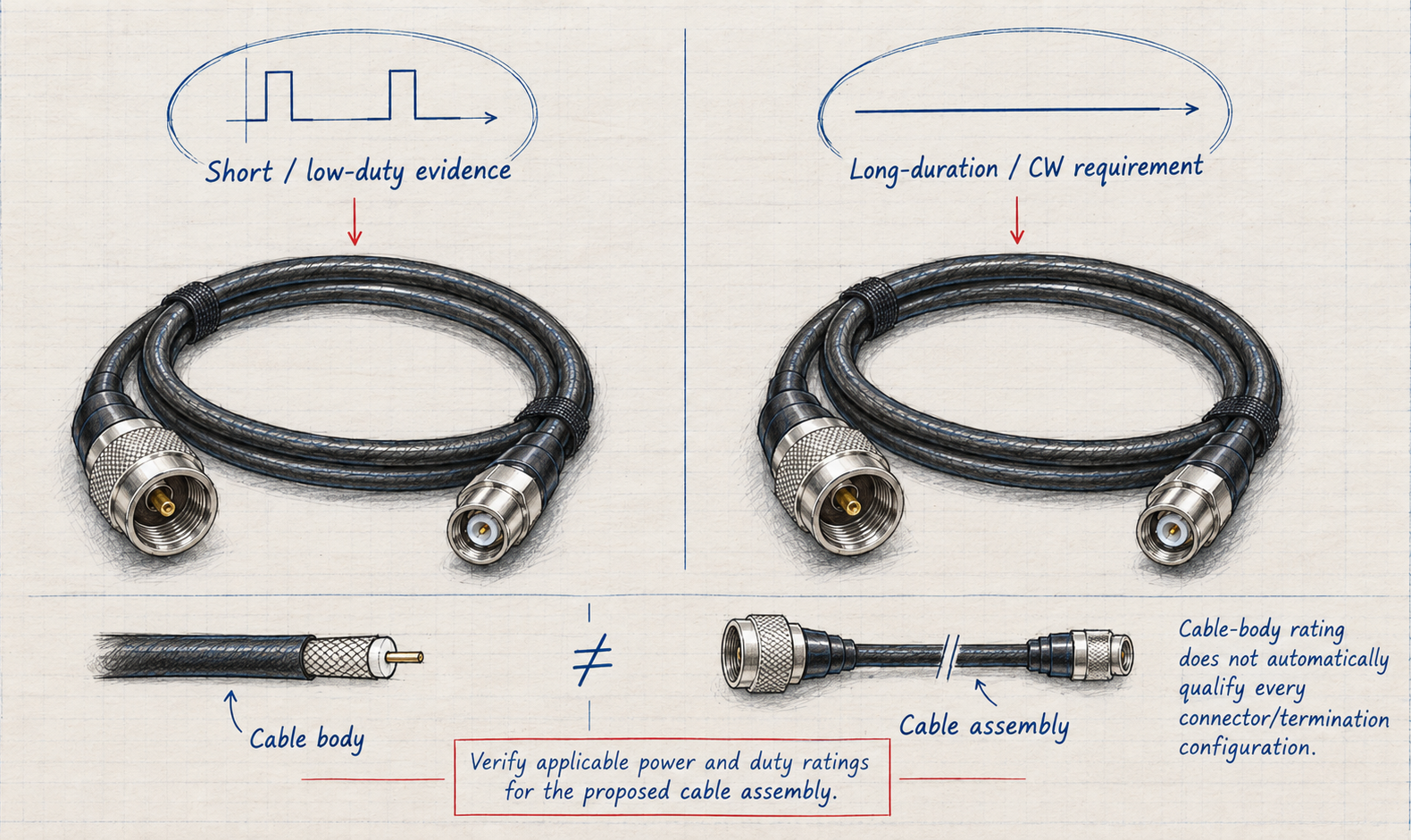
For example, evidence from a short or low-duty test does not by itself prove suitability for long-duration or continuous operation. Likewise, a generic “high-power” description does not identify the frequency, environment, connector configuration, or duty boundary under which the rating applies.
The correct qualification question is:
Does the evidence for this proposed cable or cable assembly apply to the frequency, RF power, duty condition, connector configuration, and environment of this project?
If the applicable evidence is incomplete, keep the cable Conditional or place the qualification on Hold and request the missing evidence. Do not convert an evidence gap into a cable failure.
Reject the cable for the current project only when applicable evidence shows that a defined project requirement is not met.
A cable-body rating also does not automatically qualify every connectorized assembly made from that cable. Where the connector, termination, or assembly configuration changes the applicable boundary, the assembly evidence must be reviewed separately.
4. Which Shielding, Impedance, and Connector Requirements Belong in Cable Selection
Shielding, cable impedance, and the RF amplifier impedance matching boundary belong in feeder-cable qualification because they define whether the proposed assembly is compatible with the RF system.
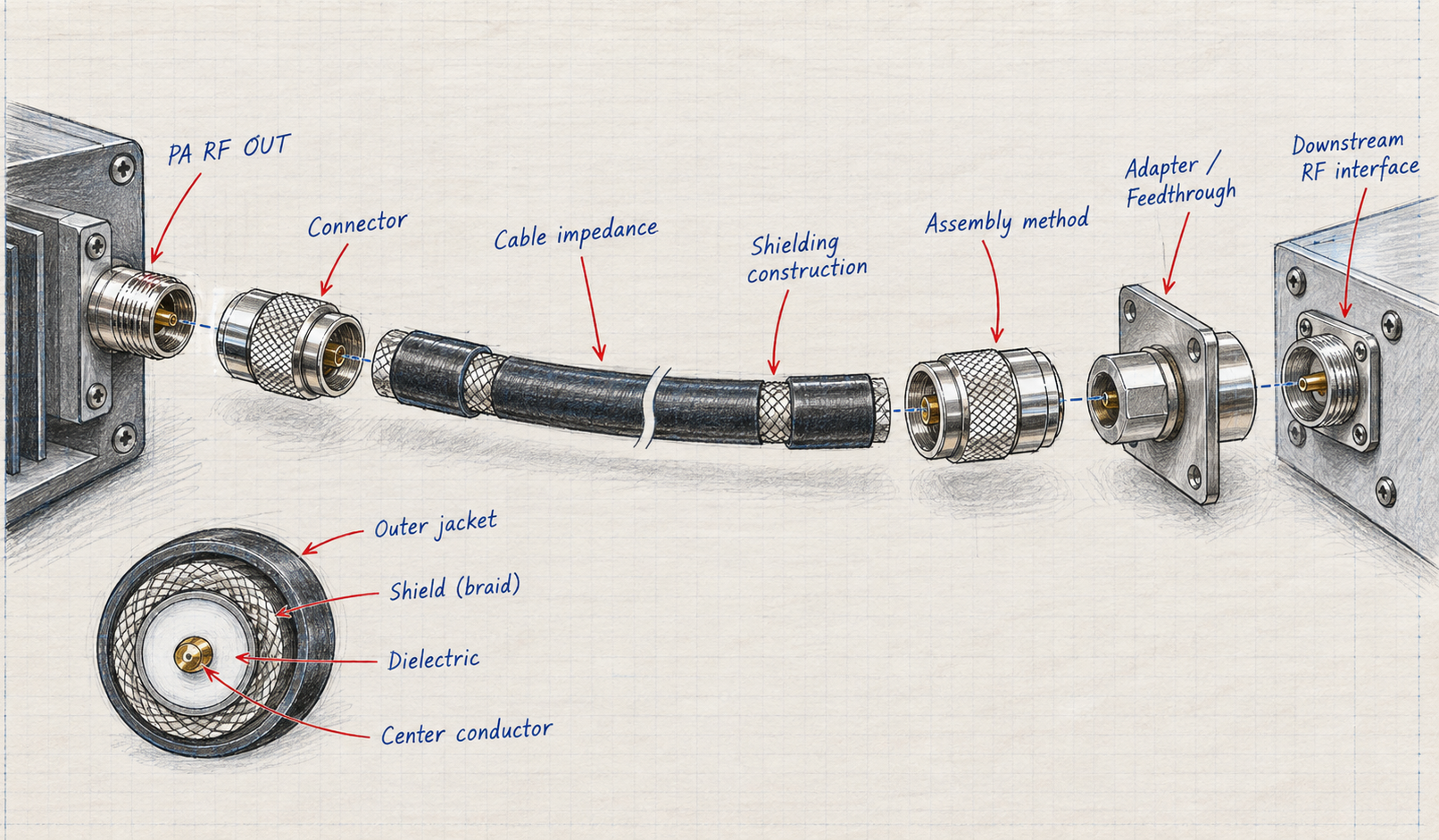
For selection purposes, buyers should identify:
- cable impedance;
- applicable shielding construction or project-specific EMC requirement;
- connector family;
- connector frequency and power applicability;
- assembly method;
- sealing requirement where relevant;
- adapters or feedthroughs included in the design;
- inspection or assembly requirements defined by the project.
Not every project requires a separate shielding or EMC qualification gate. It becomes an independent requirement when the system defines a specific shielding, leakage, coupling, EMC, or interference boundary that the feeder must satisfy.
The cable-selection page should stop at these requirements.
It should not attempt to diagnose every possible connector or mismatch failure after installation.
If weak crimping or termination is already suspected, isolate the termination fault separately rather than treating the symptom as proof that the original cable choice was wrong.
The same boundary applies to mismatch. A proposed cable should have a compatible impedance and interface, but a frequency-specific VSWR problem found during system testing requires its own measurement and root-cause work. Review the existing frequency-specific VSWR problems instead of turning cable qualification into a complete mismatch-diagnosis procedure.
The selection decision is therefore about interface eligibility. After cable qualification, the broader RF PA load conditions before integration should verify the feeder, connector, antenna, reference-plane, and protection boundary before full-power operation.
5. How Routing and Environment Change the Cable Requirement
An electrically suitable cable can still be inappropriate for RF amplifier system integration when its mechanical or environmental limits do not match the planned installation.
Cable qualification should therefore include the environment and mechanical route before the design is locked.
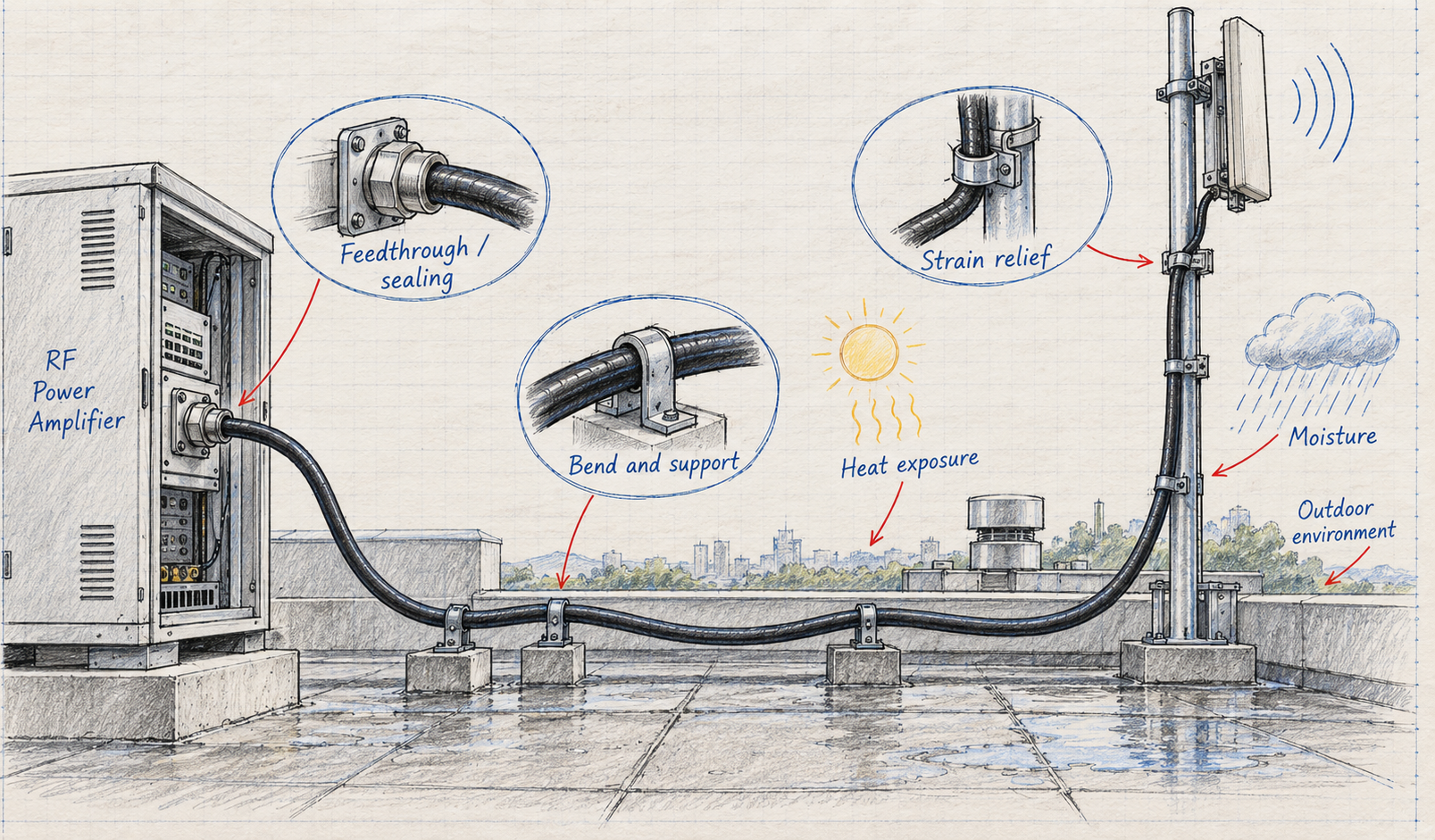
Relevant questions include:
- Will the feeder remain inside a cabinet or run outdoors?
- Is the route fixed or subject to repeated movement?
- What bend restrictions apply to the proposed cable?
- Is strain relief required?
- Are there cabinet feedthroughs or adapter transitions?
- Is the route close to heat sources?
- Will connectors or cable sections be exposed to moisture?
- Is vibration relevant?
- Will the installation be on a roof, mast, vehicle, enclosure, or other exposed structure?
- Can the cable be inspected or replaced after installation?
The purpose of these questions is not to diagnose future failures in advance. It is to decide whether the cable’s documented mechanical and environmental limits match the planned installation.
For example, a cable with attractive electrical loss data should not be approved for a fixed route that is known to violate an applicable documented bend requirement.
Likewise, “outdoor” should not be treated as a complete engineering definition. The evidence should match the actual exposure or the specific project requirement being used for approval.
Mechanical and environmental suitability are therefore independent qualification gates, not optional notes after RF performance has already been approved.
6. What Evidence Makes Two Cable Options Comparable Before RFQ
Two cable options are only meaningfully comparable when their evidence addresses the same project requirement under sufficiently aligned conditions.
A buyer should not compare one cable using frequency-specific manufacturer data and another using only a generic family claim, then treat both options as equally proven.
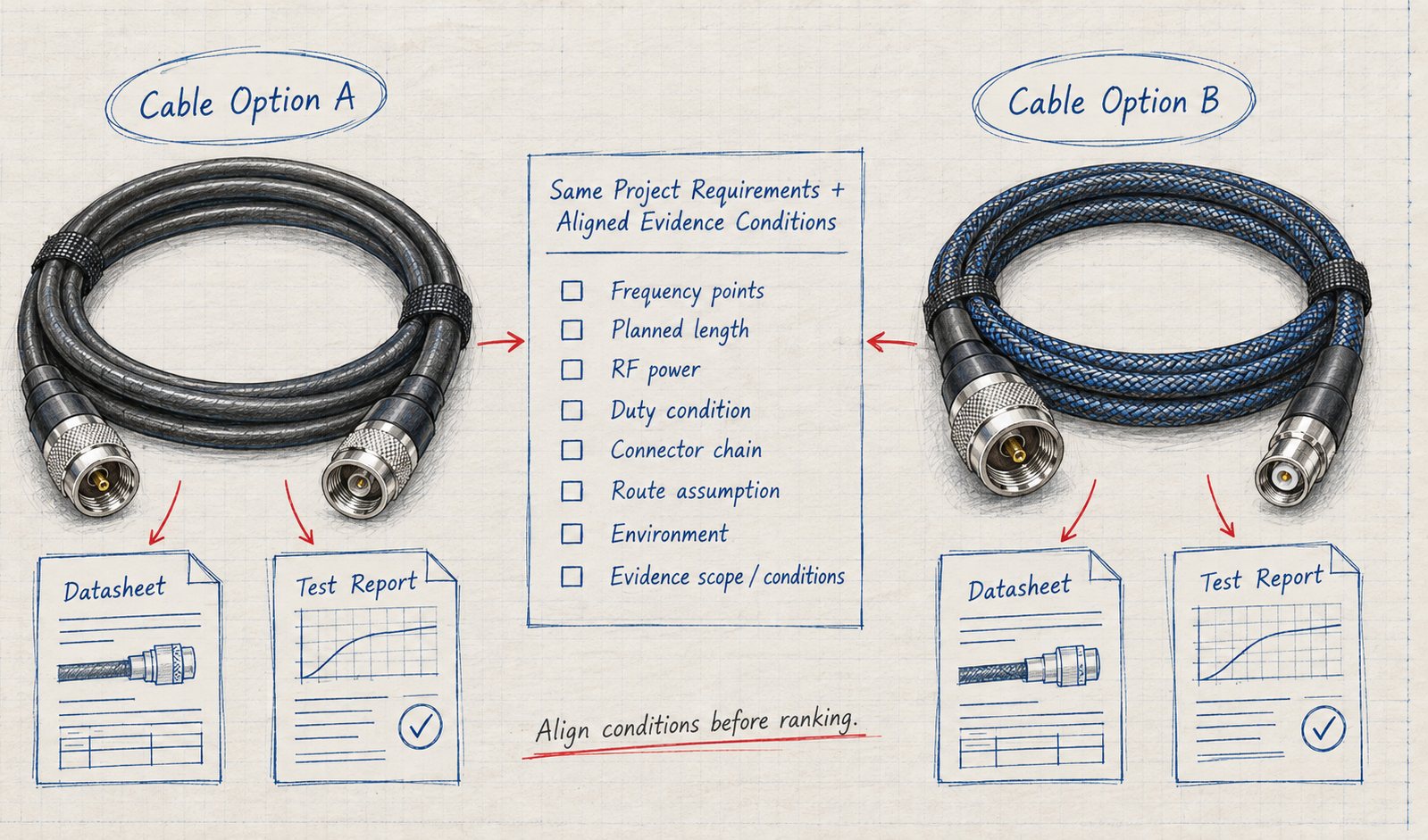
The same applies when the evidence uses different:
- frequency points;
- RF power boundaries;
- duty conditions;
- temperature conditions;
- connectorized assembly scopes;
- route assumptions;
- environmental conditions.
If two cable options are supported under materially different conditions, do not rank them yet. Align the comparison conditions or request the missing evidence before deciding which option is better for the project.
Use the following evidence map before RFQ:
| Buyer Requirement | Required Evidence | Required Condition | Evidence Scope | Decision Use |
|---|---|---|---|---|
| Frequency suitability | Loss data and applicable ratings for the proposed cable model | Data must cover the relevant project frequency points | Proposed cable model | Determine frequency eligibility |
| Installed-length suitability | Applicable loss per length plus planned feeder length | Frequency and route length must be defined | Cable-only path estimate | Determine whether the cable can enter the RF path budget |
| RF power and duty suitability | Manufacturer rating or other applicable qualification evidence | Must apply to the relevant frequency, operating condition, and assembly boundary | Cable or cable assembly covered by the evidence | Determine power/duty eligibility |
| Interface suitability | Impedance, connector family, and applicable connector ratings | Must match the PA and downstream RF interfaces | Proposed cable assembly interfaces | Determine interface eligibility |
| Shielding / EMC suitability, where required | Applicable shielding construction or project-specific leakage, coupling, or EMC evidence | Required only when the project defines a relevant shielding or EMC boundary | Proposed cable or assembly | Determine whether the feeder satisfies the defined EMC requirement |
| Mechanical suitability | Bend, routing, movement, and installation requirements | Must correspond to the planned route | Proposed installation | Determine mechanical eligibility |
| Environmental suitability | Applicable temperature, outdoor, moisture, vibration, or other project evidence | Must correspond to the actual defined environment | Proposed installation environment | Determine field suitability |
| Approval traceability | Cable model, relevant datasheet or test evidence, configuration, and project requirement | Evidence scope must be identifiable | Proposed cable or assembly | Support Qualify / Conditional / Hold / Reject |
Keep Cable Evidence Separate From PA Evidence
An RF amplifier test report linked to the PA S/N can support traceability for the amplifier unit and its PA-side acceptance condition.
It does not automatically prove that a proposed feeder cable model or cable assembly is suitable.
Cable qualification should be supported by evidence that actually belongs to the cable or cable assembly being evaluated.
Depending on the project, that can include:
- exact cable model;
- applicable frequency-loss data;
- planned length;
- power or duty rating evidence;
- impedance;
- connector configuration;
- mechanical requirements;
- environmental requirements;
- assembly identity where project-level traceability requires it.
PA evidence and cable evidence may later appear in the same system-acceptance package, but their evidence scope should remain identifiable.
A dummy-load baseline and real-antenna check can help verify the broader RF-chain boundary after integration. It does not replace pre-installation cable qualification.
7. How to Decide Qualify, Conditional, Hold, or Reject a Proposed Cable
The final cable-selection output should be a decision, not another list of specifications.
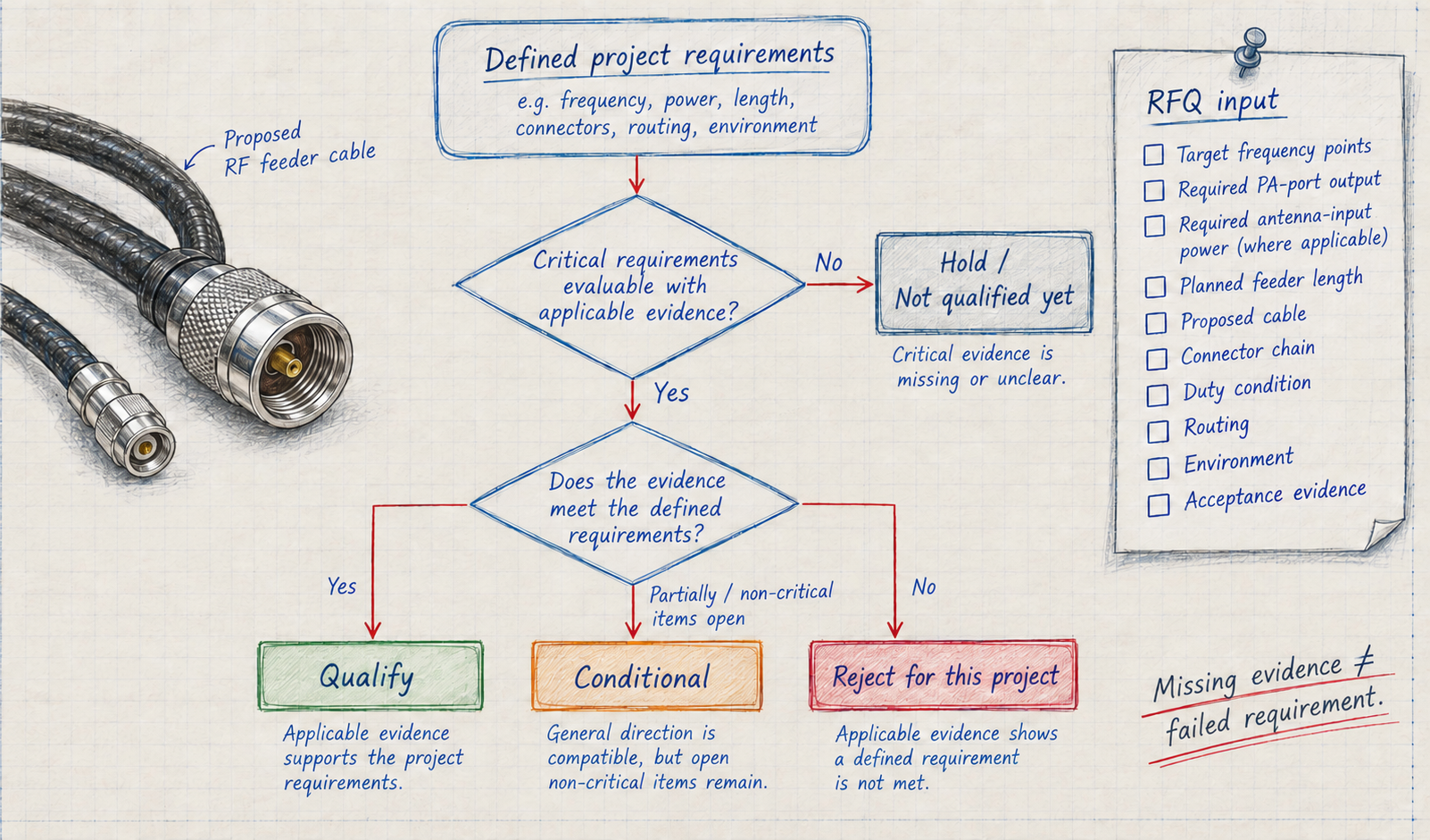
Qualify
A proposed RF feeder cable can be Qualified for the defined project boundary when applicable evidence supports the required:
- frequency points;
- planned installed length;
- loss expectation;
- RF power and duty condition;
- impedance and connector interfaces;
- routing restrictions;
- mechanical limits;
- environmental conditions;
- any defined shielding or EMC requirement;
- project acceptance requirements.
“Qualify” means the cable is supported for the defined project conditions. It is not a universal statement that the cable is suitable for every RF PA system.
Conditional
Use Conditional when the overall cable direction appears compatible but one or more defined items still need to be closed before design lock or installation.
Examples include:
- the final feeder length is not yet frozen;
- the connector assembly has not been finalized;
- the installation route may still change;
- a non-critical environmental requirement is still being finalized.
A Conditional decision should identify exactly what remains open.
It should not be used as a vague substitute for final approval.
Hold or Not Qualified Yet
Use Hold / Not Qualified Yet when a critical requirement cannot yet be evaluated because the applicable evidence is missing or its scope is unclear.
Examples include:
- loss data is missing at a critical project frequency;
- the applicable RF power or duty boundary cannot be confirmed;
- a cable-body rating exists but the connectorized assembly scope is unclear;
- the connector rating is not available for the required condition;
- an environmental claim is generic and cannot be tied to the project’s actual exposure;
- the available evidence does not identify the exact cable model or configuration being proposed.
The action is:
Do not approve yet. Request the missing evidence.
An evidence gap does not prove that the cable is defective or unsuitable.
Reject for This Project
Reject the proposed cable for the current project only when applicable evidence shows that a defined requirement is not met.
Examples include:
- the verified frequency range does not cover a required project frequency;
- the documented cable loss cannot satisfy the defined path requirement;
- the verified RF power or duty boundary is below the project requirement;
- the connector or impedance interface is confirmed to be incompatible;
- a fixed installation route conflicts with a documented mechanical limit;
- the project’s environmental requirement exceeds the applicable evidence for the proposed cable or assembly.
This decision applies to the defined project boundary.
It does not mean that the cable model is defective or unsuitable for every other RF application.
What Buyers Should Send Before RFQ
Before asking a supplier to compare feeder options, define:
| RFQ Input | What to Provide |
|---|---|
| Target frequency points | Low, mid, high, and other critical project frequencies |
| Required PA-port output | Amplifier-side output target |
| Required antenna-input power | Downstream target where the project defines one |
| Planned feeder length | Estimated or fixed installed route length |
| Proposed cable | Exact model when known, or required loss/rating boundary |
| Connector chain | Connectors, adapters, feedthroughs, and other planned transitions |
| Duty condition | CW, pulsed, burst, intermittent, or other relevant operating rule |
| Routing | Cabinet, mast, rooftop, vehicle, outdoor, movement, or other installation constraints |
| Environment | Relevant temperature, moisture, vibration, or exposure requirement |
| Acceptance evidence | Evidence required before design approval, installation, or release |
Where feeder-path evidence also affects an RF amplifier acceptance test, connect the result to the broader acceptance framework rather than treating cable qualification as the complete system-acceptance decision.
If the feeder requirements are sufficiently defined and the next task is amplifier product discovery, RF SKYPOWER’s existing RF Power Amplifier Modules page can be used to review available product families. A product-family page does not prove that a specific module or feeder configuration is suitable for the project.
FAQ
What makes two RF feeder cables actually comparable?
Two cables become meaningfully comparable when their evidence applies to the same project frequency points, route length, RF power and duty condition, connector or assembly boundary, routing, environment, and evidence scope.
If those conditions are materially different, do not rank the cables yet. Align the comparison basis or request the missing evidence first.
Can low insertion loss alone prove that a cable is suitable?
No. Insertion loss is important, but cable qualification also depends on applicable power and duty evidence, impedance and interfaces, connectorized assembly scope, routing constraints, mechanical limits, environmental requirements, and any shielding or EMC requirement defined by the project.
What cable data should buyers provide before RFQ?
Provide the target frequency points, required PA-port and antenna-input power where applicable, planned feeder length, proposed cable model or applicable loss data, connector chain, duty condition, routing, environment, and required acceptance evidence.
Conclusion
An RF feeder cable should be qualified only when applicable evidence shows that the proposed cable or assembly matches the project’s frequency, installed length, RF power and duty condition, interfaces, routing, environmental boundary, and other defined acceptance requirements.
If the evidence is complete and applicable, Qualify the cable for that defined project boundary. If defined items remain open, keep it Conditional. If critical evidence is missing, place the qualification on Hold / Not Qualified Yet and request the missing information. Reject the proposed cable for the project only when applicable evidence shows that a defined requirement is not met.
“Low-loss,” “high-power,” or “outdoor” is therefore not a qualification decision by itself.
Before RFQ or installation, the independent next action is to align the project conditions and the cable evidence so the proposed options are genuinely comparable. This prevents cable selection, PA selection, installed feeder-loss testing, and final system acceptance from being treated as the same engineering decision.