
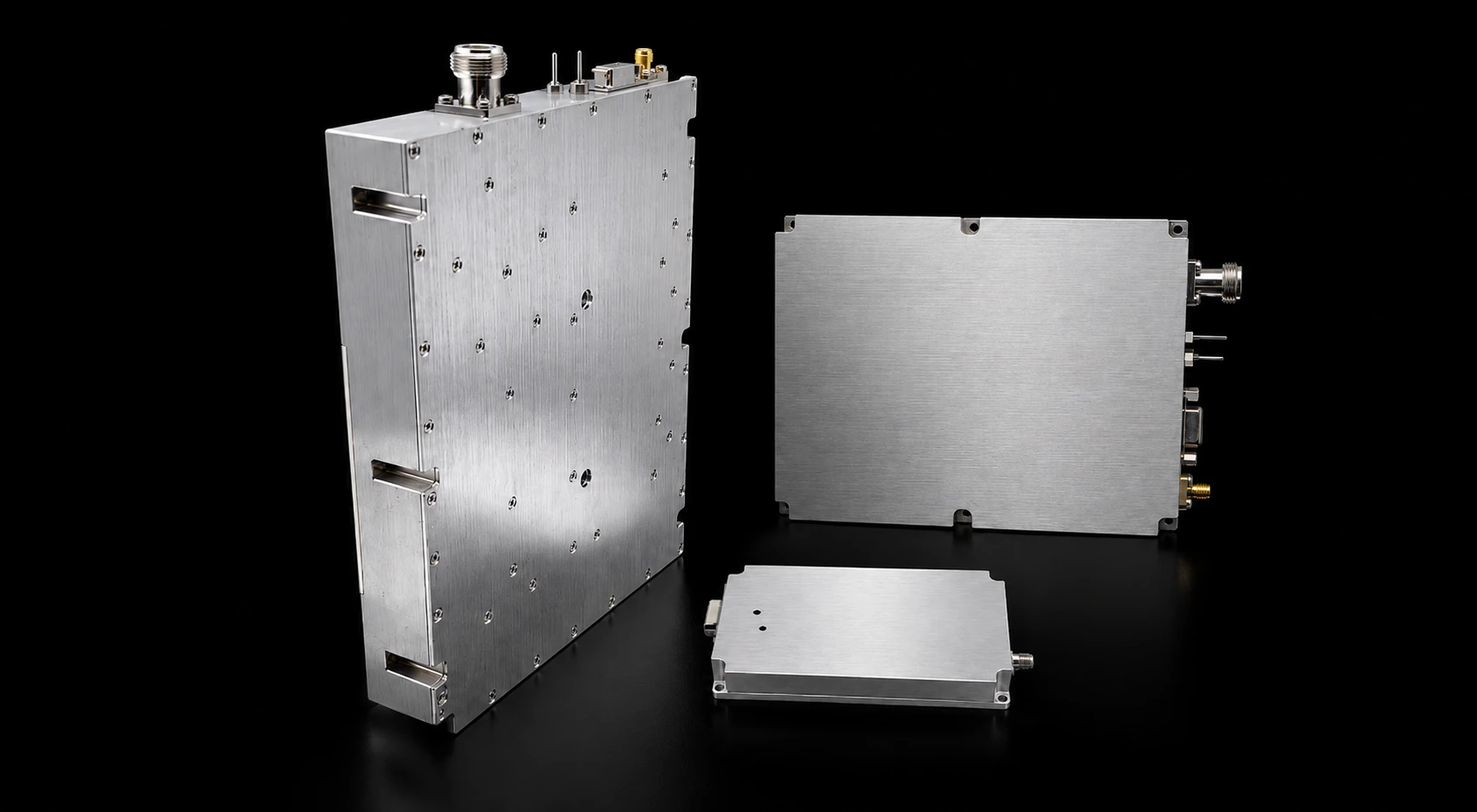
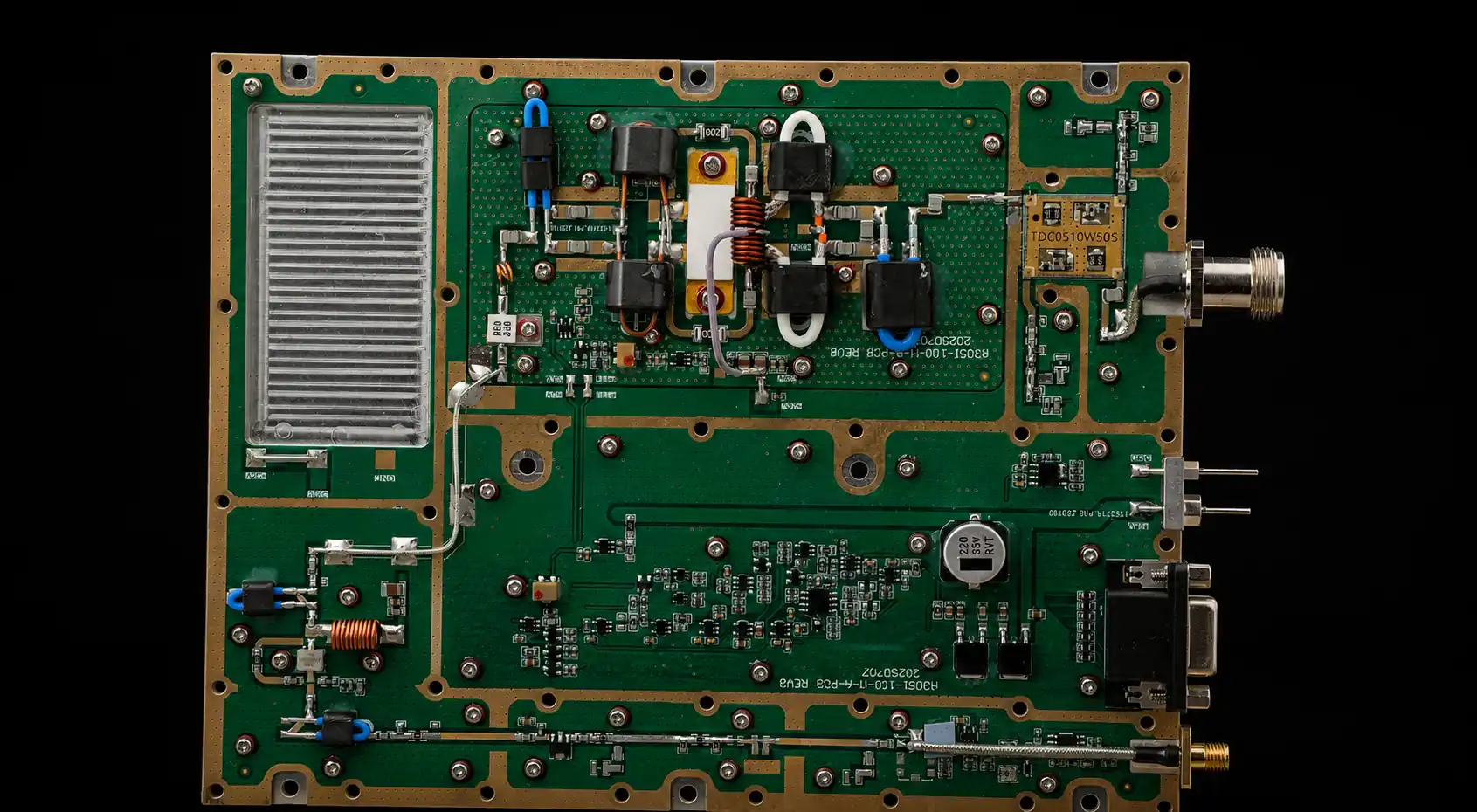
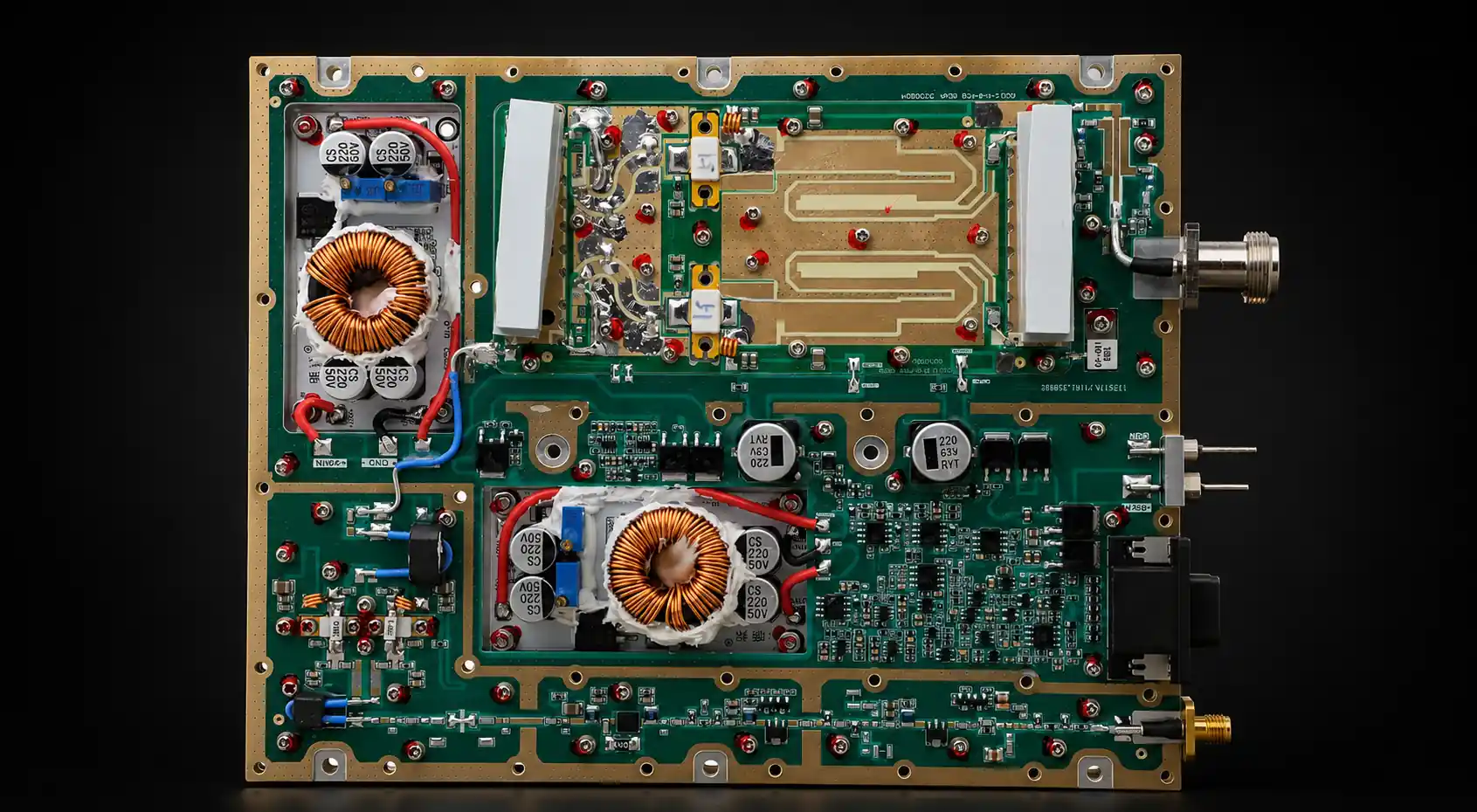
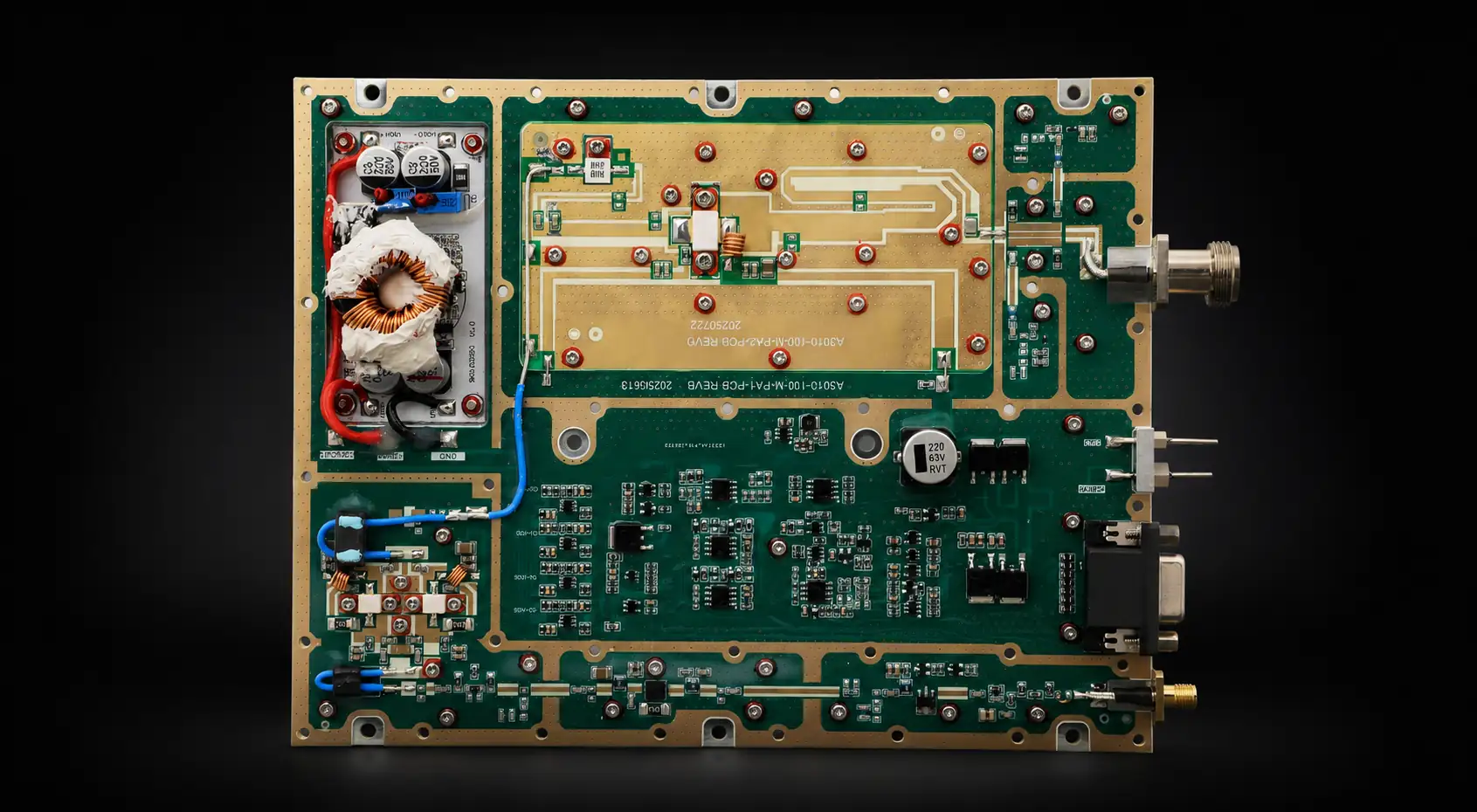


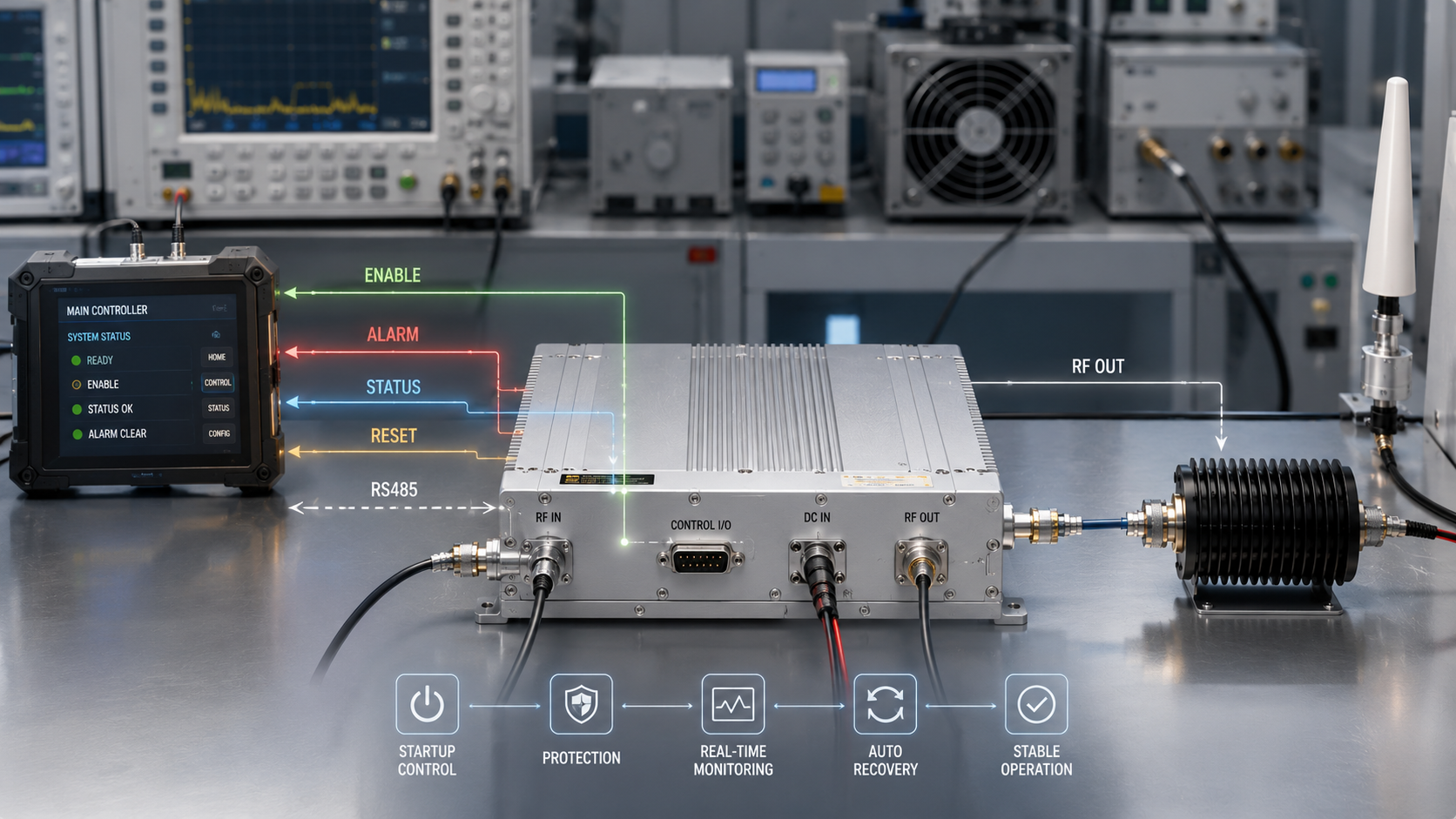
RF PA control logic should be defined before wiring and firmware are frozen because an interface signal is not the same as a system decision. For each available Enable, Alarm, Status, Reset, or communication event, the project should define the precondition, authoritative state, controller action, and recovery rule. Otherwise, a healthy PA can be interpreted as faulty, a controller can act on stale status, or a system can move to the next state before the required condition has actually been reached.
The exact logic is product- and project-dependent. Not every RF PA exposes the same signals, status fields, protection states, communication method, or recovery behavior. Control rules therefore need to follow the actual module interface and system architecture rather than assume a universal PA state machine.
Start by turning each available interface state into an explicit system rule: when it is valid, which source is authoritative, what action follows, and how failure or recovery is handled.
1. What Must RF Power Amplifier Control Logic Define Before Integration?
RF power amplifier control logic defines the relationship between an observed state or command and the action that follows inside the complete system.
A connector drawing or register map may tell you that an Enable input, Alarm output, Status field, Reset command, or communication port exists. It does not automatically tell you:
- when that state is valid;
- which signal is authoritative when two indications disagree;
- what the controller should do next;
- what blocks the next transition;
- what recovery condition is required after a fault;
- what happens if the expected confirmation never arrives.
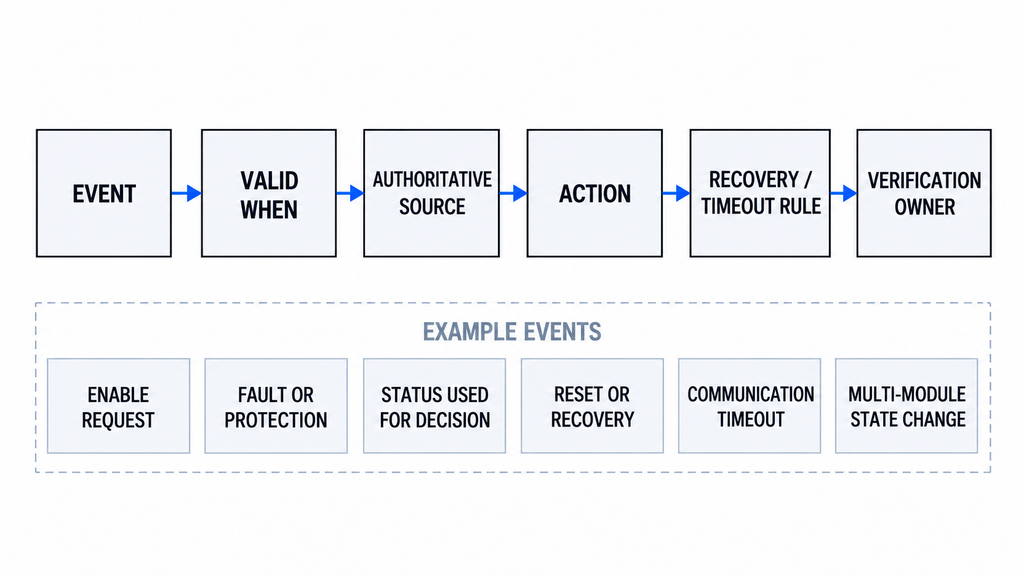
If the electrical interface itself is still unclear, define that boundary first. The RF PA control interface review should establish what signals and communication functions are actually available before system-level logic is frozen.
A useful control definition should also separate states that are easy to confuse. A command response, an enabled state, a protection-clear indication, and measured RF readiness should not be treated as interchangeable unless the applicable interface definition and project architecture establish that relationship.
RF PA Control Logic Definition Matrix
The following matrix is a definition template, not a universal PA state machine. Replace the general descriptions with the conditions and evidence that apply to the selected module and controller.
Define Every Control Transition Before Integration
Seven common states, six questions for each decision · Swipe horizontally to review the complete logic →
| Control State / Event | Valid When | Authoritative Source | Controller Action | Recovery / Timeout Rule | Verification Owner |
|---|---|---|---|---|---|
| STATE 01 Pre-enable readiness state | All project-defined prerequisites required before the enable decision are valid. | Defined system-readiness logic plus applicable PA/interface status. | Permit the next control transition only when the required readiness conditions are confirmed. | Hold the transition if a required prerequisite is missing or invalid. | System integrator with interface owner |
| STATE 02 Enable request | The project-defined conditions for allowing RF operation are satisfied. | Defined enable state and any required readiness indication. | Issue or maintain the enable action according to the approved logic. | Block or cancel the transition if required confirmation is not received. | Controller / firmware team with PA interface owner |
| STATE 03 Fault or protection event | The applicable alarm or protection state is valid according to its definition. | Defined PA protection or alarm source. | Apply the project-defined response for that fault category. | Follow the approved latch, reset, wait, inspection, or other recovery rule. | Protection owner and system integrator |
| STATE 04 Status used for a decision | The value is valid, current enough for the decision, and associated with the correct module or channel. | Defined native or derived status source. | Use the value only for the decisions it is defined to support. | Apply the predefined fallback rule if the status is missing, stale, invalid, or conflicting. | PA/interface owner and controller team |
| STATE 05 Reset / recovery request | The fault condition and project recovery prerequisites permit reset. | Defined protection state plus applicable recovery confirmation. | Execute the approved recovery action without assuming RF operation has already returned. | Stop or escalate if the required recovery condition is not confirmed. | Protection owner and controller team |
| STATE 06 Communication timeout or loss | An expected command response or required confirmation does not arrive under the defined communication rule. | Controller communication state plus applicable PA status. | Move to the project-defined safe, held, or degraded state. | Apply the defined retry, timeout, hold, or escalation rule. | Firmware / controller team |
| STATE 07 Multi-module state change | The source module and channel are unambiguously identified. | Address, channel identity, module status, or another defined source identifier. | Apply the action only to the intended scope unless system logic explicitly requires a wider response. | Prevent an unidentified or ambiguous event from being treated as a cabinet-wide state. | System controller owner |
The purpose of this matrix is to remove implied behavior. Every important transition should answer six questions: What happened? When is it valid? Which source proves it? What action follows? What happens if completion fails? Who verifies the rule?
2. Which Conditions Must Be True Before RF Output Is Allowed?
An Enable input should not be treated as proof that every system condition required for RF operation has already been satisfied.
The system first needs to define which prerequisites actually matter for the application. Where cooling is a permission condition, RF power amplifier thermal management should define the thermal state that must be valid before the controller permits the next transition. These are project requirements, not a universal list that every PA must implement internally.
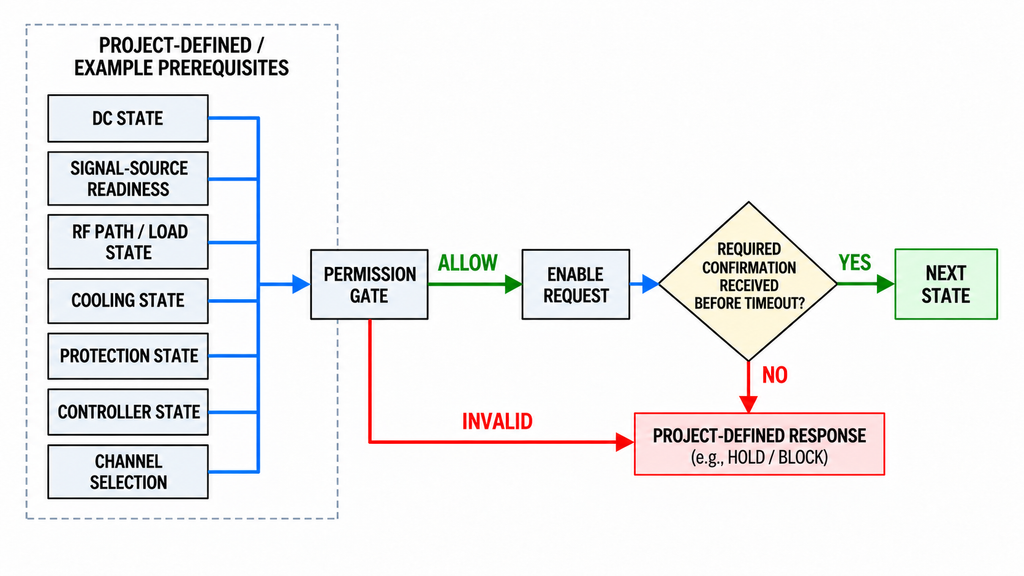
The important question is not simply:
“Is Enable high?”
It is:
“What must be true before this system is allowed to request or maintain RF operation?”
That distinction prevents the controller from assigning too much meaning to one signal.
For example, a project may define that an Enable request is allowed only after the required supply state is valid and no blocking protection condition is reported. Another architecture may have additional prerequisites controlled outside the PA. The PA interface documentation and system design must establish which conditions are real and where they are observed.
The logic should also define what happens when a prerequisite becomes invalid after enable. Possible responses may include holding the state, blocking a new request, applying a project-defined shutdown action, or escalating to another system controller. The correct response cannot be inferred from the name of the Enable signal alone.
At the system-logic level, the required output is the permission rule that determines whether the next RF-control transition is allowed. Detailed RF PA enable logic should handle sequencing, default states, fail-safe implementation, and electrical validation separately from this system-level permission rule.
3. How Should Faults Map to Controller Actions and Recovery?
A fault indication becomes useful only when the controller knows what decision it is allowed to make from that indication.
A general Alarm output may prove only that an abnormal state has been reported. It may not identify whether the underlying condition relates to reflected power, temperature, supply behavior, current, communication, or another monitored condition. If the interface provides separate fault categories, those definitions should be preserved. If it provides only a combined indication, the system should not invent a more specific diagnosis than the available evidence supports.
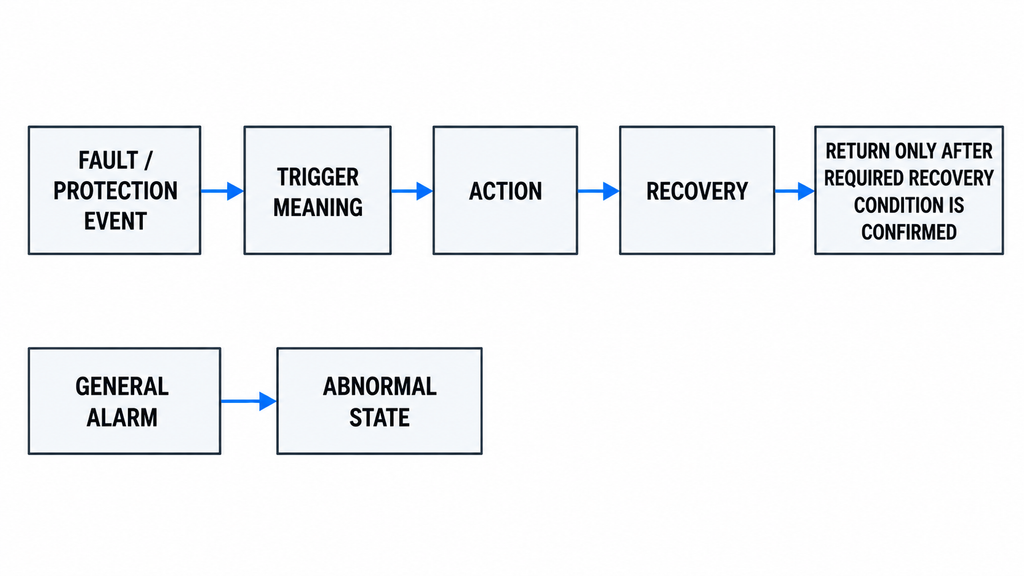
For each relevant fault, define three things together:
- Trigger meaning — what condition the reported state represents.
- Controller action — what the system does while that state is valid.
- Recovery rule — what must happen before the affected function can return to service.
An alarm without an action leaves the controller uncertain. An action without a recovery rule creates unpredictable field behavior. A reset rule without a defined fault state can lead to repeated retries without proving that the original condition has cleared.
Recovery may be automatic, controller-commanded, manually authorized, latched, or handled another way depending on the actual product and project. There is no universal rule that a particular alarm should automatically recover or that a specific fault must always shut down the PA. Those behaviors have to come from the applicable protection definition.
One published RF SKYPOWER OEM integration case shows why readable operating states matter in practice. In that project, the controller had access to alarm, telemetry, shutdown/reset, and communication states through a defined RF-core interface. The example supports the value of exposing relevant state information to the controller, but its specific interface and protection implementation should not be generalized to every RF PA or customer project.
Protection trigger thresholds, latch behavior, reset testing, and recovery acceptance should follow the applicable protection definition, with RF power amplifier load mismatch protection verified separately where reflected-load conditions matter.
4. Which Status Is Authoritative for Each Control Decision?
More status data does not automatically create better control logic. RF power amplifier alarm monitoring should only drive a control decision after the status-feedback mapping defines which reported state is authoritative.
Before a status value is allowed to drive control logic, define four things:
- its source;
- its validity or freshness rule;
- the module or channel it belongs to;
- the specific decision it is allowed to control.
This matters when several indications appear to describe the same operating state.
A controller command may have been accepted while the requested PA state is still changing. An enable indication may be valid without proving a separate RF-performance condition. A protection-clear state may show that no blocking protection is reported without proving target RF output.
The system should therefore avoid collapsing several different states into one generic “ready” condition unless the applicable interface specification explicitly defines that relationship.
Detailed signal levels, telemetry scaling, field mapping, logging, channel identity, and freshness rules belong in the RF PA status feedback mapping rather than the system-level control rule. System control logic should use that validated status map to decide what action is permitted.
5. What Should Happen When Commands Time Out or Communication Is Lost?
A communication interface is useful only when the system also defines failure behavior.
A project may use discrete control, GPIO, a serial interface, a bus, an AT-command layer, or another method. The actual interface and supported functions must come from the selected module documentation rather than being assumed across RF PA products.
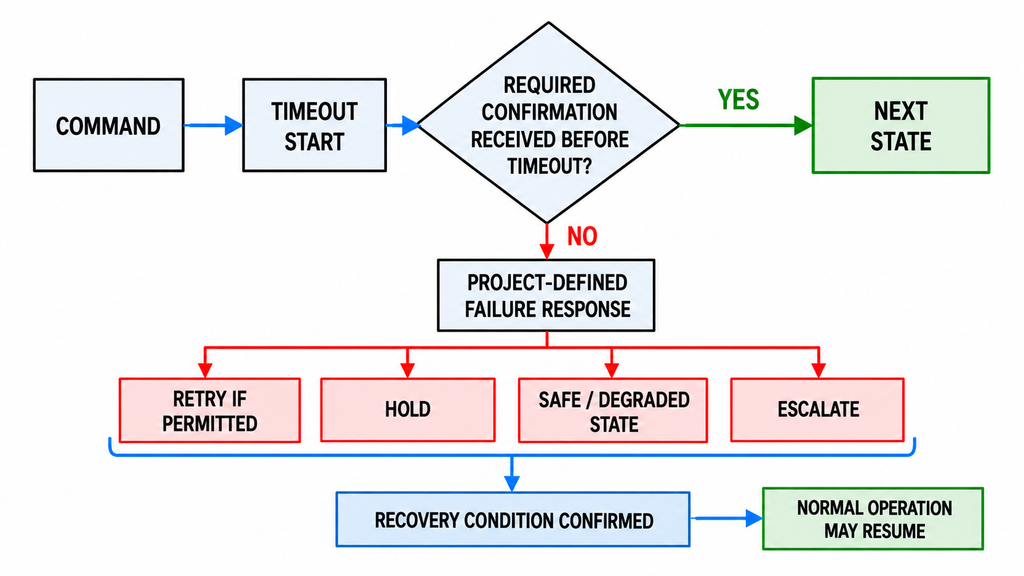
Communication-loss logic should define what event the controller is waiting for, what the available response actually proves, and what state the system enters if the expected confirmation does not arrive.
A protocol acknowledgement such as OK, ACK, or another result code should not be extended into proof of PA readiness or measured RF readiness unless the applicable interface definition explicitly establishes that relationship.
For each command or status path that affects system operation, define:
- what starts the timeout;
- what confirmation ends it;
- whether retry is permitted;
- what state is entered after failure;
- whether the response applies to one channel or a wider system scope;
- what condition permits normal operation to resume.
The answers are architecture-specific.
For RF amplifier RS485 control or other command-based interfaces, exact command spacing, response latency, polling intervals, state-completion timing, and RF-ready timing should be verified in the AT command timing review against the actual protocol. The control-logic requirement is to define the action taken when an expected communication state is not achieved.
6. How Should Multi-Module Logic Identify the Affected Channel?
Multi-module systems add one requirement that cannot be left implicit: every meaningful control event must be associated with the correct source.
When several RF PA modules or channels share a cabinet, controller, communication bus, power architecture, or operator interface, the system should be able to determine which module produced a state and which channel an action will affect.
Define:
- the module or channel identity;
- how commands are associated with their destination;
- how asynchronous or unsolicited events are attributed;
- whether an event affects one channel, a defined group, or the complete system;
- how recovery is applied to the affected scope.
One channel reporting a fault should not automatically be interpreted as proof that the complete cabinet has failed. Conversely, a system-level interlock should not be treated as a local event if the approved architecture defines a wider response.
The same boundary applies to readiness. A single module reaching its defined state does not prove that every required channel has reached the state required by the system. The controller should use the project-defined scope when deciding whether a wider transition is permitted.
7. What Must Be Frozen Before Wiring and Firmware Are Finalized?
The control logic is ready for implementation only when engineering teams can convert it into wiring, firmware, test steps, and service behavior without relying on undocumented assumptions.
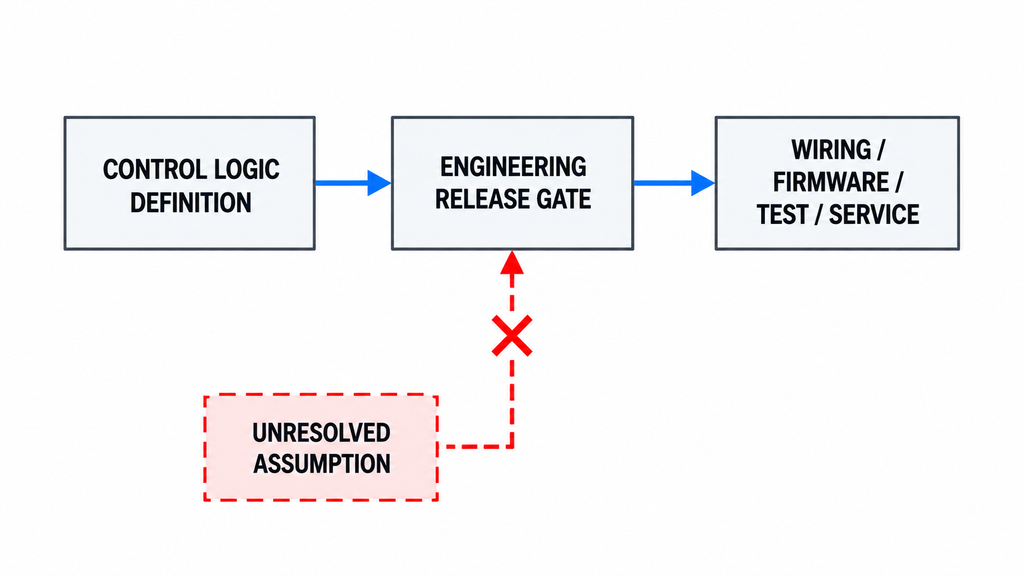
Before freezing the harness or controller software:
- Freeze the interface revision: identify the actual pinout, communication document, register map, command definition, or other interface source used by the control logic.
- Define every permission condition: state what must be true before each critical transition is allowed.
- Name the authoritative state: identify the signal, field, measured condition, or combined logic that permits the controller to make each decision.
- Define failure behavior: document what the controller does when a command, status, or expected transition is missing, stale, invalid, or contradictory.
- Define protection recovery: record what blocks operation, what permits reset, and what confirms completion of the recovery rule.
- Define channel identity: ensure every command, status, alarm, and recovery action can be associated with the correct module or channel where more than one is present.
- Separate interface state from RF evidence: use RF power amplifier testing to verify measured RF performance instead of treating a digital response as proof of it.
- Assign verification responsibility: identify who will verify each critical rule during integration or acceptance.
- Record unresolved dependencies: do not freeze an assumption as though it were a confirmed interface fact. Obtain the missing product, protocol, protection, timing, or test evidence first.
- Align the acceptance plan: determine which control transitions need to be demonstrated or logged before the system is approved.
The engineering output should be a controlled definition that firmware, wiring, RF, test, and integration teams can interpret consistently.
That definition does not prove that a specific PA, firmware revision, protection implementation, or delivered unit meets the project requirement. Where acceptance depends on exact timing, thresholds, RF performance, protection response, or other model-specific behavior, applicable product or test evidence is still required.
Conclusion:
RF power amplifier control logic should be defined early enough that wiring, firmware, test planning, and service behavior can all follow the same state-transition rules. The central task is not to create the longest possible list of Enable, Alarm, Status, Reset, and communication functions. It is to define what each relevant event means, when it is valid, which source is authoritative, what action follows, and how the system behaves when the expected transition does not occur.
That framework can make integration decisions explicit, but it cannot replace the actual module interface, protocol specification, protection definition, project acceptance criteria, or model-specific test evidence. In particular, an interface signal or digital response should not be interpreted as proof of a different operating or RF condition unless that relationship has been defined and verified.
Before releasing the next wiring or firmware revision, complete the control-logic matrix with the RF, controller, wiring, and test owners and mark every unresolved interface assumption. Obtain the missing evidence before those assumptions become embedded in the build.
Once that matrix is defined, use the Custom RF Power Amplifier Modules page to identify candidate module families, then confirm from the applicable interface evidence that a candidate PA can provide the commands, states, protection feedback, recovery behavior, and evidence required by the project. For an RFQ or integration review, prepare the module and channel plan, controller or interface type, enable conditions, required status and alarm states, reset and recovery rules, communication-loss behavior, timing expectations, and required acceptance evidence, then send the project requirements to RF SKYPOWER for engineering review.