


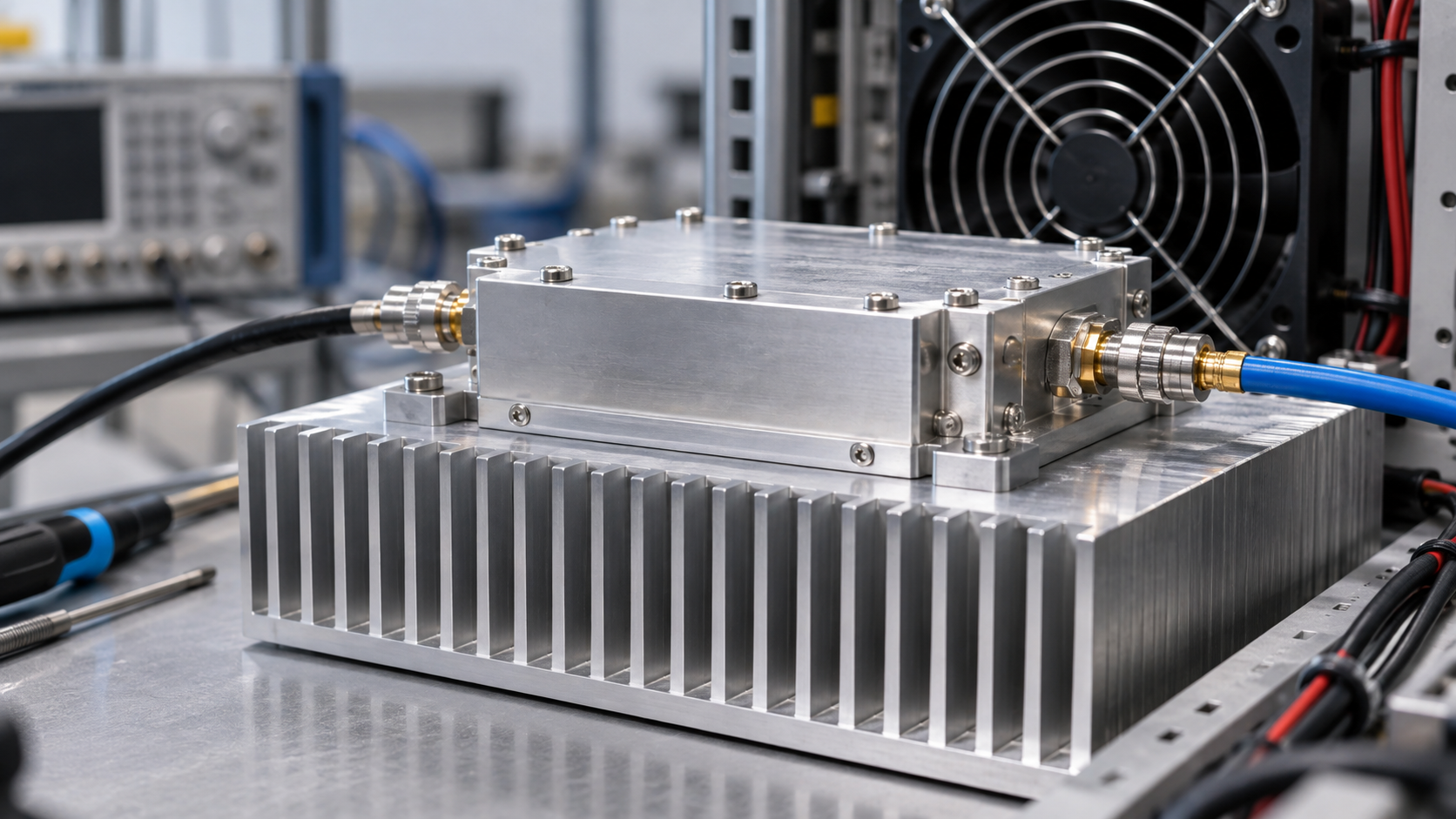
RF PA thermal grease can become a hidden integration risk even when the module looks normal during a short bench test. Excess material, incomplete coverage, contamination, uneven contact, or an uncontrolled mounting process can increase interface resistance and contribute to local heating or unstable hot-state behavior.
The engineering question is therefore not simply whether thermal grease was applied. It is whether the PA-to-heatsink thermal interface was created by a controlled process, whether the relevant surfaces and mounting condition are acceptable, and whether the completed assembly behaves consistently under the operating condition that matters to the project.
Thermal grease is only one part of RF power amplifier thermal management, so this article isolates the grease/TIM interface rather than the complete heat path. Its scope is application control, surface condition, mounting influence, inspection limits, hot-state correlation, and the evidence needed before that interface is accepted.
1. What RF PA Thermal Grease Must Control
Thermal grease is used to reduce air-filled microscopic gaps between mating thermal surfaces. Its purpose is not to create the thickest possible conductive layer, nor does visible grease alone prove a good interface.
The acceptable interface depends on the specific grease or TIM, surface condition, module geometry, mounting design, and approved assembly process.
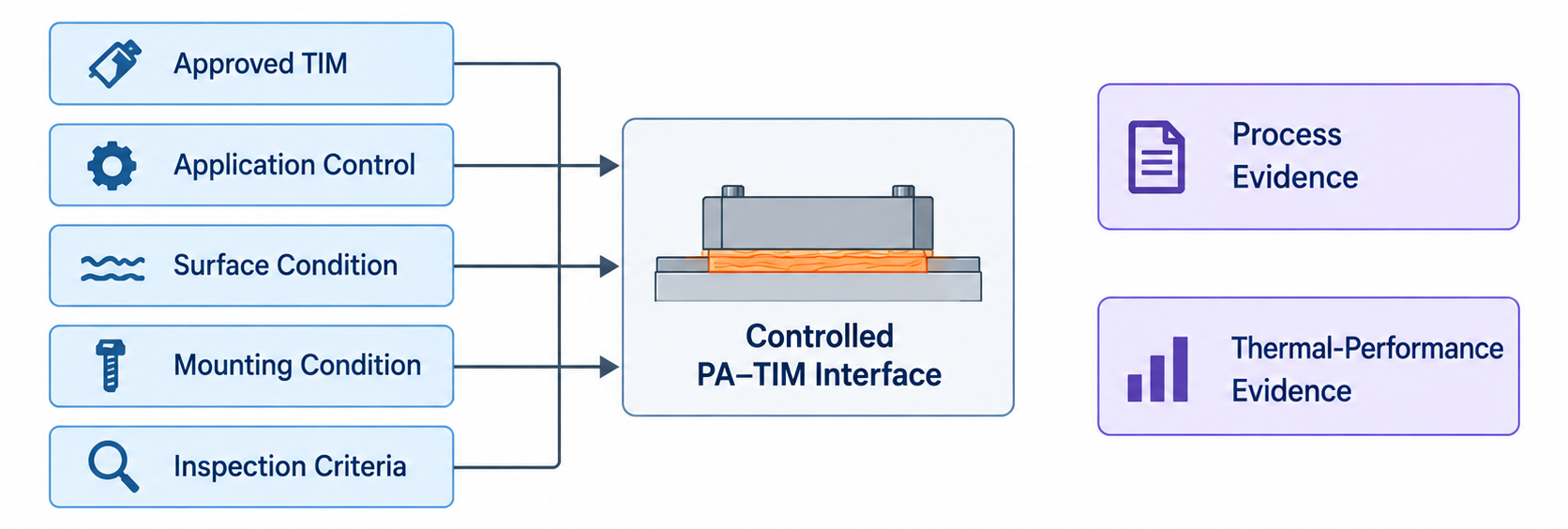
A controlled interface should define:
- the approved thermal-interface material;
- application method or quantity control;
- required coverage boundary;
- cleanliness of both mating surfaces;
- applicable surface-condition requirements;
- mounting condition;
- inspection criteria;
- rework or reassembly requirements;
- the evidence used to evaluate the completed assembly.
The important distinction is between process evidence and thermal-performance evidence.
A documented grease application can show that the intended process was followed. It does not by itself prove that the completed PA will maintain acceptable thermal and RF behavior during the required operating duration.
Likewise, a photo showing visible grease at the edge can help identify gross application problems, but it cannot establish the complete internal bond-line thickness, full-area coverage, contact pressure, or thermal resistance.
That limitation should remain explicit during inspection and approval.
2. Why Too Much or Too Little Thermal Grease Creates Interface Risk
Both insufficient and excessive thermal grease can create interface problems.
Too little material may leave areas where microscopic voids or larger gaps remain poorly filled. Depending on the mating surfaces, this can create localized regions with higher thermal resistance.
Too much material can also be undesirable if it creates an unnecessarily thick interface or redistributes unevenly during assembly.
The correct target is therefore not “as little as possible” or “as much as possible.” The application should follow the boundary established for the actual material, contact surfaces, module geometry, and mounting process.
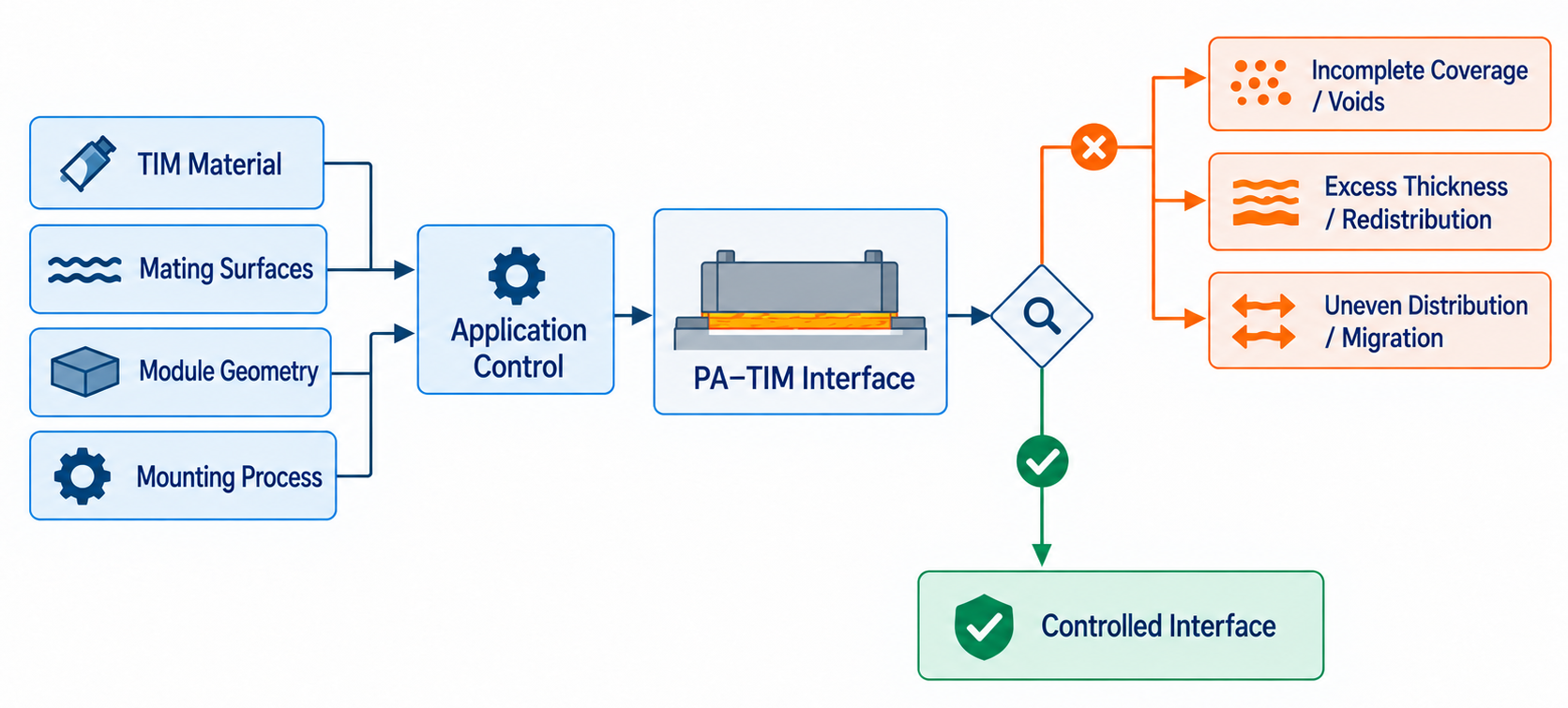
Potential interface problems include:
- incomplete coverage;
- dry contact zones;
- trapped voids;
- excessive local material thickness;
- contamination;
- uneven distribution;
- material migration;
- unit-to-unit application variation.
The word thin should not be treated as a universal numerical requirement. Different materials and interface designs can require different application methods or bond-line conditions.
What matters is whether the approved process produces a controlled and repeatable interface for the actual mechanical design.
Edge squeeze-out needs the same caution.
An even edge trace may be useful as one visual process indicator when the approved assembly method expects it, but it is not proof of internal coverage or correct bond-line thickness. Large squeeze-out is not automatically better, and limited visible squeeze-out is not automatically a failure.
Inspection criteria must therefore be tied to the process being used rather than to a generic visual rule.
3. How Surface Condition Changes Thermal-Grease Contact
Thermal grease cannot compensate for every mechanical defect.
If the PA baseplate, heat spreader, or heatsink mating surface has poor flatness, local damage, contamination, burrs, or another contact defect, adding more grease may hide the gap visually without solving the underlying interface problem.
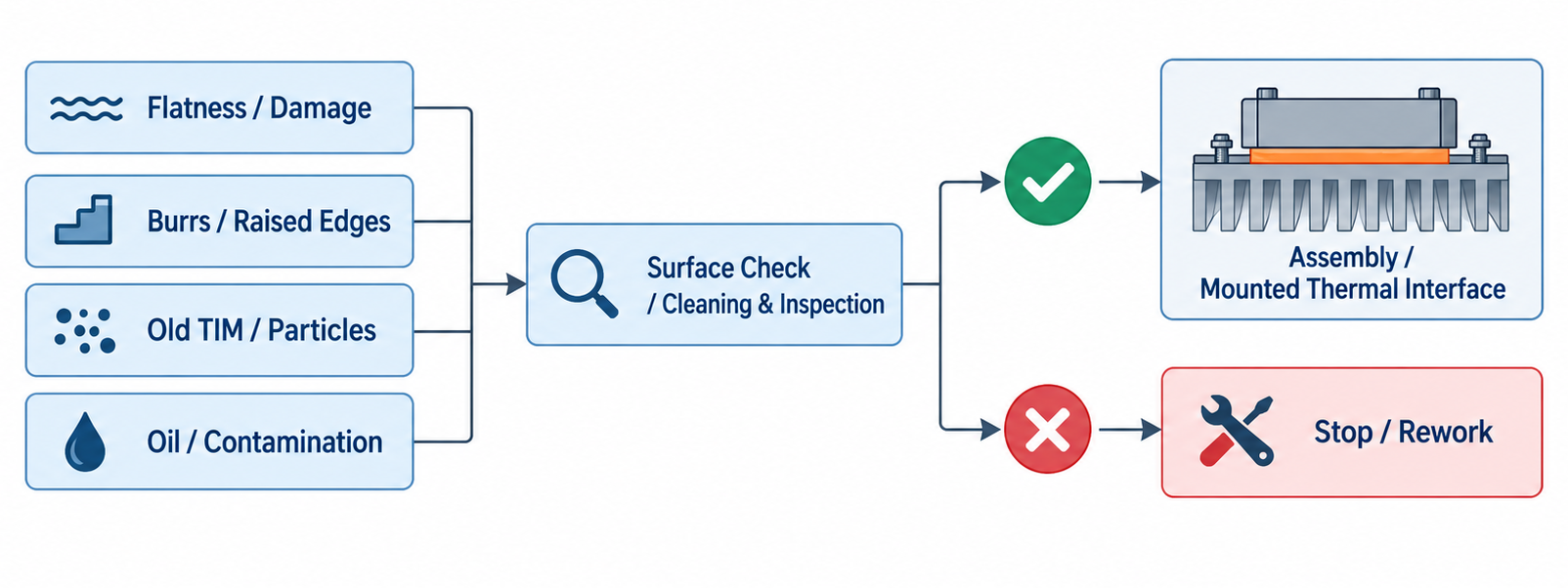
Surface condition can affect how the interface material distributes under mounting pressure. Relevant checks may include:
- flatness where specified;
- surface damage;
- burrs or raised edges;
- machining defects;
- residual old TIM;
- dust or metal particles;
- oil or fingerprints;
- oxidation or other contamination.
Cleaning and inspection should therefore belong to the controlled assembly process rather than being treated as an informal visual step.
Material choice alone also does not prove interface quality. A copper RF power amplifier heat sink can improve heat spreading, but it cannot by itself correct poor contact, contamination, uncontrolled grease application, or an unsuitable mounting condition.
If the decision depends primarily on heatsink mass, material, geometry, airflow, or the complete external heat path rather than the grease interface, the problem has moved beyond the scope of thermal grease alone. The existing RF PA heatsink design review should then be considered separately.
The grease review should therefore answer a narrower question:
Are the two mating surfaces and the interface material controlled well enough that the grease layer is not being asked to compensate for a separate mechanical or cooling problem?
4. What Mounting Pressure Must Control—and Where the Grease Review Stops
Mounting pressure affects how the thermal-interface material distributes and how the mating surfaces are brought together.
Uneven loading can contribute to local differences in interface condition. A well-controlled grease application can therefore still produce a weak result if the mechanical joint does not create the intended contact condition.
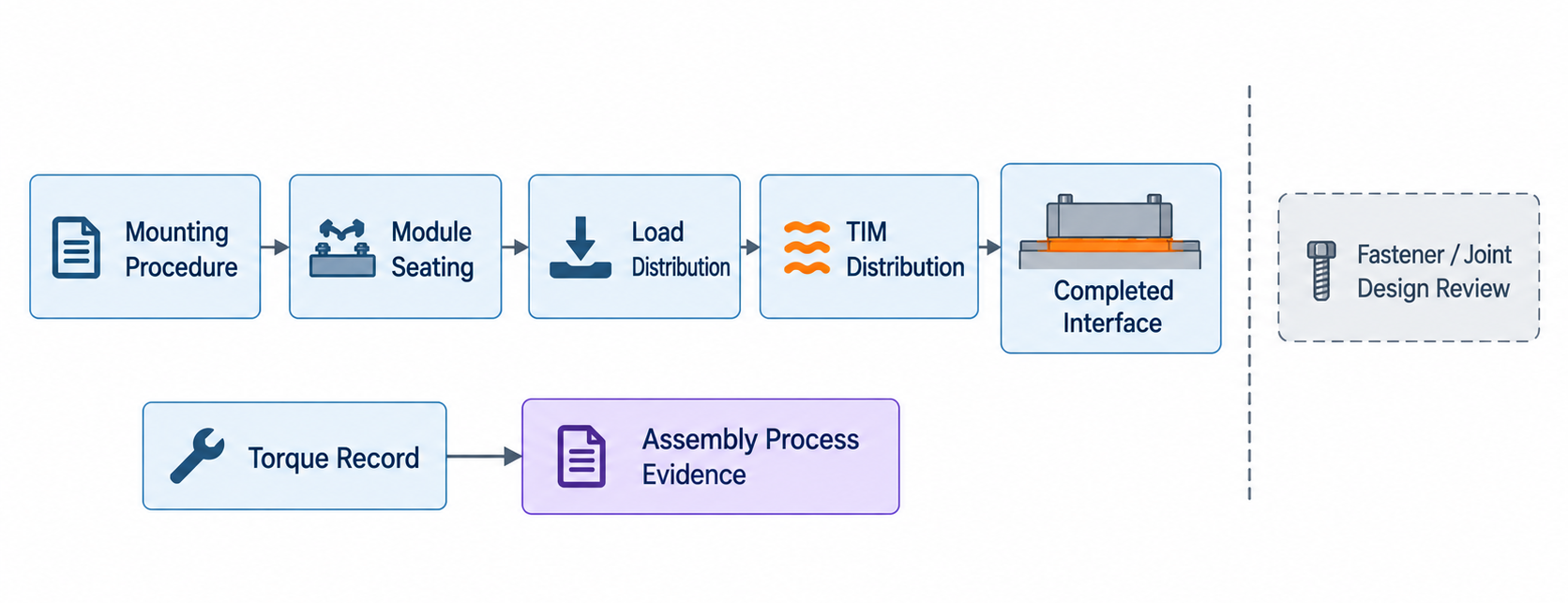
For the thermal-interface review, the important checks are limited to whether:
- the module is seated correctly;
- mounting load is distributed as intended;
- the approved assembly method is followed;
- the interface is not visibly displaced or disturbed;
- the completed joint does not show signs of distortion or abnormal contact.
Torque should be treated carefully.
A torque value is an assembly control input, not a direct measurement of thermal contact quality. Actual preload can also depend on the fastener, thread, washer, lubrication, surface condition, joint geometry, and assembly process.
This article therefore should not establish universal torque values, tightening patterns, washer requirements, or thread-engagement rules.
Where acceptance depends on preload, torque, thread engagement, or joint retention, use the applicable mechanical specification and RF PA fastener control requirements rather than treating grease inspection as proof of joint quality.
Reassembly also requires a defined boundary. Removing the module can disturb the existing interface, introduce contamination, or change material distribution. The old grease should not automatically be assumed suitable for reuse.
After removal, follow the approved cleaning, reapplication, and reassembly procedure for the specific interface rather than relying on the previous visible condition.
The thermal-grease decision ends once the question becomes primarily one of fastener preload, joint design, mechanical distortion, or structural retention.
5. When Hot-State Drift Makes the Thermal Interface a Suspect
Thermal-interface problems may become visible only after the PA has accumulated enough heat for the relevant thermal path to matter.
A short cold-state output test therefore cannot establish that the grease interface is acceptable for long-duty operation.
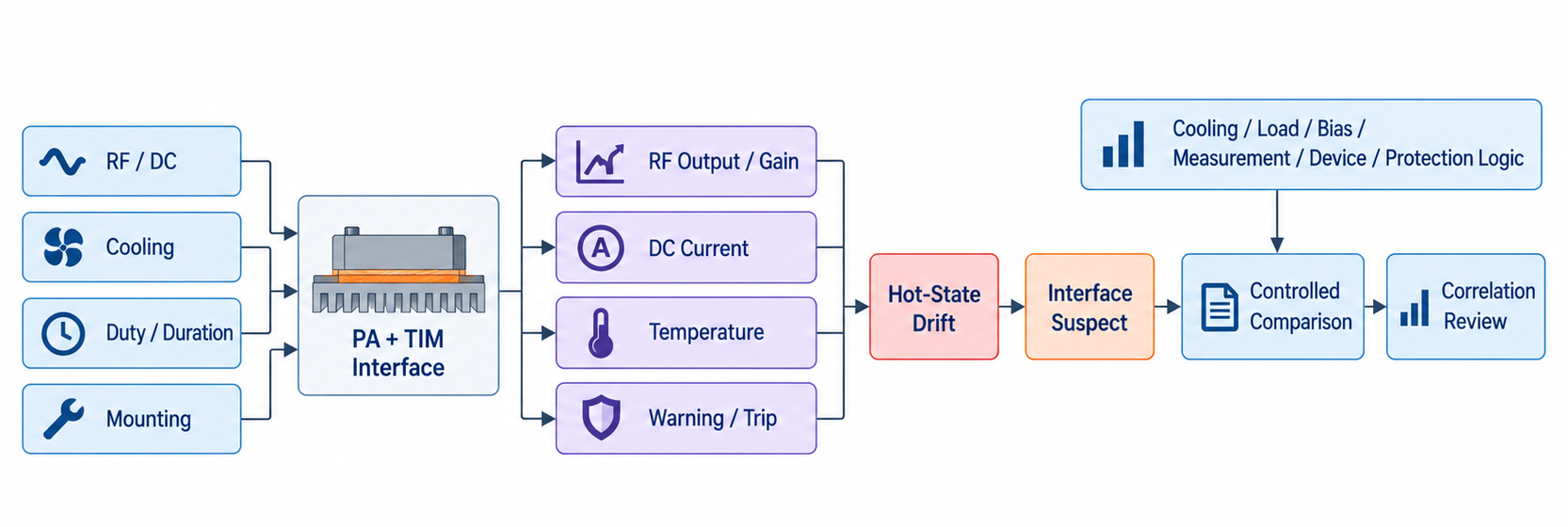
Possible observations during heat buildup can include:
- RF output drift;
- gain change;
- changing DC current;
- faster-than-expected temperature rise;
- earlier thermal warning or protection;
- inconsistent recovery;
- repeated-test variation.
These observations can make the thermal interface a suspect, but they do not prove that grease is the root cause.
Similar symptoms may also arise from the heatsink, airflow, cooling boundary, temperature measurement, device behavior, bias condition, protection logic, RF load, or another part of the system.
The correct next step is to compare behavior under sufficiently aligned operating conditions and determine whether the interface remains a credible mechanism.
If the question is whether RF output remains acceptable after the assembly reaches the required hot condition, existing thermal soak power data can provide the deeper hot-state evidence needed for that decision.
The thermal-grease review itself should focus on correlation:
Does the observed hot-state behavior justify inspecting or reworking the interface, and does the behavior change when the interface condition is validly isolated?
A before-and-after result can strengthen the diagnosis only when the other decision-relevant conditions are sufficiently controlled. Changing grease while also changing the heatsink, airflow, mounting, drive condition, or test setup does not isolate grease as the cause.
An RF amplifier over temperature protection event does not automatically prove a thermal-interface failure, because the trigger may originate elsewhere in the thermal or control path.
If alarm behavior itself is unclear, treat it as a separate protection-logic question rather than evidence of grease failure.
6. What Thermal-Interface Process Evidence Buyers Should Check
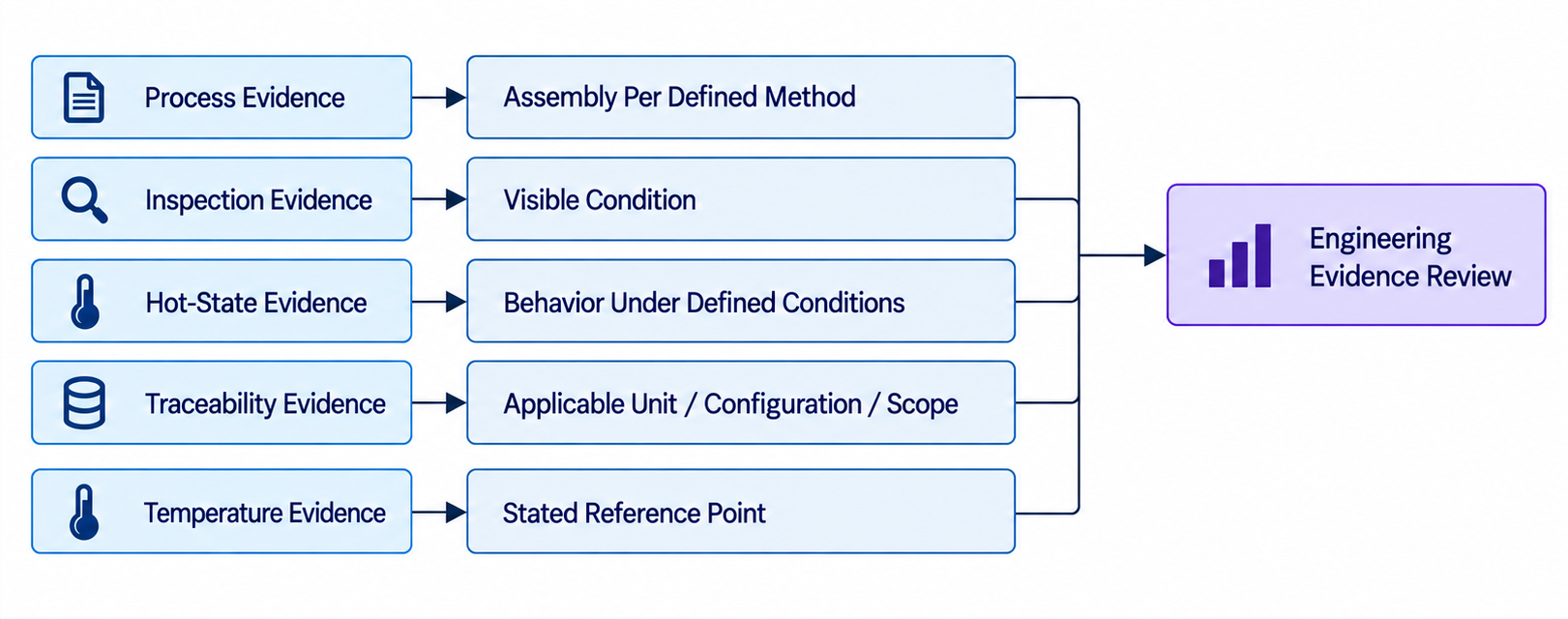
Thermal-interface approval should distinguish what each type of evidence can actually support.
A process record can support repeatability. An inspection can identify visible defects. A hot-state test can show how the completed assembly behaved under defined conditions. None of those evidence types should automatically be expanded beyond its actual scope.
Thermal Interface Control & Acceptance Map
| Control Item | Process Boundary | Evidence | What It Supports | What It Cannot Prove |
|---|---|---|---|---|
| Interface material | Approved grease/TIM and applicable process | Material identification or controlled work instruction | Correct material/process basis | Installed hot-state performance |
| Application | Defined application method, quantity, or coverage rule | Application record or process inspection | Process repeatability | Exact internal bond-line condition across the full interface |
| Surface condition | Defined mating surfaces before assembly | Cleaning and surface inspection record | Absence of identified visible contamination or damage | Complete thermal-path performance |
| Mounting influence | Applicable assembly/mounting procedure | Assembly or torque-process record where required | Process was performed to the defined method | Actual interface thermal resistance by itself |
| Visual interface condition | Approved inspection boundary | Visual inspection, including squeeze-out where relevant | Detection of specified visible abnormalities | Full internal coverage, pressure distribution, or correct thickness |
| Temperature evidence | Defined physical measurement point | Temperature record with stated location | Temperature at the stated reference point | Junction, case, baseplate, or other temperatures not measured or validly derived |
| Hot-state behavior | Defined RF/DC, cooling, duty, duration, and thermal condition | Hot-state RF/DC/temperature record | Behavior of the evaluated assembly under those conditions | Grease as the confirmed root cause by itself |
| Traceability | Identified unit, configuration, process revision, or sample scope | S/N or other applicable traceability record | Scope to which the evidence applies | Automatic proof for an entire batch, series, or future units |
An RF amplifier baseplate temperature value is useful only when the measurement point, operating condition, and acceptance reference are identified.
Heatsink edge temperature, local baseplate temperature, case temperature, inlet-air temperature, and other reference points cannot be treated as interchangeable.
Where measurement location changes the acceptance meaning, define the physical temperature reference point before comparing results.
Evidence scope also matters.
A test record from one identified unit supports that evaluated unit under the recorded conditions. Representative-sample evidence may support a defined sampling decision, but it should not automatically be described as delivered-unit proof.
If unit-level traceability is required, it should be specified explicitly rather than inferred from a generic statement such as “factory tested.”
Thermal-interface process changes deserve the same discipline. Changes to grease material, application volume, mounting condition, mating surfaces, machining, or heatsink fit can alter the interface being evaluated.
When such changes occur between revisions or batches, they should be handled through the applicable RF PA process-change review rather than assuming previous evidence automatically remains representative.
7. What Must Be Defined Before Thermal-Interface Approval
Before approving the interface, convert vague expectations such as “thermal grease applied” or “good cooling” into defined requirements.
At minimum, the project should identify:
- the PA/module configuration being evaluated;
- the approved interface material or material requirement;
- applicable mating surfaces;
- application or process-control requirement;
- mounting-process responsibility;
- inspection criteria;
- relevant cooling condition;
- required duty cycle and operating duration;
- temperature reference point;
- hot-state evidence requirement;
- required evidence scope;
- rework or process-change handling where relevant.
Do not turn each item into an unsupported universal specification.
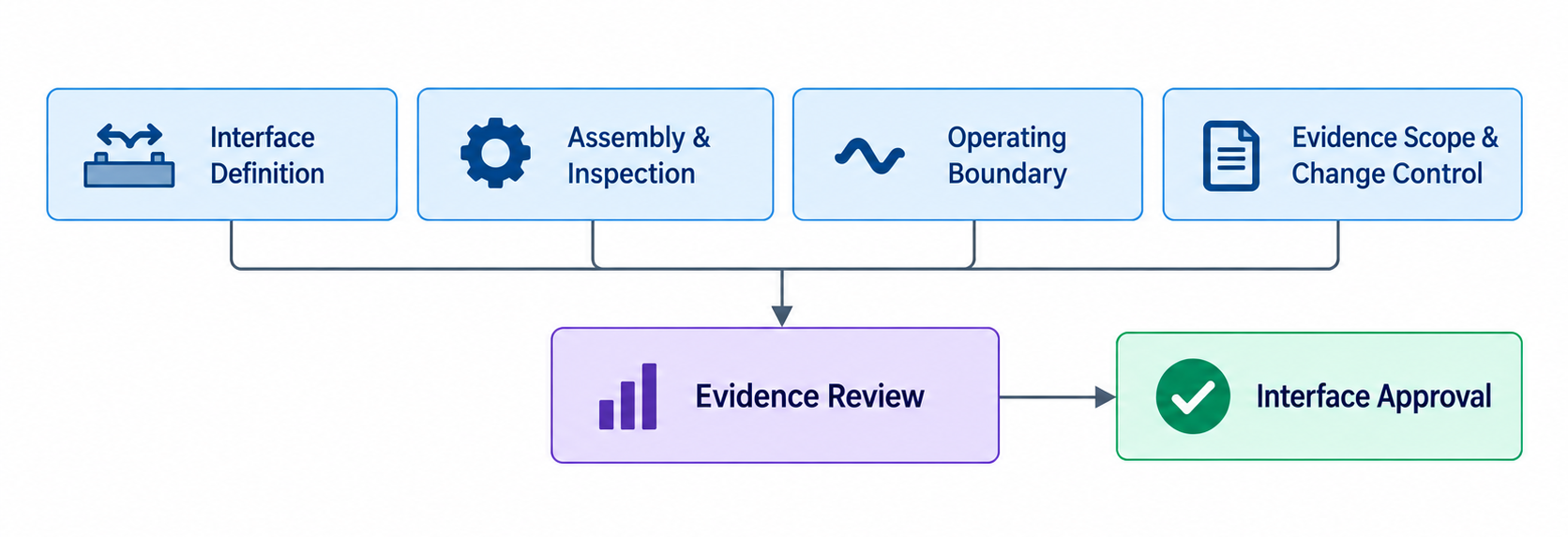
For example, the RFQ should not invent a generic grease thickness, torque value, or temperature threshold when those values depend on the actual material, mechanical design, or product evidence.
Instead, request the applicable controlled requirement and the evidence showing how it is verified.
The approval logic should remain simple:
Process evidence answers whether the interface was assembled under a defined method.
Inspection evidence answers whether specified visible conditions were checked.
Hot-state evidence answers how the completed assembly behaved under the recorded RF, DC, thermal, cooling, and duration conditions.
Traceability evidence answers which unit, configuration, revision, or sample scope the result applies to.
No single item should be expanded into proof of the others.
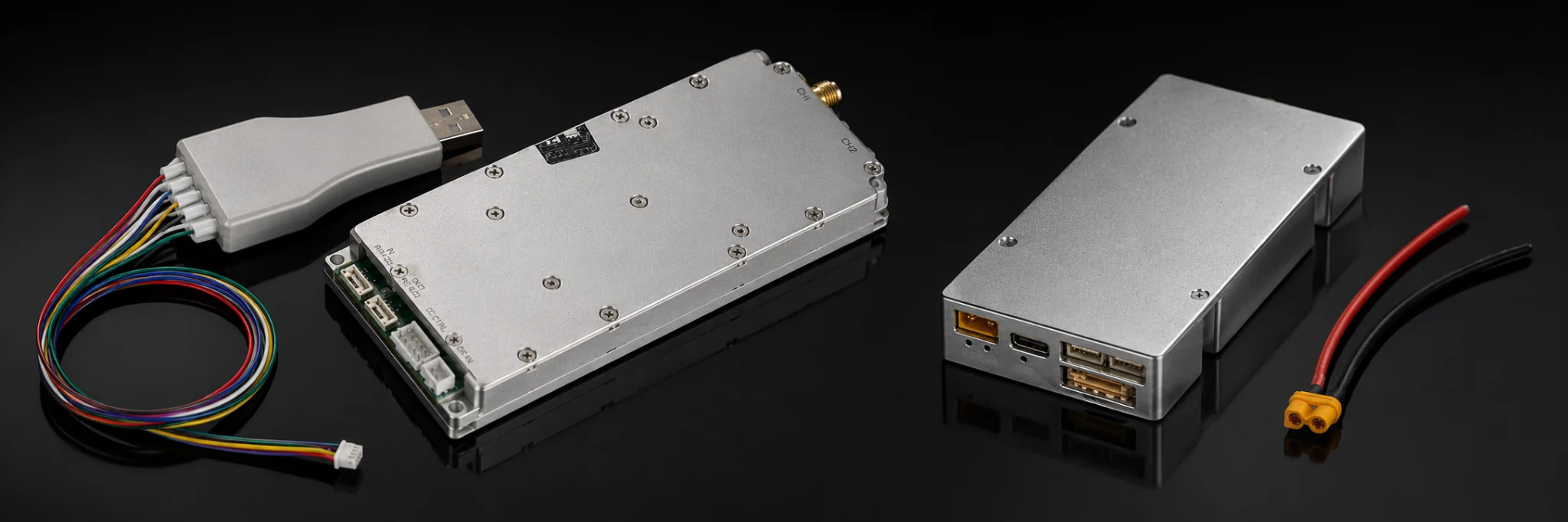
For projects where long-duty RF output depends on controlled thermal-interface quality, RF SKYPOWER’s RF Power Amplifier Modules can be reviewed against the project’s output, duty-cycle, cooling, mounting, thermal-interface, protection, and evidence requirements before RFQ.
Product or configuration discovery does not by itself prove that a particular PA will meet the installed thermal requirement. That decision still depends on the applicable module evidence and the final integration condition.
FAQ
Can too much thermal grease make RF PA cooling worse?
It can. Excess material may create an unnecessarily thick interface or redistribute unevenly during assembly. However, “thinner is always better” is also too broad. The acceptable application depends on the grease/TIM, mating surfaces, mechanical design, and approved process.
Can a copper heatsink fix poor grease contact?
Not by itself. Copper can improve heat spreading, but it does not automatically correct contamination, poor flatness, incomplete interface control, trapped gaps, or unsuitable mounting. Heatsink performance and grease-interface quality must be judged as separate parts of the complete heat path.
How do I know if grease is causing output drift?
Hot-state output drift can make the interface a reasonable suspect, but it does not confirm the root cause. Compare RF, DC, temperature, cooling, duty, and mounting conditions, inspect the interface, and isolate the relevant change before concluding that thermal grease caused the drift.
Conclusion
RF PA thermal grease should be approved as a controlled thermal interface, not from the presence of visible grease or a short cold-state output pass.
A defensible interface review combines the approved material and application process with mating-surface condition, mounting control, defined inspection criteria, and hot-state evidence under the operating conditions relevant to the project.
The most important interpretation boundary is that no single observation proves the whole interface. Visible squeeze-out does not prove internal coverage, a torque record does not directly prove thermal resistance, and hot-state drift does not by itself prove that grease is the root cause.
Before approval, define the interface process, temperature reference, cooling condition, duty and duration, hot-state evidence, and the unit or sample scope to which that evidence applies.
If the remaining uncertainty is primarily about heatsink geometry, fastener mechanics, temperature measurement, thermal protection, or stabilized RF performance, move that question to the corresponding engineering review rather than forcing the grease interface to explain the entire thermal system.
For an RFQ, document the thermal-interface requirements that actually matter to the project and request evidence at the appropriate scope. RF SKYPOWER can then review those requirements against the proposed PA configuration without treating configuration selection itself as proof of installed thermal performance.