
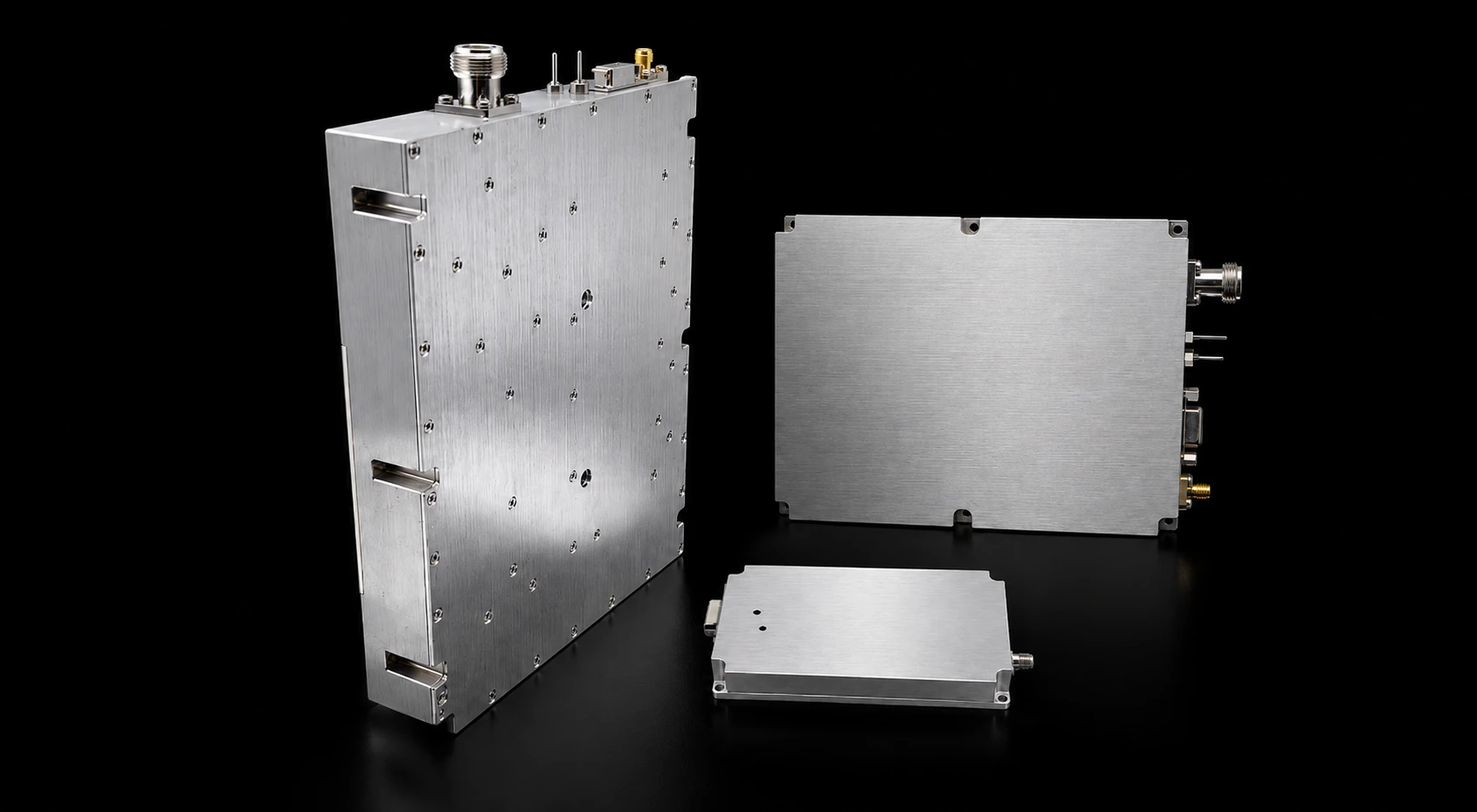
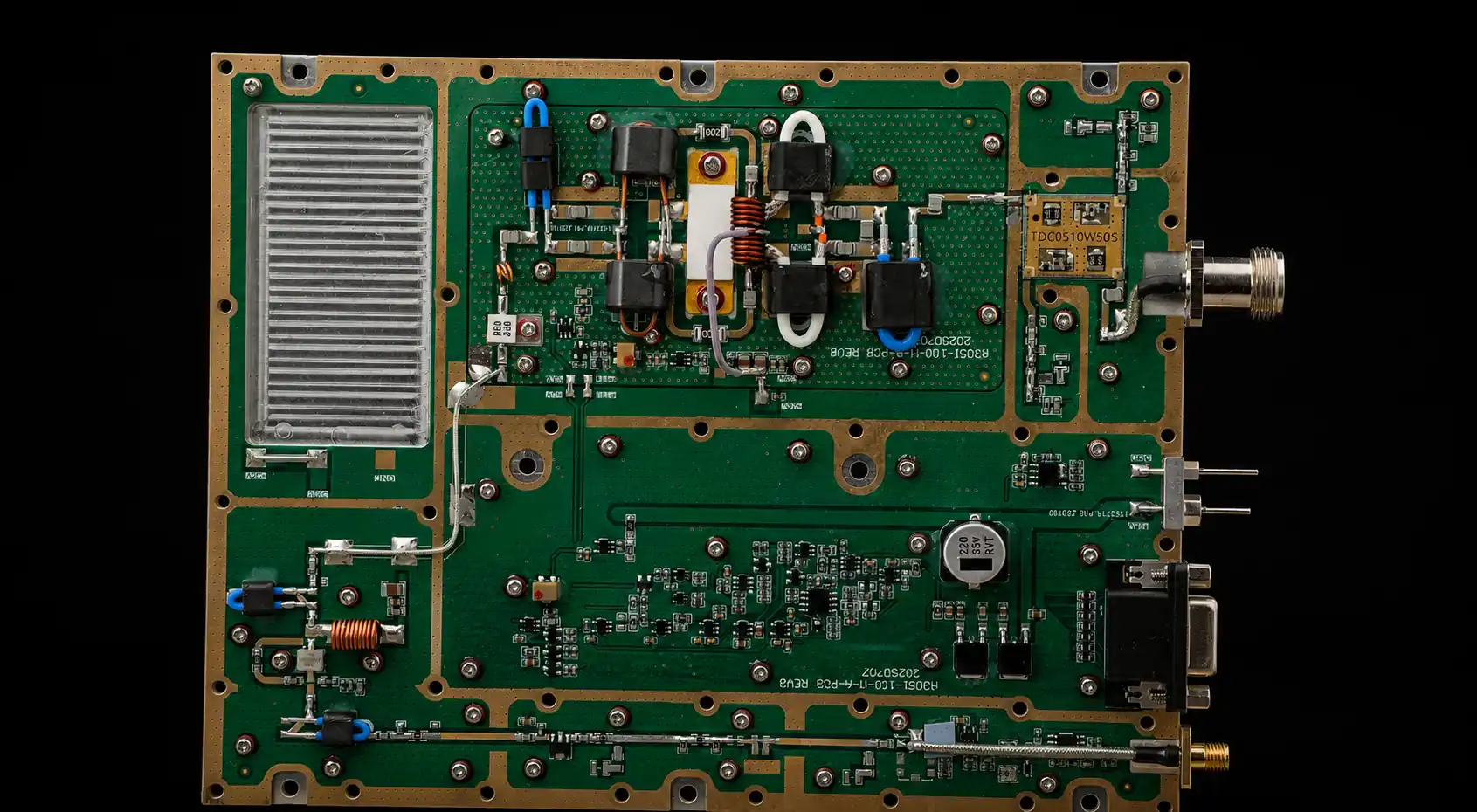
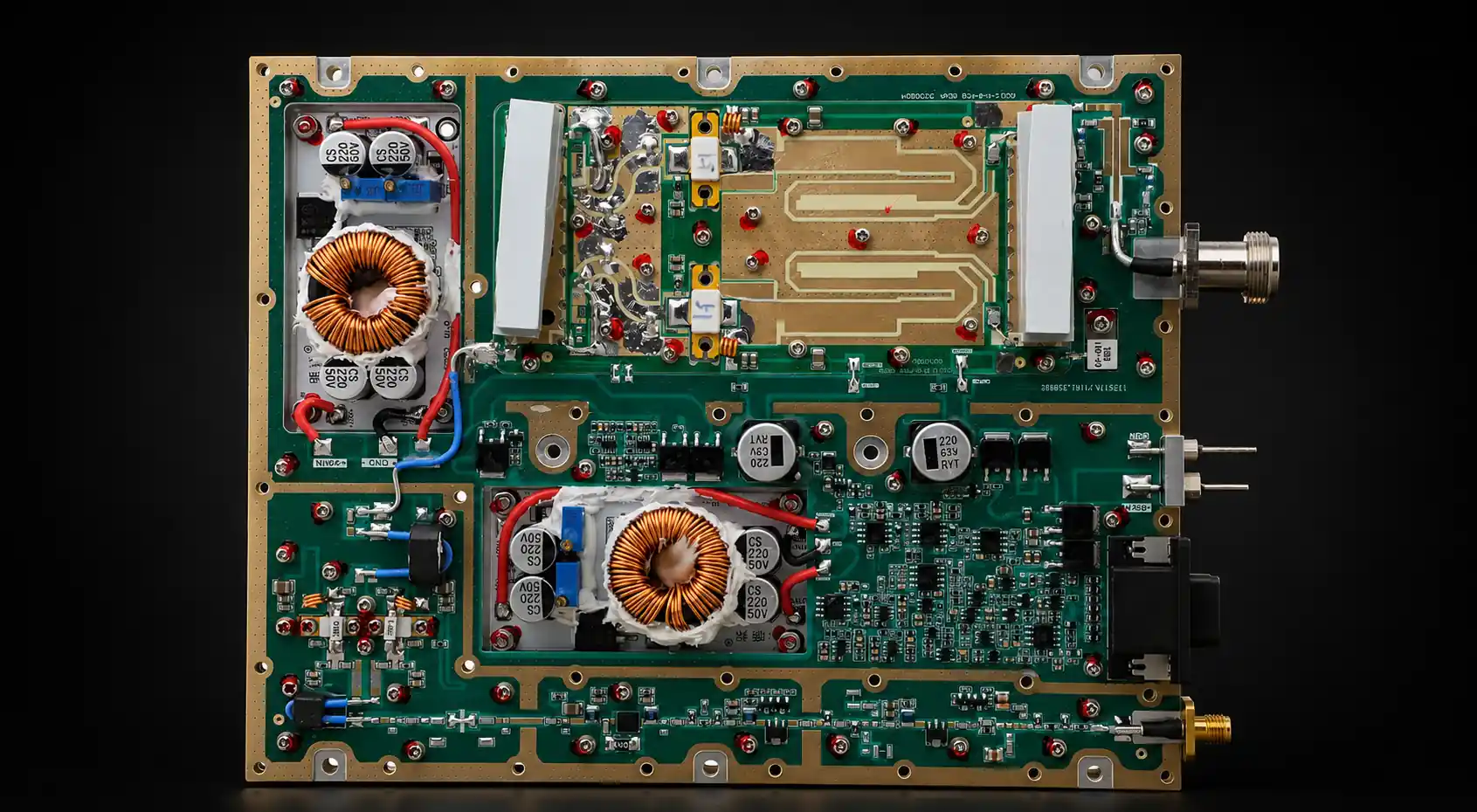
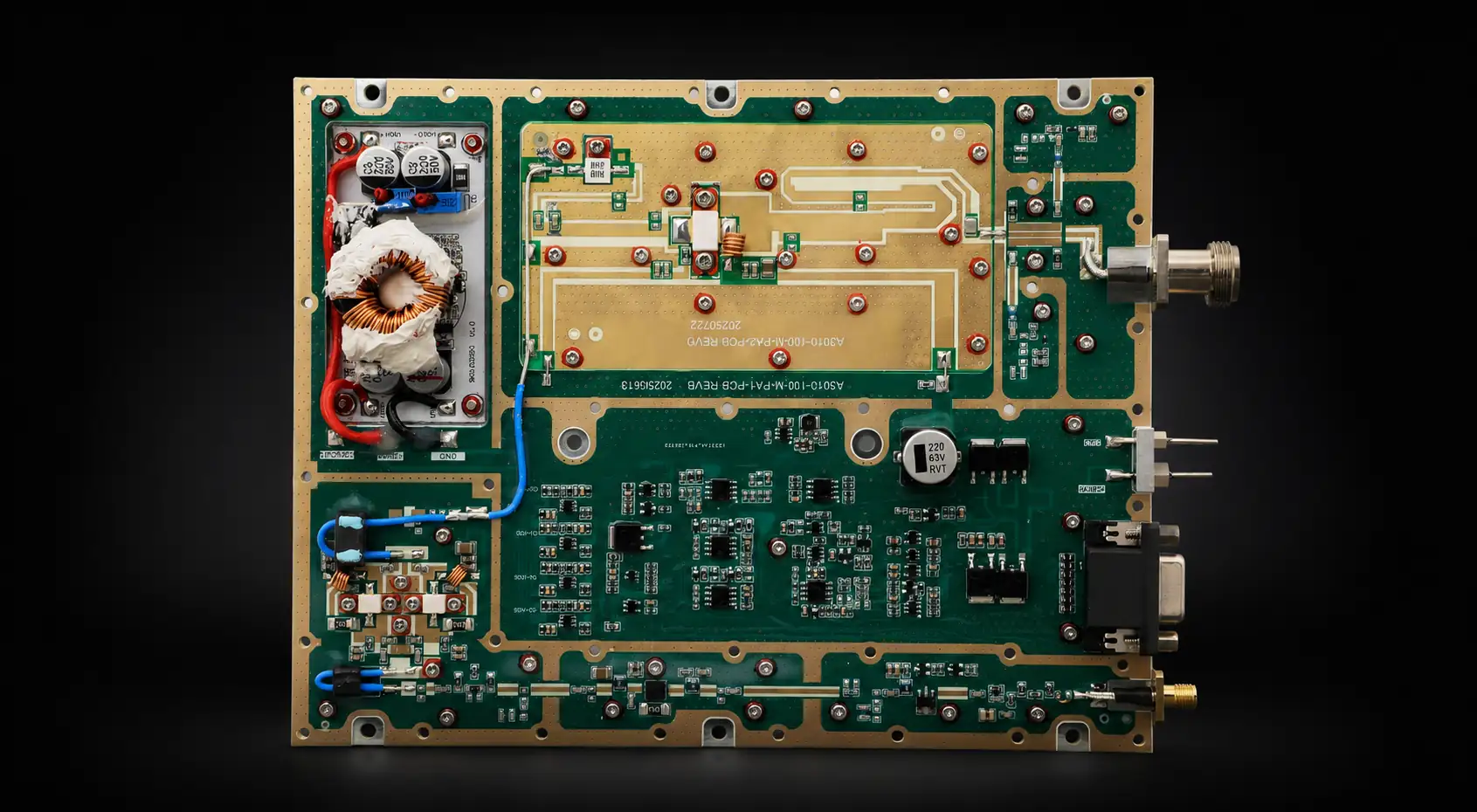
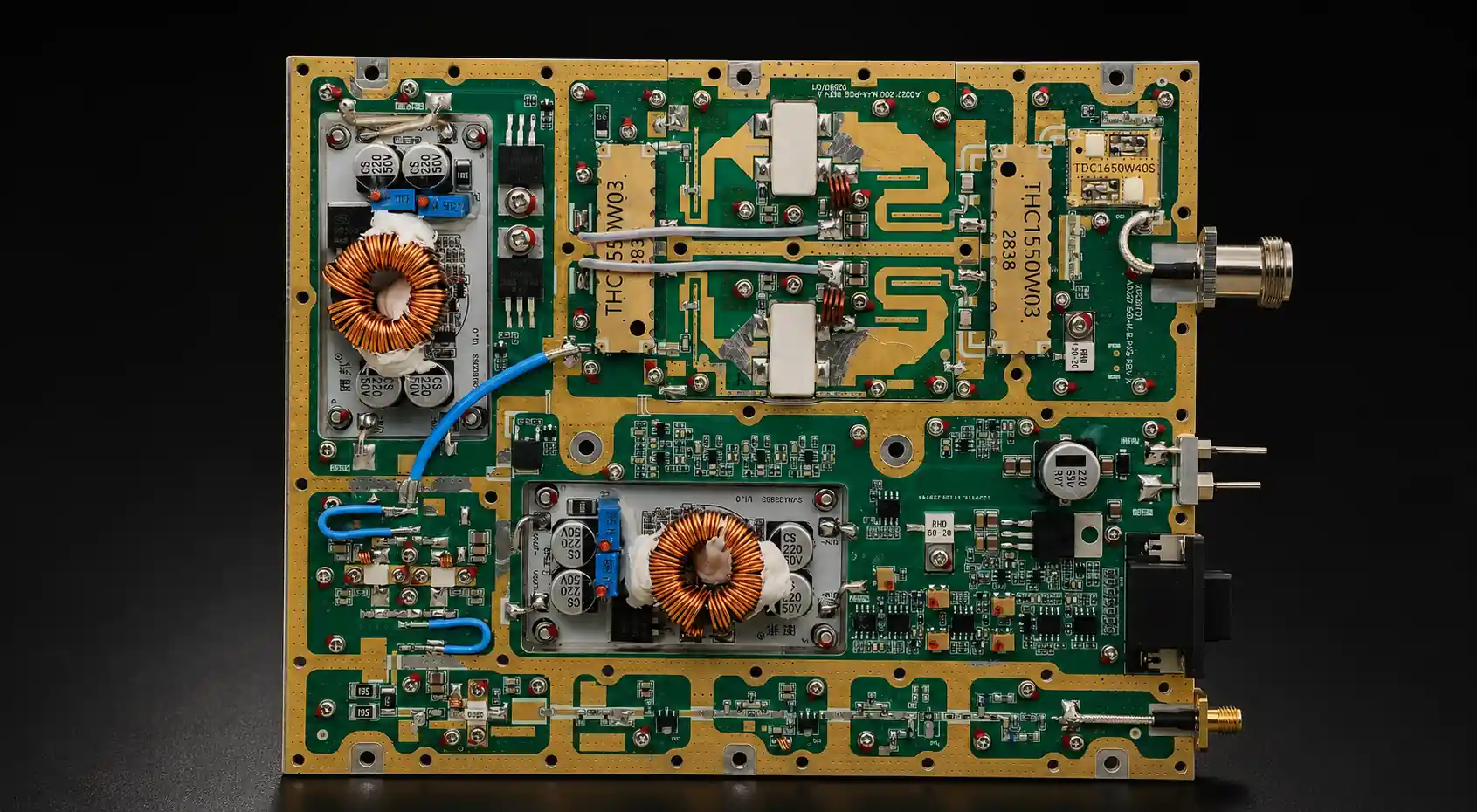
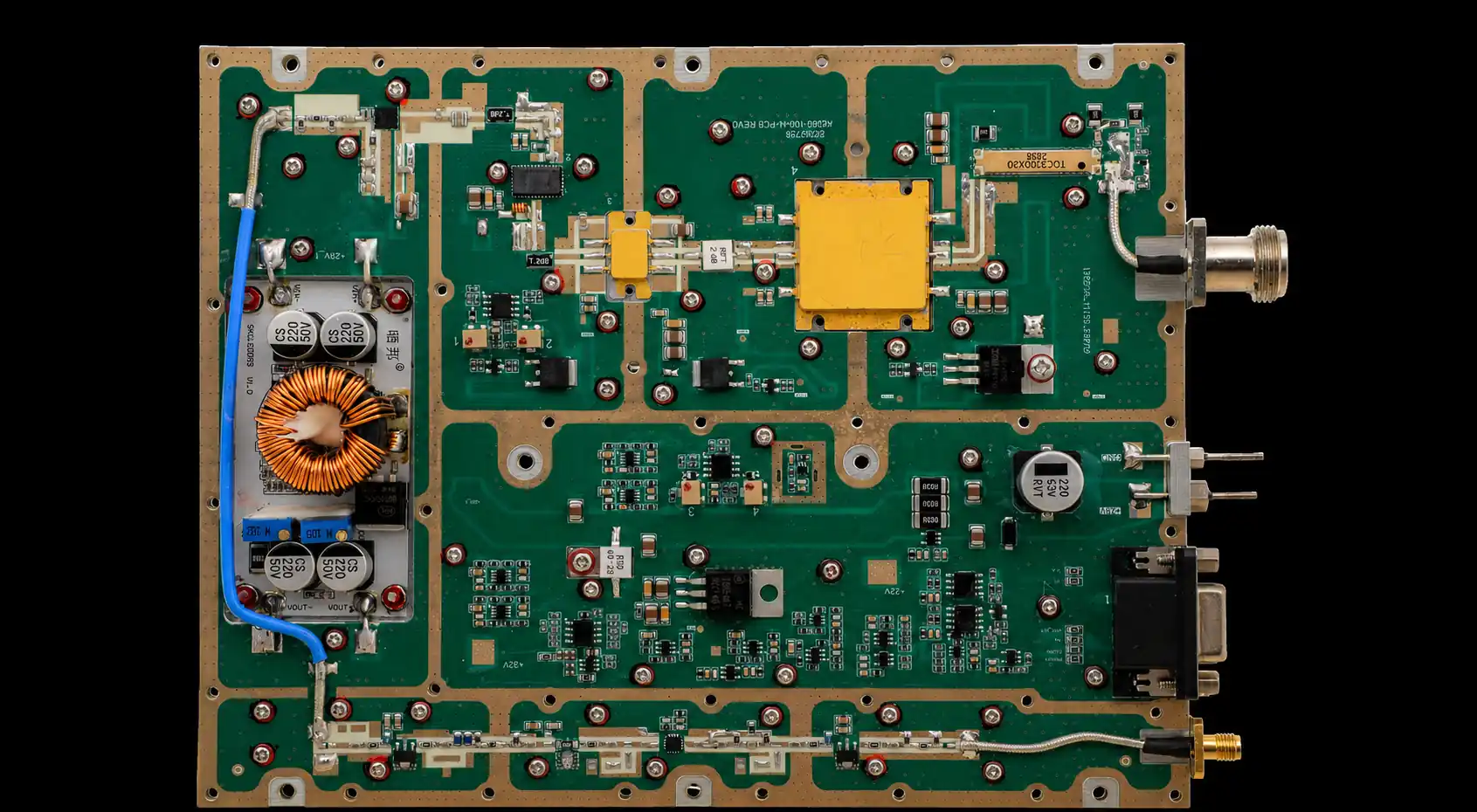
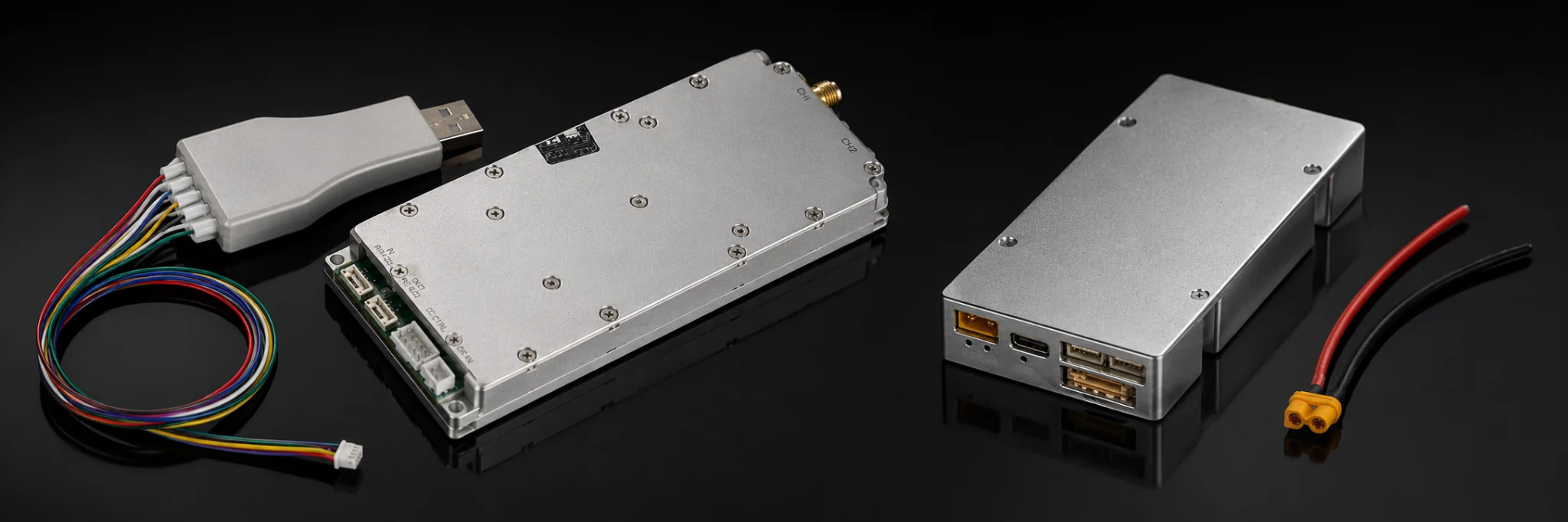

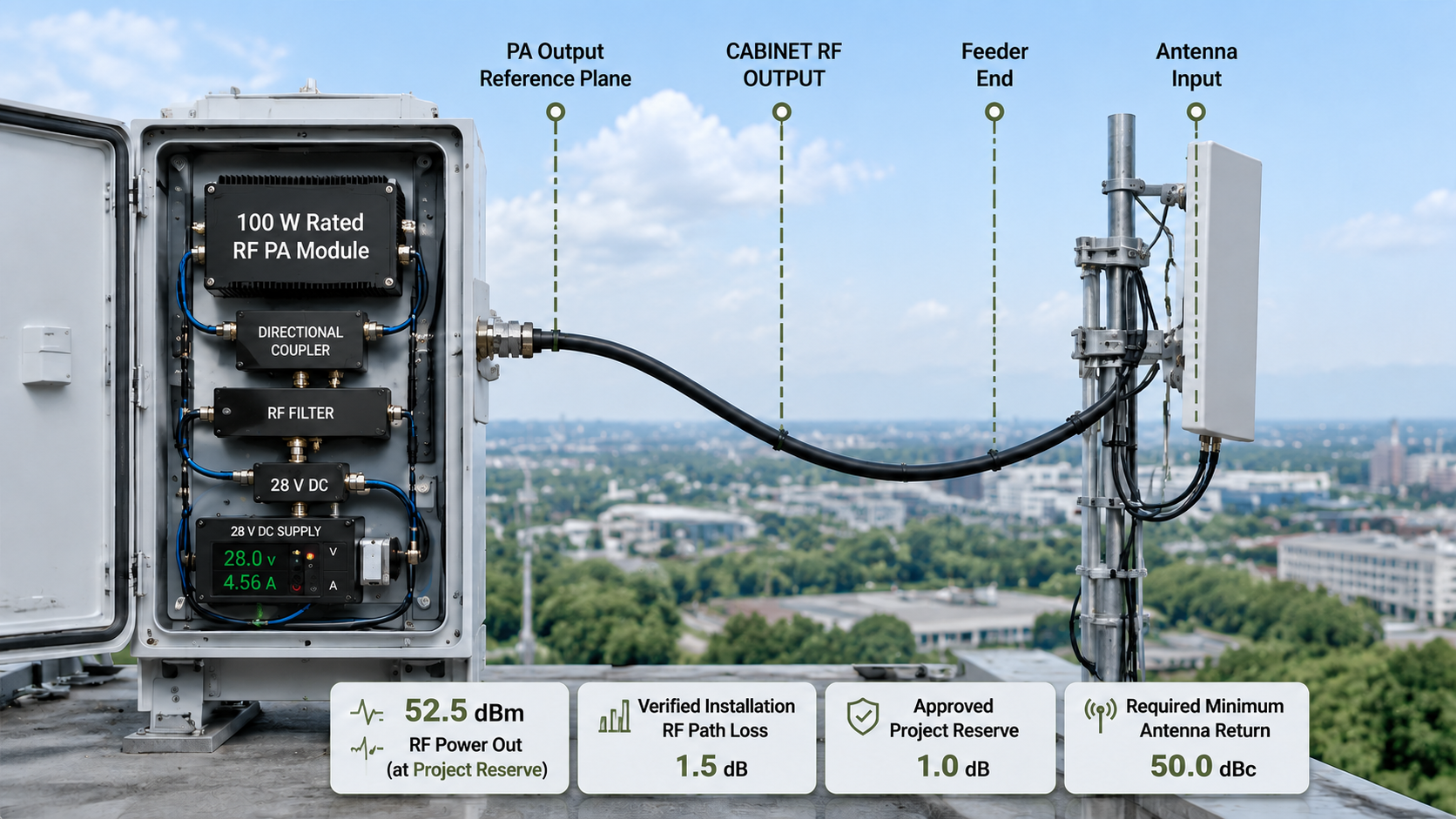
Usable RF output power is not simply the wattage printed on an RF PA label. It is the minimum power that remains available at a defined reference plane under the project’s required frequency, RF-path, thermal, DC, duty-cycle, and load conditions.
A 100 W rating may describe output at the PA connector under a controlled 50 Ω load. It does not automatically describe the power available after feeder cables, connectors, filters, RF switches, combiners, lightning protection, or other installed path elements. It also does not prove the minimum output available at band edges or after the module reaches its operating temperature.
For rooftop systems with long operating windows, verify continuous RF output after warm-up instead of treating a short PA-port measurement as proof of sustained downstream power.
This article focuses on the selection boundary. It explains how to define the required downstream output, identify the correct reference plane, account for verified RF-path loss, and work backward to the minimum PA-port output needed before selecting an RF PA power class.
The engineering decision should connect:
Required downstream output → Reference plane → RF-path loss → Minimum PA-port output → Operating conditions → RF PA selection
1. What Rated RF PA Output Power Actually Proves
Rated output power identifies the declared power class of an RF PA under stated conditions. It is useful for initial comparison, but it does not automatically prove the minimum output available in the installed RF system.
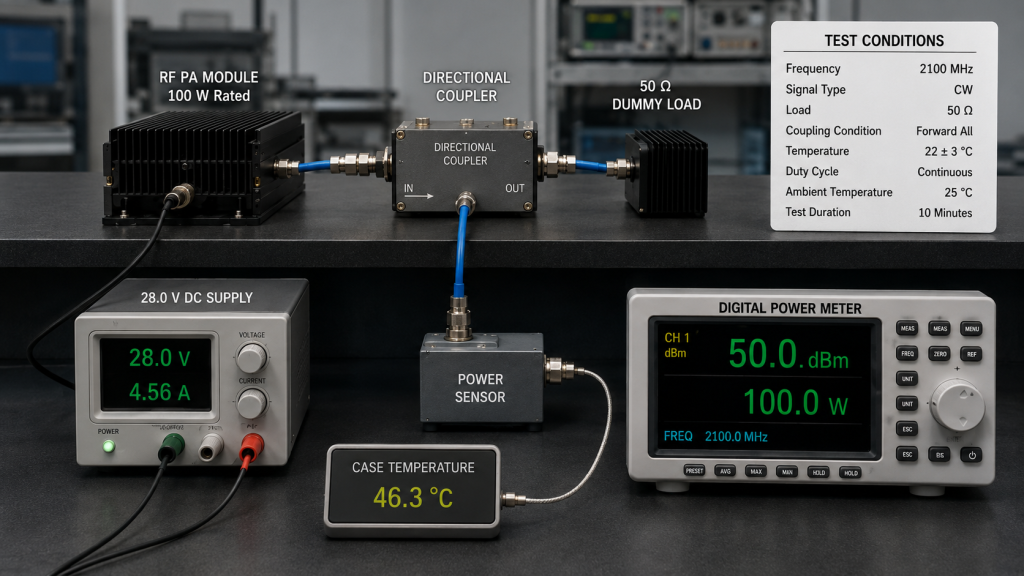
A meaningful rating should identify:
- Output reference plane
- Test frequency or frequency range
- RF input drive
- Module-side DC voltage
- Load condition
- Cooling condition
- Thermal state
- Duty cycle
- Test duration
Without these conditions, a wattage value is incomplete.
Rated, Typical, and Minimum Output Are Different
Three output descriptions should not be treated as interchangeable.
Rated output power is the declared module power class under stated conditions.
Typical measured output is a representative result. It may describe a normal production result, but it does not necessarily define the minimum acceptance limit.
Minimum compliant output is the lowest accepted output under the agreed frequency, thermal, DC, load, and duty-cycle conditions.
For selection, the most useful value is normally the minimum compliant PA-port output. A maximum result or one typical center-frequency measurement cannot prove that the module will maintain the required output across the project’s operating boundary.
For example, two modules may both carry a 100 W rating while differing in:
- Minimum output at required frequency points
- Band-edge behavior
- Hot-state output
- Module-side voltage sensitivity
- Current demand
- Cooling requirements
- Reflected-power response
- Protection foldback behavior
Rated power remains useful for identifying the initial module family. Final selection requires more than the label.
Engineers following a broader C-UAS RF PA selection process should evaluate output together with frequency range, RF path, cooling, power supply, control, protection, and acceptance evidence.
More Rated Watts Do Not Automatically Mean Better System Performance
A 200 W RF PA may provide more available output than a 100 W model, but only when:
- The higher output remains available at the required frequency points.
- The module receives sufficient DC voltage and current.
- The cooling system supports the required duty cycle.
- The installed RF path can handle the power.
- The antenna load remains within the approved boundary.
- Protection behavior does not reduce or interrupt output.
A higher PA power class is useful only when the additional output remains available at the required reference plane and the RF path, load, cooling, DC supply, and antenna system can support it.
RF output power should therefore not be used alone to predict:
- Coverage distance
- Field strength
- Antenna performance
- System effectiveness
- Final radiated result
Those results depend on the complete RF system.
2. Which RF Output Reference Plane the Project Requires
Every RF output requirement should answer one question:
Where must this minimum output be available?
The answer determines how the power requirement should be written and how the RF PA should be selected.
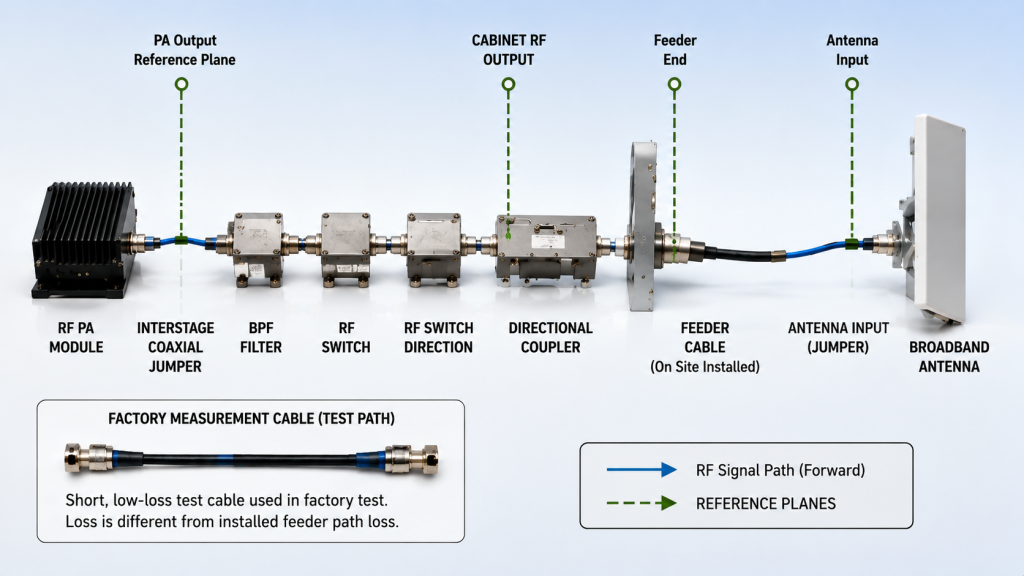
Common reference planes include:
- PA output connector
- Cabinet RF output
- Feeder end
- Antenna input
These are different electrical locations.
PA Output Connector
The PA output connector is the most direct module-level reference plane.
A result measured here describes the output leaving the RF PA before installed downstream losses. This is often the clearest point for module qualification and supplier comparison.
However, PA-port output alone does not prove the power available at the cabinet output or antenna input.
Cabinet RF Output
The cabinet output may be located after:
- Internal cable assemblies
- Filters
- RF switches
- Combiners
- Couplers
- Lightning-protection components
- Bulkhead connectors
A cabinet-output requirement must include the losses between the PA connector and the cabinet boundary.
Feeder End
The feeder end is the point after the installed transmission cable.
This reference plane is useful when the system integrator needs to confirm how much power remains after the feeder but before a final antenna-side adapter or protection component.
Antenna Input
The antenna input is normally located after the complete feeder path.
It may include losses from:
- PA-to-cabinet cable
- Cabinet connector
- RF switch
- Filter
- Lightning protector
- Main feeder
- Antenna-side jumper
- Adapter
A 50 dBm requirement at the PA output connector is not the same as a 50 dBm requirement at the antenna input.
If 50 dBm must remain at the antenna input, the selected RF PA must provide enough output to cover the verified downstream loss and the approved project reserve.
In a multi-band system, apply the same reference-plane rule to every channel before comparing RF power consistency; PA-port, cabinet-output, feeder-end, and antenna-input values are not interchangeable.
Do Not Mix Test and Installed Reference Planes
A factory test cable may introduce loss between the PA output connector and the power sensor. That test-path loss belongs to the measurement setup.
An installed feeder introduces loss between the PA and the system reference plane. That loss belongs to the deployment path.
These two losses should not be mixed.
The test report should identify where the reported output applies. The project requirement should separately identify where the operational minimum must remain available.
3. How to Work Backward to the Required PA-Port Output
RF PA selection should begin with the required downstream result rather than the largest available module rating.

A practical planning relationship is:
**Required PA-port output (dBm)
= Required downstream output (dBm)
- Verified installed RF-path loss (dB)
- Approved project reserve (dB)**
This relationship uses:
- dBm for absolute power
- dB for relative loss or reserve
Do not subtract a dB value directly from a watt value. Convert the power into dBm or use the correct linear power ratio.
Step 1: Define the Required Downstream Output
Start with the minimum power needed at the selected system reference plane.
The requirement should state:
- Minimum output
- Reference plane
- Required frequency points
- Operating condition
- Load assumption
- Temperature condition
- Duty-cycle requirement
A requirement such as 100 W output remains incomplete until the reference plane and conditions are defined.
A stronger requirement is:
Minimum 50.0 dBm at the antenna input across the required test points under the approved thermal, DC, duty-cycle, and load conditions.
Step 2: Add the Installed RF-Path Loss
Identify the verified loss between the PA output connector and the selected downstream reference plane.
Possible elements include:
- Feeder cable
- Internal jumper
- Connector transitions
- Adapter
- Filter
- RF switch
- Combiner
- Directional coupler
- Lightning-protection device
Loss should be evaluated at the applicable frequency points because one path-loss number may not represent the complete operating band.
Step 3: Add the Approved Project Reserve
The project may require additional reserve above the minimum boundary.
The reserve may address defined variation involving:
- Path-loss uncertainty
- Production variation
- Temperature
- Frequency response
- Connector aging
- Maintenance condition
- Future integration changes
Reserve should not be an arbitrary safety number. It should follow the project’s approved RF PA power-margin method.
Example Selection Logic
Assume the project requires:
- 50.0 dBm at the antenna input
- 1.5 dB verified installed-path loss
- 1.0 dB approved project reserve
The initial PA-port selection target becomes:
50.0 dBm + 1.5 dB + 1.0 dB = 52.5 dBm
A 52.5 dBm target is approximately 178 W.
This does not mean that any module labeled 200 W automatically passes. The candidate PA should still prove that its minimum compliant PA-port output remains above the required target under the agreed frequency, thermal, DC, duty-cycle, and load conditions.
Select by Minimum Evidence, Not Nominal Class Alone
The final power class should be selected from evidence showing:
- Minimum PA-port output
- Required frequency points
- Band-edge performance
- Module-side voltage
- Full-load current
- Stabilized thermal condition
- Duty cycle
- Cooling setup
- Load condition
- Protection state
The project should not select a 200 W module merely because the calculated target is below 200 W. It should verify whether that specific module design maintains the required minimum output under the project boundary.
4. Which Conditions Can Reduce Minimum Verified Output
Not every reduction between rated output and usable downstream power has the same cause.
The engineering review should separate:
- Installed RF-path loss
- Changes in PA operating output
- Load and protection behavior
Treating all three as one generic “power loss” makes diagnosis and selection less accurate.
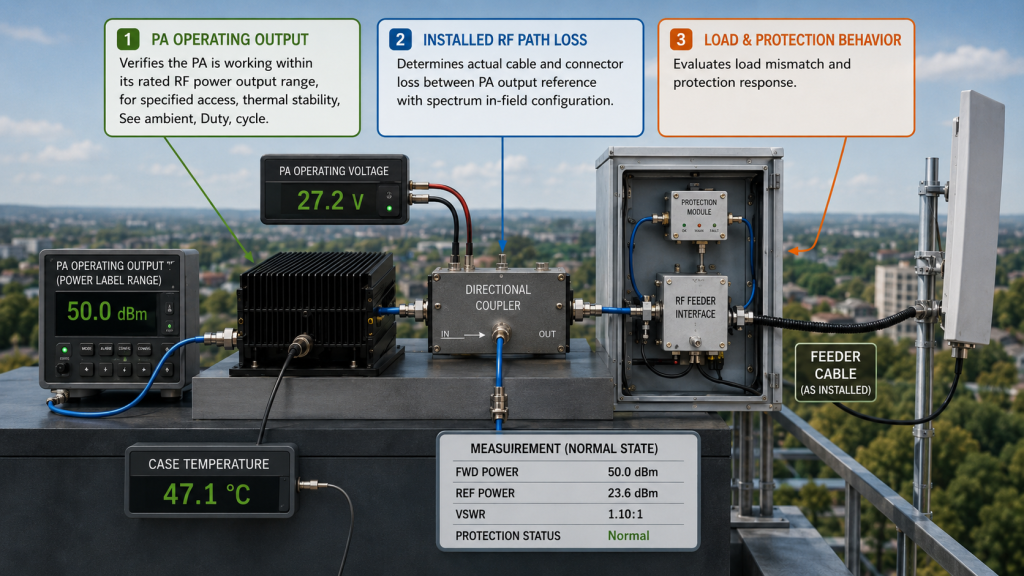
Installed RF-Path Loss
Installed path elements reduce the power available after the PA output connector.
Common contributors include:
- Feeder cable
- Connector transitions
- Adapters
- Filters
- RF switches
- Combiners
- Couplers
- Lightning protection
- Cabinet feedthroughs
These losses should be measured, calculated from controlled data, or otherwise defined through an approved engineering method.
Long feeders and higher-frequency paths can produce greater loss. Connector quality, installation, bend radius, cable condition, and adapter count can also change the result.
A detailed RF PA feeder cable loss check should identify the applicable frequency, cable assembly, reference planes, and measured or corrected result.
PA Operating Conditions
Some conditions change how much output the RF PA itself can sustain at its output connector.
These include:
- Frequency
- Band-edge behavior
- RF input drive
- Module-side DC voltage
- Available current
- Thermal stabilization
- Ambient temperature
- Cooling condition
- Duty cycle
- Test duration
For example, reduced module-side voltage may lower the available RF output even when the remote power-supply display still shows its nominal setting.
A module may also produce the required output during a brief startup test but move closer to its minimum limit after internal heat builds.
The selection evidence should therefore state whether the output result represents:
- Cold startup
- Short-duration operation
- Thermally stabilized operation
- Continuous operation
- Pulsed operation
- Another defined duty condition
Load and Protection Conditions
VSWR, reflected power, alarms, foldback, shutdown, and recovery are not fixed insertion losses.
They describe how the module responds to the RF load.
The review should identify:
- Forward-power condition
- Reflected-power condition
- VSWR or mismatch boundary
- Alarm state
- Foldback behavior
- Shutdown behavior
- Recovery condition
A module operating into a controlled 50 Ω load may maintain its rated output. The same module may reduce output when connected to an RF path with greater mismatch.
This does not mean the PA has a fixed number of decibels of “VSWR loss.” It means the operating load has changed and the protection system may alter the PA output state.
Why These Three Groups Must Stay Separate
Path loss reduces power after the PA port.
Frequency, heat, DC supply, input drive, and duty cycle can change how much output the PA itself can sustain.
Load mismatch and protection logic can trigger alarms, output foldback, shutdown, or recovery behavior.
Each group requires different evidence and a different corrective action.
5. What Evidence Separates Selection from Shipment Approval
The selection stage and the shipment-approval stage should use the same engineering boundary, but they do not serve the same purpose.
Selection-Stage Evidence
Before selecting an RF PA, define:
- Required reference plane
- Required downstream minimum output
- Frequency points
- Installed RF-path loss
- Project reserve
- Minimum PA-port output target
- Ambient temperature
- Cooling method
- Duty-cycle condition
- Module-side DC voltage
- Current requirement
- Load assumption
- Required power class
Selection evidence answers:
Which RF PA design and power class should move into RFQ, sample evaluation, or project qualification?
It does not approve a specific production unit for shipment.
Shipment-Stage Evidence
Shipment approval should later confirm that the delivered module meets the selected boundary.
The report may need to identify:
- Module S/N
- Hardware version
- Test frequency points
- RF input condition
- Module-side voltage
- DC current
- Load condition
- FWD / REV / VSWR status
- Thermal state
- Test duration
- Measurement reference plane
- Correction method
- Minimum acceptance limit
- Final PASS or HOLD judgment
Detailed RF output power verification before shipment should confirm the delivered S/N under the agreed frequency, load, DC, thermal, measurement, and correction conditions.
Do Not Use Shipment Evidence to Replace Selection Planning
A supplier may provide a valid output report, but the report cannot prove project suitability when the buyer has not defined:
- Where the output is required
- How much installed loss applies
- Which reserve is required
- Which thermal and duty conditions apply
- Which frequency points matter
Selection planning defines the required boundary.
Shipment testing proves whether the delivered unit meets that boundary.
Usable RF Output Power Decision Map
| Power Layer | What It Means | Required Evidence | Main Decision |
|---|---|---|---|
| Rated output | Declared PA power class under stated conditions | Reference plane, frequency, drive, Vdc, load, cooling, and duration | Is the module in the correct initial power family? |
| Minimum verified PA-port output | Lowest accepted module-port result under agreed conditions | Required-point or full-band data under defined thermal and DC state | Can the module meet the required PA-port baseline? |
| Installed RF-path loss | Loss after the PA output connector | Feeder, connector, filter, switch, combiner, and protection-device data | How much power is lost before the required downstream plane? |
| Required downstream output | Minimum power required at the selected system reference plane | Project requirement and reference-plane definition | What must remain after the installed RF path? |
| Project reserve | Approved allowance above the minimum requirement | Defined reserve or power-margin method | Is sufficient margin available for the approved variation? |
| Final PA selection | PA class that satisfies the complete chain | Minimum output, path loss, reserve, thermal, DC, and load review | Which RF PA power class should move to RFQ? |
The table should be completed using project-specific values. It should not replace the detailed test plan or final S/N-linked shipment report.
RFQ: How to Define Usable RF Output Power
The RFQ should define the required system boundary before asking the supplier to recommend a wattage class.
Ask the following questions:
- At which reference plane is the minimum RF output required?
- What minimum output is required at that reference plane?
- Which frequency points and band edges must remain compliant?
- Which feeder, connector, filter, switch, combiner, or lightning-protection losses apply?
- Which ambient temperature, cooling, duty-cycle, and module-side DC conditions apply?
- Which load, VSWR, reflected-power, and protection conditions should be considered?
- What approved project reserve is required before selecting the PA power class?
- What shipment evidence must prove that each delivered S/N meets the selected boundary?
The RFQ should provide:
- Frequency range
- Required test points
- Minimum downstream output
- Output reference plane
- Known or estimated path loss
- PA-to-antenna path configuration
- Connector and feeder requirements
- Filter or RF-switch requirements
- Project reserve
- RF input condition
- Module-side DC voltage
- Available current
- Ambient temperature
- Cooling method
- Duty cycle
- Load boundary
- Quantity
- Required report format
- S/N traceability
- Final acceptance criteria
A supplier response should distinguish:
- Rated power class
- Typical output
- Minimum compliant PA-port output
- Applicable operating conditions
- Required cooling and DC input
- Installed-path assumptions
- Shipment-verification evidence
Statements such as 100 W output, high power, or maximum 200 W are not sufficient without the associated reference plane and operating conditions.
Conclusion
Usable RF output power begins with a defined system requirement, not a module label.
The selection process should identify:
- Where the minimum output is required
- How much power must remain at that point
- Which installed RF-path losses apply
- Which project reserve is approved
- Which conditions affect PA-port output
- Which RF PA power class can meet the resulting minimum target
The final selection chain should remain:
Required downstream output → Defined reference plane → Verified installed-path loss → Approved project reserve → Minimum compliant PA-port output → RF PA power-class selection
Rated output helps identify an initial module family. Minimum verified output, reference-plane planning, RF-path loss, thermal and DC conditions, load behavior, and project reserve determine whether that module is suitable for the actual system.
For projects requiring custom RF power amplifier modules, RF SKYPOWER can support early engineering review of the required output reference plane, minimum downstream power, installed RF-path loss, target frequencies, operating temperature, duty cycle, module-side DC condition, antenna-load assumption, and suitable RF PA power class.
Submit the required frequency range, minimum output, reference plane, feeder and connector path, filters or switching elements, ambient condition, cooling method, duty cycle, DC supply, load boundary, project reserve, quantity, and shipment-evidence requirements through our engineering RFQ.