


RF PA stress testing should show whether the tested unit or approved sample remains within the project-defined reliability requirement after the required stress, under conditions that make the pre- and post-stress evidence meaningfully comparable.
A completed stress record is not proof by itself. Before a reliability result is used in a shipment or engineering decision, the reviewer should be able to tell what was tested, under which conditions, what changed after stress, and what evidence scope the result actually supports.
The key question is not simply:
“Was reliability testing performed?”
It is:
“Does the available evidence show that the tested object still satisfies the approved reliability requirement after the required stress?”
1. What Must an RF PA Reliability Test Prove?
Reliability testing should establish whether the behaviors named in the approved reliability requirement remain acceptable after the required stress.
It should not imply that every RF, DC, thermal, environmental, and protection test is mandatory for every RF power amplifier.
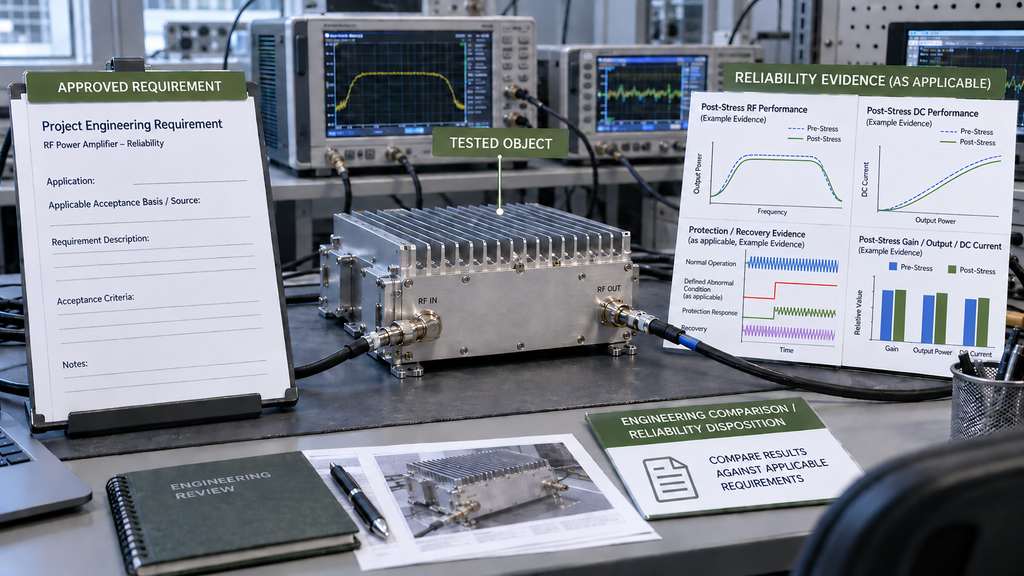
The requirement should already come from an applicable source such as:
- an RFQ;
- a product specification;
- a contract requirement;
- an approved qualification plan;
- an acceptance procedure;
- or another controlled engineering requirement.
Within broader RF power amplifier testing, After the RF power amplifier reliability review before RFQ defines the requirement, the broader RF power amplifier testing framework can establish the measurement conditions before the reliability test produces evidence against that approved basis.
Depending on the project, the evidence may need to show whether:
- required RF output remains within the applicable boundary;
- required frequency points remain acceptable;
- RF behavior shows a material post-stress change;
- Vdc or Idc behavior changes abnormally;
- hot-state performance remains acceptable;
- an alarm or protection event occurred during stress;
- required protection and recovery behavior is correct;
- the tested object and configuration remain traceable;
- and the available evidence is sufficient for the required reliability decision.
This distinction prevents two common errors.
The first is treating a list of completed test activities as proof of reliability.
The second is turning one project’s reliability plan into a universal requirement for every amplifier.
Once the requirement is defined, the useful sequence is:
Pre-Stress Baseline → Required Stress → Comparable Post-Stress Evidence → Engineering Comparison → Reliability Disposition
That sequence is the core of this procedure.
2. Freeze the Pre-Stress Test Baseline
Before applying reliability stress, establish a baseline that can later be compared with the post-stress evidence.
If a material measurement or operating boundary changes between the two stages, an apparent difference may come from the test condition rather than from the amplifier.
Where RF power amplifier thermal management affects the result, cooling and thermal state should be defined before the stress begins.
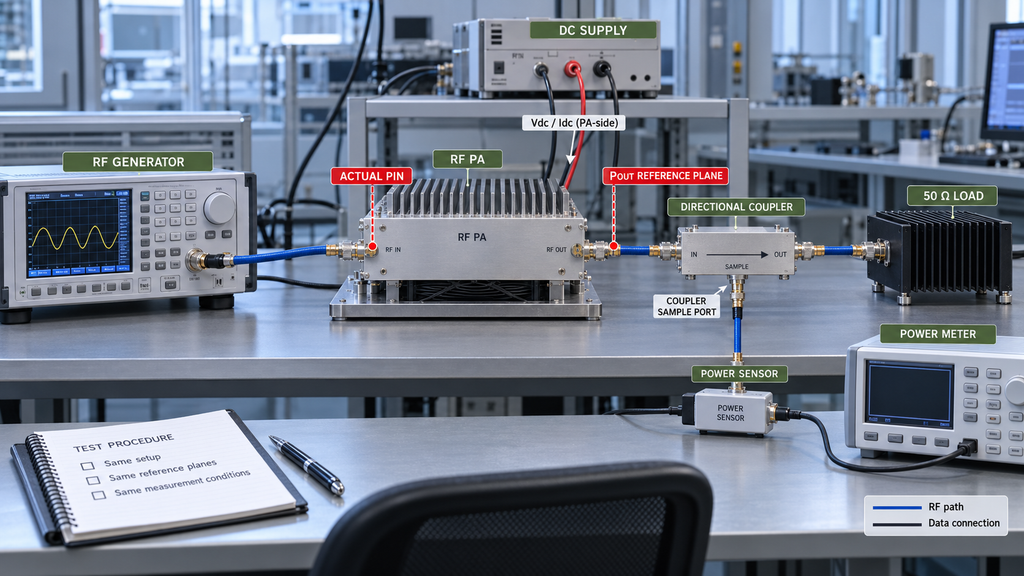
Pre-Stress Baseline Record
| Item | What Should Be Defined |
|---|---|
| Test object | Model plus the identity required by the project: individual unit, sample, or another controlled test object |
| Configuration | Applicable hardware, firmware, option, or controlled revision where relevant |
| Frequency points | Required frequencies or approved test-point set |
| Signal condition | Project-defined waveform, modulation, CW condition, or operating state |
| Actual Pin | Approved input-power condition at the defined PA input reference plane |
| Pout reference plane | Physical boundary to which output power is reported |
| Vdc / Idc | DC condition at the defined PA-side measurement boundary |
| Load | Approved controlled-load or other defined load condition |
| Cooling | Heatsink, airflow, mounting, or another applicable thermal boundary |
| Thermal state | Cold, stabilized, or another project-defined state |
| Duty cycle / duration | Operating condition relevant to the comparison |
| Protection state | Normal operating state before stress |
| Evidence scope | Individual-unit, sample, batch, qualification, or another approved scope |
Not every field needs the same level of detail in every project.
The governing rule is simpler:
Any condition capable of materially changing the reliability decision should not be left ambiguous.
For example, avoid comparing:
- a cold pre-stress result with a stabilized hot post-stress result without accounting for thermal state;
- a generator setting before stress with measured Actual Pin after stress;
- Pout reported at the PA terminal before stress with Pout reported at another reference plane after stress;
- one load condition before stress with another after stress;
- or one configuration revision with another without documenting and reconciling the change.
Actual Pin deserves particular attention.
The post-stress measurement should follow the same approved input-power rule. If a different condition must be used, the difference should be explicitly reconciled before the results are treated as comparable.
A vague statement such as “similar drive level” is not a substitute for a controlled comparison boundary.
The same applies to output power.
A pre-stress Pout value and a post-stress Pout value are directly comparable only when the applicable reference plane and correction basis are understood.
When the Baseline Cannot Support a Valid Comparison
If the baseline condition cannot be reconstructed or reconciled, do not attribute a later difference to reliability degradation.
Correct the evidence boundary where possible and repeat the required measurement.
A technically valid retest is stronger than an unsupported PASS or FAIL conclusion.
3. Run the Required Reliability Stress
After the baseline is frozen, apply only the reliability stresses required by the approved project or acceptance plan.
Possible stress branches may include:
- long-duration operation or burn-in;
- stabilized hot-state operation;
- low- or high-temperature exposure;
- vibration or another mechanical stress;
- defined duty-cycle operation;
- project-defined DC-boundary stress;
- controlled load-mismatch testing;
- or another application-specific stress.
These examples are not a universal test list.

A fixed indoor amplifier, vehicle-mounted RF subsystem, outdoor installation, and high-duty-cycle transmitter may require different reliability evidence.
The stress record should establish what the tested object actually experienced.
Depending on the procedure, that may include:
- test-object identity;
- applicable configuration;
- stress type;
- RF operating state;
- frequency or operating mode;
- Actual Pin condition where relevant;
- stress duration;
- duty cycle;
- DC condition;
- load condition;
- cooling or mounting condition;
- temperature condition;
- monitoring points;
- alarm or protection events;
- interruptions or shutdowns;
- and authorized configuration changes.
Long-duration operation is a good example of why the stress name alone is weak evidence.
A statement such as:
“Burn-in passed.”
does not tell the reviewer:
- at what RF operating condition the test ran;
- for how long;
- under what cooling condition;
- whether RF or DC behavior was monitored;
- whether alarms occurred;
- whether the test was interrupted;
- or whether the tested object was re-evaluated afterward.
RF PA batch burn-in may be one required reliability stress, but burn-in alone is not automatically the complete reliability decision.
The same principle applies to temperature, vibration, load, or other project-defined stress.
Applying the stress is only one part of the procedure.
The reviewer still needs appropriate evidence showing what happened afterward.
Stress completed without an appropriate post-stress comparison is incomplete reliability evidence.
4. Repeat Comparable Evidence After Stress
After the required stress is completed, repeat the evidence needed to make the reliability decision.
The purpose is not to reproduce every unrelated measurement merely to create a longer report.
The purpose is to obtain post-stress evidence that is sufficiently comparable with the approved baseline.
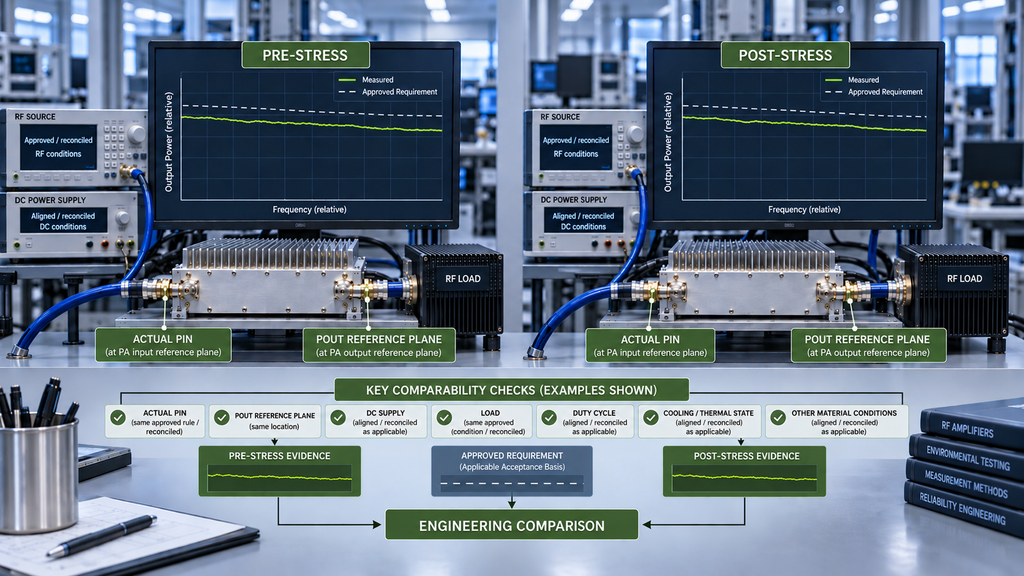
Pre- vs. Post-Stress Comparison
| Evidence | Pre-Stress | Post-Stress | Review Question |
|---|---|---|---|
| Test object / configuration | Identified | Reconfirmed | Same identified unit, sample, or other approved test object? |
| RF output | Baseline result | Repeat result | Material change or limit violation? |
| Frequency points | Defined | Required points repeated | Same decision coverage? |
| Actual Pin | Approved input-power rule defined | Same rule, or explicitly reconciled condition | Is the RF comparison valid? |
| Pout reference plane | Defined | Same boundary | Are output values comparable? |
| Vdc / Idc | Baseline result | Repeat result | Material electrical change? |
| Load | Defined | Same approved condition | Same load boundary? |
| Thermal state | Defined | Aligned or reconciled state | Is temperature distorting the comparison? |
| Alarm / protection status | Baseline status | Event/status record | Unexpected behavior? |
| Recovery | Defined expected behavior where applicable | Post-event verification | Did recovery follow the approved rule? |
| Evidence scope | Defined | Reconfirmed | What does the result actually prove? |
A reliability comparison should not invent a universal drift limit after the measurements are complete.
A difference becomes an acceptance issue when it:
- exceeds an approved limit;
- violates an applicable requirement;
- crosses a defined engineering-review boundary;
- creates abnormal protection or recovery behavior;
- or otherwise requires review under the approved test plan.
If two measurements differ but both remain within the applicable requirement, preserve the measured evidence and apply the approved disposition rule.
Do not create a new failure threshold simply because a difference is visible.
Likewise, do not automatically attribute a large difference to amplifier degradation.
First verify the comparison boundary.
Check whether any material condition changed, including:
- Actual Pin;
- Pout reference plane;
- DC input;
- load;
- duty cycle;
- cooling;
- thermal state;
- configuration;
- or measurement correction.
Then determine whether the result can legitimately be compared with the baseline.
When Post-Stress Evidence Is Not Comparable
If a material difference in test condition cannot be reconciled, the test does not yet support a valid reliability conclusion.
Correct the evidence boundary where possible and repeat the required measurement.
This avoids both false failures and false passes.
5. Verify Protection and Recovery Behavior
Protection evidence belongs in a reliability review only when the applicable reliability requirement includes a relevant abnormal condition or recovery requirement.
A reliability test does not need to reproduce an entire protection-state-machine qualification unless that is the actual test objective.
For a required protection branch, the record may need to establish:
Defined Abnormal Condition → Detection → RF Response → Alarm / Status → Recovery → Post-Event Verification
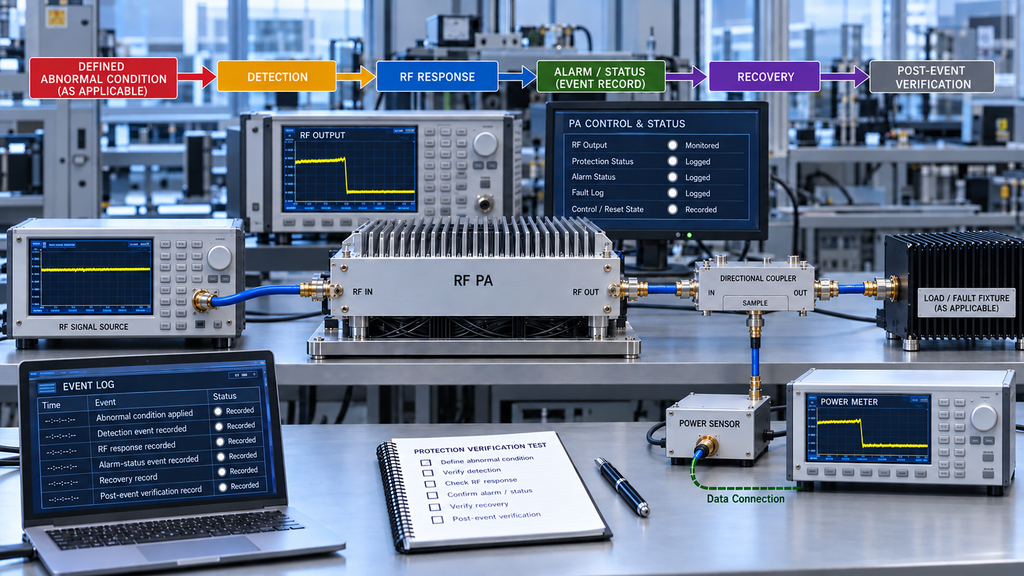
The reviewer should be able to determine:
- what abnormal condition was intentionally applied;
- whether the expected response occurred;
- whether RF output remained active, reduced, or disabled as required;
- whether the expected alarm or status appeared;
- whether the condition latched where applicable;
- whether reset or automatic recovery was required;
- whether recovery followed the approved rule;
- and whether the required post-event RF state remained acceptable.
Do not invent protection thresholds, retry counts, alarm polarity, recovery delays, or shutdown rules from generic RF PA practice.
Those conditions must come from the applicable product or project definition.
A protection event also needs correct interpretation.
An intentional shutdown under a defined fault condition is not automatically a reliability failure.
If shutdown is the approved response, it may demonstrate correct protection behavior.
The reliability concern appears when the trigger, response, visibility, recovery, or post-event result does not match the approved requirement.
6. Review the Reliability Record and Evidence Scope
The final reliability record should connect four things:
the controlled test object, the pre-stress baseline, the required stress, and the post-stress disposition.

A long RF amplifier test report is not automatically a strong reliability record.
The required traceability depends on the evidence scope.
For an individual-unit shipment requirement, the evidence may need to remain linked to the delivered unit’s S/N and applicable configuration.
For a qualification sample, design-verification sample, or approved batch-level plan, a different identity structure may be valid.
These evidence scopes should not be silently upgraded into one another.
For example:
- sample qualification evidence does not automatically prove every production unit;
- batch evidence does not automatically become individual-unit evidence;
- individual-unit production evidence does not automatically establish a broader design-qualification claim.
The reliability record should therefore make its evidence scope explicit.
At minimum, the reviewer should be able to identify:
- the tested object;
- applicable configuration;
- baseline record;
- applied stress;
- material test conditions;
- event history where relevant;
- post-stress evidence;
- applicable acceptance basis;
- evidence scope;
- and final reliability disposition.
The useful evidence chain is:
Test Object → Baseline → Stress → Post-Stress Evidence → Acceptance Basis → Disposition
If those elements cannot be connected, the report may be incomplete even when each individual record appears technically plausible.
7. Release, Retest, or Hold
Where the approved plan uses **RELEASE, RETEST, and HOLD—or equivalent project-defined dispositions—**apply them only to the defined reliability-test requirement and its stated evidence scope.
These dispositions do not by themselves approve every other shipment, system, contractual, or application requirement.

In an RF amplifier acceptance test, the applicable criteria must come from the approved project basis.
This article does not create universal RF PA pass limits.
RELEASE
Where RELEASE is the approved disposition, it may be supported when:
- all required reliability stresses were completed;
- the tested object and applicable configuration are traceable;
- the required pre- and post-stress evidence is sufficiently comparable;
- applicable results remain within the approved reliability boundary;
- no unresolved material change remains;
- required protection and recovery behavior is acceptable;
- and the evidence scope is sufficient for the intended reliability decision.
A reliability RELEASE means the defined reliability requirement is supported by the available evidence within that stated scope.
It does not mean the amplifier has been proven under every possible field condition.
It also does not replace any separate shipment-acceptance requirement outside the reliability scope.
RETEST
Where RETEST is an approved disposition, it may be appropriate when the reliability decision is blocked by a correctable evidence problem, such as:
- missing measurement data;
- inconsistent Actual Pin;
- unclear reference plane;
- uncertain correction or measurement boundary;
- unmatched thermal state;
- incorrect load condition;
- incomplete event logging;
- interrupted test execution;
- missing post-stress evidence;
- or another condition that prevents a valid comparison.
Retest should not be used to erase an unfavorable valid result.
The reason for retest and the relationship between the original and repeated evidence should remain traceable.
HOLD / ENGINEERING REVIEW
Where HOLD or engineering review is part of the project-defined disposition process, it may be appropriate when the evidence identifies, or cannot resolve, a material reliability concern.
Examples may include:
- an applicable result outside the approved limit;
- unexplained material RF change;
- abnormal Vdc or Idc behavior;
- unexpected alarm or shutdown;
- incorrect required protection behavior;
- incomplete or inconsistent recovery;
- uncontrolled configuration change;
- unresolved test-object identity;
- or insufficient evidence to support the required reliability decision.
HOLD is not automatically a final product rejection.
It means the defined reliability requirement should not be treated as closed until the abnormal result, evidence gap, or engineering disposition is resolved.
FAQ
Is one output-power test enough to prove RF PA reliability?
No.
A single output measurement can establish a baseline under one condition, but it does not show what happens after the reliability stress required by the project.
Reliability evidence normally needs an approved baseline, the required stress, sufficiently comparable post-stress evidence, and an applicable acceptance basis.
Is a completed burn-in record enough for reliability approval?
Not necessarily.
Burn-in proves only the scope supported by the burn-in procedure and its evidence.
If the reliability requirement also depends on post-stress RF behavior, DC behavior, event history, protection response, or another condition, that evidence still needs to be reviewed.
A burn-in completion statement should not automatically be treated as complete reliability approval.
Does a protection shutdown mean the RF PA failed the reliability test?
No.
If shutdown is the defined response to an intentionally applied abnormal condition, the shutdown itself may be correct behavior.
The reviewer should check the approved trigger, RF response, alarm or status, recovery rule, and post-event result before making the reliability disposition.
What should happen if the post-stress RF result changes?
First determine whether the pre- and post-stress measurements are sufficiently comparable.
Check the Actual Pin rule, Pout reference plane, DC boundary, load, cooling, thermal state, configuration, and other material conditions.
If the comparison is valid, judge the result against the approved requirement.
If the evidence boundary is not valid or cannot be reconciled, correct the condition and repeat the required measurement rather than inventing a degradation conclusion.
Conclusion
Before contacting a supplier, freeze the reliability requirement that will govern the decision.
At minimum, define the required stress, the pre- and post-stress measurement boundary, the applicable acceptance source, and the evidence scope.
Where relevant, also define:
- frequency points;
- waveform or RF operating state;
- target Pout;
- Actual Pin rule;
- DC boundary;
- load condition;
- duty cycle;
- cooling and thermal condition;
- required protection behavior;
- and the identity level required for the evidence.
Then use the reliability test to answer one controlled question:
Did the tested object remain within the approved reliability requirement after the required stress, based on sufficiently comparable evidence?
The engineering sequence is:
Baseline → Required Stress → Comparable Retest → Reliability Disposition
Where RELEASE is the project-defined disposition, it closes only the reliability requirement supported by that evidence scope.
It does not automatically close unrelated shipment, system, contractual, or application acceptance requirements.
For an RF SKYPOWER engineering or RFQ review, provide the project-defined RF conditions, stress requirements, acceptance source, and required evidence scope.
RF SKYPOWER can use those inputs to review the intended test boundary and evidence plan before evaluating applicable RF power amplifier modules or a project-specific configuration.
Engineering review can align the requirement and test plan.
It does not by itself prove that a specific amplifier, sample, batch, or shipment has satisfied that requirement before the corresponding test evidence exists.