
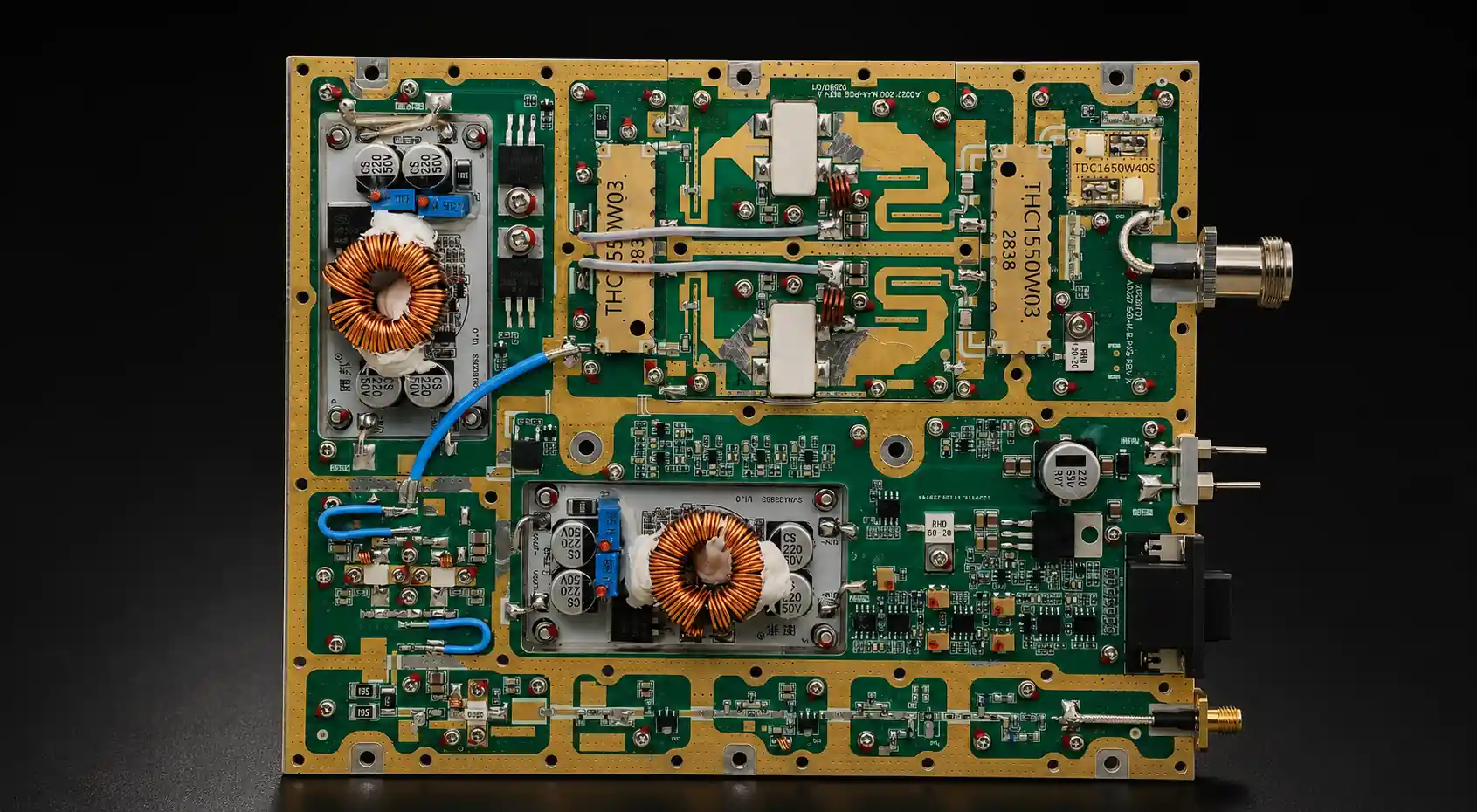
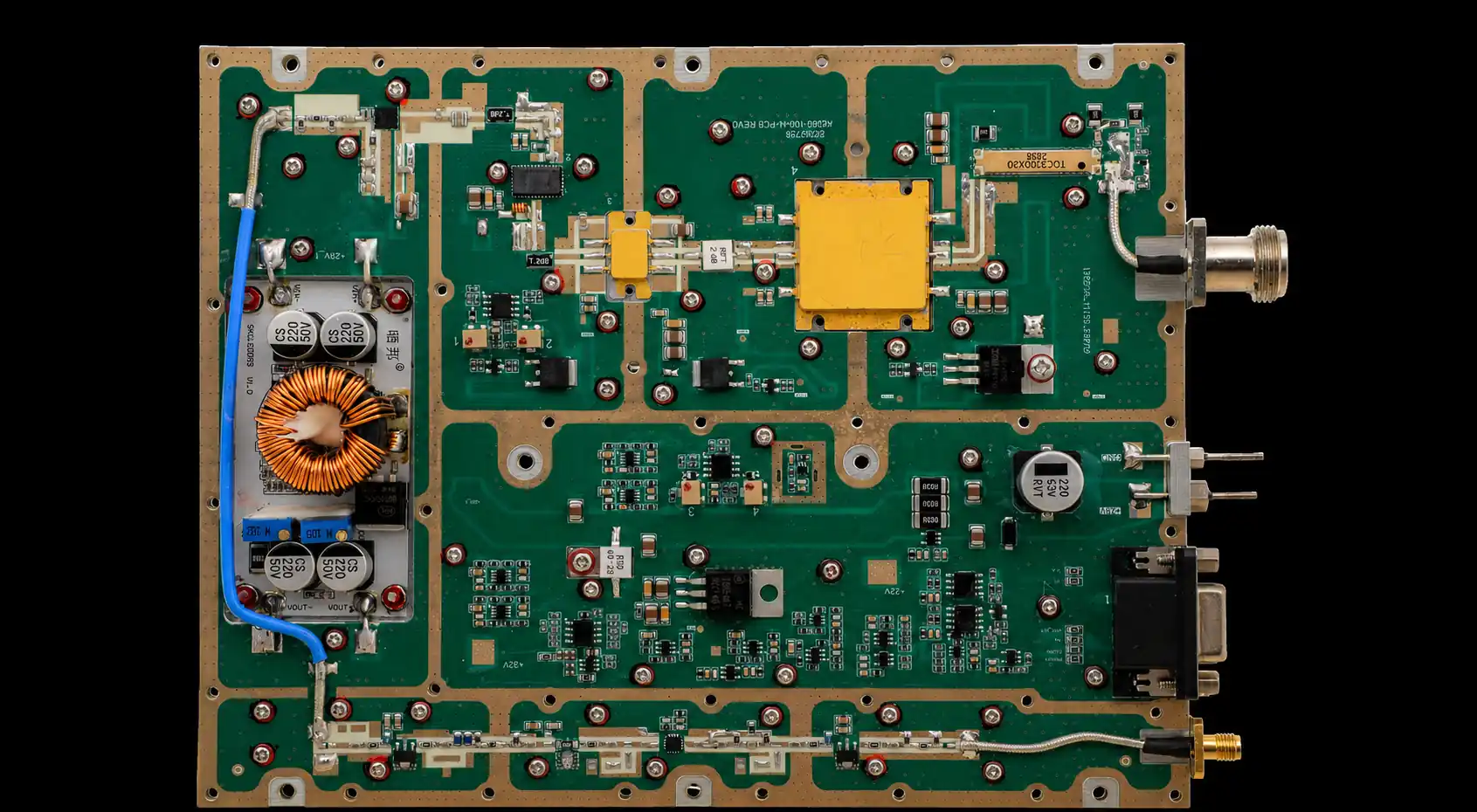
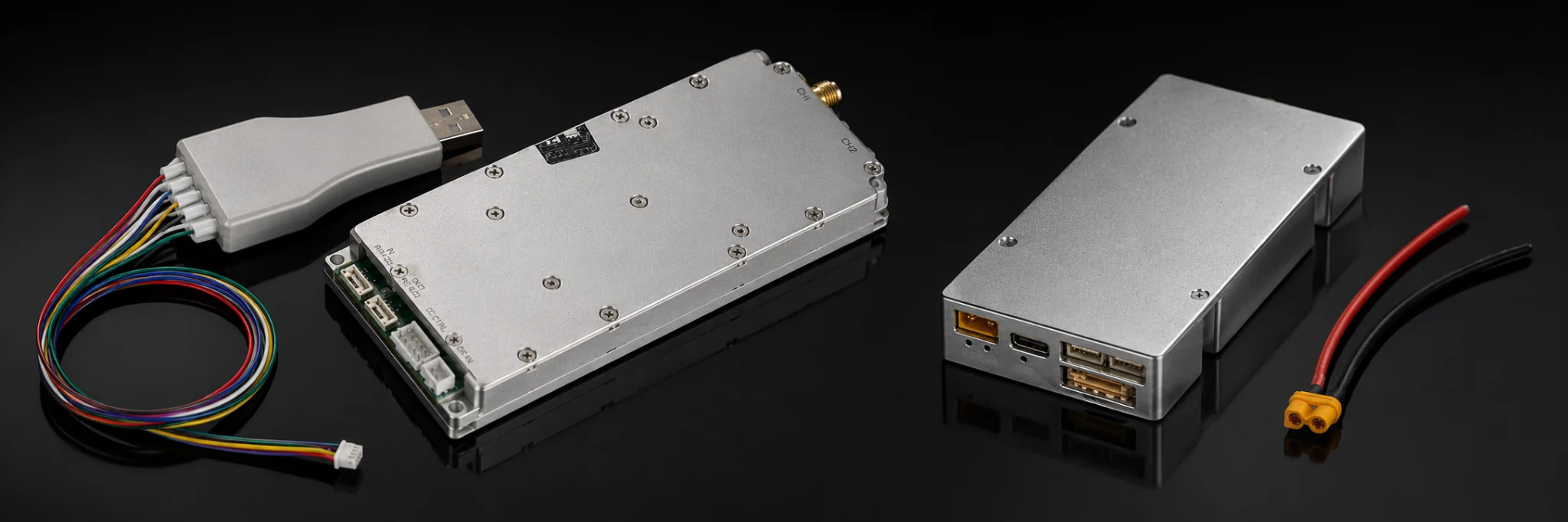

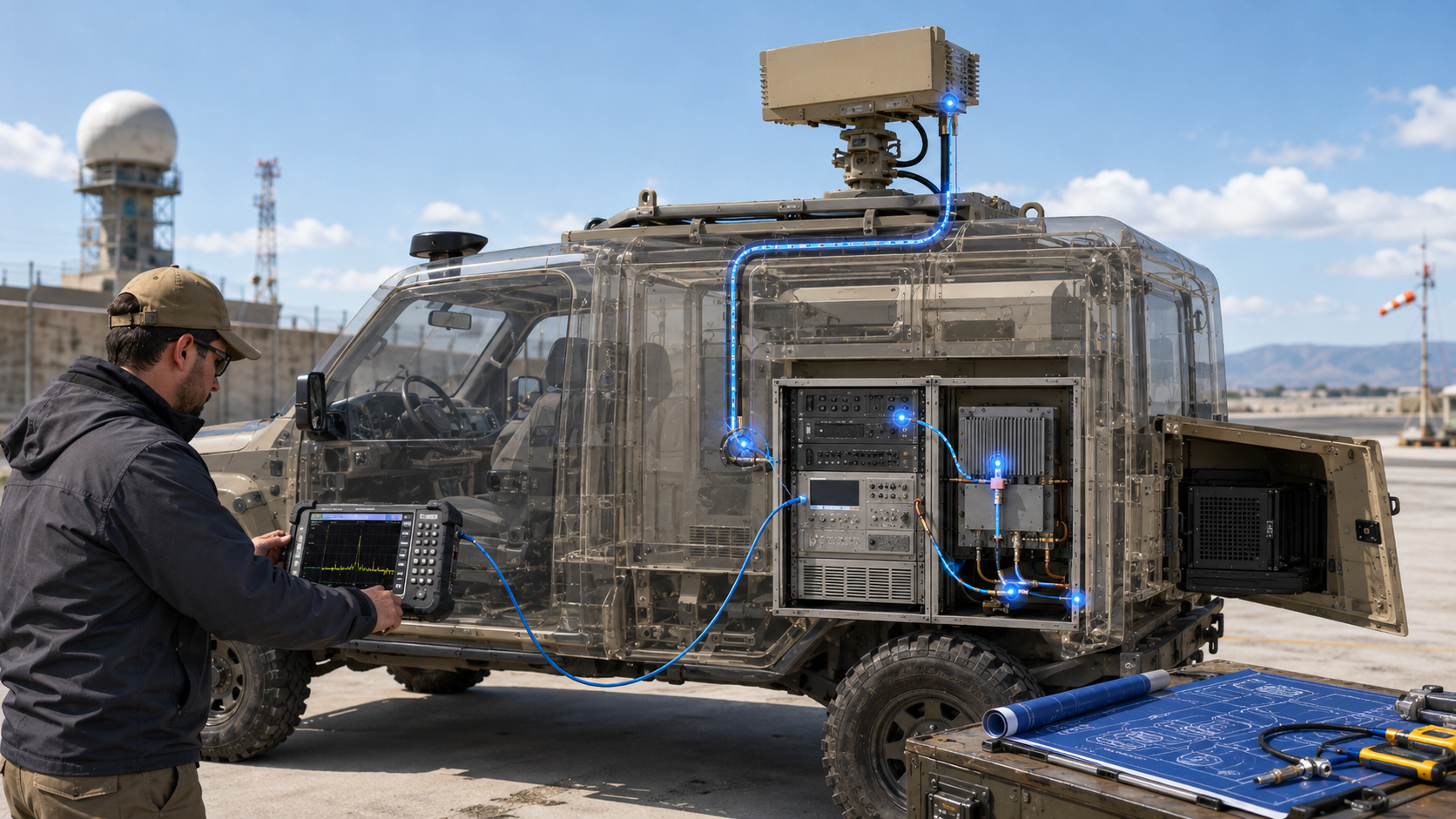
Vehicle RF power measurement can fail even when every reading is technically correct. The problem begins when PA-port, cabinet-output, feeder-end, and antenna-input values are compared as if they belong to the same reference point.
A 100 W result at the RF PA connector does not prove that 100 W reaches the antenna input. A lower antenna-input reading also does not automatically indicate insufficient PA output. Each value belongs to a different boundary in the installed RF chain.
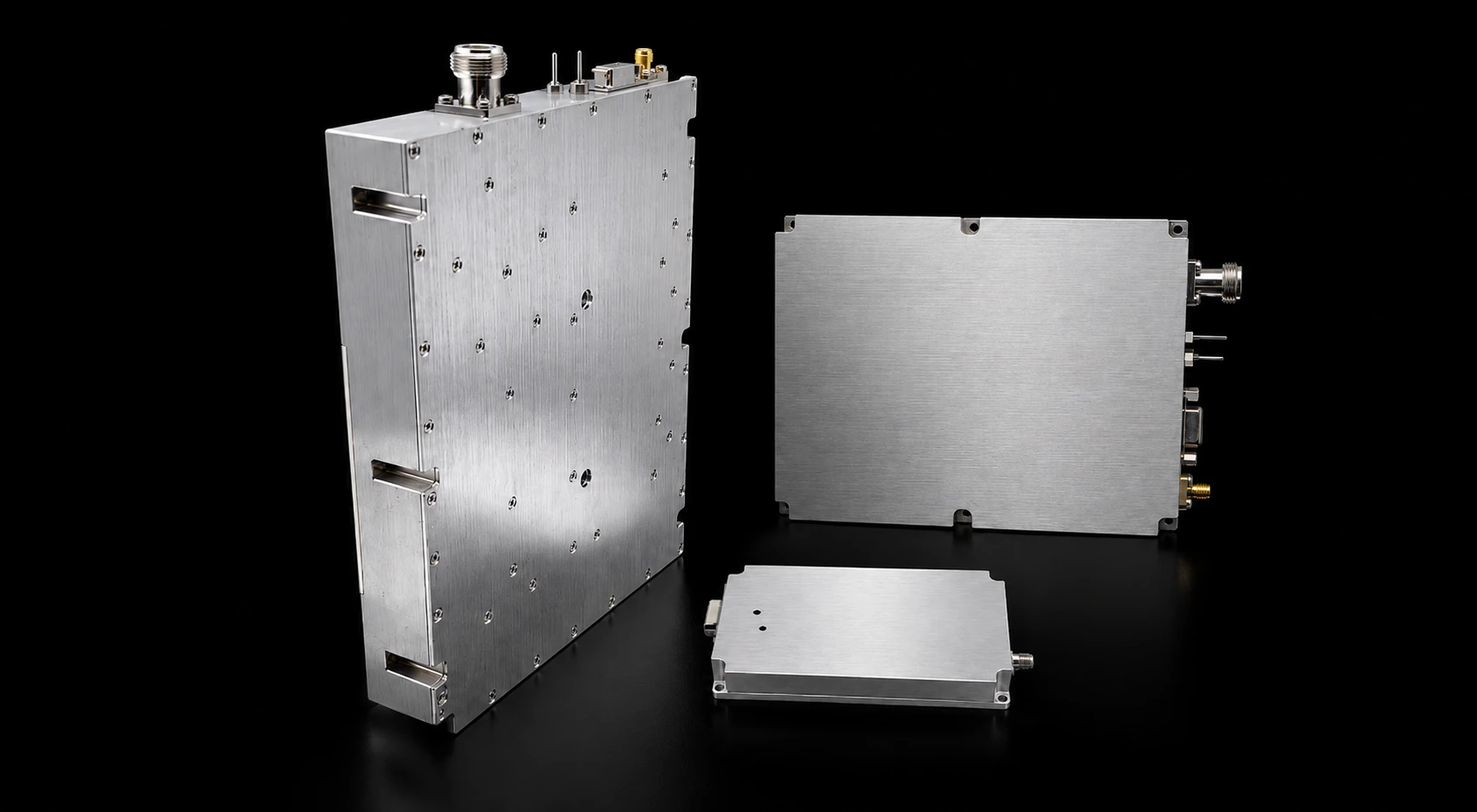
For vehicle integrators evaluating RF Power Amplifier Modules, the first requirement is to define whether the stated output applies at the PA connector, cabinet output, feeder end, or antenna input.
A repeatable result must also identify the frequency, load, included RF path, vehicle operating state, PA-terminal voltage, warm-up time, and active channel count. Without those conditions, two correct measurements may still support the wrong acceptance decision.
1. How to Define RF Power Measurement Boundaries in Vehicle C-UAS
A measurement boundary is the exact physical point in the RF chain where a reported power value applies.
The RF PA supplier may report output at the module connector. The cabinet integrator may measure at the external RF bulkhead. The vehicle team may test at the end of the roof feeder. The final acceptance requirement may apply at the antenna input.
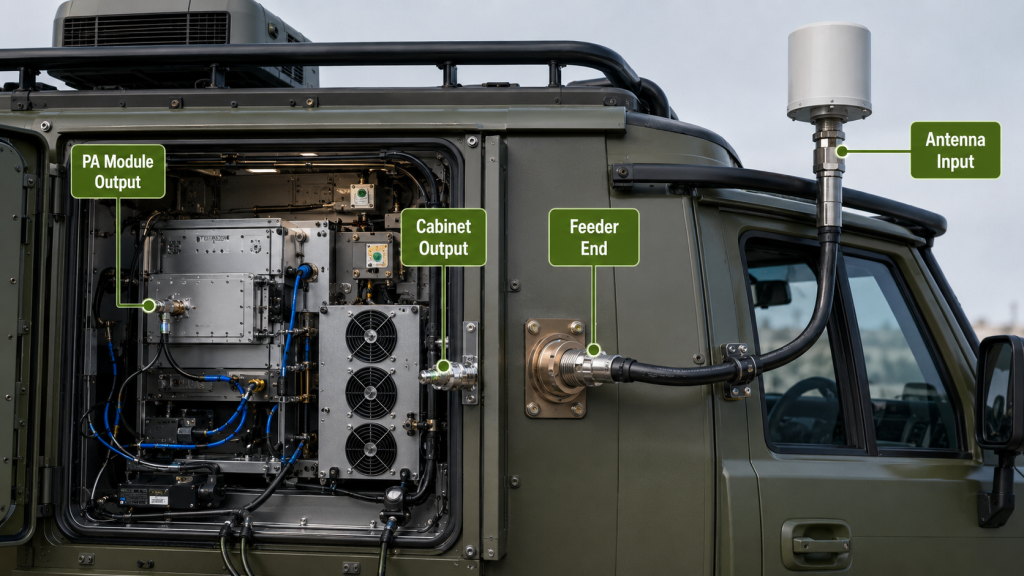
These values cannot be compared directly unless they refer to the same boundary and test condition.
Before a project defines a wattage requirement, it should answer:
- Where must the required power be demonstrated?
- Which RF path components are included?
- Which frequency and load apply?
- What vehicle operating state applies?
- What PA-terminal voltage is permitted?
- How long must the system operate before the reading is taken?
A dummy-load RF PA baseline remains necessary because it separates the amplifier from downstream vehicle variables. It confirms the PA baseline under a controlled load, but it does not prove the complete cabinet, feeder, or antenna path.
The acceptance requirement should therefore name the boundary before it names the pass/fail value.
For example:
Required output: 100 W at the PA module output connector under the specified drive, supply, frequency, load, and thermal condition.
This statement is different from:
Required output: 100 W at the cabinet RF output after the internal RF path.
It is also different from:
Required output: 100 W at the antenna input after the installed feeder and connector path.
Each statement creates a different engineering responsibility.
2. What PA-Port, Cabinet-Output, and Antenna-Input Readings Prove
Each measurement point proves a different part of the RF chain.
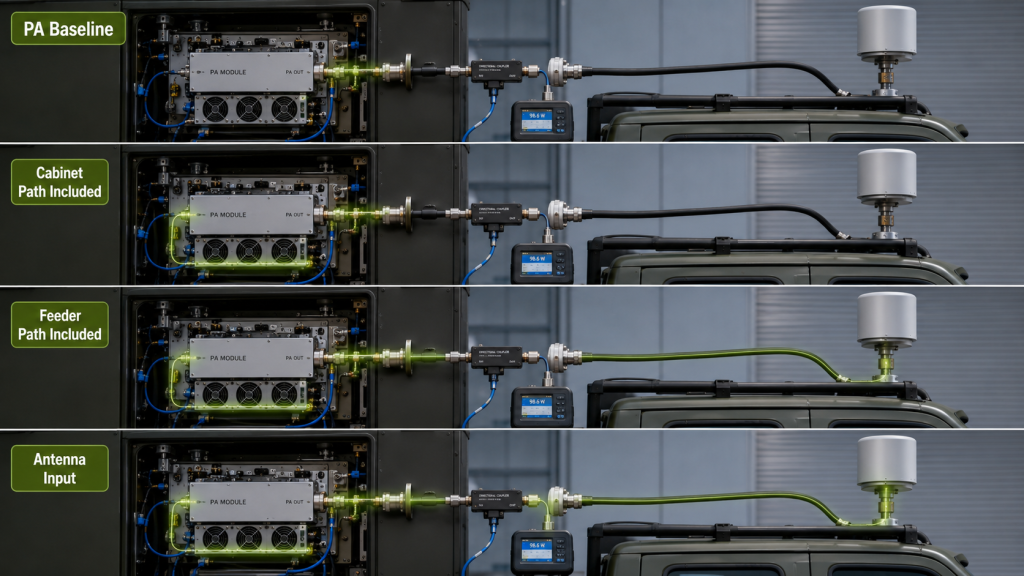
Vehicle RF Power Measurement Boundary Matrix
| Measurement point | What it proves | What it excludes | Best use |
|---|---|---|---|
| PA module port | RF PA output under a defined drive, supply, frequency, load, and thermal condition | Cabinet routing, external feeder, antenna match, and vehicle installation effects | Supplier testing, incoming inspection, PA troubleshooting |
| Cabinet RF output | Output delivered by the PA and internal cabinet RF path | External feeder and antenna condition | Cabinet integration and cabinet acceptance |
| Feeder end | Power delivered through the installed vehicle cable and connector path | Antenna match after final connection | Installed cable-path review |
| Antenna input | RF power delivered to the installed antenna connector | Radiation pattern, mounting influence, and field coverage | Installed-path acceptance |
The PA-port result is the correct baseline for judging the amplifier itself. It supports incoming inspection, batch comparison, S/N-linked test records, and fault isolation.
The cabinet-output result includes more of the integrated system. It may include internal jumpers, filters, combiners, bulkhead connectors, and cabinet feedthroughs.
The feeder-end result includes the installed vehicle cable route. The antenna-input result includes the feeder and all connector transitions immediately before the antenna.
A lower downstream reading does not automatically mean the PA failed. The difference may come from:
- Internal RF jumpers
- Cabinet bulkheads
- Filters or combiners
- Adapters
- External feeder cable
- Connector installation
- Antenna-side transitions
When the main question is the difference between cabinet output and antenna input, use a separate RF PA feeder cable loss check.
The acceptance report should state which parts of the RF chain are included in each result. A PA-port value and an antenna-input value may both be correct, but they do not prove the same condition.
3. How Vehicle Layout Determines a Repeatable Test Point
The best theoretical measurement point is not always the most practical service point.
In a vehicle C-UAS cabinet, the RF PA may be positioned for cooling, shielding, power distribution, and mechanical protection. The antennas may be mounted on the roof, mast, perimeter frame, or another external structure.
After final assembly, the PA connector may no longer be accessible. The antenna input may be sealed, weatherproofed, or difficult to reach without removing installed hardware.
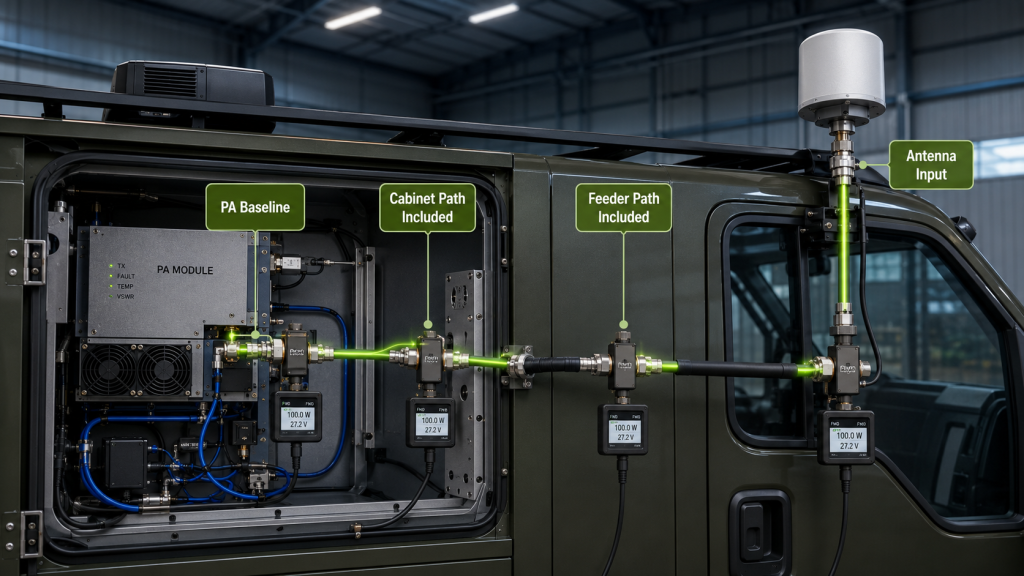
For that reason, the project may need both:
- An initial acceptance boundary
- A later service-retest boundary
The initial acceptance test may use the antenna input. Later maintenance may use the cabinet RF output because it remains accessible.
If the two boundaries are different, record both during commissioning. Their measured relationship becomes the field baseline.
The vehicle RF drawing should identify:
- PA output connector
- Internal cabinet RF path
- Cabinet RF bulkhead
- External feeder route
- Feeder-end connector
- Antenna input
- Acceptance measurement point
- Service-retest point
Multi-channel systems should identify each path separately.
Use channel-specific labels such as:
- Channel A PA output
- Channel A cabinet RF output
- Channel A antenna input
- Channel B PA output
- Channel B cabinet RF output
- Channel B antenna input
This matters because different channels may use different cable lengths, connector types, bulkhead positions, or antenna locations.
The objective is to select a test point that remains identifiable and repeatable after the vehicle build is complete.
4. Why Vehicle Operating State Changes RF Power Results
A physical measurement point is only one part of the test definition. The vehicle operating state must also remain consistent.
A reading taken with the engine off and one RF channel active may not match a reading taken with the engine on, all channels active, and the cabinet closed.
Both results may be valid, but they represent different operating conditions.
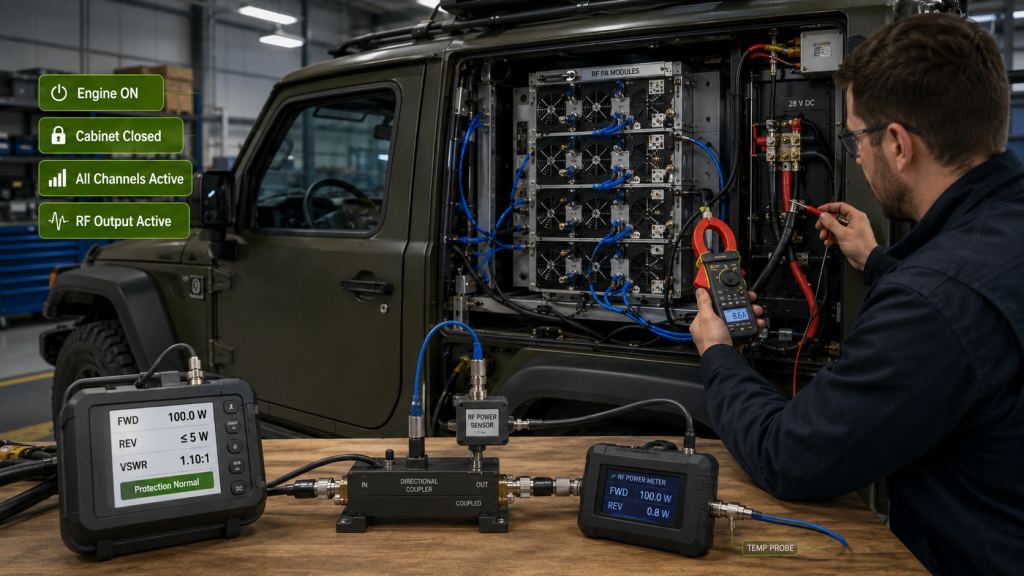
A repeatable vehicle RF power test should record:
- Engine off or engine on
- Battery-only or alternator-supported operation
- Single-channel or multi-channel operation
- RF duty condition
- Warm-up time
- Cabinet and cooling state
- PA-terminal voltage
- DC current
- Alarm and protection status
PA-terminal voltage is particularly important.
A document that states only “28 V nominal” does not prove that the PA received the same voltage during RF output. Cable resistance, distribution wiring, connectors, protection devices, and simultaneous channel operation can create voltage drop between the vehicle bus and the amplifier terminals.
Record the voltage at the PA terminals while RF output is active.
Thermal state should also be defined. A cold-start reading may confirm startup output, but it may not represent continuous or high-duty operation. The test duration should match the project requirement.
For a multi-channel cabinet, distinguish between:
- One channel active
- Selected channels active
- All channels active
- Sequential operation
- Simultaneous operation
Total current, temperature, airflow demand, and PA-terminal voltage can change when several modules operate together.
Where band-wide performance is part of acceptance, use the same measurement boundary and vehicle state for every frequency point. A low-band result measured at the PA port should not be compared with a high-band result measured after the vehicle feeder.
Comparable results require both:
- The same RF measurement boundary
- The same operating-state definition
5. How VSWR and Protection Data Locate the Failing Boundary
Low forward power alone does not show where the problem begins.
Forward power, reflected power, VSWR, PA-terminal voltage, current, temperature, and protection status provide a stronger diagnostic record.
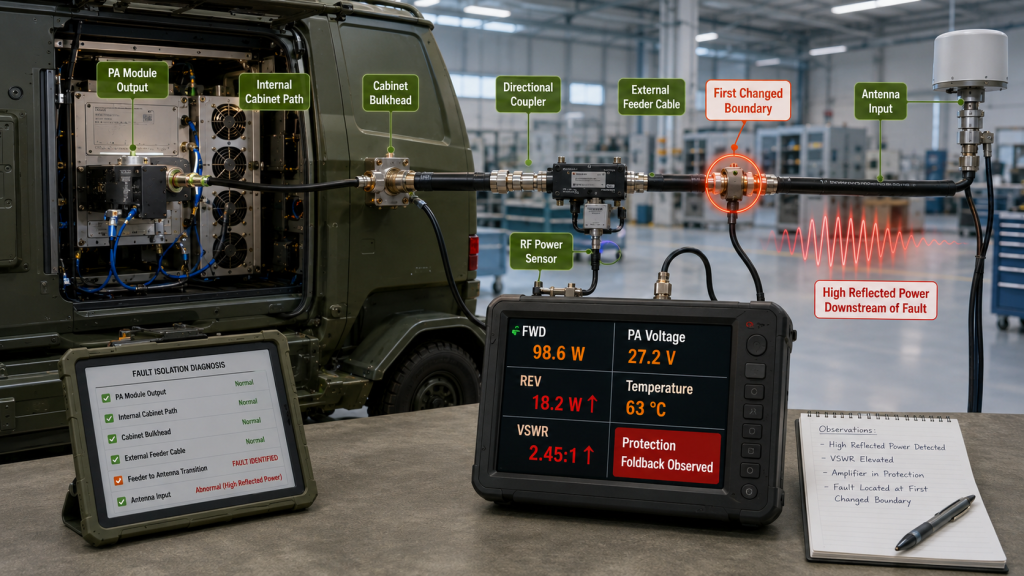
Where the RF architecture and access conditions allow, add one path segment at a time:
- Test the PA module into a known 50 Ω load.
- Add the internal cabinet RF path.
- Add the cabinet bulkhead.
- Add the external vehicle feeder.
- Add the antenna-side transition.
- Connect the installed antenna.
Repeat the test at the affected frequency and operating state.
The first path stage that changes forward power, reflected power, VSWR, or alarm status identifies the next inspection boundary.
For example:
- A problem present during dummy-load testing points toward the PA, drive, supply, load, thermal condition, or bench setup.
- A problem that begins after the cabinet path is added points toward an internal jumper, connector, filter, combiner, or bulkhead.
- A problem that begins after the vehicle feeder is connected points toward the cable route or its connectors.
- A problem that appears only with the antenna connected points toward antenna match, installation, mounting, or the final interface.
- A problem that appears after vehicle movement or vibration points toward mechanical instability in the RF path.
Protection foldback should not automatically be described as weak PA output. The amplifier may be responding correctly to an unsafe reflected-power or thermal condition.
Likewise, a stable PA-port result proves only the controlled PA baseline. It does not prove that the downstream RF path is correct.
The diagnostic goal is to identify the first boundary where the result changes.
6. What Evidence Makes Vehicle RF Power Tests Repeatable
A useful report must allow another engineer to repeat the same test and reach the same judgment.
“100 W passed” is not enough. It does not identify the measurement point, load, vehicle state, thermal condition, frequency, or delivered unit.
Each reported result should record:
- PA module S/N
- Cabinet or vehicle-system S/N
- RF channel ID
- Frequency
- Input drive condition
- Measurement boundary
- Load type
- Included RF path
- Forward power
- Reflected power or VSWR
- PA-terminal voltage
- DC current
- Warm-up time
- Temperature
- Vehicle operating state
- Active channel count
- Alarm or protection status
- Test instrument or method
- Pass/fail boundary
These fields should be carried into the project’s S/N-linked RF PA acceptance record rather than stored as disconnected screenshots.
For One Report One Unit traceability, the report should identify whether each result belongs to:
- The PA module
- The integrated cabinet
- The installed vehicle RF path
Where possible, retain both the controlled baseline and the installed result:
- PA-port result into a known load
- Cabinet-output result after internal routing
- Antenna-input result after the external feeder
- Vehicle state during each test
- Alarm status during each test
This evidence allows future service teams to determine whether a change begins at the PA, inside the cabinet, across the feeder, or after the antenna is connected.
What RFQ Details Should Define Vehicle RF Power Acceptance?
The RFQ should define the required result before the supplier selects the test method.
“100 W RF PA” is a module requirement. It is not automatically the same as “100 W at cabinet output” or “100 W at antenna input.”
A stronger RFQ should define:
- Frequency range
- Target RF output
- Required measurement boundary
- Dummy-load or installed-path test
- Feeder length and connector chain
- Single-channel or multi-channel operation
- Duty condition
- Engine and supply state
- Allowed PA-terminal voltage range
- Cooling method
- Warm-up and test duration
- Antenna VSWR boundary
- Control interface
- Required test-report format
- Required S/N traceability
- Factory and field retest method
Examples include:
Required output: ___ W at the PA module port, measured into a defined 50 Ω load after the specified warm-up period.
Required output: ___ W at the cabinet RF output, with the engine on, cabinet closed, and all specified channels active.
Required output: ___ W at the antenna input, including the installed feeder and connector path.
The RFQ should also define whether the initial acceptance point and later service point are the same.
If the antenna input will become inaccessible after installation, specify an accessible cabinet-output point for maintenance and record the relationship between the two boundaries during commissioning.
RF SKYPOWER can support early engineering review for vehicle-mounted C-UAS RF chains. Submit the operating frequency range, required output boundary, PA-port or antenna-input target, feeder layout, 28 V supply condition, channel count, duty cycle, cooling method, antenna VSWR boundary, control interface, and required S/N-linked test evidence.
The review should define where output will be measured, which vehicle state applies, and how the result will be repeated during cabinet integration and field acceptance.
Submit your vehicle C-UAS RF requirements.
Conclusion
Vehicle RF power results become unreliable when teams compare measurements from different physical boundaries or operating states.
PA-port power proves the amplifier baseline. Cabinet-output power proves the integrated cabinet path. Feeder-end and antenna-input measurements show what reaches later stages of the installed vehicle RF chain.
Define the measurement boundary in the RFQ, mark it in the vehicle drawing, test it under the required operating state, and connect the result to the correct module or system S/N.
A vehicle C-UAS system should be accepted using repeatable measurement boundaries—not an undefined wattage label.