
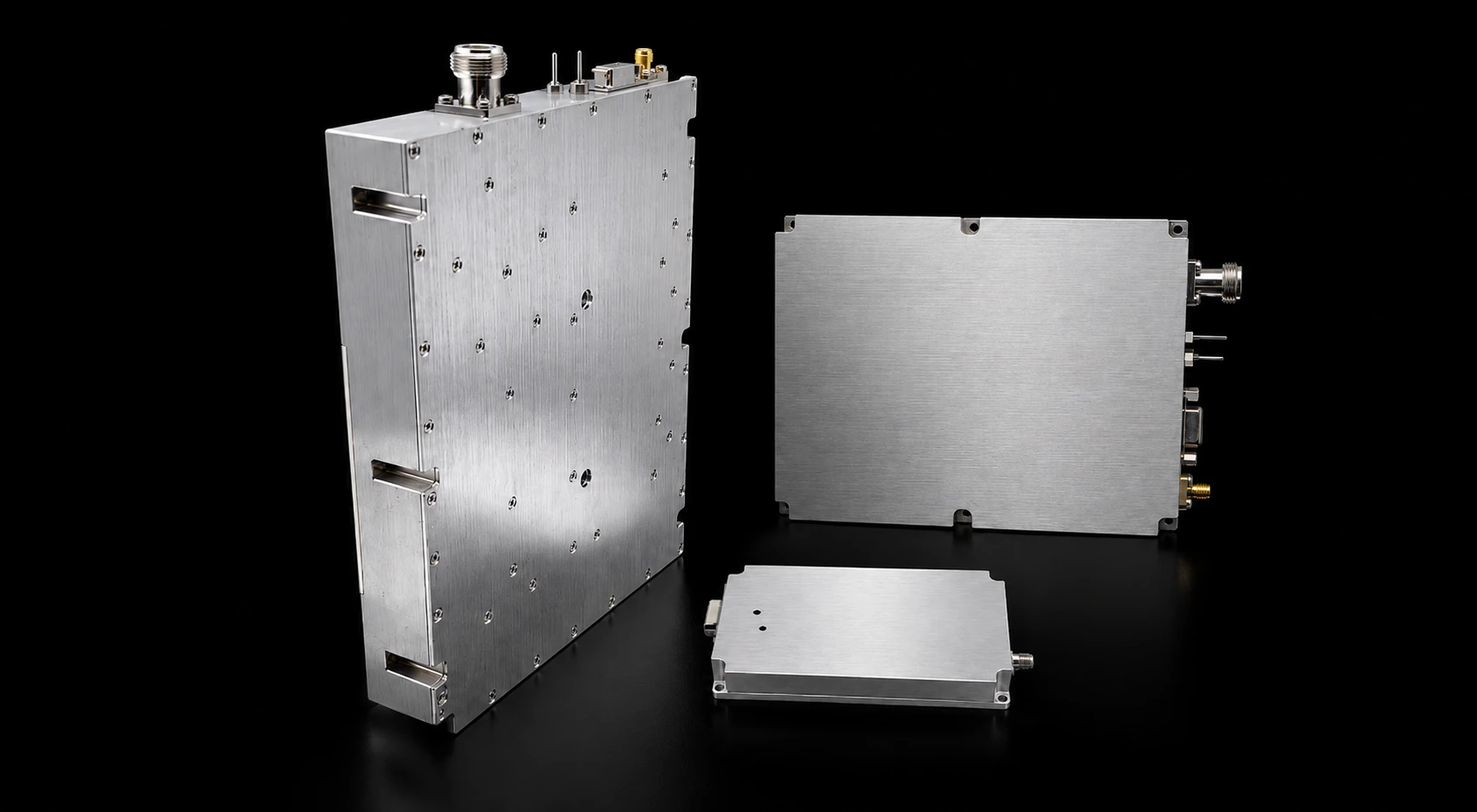
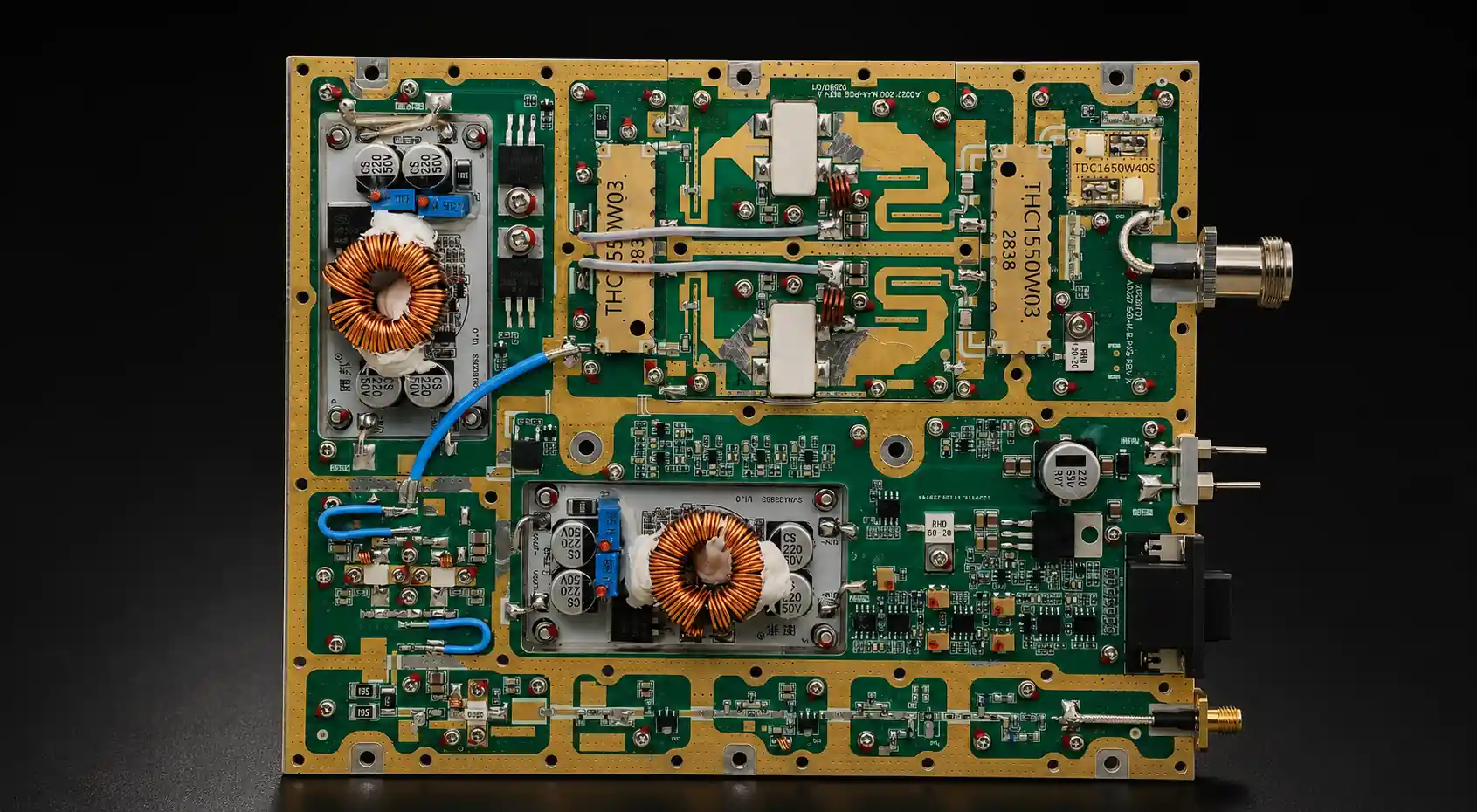
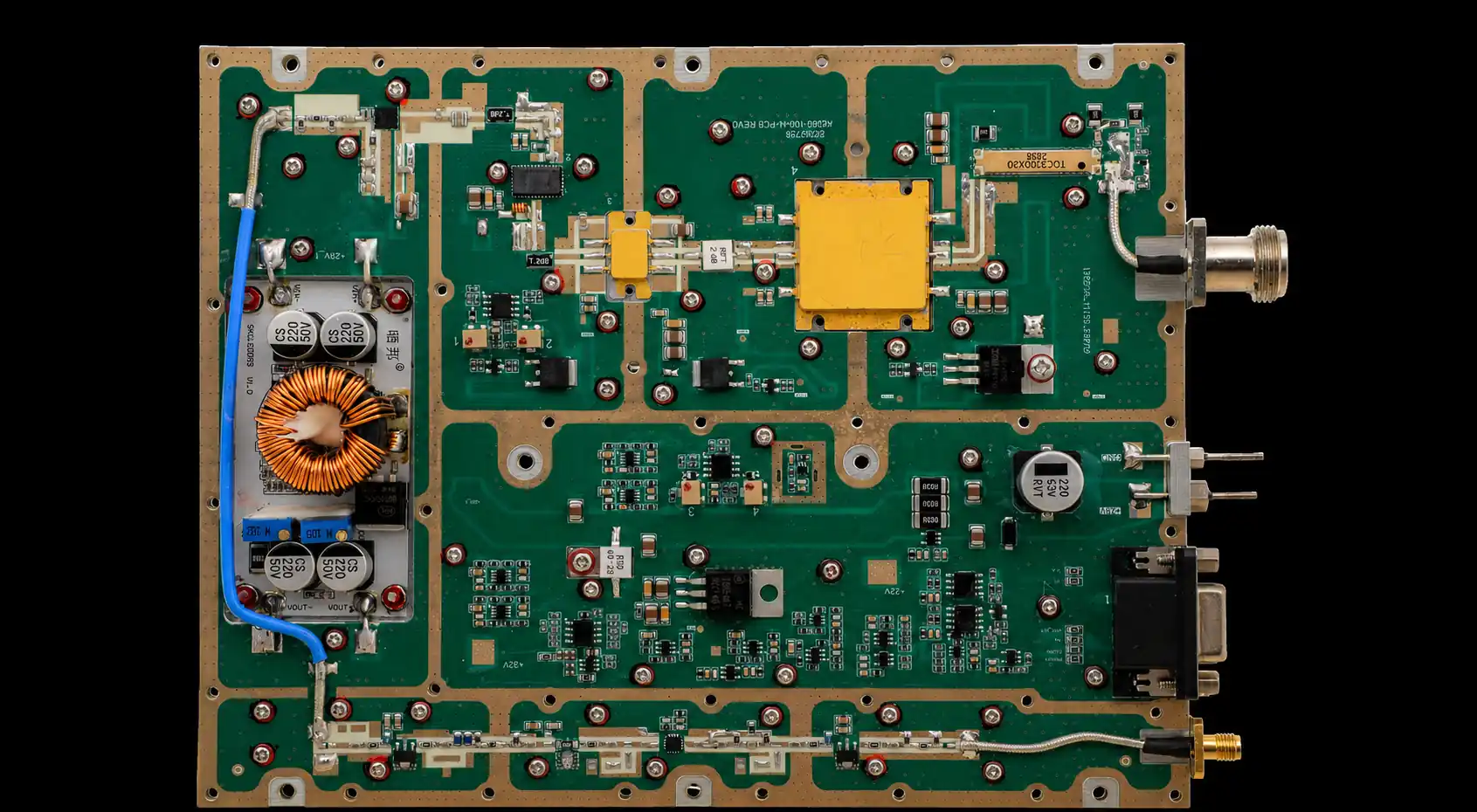

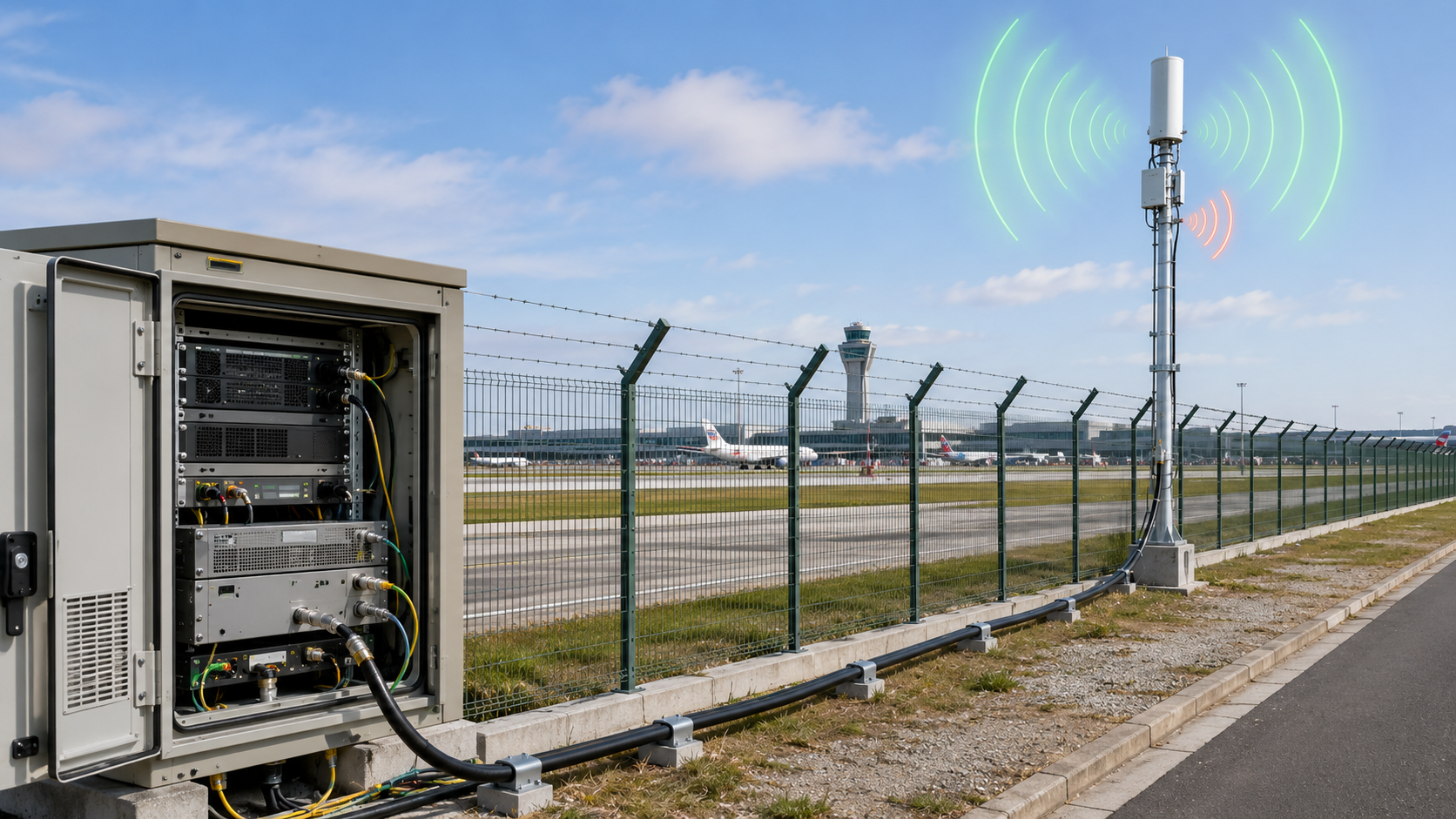
Usable RF output power must be tied to a defined measurement reference plane. A 100 W result at the PA output connector is not automatically the same as the forward power reaching the antenna input, the net RF power accepted by the antenna, or the final radiated result.
When reviewing RF Power Amplifier Modules, engineers should separate three effects before judging an output shortfall:
- Insertion loss in the feeder and RF path
- RF power reflected by antenna mismatch
- Reduction in forward power caused by protection or thermal behavior
The acceptance question is not only whether the PA reaches rated output on a 50 Ω dummy load. It is whether corrected forward and reflected power, measured at the same reference plane, operating state, time, and power definition, still support the required system output.
1. Why Usable RF Output Needs a Defined Reference Plane
The phrase “RF output power” can describe several different values along the RF chain.
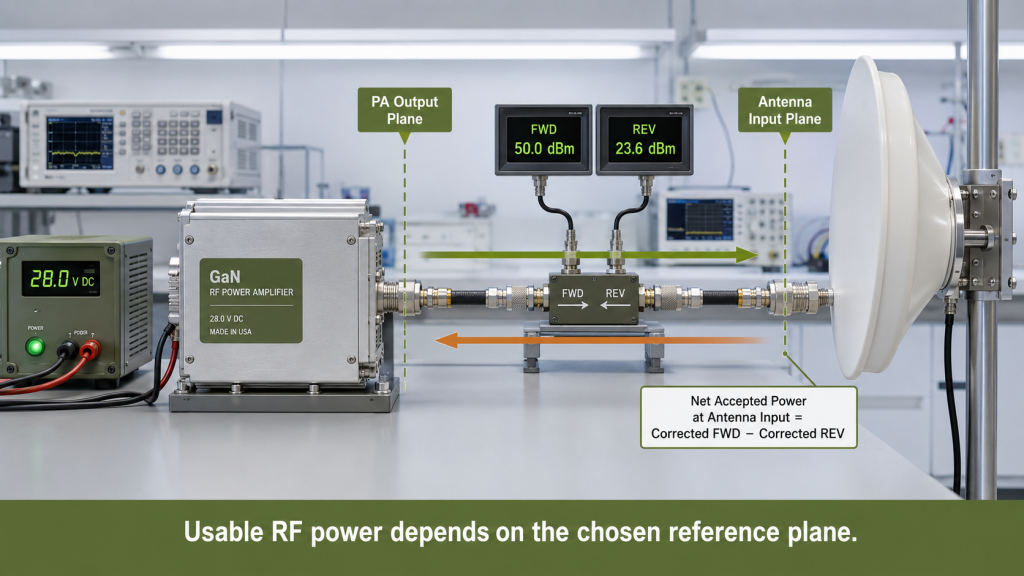
Forward and Net Power at the PA Output Plane
Forward power at the PA output plane is the incident RF wave leaving the amplifier toward the external RF path.
Under mismatch, it should not be confused with:
- Rated output under specified matched-load conditions
- A previous dummy-load measurement
- Reflected power returning to the PA
- Net power entering the external RF path
When both channels are corrected to the same PA reference plane:
Net Power at the PA Plane = PA-Port Forward Power − PA-Port Reflected Power
The relationship between rated watts and measured RF PA output power should be defined before installation-path losses are added.
Forward Power at the Antenna Input
Forward power at the antenna input is the incident RF power reaching the antenna connector after the installed RF path.
It is normally lower than PA-port forward power because the path may include:
- Cabinet cables
- RF switches
- Filters
- Directional couplers
- Adapters
- Lightning protectors
- Long feeder cables
- Outdoor connectors
These components create insertion loss even when the antenna is well matched.
Reflected Power at the Antenna Input
Reflected power is the portion of incident RF power returning from the antenna or load because of impedance mismatch.
Forward and reflected power must use:
- The same reference plane
- The same operating state
- The same measurement time or synchronized acquisition window
- The same frequency scope
- The same detector type
- The same measurement bandwidth
- The same averaging period
- The same average, peak, or envelope-power definition
Average forward power should not be combined with peak, narrowband, or differently integrated reflected power.
A forward reading captured before protection foldback must not be combined with a reflected reading captured after the PA has reduced its output.
Net Accepted RF Power
When forward and reflected power are corrected to the same reference plane and expressed in linear units:
Accepted Power = Forward Power − Reflected Power
Net accepted power represents the RF power not reflected at that plane.
It is a valid usable-power metric only when the project has selected that reference plane as the authoritative acceptance boundary.
For example:
- A PA supplier may approve output at the PA port.
- A cabinet supplier may approve output at the cabinet connector.
- An installation contractor may approve forward or accepted power at the antenna input.
- A system integrator may require EIRP or field-strength evidence.
In this article, usable RF output means the RF power available or accepted at the project-defined reference plane. Net accepted antenna-input power applies only when the antenna input is the agreed acceptance boundary.
Accepted Power Is Not Radiated Power
Accepted antenna-input power does not prove how much power is radiated.
Radiated performance also depends on:
- Antenna efficiency
- Realized gain
- Radiation pattern
- Polarization
- Installation environment
- Nearby structures
- Direction of interest
A good match therefore does not automatically prove final C-UAS system EIRP.
2. What Lowers Antenna-Side RF Power
Lower antenna-side power does not always mean the PA itself is weak.
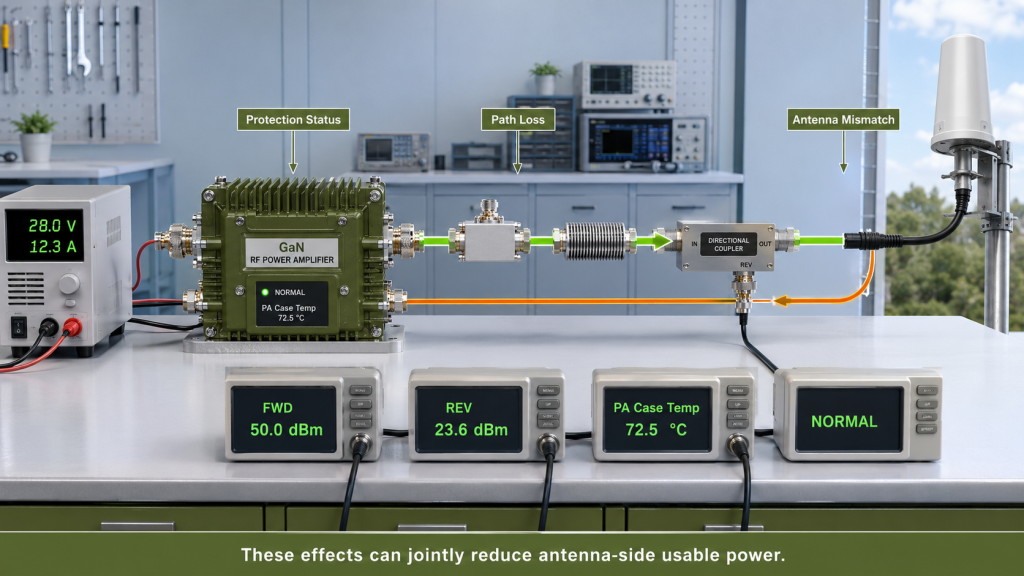
Why Antenna-Side Power Is Lower
| Mechanism | What Changes | Required Evidence | Typical Action |
|---|---|---|---|
| Path insertion loss | Less forward power reaches the antenna | Frequency-specific path loss | Reduce or redesign the RF path |
| Antenna mismatch | Part of the incident power is reflected | Corrected FWD, REV, return loss, or VSWR | Correct the antenna or installation |
| Protection foldback | The PA actively reduces forward output | Time-aligned power and protection log | Remove the load problem before approval |
| Reference-plane error | Measurements from different locations are compared | RF-path diagram and correction table | Recalculate to one approved plane |
| Antenna efficiency | Accepted power is not fully converted to radiation | Gain and efficiency evidence | Continue to EIRP or field validation |
Path Insertion Loss
Path insertion loss exists even when the load is well matched.
In a matched or adequately characterized path, a 2 dB one-way insertion loss leaves about 63% of the incident forward power at the far-end reference plane.
Under material source or load mismatch, the real transferred power may also depend on reflection phase, connector discontinuities, multiple reflections, and transducer gain.
The project should therefore use frequency-specific feeder and connector loss rather than one assumed value for the complete band.
Mismatch Reflection
Mismatch occurs when the antenna or load impedance differs from the expected system impedance.
A portion of the incident RF power is reflected. This is separate from feeder insertion loss.
A system may have:
- Low feeder loss and poor antenna match
- High feeder loss and good antenna match
- Both high path loss and poor antenna match
These conditions require different corrective actions.
Protection Foldback
Higher reflected power may cause the PA to:
- Raise an alarm
- Reduce gain
- Reduce forward output
- Limit current
- Shut down
- Recover automatically
- Require a reset
The accepted-power calculation must use the actual measured forward power after the system reaches the tested thermal and protection state.
Nominal output or a previous dummy-load result must not be substituted after foldback has changed the PA output.
A detailed RF PA protection logic review should define alarm, foldback, shutdown, and recovery separately from the antenna-match requirement.
PA Safety and System Acceptance Are Different
A mismatch may be safe for the PA but still unacceptable for the system.
Module-safe mismatch means the PA survives and its temperature, current, protection action, and recovery remain within approved limits.
System-acceptable mismatch means the required output remains available at the selected reference plane across all critical frequencies and hot-state conditions.
VSWR magnitude alone does not define worst-case PA stress. Reflection phase can change device voltage, current, dissipation, stability, and protection behavior. Design qualification may therefore require controlled phase coverage even when field acceptance uses a simpler VSWR limit.
Survival is not the same as performance.
3. How to Calculate Net Accepted RF Power
The calculation should use actual forward power at the selected reference plane—not the PA nameplate rating.

Reflection Coefficient From VSWR
When VSWR is known:
|Γ| = (VSWR − 1) / (VSWR + 1)
The reflected-power fraction is:
Reflected Power Fraction = |Γ|²
The accepted-power fraction is:
Accepted Power Fraction = 1 − |Γ|²
Therefore:
Accepted Power = Forward Power × (1 − |Γ|²)
Mismatch loss is:
Mismatch Loss = −10 log₁₀(1 − |Γ|²)
Mismatch loss describes the reduction between incident forward power and net accepted power at the same reference plane. It does not include feeder insertion loss.
Example 1: 100 W at the Antenna Input
Assume:
- Measured forward power at the antenna input: 100 W
- VSWR at the same plane: 2.0:1
- Stable operating state with no change in forward power during measurement
The reflection coefficient is:
|Γ| = (2 − 1) / (2 + 1) = 1/3
The reflected-power fraction is:
|Γ|² = 1/9 ≈ 11.1%
Therefore:
- Reflected power: approximately 11.1 W
- Net accepted power: approximately 88.9 W
- Mismatch loss: approximately 0.51 dB
The antenna accepts about 88.9 W at that reference plane. This does not account for antenna efficiency or gain.
Example 2: 100 W PA-Port Forward Power and 2 dB Feeder Loss
This is a first-order engineering calculation.
Assume:
- Measured PA-port forward power under the tested antenna-load condition: 100 W
- The PA has not entered protection foldback
- One-way feeder insertion loss at the test frequency: 2.0 dB
- Antenna-input VSWR: 2.0:1
- The feeder is characterized
- Source-mismatch interaction and multiple reflections are not material
The forward power reaching the antenna input is:
100 × 10^(−2/10) ≈ 63.1 W
With a 2.0:1 VSWR, the accepted fraction is approximately 88.9%.
Therefore:
Accepted Power ≈ 63.1 × 0.889 ≈ 56.1 W
The results are:
- Measured PA-port forward power: 100 W
- Forward power at the antenna input: approximately 63.1 W
- Net accepted antenna-input power: approximately 56.1 W
If protection foldback reduces PA-port forward power, repeat the complete calculation using the reduced value.
Where source match, reflection phase, or multiple reflections materially affect the result, use a calibrated vector or transducer-gain analysis instead of this simplified method.
Do Not Subtract Reflected dBm Directly
Forward and reflected dBm values are logarithmic absolute-power values. They cannot be subtracted to calculate net accepted power.
For example:
- Forward power: 50 dBm = 100 W
- Reflected power: 40 dBm = 10 W
- Net accepted power: 90 W
- 90 W ≈ 49.54 dBm
- Return loss: 50 dBm − 40 dBm = 10 dB
The 10 dB difference represents return loss, not net accepted power.
The correct process is:
- Correct both channels to the same reference plane.
- Confirm that they use the same time, detector, bandwidth, averaging, and power definition.
- Convert forward dBm to watts.
- Convert reflected dBm to watts.
- Subtract reflected watts from forward watts.
- Convert the result back to dBm when required.
Raw sensor readings should not be subtracted before coupling-factor, cable-loss, attenuator, sensor-response, and frequency corrections are applied.
Use Frequency-Resolved Data for Multiple Signals
One aggregate VSWR or total reflected-power value may hide a severe mismatch at an individual frequency.
For multi-frequency, frequency-hopping, multi-carrier, or broadband signals, use frequency-resolved or channelized FWD and REV evidence when individual bands have separate output or protection requirements.
The forward and reflected channels must also integrate the same spectral range. A broadband average forward-power result cannot be combined with reflected power measured over only one narrow channel.
4. Why PA-Port VSWR Can Hide Antenna Mismatch
Low reflected power at the PA port does not automatically prove a well-matched antenna.
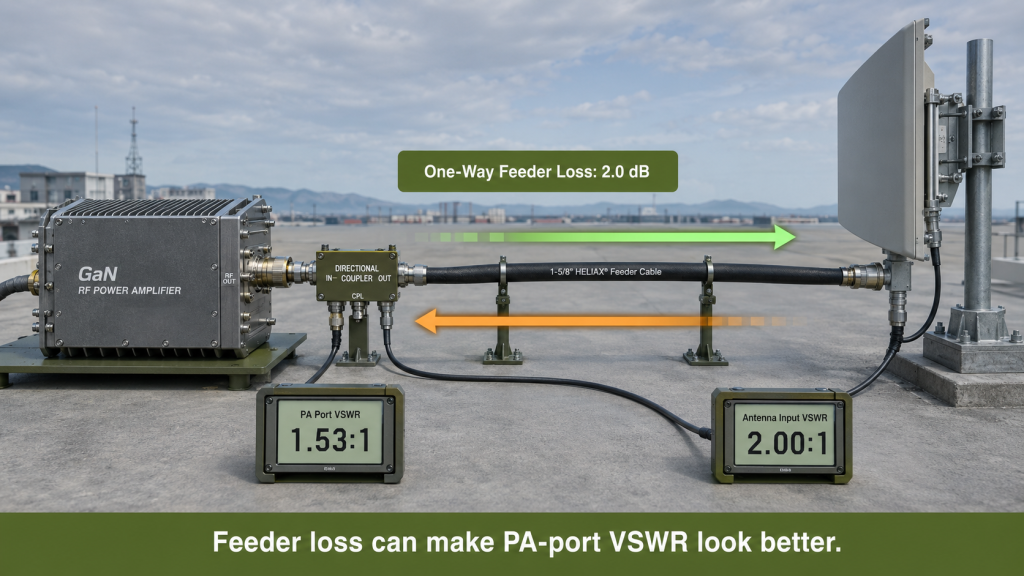
A lossy feeder attenuates the forward wave before it reaches the antenna. It then attenuates the reflected wave again on the return path.
As a result, the mismatch measured at the PA side may appear better than the actual antenna-input mismatch.
Quantifying the Masking Effect
In a simplified one-way-loss model:
PA-Side Return Loss ≈ Antenna Return Loss + 2 × Feeder Loss
For example:
- Antenna VSWR: 2.0:1
- Antenna return loss: approximately 9.54 dB
- One-way feeder loss: 2.0 dB
The apparent PA-side return loss may be:
9.54 + 2 × 2.0 = 13.54 dB
A return loss of about 13.54 dB corresponds to an apparent VSWR of approximately 1.53:1.
The PA may therefore appear to see about 1.53:1 even though the antenna itself remains approximately 2.0:1.
This relationship is simplified. Source mismatch, phase, connector reflections, and multiple reflections may change the measured result.
Reference-Plane Rules
When evaluating mismatch:
- PA-port FWD and REV can assess the load seen by the PA.
- Antenna-input FWD and REV should be used to calculate accepted antenna-input power.
- Feeder loss must be corrected when moving results between planes.
- PA-port VSWR should not automatically be labelled as antenna VSWR.
- Low PA-port reflected power should not automatically approve the antenna.
When antenna-input accepted power is required, either measure near the antenna-input plane or de-embed the characterized feeder path.
Low-Power and High-Power Checks
| Test Level | Main Question |
|---|---|
| Low-power VNA or cable-and-antenna test | Where are the return loss, insertion loss, and path discontinuities? |
| High-power operating test | What are the actual FWD, REV, voltage, current, temperature, and protection states? |
Low-power S11 does not prove high-power thermal and protection behavior. High-power PA-port readings do not replace installed-path diagnosis.
Use a known-good load for the PA baseline, a characterized mismatch load for protection qualification, and the installed feeder and antenna path for final acceptance. Repeat critical installed-path checks after relevant RF-path changes.
The purpose of dummy-load testing and real antenna checks is to establish different parts of the same approval chain.
5. What Evidence Should Support Installed-Path Approval
Installed-path approval should connect RF power, path loss, antenna match, protection behavior, and measurement-system capability.

Define the Measurement System
The report should identify:
- PA output, cabinet output, and antenna-input reference planes
- Directional-coupler location
- Frequency-dependent coupling factors
- Cable, attenuator, adapter, and sensor corrections
- Detector type and measurement bandwidth
- Averaging and power definition
- Measurement timestamps or synchronization
- Instrument dynamic range and sensor floor
FWD and REV should be simultaneous or time-aligned when protection can change forward power. Values captured before and after foldback must not be combined.
Check Coupler Directivity and Dynamic Range
A directional coupler cannot separate forward and reflected waves perfectly.
When true reflected power is low, the REV channel may be influenced by:
- Forward leakage caused by limited coupler directivity
- Sensor noise floor
- Adapter or connector reflection
- Frequency-dependent coupling error
- Insufficient channel isolation
If the reflected signal approaches the coupler-directivity limit or sensor floor, calculated return loss, VSWR, and accepted power should be reported as uncertain rather than exact.
An unusually low REV reading is not automatically evidence of a nearly perfect match.
Record the Operating Result
At each critical frequency or channel, record:
- Corrected FWD
- Corrected REV
- Calculated accepted power
- PA-terminal voltage
- DC current
- Case temperature
- Duty cycle and run duration
- Alarm or foldback state
- Recovery result
- Model and serial number
The report should identify the applicable feeder loss and antenna-match evidence. Design qualification may cover the full mismatch envelope, while installation or shipment evidence can focus on the conditions required for release.
6. What the RFQ and Acceptance Rule Should Define
The RFQ should establish the output target, reference plane, RF path, load boundary, and decision method before testing begins.
Required RFQ Data
Define:
- Required frequencies or active channels
- PA-port forward-power target
- Antenna-input forward-power target
- Net accepted-power target, when applicable
- Authoritative reference plane
- Frequency-specific RF-path loss
- Permitted antenna return loss or VSWR
- Protection and recovery requirements
- Required design, installation, sample, or S/N-linked evidence
- The agreed operating and measurement conditions in the acceptance procedure
Decision Rules
The acceptance plan should state:
- Which power result controls the decision
- Which corrections are applied
- Whether frequency-resolved data are required
- Permitted measurement uncertainty
- Guard-band method near the limit
- Retest conditions and maximum retest count
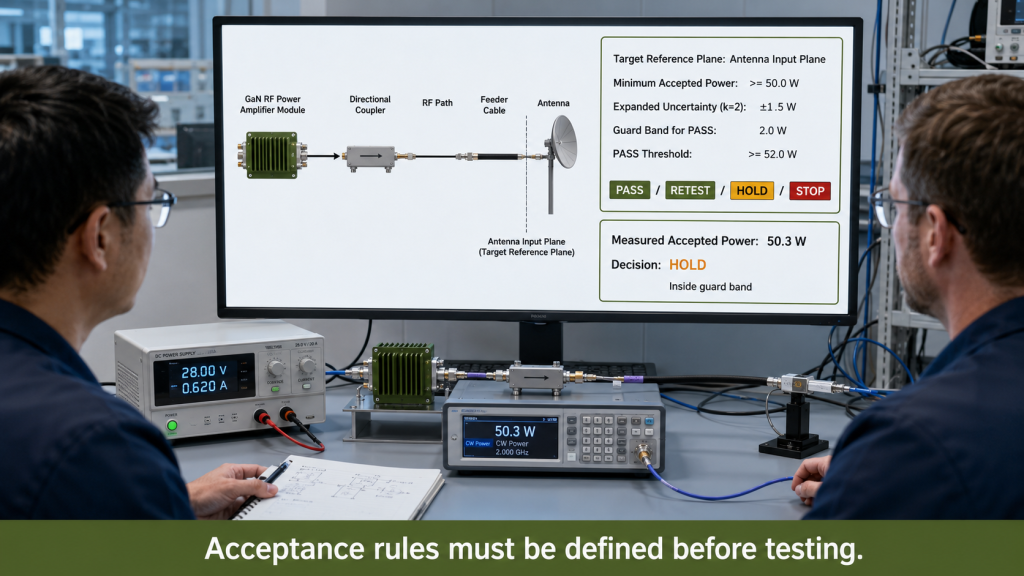
- PASS, RETEST, HOLD, and STOP criteria
- Action after protection activity
For example, if the minimum accepted-power requirement is 50 W and the measured result is 50.3 W with an expanded uncertainty of ±1.5 W, the center reading alone should not automatically produce a PASS.
The agreed guard-band rule must determine the result.
Measurement uncertainty should not be added after testing to widen the requirement or convert an otherwise failing result into a pass.
An installation should not pass only because:
- The dummy-load result passed
- The PA survived the antenna load
- VSWR remained below a general number
- The alarm did not trigger
- PA-port reflected power appeared low
It should pass only when corrected, time-aligned, frequency-appropriate, and uncertainty-aware evidence meets the predefined system requirement.
FAQ
Can I Subtract Reflected dBm Directly From Forward dBm?
No.
Correct the forward and reflected channels independently to the same reference plane, time, bandwidth, and power definition. Convert both values to watts, subtract reflected watts from forward watts, and convert the result back to dBm when needed.
After correction, the difference between forward dBm and reflected dBm represents return loss—not net accepted dBm.
Does Low VSWR at the PA Port Prove a Good Antenna Match?
Not always.
A lossy feeder attenuates the reflected wave before it reaches the PA. This can make the PA-side return loss appear better than the antenna-input return loss.
The feeder loss, reference plane, coupler directivity, and channel corrections must be known before PA-port VSWR is treated as antenna-match evidence.
Does Good Antenna Match Prove Radiated Power or EIRP?
No.
A good match means that relatively little incident power is reflected at the selected reference plane.
It does not prove antenna efficiency, realized gain, radiation pattern, polarization, directional coverage, or final EIRP.
Those require separate antenna and system-level evidence.
Conclusion
Usable RF output power is not nominal PA power minus a VSWR number.
A defensible result must separate:
- PA-port forward and reflected power
- Net power at the PA output plane
- RF-path insertion loss
- Forward and reflected power at the antenna input
- Net accepted power
- Protection foldback
- Measurement-system limitations
- Antenna efficiency and radiated performance
FWD and REV must be independently corrected and measured at the same reference plane, time, frequency scope, bandwidth, detector, averaging period, and power definition.
Forward and reflected dBm must not be subtracted directly to calculate accepted power. A single aggregate VSWR may also hide a severe mismatch at one active frequency.
RF SKYPOWER can support early engineering review for usable RF output under real antenna-load conditions. Send the operating frequencies, PA-port forward-power target, antenna-input or net accepted-power target, feeder type and length, frequency-specific path loss, connector and filter path, antenna return loss or VSWR, FWD and REV measurement plane, signal bandwidth, detector and averaging method, PA-terminal voltage, duty cycle, cooling condition, protection response, measurement uncertainty, and required S/N-linked acceptance evidence.