
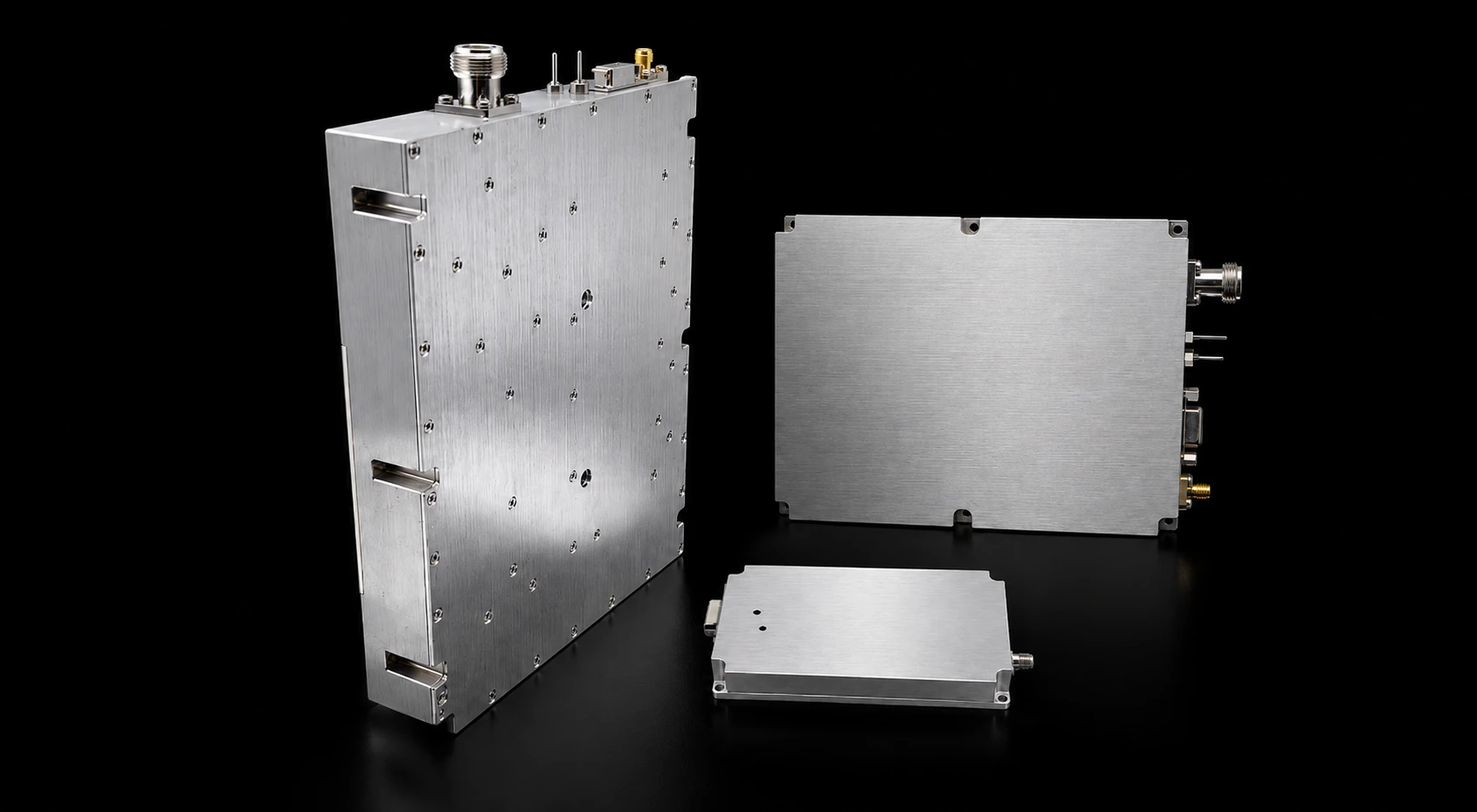
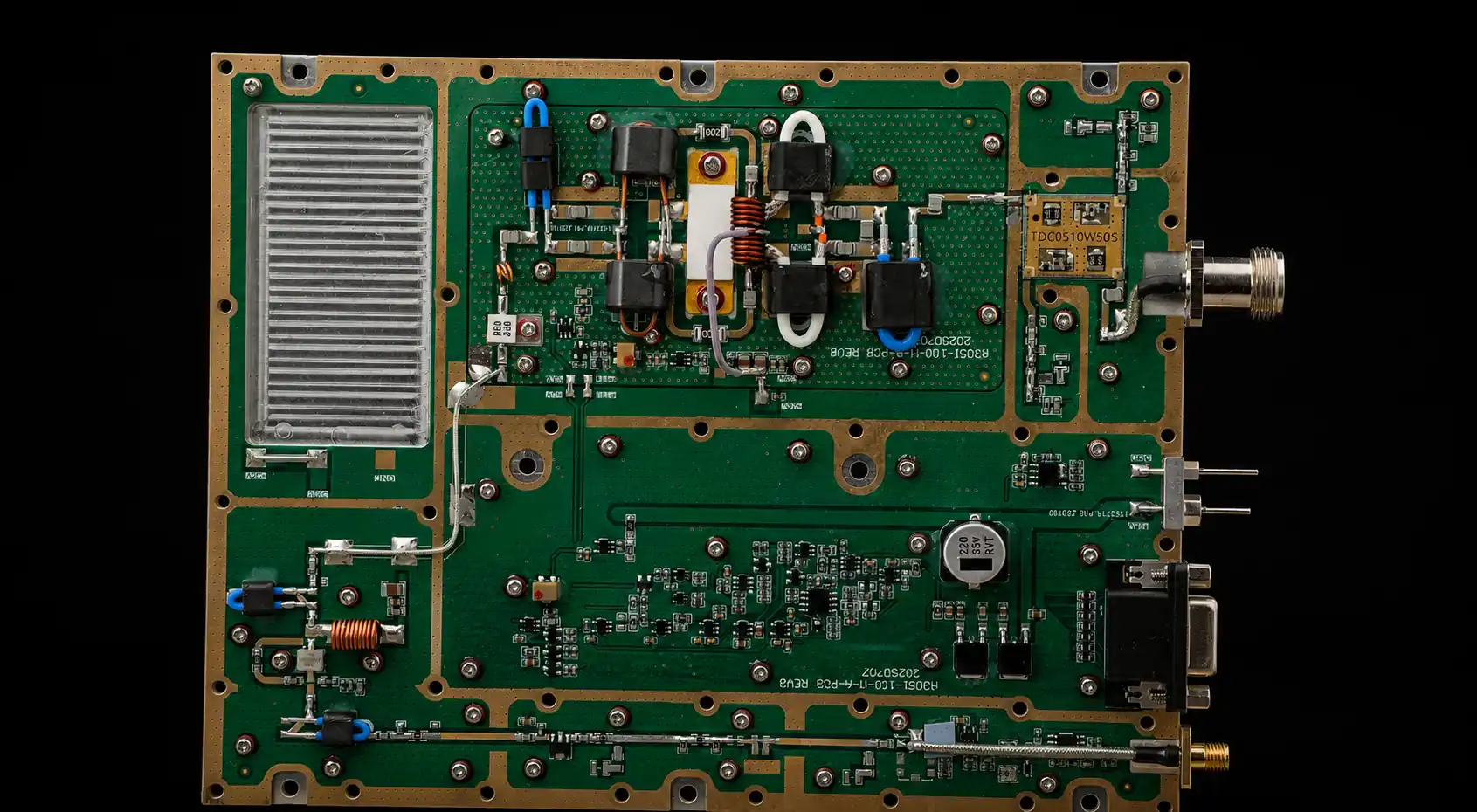
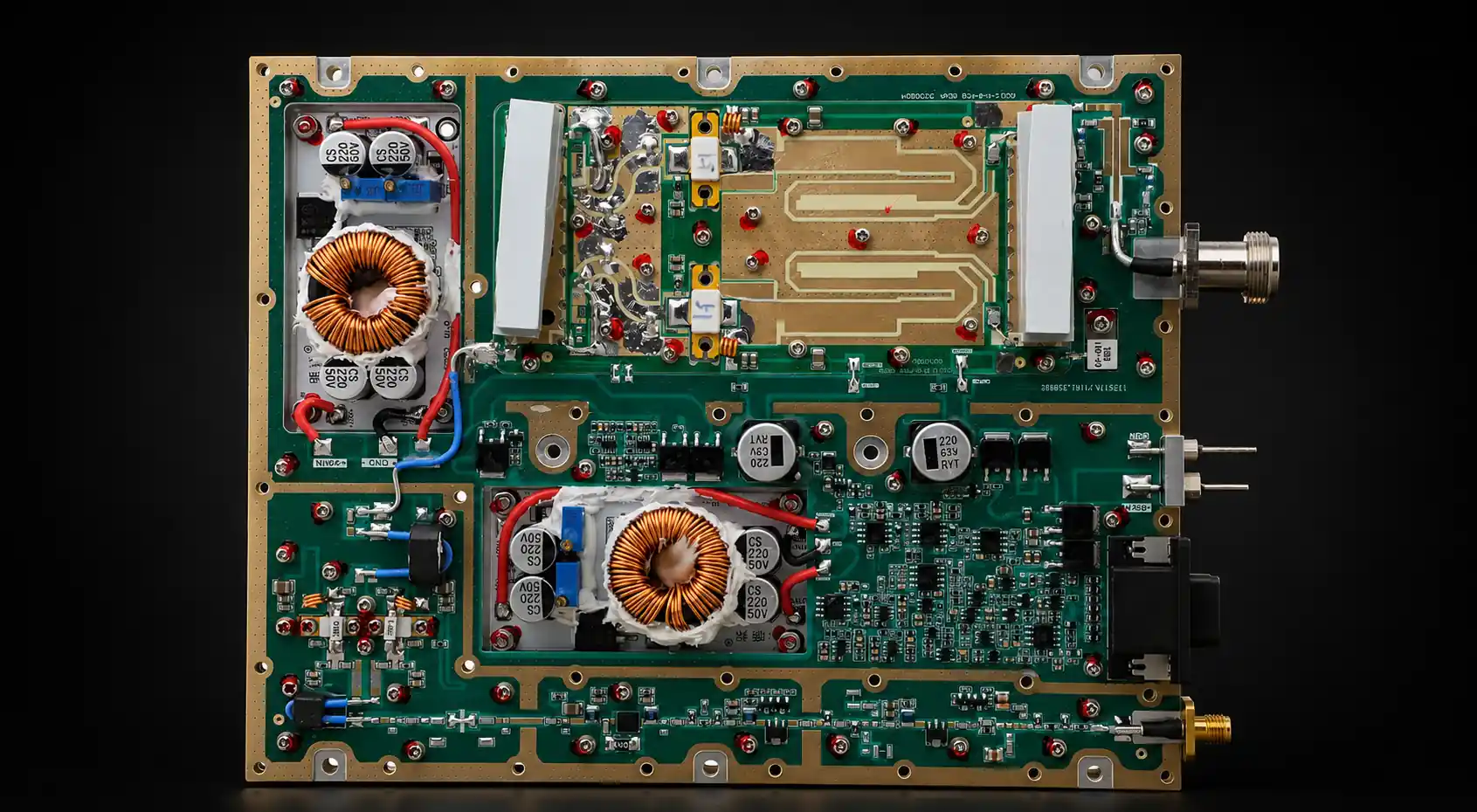
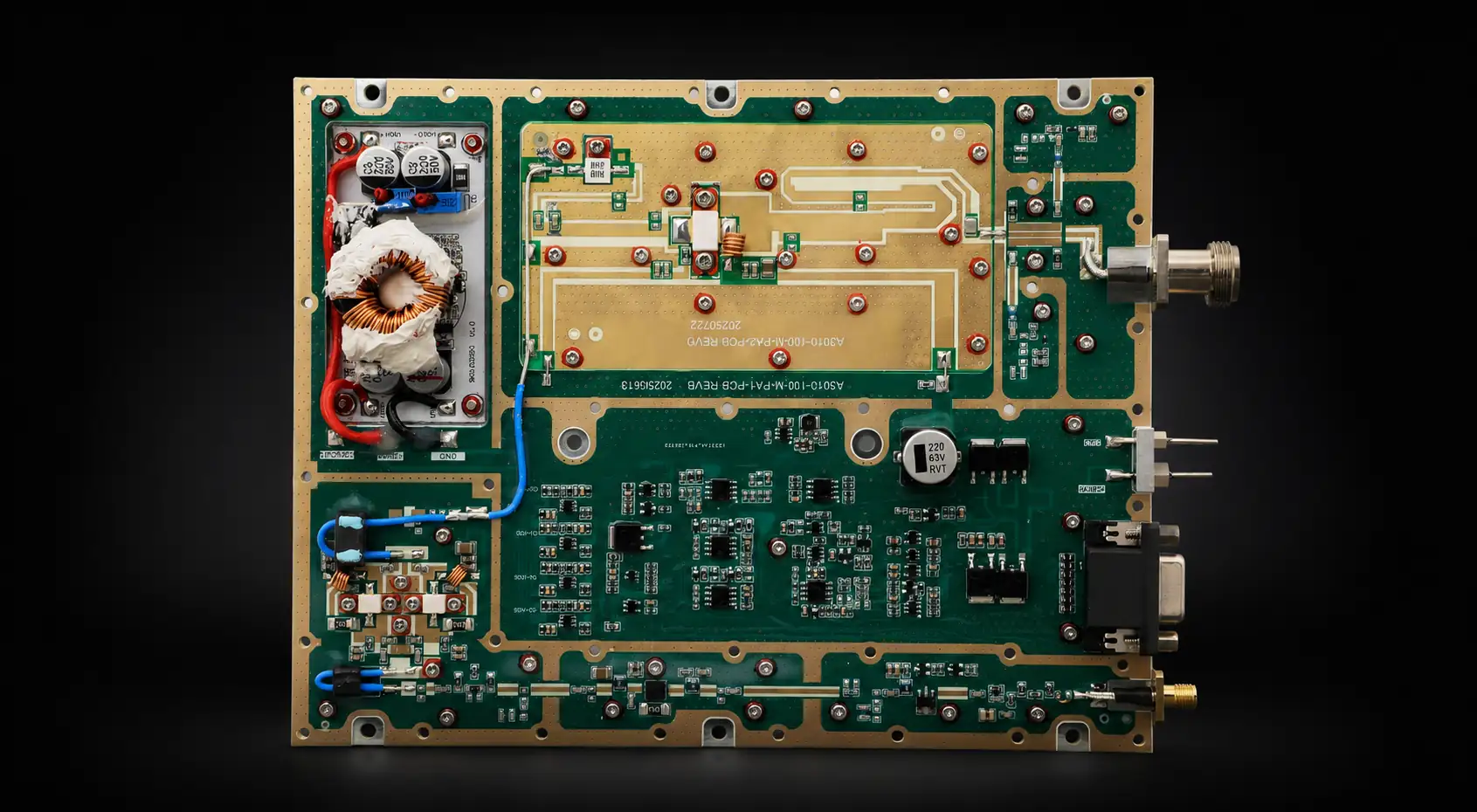
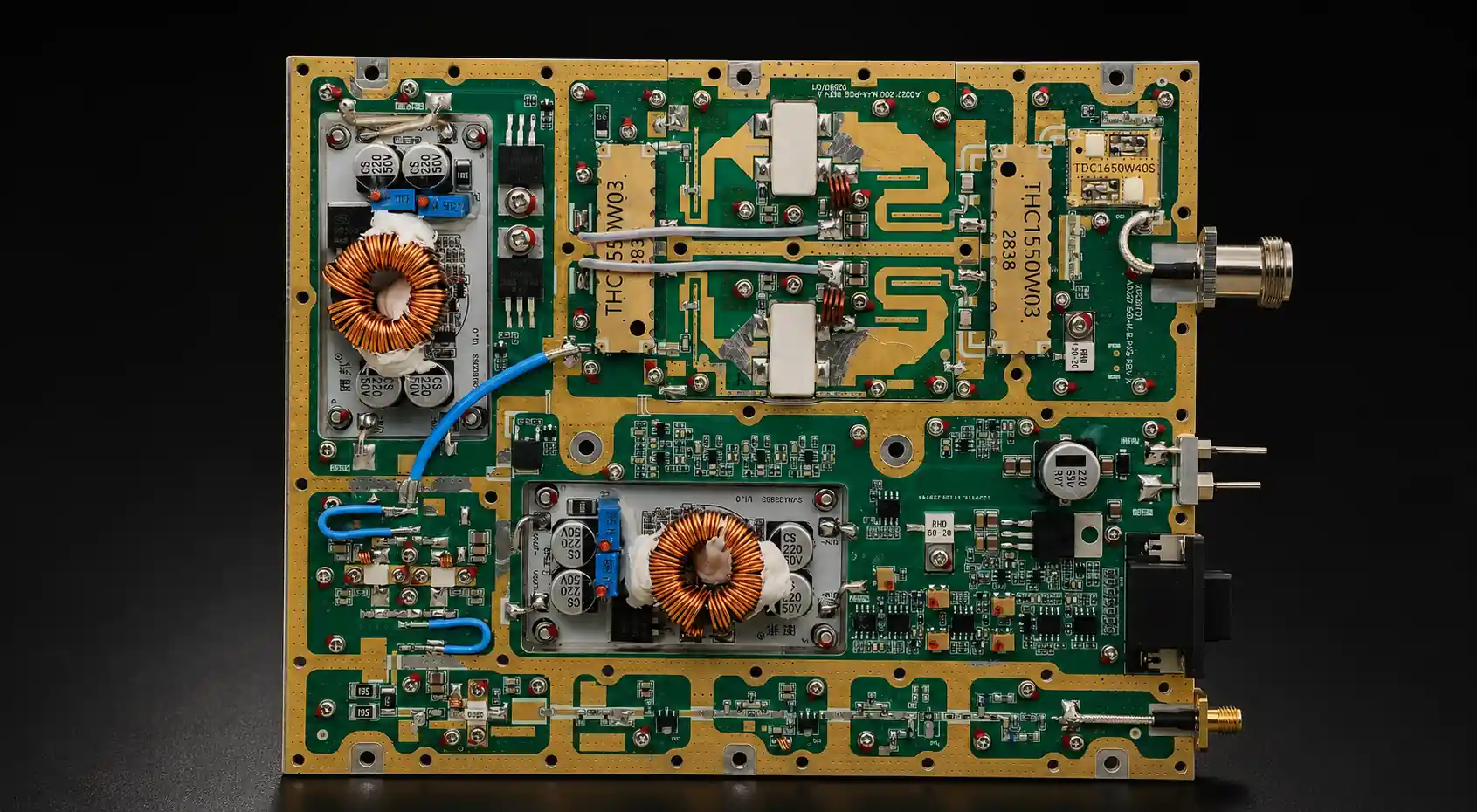
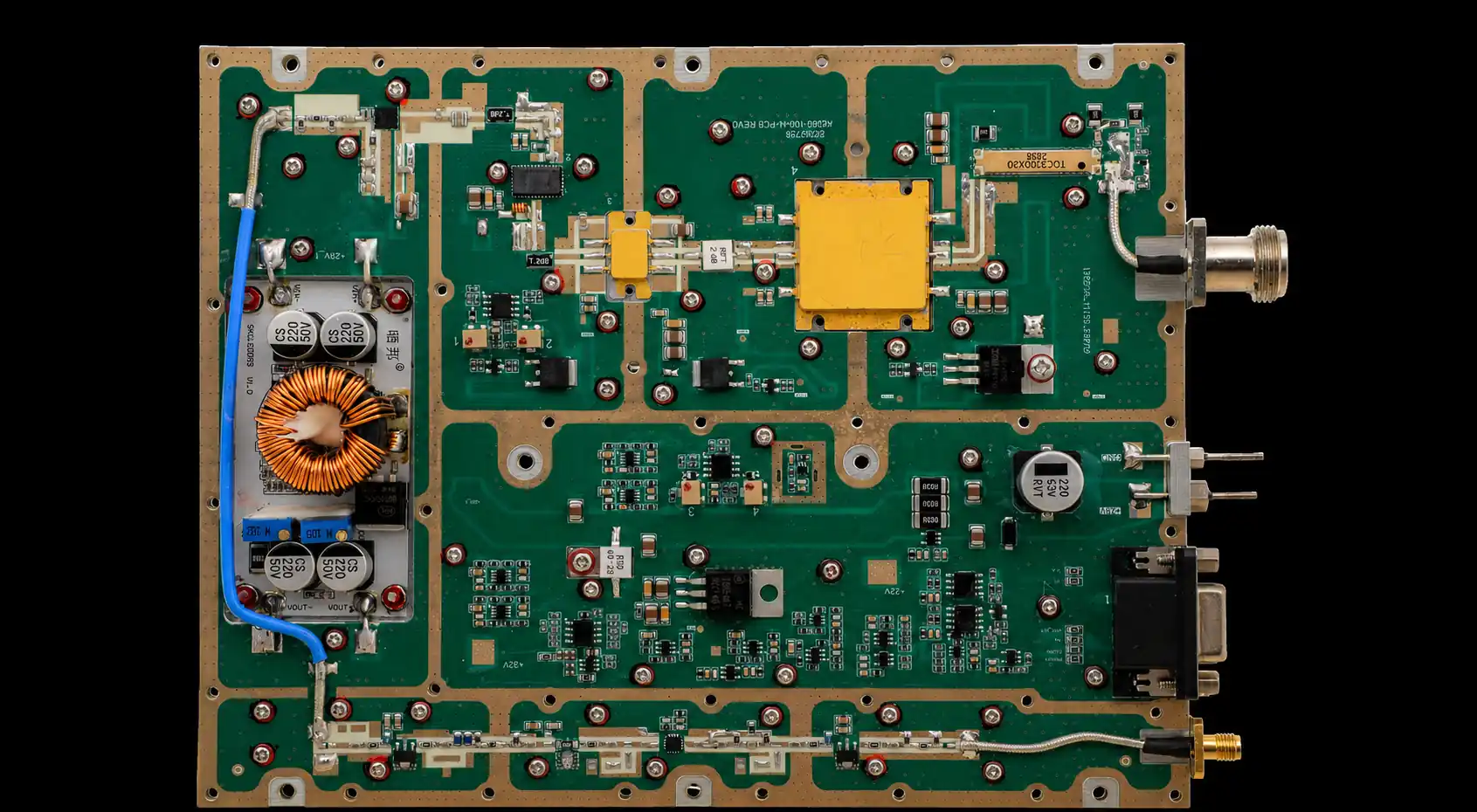

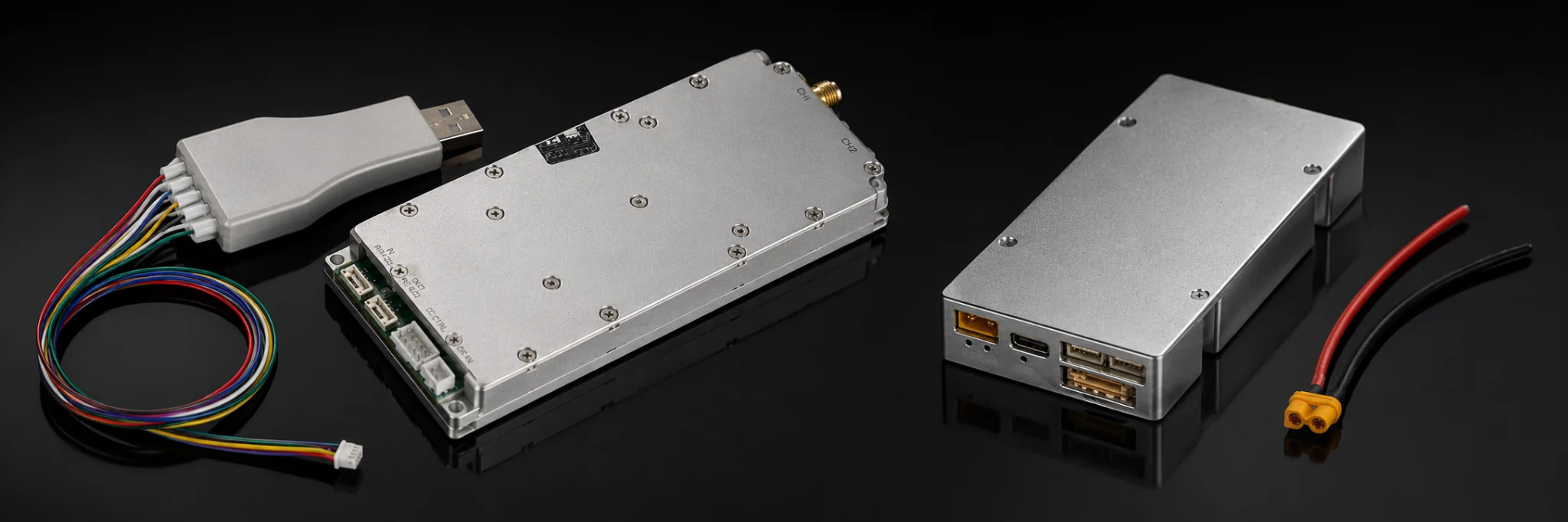



C-UAS system EIRP is not the wattage printed on an RF power amplifier label. It is a direction-specific result calculated from PA output at a defined reference plane, minus verified RF-path loss, plus the applicable antenna gain.
A 100 W PA can meet its module-level output target and still miss the project EIRP target if the installed RF path introduces excessive loss. The opposite is also possible. A directional antenna may produce a higher EIRP in one sector than the PA wattage alone suggests.
Before selecting RF Power Amplifier Modules, define four inputs:
- PA output at an agreed reference plane
- Total installed RF-path loss
- Antenna gain for the required frequency and direction
- Operating conditions represented by the calculation
Each frequency, active RF path, and antenna direction should then be calculated separately.
1. What PA Output Proves—and What EIRP Adds
PA output power describes how much RF power is available at a defined measurement point. That point may be:
- The PA output connector
- The cabinet RF output
- The feeder end
- The antenna input
These measurement points are not interchangeable.
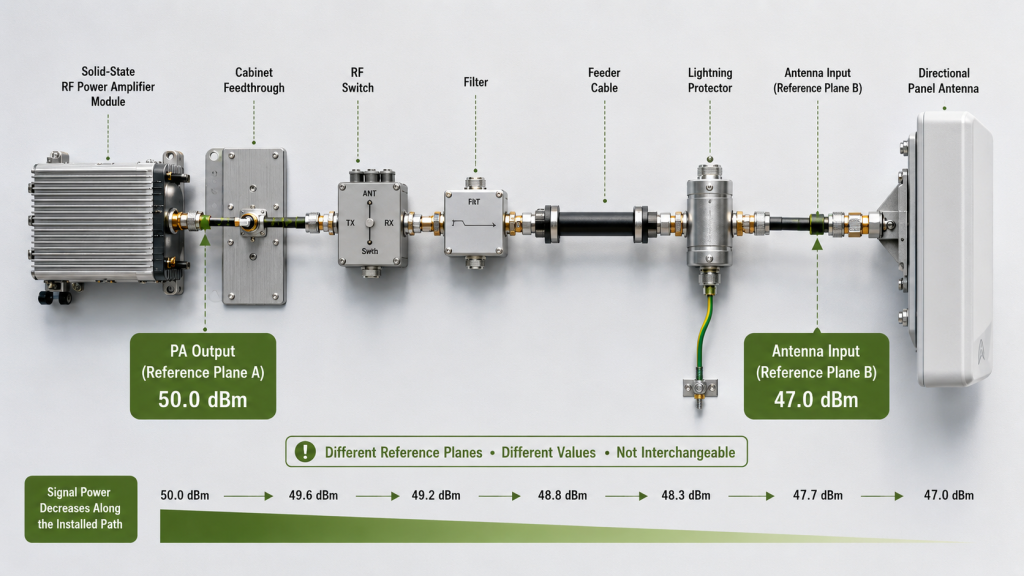
A result of 50 dBm at the PA output connector does not prove that 50 dBm reaches the antenna. The installed path may contain switches, filters, splitters, lightning protectors, cabinet feedthroughs, feeder cables, adapters, and connectors. Each component can reduce the power available at the antenna input.
EIRP adds the applicable antenna gain after the losses between the selected PA-output boundary and the antenna have been included.
Common PA power levels convert to dBm as follows:
- 50 W is approximately 47 dBm
- 100 W is 50 dBm
- 200 W is approximately 53 dBm
Increasing PA output from 100 W to 200 W adds approximately 3 dB at the same reference plane. It does not automatically add 3 dB to installed EIRP if the new configuration adds RF-path loss or changes sustained PA output through thermal or protection behavior.
Before using any PA result, define the RF power measurement points in vehicle C-UAS installations when that installation model applies. Otherwise, a PA-port result may be compared with an antenna-input requirement, creating an apparent shortfall that is only a reference-plane error.
PA output is therefore the starting value. EIRP is the directional result after the installed RF path and antenna are included.
2. How to Calculate C-UAS System EIRP
The basic formula is:
EIRP (dBm) = PA Output (dBm) − RF Path Loss (dB) + Antenna Gain (dBi)
The reliability of the result depends on whether all three inputs use the same frequency, active path, operating state, and calculation boundary.
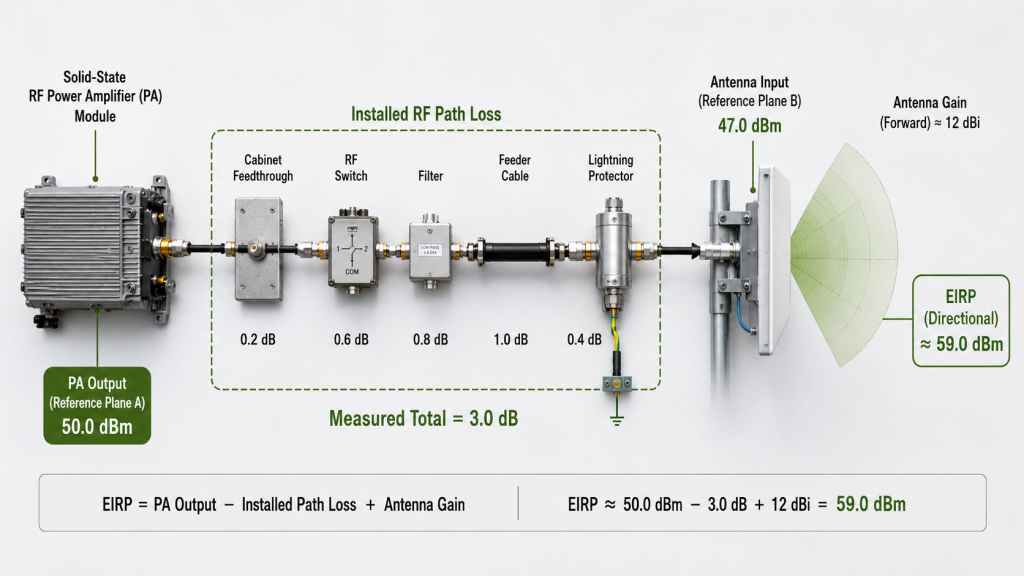
Method A: Start from PA-Port Output
Use this method when RF output is measured or specified at the PA output connector.
Subtract every verified loss between the PA connector and the antenna input, including the applicable:
- Cable loss
- Connector and adapter loss
- Switch or filter loss
- Splitter or combiner loss
- Cabinet feedthrough loss
- Lightning-protector loss
Then add the antenna gain for the required frequency and direction.
Method B: Start from Antenna-Input Power
Use this method when power has already been measured at the antenna input.
In this case:
EIRP (dBm) = Antenna-Input Power (dBm) + Antenna Gain (dBi)
Do not subtract feeder, connector, switch, or filter loss again. Those losses have already affected the measured antenna-input power.
Worked Example
Assume that:
- PA output at the agreed PA-port reference plane is 100 W
- 100 W equals 50 dBm
- Verified installed RF-path loss is 3 dB
- Antenna gain in the target direction is 12 dBi
The calculation is:
50 dBm − 3 dB + 12 dBi = 59 dBm EIRP
The 59 dBm result is an equivalent directional radiated-power value. It does not mean that 59 dBm leaves the PA output connector.
Worked C-UAS EIRP Calculation
| Input | Value | Data Source |
|---|---|---|
| Frequency | 2.4 GHz | Project requirement |
| PA-output reference plane | PA output connector | Agreed test boundary |
| PA output | 50 dBm | Measured |
| Installed RF-path loss | 3 dB | Measured path-loss record |
| Antenna gain in target direction | 12 dBi | Antenna or installed-pattern data |
| Calculated EIRP | 59 dBm | Calculated |
| Required direction | Sector A | Deployment drawing |
This is an example, not a default loss or gain budget. Actual values must be confirmed for the installed system.
The feeder and connector loss should reflect the actual cable type, length, frequency, connector count, and installed passive components. A nominal cable value without the complete path can overstate antenna-input power.
Avoid Double-Counting Loss
Use either:
- PA-port power minus the complete verified installed loss, or
- Measured antenna-input power
Do not subtract the same loss twice.
A mismatch condition also requires a defined calculation boundary. Do not convert a theoretical VSWR value into an additional fixed power deduction unless the approved project method explicitly requires it.
If antenna mismatch changes PA output or activates protection, use the measured operating-state power at the agreed reference plane. Do not apply another estimated mismatch deduction after that effect is already included in the measured power.
Antenna gain terminology must also match the selected power reference.
Use antenna gain when the calculation starts from power delivered to the antenna input. Use realized gain only when the selected power reference and gain definition are explicitly matched.
Do not combine delivered antenna-input power with realized gain if both values already include the same antenna-port mismatch effect. That would count the mismatch twice.
3. How Installed Conditions Change the EIRP Inputs
Two systems using the same PA model can produce different EIRP values because their installed paths, antennas, and operating conditions are different.
The calculation should answer three questions:
- How much power leaves the PA at the agreed reference plane?
- How much power remains at the antenna input?
- What antenna gain applies at the required frequency and direction?
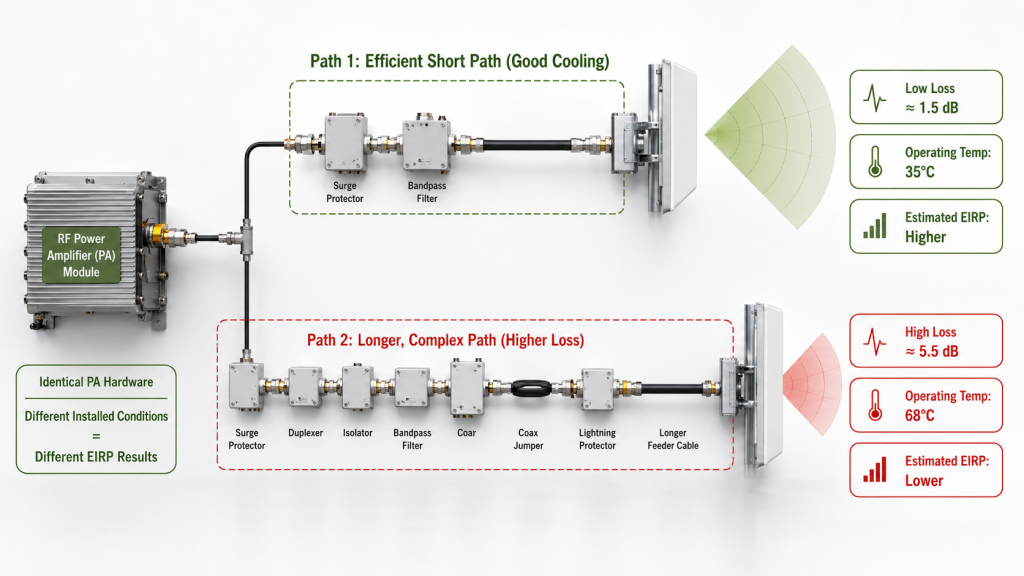
Installed RF-Path Loss
A short feeder path with few connections may preserve most of the PA output. A remote antenna path with long cable, cabinet transitions, switches, protection devices, and outdoor connectors may introduce much more loss.
Path loss also changes with frequency. A value measured at one point should not automatically be applied across a wide operating band.
For multiband or broadband systems, record path loss at the frequency points that matter to the project.
Antenna Gain and Direction
Antenna gain is not an equal increase in every direction.
The calculation should identify:
- Antenna model
- Frequency
- Gain value and unit
- Polarization
- Azimuth direction
- Elevation angle
- Applicable radiation pattern
A value stated in dBd should not be entered as dBi without conversion.
Maximum datasheet gain may also differ from the gain available in the installed direction. Antenna tilt, mounting position, radomes, nearby metalwork, ground-plane conditions, polarization, antenna spacing, and mutual interaction can change the installed result.
For final approval, state whether the selected value comes from:
- Datasheet gain
- Simulated installed gain
- Measured installed gain
- Measured realized gain
The selected value must match both the power reference and the required evidence level.
Operating-State PA Output
Nominal PA output should not be used when the actual operating condition changes delivered power.
The accepted starting value should represent the required:
- PA-terminal voltage
- Temperature condition
- Duty condition
- Active channel configuration
- Cooling arrangement
- Load condition
If temperature, supply voltage, or antenna mismatch changes PA output, calculate EIRP from the accepted operating-state result rather than the nominal rating.
A controlled dummy-load baseline and real-antenna check can help separate PA capability from installed-path loss, load mismatch, and protection behavior.
When antenna mismatch changes usable RF output, the measured operating-state power should replace the nominal PA rating in the EIRP calculation.
4. How to Calculate EIRP for Splitters and Multiple RF Paths
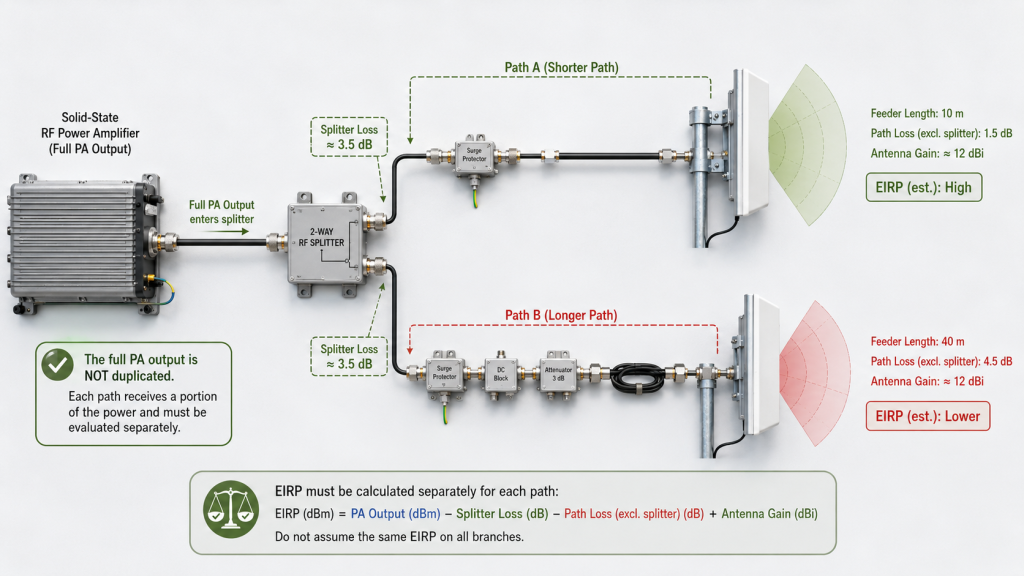
Total installed PA wattage is not one system EIRP value.
Each active RF path has its own:
- PA output
- Frequency
- Total path loss
- Antenna gain
- Direction
- Operating condition
The calculation must follow the real architecture.
Single PA and Single Antenna
For a direct single-path architecture:
EIRP = PA output − installed path loss + antenna gain
The reference plane, frequency, and antenna direction must still be stated.
Single PA, Splitter, and Multiple Antennas
A splitter divides power between its output branches and introduces additional insertion loss.
Each antenna path should be calculated separately:
Path A EIRP = PA output − Path A total loss + Antenna A gain
Path B EIRP = PA output − Path B total loss + Antenna B gain
For each branch, total loss should include:
- Power division
- Splitter insertion loss
- Branch feeder loss
- Branch connector and adapter loss
- Other branch-specific passive loss
Do not apply the full PA output to every splitter branch.
The branches may also have different feeder lengths, connector counts, filters, antenna gains, and directions.
Multiple PAs and Multiple Antennas
When each PA drives a separate antenna, calculate each PA-to-antenna path independently.
Do not add all module wattages and describe the total as one EIRP value when:
- Antennas point in different directions
- Channels operate at different frequencies
- Paths contain different losses
- Antennas have different gains
- Channels are not active at the same time
- Switching or sequencing controls the active path
Combining power from multiple transmit paths requires a defined combining or array model. Separate independently aimed antennas should not be treated as one summed EIRP value.
Sector Antenna Systems
For a sector layout, identify each result by sector or direction.
For example:
- Sector A: north perimeter
- Sector B: east approach
- Sector C: rooftop coverage
The EIRP calculated for Sector A should not be used to approve Sector B unless both paths have the same PA output, path loss, antenna gain, installation, and operating condition.
5. What Evidence Should Support an EIRP Calculation?
An EIRP claim should be traceable to its inputs.
A PA output screenshot alone does not prove system EIRP. It can confirm module output at one reference plane, but it does not show the installed path loss or antenna gain.

A practical calculation record should include:
- Frequency
- PA-output reference plane
- Measured PA output
- PA-terminal voltage and temperature condition
- Active RF path
- Verified installed path loss
- Antenna model and directional gain
- Gain type and data source
- Measurement or calculation method
- Final EIRP
- Configuration or serial-number reference
- Target and applicable limit, where required
Measured, calculated, datasheet, simulated, and assumed values should be identified separately.
For example:
- Measured: PA output at 2.4 GHz
- Measured: installed path loss
- Datasheet or measured: antenna gain in Sector A
- Calculated: Sector A EIRP
This makes it easier to identify which input must be checked when the result changes.
An EIRP value may be mathematically correct but still difficult to approve if its inputs cannot be traced to test records, installation data, or an agreed engineering assumption.
6. What to Define in the EIRP RFQ Before Approval
An RFQ that asks only for a 100 W or 200 W PA defines a component power class. It does not define the installed C-UAS system EIRP.

Before quotation, the buyer and supplier should agree on:
- Frequency points
- Required EIRP by direction
- PA-output reference plane
- Installed RF-path configuration
- Antenna gain type and data source
- Operating voltage and temperature
- Active channel or path condition, where applicable
- Acceptance method
- Applicable project, licensed, or jurisdiction-specific limits, where required
EIRP RFQ and Acceptance Checklist
| RFQ Item | Required Definition | Expected Deliverable |
|---|---|---|
| Frequency | Bands and critical test points | Per-frequency calculation |
| PA output | Required power and reference plane | S/N-linked PA output report |
| RF path | Feeder, connectors, switches, filters, splitters, and protection devices | Installed path-loss record |
| Antenna | Model, gain type, unit, direction, and pattern source | Datasheet, simulation, or installed-pattern data |
| Operating state | Voltage, temperature, duty, and active path | Agreed test condition |
| EIRP target | Minimum required result by direction | Per-path calculation sheet |
| Applicable limit | Project, licensed, or jurisdiction-specific boundary, where required | Limit comparison |
| Acceptance method | Calculation, antenna-input measurement, or field verification | Acceptance record |
If the calculated EIRP misses the target, first separate PA-output shortfall from installed-path loss, antenna-direction error, thermal derating, mismatch behavior, and reference-plane error before increasing the PA power class.
A higher-power PA may be justified after these variables are verified. It should not be the automatic first response to an incomplete EIRP calculation.
Conclusion
A credible C-UAS EIRP calculation requires four steps:
- Define the PA-output reference plane.
- Verify the complete installed RF-path loss.
- Apply the antenna gain that matches the selected power reference, frequency, and direction.
- Record the operating condition and evidence behind every input.
The result should be calculated separately for each frequency, active path, and antenna direction. PA wattage alone cannot represent the installed directional result.
RF SKYPOWER can support an early engineering review before the RF architecture is locked.
For an initial review, provide:
- Frequency points
- Target EIRP by direction
- PA-output reference plane
- Feeder type and length
- Antenna gain type and direction
Where applicable, also provide:
- Hot-state output requirement
- VSWR or reflected-power boundary
- DC supply condition
- Active channel configuration
- Applicable limits
- Required calculation or test-report format
These inputs allow PA output, installed path loss, antenna gain, and applicable limits to be reviewed against one consistent calculation boundary before quotation or final approval.
Submit the C-UAS EIRP requirement to the RF SKYPOWER engineering team.