

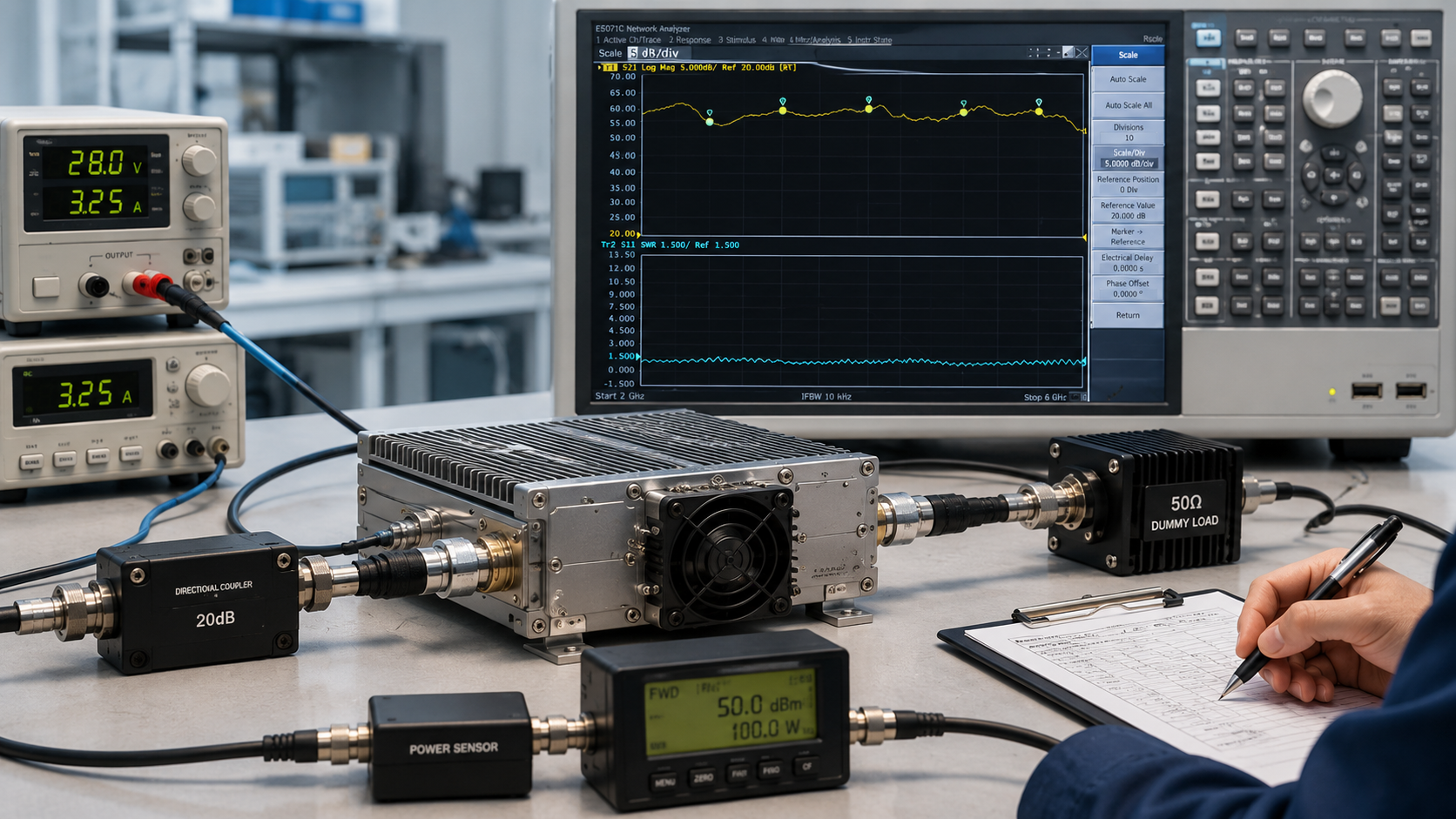
An RF PA frequency range defines the span in which an amplifier is designed to operate. It does not prove that every frequency inside that span will meet the same output, gain, thermal, load, or modulated-signal requirements.
For a C-UAS project, inclusion inside the nominal range is only the first check. Each required frequency must still meet the agreed limits at a defined reference plane and under a defined input, supply, waveform, load, duty, and temperature condition.
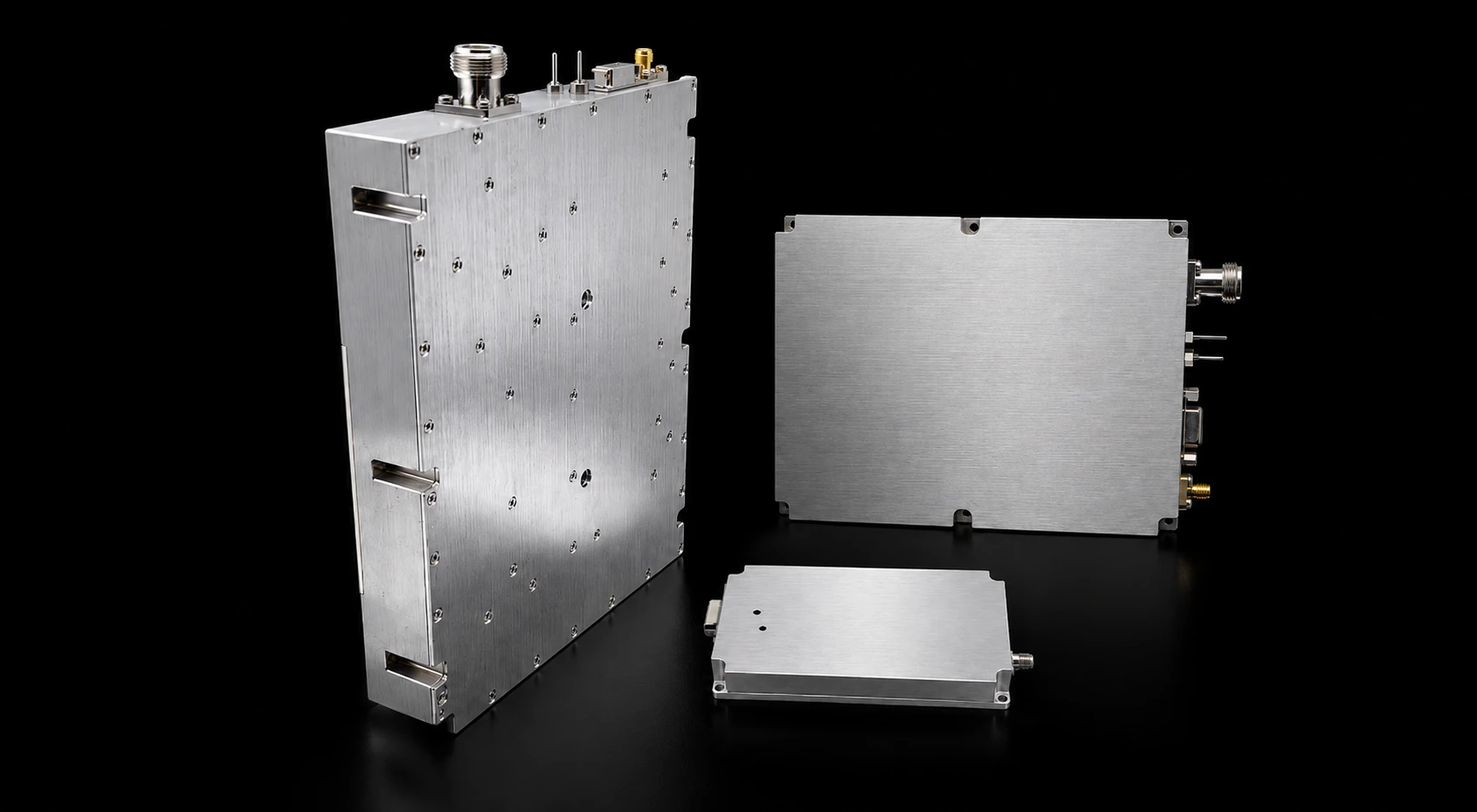
Before selecting Wideband RF Power Amplifier Modules, define the project-critical frequencies and the evidence each point must pass.
In this article, the project-qualified frequency range means the required frequency points that pass the agreed project criteria. It is a project-specific engineering boundary, not a universal datasheet parameter.
1. What the Nominal RF PA Frequency Range Actually Proves
The nominal frequency range is the declared operating span of the RF PA.
It is useful for initial screening. A module whose declared range excludes a required project frequency is normally not a suitable candidate.
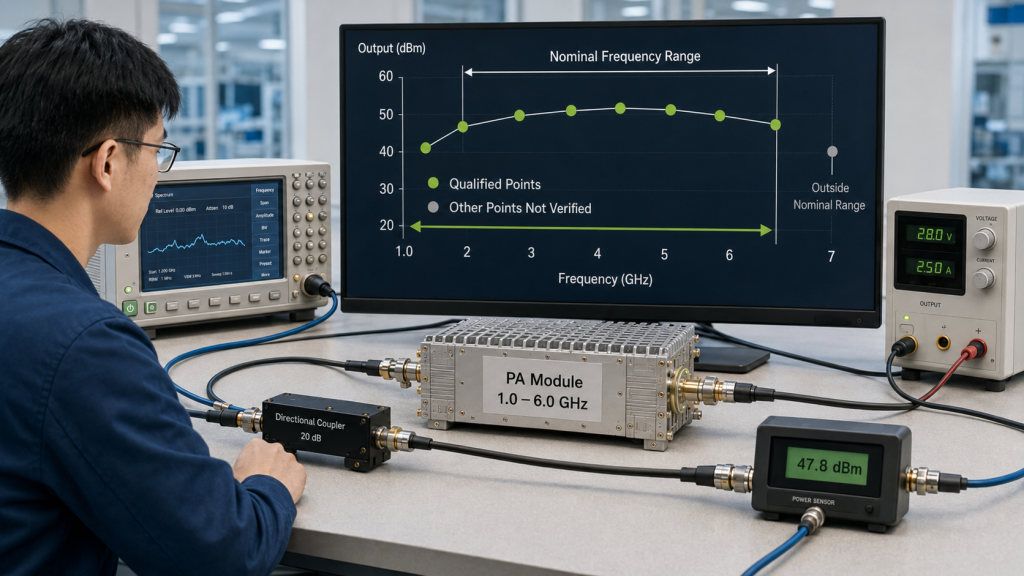
However, the nominal range alone does not prove:
- Equal output at every frequency
- Equal gain across the full nominal range
- Full-power performance at both range edges
- Stable output after thermal stabilization
- Acceptable behavior under the required load
- Repeatable performance across production units
- Equivalent CW and modulated-signal performance
A frequency can sit inside the declared range and still miss a project-specific output, linearity, thermal, or protection limit.
This does not automatically mean the PA is defective. The datasheet and project may simply describe different input, load, temperature, waveform, or measurement conditions.
Three Frequency Boundaries That Should Not Be Confused
| Term | What It Means | What It Does Not Prove |
|---|---|---|
| Nominal frequency range | The declared total operating span of the PA | Equal performance at every point |
| Instantaneous bandwidth | The signal spectrum handled at the same time under a defined waveform and linearity requirement | Full-power capability across the entire nominal range |
| Project-qualified frequency range | The required frequency points that pass the agreed project criteria | A universal supplier or datasheet parameter |
Instantaneous bandwidth is different from total operating range.
A PA may cover a wide nominal frequency range but still require separate verification of:
- Simultaneous signal bandwidth
- Average RF output
- Required output back-off
- Gain and phase behavior
- EVM or adjacent-channel performance
- Thermal behavior under the selected waveform
The C-UAS RF PA selection process should therefore begin with required frequencies, waveform conditions, output boundaries, and acceptance limits—not simply with the widest available datasheet range.
2. How to Define the Project-Qualified Frequency Range
The project-qualified frequency range is the set of required frequency points that pass the agreed criteria at the same reference plane and operating condition.
It may equal the full nominal range, but it may also be narrower for a specific project.
Separate the PA Boundary from the Installed-System Boundary
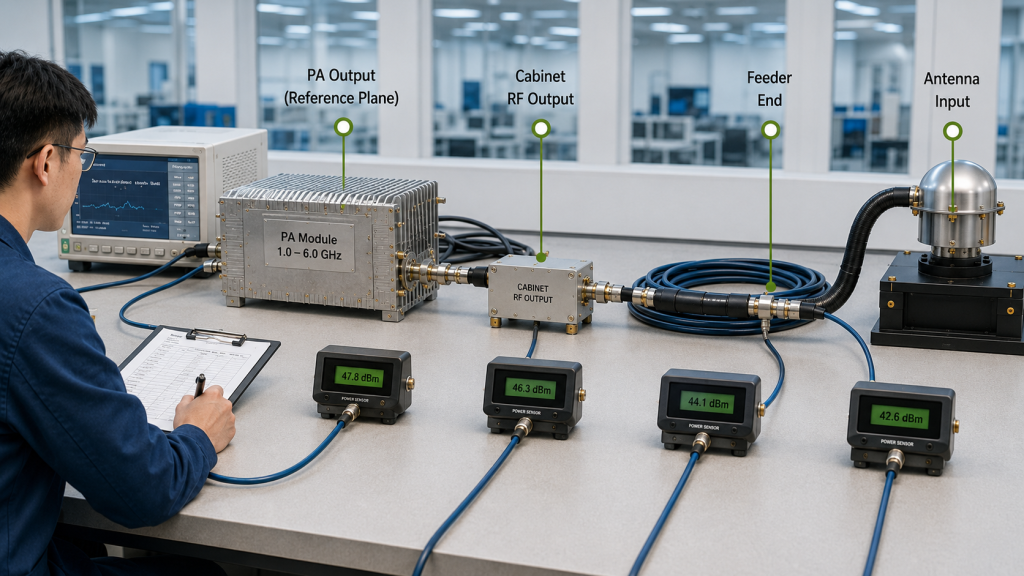
Two different qualification boundaries should be kept separate.
The PA-qualified frequency range is verified at the PA output under defined:
- RF input
- PA-terminal voltage
- Waveform
- Output operating point
- Load condition
- Temperature
- Duty condition
The installed-system usable range also includes:
- Cabinet RF components
- Switches and filters
- Splitters or combiners
- Feeder cables
- Connectors and adapters
- Protection devices
- Antenna-path behavior
- Installed cooling and supply loss
A system-level failure does not automatically prove that the PA has failed its qualified frequency range.
For example, a PA may meet the required output at its own output connector while the antenna-input power misses the target because of excessive feeder or switch loss. That is an installed-path problem unless the PA-port result also fails its agreed limit.
Define the Reference Plane First
Common output reference planes include:
- PA output connector
- Cabinet RF output
- Feeder end
- Antenna input
A requirement of 50 dBm at the PA output connector is not the same as 50 dBm at the antenna input.
The selected reference plane must remain consistent when comparing:
- Supplier reports
- Incoming inspection
- Installed-system measurements
- Normal- and hot-state results
- Different production units
Otherwise, a reference-plane difference may be mistaken for weak frequency performance.
Define the Output Operating Point
An output requirement must state what kind of output is being accepted.
Possible operating points include:
- Linear output
- P1dB output
- Compressed output
- Saturated CW output
- Continuous CW output
- Pulsed peak output
- Backed-off modulated average output
These conditions are not interchangeable.
A PA may reach a high saturated CW output but require significant output back-off to meet EVM or adjacent-channel limits with a high-PAPR waveform.
Writing only:
Minimum output: 50 dBm
is therefore incomplete.
A stronger requirement states:
Minimum 50 dBm continuous CW output at the PA port after thermal stabilization
or:
Minimum 44 dBm average modulated output while meeting the agreed EVM and adjacent-channel limits
Minimum Criteria for Each Required Point
At minimum, every required frequency point should define:
- Output threshold and operating point
- Output reference plane
- RF input condition
- PA-terminal DC condition
- Load condition
- Waveform condition
- Pass/fail rule
Additional requirements should be added where relevant:
- Thermal stabilization
- Continuous or specified duty
- Mismatch boundary
- Production repeatability
- S/N-linked evidence
- Modulated-signal quality
- Protection or foldback limits
Not every prototype, production batch, and installed system requires the same evidence level. The scope should reflect the project risk.
Define a Point-Level Pass/Fail Rule
A statement such as “the PA covers the required band” is not an acceptance rule.
A project-ready requirement should state:
- Exact frequency
- Required output
- Output operating point
- Allowed tolerance
- RF input condition
- PA-terminal voltage
- Load condition
- Waveform
- Temperature and duty condition
- Required evidence
If one project-critical frequency misses the agreed limit, that point does not belong to the project-qualified frequency range until:
- The operating condition is corrected
- The design or cooling is improved
- The acceptance requirement is revised
- Another PA design is selected
A nominal range declaration cannot replace a failed result at a required frequency.
3. Which Frequency Points and Test Methods Should Be Used?
A project does not always need to test every possible frequency inside the datasheet range with equal depth.
It does need evidence for every frequency that affects system approval.
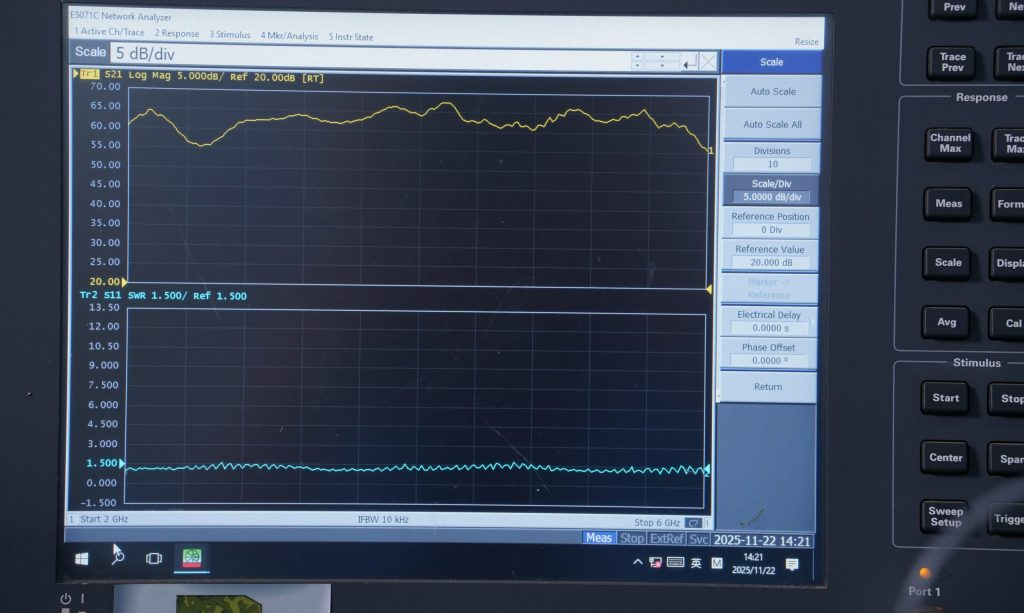
The test plan should normally include:
- Every project-critical operating frequency
- The lowest required frequency
- The highest required frequency
- Known weak or high-loss points
- Frequencies near required transitions
- Critical hot-state retest points
- A center point when it helps compare band shape or supplier data
The datasheet edges should be tested when the project depends on them. An unused nominal edge should not replace an actual project frequency.
Do Not Approve the Range from One Center-Frequency Result
A center-frequency screenshot proves only one point under one test condition.
It does not prove:
- Low-band output
- High-band output
- Gain flatness
- Edge margin
- Hot-state stability
- Protection-free operation
- Production repeatability
A point-by-point record is more useful than one general PASS statement.
Fixed-Drive Sweep vs Adjusted-Drive Sweep
The test plan must state whether RF input remains fixed.
A fixed-drive sweep uses the same input level at every frequency. It helps reveal:
- Gain variation
- Output flatness
- Weak-response points
- Frequency-dependent drive sensitivity
- Protection behavior under a common input condition
An adjusted-drive maximum-output sweep changes the input at each frequency to find the maximum available output or the input required to reach a target.
It helps determine:
- Maximum obtainable output
- Required drive by frequency
- Compressed or saturated output capability
- Whether the upstream driver can provide enough input
These two tests do not provide the same evidence.
A supplier should not increase input at weak frequencies and then present the results as fixed-drive output flatness. If input is adjusted, the report should record the input power at every point.
Choose Test Resolution by Risk
A limited set of points may be sufficient when:
- Required frequencies are fixed and few
- Existing sweep data shows stable behavior
- No required point sits near a weak region
- The full nominal range is not being approved
A denser sweep may be needed when:
- The full nominal range is being approved
- The system uses agile or selectable channels
- Output changes near a required edge
- Gain flatness is important
- A filter or matching transition may create a narrow weak zone
- Previous tests found irregular behavior
The purpose of the sweep is to find approval risks, not to produce a visually smooth chart.
A swept-frequency full-power test should record the test type, RF input, PA-terminal voltage, waveform, load, reference plane, output operating point, stabilization condition, and test duration.
4. Why the Qualified Range Can Be Narrower Than the Nominal Range
Several variables can cause a required frequency inside the nominal range to miss its acceptance limit.
PA Response Across Frequency
Wideband matching networks do not always produce identical gain, efficiency, and output at every point.
A lower-output point is not automatically unusable. It becomes unacceptable when it crosses the project’s output, gain, current, thermal, linearity, or protection limit.
This is why RF PA band-edge performance should be judged against required frequencies and available margin rather than the printed span alone.
Installed-Path Loss
Frequency-dependent loss in feeders, connectors, switches, filters, splitters, and protection devices can make the installed-system usable range narrower than the PA-qualified range.
The project should distinguish between:
- PA-port performance
- Cabinet-output performance
- Antenna-input performance
A failed antenna-input result should be traced back to the PA-port output and installed path before the PA itself is rejected.
Load and Protection Behavior
A controlled 50 Ω load establishes the PA baseline.
If an agreed mismatch or antenna-path condition changes output or activates protection, the measured operating-state result—not the nominal rating—should be used for the relevant system-level decision.
The report should identify whether the result applies to a controlled dummy load, an agreed mismatch boundary, or an installed antenna path.
Hot-State Performance
A frequency that passes after startup may miss the requirement after thermal stabilization.
When continuous or high-temperature operation is required, critical points should be retested after the defined stabilization period using the agreed cooling, voltage, duty, and load conditions.
5. What Evidence Should Support the Qualified Range?
A qualified-range claim should be traceable to the test method, tested configuration, and output boundary.
The evidence should cover four areas:
- Test identity and traceability
Module model, serial number, controlled configuration, report identity, and calibration reference. - Frequency-point inputs and outputs
Frequency, RF input, test type, output operating point, measured output, PA-terminal voltage, and current where required. - Measurement and operating boundaries
Reference plane, waveform, load, temperature, duty, stabilization condition, and applicable protection boundary. - Pass/fail result
Acceptance threshold, measured result, margin, and alarm, foldback, or shutdown status.
The report should distinguish between:
- Measured values
- Calculated values
- Datasheet values
- Simulated values
- Assumed values
- Project acceptance limits
Correct Instrument Readings to the Reference Plane
The value displayed on a power meter or spectrum analyzer may not equal PA-port output.
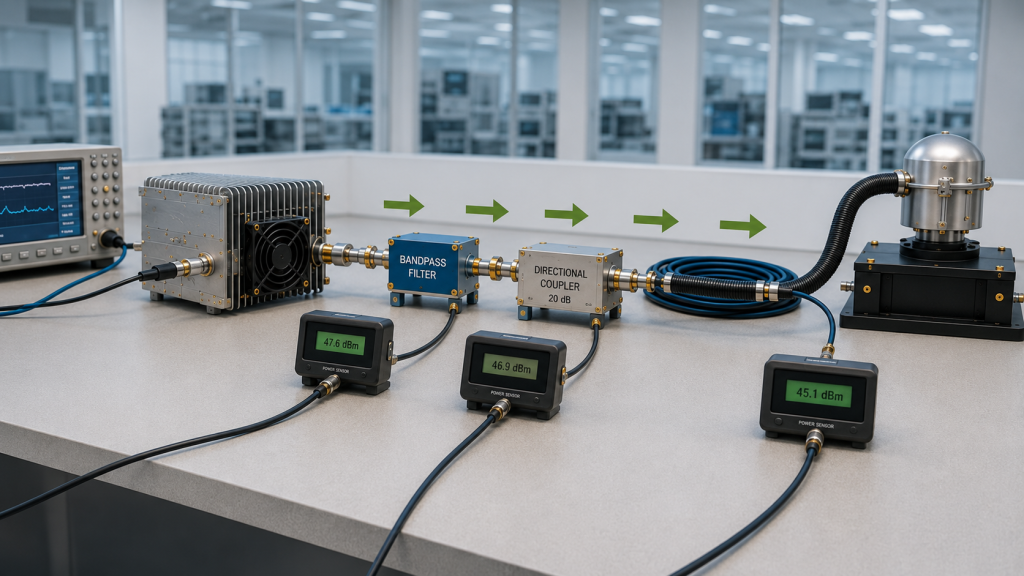
A high-power test path may include:
- Directional-coupler factor
- Attenuator loss
- Measurement-cable loss
- Connector loss
- Splitter loss
- Power-sensor correction
The report should show how the instrument reading is corrected to the stated reference plane.
Where these values change with frequency, the correction should also be frequency-specific.
For example:
Corrected PA Output = Instrument Reading + Total Path Correction
The Total Path Correction should identify the applicable coupler, attenuator, cable, connector, and sensor corrections rather than using one unexplained fixed value across the full range.
Results close to the pass/fail threshold should also account for measurement uncertainty.
A measured result only slightly above the minimum limit may not provide sufficient approval margin when the combined measurement uncertainty overlaps the failure boundary.
For production approval, state whether the evidence applies to:
- One engineering sample
- A production sample
- Every delivered unit
Critical weak-frequency results should remain linked to the tested module or report identity.
What to Specify in the RFQ Before Approval
An RFQ that requests only a frequency range and wattage leaves the main acceptance boundaries undefined.
For example:
Wideband RF PA, 100 W
does not define:
- Which frequencies are critical
- Whether 100 W applies at every point
- Whether the input is fixed or adjusted
- Which output operating point applies
- Where output is measured
- Whether the waveform is CW or modulated
- What load and temperature apply
- What correction method is used
- What evidence must be delivered
RF PA Frequency-Range RFQ and Acceptance Checklist
| RFQ Item | Required Definition | Acceptance Evidence |
|---|---|---|
| Nominal range | Required overall operating span | Controlled supplier specification |
| Critical frequencies | Exact project-required points | Point-by-point results |
| Qualification boundary | PA-qualified range or installed-system usable range | Defined test boundary and diagram |
| Reference plane | PA port, cabinet output, feeder end, or antenna input | Calibration and correction record |
| Output requirement | Threshold, tolerance, and operating point | Linear, P1dB, saturated CW, pulsed, or backed-off modulated result |
| Sweep method | Fixed-drive or adjusted-drive test | Input level recorded at every frequency |
| Waveform | CW, pulsed, modulated, noise-like, or multicarrier | Waveform, bandwidth, PAPR, and output back-off |
| RF input and DC supply | Input range and PA-terminal voltage under load | Input, voltage, and current record |
| Load boundary | Dummy load or agreed non-ideal condition | Dummy-load confirmation or applicable FWD, REV, VSWR, and protection status |
| Thermal and duty condition | Temperature, cooling, duty, and stabilization time | Stabilized output and temperature |
| Measurement correction | Coupler, attenuator, cable, connector, and sensor correction | Frequency-specific Total Path Correction |
| Measurement uncertainty | Required when results approach the acceptance limit | Stated uncertainty or approval margin |
| Traceability | Module, configuration, and report identity | S/N-linked or configuration-linked report |
Do not approve a PA only because its nominal range includes every required frequency.
Approve the PA-qualified range when the required points pass the agreed PA-level test conditions. Approve the installed-system usable range only after the additional path, supply, cooling, load, and antenna effects have also been verified.
Conclusion
A nominal RF PA frequency range is a screening boundary. Project approval depends on whether each required frequency meets the agreed output and operating limits at the same reference plane.
Keep PA-level qualification separate from installed-system validation. State the output operating point, waveform, sweep method, test-path correction, and pass/fail margin. Do not approve a wideband PA from the datasheet span or one center-frequency screenshot alone.
RF SKYPOWER can support an early frequency-range review before the PA band and test scope are locked.
For an initial review, provide:
- Nominal range and critical frequencies
- PA-level or installed-system acceptance boundary
- Required output and operating point
- Fixed-drive or adjusted-drive test method
- CW or modulated waveform condition
- RF input and 28 V supply condition
- Load, thermal, and duty boundaries
- Required calculation and report format
These inputs allow each required point to be reviewed against one consistent engineering boundary before module selection or quotation.
Submit the RF PA frequency-range requirement to the RF SKYPOWER engineering team.