
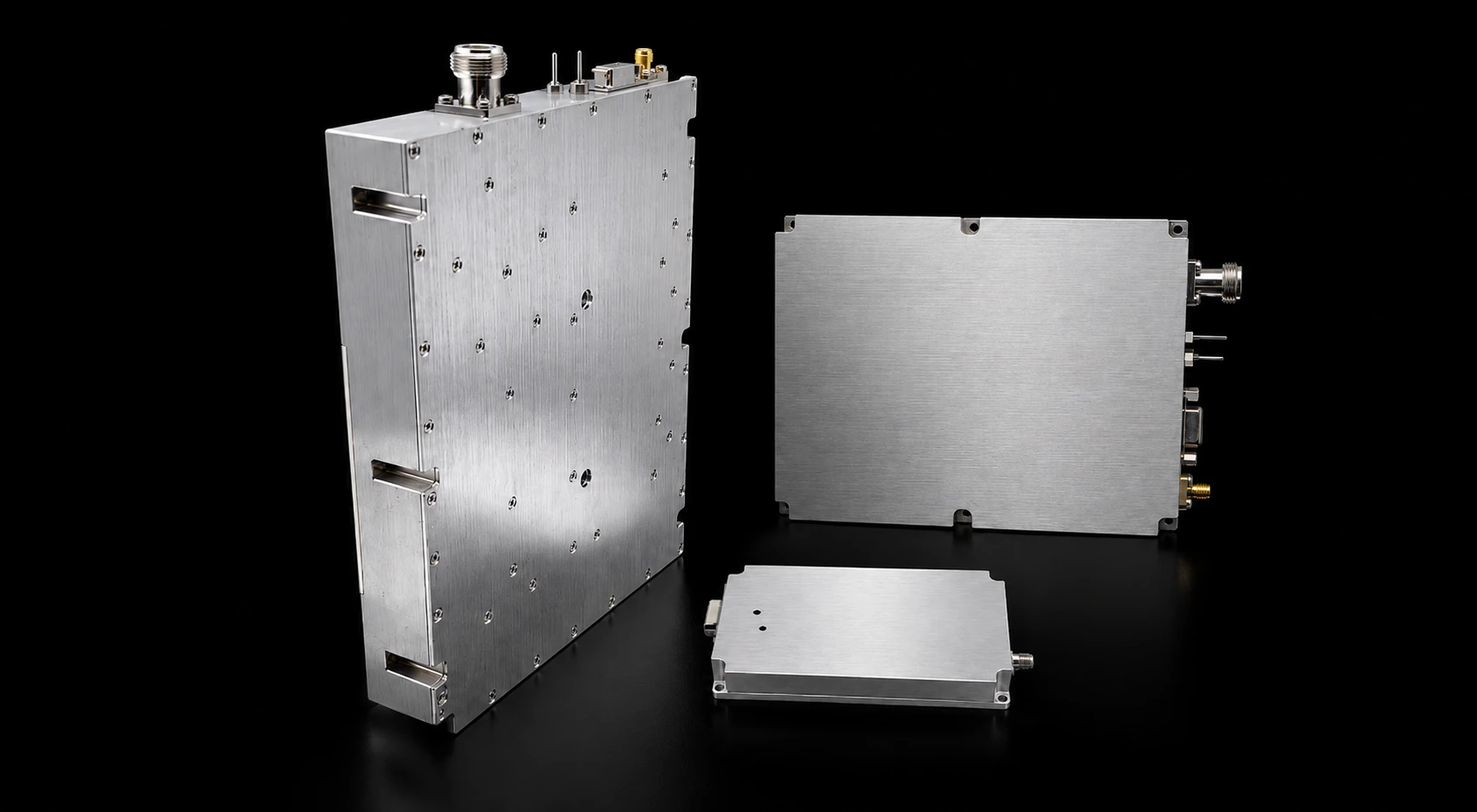

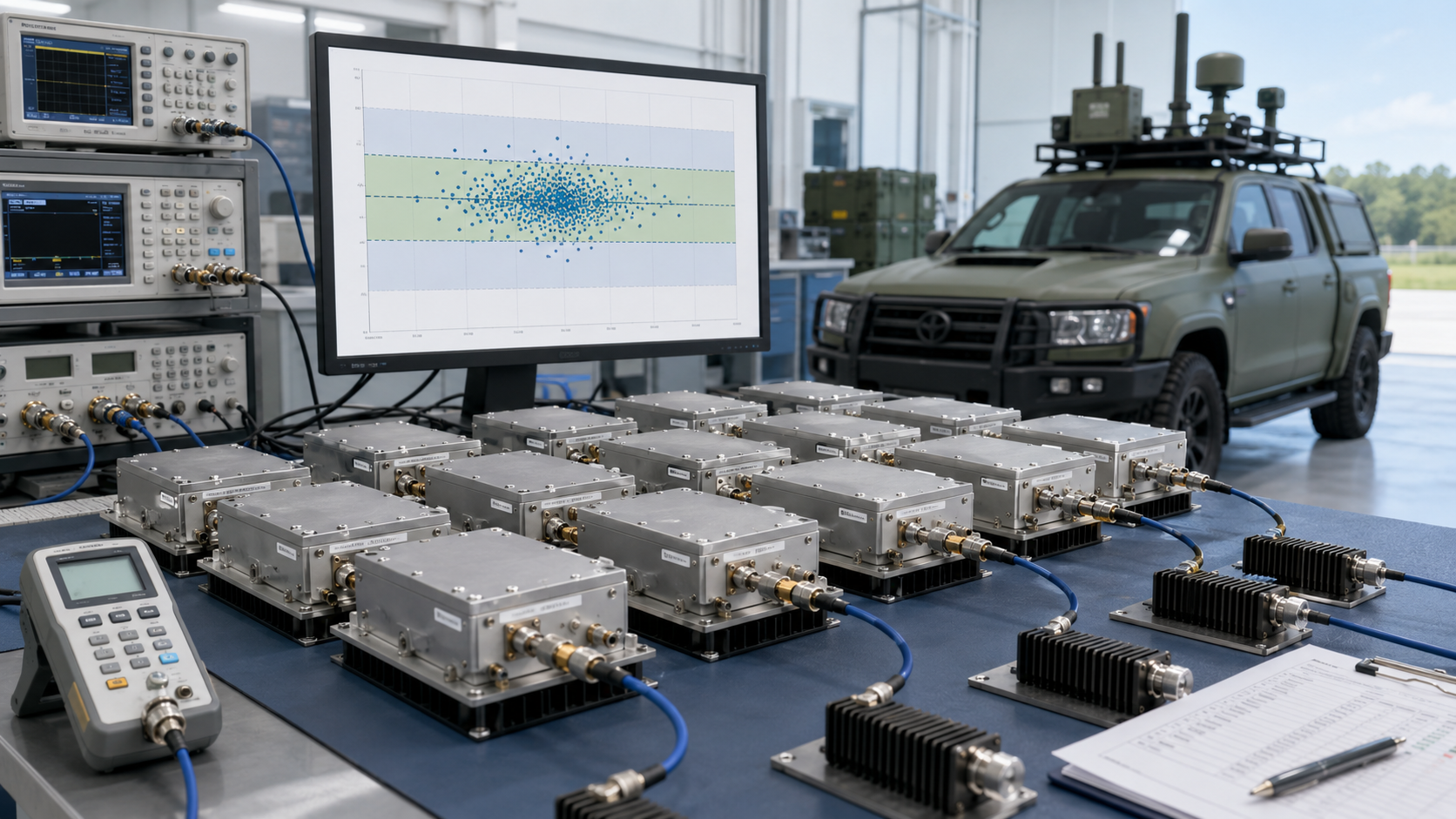
RF power tolerance for batch PA acceptance should define the shipment limits for each tested unit and the rules used to approve the delivery lot. A nominal 100 W rating does not require every RF Power Amplifier to produce one identical reading, but it also does not define which units pass, how much measured variation is acceptable, or how sampled results support a lot-level decision.
When reviewing RF Power Amplifier Modules, the buyer should separate three questions:
- Does each tested unit meet the contractual product specification?
- Do the measured units show an unexplained shift, spread, subgroup, or engineering review trigger?
- When only a sample is tested, what contractual or statistical basis allows that sample to support acceptance of the full lot?
When every unit is tested, the measured data can describe the delivered batch directly. When only selected units are tested, the report should call the result a sample distribution, state the total lot quantity and tested quantity, and explain the basis used to make the lot-level decision.
A valid acceptance plan must be agreed before production data is available. It should define the measurement boundary, unit-level limits, sampling method, batch review triggers, measurement decision rule, retest method, required evidence, and disposition actions.
1. Why Nominal Power Does Not Define Batch Acceptance
Nominal power identifies the intended product class. It is not automatically the contractual shipment limit for every delivered unit.
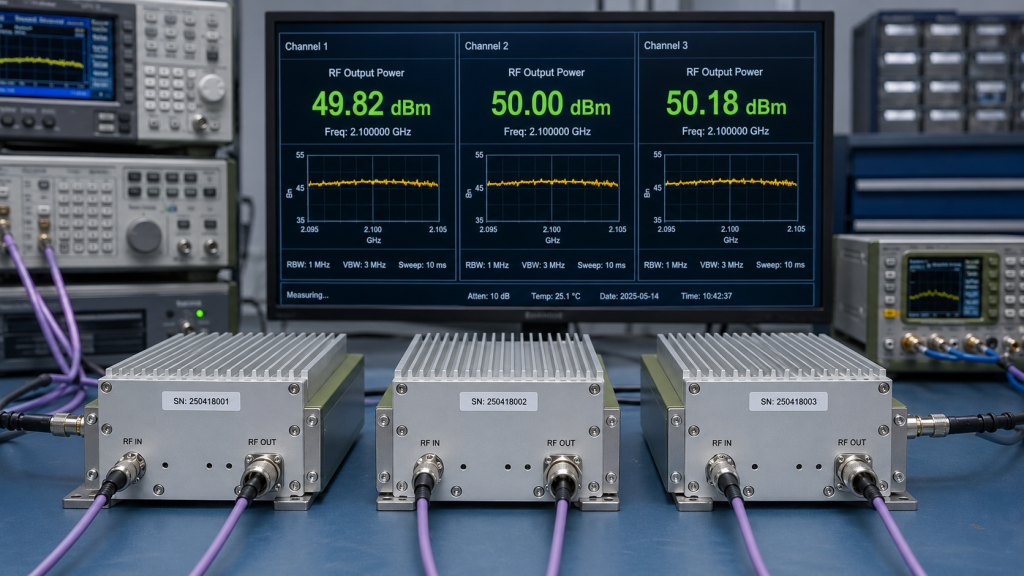
A module described as 100 W may be associated with several different values:
- Nominal or catalog output
- Minimum guaranteed output
- Typical measured output
- Maximum permitted output, when required
- Output at a specified frequency
- Output across a full operating band
- Cold-state output
- Stabilized hot-state output
- PA-port output
- Antenna-port output after RF-path loss
These values cannot be used interchangeably.
The relationship between nominal output and usable RF output power should be established before the batch tolerance is written. A PA-port acceptance limit cannot be compared directly with an antenna-port result unless feeder, connector, adapter, and antenna-path losses are reconciled.
Individual Compliance and Lot Acceptance Are Different
An individual-unit decision asks:
- Does this tested unit meet the minimum output at every required frequency?
- Does it satisfy any specified gain, current, temperature, or protection limits?
- Was it measured under the approved conditions?
- Is the result linked to the correct serial number and configuration?
A lot-level decision asks:
- Were all units tested or only a defined sample?
- Does the measured-unit or sample distribution satisfy the rules agreed before production?
- Are there unexplained review triggers, subgroups, or time-sequence shifts?
- Does the sampling plan support acceptance of the untested portion of the lot?
- Are the results traceable to one comparable product and process state?
A tight distribution cannot excuse an individual specification failure.
Individual passes also do not automatically prove compliance with a separately agreed batch-level rule. However, a new distribution requirement should not be introduced after the production data has been reviewed.
Why Measured Variation Matters
Controlled variation supports:
- Repeatable system calibration
- Multi-channel balance
- Compatible RF drive settings
- Predictable DC power demand
- Predictable thermal loading
- Stable protection margin
- Replacement-module compatibility
- Future production-lot consistency
The objective is not to force every unit to produce one identical number. It is to confirm that every accepted tested unit meets the product specification and that the lot is released using a predefined and traceable decision method.
2. What RF Power Tolerance Must Control
RF power tolerance should not be written as:
Output should be close to 100 W.
The requirement should identify the parameter, reference value, unit, frequency, test boundary, and decision rule.
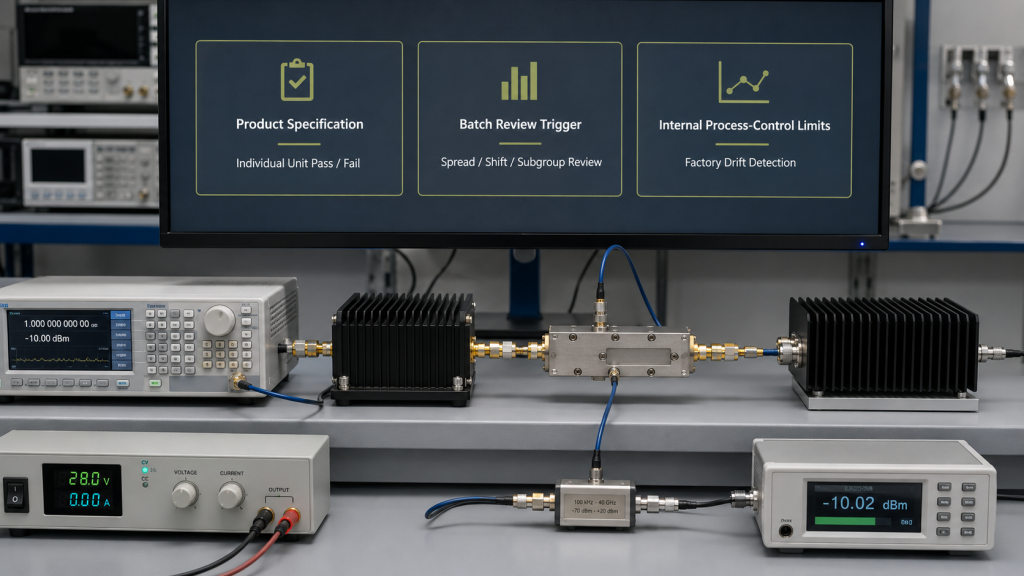
Separate Three Types of Limits
A defensible acceptance plan distinguishes three different boundaries.
Product Specification Limits
These are the contractual Pass or Fail limits for individual units.
Examples include:
- Minimum RF output
- Maximum RF output, when required
- Maximum current
- Maximum temperature
- Gain or RF input-drive limits
- Permitted protection behavior
A stable batch trend cannot override an individual product specification failure.
Batch Review Triggers
These identify measured patterns that require additional review, such as:
- An unusually wide sample or tested-unit spread
- A shift toward one specification boundary
- Separate subgroups
- Test-station separation
- Production-date drift
- Reworked-unit separation
A batch review trigger does not automatically mean that individual units failed their product specification. The RFQ should define whether the trigger leads to retest, expanded sampling, segregation, engineering review, or lot hold.
Internal Process-Control Limits
These are supplier-side limits used to detect production drift before the contractual specification is violated.
An internal process-control limit should not automatically become a customer rejection limit. It may be tighter than the contractual specification and may trigger factory investigation without creating a contractual product failure.
The reverse is also true: stable internal process data cannot approve a unit that is outside the customer specification.
Choose the Tolerance Format
RF power tolerance may be expressed in:
- Watts
- Percentage
- dB
The chosen format should remain consistent throughout the RFQ, test report, and acceptance decision.
When values are converted, the report should show:
- The reference output
- The corresponding values
- The calculation method
- The applicable frequency
A tolerance does not need to be a symmetrical ± value around nominal power.
A project may define:
- A minimum output only
- Minimum and maximum output
- Minimum output plus maximum current
- Minimum output plus temperature or gain limits
- Frequency-specific limits
- A full-band output envelope
- Separate hot-state and normal-temperature limits
Acceptance Layers
| Acceptance Layer | What Must Be Defined | What It Supports | What It Cannot Replace |
|---|---|---|---|
| Nominal power | Rated product class | Identifies the intended power level | Contractual unit limit |
| Product specification | Unit-level limits at required frequencies | Pass or Fail for each tested unit | Lot-level review |
| Batch review trigger | Predefined center, spread, subgroup, or trend condition | Additional lot review | Individual product specification |
| Internal process-control limit | Supplier’s internal trend boundary | Early production-drift detection | Customer rejection limit |
| Sampling basis | Lot size, sample size, selection method, acceptance rule | Agreed lot-level inference | Proof that every unit was tested |
| Measurement decision rule | Uncertainty, guard band, retest, and rounding method | Consistent boundary decisions | Expansion of the product specification |
High Output Is Not Automatically Good or Bad
An output above nominal is not automatically a failure or a benefit.
First check:
- RF input drive
- ALC status
- Reference-plane correction
- PA-terminal voltage
- DC current
- Temperature
- Gain
- Compression behavior
- Protection margin
A higher reading may result from more RF drive, different path correction, a measurement-chain offset, or a different thermal condition.
An upper RF output limit should be used only when the project requires one. Some projects may instead control high-side behavior through maximum current, temperature, gain, RF input sensitivity, or system-level limits.
Frequency Limits Must Be Explicit
The same numerical tolerance does not have to apply at every frequency.
The RFQ may define:
- Separate limits for each frequency
- Different center- and band-edge limits
- A full-band output envelope
- Minimum output plus gain-flatness limits
- A point-by-point pass rule
- A full-band pass rule
A strong center-frequency result must not hide a weak band edge.
3. How to Build a Comparable Batch or Sample Dataset
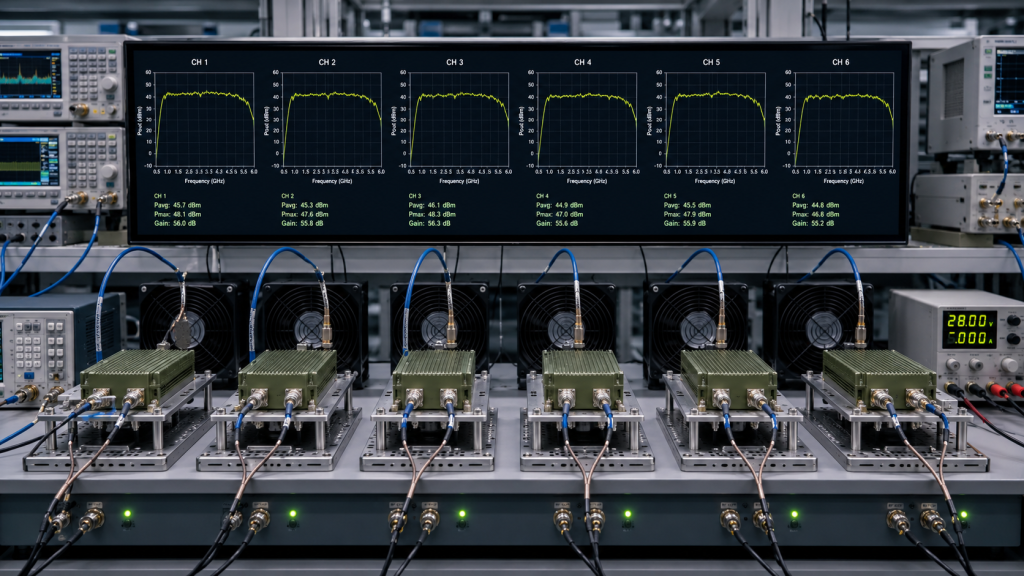
A measured distribution is useful only when the units and test conditions are comparable.
Differences in configuration, input drive, voltage, temperature, load, measurement chain, or test sequence can create apparent unit variation.
Define the Lot and Product Identity
Record:
- Purchase order or delivery lot
- Total lot quantity
- Production lot
- Product model
- BOM version
- Hardware revision
- Firmware or control version
- Process revision
- Production date or period
- Test station
- Calibration state
- Burn-in status
- Rework status
A delivery lot should not be treated as one comparable population when it contains different hardware revisions, BOM states, process changes, test stations, or undocumented rework histories.
When several groups are combined, the report should state why their data can be evaluated together.
Control the Test Conditions
Use the same or proven-equivalent:
- RF waveform
- Occupied bandwidth
- RF input level
- ALC condition
- Frequency points
- Frequency order
- Sweep direction
- Dwell and settling time
- Output reference plane
- RF load
- VSWR boundary
- PA-terminal voltage
- Cooling method
- Stabilization rule
If output is maintained by increasing RF input drive, the comparison may hide gain variation. Record Pin and Pout when driver compatibility or gain consistency matters.
A full-power swept RF PA test can establish a comparable dataset when acceptance applies across an operating band. The same frequency list is not sufficient when test order, dwell time, or accumulated heating differs.
Separate Product Variation From Measurement Variation
Record:
- Measurement equipment
- Calibration validity
- Cable and connector losses
- Coupler correction
- Attenuator value
- Sensor correction
- Total path correction
- Measurement uncertainty
- Rounding method
Different test stations may be used when their equivalence is supported by:
- Traceable calibration
- Common correction methods
- Compatible uncertainty
- A reference or control unit
- Cross-check measurements
- Documented station offsets
A wide result range should not be classified as product variation until measurement-chain and test-station variation have been reviewed.
Do Not Compare Raw Range Without Considering Tested Quantity
The observed minimum-to-maximum range depends partly on how many units were tested.
A dataset containing five units is less likely to show extreme values than one containing two hundred units. Batches or samples with different tested quantities should therefore not be compared from raw range alone.
The acceptance plan should define:
- The spread metric to be used
- The minimum tested quantity required
- Whether the metric is applied to the full tested batch or only to a sample
- Whether comparisons between lots require similar tested quantities
The project may use:
- Minimum-to-maximum range
- Standard deviation
- A percentile interval
- Another agreed engineering or statistical metric
This article does not prescribe one universal method. The selected method should match the lot size, test coverage, risk, and contractual purpose.
Define the Sampling Plan Before Units Are Selected
When less than 100% of the lot is tested, define:
- Total lot size
- Sample size
- Random, systematic, or stratified selection
- Coverage of production dates or subgroups
- Acceptance number
- Rejection number
- Failed-sample escalation
- Treatment of reworked units
- Whether selected units may be replaced
- Basis for lot-level inference
Selected units should not be replaced after selection merely because they are difficult to test or produce an unfavorable result.
When replacement is necessary, the reason, approval, and replacement method should be documented.
4. How to Judge Limits, Distributions, and Review Triggers
Lot acceptance should follow a predefined sequence.
First: Check Individual Product Specifications
For every tested unit, confirm:
- Output at each required frequency
- Upper output limit, when specified
- Gain or required RF input
- PA-terminal voltage
- DC current
- Temperature
- FWD, REV, and VSWR
- Protection status
- S/N traceability
A batch or sample average cannot approve a unit that fails an individual contractual limit.
Second: Identify the Data Scope
State whether the results represent:
- 100% of the delivery lot
- A defined sample
- Only selected engineering units
- Reworked units
- A reference or validation lot
When every unit is tested, the report may describe the tested batch distribution.
When only a sample is tested, the report should use terms such as:
- Sample center
- Sample spread
- Sample review trigger
- Sample-based lot decision
It should not imply that every delivered unit was measured.
Third: Review the Agreed Center and Spread
Depending on the project, the summary may use:
- Mean
- Median
- Range
- Standard deviation
- Percentile interval
- Another agreed method
The report should show:
- Total lot quantity
- Tested quantity
- Summary method
- Measured center
- Measured spread
- Applicable batch or sample review trigger
The observed spread is not automatically the contractual tolerance.
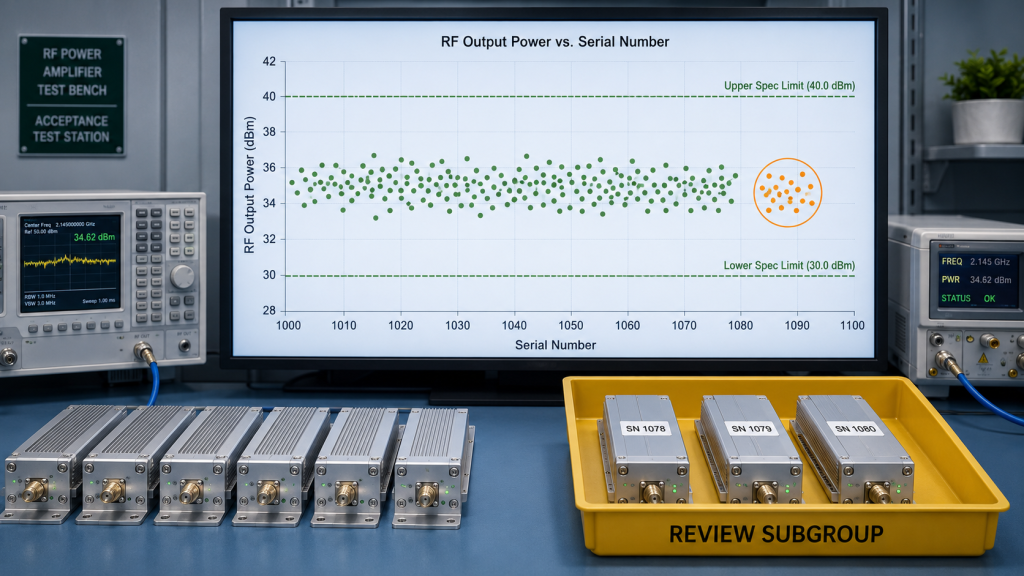
A wide sample or tested-unit distribution may trigger review only when the review method was defined before production data was available.
Fourth: Review Engineering Triggers and Subgroups
Not every review trigger is a formal statistical outlier.
Engineering review may be triggered by:
- A result near a specification boundary
- A unit separated from the main measured group
- Unusual current or temperature
- A different gain or RF input requirement
- Repeated protection activity
- A frequency-specific weak point
- Reworked-unit behavior
- A subgroup linked to one BOM, date, station, or process state
Also check for:
- Two distinct clusters
- Early-lot versus late-lot movement
- Test-station separation
- Hardware-revision separation
- Reworked-unit separation
- Frequency-dependent subgroup behavior
The trigger and the resulting action should be agreed in advance. A new rejection rule should not be introduced after the data is reviewed.
Fifth: Apply the Sampling Acceptance Rule
For sampled acceptance, compare the results with the predefined:
- Acceptance number
- Rejection number
- Allowed nonconformities
- Expanded-sampling rule
- 100% sorting rule
- Lot-hold rule
A sample result supports a lot-level decision only through the agreed sampling plan. It does not prove that every untested unit complies.
Sixth: Control Retesting
Retesting should not become a method for selecting the most favorable number.
The retest rule should define:
- When retesting is permitted
- How many retests are allowed
- Whether the original result remains valid
- Whether the decision uses the first valid result, repeat result, average, or another predefined value
- How invalid measurements are identified
- How all retest results are reported
The highest result should not be selected only because it creates a Pass.
An original valid failure should remain in the report even when subsequent testing leads to a different final disposition.
Seventh: Apply the Disposition
Pass
Use when:
- Tested units meet the applicable product specifications
- Sampling acceptance criteria are satisfied, when used
- Predefined batch or sample review triggers are resolved
- No unexplained subgroup remains
- Measurement confidence is adequate
- Evidence is complete
Retest
Use when:
- A measurement is invalid or not repeatable
- A condition was not controlled
- Calibration or correction is uncertain
- The result is near the decision boundary
- Retesting is permitted by the predefined rule
Segregate or Sort
Use when:
- A subgroup differs from the main lot
- Results correlate with a revision, station, date, or rework state
- Expanded testing or 100% sorting is required
- The complete lot should not be approved as one group
Engineering Review or Rework
Use when:
- Product or process drift is suspected
- Current, gain, temperature, or protection behavior changed
- A correctable RF, DC, thermal, control, or assembly issue is identified
The RFQ should define whether reworked units require RF retest, post-burn-in verification, partial repeated burn-in, or full repeated burn-in.
Hold or Reject
Use when:
- A unit remains outside its contractual product specification
- The sampled lot exceeds the agreed rejection criterion
- An agreed batch-level requirement is not met
- An unexplained subgroup remains
- Test evidence is incomplete
- Traceability is inadequate
- A prohibited protection event occurs
Missing evidence may justify a shipment hold without automatically proving a hardware failure.
5. What Evidence Should Support Lot Release
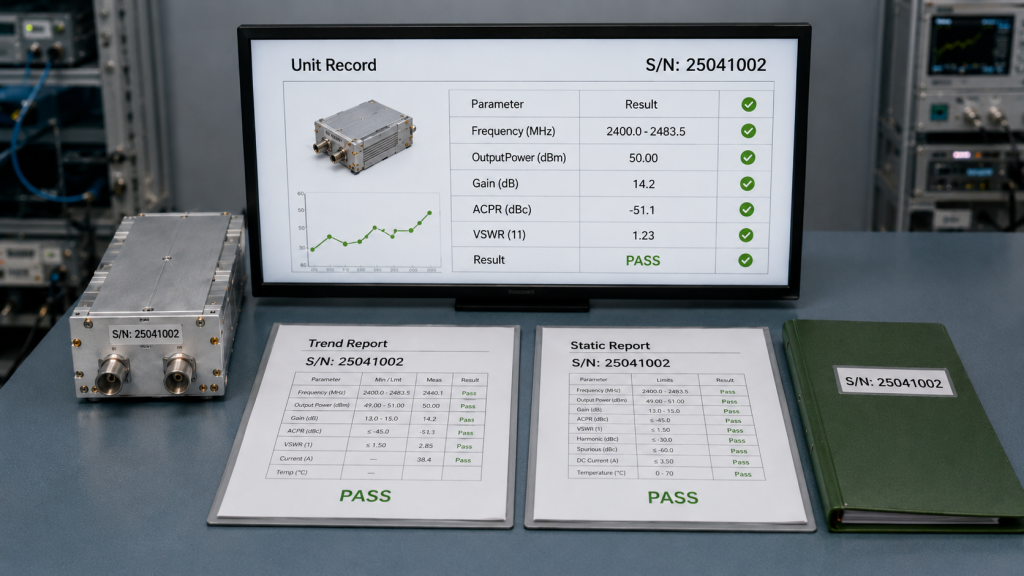
The evidence package should connect every measured result to the correct unit, test state, and lot-level decision.
Unit-Level Record
For every tested unit, record:
- Model and serial number
- BOM, hardware, and firmware state
- Production and rework status
- Burn-in status
- Frequency and waveform
- RF input level and ALC state
- Output reference plane
- Pout and gain
- PA-terminal voltage and current
- Temperature
- FWD, REV, and VSWR
- Protection status
- Test station
- Calibration and path corrections
- Measurement uncertainty
- Original result
- Retest reason
- Number of retests
- All valid retest results
- Final decision value
- Final unit disposition
Measurement uncertainty should be handled through the agreed decision rule. It should not be added to the product tolerance after testing to convert an otherwise failing result into a Pass.
When burn-in forms part of shipment screening, the RF output after burn-in record should identify whether the result represents the as-burned hot end, cooled and restabilized condition, or an authorized post-adjustment state.
Lot or Sample Summary
The summary should identify:
- Delivery-lot quantity
- Tested quantity
- Whether testing was 100% or sampled
- Sampling method
- Acceptance and rejection criteria
- Individual specification results
- Measured-unit or sample center
- Measured-unit or sample spread
- Review triggers
- Subgroups
- Failed and retested units
- Reworked and segregated units
- Basis for the lot-level decision
- Final released quantity
Do not replace S/N-level data with only:
- Minimum
- Maximum
- Average
- One screenshot
- One general Pass statement
A proper RF PA test report before shipment should connect measured data to the correct unit, configuration, test condition, retest history, and acceptance decision.
Replacement-Lot Evidence
A replacement lot should meet the same approved product specification or an explicitly approved equivalent requirement.
Confirm:
- BOM, hardware, and firmware traceability
- Compatible frequency and output limits
- Compatible gain or RF input requirement
- Current and thermal boundaries
- Protection compatibility
- Same or approved-equivalent test method
The same model number alone does not prove lot equivalence.
Link the Result to Final Acceptance
RF power tolerance should form one part of the complete C-UAS RF PA acceptance checklist.
Lot release should also account for burn-in, protection, thermal behavior, version control, load conditions, and document traceability.
6. What the RFQ Should Define Before Production
The RFQ should establish the acceptance and decision framework before production begins.
Lot and Sampling Rules
Define:
- Delivery-lot and production-lot boundaries
- Total lot quantity
- 100% or sampled testing
- Sample size and selection method
- Acceptance and rejection numbers
- Coverage of revisions, dates, stations, and rework states
- Failed-sample escalation
- Selected-unit replacement rule
Acceptance Boundaries
Define:
- Individual product specification limits
- Frequency-specific requirements
- High-side control parameter, when required
- Batch or sample review triggers
- Internal process-control data required from the supplier, when applicable
- Minimum data quantity for distribution review
Decision Rules
Define:
- Measurement uncertainty treatment
- Guard band, when required
- Rounding method
- Retest trigger
- Number of permitted retests
- Authoritative decision value
- Expanded sampling or 100% sorting rule
- Segregation, rework, hold, and rejection criteria
Measurement uncertainty must not be used after testing to enlarge the contractual product specification.
Required Evidence
Define:
- S/N-linked unit records
- Lot or sample summary
- Original and retest results
- Configuration and rework traceability
- Test-station and calibration records
- Post-burn-in status, when required
- Lot-level approval record
The RFQ should not ask only:
What is the PA output tolerance?
It should ask:
What individual specifications, sampling basis, batch review triggers, measurement decision rules, retest controls, and S/N-linked evidence will be used to approve this delivery lot?
That question creates an acceptance process that can be measured, repeated, and audited.
FAQ
Does Every PA in a Batch Need Identical Output?
No.
Normal production and measurement variation means that units will not produce one identical reading.
Every tested unit must still meet its contractual product specification. Any batch- or sample-level review rule must also have been agreed before production.
“Not identical” does not mean “uncontrolled.”
Can a Lot Pass If Every Tested Unit Meets the Minimum but the Spread Is Wide?
It depends on the agreed acceptance plan.
When the contract defines only individual-unit limits, a wide measured spread may trigger engineering review but should not become a new rejection criterion after testing.
When a batch- or sample-level spread rule was agreed before production, the measured data must also satisfy that rule.
For sampled testing, the report should identify the result as a sample distribution and explain how the sampling plan supports the full-lot decision.
Should RF Power Tolerance Be Stated in Watts, Percentage, or dB?
Any of these formats may be used when the reference value and calculation method are clear.
The RFQ and report should use one agreed format or show corresponding values when converting between watts, percentage, and dB.
The minimum absolute output at each required frequency normally remains the clearest unit-level system requirement.
Conclusion
RF power tolerance is not only a minimum and maximum wattage range.
A defensible lot decision separates:
- Individual product specifications
- Batch or sample review triggers
- Internal process-control limits
- Product variation
- Measurement variation
- 100% test evidence
- Sample-based lot inference
The observed range must be interpreted with the tested quantity and agreed spread method. Retesting must preserve the original result and follow a predefined decision rule. Measurement uncertainty must be handled through that rule rather than used to expand the product specification after testing.
A batch average cannot approve a failing unit. A stable sample also cannot prove that every untested unit complies unless the agreed sampling plan supports the lot-level decision.
RF SKYPOWER can support early engineering review for batch RF power tolerance and shipment acceptance. Send the lot quantity, model and revision state, unit-level specifications, sampling plan, frequency conditions, output reference plane, 28 V terminal boundary, load and thermal conditions, batch or sample review triggers, measurement uncertainty rule, retest method, post-burn-in scope, and required S/N-linked report format.