
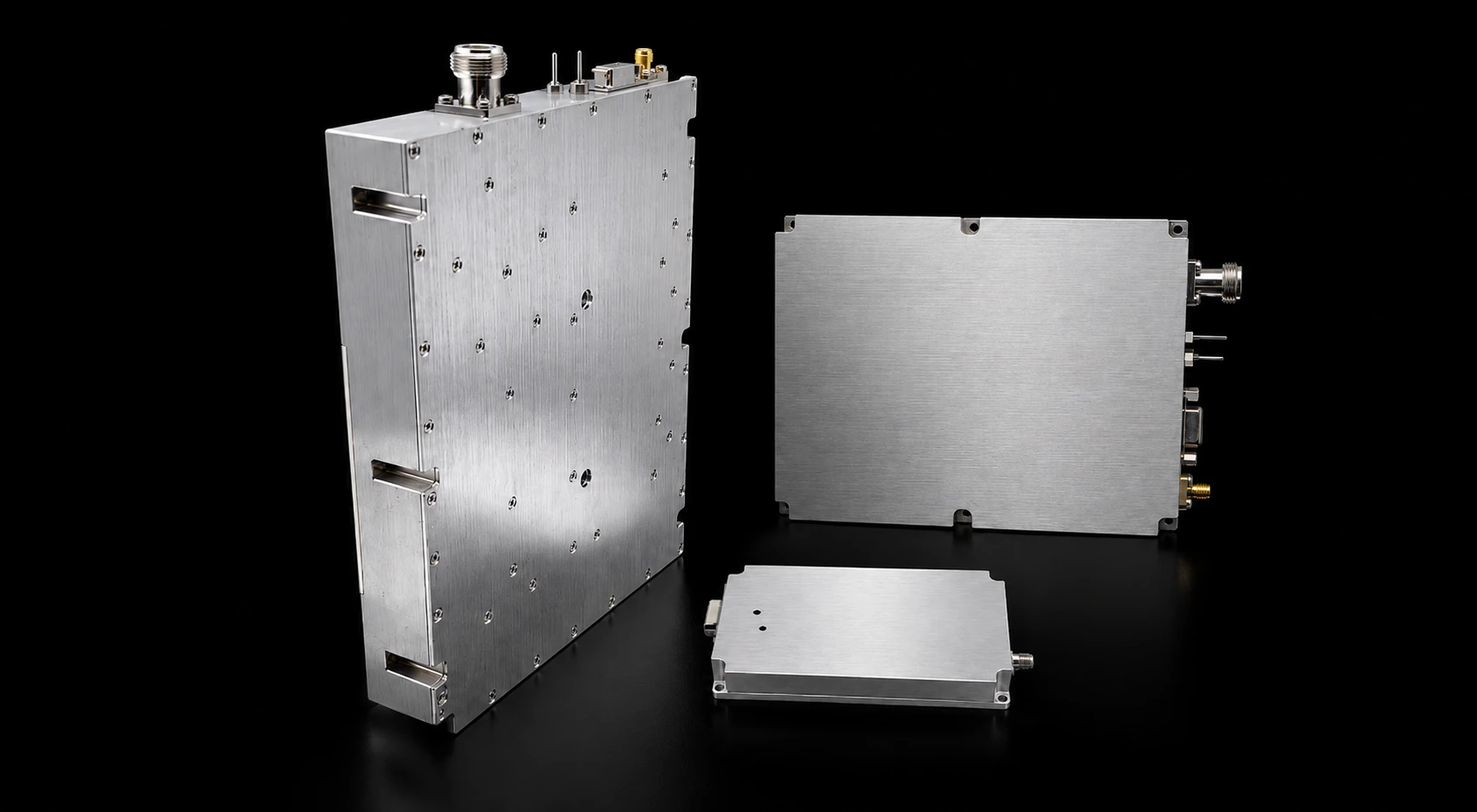
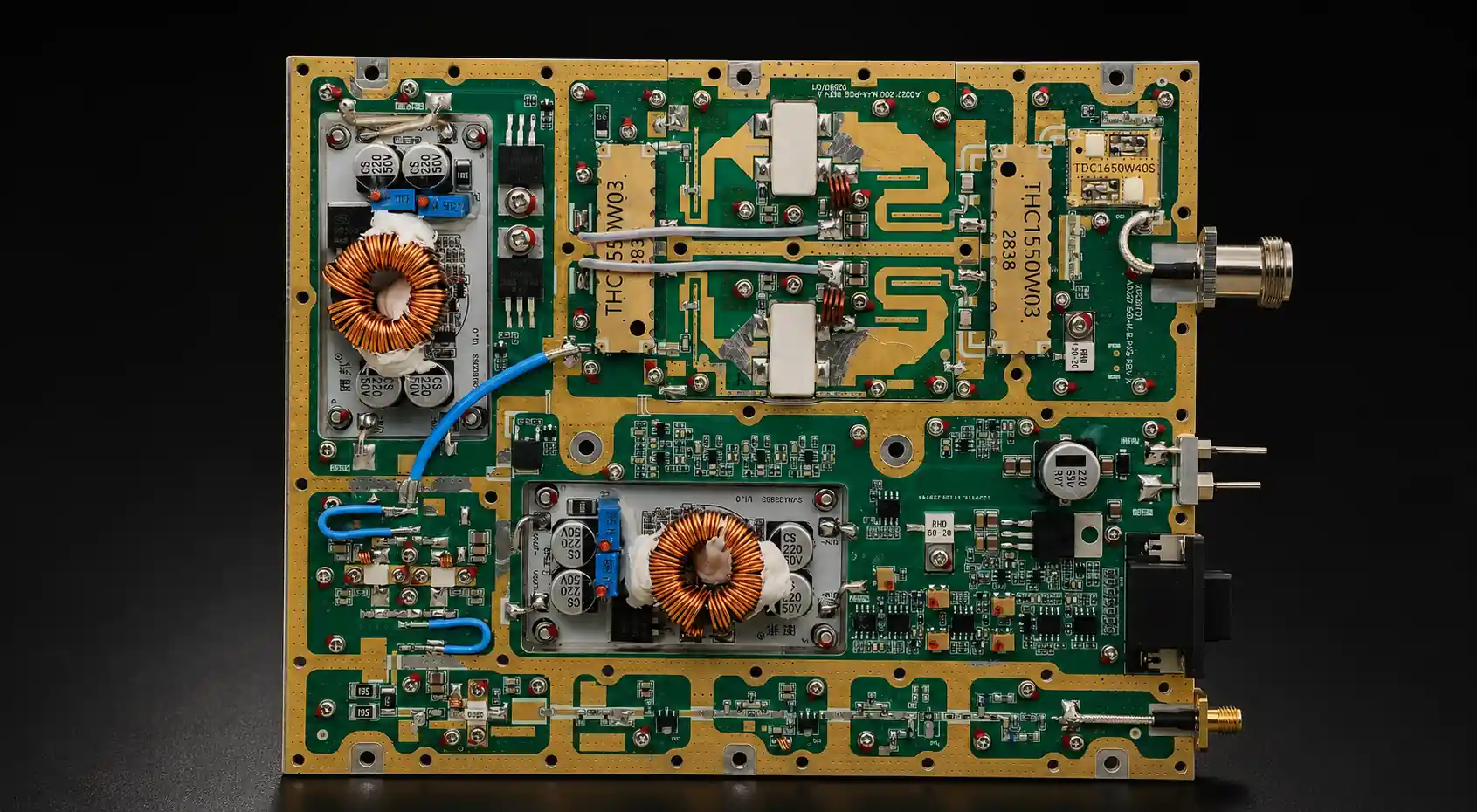
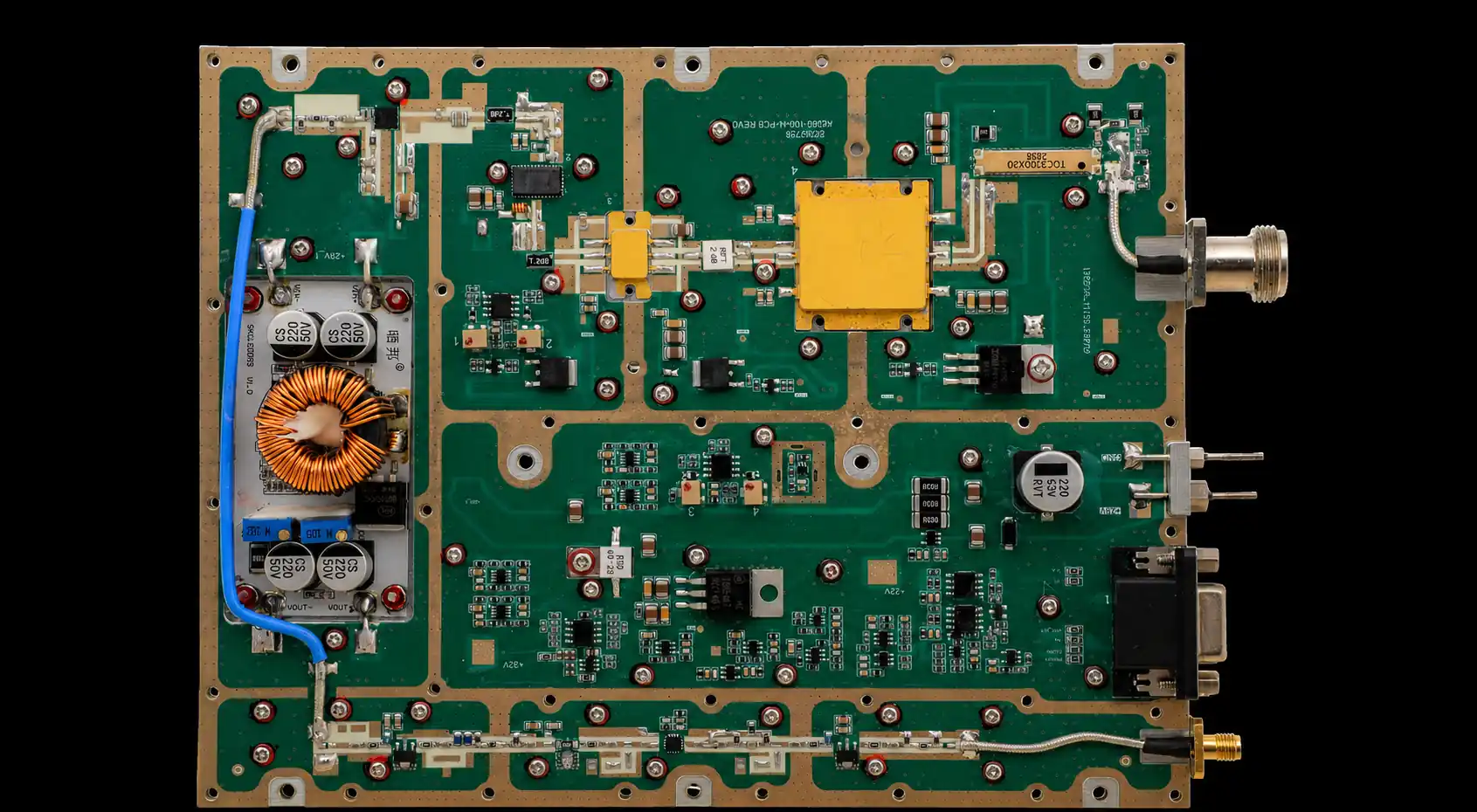
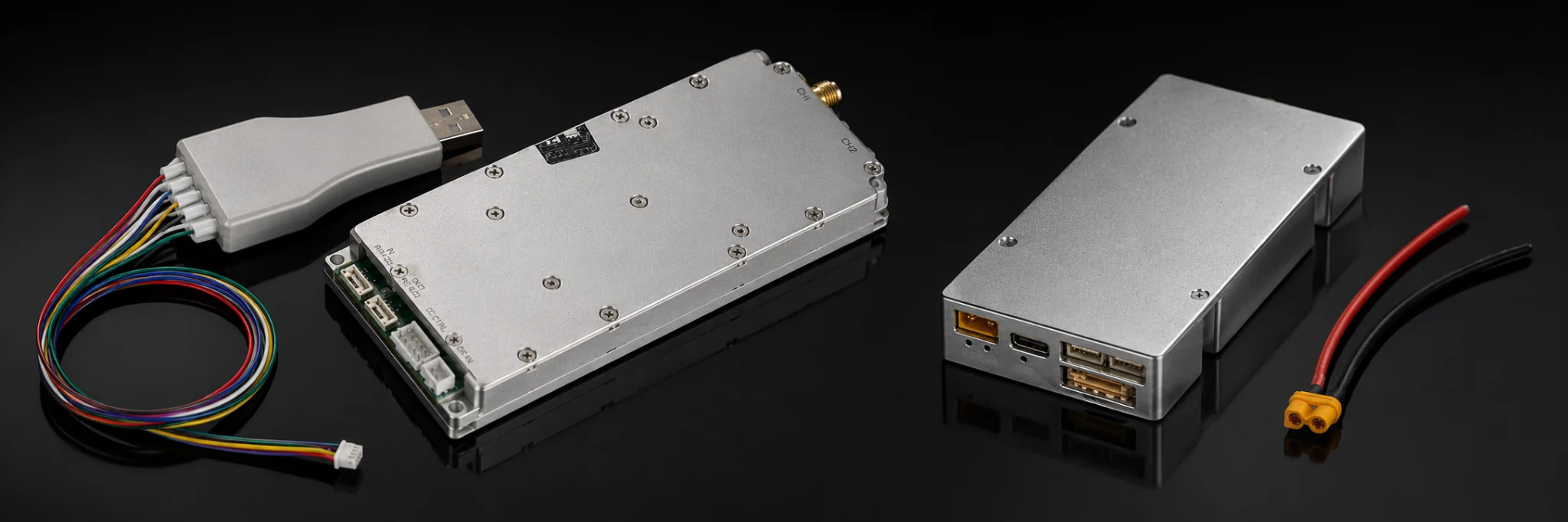

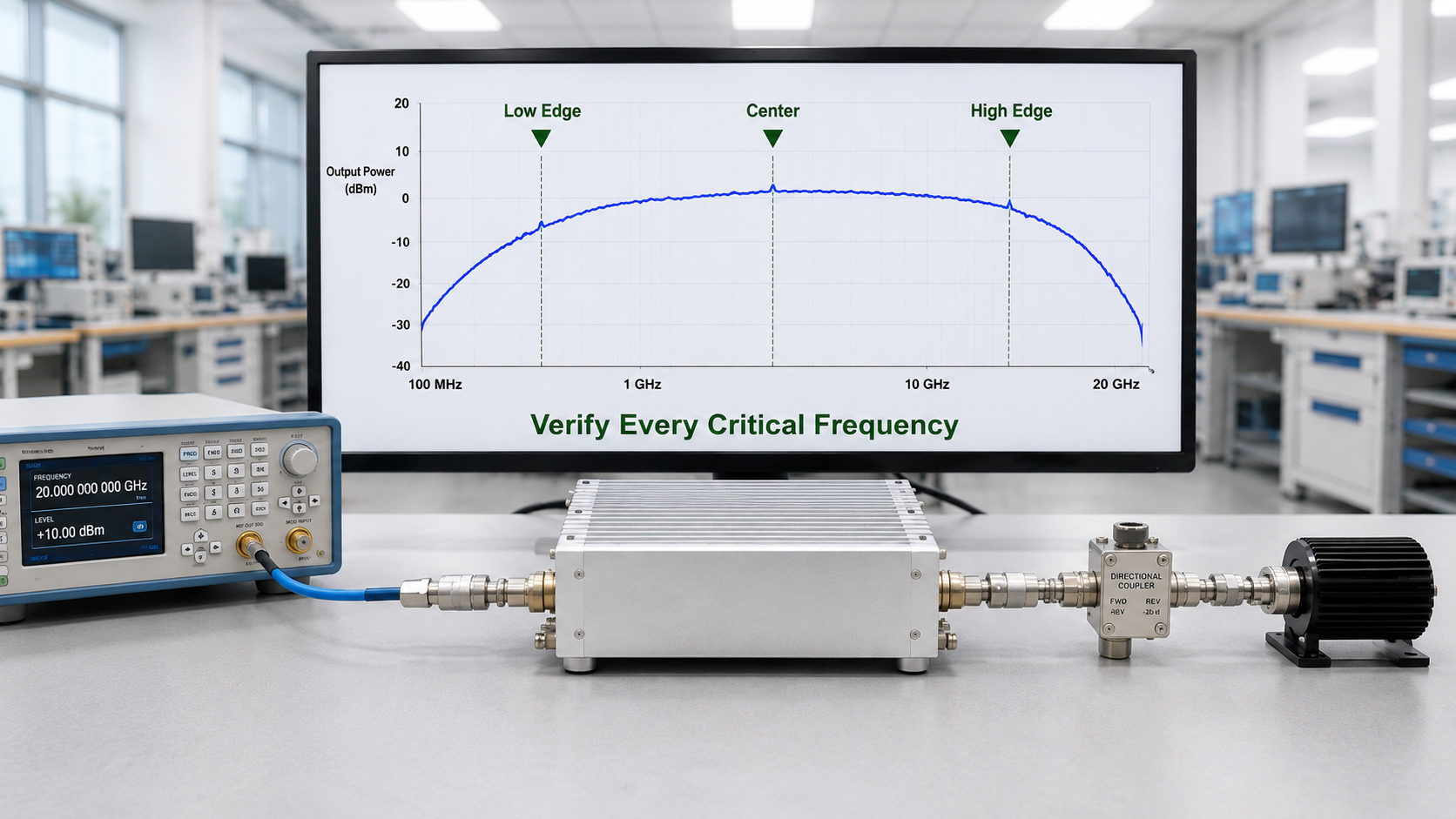
A broadband RF power amplifier should not be approved from its frequency range and nominal output alone. The supplier should prove how the amplifier behaves across the required frequencies, signal conditions, thermal state, RF load, and measurement boundary.
When reviewing RF Power Amplifier Modules, engineers should first define how the actual signal will use the stated operating range. A broadband label does not automatically prove equal output across the band, acceptable combined-signal behavior, hot-state stability, or freedom from unexpected out-of-band output.
The real approval question is:
Can the amplifier meet the required output, gain, spectral behavior, thermal stability, and protection conditions at every critical operating state?
A useful RFQ converts the broadband label into measurable requirements before the platform is approved.
1. Why a Broadband Frequency Range Does Not Prove System Fit
The operating range identifies the frequency region in which an amplifier is intended to function. It does not prove equal performance at every point inside that region.
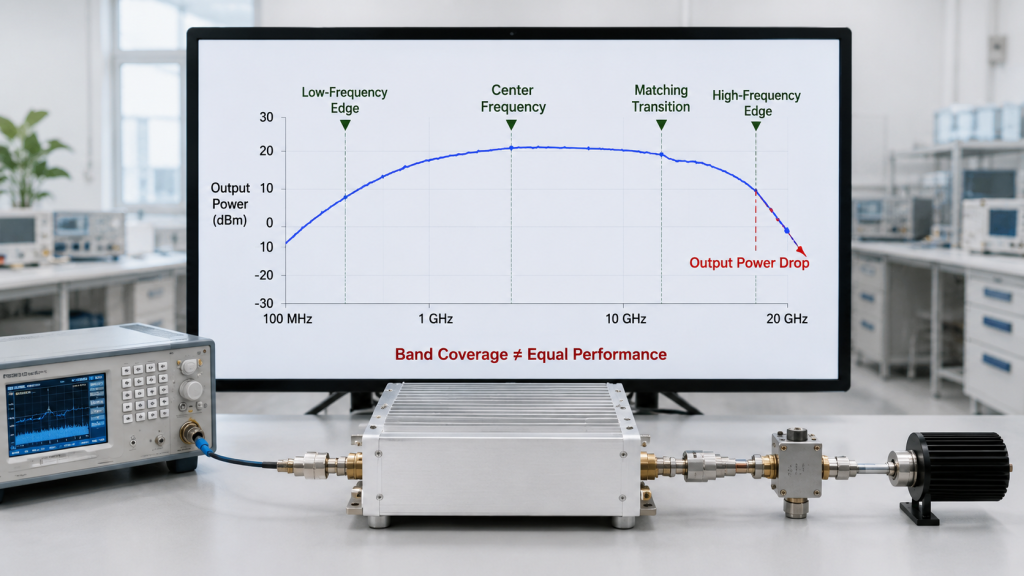
A module may behave differently at:
- The low-frequency edge
- The center of the band
- The high-frequency edge
- Matching-transition regions
- Frequencies requiring more RF input drive
- Frequencies reached after greater thermal accumulation
- Combined-signal operating points
The published range should therefore be treated as the boundary of the verification task, not as the final acceptance result.
Define How the Signal Uses the Band
A broadband analog RF path may allow several signals to pass without switching or retuning. However, the total operating range does not define the signal condition that has actually been qualified.
The RFQ should state whether the system uses:
- One frequency at a time
- Frequency-hopping operation
- Several simultaneous signals
- Separate operating modes
- A switched or tuned RF path
When several signals operate together, define their total span, occupied bandwidth, power allocation, composite output, and required spectral behavior.
Two widely separated signals may both fall inside the analog passband. That does not prove acceptable compression, intermodulation, current, heat, filtering, or protection behavior when they are active together.
Do Not Assign an Unverified Instantaneous Bandwidth
Instantaneous bandwidth may be relevant at system level, but it should not be copied from an SDR or receiver and automatically assigned to the PA.
For the amplifier, define the real operating condition:
- Active frequencies
- Maximum simultaneous signal span
- Occupied spectrum
- Waveform
- Composite output
- Required spectral limits
The supplier should then state whether that condition is supported by design data, qualification testing, sample verification, or unit-level shipment evidence.
Choose the Correct Architecture
A broadband module can simplify frequency expansion and reduce the number of RF paths. A narrowband module may provide a more optimized response over one limited band. A mixed architecture may use broadband coverage for flexible channels and narrowband modules for fixed high-priority frequencies.
The choice should consider output, gain, spectral requirements, available RF drive, cooling, filtering, cabinet space, and control architecture.
A detailed broadband versus narrowband RF PA module comparison should be completed before broadband coverage is treated as the default solution.
2. What Signal, Power, and Spectral Conditions Must Be Defined
Two projects may request the same frequency range while placing very different demands on the amplifier.
One may use a single CW carrier at one frequency at a time. Another may use frequency hopping, several modulated signals, or a noise-like broadband waveform. Their output, spectral behavior, current, heat, and protection requirements are not equivalent.
Define the Representative Waveform
The RFQ should identify whether the input is:
- CW
- Pulsed
- Modulated
- Frequency-hopping
- Swept
- Noise-like
- Single-signal or combined-signal
It should also define occupied bandwidth, duty cycle, run duration, and crest factor or PAPR when relevant.
CW data can establish a useful full-band baseline. It should not automatically be treated as proof for a waveform with different peak demand, average power, compression, spectral distribution, and thermal loading.
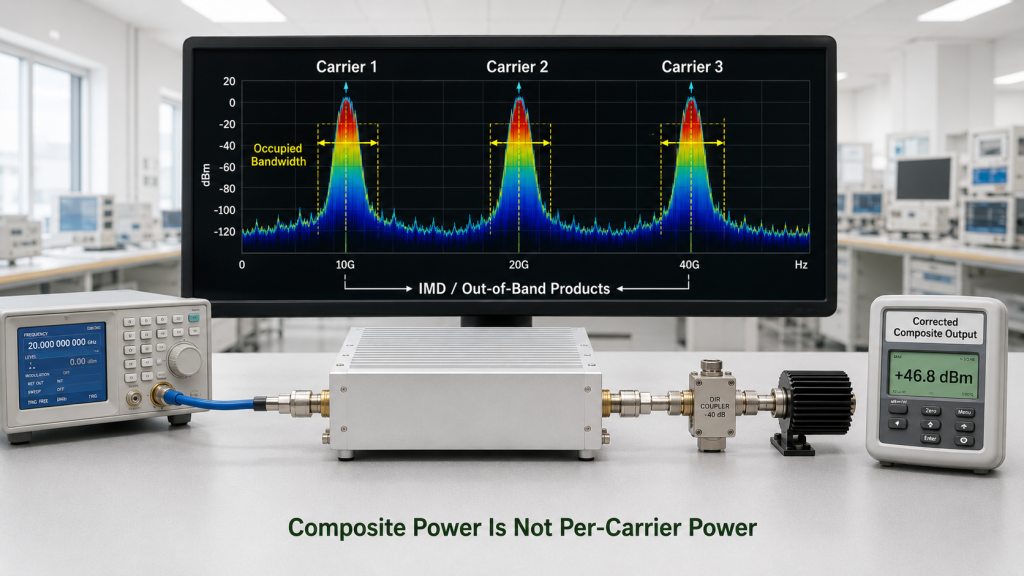
Separate Composite Power From Per-Signal Power
When several signals are active, the report should distinguish:
- Total composite average output
- Output assigned to each carrier or channel
- Carrier power ratio
- Peak or envelope power, when relevant
- Measurement bandwidth
- Detector or integration method
- Measurement reference plane
A nominal total output of 100 W does not prove that every active signal receives the required power.
The report should also state whether the result is measured across the complete instrument bandwidth, within a defined occupied bandwidth, or as channel power around each carrier.
Define the Required Spectral Behavior
The correct metric depends on the waveform and system purpose.
Linear communication or SDR transmitters may require:
- IMD
- ACPR or ACLR
- EVM
- Spectral regrowth
Frequency-hopping, noise-like, EW, test, or C-UAS waveforms may instead prioritize:
- Occupied bandwidth
- In-band power distribution
- Power spectral density
- Band-edge roll-off
- Out-of-band emissions
- Harmonics
- Discrete spurious signals
Not every project requires every metric. The RFQ should define the spectral behavior that affects system acceptance.
Broadband Terms That Must Not Be Confused
| Item | What It Defines | What It Does Not Prove | Required Evidence |
|---|---|---|---|
| Operating range | Total frequency region supported | Equal performance at every frequency | Defined frequency map |
| Simultaneous signal span | Lowest-to-highest active signal span | Acceptable combined output | Representative combined-signal test |
| Occupied bandwidth | Spectrum occupied by the waveform | Entire operating range used at once | Waveform-specific measurement |
| Composite output | Total measured output of active signals | Required power for each signal | Defined detector and integration bandwidth |
| Gain flatness | Gain variation at a defined Pin | Equal high-power output | Corrected gain data |
| Output flatness | Pout variation at a defined operating point | Equal drive, efficiency, or temperature | Corrected Pin, Pout, current, and temperature |
| Spectral behavior | In-band and out-of-band signal quality | Adequacy from output watts alone | Project-specific spectral evidence |
| RF stability | Freedom from unintended oscillation | Acceptable gain or Pout alone | Wide-span spectrum checks |
| VSWR protection | Response to a defined mismatch | Rated output maintained under mismatch | FWD, REV, foldback, shutdown, and recovery |
For available standard frequency ranges and output-power options, engineers can review wideband RF power amplifier modules before defining project-specific requirements.
3. How to Verify Gain, Output, and Spectral Behavior Across the Band
Broadband verification should answer three separate questions:
- How does gain change with frequency?
- How does usable output change with frequency?
- Does the output spectrum remain acceptable under the representative signal condition?
These questions are related, but they are not interchangeable.
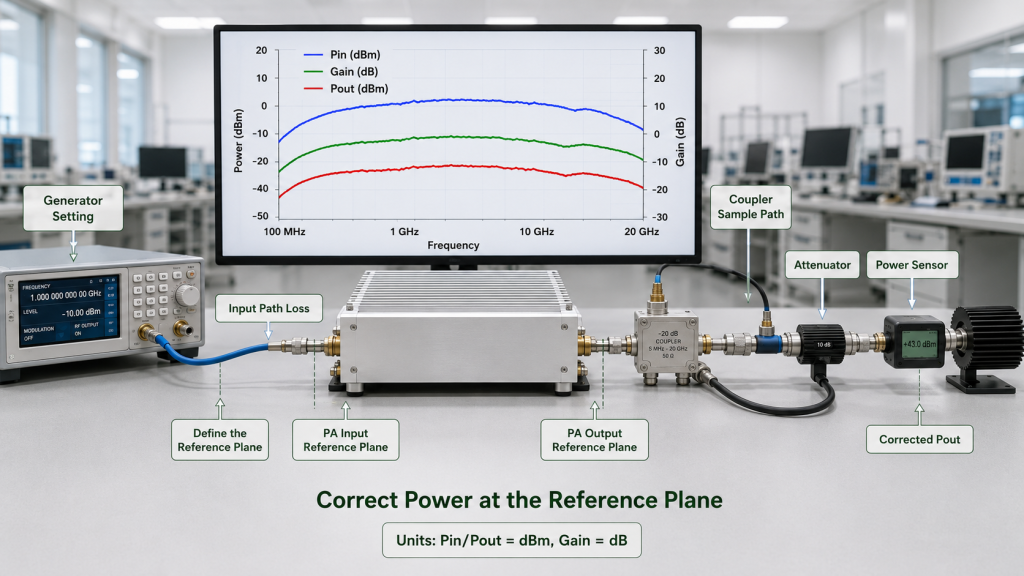
Correct Pin to the PA Input
Signal-generator settings do not automatically equal the power reaching the PA input.
Input cables, connectors, adapters, switches, and attenuators may introduce frequency-dependent loss. Pin should therefore be defined at the PA input reference plane.
A single path-loss correction should not be used across a wide frequency range unless its validity has been demonstrated.
Verify Gain Flatness
Gain flatness describes gain variation across frequency under a defined input and operating state.
The record should identify:
- Corrected Pin
- Waveform
- Frequency
- PA-terminal voltage
- Temperature
- RF load
- Small-signal or large-signal condition
A useful RF PA gain-flatness result cannot be interpreted without knowing the actual input condition at each frequency.
Correct Pout to the Approved Reference Plane
Output cables, directional couplers, attenuators, adapters, filters, and sensors may also have frequency-dependent behavior.
Pout should be corrected to the approved output reference plane using the applicable correction at each frequency. Measurement uncertainty may also vary across the band.
Verify Output Flatness Separately
Output flatness describes Pout variation across the required frequencies at a defined operating point.
The test may use fixed Pin, fixed compression, rated output, or another agreed method. The method should be stated.
If Pin is increased at weak frequencies to maintain a flat Pout curve, the report may hide reduced gain or inadequate driver margin. Corrected Pin, corrected Pout, gain, current, voltage, and temperature should therefore be connected at each critical point.
Use CW and Representative Waveform Tests for Different Purposes
A CW or single-tone sweep can establish gain, output, current, band-edge behavior, thermal accumulation, and protection status.
A representative waveform test can establish composite output, per-signal output, in-band power distribution, spectral regrowth, IMD, ACPR, EVM, or other required spectral behavior.
Separate single-tone measurements do not automatically predict how the amplifier will behave when signals operate together.
Include the Band Edges
The frequency map should include the low edge, high edge, center, project-critical frequencies, and any matching-transition regions.
A strong center-frequency result cannot approve a weak band edge.
A dedicated RF PA band-edge performance review should use the same or equivalent input, output, voltage, load, and thermal conditions as the rest of the acceptance test.
Control Sweep Order
A broadband sweep should define frequency order, sweep direction, dwell time, settling time, starting thermal condition, Pin control method, and cooling condition.
If the low edge is measured immediately after startup and the high edge after substantial heating, the measured difference contains both frequency response and thermal drift.
A full-power swept RF PA test can establish the baseline when corrected Pin, corrected Pout, current, voltage, temperature, FWD, REV, and protection state are recorded through one controlled sequence.
4. How Voltage, Heat, Load, Filtering, and Stability Change the Result
A favorable bench result may not remain valid inside a cabinet with real DC wiring, restricted airflow, filters, switches, cables, and antenna mismatch.
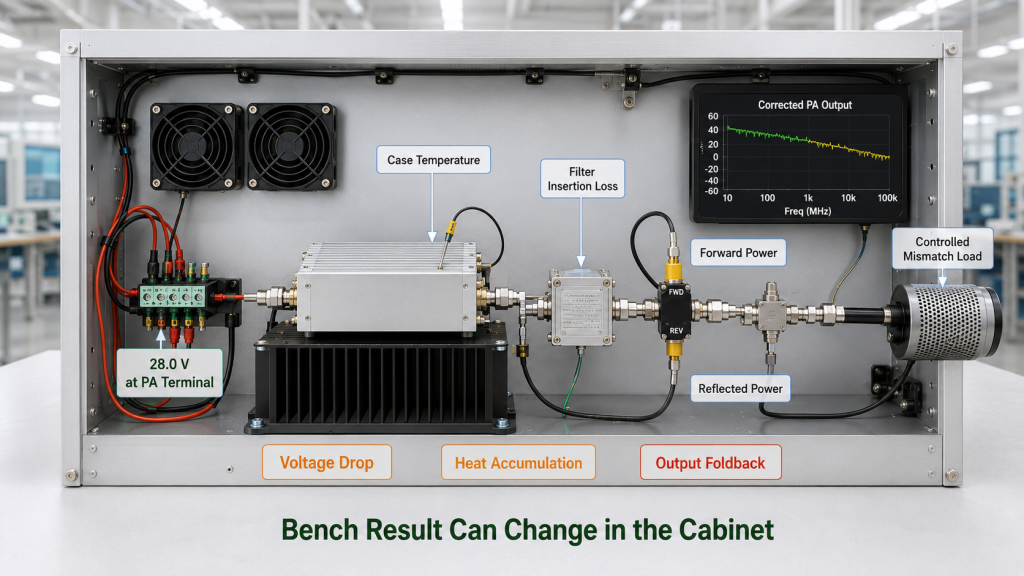
Verify the PA-Terminal Voltage and Thermal State
Record voltage at the PA terminals during RF operation, not only at the power-supply output.
The test should also define duty cycle, run duration, cooling method, ambient condition, case-temperature point, and stabilization rule.
The report should distinguish cold-start, warming, thermally stabilized, and post-protection output. A short peak result should not be used as proof of sustained broadband performance.
For RF SKYPOWER’s standard platforms, the RFQ can define the required 28 V terminal boundary. Other platforms should use their applicable PA-terminal voltage.
Match the Reference Plane to Responsibility
The correct output reference plane depends on the delivered equipment.
- PA output port for module-level acceptance
- Filtered output when filtering belongs to the RF assembly
- Cabinet output when internal RF-path components are included
- Antenna input when the feeder forms part of acceptance
The report should state the reference plane and the frequency-dependent corrections applied between the PA and the measurement point.
Define the Filtering Boundary
Harmonic, spurious, and out-of-band limits should identify whether they apply at the raw PA output, after an external filter, or at the cabinet output.
The RFQ should also state who supplies the filter, whether insertion loss is included in the output target, and which filter state is active.
A supplier should not be held to a filtered system-level limit at an unfiltered PA port unless that responsibility is explicitly included.
Verify Broadband Stability
Output power and gain do not prove that the amplifier remains stable in every required state.
Relevant checks may include:
- No RF input
- Normal driven operation
- High input drive
- Hot-state operation
- Startup and shutdown
- Enable transitions
- Protection foldback and recovery
- Defined mismatch conditions
- Different switching or filter states
Wide-span spectrum observation can help identify self-oscillation, parasitic signals, unexpected discrete outputs, and hot-state spectral changes.
Small-signal device stability factors do not automatically replace large-signal, hot-state, transition, or mismatch verification of the complete PA assembly.
Separate Protection From Output Under Mismatch
VSWR protection describes how the amplifier responds to mismatch. It does not prove that rated output remains available.
The mismatch test should define forward power, frequency, VSWR or return loss, duration, cooling condition, foldback, shutdown, recovery, and permanent-damage criteria.
Mismatch phase coverage may also be required because the same VSWR magnitude can create different device stress at different reflection phases.
5. What Evidence Should Support Broadband PA Approval
The RFQ should separate design qualification from production and shipment testing.

| Evidence Level | Typical Scope | Main Purpose |
|---|---|---|
| Design qualification | Full frequency map, hot-state operation, representative waveform, filtering, mismatch, and stability | Prove the approved design |
| Lot or sample verification | Selected full-band, hot-state, and spectral checks | Detect lot or process drift |
| Unit-level shipment test | Critical frequencies, Pin or gain, Pout, voltage, current, alarms, and S/N | Prove the delivered unit meets shipment limits |
Design qualification may include complete frequency, waveform, mismatch, and stability testing. It does not mean every delivered unit must repeat the entire qualification program.
Lot or sample verification should define the lot size, sample size, selection method, required checks, and failed-sample escalation.
Unit-level shipment evidence should focus on the parameters needed for final release and should remain linked to the correct model, hardware state, and serial number.
For combined-signal tests, the report should also identify the detector, integration bandwidth, total composite power, per-signal power, reference plane, filter state, and whether distortion products are included.
6. What the RFQ Should Define Before Approval
The RFQ should define the acceptance boundary before the platform is approved or production results are reviewed.

It should state:
- Required frequency map
- Signal mode and waveform
- Maximum simultaneous signal span
- Composite and per-signal output targets
- Permitted gain and output variation
- Required spectral behavior
- PA-terminal voltage
- Cooling and hot-state condition
- RF load and output reference plane
- Filtering responsibility
- Required stability states
- Mismatch and recovery requirements
- Qualification, sample, or unit-level evidence
- Measurement uncertainty
- Retest and failed-sample rules
- Pass, Review, Hold, and Reject conditions
A complete RFQ should not ask only:
Can you provide a broadband PA covering this frequency range?
It should ask:
Can the proposed amplifier meet the required frequency map, actual signal condition, corrected input and output targets, spectral behavior, hot-state, filtering, stability, load, protection, and evidence requirements?
That question gives the supplier enough information to select, test, or design the correct platform.
FAQ
Can One Broadband RF PA Amplify 2.4 GHz and 5.8 GHz Simultaneously?
Possibly, but the operating range alone is not enough to approve that condition.
Both frequencies may fall inside the amplifier’s analog passband. The project must still define the combined signal span, composite power, per-carrier power, waveform, spectral limits, current, temperature, filtering, stability, and protection requirements.
Separate single-tone tests do not automatically prove acceptable simultaneous operation.
Is Gain Flatness the Same as Output Flatness?
No.
Gain flatness describes gain variation across frequency under a defined and frequency-corrected input condition.
Output flatness describes Pout variation across frequency at a defined operating point and output reference plane.
A flat gain curve does not automatically prove flat high-power output. A flat output curve may also hide different input drive, compression, current, efficiency, or temperature conditions.
Can a CW Sweep Approve a Modulated or Noise-Like Application?
Not by itself when waveform or spectral behavior forms part of acceptance.
A CW sweep can establish the full-band baseline, including gain, output, current, temperature, band-edge behavior, and protection status.
A representative waveform test is still needed when acceptance depends on composite power, occupied-band power distribution, PAPR, IMD, ACPR, EVM, spectral regrowth, discrete spurs, or combined-signal interaction.
Conclusion
A broadband RF power amplifier should not be approved from frequency range and nominal wattage alone.
The project should define the required frequency map, actual signal condition, corrected input and output reference planes, composite and per-signal power, gain and output flatness, spectral behavior, hot-state stability, filtering responsibility, RF stability, mismatch response, and required evidence level.
RF SKYPOWER can support early engineering review for broadband RF PA selection and approval. Send the operating range, critical frequencies, signal mode, waveform, simultaneous signal span, input-drive boundary, composite and per-signal output targets, spectral limits, PA-terminal voltage, cooling condition, output reference plane, filter responsibility, load, mismatch, stability requirements, control interface, protection behavior, and required S/N-linked evidence level.