

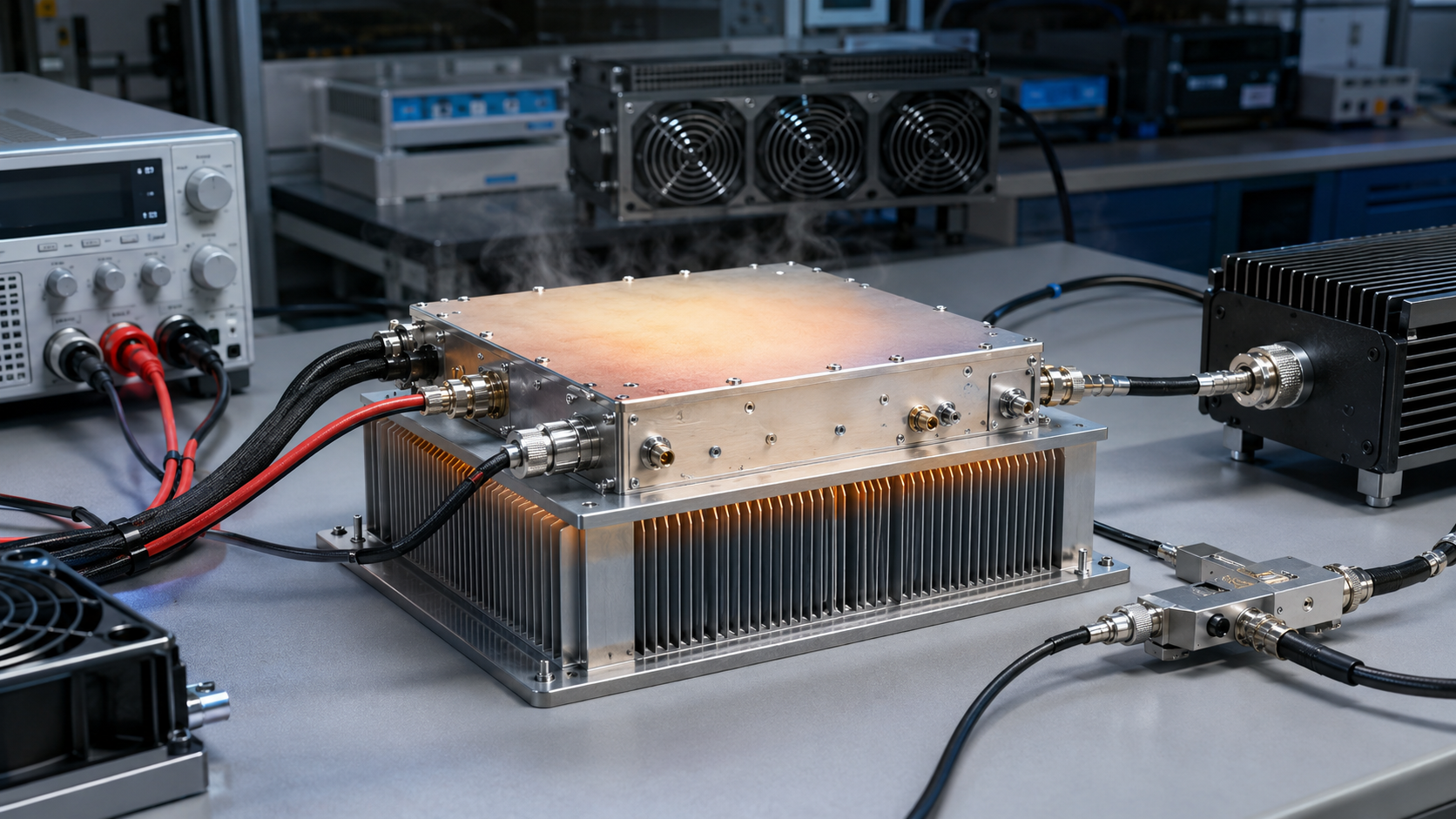
RF PA duty cycle failures often appear after a module has already passed a short output test. The amplifier reaches target power at startup, but output begins to drift as operating time increases. Current may rise, case temperature may continue climbing, or protection may reduce output before the system reports a complete fault.
For system integrators, duty cycle is rarely an isolated percentage. Run time, module-terminal voltage, cooling, frequency, antenna VSWR, and simultaneous channel loading determine whether rated power remains usable after warm-up.
Before approving RF Power Amplifier Modules, define whether the requirement is burst, intermittent, high-duty, or True CW. The acceptance test should reproduce the same operating rhythm, cooling condition, DC input, RF load, and run time required by the final system.
1. What RF PA Duty Cycle Changes in Real Operation
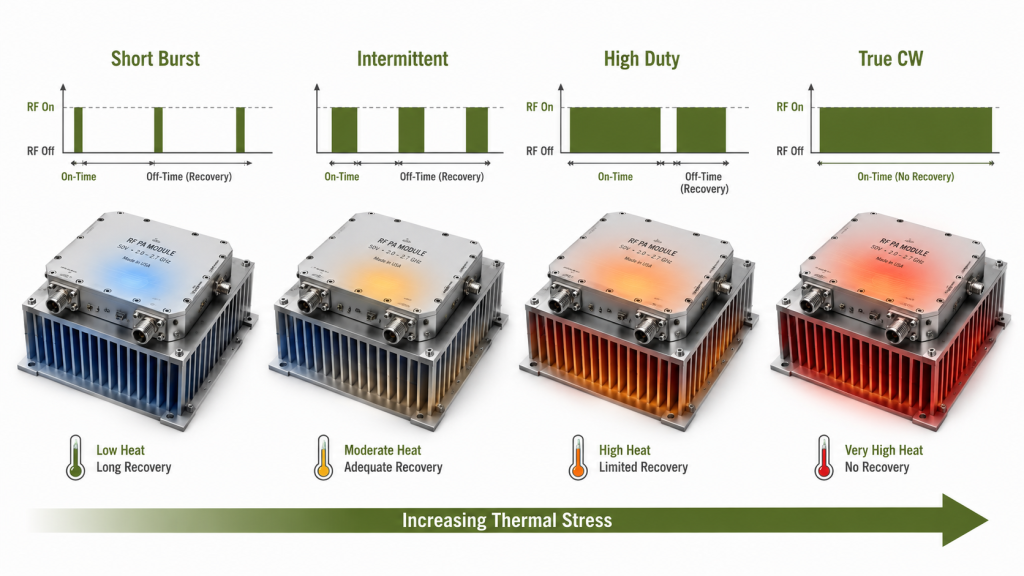
RF PA duty cycle describes how long the amplifier transmits during a defined operating period. A module operating for 10 seconds and resting for 90 seconds has a 10% duty cycle. A module transmitting without a planned off-time is operating under a continuous or True CW requirement.
The percentage alone is not enough. A useful operating requirement should also state:
- Continuous transmit time
- Recovery time between transmissions
- Total daily operating time
- Required RF output
- Working frequency range
- Ambient temperature
- Cooling method
- Load or antenna condition
- Number of modules operating simultaneously
These conditions change the severity of the application.
A short burst allows the amplifier, heatsink, DC cables, connectors, and cabinet air to recover between transmissions. As the duty cycle increases, average current and heat also increase. At True CW, the complete RF system must support a stable electrical and thermal balance without relying on recovery time.
| Operating Mode | Operating Pattern | Main Risk | Evidence to Request |
|---|---|---|---|
| Short burst | Brief output with long recovery | Peak output is mistaken for sustained output | Burst duration and peak power |
| Intermittent duty | Defined work and rest cycle | Recovery time is not reproduced in testing | On-time, off-time, and repeated-cycle results |
| High duty | Long output with limited recovery | Heat and current accumulate over time | Stabilized output and temperature trend |
| True CW | No planned off-time | Full thermal and electrical stability is required | Stable power, voltage, current, and protection status |
A catalog wattage cannot be evaluated without its test conditions.
A 100 W result measured for several seconds does not prove that the module will hold 100 W during prolonged operation. Before approving the rating, confirm whether the result represents a cold-start peak, a defined work/rest cycle, or stable output after warm-up.
2. What Duty Cycle Failures Look Like After Warm-Up
A duty-cycle failure does not always cause immediate shutdown. The more common result is a gradual loss of usable performance.
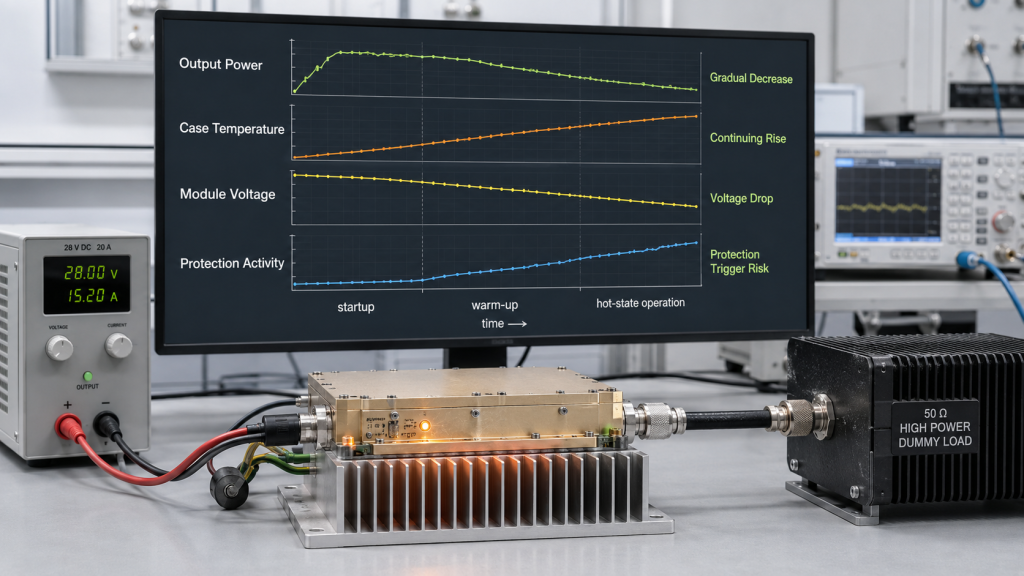
Typical warning signs include:
- Output power or gain decreases after warm-up
- Module-terminal voltage falls under sustained load
- Current approaches the power-supply limit
- Case temperature continues rising
- Fan speed increases without reaching thermal stability
- Temperature, reflected-power, or derating protection activates
- The amplifier shuts down after an initially stable period
- Output recovers only after cooling
These symptoms may come from several parts of the system. The amplifier can reach a thermal limit, but the same output drift may also be caused by DC voltage drop, restricted airflow, an overloaded shared supply, or rising reflected power.
The acceptance criterion should therefore be based on minimum stable output after warm-up, not the highest reading recorded at startup.
For example, a module may briefly exceed the requested power while cold. It may then settle at a lower value as temperature rises. That behavior is acceptable only when the final stabilized output still meets the project requirement and no protection boundary is exceeded.
A single peak screenshot cannot show this trend. A useful test record needs synchronized measurements of:
- Output power versus time
- Case temperature versus time
- Current versus time
- Module-terminal voltage
- Forward and reflected power
- Frequency point
- Cooling condition
- Alarm or protection status
The engineering question is not simply whether the amplifier can reach the target. It is whether the complete system can hold the required output after reaching thermal equilibrium.
3. How System Conditions Increase Duty Cycle Risk
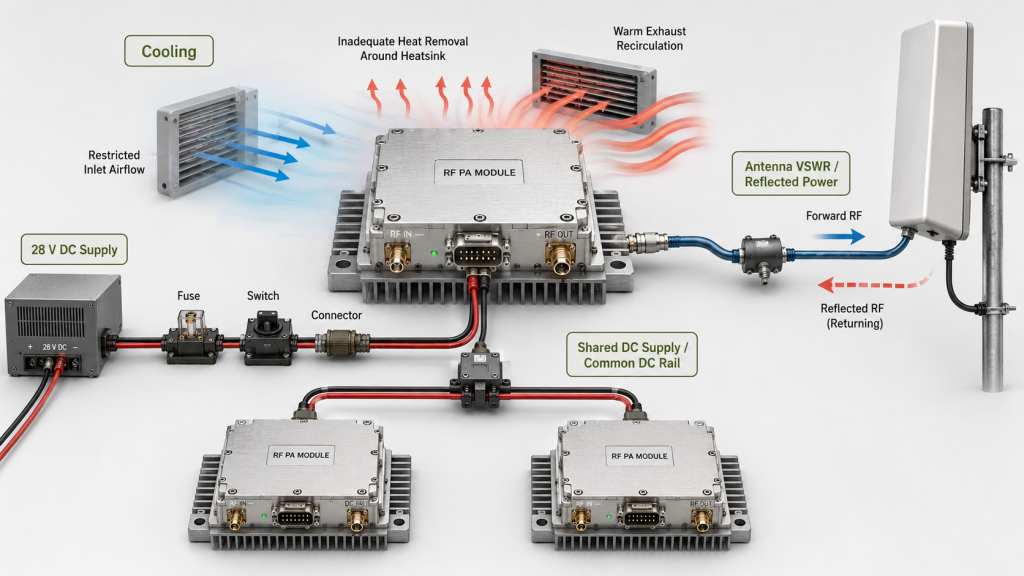
Long-duty operation becomes unstable when the cooling system, module-terminal voltage, or RF load cannot support sustained output. These conditions should be reviewed together because they often produce similar symptoms after warm-up.
Cooling condition
The amplifier converts part of its DC input into RF output. The remaining energy becomes heat.
At low duty cycle, off-time may remove enough heat to prevent continuous temperature rise. At high duty cycle, heat accumulates until the module and cooling system approach thermal balance. If the heatsink, airflow, thermal interface, or cabinet exhaust is inadequate, output can drift or thermal protection can activate.
The test should reproduce the intended installation as closely as practical. Record:
- Ambient air temperature
- Heatsink or cold-plate configuration
- Fan model and airflow direction
- Cabinet inlet and outlet conditions
- Module mounting method
- Case-temperature measurement point
Testing an amplifier on a large open bench heatsink does not automatically prove that it will behave the same way inside a restricted enclosure.
Cabinet-level reviews should also connect the duty-cycle result with RF PA efficiency and cabinet heat under the installed airflow and simultaneous-module condition.
DC input condition
High-duty output also requires continuous DC support. Measure voltage at the amplifier terminals while RF output is active. A power supply may display the correct voltage while cable, connector, switch, fuse, or distribution loss reduces the voltage reaching the module.
Possible results include:
- Lower RF output
- Increased current demand
- Early gain compression
- Unstable control behavior
- Interaction between modules sharing one supply rail
A proper DC review should include supply capacity, cable length, conductor size, connector loss, startup current, full-load current, and simultaneous operation.
The detailed checks for module-terminal voltage under real RF load should be completed before output loss is assigned to the RF module alone.
RF load condition
Reflected power becomes more serious when it is applied continuously. A clean 50 Ω dummy load is appropriate for controlled module testing, but the installed antenna path introduces additional variables:
- Feeder loss
- Connectors and adapters
- Antenna VSWR across frequency
- Weatherproofing
- Cable routing
- Nearby metal structures
- Antenna detuning
- Vibration or connector movement
VSWR protection reduces damage risk, but it does not make every load condition acceptable. Repeated derating or alarm recovery is not equivalent to stable rated output.
When output becomes unstable only after installation, check for antenna-path VSWR failures before replacing the amplifier.
4. How to Test RF PA Duty Cycle at Hot State
A duty-cycle test should reproduce the required transmit time, recovery time, cooling, DC input, frequency, and RF load. It should continue beyond the first target-power reading and record performance through stabilized operation.
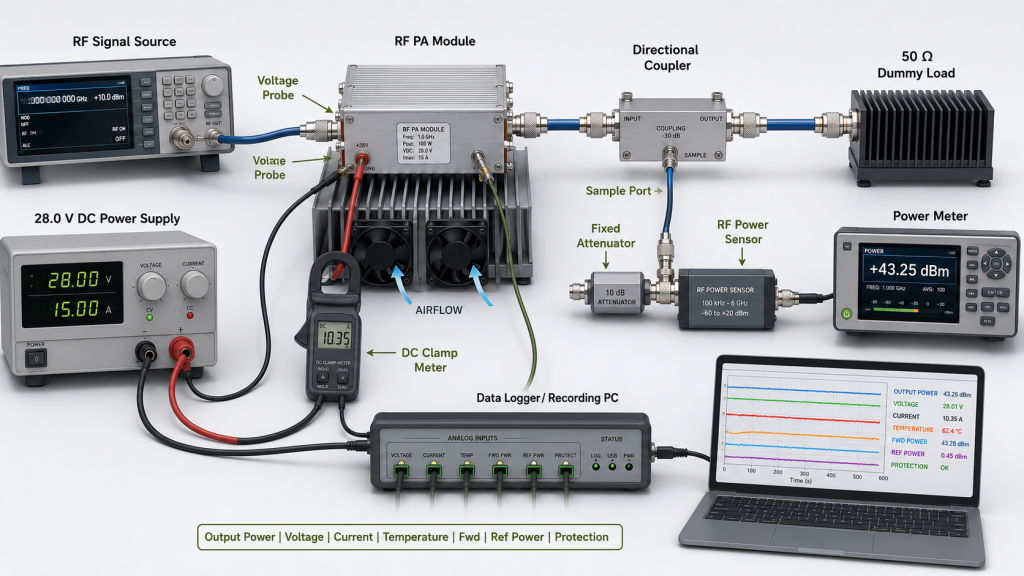
Start by defining:
- Transmit time
- Rest time
- Number of repeated cycles
- Maximum continuous run
- Frequency points
- Input drive level
- Required RF output
- Cooling configuration
- DC supply condition
- RF load
- Ambient temperature
For intermittent operation, repeat the real work/rest cycle enough times to expose cumulative heating. For True CW operation, continue the test until output and temperature no longer show a material upward or downward trend during the agreed observation period.
Record output power, module-terminal voltage, current, case temperature, forward power, reflected power, and protection status from startup through the full test period.
Test more than one convenient frequency
A center-frequency result may not represent the complete working band. Gain, efficiency, current, output matching, and thermal load can change with frequency.
At minimum, check:
- Low required frequency
- Center frequency
- High required frequency
- Any known weak or high-current point
For a wideband module, cold-state swept results should be followed by stabilized checks at the weakest required points. Projects that depend on complete band coverage should use full-power swept testing rather than one convenient center-frequency screenshot.
Separate module testing from installation testing
The first acceptance stage should use a controlled RF path with a suitable dummy load, directional coupler, attenuation, and calibrated measurement equipment.
The installed antenna path can then be checked as a separate system-level stage. Keeping these two stages separate helps identify whether an unstable result originates in the module, DC supply, cooling system, cable, connector, or antenna.
5. What Evidence Should Prove Long-Duty Output
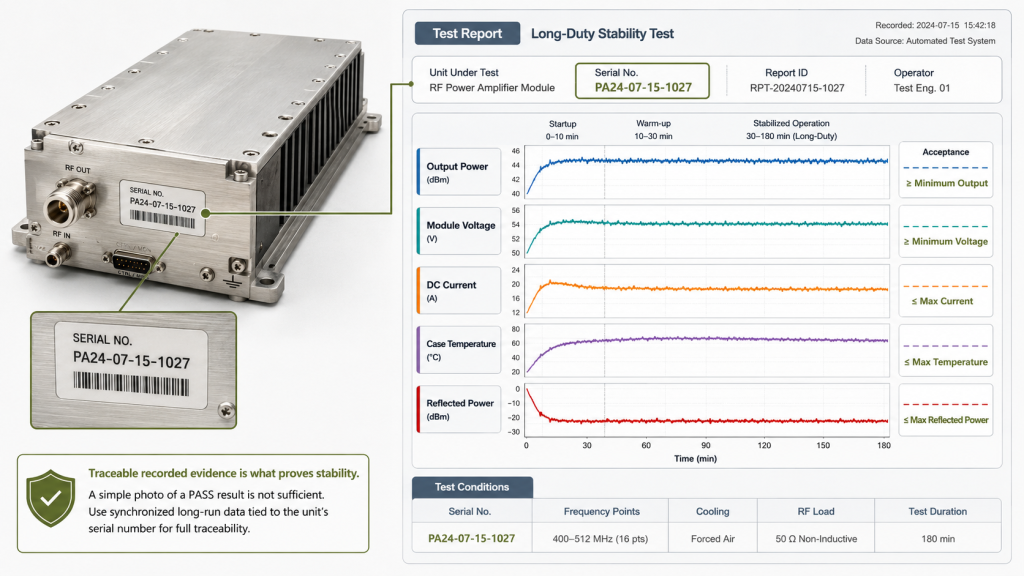
A PASS label or power-meter photograph does not show whether the required duty cycle was reproduced.
The report should allow an integrator to understand and repeat the operating condition. It should also connect the result to the exact unit being delivered.
Duty-Cycle Acceptance Checklist
- Module model
- Module serial number
- Test date
- Test frequency points
- Input drive level
- Output power versus time
- Module-terminal voltage versus time
- Current versus time
- Case temperature versus time
- Forward and reflected power
- Load type and measured VSWR
- Cooling configuration
- Ambient temperature
- Work and rest timing
- Total test duration
- Alarm and protection status
- Final stable output
- Pass criteria and measured result
Recorded data shows what happened during the test, while acceptance limits determine whether the result is usable for the project.
Acceptance limits should be defined before testing begins. They may include:
- Minimum stabilized output
- Maximum permitted output drift
- Maximum case temperature
- Allowed DC voltage range
- Maximum current
- Reflected-power or VSWR boundary
- No unexpected protection events
- Repeatable performance at required frequency points
The most useful evidence is a synchronized long-run record. It shows whether falling output is associated with increasing temperature, DC voltage drop, current limiting, reflected power, or protection activity.
Serial-number-linked evidence is especially important for sample approval and batch procurement. A strong result from an engineering prototype does not prove that every delivered module was tested under the same condition.
The report does not need to imitate every field variable. It does need to state the test boundaries clearly enough that procurement, engineering, and the supplier are approving the same operating requirement.
6. How to Define Duty Cycle Requirements in an RFQ
Many buyers do not know the exact duty-cycle percentage when they first request a quotation. That should not stop the supplier from receiving useful operating information.
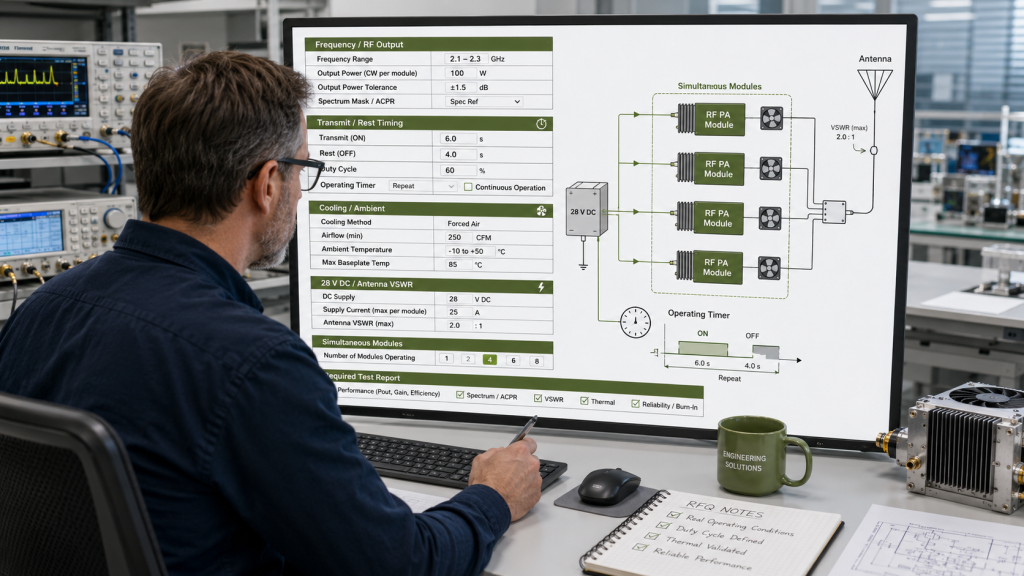
When the percentage is unknown, describe the actual work pattern:
- How long does the amplifier transmit each time?
- How long does it rest?
- How often is the cycle repeated?
- What is the longest continuous run?
- Does operation occur occasionally or throughout the day?
- Do several RF modules operate simultaneously?
- What ambient temperature is expected?
- How is the module cooled?
- What DC voltage and current are available?
- Is the output requirement measured at the PA port or antenna end?
- What antenna, feeder, and VSWR conditions are expected?
- Is long-run test evidence required before shipment?
A practical RFQ statement can use this format:
Required frequency range:
Required RF output:
Output reference plane: PA port / antenna end
Transmit time per cycle:
Rest time per cycle:
Maximum continuous run:
Daily operating pattern:
Simultaneous module count:
Ambient temperature:
Cooling method:
DC supply at module terminals:
Antenna or load condition:
Required test duration:
Required report data:
If the final duty cycle is still under system review, state the most severe expected operating condition. This gives the supplier a clear basis for module selection, thermal design, protection review, and acceptance testing.
Do not allow the RFQ to contain only a frequency range and a wattage. Those two values cannot define whether the module is suitable for burst, intermittent, high-duty, or True CW operation.
FAQ
Can peak power be used as a CW rating?
No. Peak power shows what the amplifier can reach for a limited time, but it does not define how long that output was held or what happened after the module warmed up. A CW rating must be supported by stable output under defined frequency, DC input, cooling, load, and test-duration conditions.
What if the exact RF PA duty cycle is unknown?
Describe the operating rhythm instead. Provide expected transmit time, rest time, maximum continuous run, daily use, simultaneous channel count, cooling condition, and ambient temperature. The duty-cycle requirement can then be translated into a realistic test condition.
How long should a duty-cycle acceptance test run?
The test should continue long enough to expose the required thermal and electrical behavior. For intermittent systems, repeat the real work/rest cycle. For True CW systems, continue until output, current, and temperature reach a stable trend under the agreed test condition.
Conclusion
RF PA duty cycle affects more than operating time. It changes average current, heat accumulation, output stability, load stress, protection behavior, and the evidence needed for acceptance.
A module that reaches target power during a short cold-start test is not automatically suitable for long-duty or True CW operation. Approval should be based on the minimum stable output after warm-up under the required frequency, cooling, DC input, and load conditions.
RF SKYPOWER can support early engineering review for RF PA duty cycle requirements before sample approval or batch procurement.
Submit the required frequency range, output target, reference plane, single-run time, and work/rest cycle. Also include the ambient temperature, cooling method, module-terminal voltage, available current, antenna VSWR, simultaneous channel count, and required test-report format.
Contact us today to define the operating condition and acceptance evidence before an amplifier is approved by short-test wattage alone.