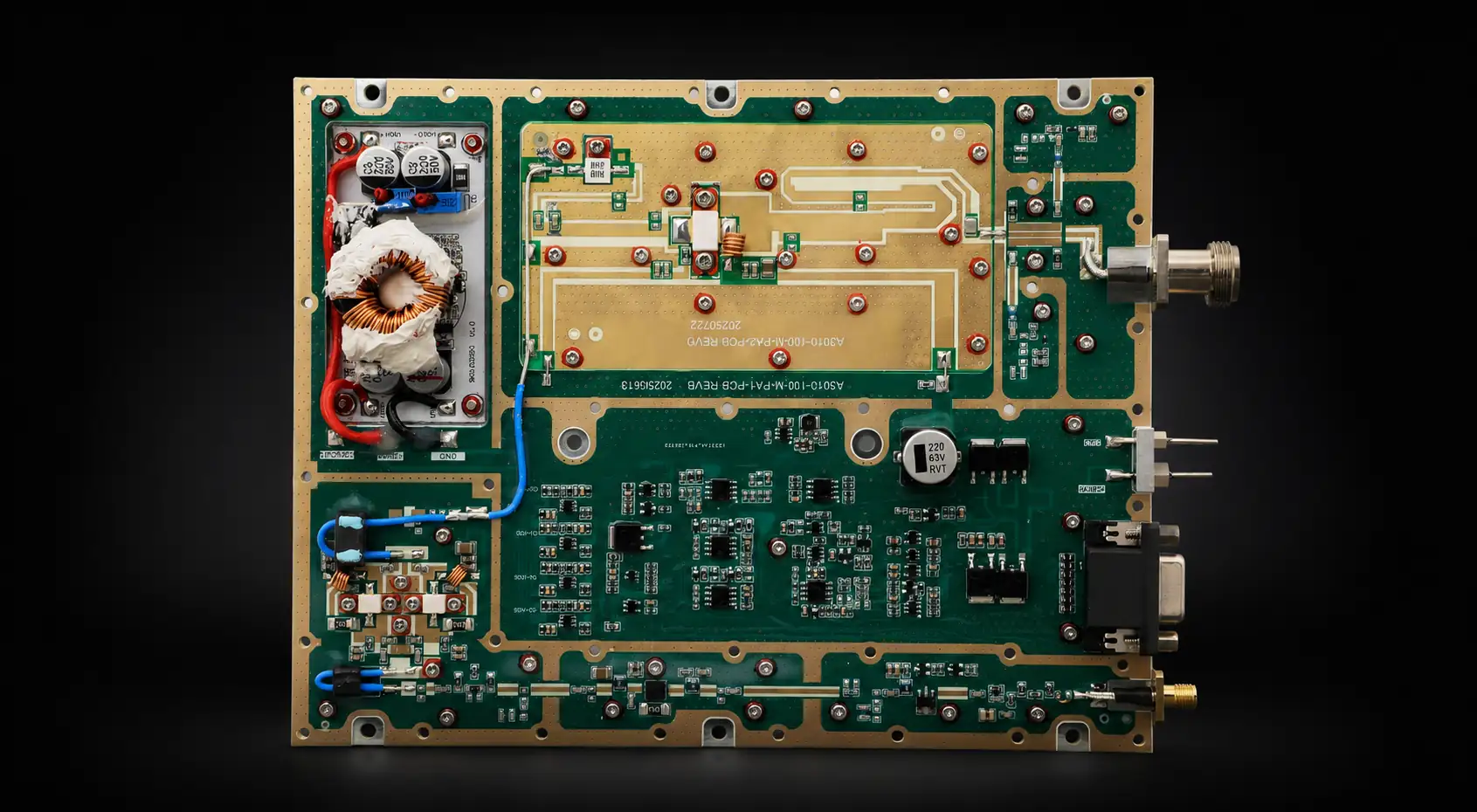
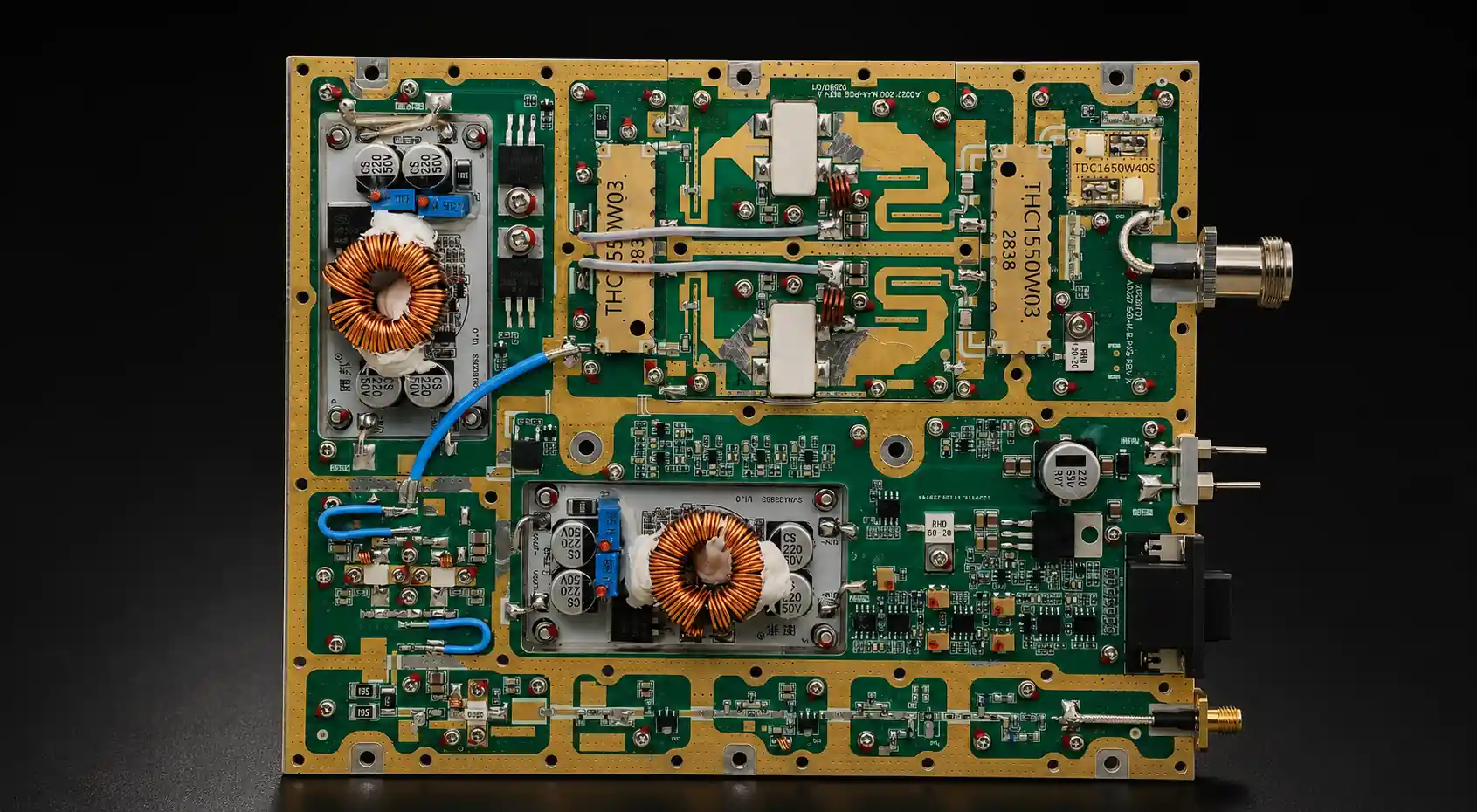
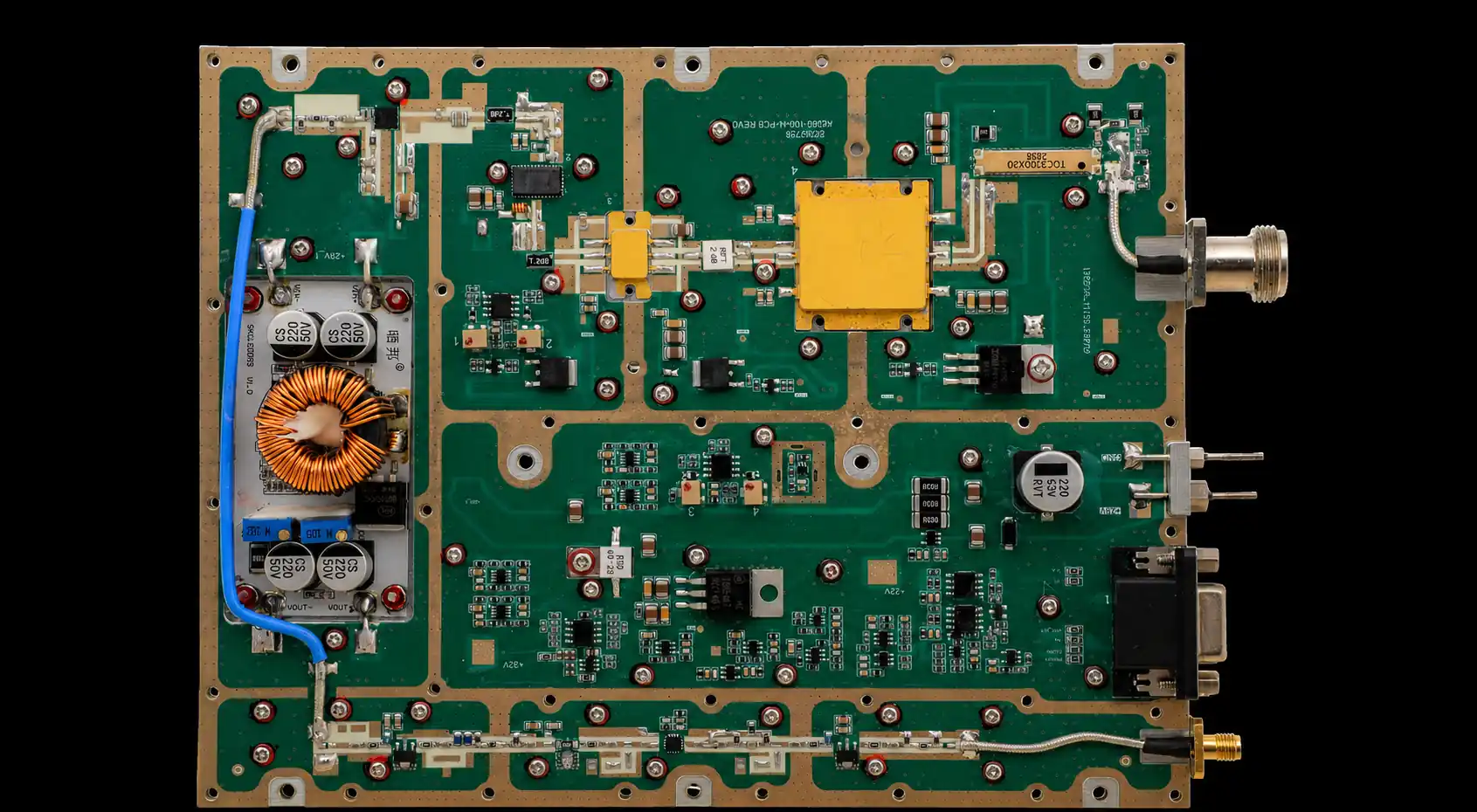
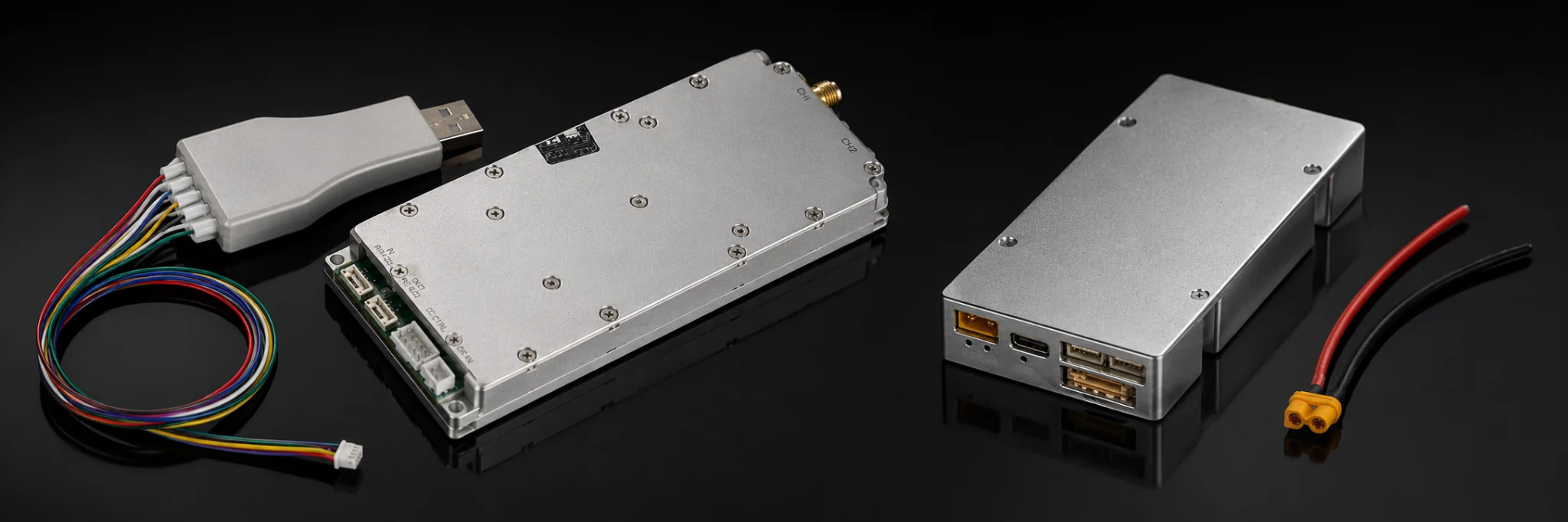



RF PA supplier stability becomes an acceptance risk when a later production batch keeps the same model number but changes an approved source, second-source condition, manufacturing origin, or critical material specification without controlled review.
A new supplier lot may also require additional evidence when its material state differs from the accepted baseline. However, a routine lot change from the same approved source should remain connected to incoming inspection and batch traceability rather than being treated automatically as a supplier change.
The relevant question is not whether every second source is unacceptable. It is whether a critical source change was identified before production, connected to the affected RF, thermal, supply, control, protection, or mechanical path, and supported by suitable validation evidence.
Four controls should remain separate:
- Supplier approval: Which manufacturers and material sources are allowed?
- Incoming inspection: What actually arrived, and can the received lot enter production?
- Process control: How will the approved material be assembled, contacted, cooled, routed, and tested?
- Final testing: Does each completed RF PA remain within its defined limits?
The supplier-change decision should connect five elements:
What changed → Which module path is affected → Required evidence → Affected lot and S/N → APPROVE, REVALIDATE, or HOLD
1. Why the Same Model Number Does Not Prove the Same Supply State
A model number identifies a product configuration. It does not prove that every critical material source, approved second source, manufacturing origin, or substitute condition remains the same as the accepted baseline.
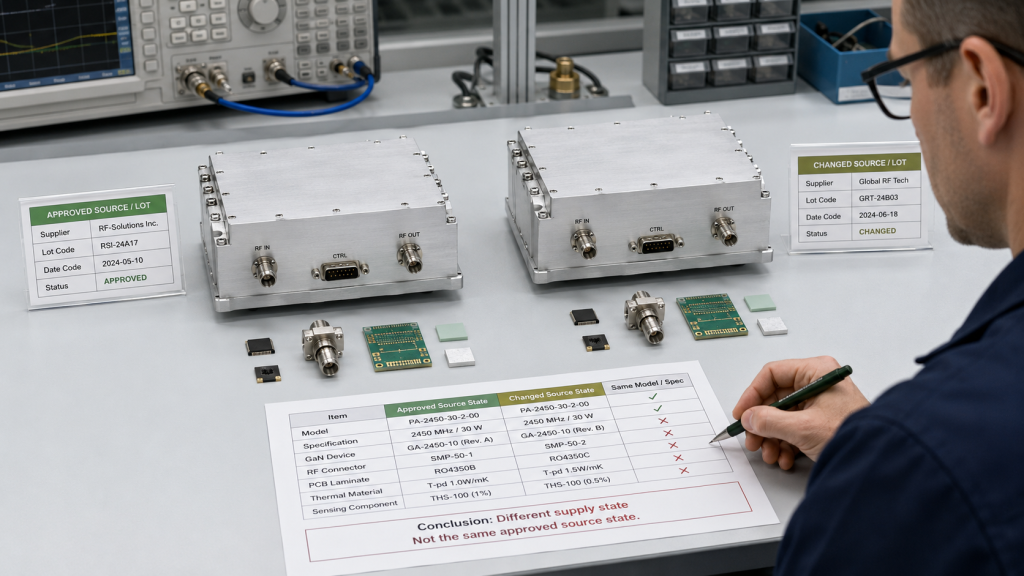
Two RF PA modules may carry the same:
- Model number
- Frequency range
- Rated output power
- Mechanical outline
- Connector type
- Control interface
- General BOM description
Yet they may not represent the same approved supply state.
The difference may involve a changed:
- GaN or LDMOS device source
- Matching or filtering component
- PCB material or fabrication source
- RF connector manufacturer or plating condition
- Thermal-interface material
- Power or GND contact
- Voltage-, current-, or temperature-sensing component
- Harness terminal or connector source
- Mechanical or shielding material
A generic BOM description may not reveal these differences.
For example, a BOM may identify an item only as an RF connector, thermal pad, sensing resistor, laminate, capacitor, or power transistor. That description does not prove that its manufacturer, material process, electrical behavior, or approved-source state remains unchanged.
Supplier Stability Does Not Mean One Supplier Forever
Supplier stability does not require one supplier to remain unchanged throughout the product life cycle.
It requires every approved source, second source, substitute material, and critical source change to enter production through a controlled approval process.
A validated second source can reduce delivery risk without weakening technical acceptance when:
- Its affected characteristics are identified.
- Its source status is approved before use.
- The required comparison evidence is completed.
- The applicable supplier and production lots are recorded.
- The finished units remain traceable to current test evidence.
The risk begins when purchasing substitution occurs without a defined technical review.
An uncontrolled source change can turn a supply decision into:
- RF performance variation
- Hot-state temperature variation
- Current or efficiency variation
- Protection or alarm differences
- Production delay
- Report revision
- Customer acceptance risk
Why Startup Alone Cannot Prove Equivalence
A changed module may start normally while differing from the accepted baseline under more demanding conditions.
Differences may appear during:
- Full-band RF testing
- Band-edge operation
- High RF output
- Continuous or high-duty operation
- Thermal stabilization
- Protection-threshold checks
- Repeated startup and shutdown
- Reflected-power conditions
- Customer retesting
A successful startup proves basic operation. It does not prove that the current supplier state remains equivalent to the approved production condition.
2. Which Supplier Changes Require Revalidation
Not every supplier or material change requires the same response.
The validation depth should follow the engineering path that may be affected.
Purchase price, component size, and visual similarity do not define technical risk. A low-cost sensing component, connector contact, matching component, or thermal material may affect acceptance more than a larger non-functional item.
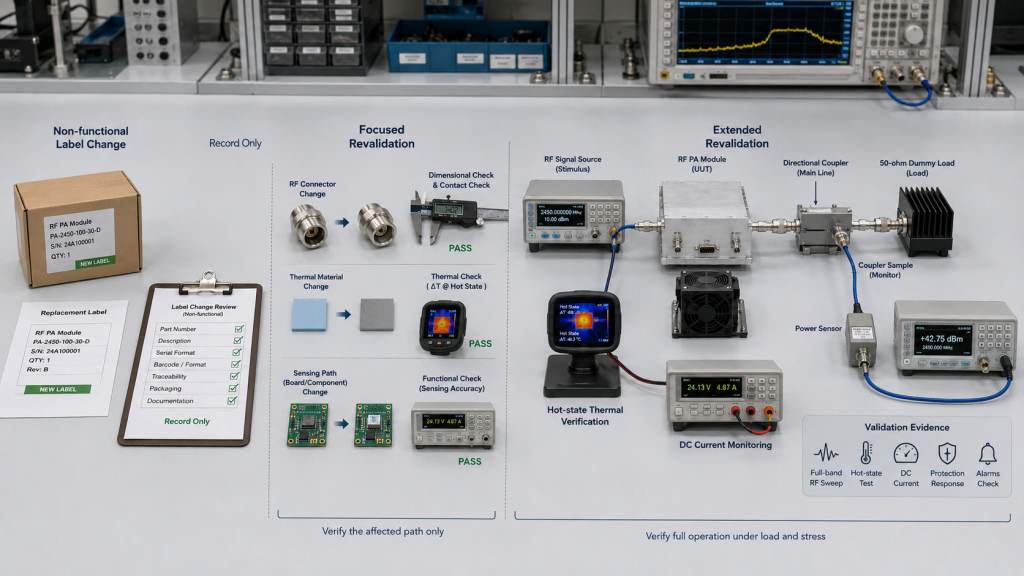
Record-Only Changes
A change may require documentation without product revalidation when it cannot affect:
- RF performance
- DC behavior
- Thermal transfer
- Mechanical fit
- Connector contact
- Control or protection behavior
- Manufacturing compatibility
- Storage or handling
- Test-data comparability
Examples may include approved changes to non-functional labels, packaging, or administrative identification.
Even record-only changes should remain documented. This prevents later investigations from confusing them with unreported technical changes.
Focused Revalidation
Focused revalidation is appropriate when the changed source can affect one defined engineering path.
Examples include changes to:
- Connector fit or contact
- Harness terminal retention
- Thermal contact
- Mechanical alignment
- Sensing accuracy
- Feedback behavior
- Coating compatibility
- Assembly compatibility
The validation may remain limited when the affected path is clear and the evidence directly addresses the possible failure mode.
Extended Revalidation
Extended revalidation is appropriate when the change may influence core RF PA behavior or make previous test data difficult to compare.
This may include changes involving:
- Final-stage RF devices
- Driver devices
- Matching networks
- Filter components
- PCB laminate or fabrication
- High-current supply components
- Major thermal-interface materials
- Protection-sensing paths
Possible effects include:
- RF output change
- Gain or gain-flatness change
- Band-edge variation
- Input or output matching variation
- Current change
- Efficiency change
- Temperature change
- Protection-response change
- Batch-repeatability change
A changed source does not automatically fail approval. It changes the evidence required before approval.
There Is No Universal Retest Package
There is no single retest package for every supplier change.
The validation scope should follow:
- The changed source or material
- The affected engineering path
- The possible failure mode
- The accepted comparison baseline
- The project acceptance requirement
The purpose is not to repeat every factory test after every purchasing adjustment.
The purpose is to make the validation scope proportional to the possible effect.
3. How Locked BOM, Approved Sources, and Golden Sample Work Together
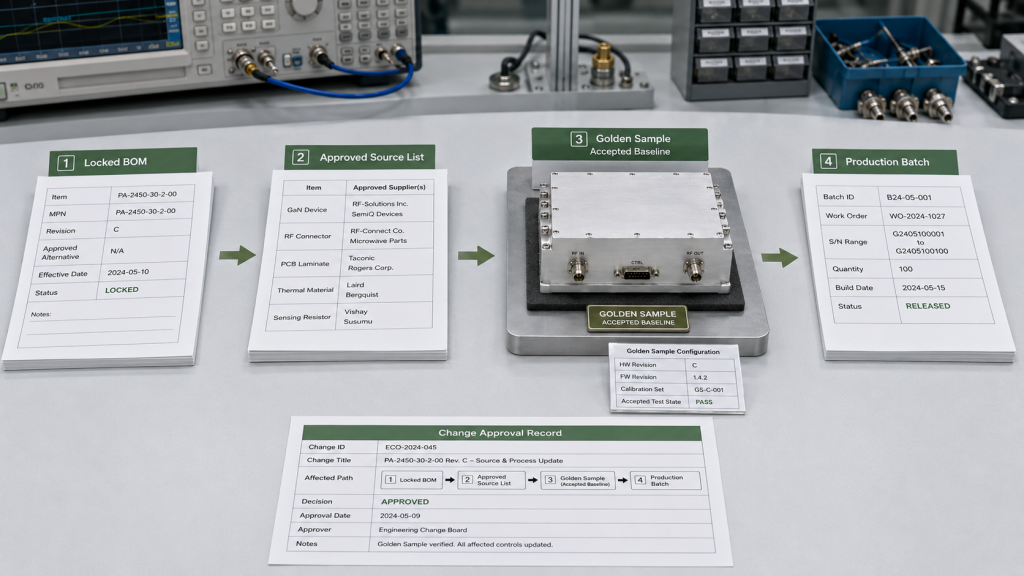
A Locked BOM, an Approved Source List, and a Golden Sample are related controls, but they answer different questions.
Locked BOM
A Locked BOM defines which components and materials are allowed in the approved design.
Depending on the risk, it may record:
- Part description
- Manufacturer
- Manufacturer part number
- Approved alternative
- Material specification
- Revision
- Critical characteristics
- Change-control status
A Locked BOM that contains only broad generic descriptions may not be sufficient when source-dependent characteristics can affect the completed module.
Approved Source List
The Approved Source List identifies which manufacturers, suppliers, fabrication sources, or second sources may provide a controlled item.
It should distinguish between:
- Fully approved sources
- Conditionally approved sources
- Sources pending validation
- Disallowed or obsolete sources
The Approved Source List does not replace incoming inspection. It defines the allowed source state against which the delivered lot should be checked.
The factory should still use RF PA incoming inspection to confirm what arrived before releasing the lot into production.
Golden Sample
The Golden Sample represents an accepted combined production state.
That state may include:
- Approved material sources
- BOM revision
- PCB revision
- Assembly process
- Thermal interface
- Mechanical configuration
- Firmware or control version
- Test method
- Accepted RF, DC, and thermal behavior
The Golden Sample is therefore more than one physical unit stored for comparison. It should remain connected to the documented configuration that made the sample acceptable.
A later batch should not be called equivalent to the Golden Sample only because:
- The model number is unchanged.
- The housing looks the same.
- The nominal frequency and output remain the same.
- One output reading is similar.
- The module starts normally.
The comparison should address the characteristics that could change.
Change Approval
Change approval connects the previous controls.
It asks:
- What changed?
- Was the source already approved?
- Which module path may be affected?
- Does the Golden Sample cover the new condition?
- Which evidence must be repeated?
- Which lots and S/N units used the changed source?
- Which report revision applies?
When the material source remains approved but assembly, routing, grounding, thermal, or test conditions change, the issue moves into RF PA process-change control.
Supplier approval and process approval should not be combined into vague claims such as “same BOM” or “same quality.”
4. What Evidence Should Approve, Revalidate, or Hold a Supplier Change
A supplier-change review should produce a documented decision rather than a general statement that the substitute is equivalent.
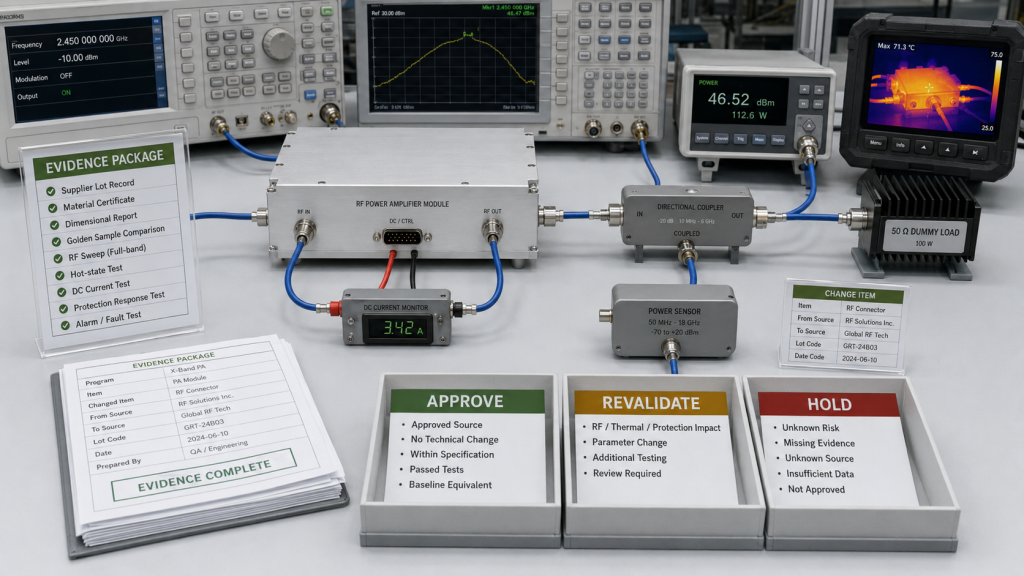
APPROVE
Use APPROVE when:
- The source is already approved.
- The delivered condition remains within the accepted source state.
- No controlled characteristic changed.
- No affected engineering path requires additional validation.
- Lot and production records remain complete.
The record should still identify what was reviewed and why revalidation was unnecessary.
REVALIDATE
Use REVALIDATE when:
- A new source or second source is introduced.
- Manufacturing origin changes.
- A critical material specification changes.
- A material process changes.
- The substitute may affect RF, thermal, supply, control, protection, fit, or test-data comparability.
- Existing Golden Sample evidence does not cover the new condition.
REVALIDATE does not mean automatic rejection. It means the changed condition requires technical evidence before batch approval.
HOLD
Use HOLD when:
- The source is not approved.
- Material identity is unclear.
- The affected characteristics are unknown.
- Comparison evidence is incomplete.
- The supplier lot cannot be linked to the affected production batch.
- The changed condition cannot be linked to module S/N.
- The applicable report version is uncertain.
- Validation results do not meet their acceptance limits.
A HOLD decision prevents an unresolved source condition from becoming a finished-batch or customer-acceptance problem.
Evidence Should Match the Possible Effect
A connector-source change may require:
- Approved-source confirmation
- Identity and dimensional review
- Contact or retention evidence
- Mating verification
- Applicable RF-path comparison
- Post-stress inspection
A sensing-component change may require:
- Feedback comparison
- Alarm-threshold verification
- Protection-response testing
- Temperature or voltage measurement comparison
A thermal-material change may require:
- Material identity
- Hot-state RF output
- DC current
- Case temperature
- Protection-state comparison
A final-stage device change may require:
- Full-band RF output
- Gain or gain flatness
- Band-edge behavior
- DC current
- Hot-state temperature
- Protection response
RF PA Supplier Change Approval Matrix
| Supplier or Material Change | Possible Module Impact | Required Evidence | Decision |
|---|---|---|---|
| Packaging or non-functional label | No RF, thermal, control, fit, or test impact | Change record and identity review | APPROVE |
| RF connector source | Fit, contact, loss, reflection, or mechanical consistency | Approved-source status, dimensional or contact evidence, and applicable RF-path comparison | APPROVE if already validated and unchanged; otherwise REVALIDATE |
| Thermal-interface source | Hot-state temperature, output, current, or protection behavior | Material identity and hot-state comparison against the accepted baseline | REVALIDATE |
| GaN, LDMOS, matching, filter, or PCB source | Output, gain, efficiency, band response, current, or temperature | Source and lot evidence, applicable sample build, RF or hot-state comparison, and traceability | REVALIDATE |
| Sensing or feedback component source | Alarm, protection threshold, or status behavior | Functional threshold, feedback, and protection comparison | REVALIDATE |
| Unapproved or unclear source | Unknown effect and incomplete evidence chain | Engineering review and complete source validation | HOLD |
Useful evidence may include:
- Supplier and manufacturer identity
- Manufacturer part number
- Material specification
- Supplier lot
- Source documentation
- Incoming inspection result
- Golden Sample comparison
- Dimensional or mechanical result
- RF sweep result
- Hot-state output
- DC current
- Temperature
- Alarm and protection response
- Burn-in or stress result
- Production-batch record
- Module S/N
- Applicable report revision
- Approval authority
Not every change requires every evidence item. The evidence package should remain focused enough to be practical and complete enough to support the decision.
The completed module result should use version-controlled RF PA test records that identify the applicable hardware state, test method, production batch, and tested S/N.
5. How Supplier Changes Must Stay Linked to Lot, Batch, and S/N
Supplier-change control is incomplete when the factory knows that a source changed but cannot identify which finished units used the changed condition.
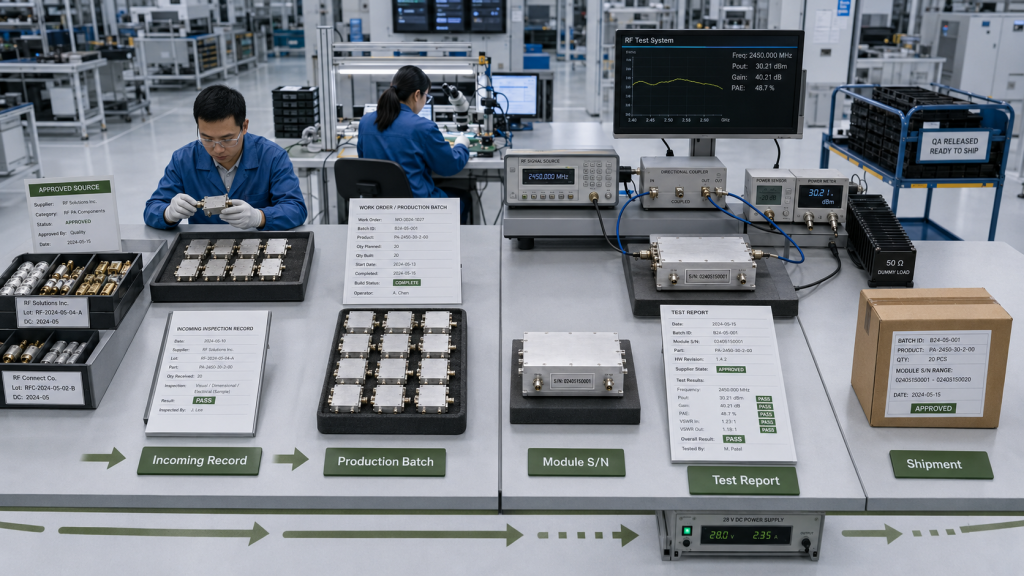
The traceability path should remain:
Approved source → Supplier lot → Incoming record → Production batch → Module S/N → Current test and shipment evidence
Supplier Lot
The supplier-lot record may include:
- Manufacturer
- Supplier
- Part number
- Lot code
- Date code
- Quantity
- Receipt date
- Incoming status
- Approved-source status
A routine lot change from the same approved source should not automatically be treated as a source change. However, it should remain traceable so that material variation can be investigated when test results differ.
Production Batch
The production record should identify where the received lot entered assembly.
It may include:
- Production batch
- Work order
- Applicable BOM revision
- Material lot used
- Process or rework status
- Date of use
- Affected quantity
This prevents the supplier-lot record from remaining isolated in purchasing or warehouse documentation.
Module S/N
The final evidence should identify which serial-numbered units used the controlled supplier lot.
This becomes important when:
- A customer compares two deliveries.
- A later failure investigation begins.
- A supplier announces a material issue.
- A second source performs differently.
- A focused retest is required.
- A report revision becomes necessary.
Without lot-to-S/N traceability, an entire shipment may have to be treated as affected even when only one production batch used the changed source.
Current Test and Shipment Evidence
The final test report does not need to list every critical supplier directly.
It should be traceably linked, through the manufacturing and batch records, to the supplier and material state used in each delivered S/N.
The buyer should not receive:
- Data from an earlier material state presented as current batch evidence
- Golden Sample data presented as shipment data
- Results from an unaffected sample
- A report without traceable batch or S/N identity
- A report version that cannot be connected to the delivered units
Final approval should connect supplier-change records with S/N-linked shipment acceptance evidence.
Repeat Orders Need the Same Control
A previous shipment may have been acceptable while a repeat order uses a different:
- Approved device lot
- Connector source
- Thermal material
- PCB source
- Sensing component
- Manufacturing origin
- Approved second source
The model number alone does not prove continuity with the earlier delivery.
Before approving a repeat order, the supplier should identify:
- Whether critical sources changed
- Which approved alternatives were used
- Which evidence was repeated
- Which production lots and S/N units were affected
- Which test-record revision applies
RFQ: What Buyers Should Ask Before Batch or Repeat-Order Approval
Buyers do not need the identity of every supplier used for every non-critical factory item.
They do need clear control over source-critical materials.
A practical RFQ should ask:
- Which components and materials are classified as supplier-critical?
- Does the Locked BOM include approved-source or supplier-state control?
- Which second sources have already been validated?
- What source or material changes trigger focused or extended revalidation?
- Can each changed supplier lot be linked to the affected production batch and module S/N?
- Can the Golden Sample configuration record, burn-in record, and current test report be traced to the same approved supplier and material state?
The RFQ should also define:
- Frequency range
- Target RF output
- Critical-material list
- Approved-source requirements
- Second-source policy
- Change-notification requirement
- Golden Sample boundary
- Required validation scope
- Lot-to-S/N traceability
- Repeat-order control
- Required shipment evidence
A useful supplier answer should explain:
- Which items are source-critical
- How approved sources are recorded
- How substitutions are reviewed
- What triggers revalidation
- Which evidence follows each risk
- How the changed lot is traced
- How the final test record matches the delivered units
Statements such as “same BOM,” “same model,” or “tested before shipment” are not sufficient when the underlying supplier state cannot be verified.
Conclusion
RF PA supplier stability should not be judged only by whether the supplier can continue delivering the same model number.
The stronger approval question is whether the current source state still matches the accepted technical baseline.
A controlled review should connect:
Supplier change → Affected engineering path → Validation evidence → Supplier lot → Production batch → Module S/N → Current shipment record
An approved second source can strengthen delivery continuity. An uncontrolled substitute can turn a purchasing decision into an RF, thermal, protection, traceability, and customer-acceptance problem.
The final decision should remain clear:
- APPROVE when the source remains within the accepted state.
- REVALIDATE when the change may affect a defined engineering path.
- HOLD when the source or evidence remains unresolved.
For projects requiring custom RF power amplifier modules, RF SKYPOWER can align approved-source control, Locked BOM status, Golden Sample comparison, supplier-change validation, lot traceability, and current S/N-linked test evidence.
Submit the frequency range, target output, critical-material list, approved-source requirements, second-source policy, change triggers, Golden Sample boundary, revalidation scope, lot-to-S/N traceability, repeat-order plan, and shipment-evidence requirements through our engineering RFQ.