
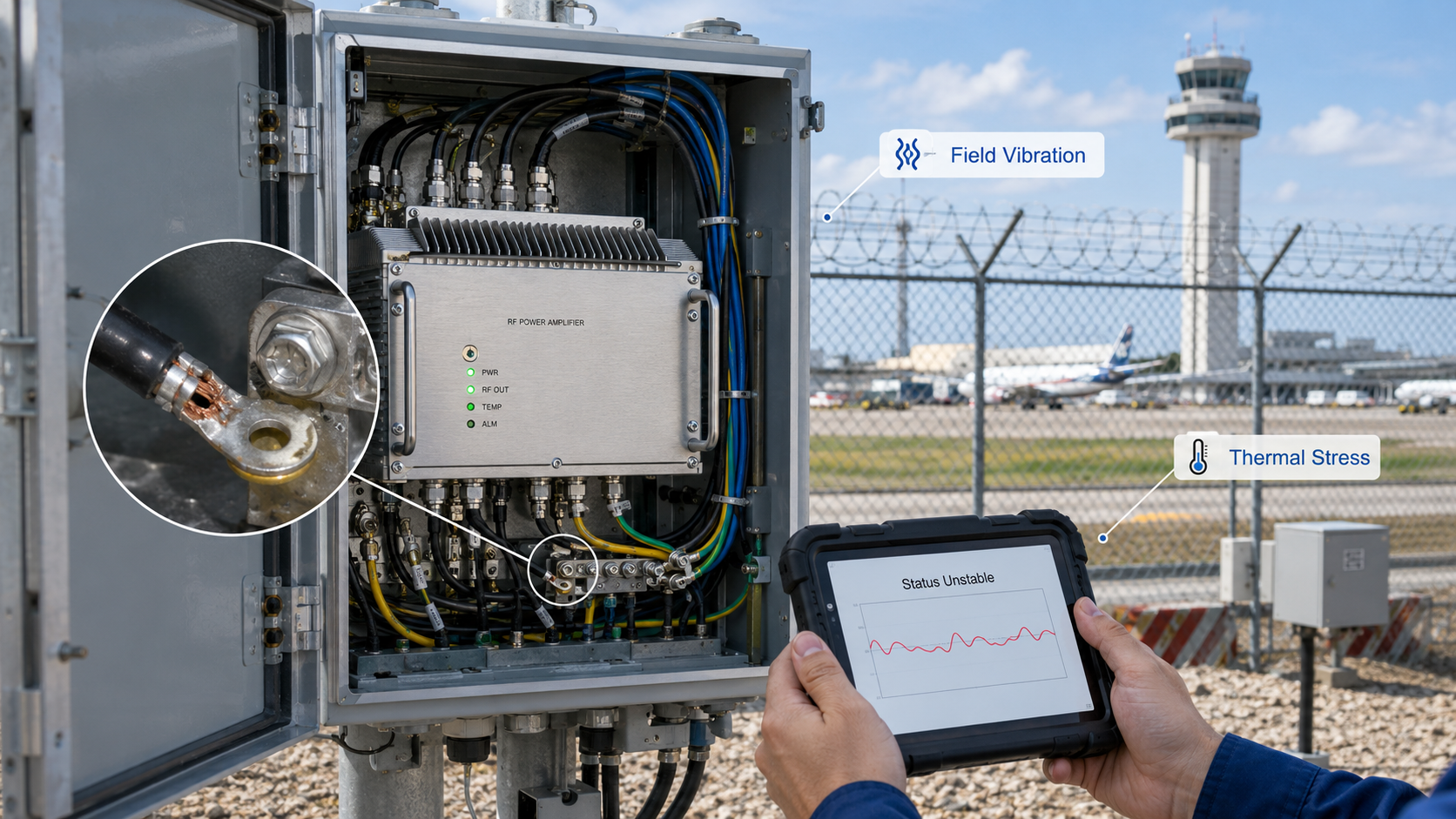
RF PA harness crimping can pass visual inspection and continuity testing while still becoming unstable under current, heat, vibration, cable movement, or repeated handling. The risk is not limited to a completely open wire. A marginal terminal connection can create module-input voltage drop, local heating, intermittent enable response, alarm jumps, unstable status feedback, or communication loss.
This article covers low-voltage power and control wire harnesses used for 28 V DC supply, GND return, enable, alarm, protection status, voltage or temperature feedback, communication, fan control, and other auxiliary functions. It does not cover crimped coaxial RF connectors, PCB interface solder joints, or complete DC cable sizing.
The acceptance decision should connect four elements:
Harness function → Crimp and strain-relief condition → Electrical and mechanical evidence → PASS, RETEST, or REWORK
1. What This RF PA Harness Crimping Check Covers
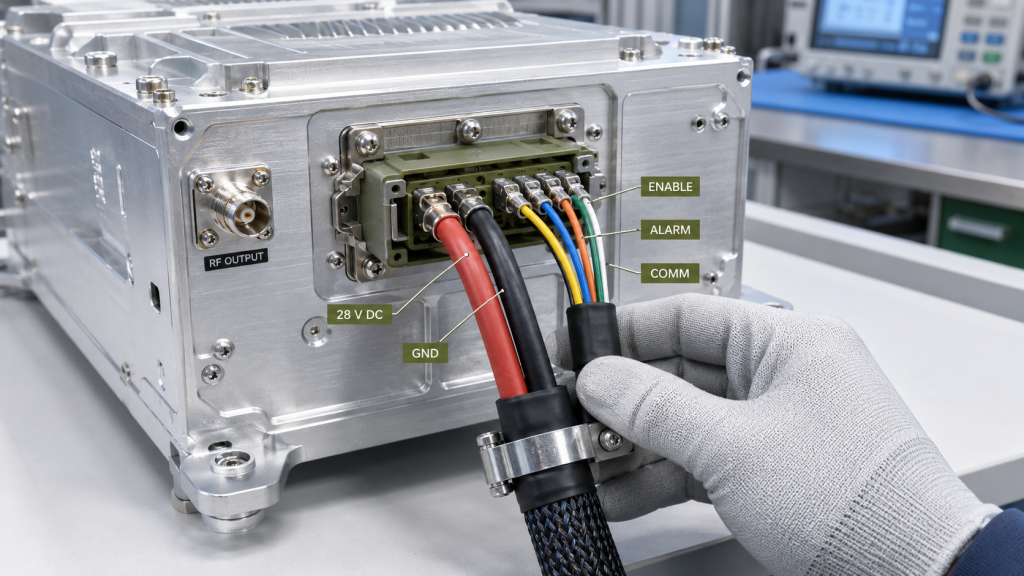
An RF PA harness may include several circuits with different current levels and failure consequences.
Typical paths include:
- 28 V DC supply
- GND return
- Enable or shutdown control
- Alarm output
- Temperature status
- Voltage or current feedback
- Reflected-power or protection status
- Communication lines
- Fan control
- Auxiliary control signals
These wire harnesses should not be evaluated in the same way as coaxial RF cable assemblies.
A coaxial RF connector must preserve a stable 50 Ω transmission path across frequency and power. Its verification may involve return loss, VSWR, insertion loss, forward and reflected power, and RF heating.
A power or control harness terminal must preserve:
- Low-resistance electrical contact
- Mechanical retention
- Correct terminal position
- Connector locking
- Signal continuity
- Strain control
- Stable behavior under the required operating condition
Detailed coaxial RF connector crimping therefore requires a separate acceptance method.
PCB-mounted connector pins and interface joints also need a separate soldering review. A reliable wire-to-terminal crimp does not prove that the connector-to-PCB joint is acceptable, and a good PCB joint does not prove that the attached harness is mechanically secure.
Why Continuity Is Not Enough
A continuity test confirms that an electrical path exists at the moment of measurement. It does not prove that the connection will remain stable when:
- High current flows through the terminal
- The connector becomes warm
- The cable is moved
- The module experiences vibration
- The harness is routed under tension
- The connector is disconnected and reconnected
- The cabinet completes a thermal cycle
A few conductor strands may maintain continuity while producing excessive resistance under load. A terminal may also remain electrically connected while its mechanical retention or insulation support is already inadequate.
The acceptance method must therefore match the harness function and the failure risk.
2. Which Power and Control Paths Need Strict Verification
Inspection depth should follow the role of each harness path.
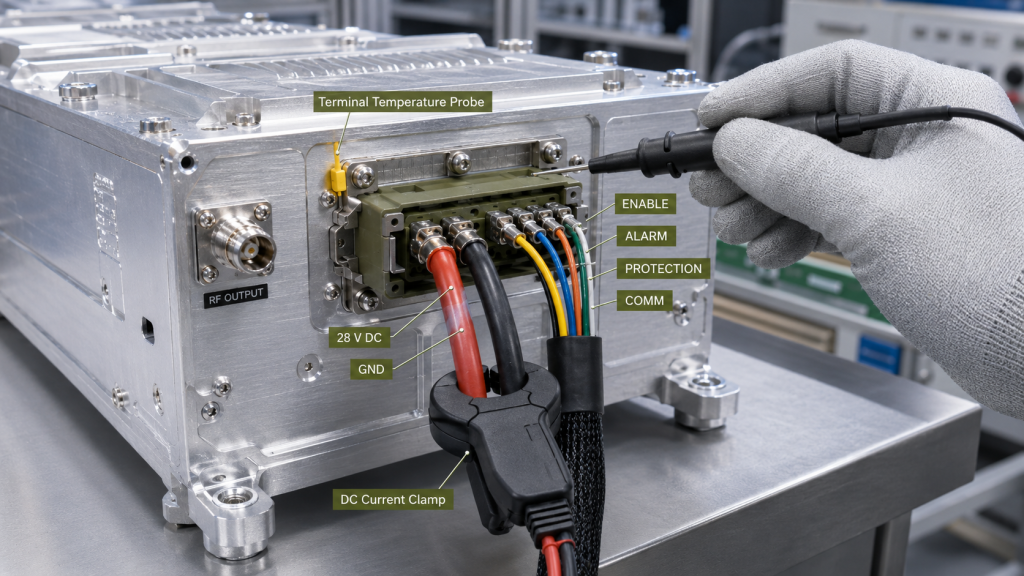
Lower-Risk Paths
A lower-risk path does not control module operation, carry significant current, or influence an acceptance decision.
Examples may include:
- Temporary laboratory indicators
- Non-critical auxiliary wiring
- Service connections that remain disconnected during deployment
- Wiring that cannot affect RF output, protection, cooling, or system control
A visual inspection and continuity check may be sufficient when the approved design and inspection plan classify the path as low risk.
Controlled-Risk Paths
Controlled-risk paths may not carry the main DC current, but their failure can affect system operation.
Examples include:
- Fan control
- Auxiliary control lines
- Communication lines
- Service interfaces
- Non-critical feedback signals
These paths may require:
- Pin and signal identification
- Connector-lock inspection
- Functional verification
- Controlled movement checks
- Post-stress continuity or communication checks
Critical Paths
Critical paths can change RF PA startup, output, shutdown, protection, or fault interpretation.
They commonly include:
- 28 V supply
- GND return
- Enable input
- Shutdown input
- Alarm output
- Protection feedback
- Current or voltage feedback
- Temperature status
- Communication used for operating control
A weak 28 V or GND crimp can create module-input voltage loss and local heating. A weak enable or control terminal can create delayed or intermittent startup. A weak alarm or status connection can cause the system controller to report the wrong module condition.
The verification method should therefore differ by path.
Power and GND Harnesses
For power and return paths, the most useful evidence may include:
- Approved wire and terminal combination
- Conductor capture
- Mechanical retention
- Module-input voltage under load
- Voltage drop across the connection or harness
- Local terminal temperature where required
- Stability before and after stress
The terminal result should not be confused with the total DC cable result. Wire gauge, cable length, connector count, and return-path resistance can also affect voltage at the module input.
A separate review of RF PA voltage drop through the complete DC path is appropriate when the issue includes cable sizing, total loop length, or power-source distance.
Control and Status Harnesses
For enable, alarm, feedback, and communication paths, verification should focus on:
- Correct pin assignment
- Terminal position
- Connector locking
- Repeatable command response
- Stable alarm and status reporting
- Communication continuity
- Movement-sensitive intermittency
- Post-stress function
The physical harness test should not replace verification of the signal definition. The meaning, timing, and expected system response of these lines should remain consistent with the approved RF PA control-interface behavior.
3. What the Crimp and Strain-Relief System Must Control
A reliable harness is not proven by the conductor crimp alone.
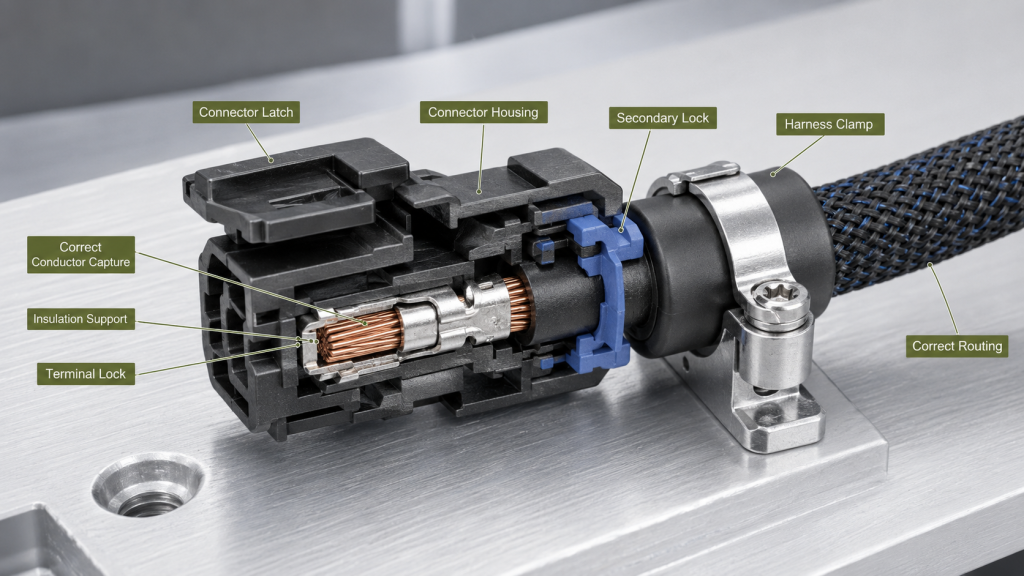
The complete connection system includes:
- Terminal-to-wire compatibility
- Conductor crimp
- Insulation support
- Terminal position
- Terminal lock
- Connector housing
- Secondary lock, where used
- Harness clamp
- Bend and routing condition
- Mechanical clearance after final assembly
Terminal, Wire, and Tool Compatibility
The terminal, conductor size, insulation diameter, crimp tool, die, and process setup should belong to an approved combination.
A visually neat crimp can still be unacceptable when:
- The conductor is too small for the terminal
- The conductor is too large for the crimp barrel
- The insulation diameter is incompatible
- The wrong tool or die is used
- The terminal is damaged during crimping
- The conductor is not inserted to the correct position
- The approved material or plating condition has changed
Crimp height, pull-force, retention, and resistance limits should come from the approved terminal, wire, tooling, and process specification. One universal numerical limit should not be applied across different harness designs.
Conductor Crimp
The conductor crimp should provide stable electrical contact without damaging the conductor.
The review should check for:
- Correct conductor insertion
- Complete conductor capture
- No visible strand escape
- No severe strand cutting
- No excessive conductor exposure
- No insulation inside the conductor-contact area
- No terminal cracking or deformation
The visual result alone does not prove electrical performance, but it can identify defects that should prevent further acceptance testing.
Insulation Support
The insulation-support area helps control cable movement near the conductor crimp.
Its purpose is not to carry the electrical current. It reduces the mechanical load transferred to the conductor strands when the cable bends, moves, or vibrates.
An inadequate insulation support can allow movement to concentrate at the conductor exit. Excessive compression can damage the insulation or prevent correct terminal fit.
Terminal Lock and Connector Housing
A correct crimp can still fail in service when the terminal is not fully seated or locked inside the housing.
The inspection should confirm:
- Correct cavity
- Correct terminal orientation
- Full insertion
- Primary lock engagement
- Secondary lock engagement, where applicable
- No terminal push-back
- No housing damage
- Correct connector mating
- Correct latch engagement
Harness Routing and Final Assembly
An acceptable crimp can become unreliable when later assembly leaves the harness under tension, concentrates vibration near the terminal, forces an immediate bend at the connector exit, or prevents the connector lock from seating correctly.
Final acceptance should therefore inspect the harness after module closure and routing, not only at the crimping station.
The review should check:
- Harness length
- Clamp position
- Bend location
- Connector-exit clearance
- Contact with sharp edges
- Cable tension
- Movement near the terminal
- Clearance from hot surfaces
- Accessibility for installation and service
4. How to Verify Electrical Contact and Mechanical Retention
Harness verification should combine identity, visual, mechanical, electrical, and functional evidence.
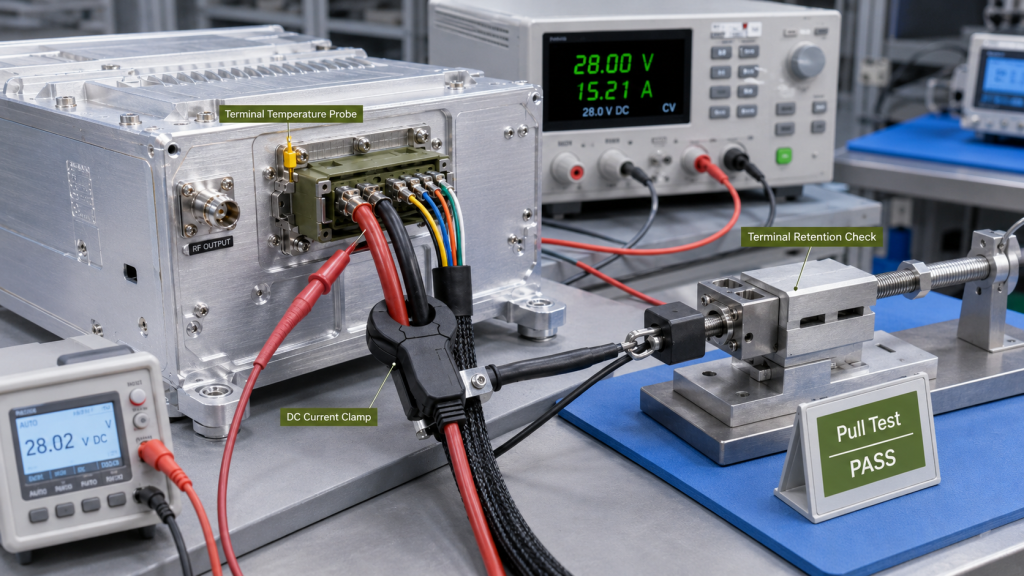
A practical sequence is:
- Confirm the harness ID, wire type, terminal model, connector, and approved tool or die.
- Inspect conductor capture, insulation support, terminal position, connector locking, and visible strand damage.
- Verify mechanical retention using the applicable approved method.
- For power and GND paths, measure module-input voltage or terminal voltage drop under the required current condition.
- Check local terminal temperature after the defined operating time when current risk justifies it.
- For enable, alarm, feedback, and communication paths, verify the actual signal function.
- Repeat the applicable electrical and functional checks after the required stress condition.
Visual and Identity Check
The record should confirm:
- Harness ID
- Drawing or revision
- Wire type and gauge
- Terminal model
- Connector model
- Pin assignment
- Tooling or process reference
- Production batch
- Inspection status
This prevents a good-looking harness from being accepted against the wrong drawing or terminal specification.
Mechanical Retention Check
Mechanical retention should confirm that the conductor, terminal, and housing remain secure under the applicable approved method.
The method may involve:
- Controlled pull verification
- Terminal-retention check
- Connector-lock check
- Sample-based destructive testing
- Fixture-based movement testing
- Inspection after routing and clamping
The required method depends on the terminal family, wire gauge, production process, and project risk.
Do not pull, sharply bend, disconnect, or apply uncontrolled movement to a live high-current harness. Mechanical stress checks should use an approved fixture or procedure, with the electrical condition selected for the project risk.
Electrical Check for Power and GND
A power harness should be evaluated under a condition relevant to its required current.
Useful evidence may include:
- Power-source voltage
- Module-input voltage
- Harness or terminal voltage drop
- Module current
- Operating duration
- Terminal or connector temperature
- Stability during the required operating period
A stable module-input voltage is more useful than confirming supply voltage only at the power source.
Unexpected voltage loss can come from:
- Weak conductor contact
- Loose terminal retention
- Damaged strands
- Connector contamination
- Inadequate wire size
- Excessive cable length
- Weak GND return
- Additional connectors or joints
The harness check should isolate the terminal and connection condition before assigning the complete loss to the cable or power supply.
Functional Check for Control and Status
For enable, alarm, feedback, and communication lines, verify the actual system function rather than continuity alone.
The test may confirm:
- Repeatable enable and shutdown
- Correct alarm activation
- Stable voltage or temperature feedback
- Correct protection-status reporting
- Communication stability
- Recovery after reconnection
- No response change during controlled cable movement
The expected signal state and acceptance boundary should be defined before testing.
RF PA Harness Crimp Verification Matrix
| Harness Path | Hidden Failure Risk | Required Evidence | PASS Condition | RETEST or REWORK Trigger |
|---|---|---|---|---|
| 28 V supply | Contact resistance, voltage drop, local heating | Approved terminal-wire combination, retention, module-input voltage, temperature where required | Voltage and temperature remain within the approved boundary | Unexpected drop, heating, loose retention, or unstable result |
| GND return | Reference shift, voltage loss, false status behavior | Ground-path inspection, retention, voltage-drop or functional evidence | Stable return path under the required load | Unstable reference, heating, movement sensitivity, or failed retention |
| Enable and control | Intermittent startup or shutdown | Pin identity, connector lock, functional test, controlled movement check | Repeatable command response before and after stress | Missed, delayed, or movement-sensitive response |
| Alarm and status feedback | False alarm, missing status, unstable diagnostics | Signal mapping, functional-state test, post-stress comparison | Feedback matches the defined module state | Jumping, missing, delayed, or inconsistent feedback |
| Communication and auxiliary lines | Communication loss or fan/control interruption | Connector lock, functional communication check, routing review | Stable operation under the required condition | Dropout, intermittent response, routing stress, or lock failure |
5. What to Retest After Heat, Vibration, or Handling
A harness should not pass only because it worked before vibration, thermal cycling, reconnection, or final cabinet routing.
The required stress condition should follow the project, such as:
- Cabinet vibration
- Vehicle movement
- Thermal cycling
- Repeated connector handling
- Module installation
- Harness rerouting
- Shipment-related mechanical stress
- Extended operation under current
After the required stress condition, repeat the same applicable checks used before stress.

Depending on the harness function, compare:
- Module-input voltage
- Voltage drop
- Module current
- Terminal temperature
- Enable response
- Alarm state
- Feedback values
- Communication behavior
- Connector retention
- Movement-sensitive symptoms
The before-and-after comparison should use equivalent:
- DC supply condition
- Module operating state
- Current level
- Test duration
- Measurement point
- Signal command
- Cooling condition
If the setup changes at the same time as the stress condition, the resulting difference may not be attributable to the harness.
When Retesting Is Required
Retesting is appropriate when:
- A measurement result is inconsistent.
- The test setup requires confirmation.
- One sample behaves differently from the rest.
- A connector was disconnected and reconnected.
- The harness routing or clamp position changed.
- The module was opened and reassembled.
- A signal problem appeared only during movement.
- A voltage or temperature result approached its acceptance boundary.
When Rework Is Required
Rework or replacement is required when:
- The conductor is not correctly captured.
- Strands are damaged or outside the crimp.
- The terminal does not meet the approved mechanical condition.
- The terminal can move or push back in the housing.
- The connector lock does not engage.
- The harness remains under excessive tension.
- The bend or clamp position transfers stress to the terminal.
- Voltage drop or heating is outside the approved boundary.
- A control or status signal remains intermittent.
- Post-stress behavior cannot reproduce the approved result.
After rework, the affected visual, mechanical, electrical, functional, and post-stress checks should be repeated. The original pre-rework result should not be reused as acceptance evidence.
6. What Evidence Supports Harness Acceptance
A useful harness acceptance record should allow another engineer to identify the harness, understand the test boundary, and connect the result to the completed RF PA module.
The record should include:
- Harness ID
- Harness revision
- Wire type and gauge
- Terminal model
- Connector model
- Approved tool or process reference
- Pin and signal definition
- Production batch
- Module S/N
- Visual inspection result
- Retention or pull-test result, where applicable
- DC voltage and current condition
- Module-input voltage
- Voltage-drop result, where applicable
- Terminal temperature, where required
- Enable, alarm, feedback, or communication result
- Stress condition
- Before-and-after comparison
- Rework history
- Final acceptance decision
- Inspector or test-station identification
- Test date
Photos may be useful when they show:
- Conductor insertion
- Insulation support
- Terminal position
- Connector lock
- Clamp position
- Bend location
- Final harness routing
A photo alone should not replace electrical, mechanical, or functional evidence.
The harness review should lead to one of three decisions:
- PASS: The wire-terminal combination, crimp condition, retention, strain relief, voltage or signal behavior, and applicable post-stress result meet the approved boundary.
- RETEST: One measurement, sample, stress condition, or comparison must be repeated before acceptance.
- REWORK: The terminal, crimp, lock, routing, strain relief, or electrical result does not meet the approved condition, and the affected harness must be repaired or replaced before retesting.
The final harness evidence should remain connected to the module identity and the S/N-linked shipment acceptance evidence used for final shipment review.
RFQ: What Buyers Should Define for Harness Crimping
General statements such as “all harnesses are continuity tested” do not define a sufficient acceptance boundary.
Buyers and system integrators should ask:
- Which harness paths carry power, GND, enable, alarm, feedback, or communication?
- Which terminal, wire, connector, tool, and die combination is approved?
- Which crimp, retention, and strain-relief criteria apply?
- How are module-input voltage, voltage drop, local temperature, and control-signal stability verified?
- Which vibration, thermal, handling, or reconnection conditions require post-stress retesting?
- Can the harness ID, test result, rework history, production batch, and module S/N be traced together?
The RFQ should also define:
- Required 28 V operating current
- Wire gauge and length
- Connector and terminal models
- Harness functions
- Pin and signal mapping
- Routing and clamp condition
- Environmental or vibration requirement
- Inspection and sampling method
- Rework and retest process
- Required shipment evidence
A useful supplier answer should identify the approved harness design, verification method, acceptance limits, post-stress retest, traceability boundary, and rework control.
A weak answer relies only on appearance and continuity.
Conclusion
RF PA harness crimping should not be accepted only because the terminal looks correct and continuity is present.
Power and GND paths must preserve voltage and current delivery without excessive loss or heating. Enable, alarm, feedback, and communication paths must remain stable under the required operating and mechanical conditions. The conductor crimp, insulation support, terminal lock, connector housing, clamp, and routing should work as one complete connection system.
The acceptance path should remain clear:
Define the harness function → Verify the crimp and strain-relief system → Check electrical and mechanical behavior → Repeat after the required stress → Decide PASS, RETEST, or REWORK
For projects requiring custom RF power amplifier modules, RF SKYPOWER can align power and control harness acceptance with the required current, connector interface, control signals, mechanical stress, and S/N-linked shipment evidence.
Submit the 28 V supply current, wire gauge, terminal and connector models, harness functions, control and feedback signals, routing condition, vibration or thermal requirements, crimp acceptance method, post-stress retest scope, and traceability requirements through our engineering RFQ.