
RF module AT command consistency matters because a C-UAS controller depends on a stable command contract. That contract covers syntax, parameters, responses, and status meanings. A module accepting one command does not prove full compatibility. Judge compatibility only after recording module identity, firmware, command-set revision, controller software, and the command subset in use.
A later module or firmware revision can create integration risk. Syntax, units, response structure, errors, asynchronous reports, or status meanings may change. Meanwhile, the controller may still apply an earlier definition. A version change does not prove incompatibility, and a shared command name does not prove compatibility.
The exact RF PA model, firmware, command-set revision, and controller software remain project-specific. Without first-party interface records, no model-specific compatibility conclusion is justified. This versioned contract forms part of broader RF PA control interface requirements.
1. What Does AT Command Consistency Actually Mean?
An AT command contract links a command with its function, syntax, parameters, units, and valid ranges. It also defines responses, result codes, errors, asynchronous messages, status meanings, and the applicable interface version. Two modules can expose the same command string. However, they may still be incompatible when a controller-dependent part of that contract changes.
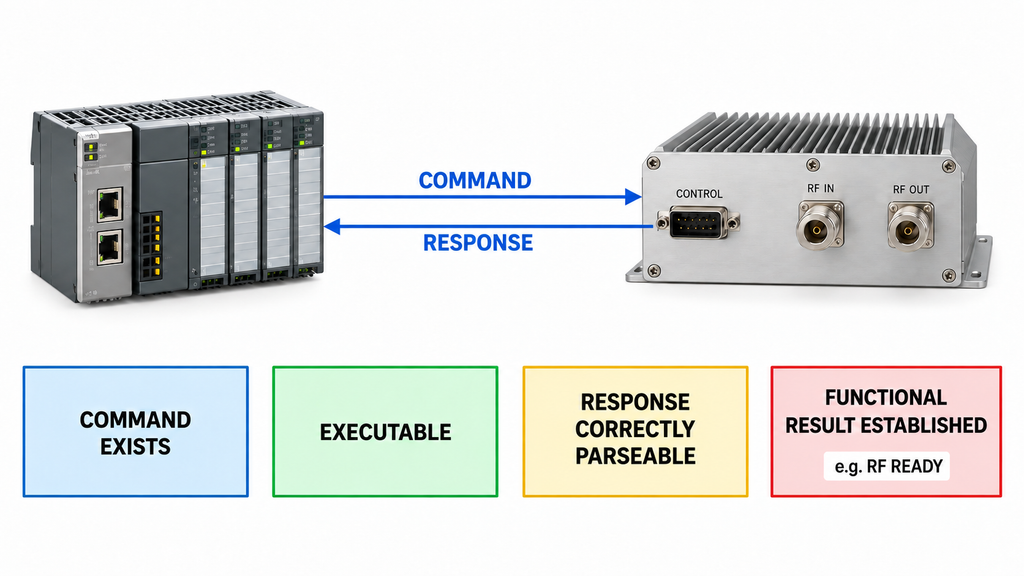
AT command consistency requires four separate checks:
- Command exists: the token appears in the interface definition.
- Command executes: the target accepts the request under defined conditions.
- Response parses: the controller interprets every returned field correctly.
- Function completes: the commanded operation reaches its required state.
How Does AT Command Compatibility for an RF Module Go Beyond an OK Response?
These conditions are not interchangeable. In particular, an OK response cannot establish RF Ready or prove that an RF function completed.
Communication may appear normal while a controller misreads a changed field order, unit, result code, or status meaning. Judge compatibility against commands and response fields that the controller uses. A generic statement that both versions “support AT commands” provides too little evidence.
Before comparing two implementations, confirm that their functions and communication interfaces align. Record both version identities and obtain each response definition. If the controller’s command subset remains unknown, stop the compatibility decision. Define that dependency scope before continuing.
This step should produce a controller-dependency inventory. Record every function, command, parameter, response field, error, asynchronous message, and state meaning that existing software consumes.
Response latency, timeout behavior, retry policy, and the transition from acknowledgement to RF Ready are separate timing questions. Those issues should be verified through AT command timing rather than inferred from command-contract consistency.
2. Which Parts of the AT Command Contract Must Be Frozen?
AT command consistency requires a frozen definition for every interface element that can change controller behavior. Record these items for each controller-used function:
- Command function plus read, write, or execute behavior.
- Request syntax, parameter order, meaning, range, and units.
- Termination rules and synchronous response structure.
- Result codes, errors, and asynchronous messages.
- Field definitions, module addressing, and channel addressing.
- Firmware, command-set, and interface document versions.
Once two versions share the same functional objective and their interface definitions are available, compare these contract elements directly. The purpose is controlled evolution, not preventing all change.
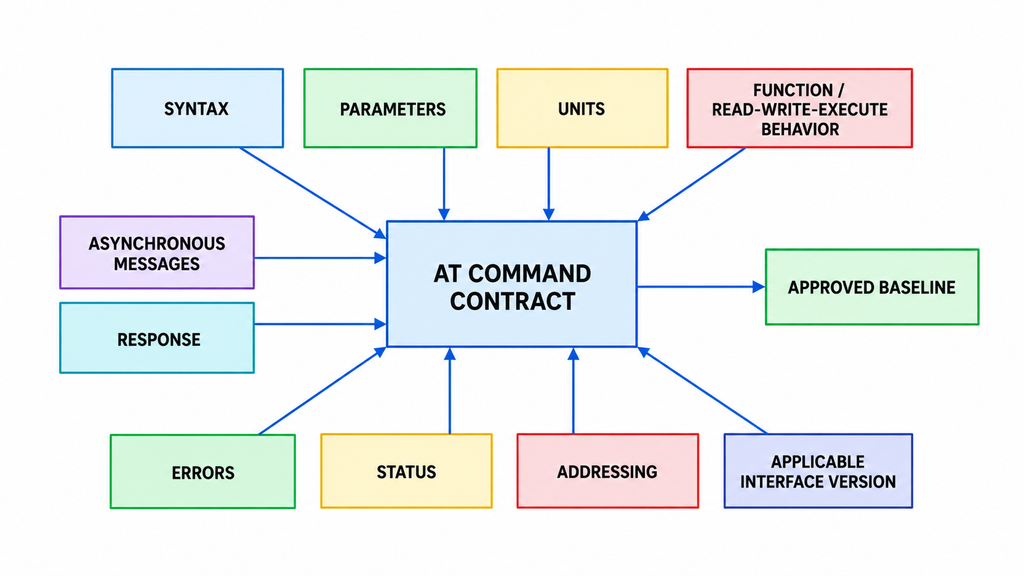
A newly added independent function that existing controller software never calls may leave the approved integration unaffected. A changed parameter unit, response field, error, or status meaning can alter parsing and control logic. Such a change requires another compatibility decision. Its effect depends on how the controller uses that interface. No universal list can classify every revision correctly.
The same rule applies to status information. If a revision changes a displayed status or alarm, record that field in the approved baseline. The record must preserve its definition and meaning. Detailed proof of field identity, channel association, data freshness, and controller display mapping belongs to RF PA status feedback mapping.
An AT command response format, its parameter units, and error behavior must be formally defined before the command contract can be reliably frozen. In that case, obtain the applicable version-controlled interface definition before declaring a later firmware or delivery configuration compatible.
The buyer output is an approved AT command contract baseline that software configuration control and supplier change review can both reference. Allowing controlled interface evolution is not the same as accepting an undocumented change to that baseline.
3. How Should Firmware and Command-Set Versions Be Mapped?
For RF PA firmware command version mapping, keep the firmware revision and command-set revision as separate identities. The command-set revision identifies one command and response definition. Firmware identifies executable software loaded in a module. Controller software forms another identity because it determines which commands, fields, and parsing rules the host implements.
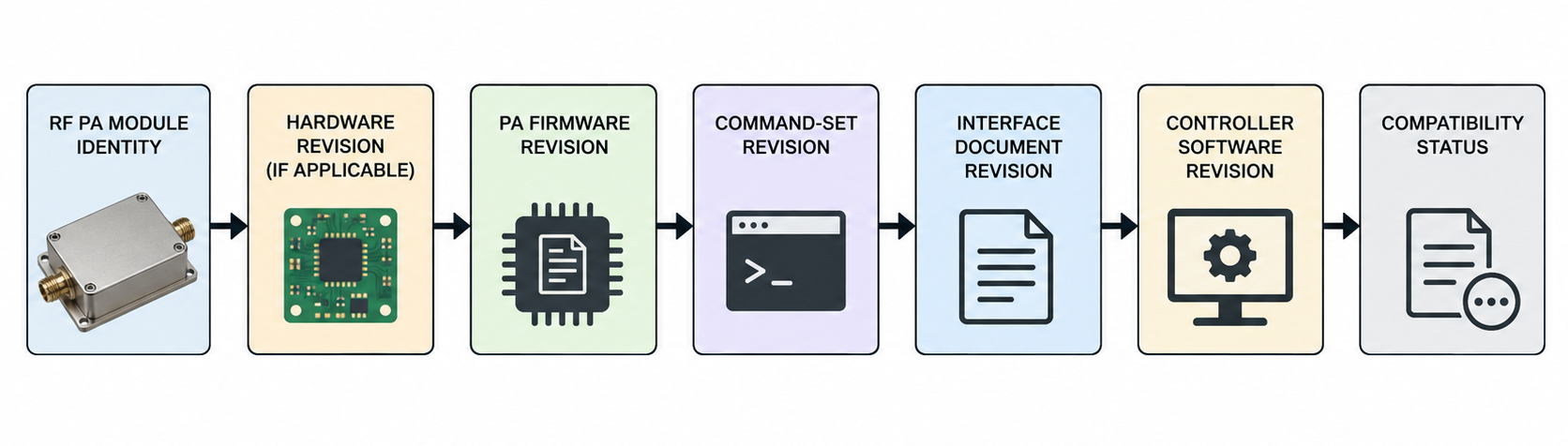
Version mapping is the traceable relationship among these identities. At minimum, an approved configuration should connect:
- Module identity or serial number.
- Hardware and PA firmware revisions.
- Protocol or command-set revision.
- Approved AT interface document revision.
- Controller software revision and compatibility status.
No single version field can substitute for the others.
What Does AT Command Consistency Require from Version Mapping?
This mapping supports the compatibility decision. If one cabinet contains several firmware versions, the controller must identify each configuration. A shared model name does not prove a shared interface revision. Likewise, a firmware label does not identify its command-set definition.
For a supplier implementation, map firmware through its interface file, version record, or other first-party evidence. 3GPP TS 27.007 shows how one AT command specification remains under version control. However, that public standard cannot establish a firmware-to-command mapping for a project-specific RF PA.
Keep a configuration pending when its firmware, command-set revision, or controller software identity remains unknown. The supplier must connect those versions with an interface document revision. Without that link, cross-version compatibility remains unconfirmed.
The required output is an approved version mapping that locks each accepted configuration to its applicable interface definition and compatibility status.
Rejected commands, stale status, or wrong-module behavior may indicate a version mismatch. Use RF PA control interface troubleshooting to isolate that fault. Troubleshooting still cannot replace preventive version mapping before approval.
4. How Should a Controller Handle Allowed Version Differences?
A controller should neither reject every new version nor accept every version that communicates. Use three outcomes: Compatible, Partially Compatible, or Cannot Conclude Yet. Choose an outcome from the controller’s dependency scope and available evidence.
Backward compatibility means a later interface revision still supports approved controller behavior within a defined scope. A version difference may be acceptable when every controller-used function remains aligned. Check requests, parameters, units, responses, errors, asynchronous behavior, and status meanings.
When Does AT Command Consistency Survive a Version Change?
An added function may leave older controller software unaffected when that software never calls it. This result does not establish compatibility for other controllers or command subsets.
A partially compatible result is appropriate only when the preserved and affected portions can be clearly separated. The approved record should state which controller functions remain valid, which require adaptation, and what software restriction or change is necessary.
Do not resolve unknown differences through parser guesswork. A controller cannot safely ignore an unfamiliar field without a formal definition. It also cannot assume that a changed response keeps its old meaning. Apply only behavior allowed by the approved protocol and software strategy.
During version review, check whether a required command, syntax, parameter, unit, or response field changed. Then review result codes, asynchronous messages, and status meanings. Regression-test every change that affects controller logic.
Use Cannot Conclude Yet when response definitions, version mapping, or regression evidence remain incomplete. A version difference becomes incompatible only when it changes required controller behavior or interpretation.
5. How Should AT Command Consistency Be Regression-Tested?
Document comparison and practical regression testing serve different jobs. Interface files show what should stay stable or change. Regression tests show whether approved controller software handles that configuration correctly. Use both forms of evidence.
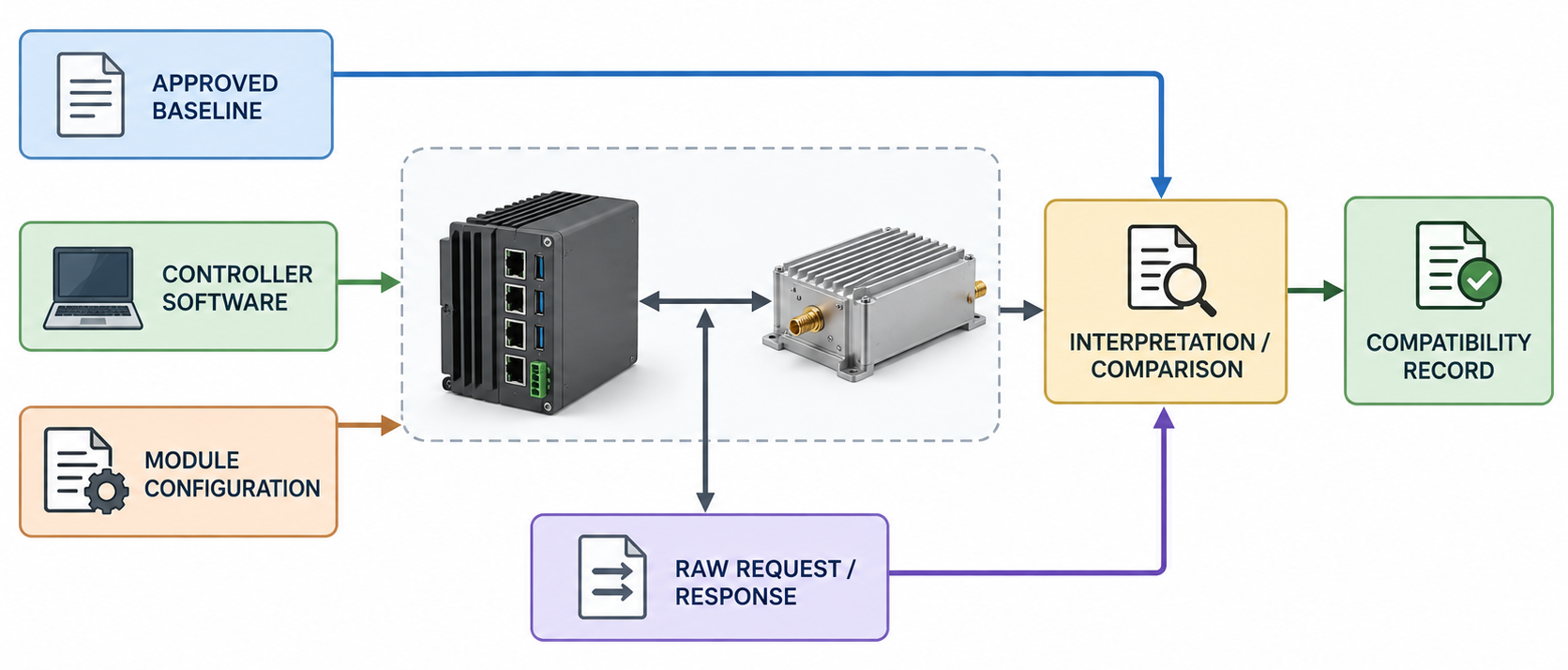
Start from the approved AT command baseline. Record the communication interface, module identity, relevant hardware revision, firmware revision, command-set revision, interface document revision, controller software revision, and test scope. Use the approved controller implementation to exercise the commands it actually depends on.
Preserve every raw request and response. Compare each record with approved syntax, fields, parameters, units, errors, asynchronous behavior, and expected meanings. Then verify how the controller parses and uses that response. If a difference affects RF behavior, continue with RF power amplifier testing instead of treating command acceptance as proof of completion. Command acceptance alone does not prove completion.
The resulting evidence should be captured in a version-linked compatibility record.
What Should an AT Command Consistency Test Matrix Record?
| Record area | Fields to capture | Verification question | Required evidence |
|---|---|---|---|
| Function and command | Function, command ID, request syntax, parameters, and units. | Does the request match the approved definition? | Interface revision and raw request. |
| Response and error handling | Expected response, result codes, errors, and asynchronous messages. | Can the controller parse every required field? | Raw response and parser result. |
| Version identity | Command set, PA firmware, hardware, and controller software. | Does each identity match an approved combination? | Version map and configuration record. |
| Compatibility decision | Compatible, Partially Compatible, or Cannot Conclude Yet. | What scope and restrictions apply? | Test report, exception list, and release decision. |
This matrix provides a project record structure. It does not claim RF SKYPOWER command, firmware, or compatibility data. A result applies only to its recorded versions, controller scope, and evidence.
For partial compatibility, record each affected function and required software change. Leave the result unresolved when a version identity, response definition, or test record remains missing.
A single module that communicates correctly establishes only the result for that sample under the recorded configuration and conditions. It cannot automatically prove that an entire delivery batch has the same configuration. A batch-level conclusion requires appropriate configuration-management or batch-level evidence.
Unit-level traceability may link serial number, hardware, firmware, interface revision, and release status. However, identity records do not prove that every unit completed a full command regression. The acceptance plan must state that test scope.
Screenshots or a statement that “testing was normal” cannot prove versioned interface consistency. Logs also need a traceable version identity. Preserve raw requests, responses, controller interpretation, test scope, and the applicable sample or batch.
If regression testing exposes response delay, timeout, retry, or RF state-completion problems, those findings should be validated against the separate AT command timing requirements.
6. What Should an RFQ Freeze for AT Command Consistency?
AT command consistency and RF amplifier change control should appear directly in the RFQ or interface control document. A phrase such as “supports AT commands” cannot constrain later deliveries. Freeze the versioned command contract that your controller depends on.
Record these contract fields:
- Required command functions and applicable protocol revision.
- Request, response, parameter, unit, and addressing rules.
- Error codes, asynchronous messages, and status meanings.
- Firmware identity and controller software dependency.
- Allowed versions, backward compatibility, and change notices.
- Evidence required after any configuration change.
The document should also define delivery traceability. Evidence may apply to one approved configuration, a batch, or individual modules. For unit-level traceability, state whether each unit needs identity confirmation or full command regression. These evidence levels prove different things.
Specific version numbers, command lists, and compatibility results must come from the actual project and formal supplier interface information. If the model or interface revision is still being selected, freeze the required fields and evidence expectations without inventing values.
RF SKYPOWER can review model-specific interface needs during an RFQ. Once requirements are defined, use the RF PA modules product range to compare categories. For startup behavior, also review the SDR-to-PA power-on sequence. A product family alone cannot prove that one model or firmware revision matches your contract.
| Open question | Review route | Evidence to prepare |
|---|---|---|
| Command definitions or controller dependencies. | Control interface review. | Command list, responses, status fields, and versions. |
| Response delay, timeout, or RF Ready timing. | Timing review. | Raw timestamps, retry policy, and state transition logs. |
| Rejected commands or wrong status after integration. | Troubleshooting review. | Version map, request logs, response logs, and controller interpretation. |
7. What Should You Confirm Before Supplier Review?
AT command consistency depends on a versioned contract for commands, parameters, responses, and status meanings. A statement that a module supports AT commands cannot prove compatibility. Record the controller’s command subset, module identity, firmware, command-set revision, interface definition, software version, and evidence scope.
Use this framework to compare defined configurations and assess each version difference. Record the result as Compatible, Partially Compatible, or Cannot Conclude Yet. Formal interface records and regression evidence must support every model-specific result.
Do not treat a shared model name, command name, or OK response as proof of interchangeability.
Before supplier review, freeze the approved AT command baseline and version map. Then test each firmware, command-set revision, or delivery configuration against actual controller dependencies. Hold the decision whenever identity, response meaning, or regression evidence remains incomplete.
For an RF SKYPOWER interface review, provide:
- Target application, frequency band, and RF PA range.
- Control interface and controller-used AT command list.
- Request, response, status, and error definitions.
- Module, firmware, command-set, and controller software versions.
- Allowed version range and change-notification rules.
- Required regression and delivery-traceability evidence.
These inputs define the review scope. They do not establish compatibility before formal model and interface information is confirmed. Use the C-UAS RF PA acceptance checklist to connect control evidence with shipment approval.
Conclusion
AT command consistency protects a C-UAS controller from silent interface mismatches across module and firmware revisions. A shared command name or OK response cannot prove compatibility. Each approval must connect the module, firmware, command-set revision, interface document, controller software, and regression evidence.
Keep the compatibility decision open whenever version identity, response meaning, or required test evidence remains incomplete. This approach prevents an undocumented interface change from becoming a field-level control fault.
If you need to verify a specific RF PA configuration, contact us with your module requirements, firmware information, controller-used AT command list, and expected response or status definitions. RF SKYPOWER can review the control-interface boundary and help define the evidence needed before sample or batch approval.