

An RF PA load check should be completed before the amplifier is operated at full power on the installed antenna path or approved for final integration. A stable 50 Ω dummy-load result confirms the module under a controlled boundary, but it does not define the feeder, connector chain, antenna match, reference point, reflected-power risk, or protection condition the PA will face after integration.
The purpose of the pre-integration review is not to repeat every factory test. It is to confirm that the real load path is defined, the bench baseline is available, the measurement boundaries are consistent, and no unresolved condition could create a false failure or an uncontrolled full-power test.
Before approval, the integrator should be able to answer four questions:
What load path will be connected → What baseline proves the PA is healthy → What changes after installation → What condition requires a stop or retest
1. What Load Boundary Must Be Defined Before Integration
“Test the PA with the antenna” is not a complete engineering condition.
Before integration begins, the test team should define:
- Required operating frequencies
- Load type
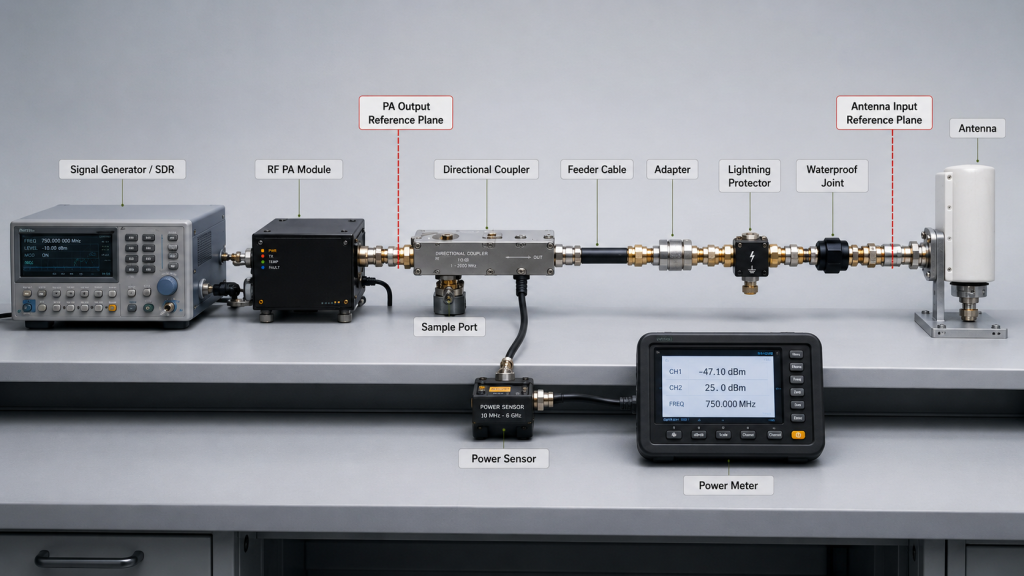
- PA output reference point
- Feeder type and length
- Connector and adapter path
- Antenna VSWR or return-loss boundary
- Lightning-protection or waterproof components
- Expected forward- and reflected-power behavior
- Protection and alarm response
- Cooling and DC supply conditions
The reference point is especially important. Output measured at the PA connector is not the same as output available at the feeder end or antenna input.
A result such as “100 W output” remains incomplete until the report states where the power was measured.
The installed RF path may include:
RF PA output → feeder cable → adapters → lightning protector → waterproof joint → antenna
A directional coupler or monitoring point may be added during testing when FWD and REV measurements are required.
Each installed component can introduce loss, reflection, contact variation, or a new measurement boundary.
A lighter review may be sufficient for a fixed 50 Ω laboratory load, but the frequency range, reference point, load condition, and retest boundary must still be documented.
For systems using long outdoor feeders, remote cabinets, vehicle vibration, several antenna paths, or high-duty-cycle operation, the load boundary should be reviewed before the PA configuration is approved.
A broader review of dummy-load testing and real antenna checks can help separate controlled module evidence from installed RF-path evidence.
2. Which Installed-Path Conditions Change the PA Load
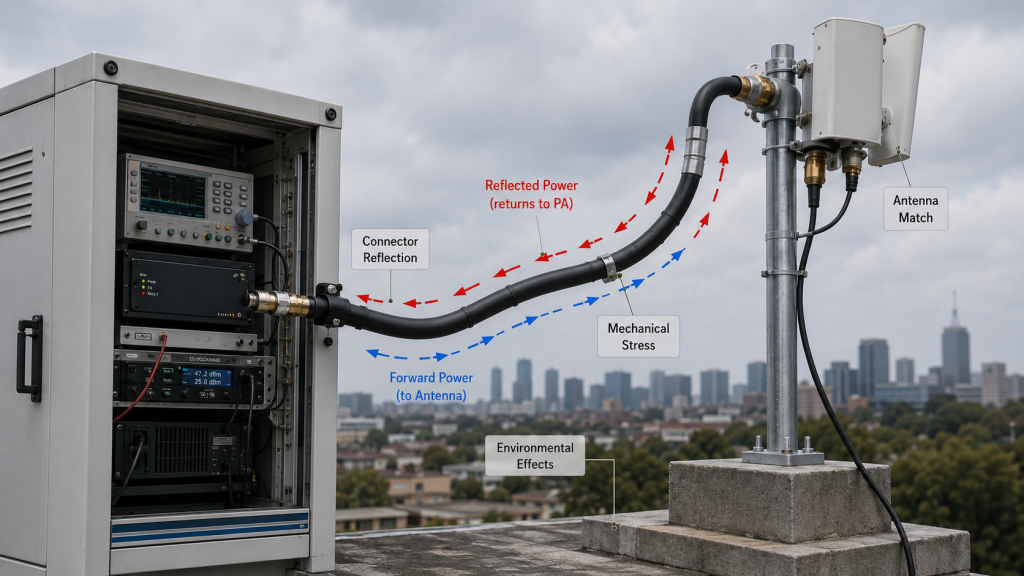
The PA does not respond only to the antenna model shown on a datasheet. It responds to the combined electrical condition presented by everything connected after its output port.
Antenna Match Across Frequency
An antenna may show acceptable matching at one frequency and weaker matching near another operating point.
For narrowband operation, a few specified frequencies may be sufficient. For wideband or multi-band systems, matching should be reviewed across every required operating region.
The check should confirm:
- Supported frequency range
- VSWR or return loss at required points
- Installation-dependent changes
- Band-edge behavior
- Effects of nearby structures or mounting hardware
The purpose is not to prove that the antenna is ideal. It is to confirm that the expected mismatch remains inside the approved operating and protection boundary.
The detailed effects of real antenna load behavior should be reviewed separately when output, current, temperature, or protection behavior changes after connection.
Feeder and Connector Path
Feeder loss reduces the power available at the antenna end. Connectors, adapters, joints, and lightning-protection devices can add both insertion loss and reflection.
The integration review should record:
- Cable type
- Cable length
- Connector types
- Adapter count
- Joint locations
- Lightning-protection device
- Expected path loss
- Frequency range and power rating
The PA-port result should not be presented as antenna-end power unless the installed-path loss has been accounted for.
A dedicated review of installed RF PA feeder loss is appropriate when the acceptance target is defined at the feeder end or antenna input.
Mechanical and Environmental Conditions
The installed load condition can also change with:
- Connector movement
- Cable bending
- Vehicle vibration
- Waterproof-joint assembly
- Outdoor temperature
- Moisture exposure
- Cabinet routing
- Mechanical strain near the connector
A path that passes during an open-bench check may behave differently after enclosure closure, cable fixation, or movement.
Protection and System Response
When mismatch increases, the relevant question is not only whether the PA survives. The team should observe how the complete system responds.
Important indicators include:
- Forward power
- Reflected power
- VSWR
- Output reduction
- Module current
- Temperature
- Protection foldback
- Alarm type
- Recovery behavior
If reflected power, VSWR, output, current, temperature, or protection status changes after the installed path is connected, the test should return to the last confirmed boundary before the PA is rejected.
The RF PA VSWR field-failure risk should be reviewed when a module is stable on a dummy load but alarms or reduces output after installation.
3. What Baseline Must Be Confirmed Before Connecting the Antenna
A controlled dummy-load baseline provides the last confirmed module-level condition before the installed path is added.
The baseline should be repeatable and linked to the actual unit under test.
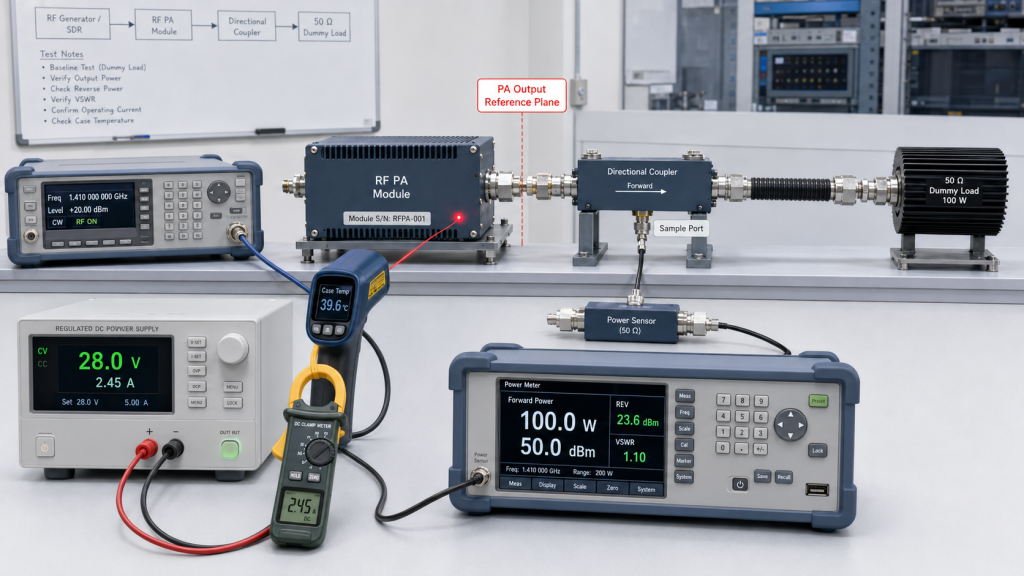
At minimum, record:
- PA serial number
- Hardware version
- Required frequency point or sweep range
- Input drive
- PA-port output
- DC voltage
- DC current
- Operating time
- Temperature condition
- Forward power at the defined reference point
- Reflected power and VSWR at the defined reference point
- Protection state
- Measurement reference plane
- Cable and attenuator corrections
The cooling condition should also be stated. A short cold-state measurement and a stabilized hot-state measurement do not represent the same operating condition.
Before connecting the installed path, confirm that:
- The dummy-load output is repeatable.
- The DC supply remains stable at the module input.
- Current behavior is consistent with the approved baseline.
- Temperature remains within the defined boundary.
- No unexplained alarm or protection state is active.
- The measurement setup and correction values are known.
If the controlled baseline cannot be reproduced, connecting the antenna path will add variables before the module condition has been confirmed.
The team should correct the baseline issue first rather than using the installed path to continue diagnosis.
4. How to Compare the Dummy-Load Baseline With the Installed Path
The comparison should change one boundary at a time.
Do not change the antenna path, test cable, adapter chain, correction value, DC supply, input drive, and thermal starting condition in the same comparison. If several conditions change together, a lower output or new alarm cannot be assigned confidently to the PA or the installed path.
A controlled sequence can follow these steps:
- Confirm the PA on the approved dummy load.
- Record the module-level baseline.
- Verify the installed path at an appropriate low-power test level.
- Confirm the antenna frequency coverage and match.
- Connect the defined feeder and antenna path.
- Begin with a controlled operating condition.
- Observe FWD, REV, VSWR, voltage, current, temperature, and alarms.
- Increase the test condition only within the approved boundary.
- Compare the installed-path result with the baseline.
- Record any changed condition before repeating the test.
The two results should use equivalent:
- Frequency points
- Input-drive conditions
- DC supply conditions
- Cooling conditions
- Operating duration
- Measurement corrections
- Output reference definitions
A lower antenna-end result does not automatically mean the PA output has fallen. It may represent expected feeder loss.
A reduced PA-port result, rising reflected power, or protection activity requires a different investigation because these indicators can show that the load condition seen by the PA has changed.
The comparison should therefore separate:
- Expected path loss
- Measurement-reference differences
- Antenna mismatch
- Connector or adapter faults
- Protection response
- Actual PA performance change
5. What Conditions Require a Retest or Integration Stop
The purpose of the pre-integration check is to produce a clear decision, not another collection of disconnected measurements.
Integration should stop until the load boundary is clarified when any of the following conditions remains unresolved:
- The antenna frequency range does not cover every required operating point.
- Antenna VSWR or return-loss evidence is unavailable.
- The feeder type, length, connector chain, or lightning protector is unknown.
- PA-port and antenna-end results are being treated as the same reference point.
- The dummy-load baseline cannot be reproduced.
- The installed path shows unexpected reflected power or unstable VSWR.
- Module-input voltage, current, temperature, output, or protection status changes unexpectedly or moves outside the approved boundary after connection.
- An alarm cannot be linked to a defined trigger condition.
- The test team cannot isolate whether the change came from the PA, feeder, antenna, supply, cooling, or measurement setup.
The pre-integration result should lead to one of three decisions:
- PASS: The load path is defined, the dummy-load baseline is stable, the reference points are clear, and installed-path indicators remain within the approved boundary.
- RETEST: The path is generally suitable, but one frequency point, correction value, connector condition, measurement, or hot-state result must be repeated.
- STOP: The antenna match, feeder path, reference plane, protection behavior, or system boundary is undefined or outside the approved condition.
Pre-Integration RF PA Load Check
| Check Item | Required Input | PASS Condition | Retest or Stop Condition |
|---|---|---|---|
| Operating points | Required frequencies or bands | Antenna and path cover all required points | Coverage or matching evidence is missing |
| Dummy-load baseline | Pin, Pout, Vdc, Idc, temperature and protection state | Baseline is stable and repeatable | Baseline cannot be reproduced |
| Reference point | PA port, feeder end or antenna input | Measurement boundary is clearly stated | Different planes are compared as the same result |
| Feeder path | Cable type, length, connectors, adapters and lightning protection | Path is documented and suitable for the frequency and power | Path details or component ratings are unknown |
| Load match | VSWR, return loss or reflected-power evidence | Match remains within the approved boundary | Unexpected REV power or VSWR appears |
| System response | Output, current, temperature, alarms and recovery | No unexplained change after connection | Output reduction, alarms or protection behavior cannot be isolated |
A test should not continue toward full operating power merely because the physical connection has been completed.
The path must first be defined well enough for any change in output or protection status to be interpreted correctly.
6. What Evidence Should Be Recorded for Integration Approval
A useful integration record allows another engineer to understand the setup, repeat the test, and identify what changed if a later result is different.
The final record should include:
- Module S/N
- Hardware version
- Load type
- Antenna type or model
- Required operating frequencies
- Output reference point
- Feeder type and length
- Connector and adapter path
- Lightning-protection device
- Forward power at the defined reference point
- Reflected power and VSWR at the defined reference point
- Input drive
- Module-input voltage
- DC current
- Temperature condition
- Operating duration
- Cooling method
- Protection state
- Alarm type
- Controller response
- Final PASS, RETEST, or STOP decision
Photos or diagrams should show the actual connection order when the path includes several adapters, joints, couplers, or protection devices.
The report should also distinguish between:
- Module-level dummy-load approval
- PA-plus-antenna load verification
- Full installed RF-chain approval
These are different evidence boundaries. Passing one does not automatically prove the next.
If the antenna, feeder, connector path, test setup, input drive, cooling condition, or reference point changes later, the affected checks should be repeated rather than compared directly with an earlier result from a different boundary.
RFQ: What Load Information Buyers Should Submit
A useful RFQ should define the expected load path before the PA is selected or quoted.
Submit the following information when available:
- Required frequency range or operating points
- Target PA-port or antenna-end output
- Antenna type or model
- Antenna VSWR or return loss
- Feeder type and length
- Connector and adapter types
- Waterproof joints
- Lightning-protection device
- Fixed-site, vehicle, cabinet, or laboratory installation
- Duty cycle
- Ambient-temperature range
- Cooling method
- 28 V DC supply condition
- Required alarm and control feedback
- Required acceptance reference point
- Required test evidence
When the final antenna has not yet been selected, state the planned frequency range, expected matching boundary, feeder path, and proposed verification method.
Early incomplete load information is still more useful than assuming that a clean 50 Ω bench result represents the final installed condition.
Conclusion
An RF PA should not be operated at full power on an installed antenna path before the load boundary, module baseline, reference point, and stop conditions are defined.
The dummy-load test proves controlled module behavior. The installed-path check determines whether that behavior remains usable after the feeder, connectors, adapters, lightning protection, antenna match, mechanical installation, cooling condition, and system protection response are added.
The approval path should remain clear:
Define the load path → Confirm the dummy-load baseline → Add the installed path → Compare equivalent conditions → Decide PASS, RETEST, or STOP
For projects requiring custom RF power amplifier modules, RF SKYPOWER can review the load boundary before module selection and integration.
Submit the operating frequencies, target PA-port or antenna-end output, antenna data, feeder path, expected VSWR, duty cycle, cooling condition, 28 V DC supply, alarm interface, and required acceptance evidence through our engineering RFQ.