



RF PA measurement uncertainty can change an acceptance decision when a measured result is close to a specified limit. A value that meets a simple-acceptance criterion may fall below the unconditional acceptance threshold under a guard-band rule.
The decision depends on the measurement conditions, applicable uncertainty, specification limit, and governing decision rule. That rule may be part of the applicable standard or separately agreed before testing.
Factory and customer engineers can obtain the same measurement yet reach different conclusions if they apply different acceptance rules. Resolving the disagreement requires valid measurement evidence and a clearly established basis for conformity.
1. Why Can the Same RF PA Measurement Lead to Different Acceptance Decisions?
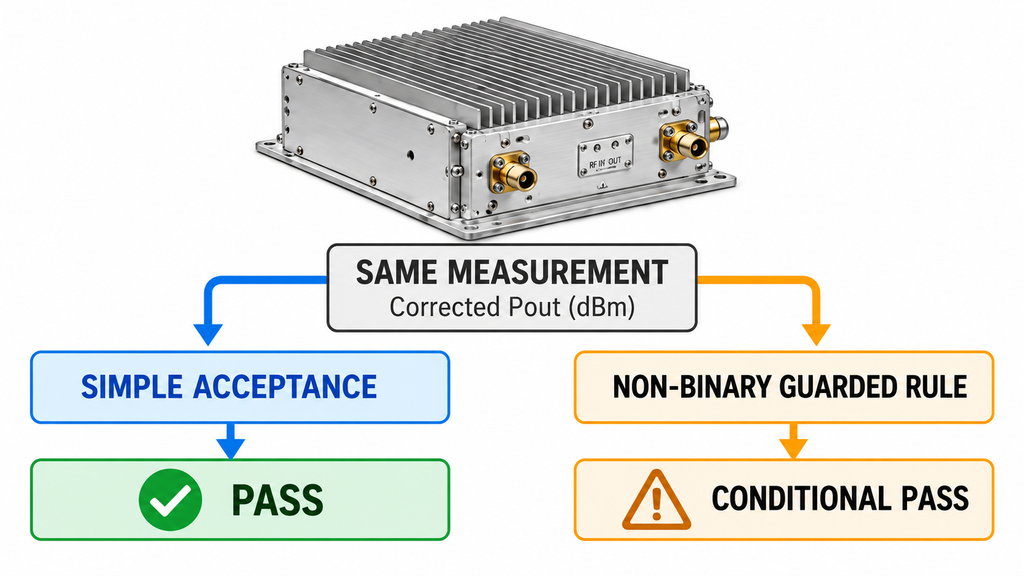
Two engineers can agree on an RF PA’s corrected output power yet reach different acceptance conclusions if they apply different rules.
A measurement result estimates a defined quantity, or measurand. Measurement uncertainty characterizes the dispersion of values reasonably attributable to that quantity. The specification limit defines the performance requirement, while the acceptance limit determines which measured values qualify under a particular decision rule.
Under simple acceptance, the acceptance limit coincides with the specification limit. A guard-band rule may set a stricter threshold to control the risk of accepting an amplifier whose actual performance falls outside the requirement.
The choice affects two types of decision error:
- False acceptance: Accepting an amplifier whose actual performance does not meet the requirement.
- False rejection: Rejecting an amplifier whose actual performance meets the requirement.
A protective guard band can reduce false-acceptance risk under appropriate assumptions, but it may increase false-rejection risk. Neither approach eliminates measurement uncertainty.
When laboratories report different power values, measurement comparability becomes the immediate concern. When they agree on the value but disagree on conformity, the applicable specification and decision rule determine which conclusion is justified.
2. What Must Be Defined Before Uncertainty Can Be Used for RF PA Acceptance?
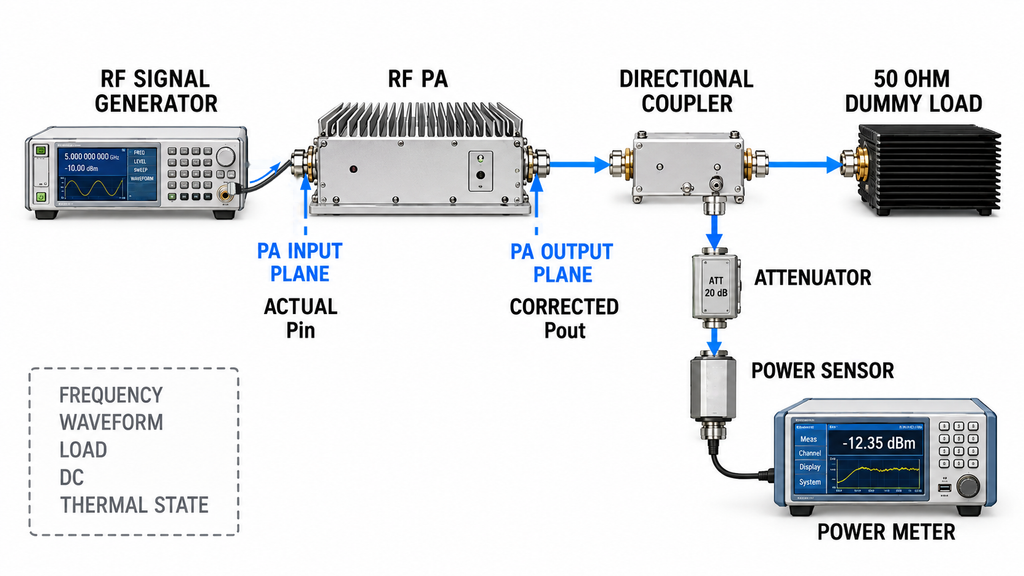
The uncertainty estimate must apply to the measurement quantity and operating conditions specified by the project.
An RF amplifier acceptance test requires a defined specification, measurement reference plane, and operating state. These conditions also determine which uncertainty assessment applies.
The specification limit may come from a controlled product specification, contract, RFQ, approved test plan, or applicable standard. A nominal or typical value is not automatically a guaranteed acceptance requirement.
For Pout acceptance, the required quantity might be corrected forward power at the RF PA output connector. A sensor installed after a coupler, attenuator, and cable does not necessarily display that value directly.
Likewise, actual Pin must be established at the PA input reference plane. The signal generator’s front-panel setting may differ from the power delivered to the amplifier.
The test conditions must identify frequency, waveform, power definition, input drive, reference planes, RF load, DC supply, and thermal state.
A cold-start measurement cannot establish stabilized hot-state output unless the requirement permits that condition. Increasing Pin to recover Pout changes the operating point and cannot verify a fixed-drive requirement without authorization.
Evidence must also remain within its tested scope. A single-frequency result does not establish full-band performance, and a representative sample does not establish conformity of every delivered unit.
If a critical test condition, reference plane, or specification source is missing, the measurement is not ready for a formal uncertainty-based conformity decision.
3. Which Uncertainty Sources Matter for Pout, Gain, and VSWR?
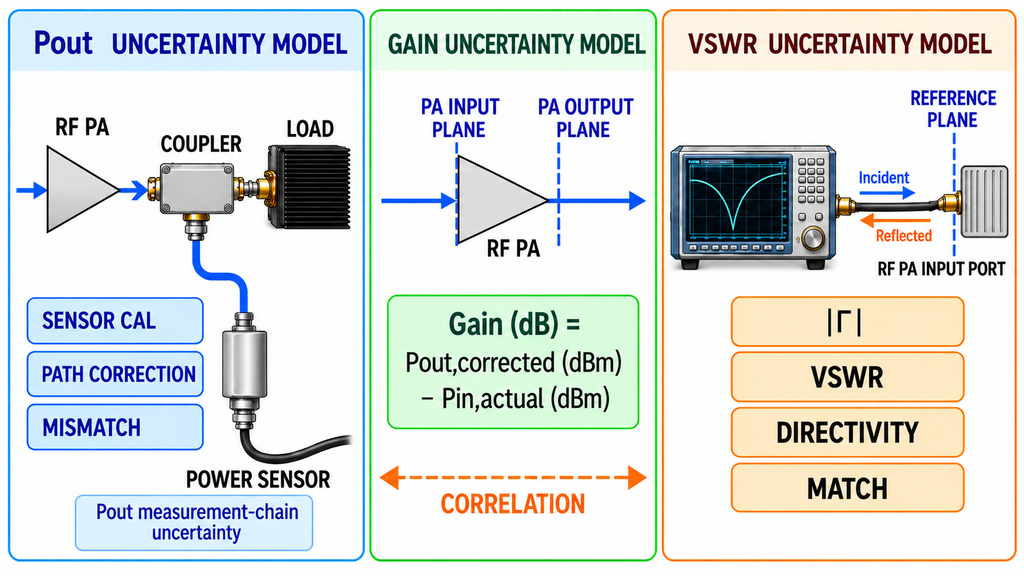
Pout, gain, and VSWR use different measurement models. Each requires uncertainty evidence appropriate to the quantity being evaluated.
Pout: Sensor, Mismatch, and Path-Correction Uncertainty
Output-power uncertainty includes contributions from the relevant measurement chain, not only the power meter.
A high-power test may use a directional coupler, attenuator, cable, adapter, and sensor. Converting the sensor reading to power at the PA output reference plane requires appropriate corrections.
Relevant uncertainty sources include sensor calibration, frequency-dependent coupling and attenuation, mismatch, connection repeatability, and coupler directivity.
Corrections already applied by the instrument must not be counted twice. Their remaining uncertainties still need consideration where relevant.
Mismatch may also change the load seen by the amplifier. A change in actual operating behavior should not automatically be treated as random measurement error.
Valid power-meter calibration evidence establishes the calibration status and applicable characteristics of the instrument under specified conditions. It does not establish the uncertainty of the complete Pout measurement chain.
Gain: Input–Output Uncertainty and Correlation
In an RF amplifier gain test, operating gain is calculated from actual input power and corrected output power.
For compatible logarithmic power measurements:
Gain (dB) = Pout,corrected (dBm) − Pin,actual (dBm)
Both measurements contribute to gain uncertainty.
Shared instruments, calibration references, or correction factors can introduce correlations. Combining every contribution as though it were independent may overestimate or underestimate the uncertainty.
Operating-drive gain must also be distinguished from small-signal S21. The scope of RF PA gain flatness measurement and acceptance is different again, addressing gain variation across frequency rather than gain at one defined operating point.
VSWR: Reflection Measurement and Reference-Plane Uncertainty
VSWR is related to reflection-coefficient magnitude, |Γ|:
VSWR = (1 + |Γ|) / (1 − |Γ|)
for |Γ| below 1.
Relevant uncertainty contributors include calibration residuals, directivity, source and load match, connector repeatability, and reference-plane definition.
The conversion from reflection coefficient to VSWR is nonlinear. An uncertainty value developed for Pout cannot be transferred directly to VSWR.
Input-port VSWR, output-load mismatch, and PA protection thresholds must remain distinct because they describe different quantities or operating requirements.
| Measurement | Quantity and Reference Plane | Main Uncertainty Sources | Critical Correction or Correlation | Required Evidence | When to Stop the Decision |
|---|---|---|---|---|---|
| Pout | Corrected RF output power at the specified PA output plane | Sensor calibration, coupling, attenuation, mismatch, repeatability | Frequency-dependent path corrections, coupler directivity and mismatch effects | Raw reading, corrections, calibration applicability, relevant uncertainty assessment | Output reference plane or material corrections cannot be established |
| Gain | Operating gain from actual Pin and corrected Pout | Input/output power measurement uncertainty, corrections, measurement repeatability | Correlated inputs or shared calibration contributions | Pin/Pout records, operating conditions, gain definition, uncertainty model | Actual Pin, gain definition, or important correlations are unresolved |
| VSWR | Reflection-related quantity at the specified RF port and plane | Calibration residuals, directivity, match, connector repeatability | Reflection coefficient and nonlinear VSWR conversion | Reflection measurement method, calibration scope, applicable uncertainty | Port, reference plane, or reflection measurement validity is unclear |
Swipe horizontally to compare all six fields →
The uncertainty assessment must match the measurand and measurement configuration. Different RF PA parameters cannot share an unexplained uncertainty figure.
4. How Should RF PA Measurement Uncertainty Be Evaluated and Reported?
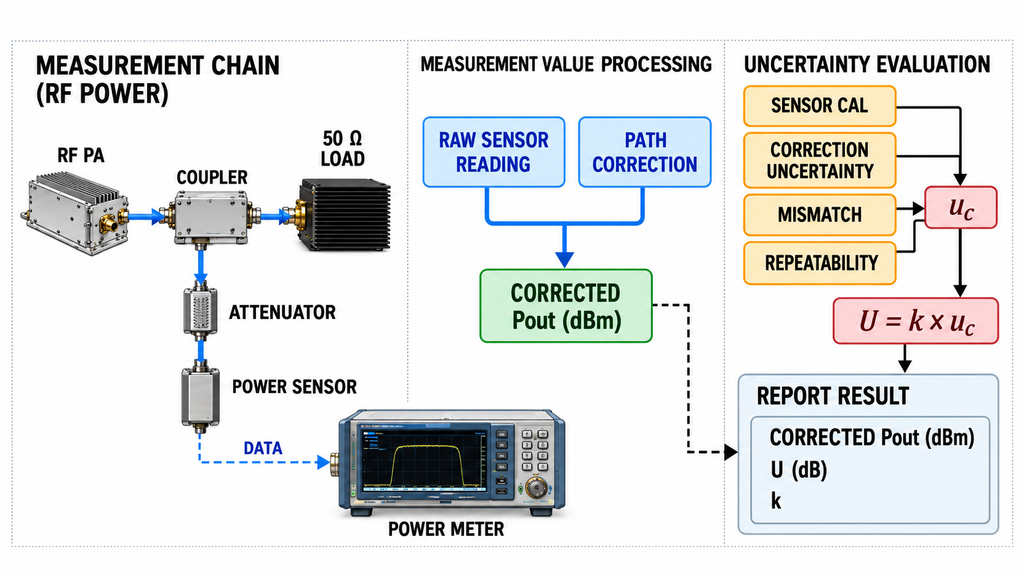
Measurement uncertainty should be evaluated using a model of the reported measurand, including relevant calibration, correction, mismatch, repeatability, resolution, and other contributions.
The associated standard uncertainties are combined according to that model, accounting for correlations where applicable.
The result is commonly expressed as the combined standard uncertainty, u_c. Expanded uncertainty is:
U = k × u_c
where k is the coverage factor.
A factor near 2 is often associated with approximately 95% coverage under suitable statistical assumptions. The relationship depends on the distribution, measurement model, and available information.
For corrected Pout expressed in dBm, the corresponding additive logarithmic uncertainty may be reported in dB, together with the coverage factor and applicable conditions.
The uncertainty must refer to the final corrected measurement. Sensor calibration uncertainty alone may not account for converting a coupler-port reading to the PA output plane. Correcting for known cable loss also leaves uncertainty associated with that correction.
JCGM 100:2008, the Guide to the Expression of Uncertainty in Measurement (GUM), provides the principles for evaluating and combining measurement uncertainties.
JCGM 106:2012, The Role of Measurement Uncertainty in Conformity Assessment, addresses their application to conformity decisions.
An incomplete uncertainty assessment may still accompany a recorded measurement, but it cannot support a conformity claim that depends on missing evidence.
5. How Do Decision Rules and Guard Bands Change Acceptance Outcomes?
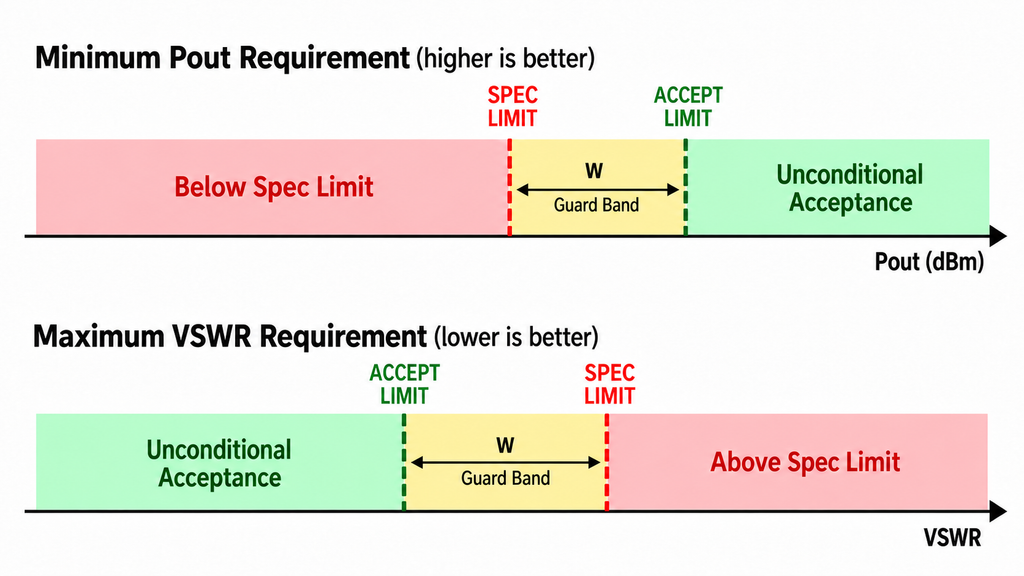
A decision rule defines how measurement uncertainty is accounted for when declaring conformity with a specification.
Under ISO/IEC 17025:2017, Clause 7.1.3, when a customer requests a conformity statement, the specification or standard and decision rule must be clearly defined. If the rule is inherent in the requested specification or standard, that clause does not require separate selection and agreement on another rule. Otherwise, the selected rule must be communicated to and agreed with the customer.
Applicable legislation or regulatory requirements may also prescribe the rule.
ILAC G8:09/2019, Guidelines on Decision Rules and Statements of Conformity, describes different approaches. It does not prescribe one universal guard band for commercial RF PA acceptance.
Under simple acceptance, the acceptance limit equals the specification limit. For a minimum Pout requirement, the measured value is compared directly with that minimum.
Simple acceptance may still be subject to separate measurement-method, capability, or maximum-uncertainty requirements. The absence of a guard band does not remove those obligations.
Under guarded acceptance, the acceptance limit moves inside the specification region.
For a minimum Pout limit:
Lower acceptance limit = Lower specification limit + Guard band
For an upper limit, such as a specified maximum VSWR, a protective guard band moves the acceptance threshold downward.
Guard-band width may be fixed or related to measurement uncertainty. It is not universally required to equal expanded uncertainty.
The decision rule also determines the permitted conformity statements. A binary rule gives two defined outcomes, commonly Pass and Fail. A non-binary rule may distinguish Pass, Conditional Pass, Conditional Fail, and Fail.
The choice affects both false-acceptance and false-rejection risk. Buyers may prioritize avoiding acceptance of underperforming equipment; suppliers may be concerned about rejecting conforming units because of measurement uncertainty.
Measurement coverage probability must not be confused with conformity probability. Expanded uncertainty associated with approximately 95% coverage does not automatically mean there is a 95% probability that an amplifier satisfies its specification.
A valid acceptance decision requires the governing rule, any separate measurement-capability requirements, and suitable measurement evidence. If no applicable decision rule can be established, the formal conformity statement remains unresolved until the basis is clarified.
6. What Does a Borderline RF PA Pout Result Mean Under Different Rules?
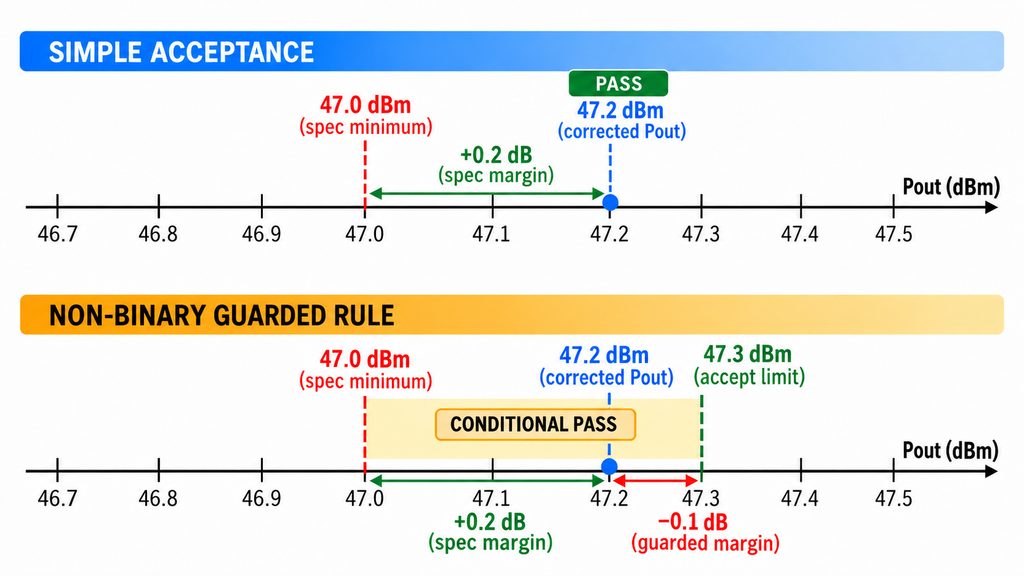
Consider a hypothetical RF PA output-power measurement. The values illustrate decision rules; they are not RF SKYPOWER product specifications or actual test data.
Assume that the output reference plane, waveform, actual Pin, load, supply voltage, and thermal state are correctly defined.
- Minimum specified Pout: 47.0 dBm
- Corrected measured Pout: 47.2 dBm
- Applicable expanded uncertainty: 0.3 dB
- Assumed guard band for the example non-binary rule: 0.3 dB
The measured result exceeds the specification minimum by:
Specification margin = 47.2 − 47.0 = +0.2 dB
Under simple acceptance, it meets the measured-value criterion, provided the test also satisfies any separately specified measurement-capability requirements.
For a non-binary guard-band rule with w = 0.3 dB, unconditional acceptance requires:
47.0 + 0.3 = 47.3 dBm
The measured result falls below that threshold:
Guard-band acceptance margin = 47.2 − 47.3 = −0.1 dB
The table compares alternative hypothetical rules. Only the rule governing the actual project determines its formal conformity statement.
| Decision Rule | Minimum Specification | Measured Pout | Expanded Uncertainty | Guard Band | Unconditional Acceptance Limit | Result Under the Rule | Required Next Action |
|---|---|---|---|---|---|---|---|
| Simple acceptance | 47.0 dBm | 47.2 dBm | 0.3 dB | 0 dB | 47.0 dBm | Pass on the measured-value criterion, subject to any separately specified measurement-capability requirement | Confirm method and uncertainty eligibility; record the result under the applicable rule |
| Defined non-binary guard-band rule | 47.0 dBm | 47.2 dBm | 0.3 dB | 0.3 dB | 47.3 dBm | Conditional Pass under the assumed rule | Record the conditional conformity statement and follow the separately authorized disposition procedure |
| No applicable rule established | 47.0 dBm | 47.2 dBm | 0.3 dB | Not established | Not established | Formal conformity conclusion not determined | Check whether a governing standard already contains a rule; otherwise obtain agreement on the rule |
Swipe horizontally to compare the complete decision record →
The assumed non-binary rule classifies results from 47.0 dBm up to, but not including, 47.3 dBm as Conditional Pass. A binary guard-band rule could assign a different outcome to the same measurement.
Conditional Pass does not automatically authorize shipment. Release, retesting, and other dispositions follow the applicable contractual or quality procedure.
The two margins describe different thresholds: +0.2 dB relative to the specification minimum and −0.1 dB relative to unconditional acceptance. Neither establishes the probability of true conformity without an appropriate risk model.
The example assumes w = U solely for illustration. Actual acceptance depends on the governing rule, measurement-capability requirements, uncertainty basis, and evidence scope.
7. When Should a Borderline Result Trigger Retest or Engineering Review?
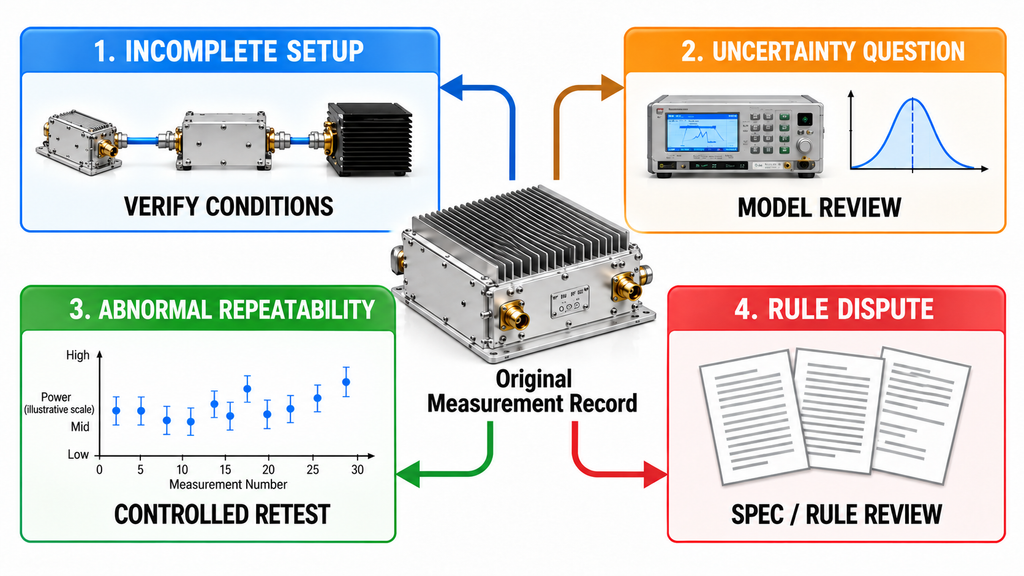
A borderline result warrants retesting when additional measurement evidence can resolve the uncertainty or when the approved procedure requires it.
If test conditions are incomplete, the missing reference plane, actual Pin, load, thermal state, or specification requirement must be established before repeating the measurement.
If the uncertainty assessment is questionable, calibration applicability, corrections, mismatch contributions, correlations, and repeatability require review.
If repeatability is abnormal, a controlled retest under defined conditions may establish whether the measurement process is stable. Original results must remain available, and repeated measurements must follow the approved interpretation method.
If the decision rule is disputed, the governing specification, standard, contract, and approved quality procedure determine its authority. Additional measurements cannot resolve a disagreement about which rule applies.
If a valid result lies outside the acceptance region, the governing rule determines the conformity statement. The quality or contractual procedure determines subsequent disposition.
A conformity classification and a shipment-release decision serve different purposes. Conditional Pass does not automatically require a shipment hold, and a shipment hold does not necessarily establish product nonconformity.
Different power values obtained by factory and customer laboratories raise a separate question of RF PA factory–customer retest comparability. Measurement quantities, reference planes, drive conditions, and instrument corrections must be aligned before the results support a meaningful comparison.
For unresolved results, the acceptance record should identify the missing evidence, responsible reviewer, and next authorized action.
8. What Should an RF PA Uncertainty-Based Acceptance Record Contain?
An RF amplifier test report used for acceptance should allow another qualified reviewer to reconstruct the conformity decision.
For unit-level acceptance, identify the model, serial number, configuration, and revision. Preserve the relevant test conditions, including frequency, waveform, actual Pin, reference planes, RF load, supply, and thermal state.
Link the raw readings and corrected results to the measurement method, correction history, uncertainty assessment, units, and coverage factor.
The conformity record should identify the applicable specification and version, acceptance limit, governing decision rule, reported outcome, and authorized signatory. If the rule is inherent in a specification or standard, identify that source.
Where ISO/IEC 17025:2017 applies, its reporting requirements are more specific:
- Clause 7.8.6.1 requires the laboratory to document and apply the decision rule, taking account of the associated decision risk and assumptions as required by the clause.
- Clause 7.8.6.2 requires the conformity statement to identify the results it covers, the specifications or standards met or not met, and the decision rule applied, unless that rule is inherent in the requested specification or standard.
These clauses do not automatically govern every manufacturer’s internal inspection or commercial acceptance process. The applicable standards, contract, and approved quality system establish the reporting obligations.
Where retesting or engineering disposition occurs, the original data, reason for review, additional evidence, and authorization must remain traceable.
A record tied to one S/N supports the reported result for that unit under the specified conditions. Batch-level conformity requires separate evidence and an appropriate acceptance basis.
A complete C-UAS RF PA shipment acceptance also considers protection, reliability, interfaces, configuration, and delivery evidence beyond an individual Pout conformity result.
The final record should connect the tested unit, measurement conditions, uncertainty, applicable rule, and authorized conclusion without extending the evidence beyond its stated scope.
Conclusion
RF PA acceptance near a specification limit depends on valid measurement evidence and the applicable decision rule. Measurement uncertainty affects the decision, but the governing rule determines the conformity statement.
A measured Pout can satisfy simple acceptance while receiving Conditional Pass under a defined non-binary guard-band rule. Conditional Pass does not authorize shipment by itself, and failing to reach an unconditional acceptance threshold does not prove defective hardware.
Resolving a disputed result requires verification of the corrected measurement, uncertainty assessment, specification, decision rule, acceptance margins, and any outstanding evidence or disposition requirements.
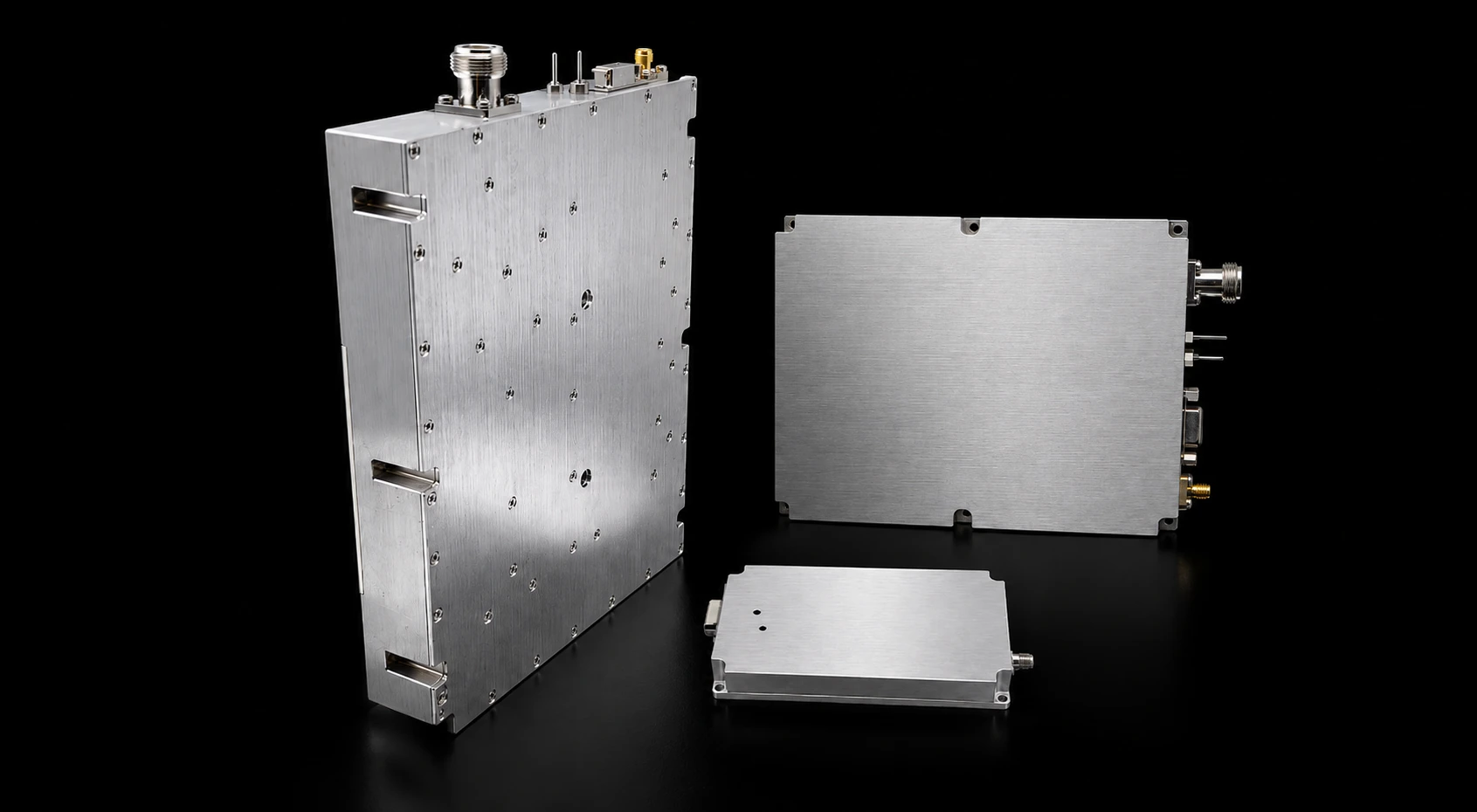
RF SKYPOWER’s RF Power Amplifier Modules cover the product-family context for projects with defined frequency, waveform, power, and thermal requirements.
Project-specific acceptance information, including actual Pin, reference planes, RF load, DC and thermal conditions, specification limits, decision rules, and unit- or batch-level evidence requirements, forms part of the technical scope handled through the RF SKYPOWER engineering RFQ channel. Product information and engineering discussions do not establish model-specific conformity or final acceptance.