

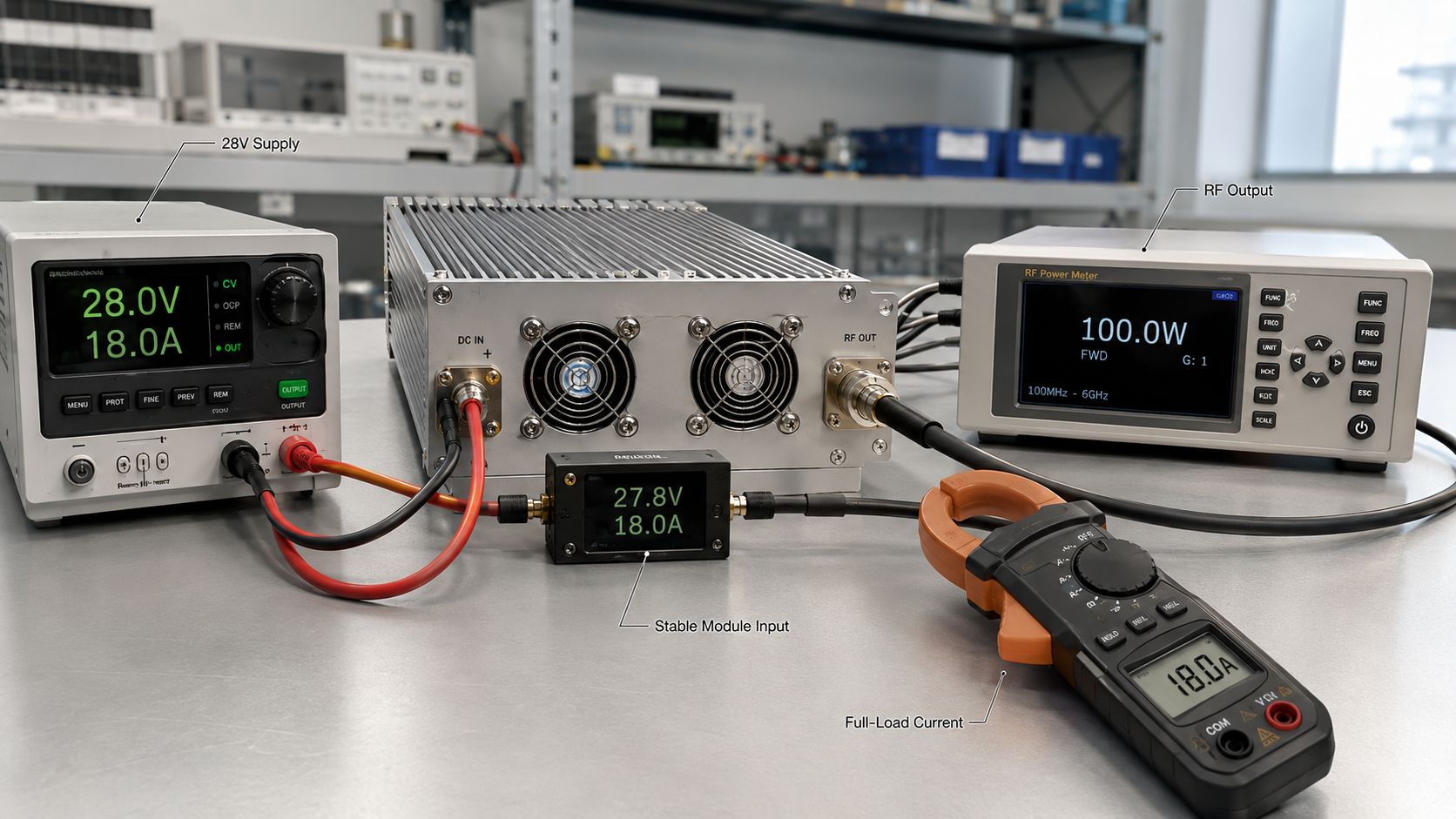
RF PA voltage margin cannot be confirmed from a 28V power-supply label alone. The supply may show 28.0V while cable loss, connector resistance, relay paths, shared loads, or rising current reduce the voltage that actually reaches the amplifier terminals under RF load.
The more important selection question is not whether the module accepts a nominal 28V input. It is whether the complete DC system keeps the PA inside a performance-qualified voltage and current window at the required frequency, RF output, duty cycle, temperature, load, and simultaneous-channel condition.
Before approving RF Power Amplifier Modules, define the minimum acceptable module-terminal voltage, maximum approved operating voltage, worst-case current demand, power-quality condition, and protection behavior. These values should be confirmed under full RF load rather than inferred from a power-supply label.
1. What 28V RF PA Voltage Margin Actually Means
Low-side RF PA voltage margin is the difference between the minimum voltage that reaches the module under load and the minimum module-terminal voltage proven to maintain the required RF performance.
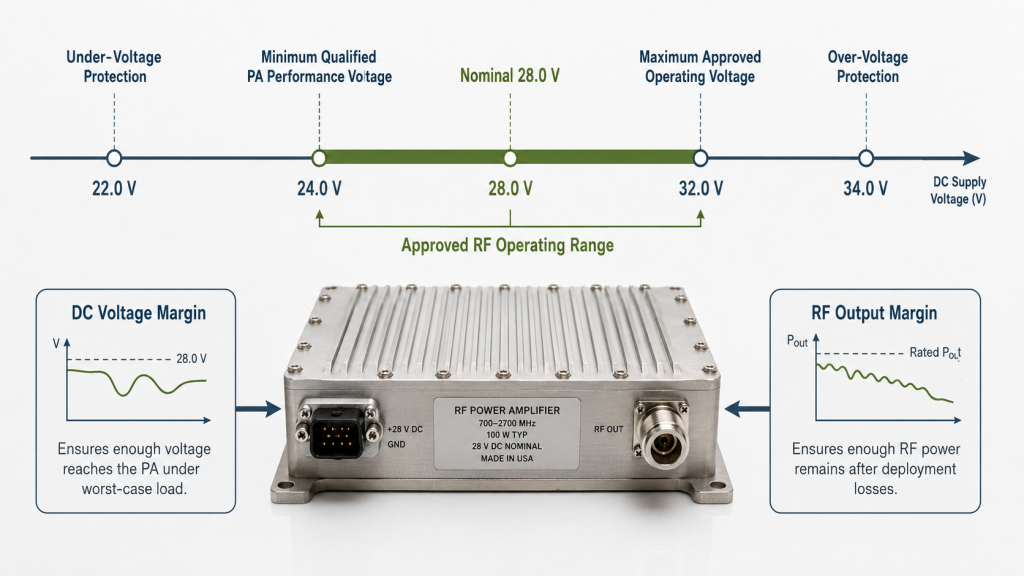
A complete voltage review should also check the distance between the maximum expected module voltage and the approved high-side operating boundary.
Voltage margin is not simply:
- The datasheet maximum voltage minus nominal voltage
- The difference between 28V and the lowest allowed input
- A fixed percentage added without reference to current, frequency, or duty cycle
- The voltage shown on the power-supply front panel
A useful selection review separates several different voltage boundaries.
| Boundary | What It Means | What to Record | Common Mistake |
|---|---|---|---|
| Nominal voltage | Intended system operating point | Supply and PA-terminal voltage | Assuming the 28V label proves loaded voltage |
| Minimum approved voltage | Lowest voltage that still meets the required RF performance | Vdc, Idc, Pout, frequency, and temperature | Using the datasheet minimum without RF testing |
| Maximum approved operating voltage | Highest voltage approved for normal operation | PA-terminal maximum and transient data | Using a protection threshold as a normal target |
| Under-voltage threshold | Alarm, derating, or shutdown boundary | Threshold and recovery behavior | Operating routinely near protection |
| Over-voltage threshold | High-side protection boundary | Threshold and source transient behavior | Treating protection as usable operating margin |
| Current boundary | Required current under the worst permitted load | Per-module and total simultaneous current | Sizing from one short, single-module test |
A datasheet input range should not be treated as a guarantee that the amplifier will deliver identical RF output across that complete range.
For example, an allowed input range may indicate that the module can power on or remain electrically protected within those limits. It does not automatically prove that output power, gain, current, temperature, and protection behavior remain unchanged at every voltage inside that range.
The selection review should therefore distinguish:
- Allowed input-voltage range
- Recommended nominal operating voltage
- Performance-qualified voltage range
- Under-voltage alarm or shutdown threshold
- Over-voltage protection threshold
The project should use the performance-qualified range for RF approval. Protection thresholds are safety boundaries, not recommended operating targets.
DC voltage margin is not RF output margin
DC voltage margin and RF output margin solve different problems.
DC voltage margin asks:
Will enough voltage still reach the PA under the worst electrical load?
RF output margin asks:
Will enough RF power remain after frequency variation, temperature, compression, feeder loss, antenna-path loss, and deployment conditions?
A system may have adequate DC voltage but insufficient RF output at the antenna end. It may also have enough nominal PA wattage but lose output because the module-terminal voltage falls under load.
The two margins should be reviewed separately. Detailed planning for RF output power margin should not be replaced by a larger DC supply alone.
2. How to Define the Required Voltage and Current Boundary
A 28V RF PA should be selected from the most demanding permitted operating condition, not from a convenient cold-state or single-frequency test.
Start by defining:
- Nominal and approved module-terminal voltage boundaries
- Required RF output and critical frequency points
- Continuous and transient current demand
- Duty cycle and simultaneous PA count
- Ambient temperature and cooling condition
- RF load or VSWR boundary
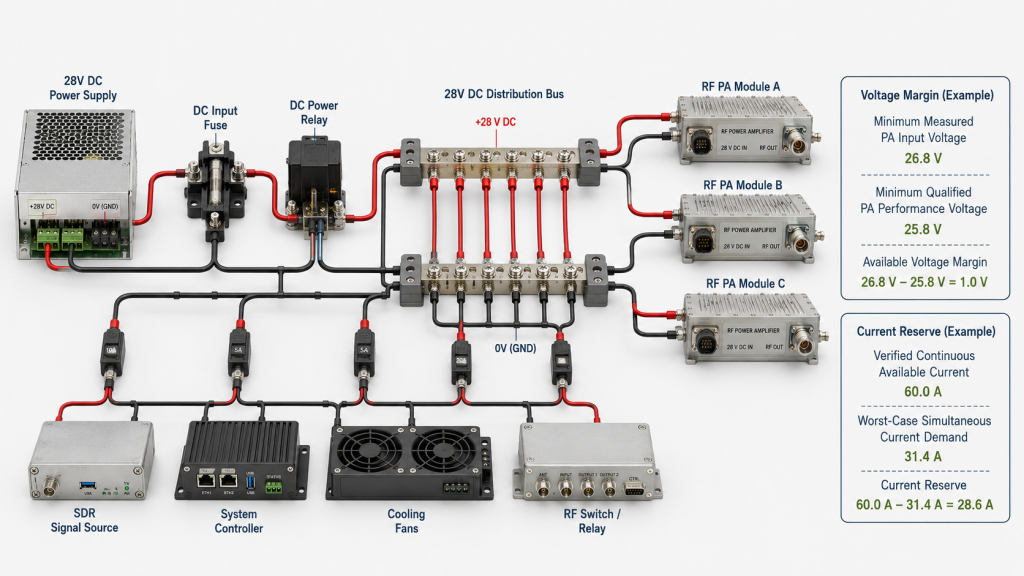
Calculate the low-side voltage margin
A useful low-side calculation is:
Loaded voltage margin = minimum measured PA-terminal voltage under the worst-case load − minimum approved PA-terminal voltage for the required RF performance
For example:
- Minimum measured PA-terminal voltage: 26.8V
- Minimum approved voltage at the required RF output: 25.8V
The available margin is:
26.8V − 25.8V = 1.0V
The 25.8V value in this example is not a universal limit. It must be supported by the required:
- Frequency
- PA-port output
- Duty cycle
- Temperature
- RF load
- Protection state
- Test duration
Do not substitute the lowest absolute datasheet voltage unless the required RF performance has been verified there.
Check the high-side operating margin
The design must also avoid excessive module voltage.
A useful high-side calculation is:
High-side operating margin = maximum approved module-terminal operating voltage − maximum expected module-terminal voltage
The approved operating boundary should remain below the absolute maximum rating or over-voltage protection threshold.
Maximum expected voltage may occur during:
- Light-load operation
- Charger or converter variation
- Battery charging
- Regulator overshoot
- Load disconnection
- Enable or shutdown transitions
- Source recovery after a transient
A system that is safe at 28.0V during steady operation may still exceed the approved boundary during a transient. High-side behavior should therefore be checked at the module terminals, not only at the power source.
Calculate current reserve from the complete load
Current reserve should be calculated as:
Current reserve = verified continuous available current − worst-case simultaneous current demand
Worst-case demand should include:
- Every RF PA allowed to transmit at the same time
- SDRs and signal sources
- Controllers
- Fans or liquid-cooling equipment
- RF switches and relays
- Monitoring equipment
- Other loads sharing the same DC bus
Startup and enable transients should be reviewed separately from continuous current.
A supply may have enough continuous current but fail during a rapid enable step. Another supply may tolerate a short surge but overheat or derate during continuous operation. Continuous capacity and transient response should therefore be verified as separate conditions.
The dominant electrical condition depends on the installation, so use the vehicle-mounted and fixed-site RF PA comparison to set platform-specific transient, continuous-current, cable-path, and module-terminal voltage tests.
Do not apply one universal current-reserve percentage to every project. The required reserve depends on:
- Power-supply derating
- Ambient temperature
- Continuous or intermittent operation
- Source transient response
- Distribution-path loss
- Simultaneous channel logic
- Recovery behavior after a load step
A supply with a high current label may still be unsuitable if it cannot maintain the required voltage during the permitted load transition.
3. How to Verify Loaded Voltage at the PA Power Terminals
The most useful voltage is the value measured at the PA power-input terminals while the amplifier produces the required RF output.
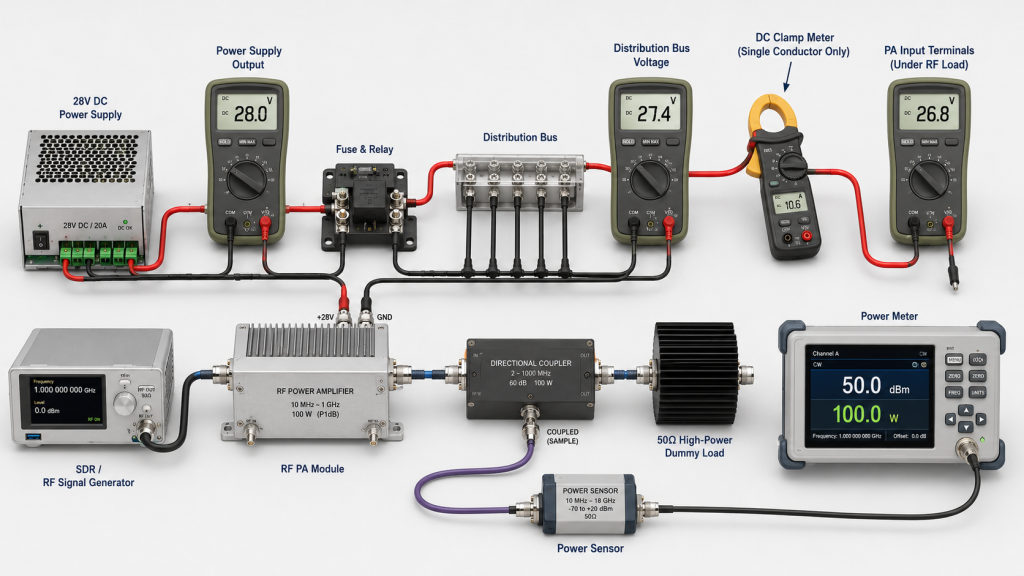
Three measurement points may show different values:
- Power-supply output
- Cabinet or distribution-bus output
- PA power-input terminals
A supply may show 28.0V while the PA receives a lower voltage because the DC path includes:
- Long cables
- Undersized conductors
- Connectors
- Fuses
- Relays
- Switches
- Terminal blocks
- Distribution boards
- Ground-return resistance
The voltage difference should be checked under the required current, not only with RF output disabled.
Measure under the required RF condition
Record module-terminal voltage while reproducing:
- Required frequency
- Required RF output
- Defined input drive
- Required duty cycle
- Stabilized temperature
- Real simultaneous-channel state
- Intended cooling load
- Agreed RF load or VSWR condition
A no-load reading confirms only that voltage reaches the cabinet. It does not prove that the complete DC path can support the amplifier under RF load.
Where DC cables are a significant part of the path, calculate and measure DC cable voltage drop under RF load. Include the complete outgoing and return path rather than using only the one-way cable length.
Separate selection verification from fault diagnosis
This article defines the operating boundary before procurement or system approval.
If a deployed PA already shows output drop, unstable startup, repeated alarms, or unexpected shutdown, the next task is fault diagnosis. In that case, compare supply voltage, distribution-bus voltage, and module-terminal voltage while checking RF PA output drops from DC power issues.
Keeping these two roles separate avoids turning a selection review into a general troubleshooting process.
4. How Duty Cycle, Power Quality, and Shared Loads Change Margin
The required voltage margin should be verified under the most demanding system state permitted by the real control logic.
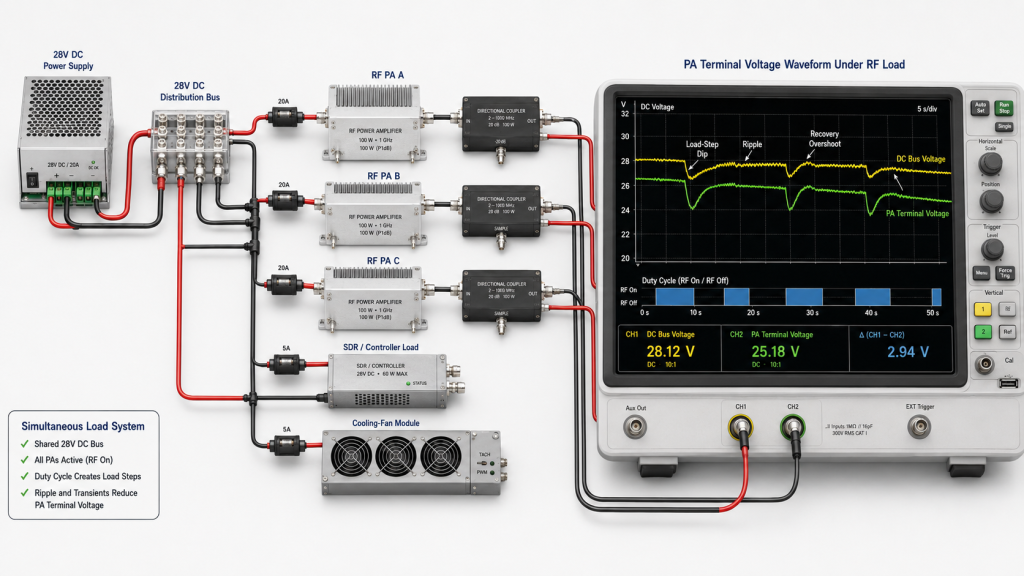
That state may combine:
- Weakest required frequency
- Maximum permitted RF output
- Long-duty or True CW operation
- Highest permitted ambient temperature
- Multiple simultaneous PA channels
- Active cooling loads
- Real cable and distribution paths
- Agreed RF load or VSWR boundary
The worst-case state should represent the most demanding combination that can actually occur. It should not combine operating states that the system control logic prevents from happening at the same time.
Duty cycle changes average electrical demand
A short burst may allow the DC system to recover between transmissions. Long-duty operation raises average current and can expose:
- Increasing cable loss
- Connector heating
- Supply derating
- Rising distribution-board temperature
- Voltage decline after warm-up
- Repeated protection activity
The test should reproduce the actual work and rest pattern. A brief power reading cannot prove that module-terminal voltage remains acceptable during a longer run.
Shared loads can reduce voltage margin
A multi-channel system should not be approved from the current of one PA multiplied by an assumed average value.
The review should identify:
- Which channels may transmit simultaneously
- Maximum RF output per channel
- Frequency-dependent current
- Cooling loads active at the same time
- SDR and controller consumption
- Enable sequence
- Shared fuse, relay, and connector ratings
- Shared cable and bus resistance
The worst case may not occur when every channel operates at the same frequency. Different PA bands can have different current demand, efficiency, and thermal behavior.When unusually high current is part of that comparison, RF PA efficiency-related DC power stress should be evaluated at the same Pout, efficiency boundary, module-terminal voltage, and operating condition.
Power quality matters under RF load
Average voltage alone may not reveal:
- Ripple
- Load-step dip
- Converter instability
- Enable transient
- Recovery overshoot
- Interaction between multiple DC converters
- Noise coupling into control or RF circuits
The required evidence depends on the system risk. At minimum, record steady loaded voltage and current. Where switching supplies, batteries, converters, or rapidly enabled PA channels are involved, also check transient behavior at the PA terminals.
Do not judge power quality only at the supply output. The cable and distribution path can change both the steady voltage and the transient seen by the amplifier.
5. What Evidence Proves the 28V Operating Window
A power-supply label, static multimeter reading, or one successful RF screenshot does not prove adequate voltage margin.
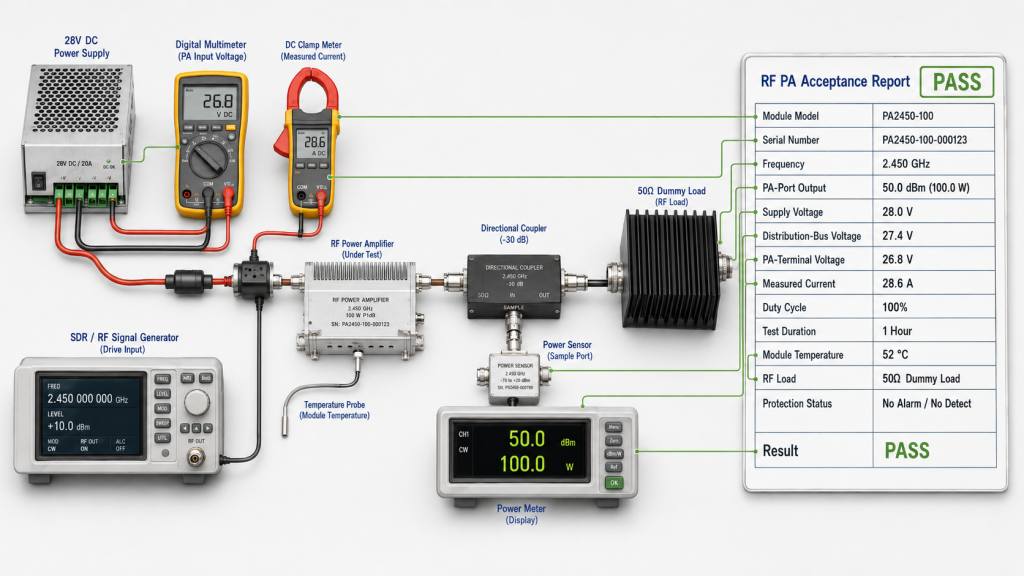
The evidence should connect DC behavior with the exact RF operating condition.
28V RF PA Voltage-Margin Acceptance Checklist
Module and Voltage Boundaries
- Module model
- Module serial number
- Nominal input voltage
- Allowed input-voltage range
- Recommended operating voltage
- Minimum performance-qualified voltage
- Maximum approved operating voltage
- Under-voltage behavior
- Over-voltage behavior
RF and Load Conditions
- Frequency points
- Required PA-port output
- Input drive condition
- Duty cycle
- Test duration
- Simultaneous PA count
- RF load and VSWR condition
DC Measurements
- Full-load current by frequency
- Total simultaneous current
- Auxiliary-load current
- DC cable and distribution path
- Voltage at the supply output
- Voltage at the distribution bus
- Voltage at the PA terminals
- Ripple under RF load
- Enable transient or voltage dip
Thermal and Evidence Conditions
- Ambient temperature
- Stabilized module temperature
- Cooling condition
- Protection and recovery status
- Pass criteria
- Serial-number-linked report
The report should show which voltage was measured and where.
A statement such as “tested at 28V” is incomplete unless it explains:
- Whether 28V was measured at the supply or PA
- Current during the measurement
- Frequency and RF output
- Duty cycle and duration
- Temperature state
- Simultaneous channel count
- RF load
- Protection status
Protection behavior is evidence, not operating margin
Under-voltage and over-voltage protection reduce damage risk. They do not prove that the system has enough normal operating margin.
A design should not rely on repeated:
- Under-voltage alarms
- Output derating
- Automatic restart
- Over-voltage shutdown
- Controller recovery
- Power cycling
The RFQ should define what happens when the voltage approaches each boundary:
- Alarm only
- Output derating
- RF disable
- Shutdown
- Automatic recovery
- Manual reset
- Status reporting
Where the system requires remote control or alarm monitoring, define how RF PA protection and alarm status is delivered to the controller.
Factory and customer tests should use equivalent measurement boundaries. If the factory measures 28V at the PA terminals while the customer records 28V only at the supply, the two results are not directly comparable.
6. How to Write 28V Power Requirements in an RFQ
A useful RFQ should not state only:
28V input, 100W output
That leaves the supplier to guess:
- Where 28V is measured
- How much voltage drop is allowed
- Which frequency has the highest current
- Whether several channels run together
- Whether output is burst, intermittent, or continuous
- What protection behavior is acceptable
A stronger RFQ should include:
Required frequency range:
Required PA-port output:
Nominal supply voltage:
Minimum approved PA-terminal voltage:
Maximum approved operating voltage:
Maximum expected PA-terminal voltage:
Required current at each critical frequency:
Simultaneous PA count:
Auxiliary DC loads:
Duty cycle and maximum continuous run:
Ambient temperature:
Cooling method:
DC cable and distribution path:
Allowed ripple or transient dip:
RF load or VSWR boundary:
Under-voltage behavior:
Over-voltage behavior:
Required recovery behavior:
Required report format:
If the exact minimum approved voltage is not yet known, ask the supplier to provide test data showing Pout, Vdc, Idc, temperature, and protection status at the proposed low-voltage boundary.
The final approval condition should identify both:
- The lowest module-terminal voltage that still maintains the required RF performance
- The worst permitted system state in which that voltage must be maintained
Without both values, “enough voltage margin” remains an assumption.
FAQ
Does a 24–32V input range guarantee full RF output across that range?
No. An allowed input range may define electrical operating or protection limits. Full RF output should be verified within a performance-qualified voltage range under the required frequency, load, duty cycle, temperature, and cooling conditions.
Where should 28V RF PA voltage be measured?
Measure at the PA power-input terminals while the amplifier produces the required RF output. Also record supply and distribution-bus voltage when the goal is to identify where DC path loss occurs.
How much current reserve should a multi-channel RF PA system have?
There is no universal percentage. Current reserve should be based on verified continuous supply capability, worst-case simultaneous PA demand, auxiliary loads, ambient derating, duty cycle, and startup or enable transients.
Conclusion
A nominal 28V supply does not prove that an RF PA has enough voltage margin. Approval should be based on the minimum voltage measured at the PA power terminals under the required RF output, frequency, current, duty cycle, temperature, cooling, load, and simultaneous-channel condition. High-side voltage, current reserve, ripple, transients, and protection behavior should then be checked as separate boundaries.
RF SKYPOWER can review the 28V operating boundary before sample approval or cabinet wiring is finalized. Submit the target frequency points, required PA-port output, nominal supply voltage, minimum acceptable module-terminal voltage, maximum approved operating voltage, full-load current, simultaneous channel count, duty cycle, cable and distribution path, ripple or transient limits, protection thresholds, and required report format.
Contact RF Engineering Team to confirm that the selected RF PA and the complete DC power architecture can support the same worst-case operating condition.