
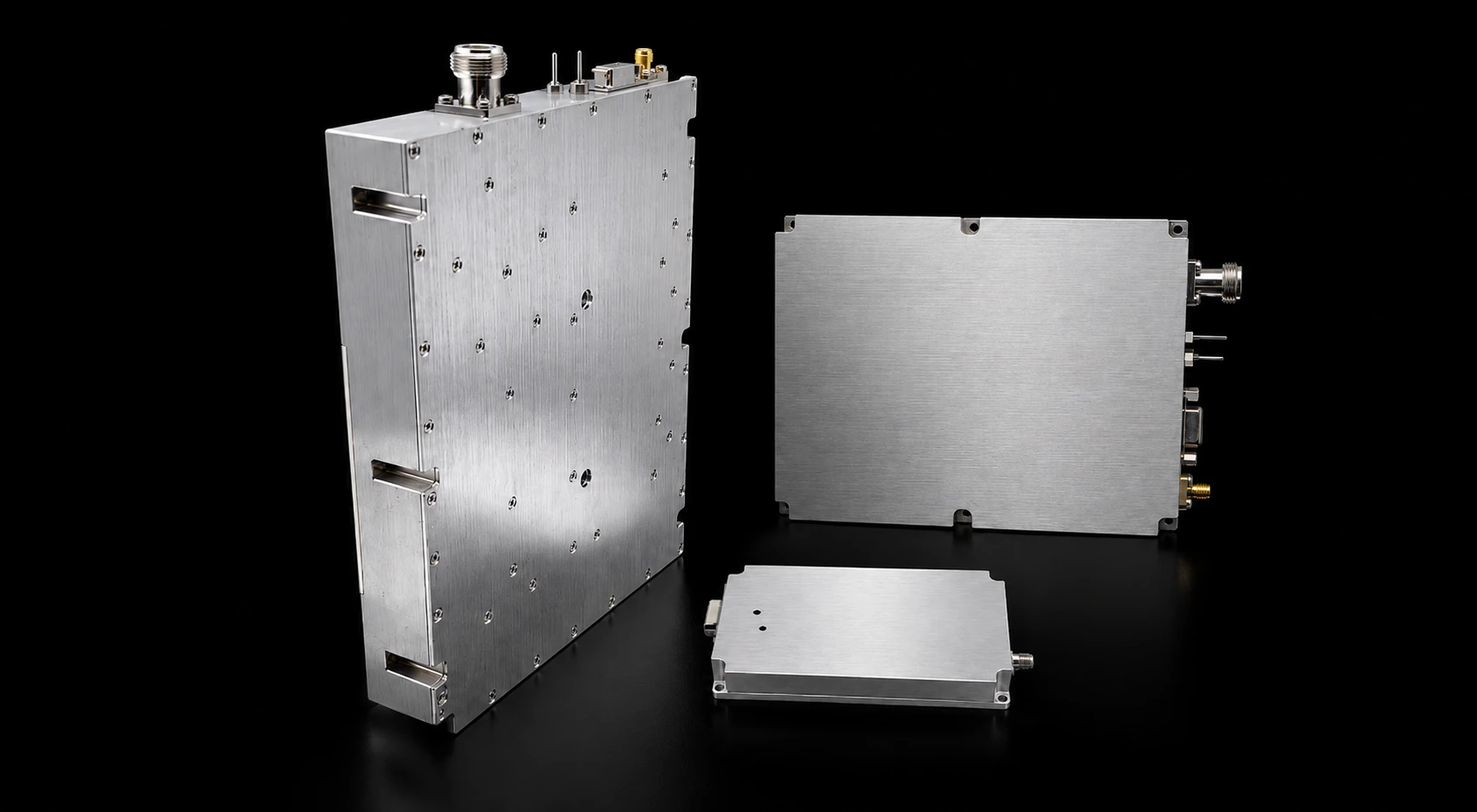
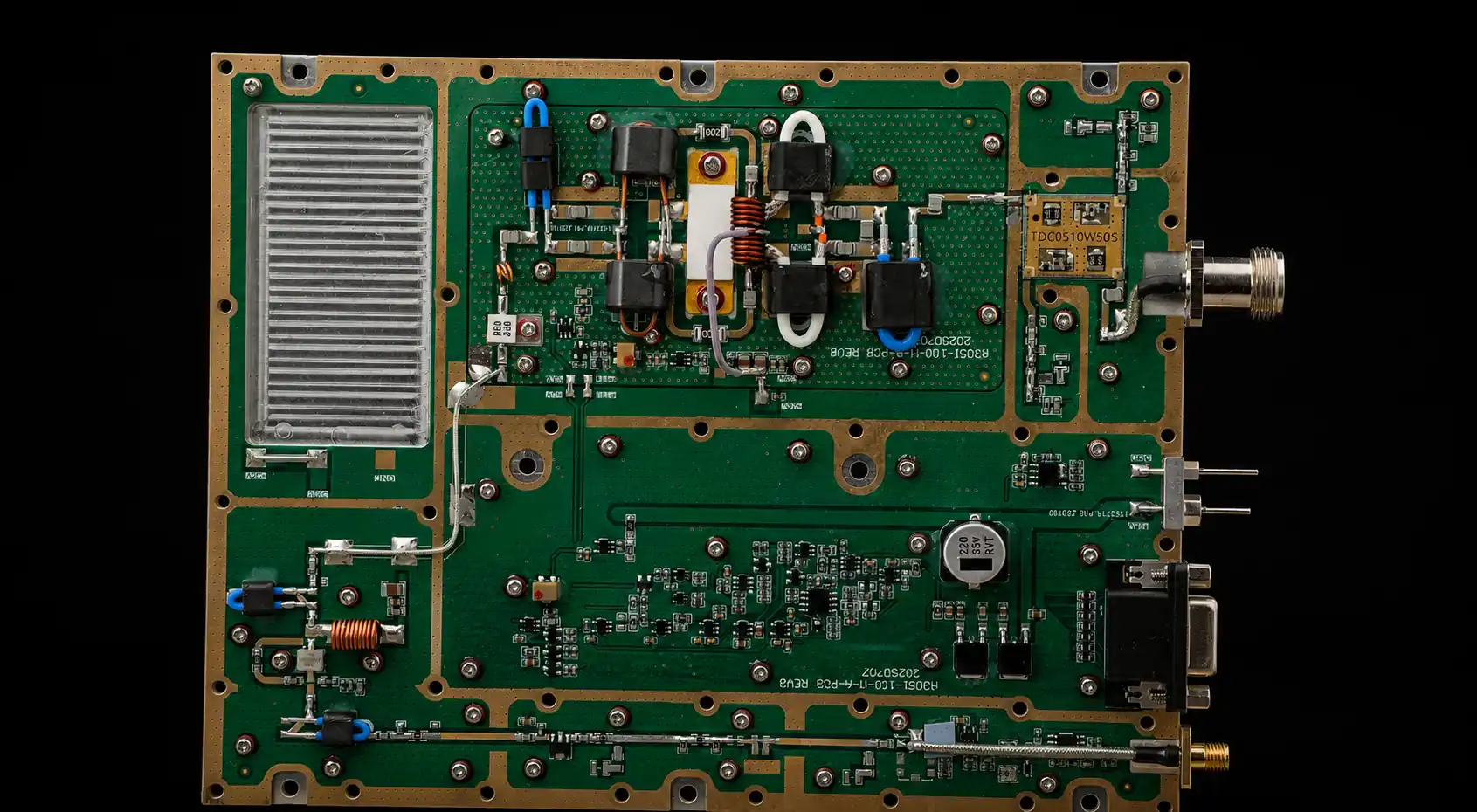
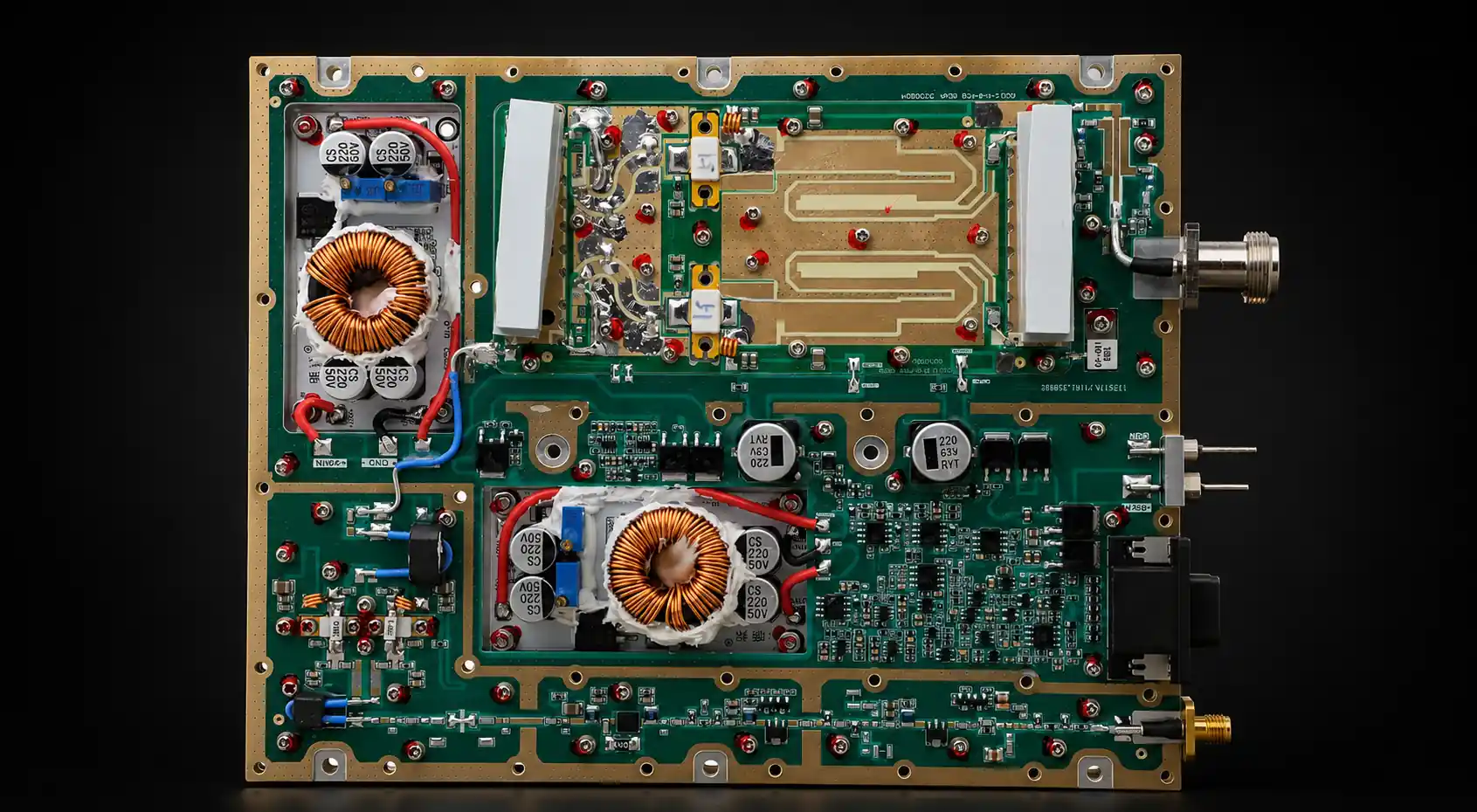
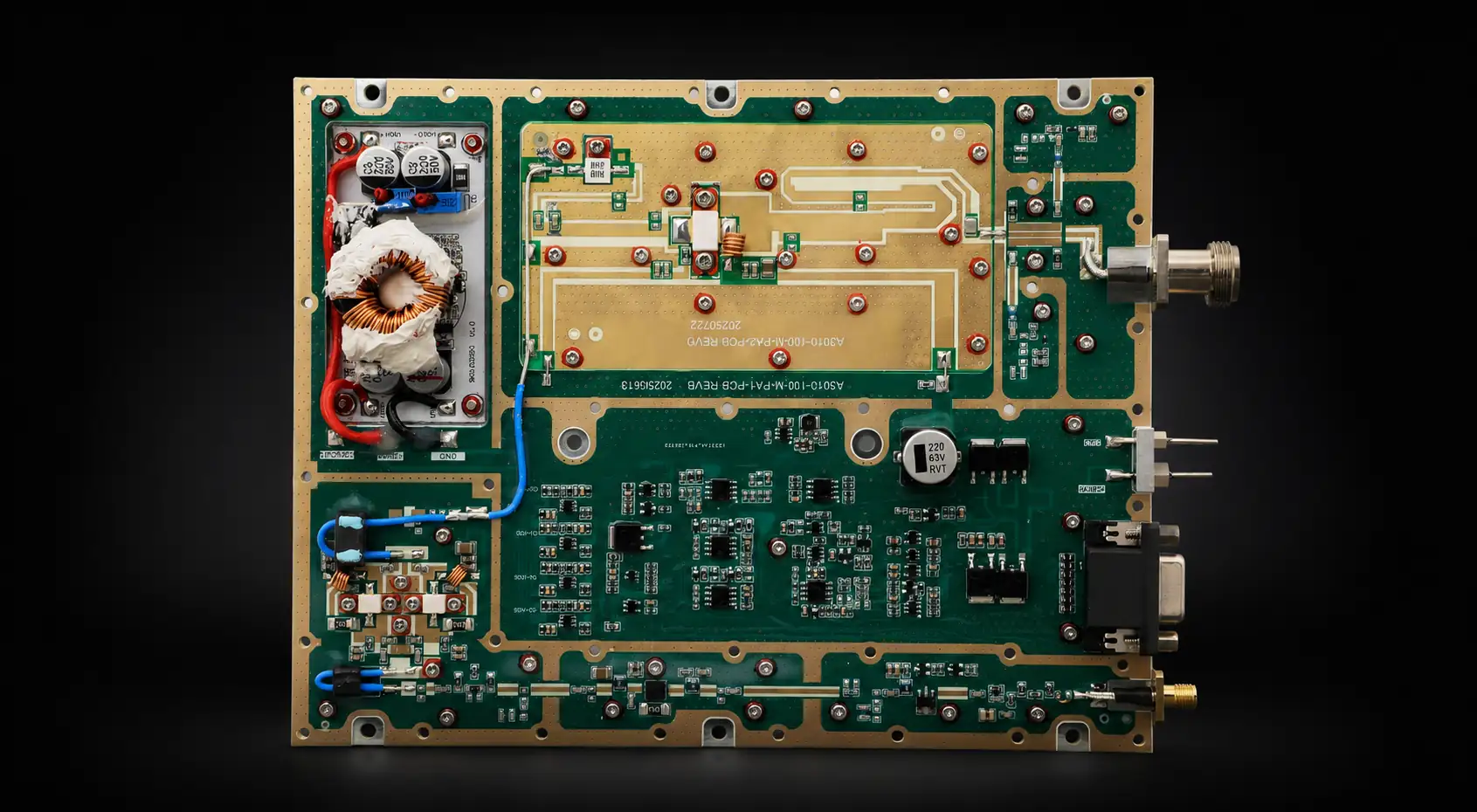


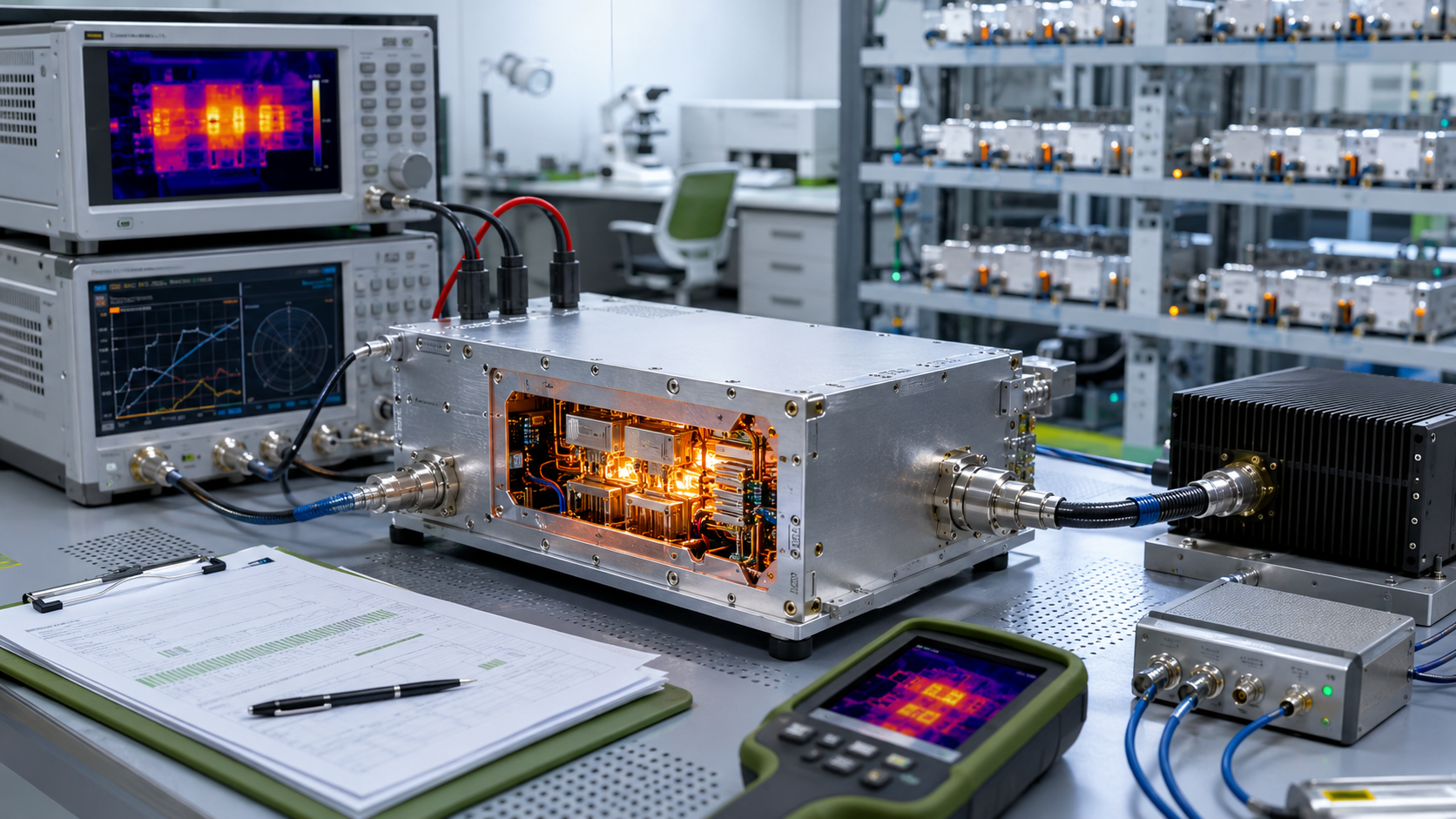
GaN device quality cannot be verified from the word “GaN,” a premium brand claim, or one cold output result. Buyers normally cannot inspect the semiconductor die directly, so approval must rely on evidence connecting the controlled device identity, incoming lot, assembly process, hot-state behavior, production spread, burn-in record, and delivered module serial number.
A module may reach rated output during a short test while later units show different current, gain, temperature, or protection behavior. These symptoms do not automatically prove a defective GaN device. Bias design, matching, package mounting, PCB grounding, thermal contact, assembly variation, and test conditions can produce similar results.
Before choosing custom RF Power Amplifier modules, define what the supplier controls before assembly, what is verified at finished-module level, and which records must remain traceable to every delivered S/N.
1. What the GaN Label Can—and Cannot—Prove
The word “GaN” identifies a semiconductor technology family. It does not prove that the production module matches the device, lot, manufacturing process, and operating condition used for the approved sample.
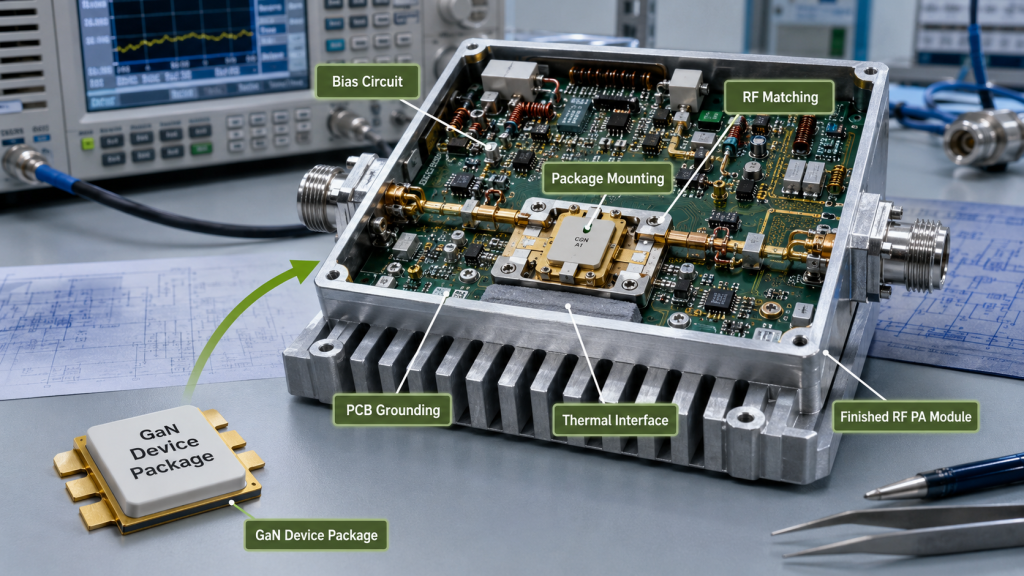
Three questions should guide the review:
- Is the approved device identity controlled?
- Is the module assembly process repeatable?
- Is production behavior consistent under the approved test boundary?
A positive answer to only one question is not enough.
A supplier may use a qualified GaN device but produce unstable modules because package mounting, bias routing, thermal contact, matching, or grounding varies. A module may also pass a cold output test while hot-state current or gain changes across production units.
The GaN label alone cannot prove:
- Device and lot traceability
- Incoming screening
- Assembly consistency
- Thermal integration
- Hot-state stability
- Batch consistency
- Burn-in performance
- Finished-module reliability
Buyers selecting frequency range, output power, duty cycle, and module architecture should use a separate GaN RF Power Amplifier module selection process. This page addresses whether the evidence is strong enough to approve the production condition.
Evidence Boundary: A module symptom may reveal GaN-related risk, but it does not prove that the GaN device is the root cause until the device identity, lot, assembly, bias, thermal path, and test conditions are reviewed together.
2. What Device and Lot Evidence Should Be Controlled?
GaN quality control begins before the device is mounted in the RF PA.
The controlled identity should include an approved manufacturer and part number or an equivalent supplier-controlled internal identity that remains traceable under the agreed confidentiality boundary.
The supplier does not need to disclose proprietary semiconductor or RF design details. It should still be able to prove that the production batch uses an approved device condition.

Controlled device identity
Useful evidence may include:
- Approved manufacturer or controlled source
- Exact part number or confidential internal identity
- Package type
- Lot or date code
- Incoming inspection record
- Approved alternative-device list
- Module S/N linkage
A Locked BOM is weak when it records only “GaN transistor.” It becomes meaningful when the approved identity, controlled alternatives, and engineering-change procedure are defined.
Lot and substitution control
The supplier should be able to answer:
- Which device condition was used in the Golden Sample?
- Which lot or date code was used in production?
- Were multiple lots mixed in one order?
- Were the same incoming limits applied?
- Was an alternative device introduced?
- Was the change reviewed and approved?
A different lot is not automatically a quality problem. An undocumented lot or uncontrolled substitution is a traceability problem.
If the exact commercial part number is confidential, the supplier may use an agreed internal code. That code must still connect the approved sample, incoming lot, BOM revision, production record, and delivered S/N.
Incoming screening
Incoming control should match the device, package, approved source, storage requirements, and manufacturing process.
It may include:
- Identity and marking verification
- Package inspection
- Lot or date-code confirmation
- Storage-condition review
- Approved parameter screening
- Rejection and quarantine records
General RF Power Amplifier incoming-part control should also cover filters, connectors, couplers, substrates, thermal materials, and other critical components. This article focuses on GaN-related evidence.
3. What Hot-State Module Data Can Reveal About GaN Risk
Hot-state output, current, gain, and temperature trends can expose behavior that a short cold test misses.
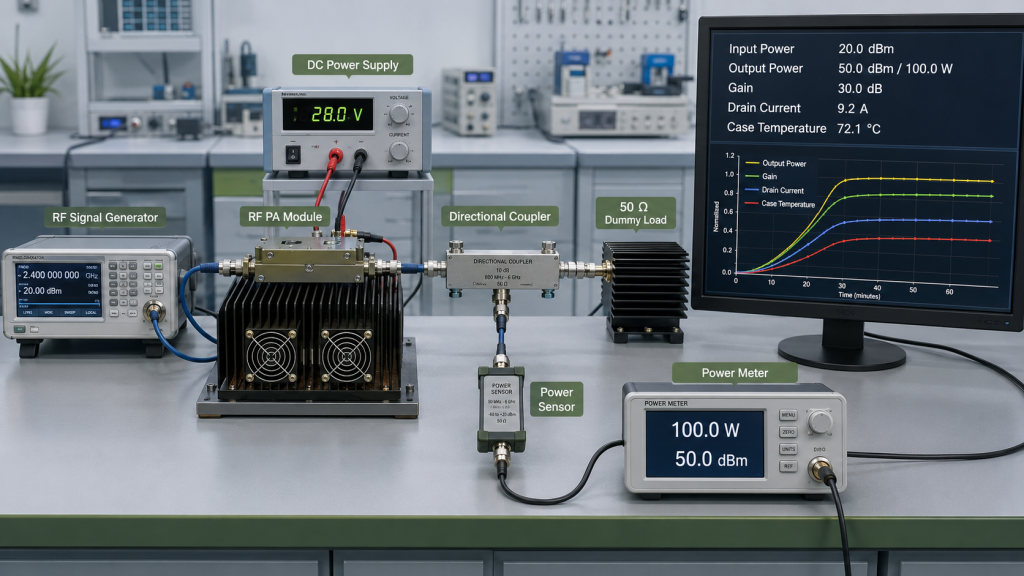
These are finished-module measurements. They reflect the combined effects of:
- Device condition
- Bias circuit
- Input and output matching
- PCB grounding
- Package mounting
- Thermal interface
- Cooling
- Supply voltage
- RF drive
- Load condition
- Measurement correction
Results should therefore be compared under the same frequency, RF drive, drain voltage, output target, load, cooling boundary, warm-up time, temperature reference, and correction method.
Output, gain, and current trends
Review output, gain, and drain current as the module reaches thermal stability.
Useful evidence includes:
- Output versus time
- Gain versus time
- Current versus time
- Band-edge behavior
- Recovery after stabilization
- Differences between multiple S/N units
Unexpected drift is a warning sign. It is not proof of a defective GaN die until the bias circuit, matching, supply path, assembly process, thermal contact, and device lot have been reviewed.
Threshold-voltage movement with temperature should not be treated as direct proof of poor GaN quality. The relevant question is whether the finished module remains inside its approved hot-state performance envelope.
Temperature evidence
Case or baseplate temperature does not directly prove channel temperature.
A channel-temperature estimate is meaningful only when the following are aligned:
- Device manufacturer’s thermal metric
- Temperature reference location
- Dissipated power
- Package and mounting condition
- Thermal-interface condition
- Calculation or modeling method
A qualified GaN device can still produce an unstable module when package mounting, grounding, thermal contact, or cooling is inconsistent.
The buyer does not need the complete PCB design. The supplier should provide sufficient RF PA thermal path verification and hot-state evidence to show that the approved condition is repeatable.
GaN Device Quality Evidence Map
| Review Area | Evidence to Request | Weak Evidence | What It Can Prove | What It Cannot Prove |
|---|---|---|---|---|
| Device identity | Approved source and traceable device identity | “Premium GaN” | Controlled production identity | Finished-module reliability |
| Lot control | Lot/date code linked to module S/N | No lot record | Traceability | Stability of every unit |
| Incoming screening | Method and acceptance limits | Visual check only | Device entry control | Assembly quality |
| Hot-state data | Output, gain, current, and temperature trends | One cold output point | Module stability trend | Device root cause alone |
| Batch comparison | Multiple S/N under the same setup | One Golden Sample | Production spread | Long-term lifetime alone |
| Burn-in | Time, load, trends, and S/N record | “Batch passed” | Early module weakness | Incoming lot control |
| Mismatch test | Defined load, VSWR, and response | “VSWR protected” | Finished-amplifier ruggedness | GaN quality alone |
4. How Batch Spread and Burn-In Expose Hidden Risk
One Golden Sample cannot prove a device lot or production batch.
Approval should follow three connected steps:
- Compare multiple S/N units.
- Run traceable burn-in.
- Connect the Golden Sample, device condition, BOM revision, process revision, and production S/N.
Compare multiple S/N units
Test multiple modules under the same operating and measurement boundary.
Review:
- Hot-state output spread
- Gain spread
- DC current spread
- Temperature spread
- Band-edge spread
- Protection-event spread
- Failure or rework rate
A narrow spread does not prove unlimited lifetime, but it shows whether production is repeating the approved condition.
A wide spread should trigger a review of the device lot, bias settings, matching parts, mounting, thermal contact, PCB assembly, rework history, and measurement setup.
Run traceable burn-in
RF PA batch burn-in can expose early module weakness through changes in output, current, gain, temperature, alarms, or recovery behavior.
The record should include:
- Test duration
- Frequency or frequency sequence
- Output and duty-cycle condition
- 28V voltage and current
- Temperature trend
- Fault events
- Before-and-after results
- Module S/N
Burn-in screens finished modules. It does not replace incoming-device control.
A questionable device lot should be stopped before assembly when possible, rather than discovered after completed modules require rework.
Connect the Golden Sample to production
The evidence chain should connect:
- Approved Golden Sample
- Controlled GaN identity and lot
- Locked BOM revision
- Assembly-process revision
- Production module S/N
- Hot-state result
- Burn-in record
- Final acceptance report
Without this connection, “same design as the sample” remains unsupported.
5. Why Mismatch and Real-Load Results Must Be Judged at Module Level
Mismatch tolerance is a property of the complete amplifier path, not the GaN device alone.
The result depends on the device operating boundary, bias, matching network, PCB, coupler accuracy, detection circuit, thermal state, protection logic, response time, load phase, and test frequency.
Controlled mismatch tests
A controlled mismatch or VSWR test is useful because the boundary can be repeated.
The report should identify:
- Frequency and forward-power level
- VSWR or reflection condition
- Load phase when controlled
- Test duration
- Module temperature
- Foldback or shutdown response
- Recovery behavior
- Post-test performance
This proves finished-amplifier behavior under the specified condition.
A statement such as “VSWR protected” does not prove detection accuracy, response time, foldback behavior, shutdown boundary, recovery logic, or repeatability across modules.
Detailed RF PA protection logic should be validated at finished-module level rather than used as direct evidence of GaN die quality.
Real antenna paths
A real antenna path can reveal effects from feeder loss, connectors, adapters, antenna mismatch, mounting, routing, and environmental conditions.
It is useful for installed-system validation but less suitable for isolated root-cause comparison because it adds variables.
Controlled loads and mismatch fixtures are better for repeatable module comparison. Real antenna testing is better for validating the deployed RF path.
Neither test should be described as direct proof of GaN device quality without traceable root-cause evidence.
6. What Evidence Should Approve, Review, or Hold the RFQ?
The final decision should use evidence from device entry through finished-module acceptance.
Approval evidence
The minimum evidence package should include:
- Controlled GaN identity under the agreed confidentiality boundary
- Package, source, and lot traceability
- Incoming screening method and limits
- Locked BOM and substitution control
- Golden Sample production condition
- Assembly-process revision
- Hot-state output, gain, current, and temperature data
- Multiple-S/N batch comparison
- Burn-in linked to S/N
- Controlled mismatch and protection result
- Final S/N-linked reliability report
Complete module verification should follow the same evidence discipline used for RF PA reliability testing before shipment.
| Decision | Typical Condition |
|---|---|
| Approve | Identity, lot, process, hot-state, batch, burn-in, and S/N evidence are complete and consistent |
| Review | Evidence exists, but one boundary, change, or abnormal trend needs investigation |
| Hold | Identity, substitution control, lot linkage, batch consistency, or S/N traceability is missing |
Review triggers
Keep the RFQ in Review when:
- Test conditions are not fully aligned.
- Batch spread is wider than expected.
- A device or process change occurred.
- Burn-in shows unexplained drift.
- A protection event lacks a complete recovery record.
- The Golden Sample condition differs from production.
Review means more evidence or root-cause work is required before approval.
Hold triggers
Keep the RFQ or batch on Hold when:
- The device identity is generic or untraceable.
- Substitutions can occur without engineering approval.
- Device lots cannot be linked to module S/N.
- Only one cold output result is available.
- Hot-state results lack a defined boundary.
- Batch spread is unknown.
- Burn-in records are not linked to S/N.
- Mismatch behavior is supported only by a feature claim.
- Test documents refer to different BOM or process revisions.
The buyer does not need every confidential semiconductor or PCB detail. The evidence must prove that the approved device condition, controlled process, and delivered batch remain connected.
Conclusion
A GaN label cannot approve an RF PA batch.
Module symptoms may reveal GaN-related risk, but they do not prove that the device is the root cause. Bias, matching, mounting, grounding, cooling, protection, and test conditions must be reviewed with the controlled device identity and lot.
Approval requires three things:
- Controlled and traceable device identity
- Repeatable module production
- Consistent S/N-linked test evidence
RF SKYPOWER can support early engineering review for GaN-based RF PA procurement. Send the required frequency range, output target, duty cycle, cooling boundary, load condition, module quantity, device-identity or substitution rules, batch-traceability requirement, hot-state test points, burn-in requirement, protection evidence, and S/N-linked report format.
Contact RF SKYPOWER before one undocumented GaN lot, uncontrolled substitution, or untraceable test record puts the complete RF PA batch into Review or Hold.