

C-UAS band mapping errors can lead to incorrect RF power amplifier (RF PA) control decisions when a detector’s frequency report and a controller’s channel record use different definitions or equipment identities. A channel may appear ready against the wrong detection event even when the hardware itself is functioning normally.
The cause may be a mismatched classification dictionary, an outdated configuration, or an incorrect association between a logical channel and a physical PA.
These problems have different consequences. A wrong display does not prove that a command reached the wrong module, and neither proves RF transmission. Engineers need to trace the original event, its meaning, and its equipment identity before deciding where the fault lies.
1. What Does a Detected Band Label Actually Prove?
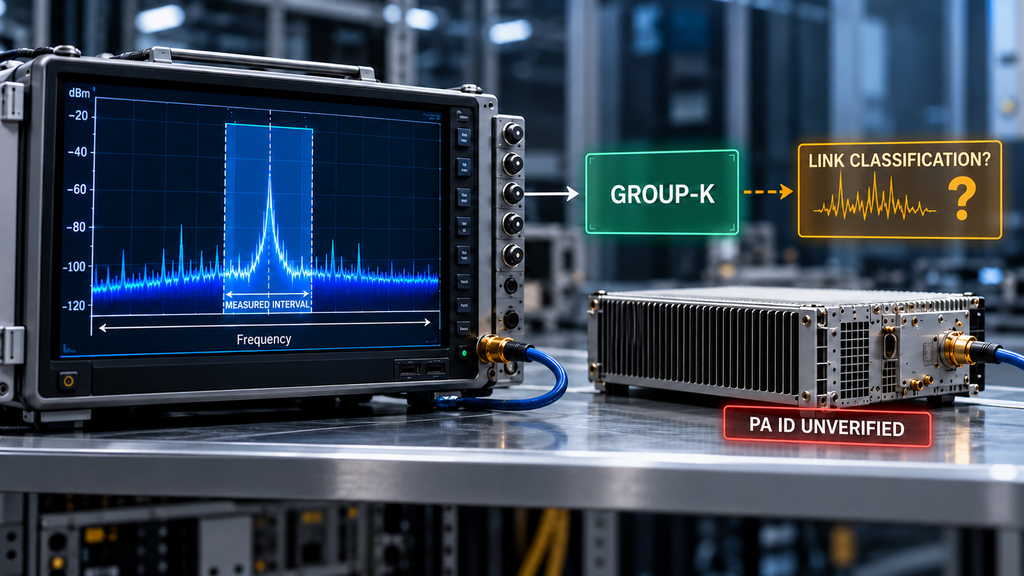
A band label records what the detector reported under its operating conditions. It does not guarantee that the classification is accurate or identify which physical PA should be associated with it.
The word band can refer to three different things.
A measured frequency interval describes a region of spectrum observed by the receiver, subject to its measurement method, resolution, and calibration.
A categorical band label groups observations according to a defined classification dictionary.
An inferred communication-link classification goes further, associating an observation with a possible signal or link type. That inference needs evidence beyond the raw spectral measurement.
Consider a detector that reports the synthetic identifier GROUP-K as a spectral category. A downstream controller recognizes the same identifier but interprets it using an older application-category definition.
Both devices display GROUP-K. Their records may nevertheless describe different things.
Band classification is not PA channel identity
A detection label describes an observation. A logical PA channel identifies a resource in the control system, while a physical PA identity identifies actual equipment.
These identities serve different purposes.
Published RF PA frequency coverage can be checked against approved frequency requirements, but that comparison cannot validate a detector’s classification of an incoming signal.
For a meaningful comparison, engineers need the reported label, its source, the applicable definition, and its validity context.
A measured interval and an inferred link classification cannot be treated as equivalent. Nor can two category names be compared reliably when their definitions are unknown.
If the source or definition cannot be established, the mapping remains unverified.
2. Where Can Band Mapping Lose Its Meaning?

During RF amplifier system integration, band mapping can become inconsistent if software translates or stores detection information without preserving its original meaning.
The failure may occur between fully functioning devices. Three areas deserve particular attention: representation, configuration version, and equipment identity.
Different representations may describe different concepts
A detector may report a measured frequency interval while another application stores only a category label.
The stored label contains less information. Unless its classification definition remains available, an engineer may be unable to reconstruct what the detector originally reported.
For example, an event record might retain GROUP-K but omit the dictionary that defined it. The message is still readable, yet its meaning is uncertain.
That is an information-evidence problem. It does not establish that the RF PA lacks the required frequency coverage.
A version mismatch requires a definition check
A detector might generate events using Dictionary Revision B while a controller interprets them using Revision A.
Different revisions do not necessarily mean different definitions.
The reviewer must establish which case applies:
- The definitions are equivalent, so the version difference does not invalidate that field relationship.
- The definitions differ, making the records semantically inconsistent.
- The definitions are unavailable, leaving equivalence unverified.
This distinction prevents a configuration difference from being incorrectly reported as a confirmed mapping failure.
Logical channels and physical modules can be confused
A supervisory interface may show logical channel CH-02, while the associated physical module is identified as PA-M02.
Suppose a monitoring record appears under CH-02 but identifies its source as PA-M05. The approved configuration, however, associates CH-02 with PA-M02.
The records disagree about equipment identity.
That finding does not establish that the controller sent a command to the wrong module. It only establishes the identity discrepancy present in the records.
Timing can create a similar ambiguity. A recent detection event displayed beside an older PA status may appear related even though the records describe different events or operating periods.
A valid comparison needs compatible definitions, traceable equipment identities, and records associated with the same event context. Without these, the relationship remains unresolved.
3. Why Can the Wrong PA Channel Appear Ready?
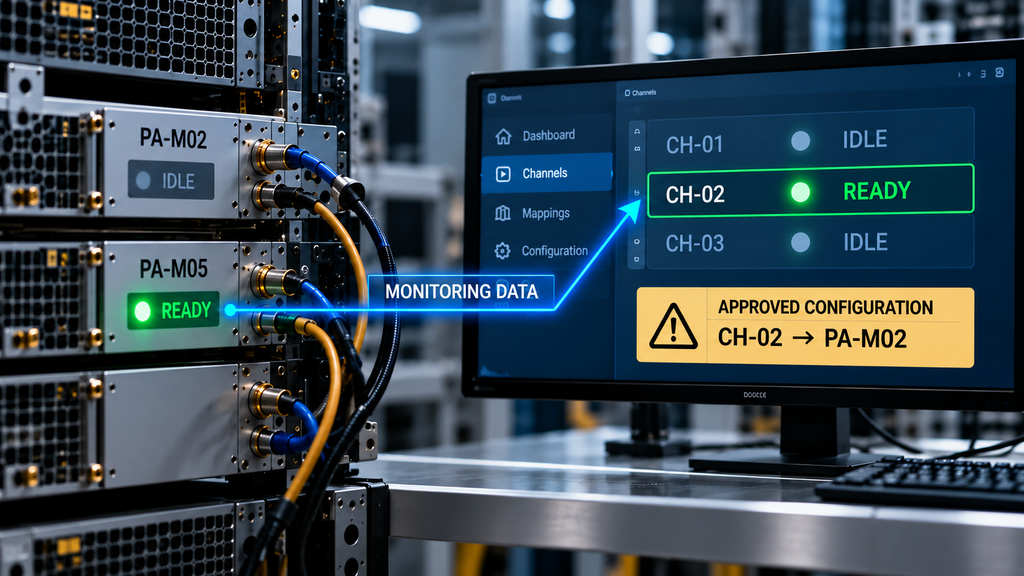
A controller may display a valid PA status under the wrong logical channel name. The reported state can be genuine even when the equipment association is incorrect.
Engineers must distinguish three outcomes: a display error, an incorrect control-target association, and an actual hardware action.
A display error may leave the control path unaffected
Imagine a monitoring interface showing a ready indication beside CH-B.
The status originated from a functioning module, but an outdated configuration associated that module with the wrong displayed channel.
Comparing the recorded source identity with the approved monitoring configuration can establish the discrepancy.
The finding concerns the display. The control path may use a separate identity mapping and may be unaffected.
Control requests and hardware actions need different evidence
A control-target mismatch requires records showing that a request was addressed to an endpoint different from its documented intended identity.
Even then, a recorded request establishes what the controller attempted, not what the hardware executed.
A command acknowledgement, an enable indication, RF PA status feedback, and measured RF output represent different forms of evidence. A recorded command response alone cannot prove that a subsequent hardware state change was completed.
For the current problem, the review should identify the strongest conclusion supported by the available records.
If they show only a display mismatch, the finding stops there. Claims about control requests, module state changes, or RF output require separate evidence.
4. How to Review Mapping Without Transmitting RF

A non-transmitting mapping review compares approved interface definitions and equipment identities with synthetic event records captured by the test software.
The purpose is to establish information consistency. The review must use an approved environment where RF transmission is independently prevented. A software-reported inhibited-output flag does not establish the physical RF state.
Compare expected and observed information
The approved reference defines the expected event fields, classification meanings, equipment identities, and test conditions.
The observed record shows what the simulated controller actually reported.
These must be distinguishable sources. They must also refer to the same event; being captured during the same test session is insufficient.
Matching dictionary revision labels alone are not enough. The field definitions applied by the observed record must be traceable to the approved reference.
Example mapping review
The following records are synthetic. They represent no actual RF SKYPOWER equipment, operating frequencies, transmission instructions, or measured RF results.
Fixtures F-01 and F-02 contain approved reference information. Logs L-01 and L-02 contain separate simulated observations.
| Synthetic event ID | Label / source | Field meaning / version | Device identity | Reported state / source | Configuration / log version | Observed agreement or difference | Open issue / responsible party |
|---|---|---|---|---|---|---|---|
| SIM-01 | F-01 and L-01: DS-01 / GROUP-K | Both use approved definition DEF-K01, Rev. B, with matching category meaning | F-01: CH-01 / PA-M01; L-01: same identity | Observation-only test. L-01 reports event receipt and a software inhibit flag; physical RF state not established | Both records share EVT-A01, use Rev. B, and fall within valid session W-01 | Event, definition, identity, and record context agree | No documentary discrepancy; integration reviewer |
| SIM-02 | F-02 and L-02: DS-02 / GROUP-L | Producer Rev. B; controller Rev. A; semantic equivalence unknown | F-02: CH-02 / PA-M02; L-02: CH-02 / PA-M05 | Observation-only test. L-02 records a simulated event; physical RF state not established | Both records share EVT-A02; dictionary revisions differ; session W-02 | Equipment identity differs; category equivalence unverified | Configuration owner: identity conflict. Interface owner: definition review |
SIM-01 supports a limited consistency conclusion. Both records refer to event EVT-A01, use the same approved classification definition DEF-K01, and identify the same equipment. Their applicable record context also agrees.
This demonstrates consistency within the synthetic information review, not actual PA operation.
SIM-02 contains two separate findings. The recorded physical equipment identity conflicts with the approved reference. The category definition remains unresolved because Revision A and Revision B have not been compared for the relevant field.
Neither finding establishes that a module was activated.
Record the result without overstating it
A review can produce three outcomes.
Consistent within scope: The relevant definitions, identities, event references, and recorded values agree with the approved reference.
Inconsistent: The evidence demonstrates a specific conflict.
Inconclusive: Missing information prevents a reliable comparison.
These outcomes may coexist across different fields. SIM-02 has an established equipment identity discrepancy and an unresolved classification-definition question.
The final record should preserve both findings.
Non-transmitting verification can establish the consistency of recorded information. Actual RF power, antenna-end performance, and operational C-UAS effectiveness require separate evidence and appropriate authorization.
5. What Evidence Separates Mapping and Hardware Faults?

A mapping discrepancy does not establish a hardware fault.
Interface specifications define what fields mean. Configuration files document intended equipment relationships. Logs record what software reported.
These sources support information-level findings.
Hardware performance requires different evidence: an identifiable module, defined operating conditions, an appropriate test method, and a known measurement reference plane.
A measurement at the PA output connector, for example, does not establish antenna-end power. Nor does a single-frequency or cold-state result demonstrate full-band, hot-state performance.
A satisfactory standalone module test also cannot prove that the integrated controller correctly associates detection events with that module.
When should the hardware judgment stop?
If the records show an incorrect displayed identity, the supported finding is an information-association discrepancy.
If authoritative control records show an incorrect requested endpoint, the finding concerns the control request.
Neither automatically proves hardware failure.
A matching software channel label cannot confirm the installed cabinet RF routing; the physical path requires separate verification.
When evidence is insufficient, record the confirmed discrepancy, the unresolved possibilities, and the information needed to investigate further. Do not assign a hardware fault before the supporting evidence exists.
6. How to Record Mapping Acceptance and RFQ Needs

A mapping acceptance record should state which information relationships were examined, what evidence supports the result, and which issues remain unresolved.
The review outcome must stay within the approved test scope. A consistent software record does not constitute full system acceptance.
Assign the evidence to the responsible party
The detection-system supplier or responsible integrator should define the reported event information and its source.
The control-software owner should document how that information is interpreted, including applicable configuration versions and traceable records.
The RF PA supplier should provide the module-level interface documentation, equipment identity, product specifications, and supporting evidence within its agreed scope.
The customer or qualified system integrator must determine whether the combined evidence meets the project’s formal acceptance requirements.
For example, a serial-number-linked RF amplifier test report may substantiate results for a particular unit under defined conditions. It does not demonstrate that the controller correctly interprets every detection event.
Turn unresolved issues into RFQ requirements
A useful technical inquiry should identify the application, relevant PA configuration, required control interface, status definitions, applicable revisions, and module-level evidence needed for review.
If an integration discrepancy remains open, the inquiry should also identify which information the module supplier can provide and what must come from the software or system-integration team.
This makes compatibility a defined engineering question rather than a general product claim.
RF SKYPOWER’s RF power amplifier modules should be evaluated against the project’s control-interface and operating requirements rather than assumed compatible based on product category alone.
[PRODUCT ROUTING TABLE PLACEHOLDER]
A drone jammer module may satisfy its own component specifications while the complete C-UAS system still requires separate interface verification and acceptance evidence.
Supplier documentation should support the specific module-level decision being made. System-level verification remains the responsibility of the appropriate integration and acceptance team.
Conclusion
C-UAS band mapping errors can undermine PA control decisions when detection labels, classification definitions, or equipment identities are interpreted inconsistently across system interfaces.
A valid review requires traceable event identities, compatible field definitions, and records that distinguish approved expectations from observed information. It can establish information consistency within the tested scope, but it cannot independently verify actual RF output, specific model suitability, or complete system performance.
The main risk is treating a normal controller status as proof that the correct physical PA and RF path have been verified.
Before requesting a supplier review, gather the relevant interface definitions, equipment identity records, configuration versions, synthetic review results, and unresolved discrepancies. This provides a basis for assigning each issue to the appropriate engineering team.
To discuss interface support and technical evidence requirements, contact the RF SKYPOWER engineering team with the relevant product configuration, control-interface definitions, and project conditions.