




RF PA coverage should be planned by converting a project-approved frequency-requirement inventory into required frequency points, PA-path assignments, antenna paths, output reference planes, operating relationships, and verification requirements before module selection begins.
The project inventory should be prepared within the applicable legal, regulatory, and site-specific boundary. Project approval of the matrix does not replace any legal authority required for operation.
A list such as 900 MHz, 1.2 GHz, 1.5 GHz, 2.4 GHz, and 5.8 GHz is only an illustrative starting point. It does not show why each point exists, whether it is required or protected, whether points operate simultaneously or sequentially, which PA path should support them, where output must be verified, or what evidence is required before approval.
In this article, RF PA frequency coverage means the project mapping between approved frequency requirements and the PA paths assigned to support them. It does not by itself prove spatial antenna coverage, operational effectiveness, legal authorization, or complete system performance.
Frequency inclusion, PA-level qualification, installed-path qualification, and spatial coverage are separate engineering boundaries.
Before comparing Wideband RF Power Amplifier Modules, engineers should first build a controlled coverage matrix that explains what must be supported, how each requirement operates, where it must be measured, and what still requires verification.
1. What an RF PA Frequency Coverage Map Actually Defines
An RF PA frequency coverage map is not a list of every frequency that appears inside a module datasheet.
It is a controlled project document that connects:
- A project-approved frequency requirement
- A required frequency point or window
- Its project status
- Its simultaneous, sequential, switched, or mutually exclusive operating relationship
- A candidate, selected, verified, or accepted PA path
- The associated RF and antenna path
- The output reference plane
- The qualification and evidence status
Several different engineering questions are often compressed into the word “coverage.” They should be kept separate.
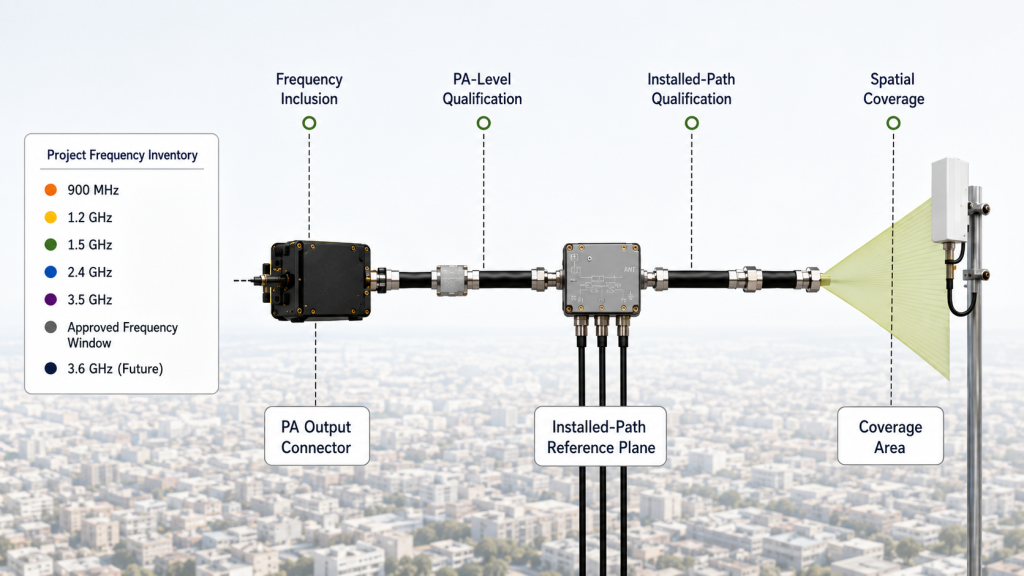
Frequency Inclusion
Frequency inclusion asks:
Does the required point or window fall inside the declared hardware frequency range?
This is only the first screening step.
A point can appear inside the nominal PA range and still fail its required output, input-drive, operating-point, thermal, load, duty, or protection condition.
Hardware frequency capability also does not mean that every frequency is enabled, configured, tested, accepted, or authorized for operation.
PA-Level Qualification
PA-level qualification asks:
Does the required point pass at the PA output under the agreed input drive, operating point, waveform, bandwidth, duty condition, PA-terminal voltage, load, thermal state, reference-plane correction, and acceptance rule?
The result should define whether it represents, for example:
- Linear operation
- A specified compression point
- Saturated operation
- Backed-off modulated operation
- Continuous or pulsed duty
- Peak, average, or integrated channel power
A frequency label alone cannot prove this boundary.
Installed-Path Qualification
Installed-path qualification asks:
Does the complete RF path deliver the required result at the cabinet output, feeder end, or antenna input under the agreed installed condition?
This boundary may include:
- Feeders and connectors
- Switches and filters
- Splitters or combiners
- Directional couplers
- Antenna matching
- DC distribution loss
- Installed cooling
- Protection behavior
A PA may pass at its own output connector while the downstream result fails because of the installed path.
Spatial Coverage
Spatial coverage asks whether the antenna system and site arrangement support the required physical area.
It depends on factors such as antenna pattern, gain, polarization, mounting, sector layout, obstructions, site geometry, propagation, and protected-zone boundaries.
A frequency coverage matrix may identify the intended antenna path, but it does not prove spatial coverage.
For the wider selection workflow, the C-UAS RF PA selection process should use the completed matrix as an input rather than starting from wattage or the widest available hardware range.
2. How to Build the Map from a Project-Approved Inventory
The first input should be a project-approved frequency-requirement inventory, not a generic list of common drone frequencies.
The final requirements should come from:
- Project engineering approval
- Applicable legal and regulatory limits
- Regional spectrum conditions
- Site review
- Integrator-defined operating boundaries
- Protected-system requirements
- Future expansion planning
The frequency points in this article are illustrative planning examples. They should not be treated as a universal link map for every airport, country, platform, or C-UAS project.
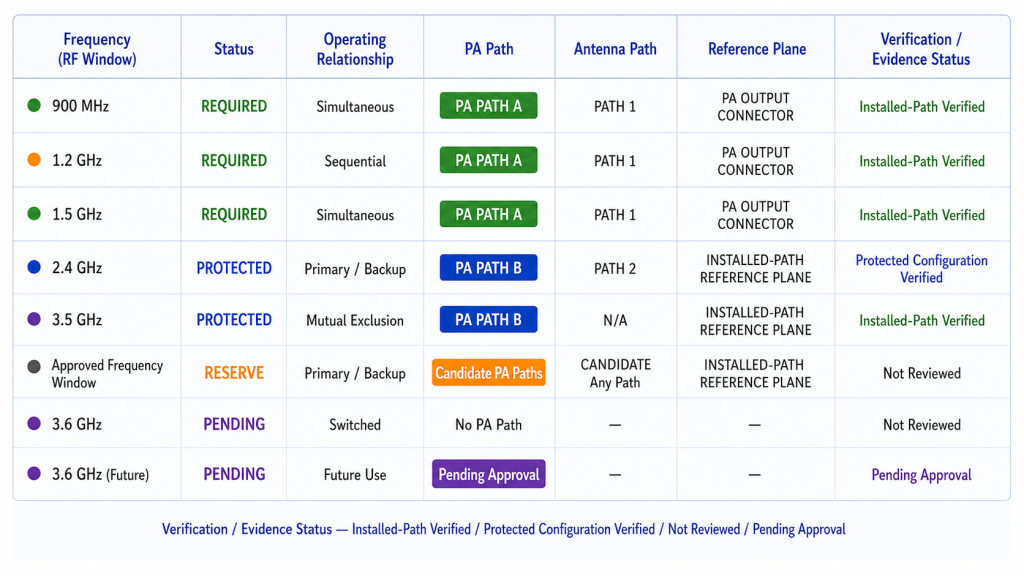
Start with the Requirement, Not the Product
Each entry should explain why the frequency requirement exists.
Depending on the project, an entry may relate to:
- A control or command requirement
- A telemetry or data requirement
- A video-related requirement
- A navigation-related requirement
- A protected site communication
- A future reserve requirement
- An excluded frequency or window
The purpose is not to publish an operating guide.
The purpose is to make sure every project-approved requirement has a clear engineering status before PA paths are selected.
Assign a Status to Every Entry
Each point or window should be classified as:
- Required — must be supported and qualified
- Protected — requires an explicit exclusion, guard-band, filtering, control, interlock, or authorization rule before any PA-path assignment is approved
- Excluded — deliberately outside the project scope
- Reserve — may be required in a later project phase
- Pending — awaiting legal, project, or engineering approval
A protected entry should not be treated as an active output requirement unless the applicable project authority explicitly defines that operating condition.
Status determines whether a frequency enters PA allocation, remains prohibited or restricted, is reserved for later use, or awaits further approval.
Define Points and Windows Precisely
The matrix should distinguish between:
- One fixed point
- A narrow operating window
- Several discrete selectable points
- A continuously tunable range
- A future reserve band
This difference affects:
- PA-path grouping
- Test-point density
- Filter and switch design
- Antenna-path assignment
- Gap and overlap review
- Control logic
- Acceptance evidence
A requirement written only as “2.4 GHz coverage” may be too vague.
The project may instead require:
- One defined point
- Several approved channels
- A limited sub-band
- A wider tunable window
The matrix should preserve that distinction.
Define the Operating Relationship
The matrix must also state how different points or windows relate during operation.
They may be:
- Simultaneous
- Sequential
- Switched
- Mutually exclusive
- Primary and backup
- Active and reserve
Two frequency points may fall inside the same PA hardware range but still require separate paths when they need simultaneous output, independent control, different antennas, different waveforms, or greater isolation.
Link-to-PA Frequency Coverage Matrix
| Field | What It Should Define |
|---|---|
| Project-approved requirement | Why the frequency point or window exists |
| Required point/window | The exact electrical requirement |
| Project status | Required, protected, excluded, reserve, or pending |
| Operating relationship | Simultaneous, sequential, switched, mutually exclusive, primary, or backup |
| Waveform and bandwidth | CW, pulsed, modulated, channel bandwidth, or other approved condition |
| PA-path assignment | Candidate, selected, verified, or accepted PA path |
| Antenna/RF path | Cabinet, switch, filter, feeder, and antenna route |
| Output reference plane | PA port, cabinet output, feeder end, or antenna input |
| Verification requirement | What must be measured or reviewed |
| Evidence status and identity | Status, report ID, PA serial number, revision, and test date |
| Gap/edge note | Transition, overlap, gap, or band-edge risk |
| Expansion note | Future points, cabinet reserve, or backup-path requirement |
The matrix should remain a controlled engineering record.
Moving one entry from reserve to required may change:
- PA-path allocation
- Antenna count
- Switching architecture
- Isolation requirements
- Cooling load
- DC distribution
- Control logic
- Verification scope
3. How to Group Required Points into PA Paths
Once the approved points, windows, statuses, and operating relationships are known, engineers can group compatible requirements into candidate PA paths.
The objective is not to use the fewest or the greatest possible number of modules.
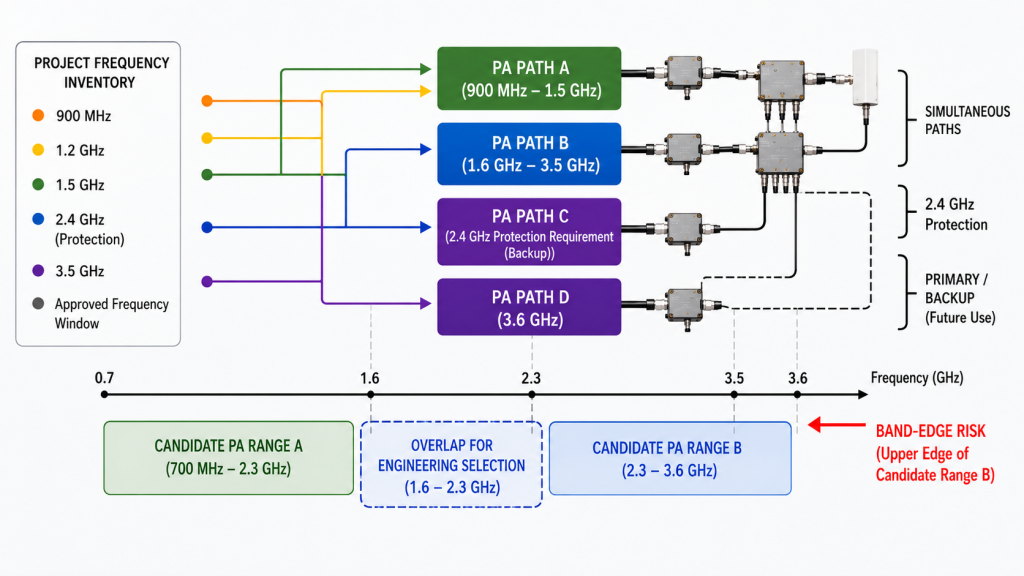
The objective is to group points without hiding:
- Output variation
- Input-drive limits
- Waveform or bandwidth conflicts
- Simultaneous-operation requirements
- Switching or isolation risks
- Band-edge weakness
- Frequency gaps
- Antenna incompatibility
- Thermal load
- Protection interaction
- Installed-path loss
Group by Compatibility, Not Module Count
A single wideband path may simplify mechanical integration, cabling, control interfaces, and spare-part planning. However, it should not be selected when grouped points require incompatible output, waveform, antenna, filtering, isolation, thermal, protection, or verification conditions.
Several narrower paths may improve band-specific control and isolation but increase switching, DC distribution, cabinet volume, connector count, integration effort, and maintenance complexity.
The grouping decision should therefore ask whether the required points can share the same:
- Output target
- Input-drive boundary
- Operating point
- Waveform and bandwidth
- Simultaneous or sequential operating state
- Switching and control state
- Isolation requirement
- Antenna and RF path
- Thermal and duty condition
- Protection strategy
- Verification method
The RF PA frequency range selection should begin only after these compatibility conditions are visible.
Do Not Let Available Products Define the Requirement
A common mistake is to begin with several available PA ranges and force the project requirements into them.
The correct order is:
- Confirm the project-approved inventory.
- Define required points and windows.
- Assign their status and operating relationship.
- Group compatible requirements.
- Compare candidate PA ranges.
- Verify PA-level and installed-path behavior.
Available product ranges can support the decision, but they should not replace the project requirement.
Flag Edge and Transition Risks Early
The matrix should identify when a required point is:
- Near the lower edge of one candidate PA
- Near the upper edge of another PA
- Inside an overlap region
- Between two declared module ranges
- Near a filter or switch transition
- Dependent on a future expansion path
A higher-frequency requirement may have greater feeder or connector loss. However, whether it is also a PA band-edge risk depends on the selected module range and system path.
Do not classify a point as an edge risk only because its absolute frequency is high.
Allow for Redundant Paths
Every required point should have at least one clear and qualified path.
Where redundancy is required, the matrix should identify:
- Primary path
- Backup path
- Shared or independent antenna path
- Switching condition
- Failure state
- Qualification status for each path
A backup path should not be treated as qualified only because the primary path passed.
4. How Antenna Paths and Reference Planes Change the Map
PA frequency inclusion does not prove that the installed antenna path can support the same range.
Each PA-path assignment should therefore be connected to a defined RF and antenna path.
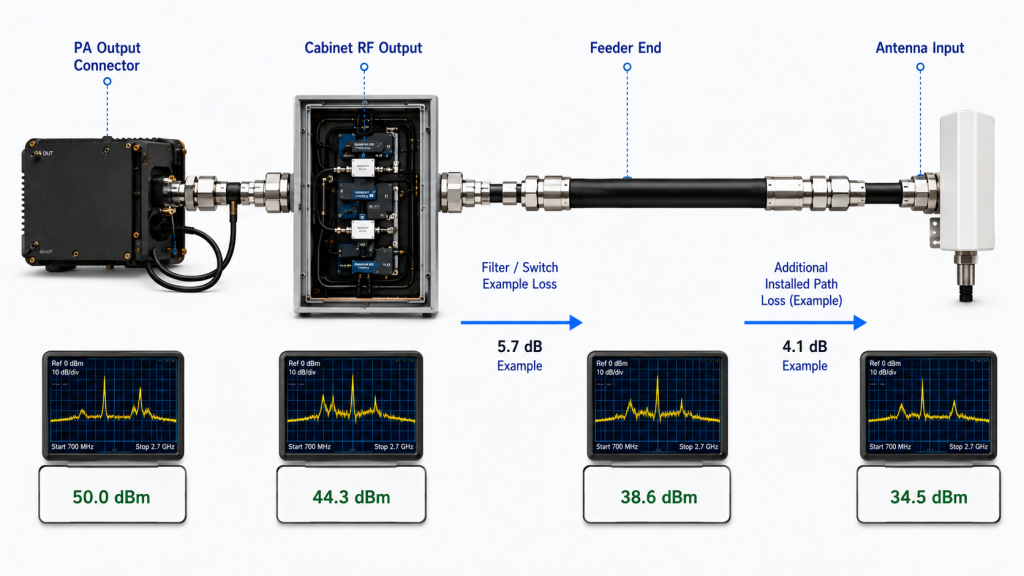
Define the RF and Antenna Path
The matrix should identify whether the PA path connects to:
- One dedicated antenna
- A multiband antenna
- A switched antenna group
- A splitter or combiner network
- A sector antenna
- A distributed feeder path
- A primary or backup antenna route
This matters because the passive and antenna path may have a narrower qualified range than the PA hardware.
A PA may support a frequency electrically while a selected filter, switch, cable, connector, or antenna path does not.
Define the Output Reference Plane
Every required point should identify where its output requirement applies:
- PA output connector
- Cabinet RF output
- Feeder end
- Antenna input
These values are not interchangeable.
An antenna-input requirement must include the installed loss between the PA and antenna. A PA-port result should not be presented as an antenna-input result without an approved correction or direct measurement.
The matrix should not list one general output value without stating the reference plane.
Keep Frequency Mapping Separate from Spatial Coverage
A PA-to-antenna assignment does not prove coverage around the site.
Spatial performance requires separate review of:
- Antenna pattern and gain
- Direction and polarization
- Mounting and sector layout
- Site geometry and obstructions
- Local propagation
- Protected-area boundaries
The matrix may identify which antenna path supports a frequency requirement, but it should not claim that RF PA frequency inclusion has proved spatial performance.
Avoid Unnecessary Frequency Span
A PA or antenna path may have hardware capability beyond the approved project requirement.
That wider capability does not mean every frequency is:
- Enabled
- Configured
- Tested
- Accepted
- Authorized for operation
However, unnecessary hardware span may widen:
- Filtering requirements
- Control and inhibit logic
- Protection review
- Antenna compromise
- Verification scope
The approved operating range should remain controlled by the project configuration, not inferred from the maximum hardware capability.
The correct target is not the widest possible frequency span.
It is a controlled and verifiable path aligned with the approved requirement.
5. How to Turn the Coverage Map into Verification Points
The matrix is not complete until every required PA-path assignment has a defined qualification status.
At minimum, the project should identify:
- Exact frequency point or window
- Assigned PA path
- Operating relationship
- Waveform and bandwidth
- Output reference plane
- Minimum output requirement
- RF input and operating point
- PA-terminal voltage
- Load or antenna-path condition
- Thermal and duty requirement
- Measurement correction
- Acceptance rule
- Evidence identity
The matrix does not need to reproduce the complete test procedure. It should show what must be passed and which evidence proves it.
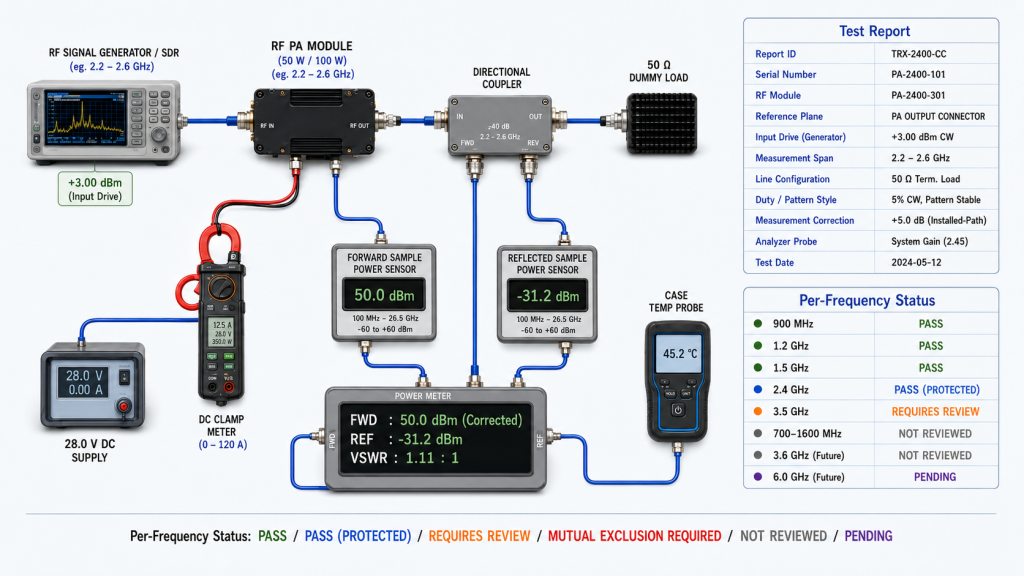
Separate Selection from Qualification
The coverage matrix answers:
Which PA path is assigned to this requirement?
Qualification answers:
Does that path pass under the agreed electrical, thermal, load, and measurement condition?
The RF PA frequency range verification should therefore follow the mapping stage.
A point should not be marked as qualified only because:
- It is inside the nominal hardware range
- It appears on a supplier brochure
- It passed at one center frequency
- Another nearby point passed
- A calculated value appears acceptable
Flag Gaps, Overlaps, and Transitions
When multiple PA paths are used, the matrix should identify:
- Uncovered gaps
- Overlap regions
- Shared antenna-path transitions
- Switch or filter boundaries
- Different output targets across adjacent paths
- Different test conditions across modules
- Primary and backup transition behavior
A separate RF PA frequency-gap review may be needed when a required window sits near the boundary between two PA paths.
The objective is not to force every adjacent PA range to overlap.
The objective is to prove that every required point has at least one clear and qualified path and that any required backup path has its own verified status.
Record Status and Evidence Identity
A useful qualification status may include:
- Not reviewed
- Supplier data only
- Calculated
- Bench verified
- Hot-state verified
- Installed-path verified
- Accepted
- Failed
- Retest required
The status should be linked to evidence identity, including where applicable:
- Test report ID
- PA serial number
- Hardware or BOM revision
- Test date
- Reference plane
- Acceptance authority
This prevents a result from one unit, configuration, or report revision from being applied automatically to another.
What to Include in the RFQ
An RFQ should not request only:
Several RF PA modules covering 900 MHz to 5.8 GHz
That wording does not define:
- Which points are required
- Which are protected or excluded
- Whether they operate simultaneously or sequentially
- Whether they use fixed points or tunable windows
- How many PA and antenna paths are required
- What isolation or switching is needed
- Where output must be measured
- Which evidence must be linked to each unit
RF PA Frequency Coverage RFQ Checklist
| RFQ Item | Required Project Input |
|---|---|
| Project-approved inventory | Approved points and windows within the applicable legal boundary |
| Project status | Required, protected, excluded, reserve, or pending |
| Requirement category | The engineering reason for each entry |
| Operating relationship | Simultaneous, sequential, switched, mutually exclusive, primary, or backup |
| Waveform and bandwidth | Approved waveform, bandwidth, duty, and reported power condition |
| PA-path grouping | Which compatible requirements may share one path |
| Switching and isolation | Required control state, isolation, interlock, or inhibit behavior |
| Output requirement | Minimum output, operating point, and reference plane |
| Antenna/RF path | Planned filter, switch, feeder, and antenna assignment |
| Thermal and supply condition | PA-terminal voltage, cooling, duty, and hot-state boundary |
| Edge/gap status | PA, filter, switch, or path-transition risk |
| Qualification level | Supplier data, bench, hot-state, installed-path, or acceptance test |
| Evidence identity | Report ID, serial number, revision, and test date |
| Expansion and redundancy | Reserve frequencies, cabinet paths, primary and backup requirements |
RF SKYPOWER can support an early engineering review before the PA-path allocation and RFQ are locked.
For the review, provide:
- Project-approved required, protected, and reserve frequencies
- Fixed points or frequency windows
- Simultaneous, sequential, switched, or backup operating relationships
- Waveform, bandwidth, output, duty, and thermal conditions
- Proposed PA and antenna-path assignments
- Required output reference plane
- Switching, isolation, and protection requirements
- Edge, gap, overlap, or redundancy concerns
- Required test level and evidence format
- Future expansion assumptions
These inputs help separate hardware frequency capability, enabled operating range, PA-level qualification, installed-path qualification, and spatial coverage before quotation and integration.
Conclusion
RF PA frequency coverage should not begin with the widest available module.
It should begin with a project-approved frequency-requirement inventory, followed by compatible PA-path grouping, RF and antenna-path assignment, reference-plane definition, and traceable qualification evidence.
The correct order is:
Requirement inventory first, coverage matrix second, PA selection third.
This sequence helps system integrators avoid missing required points, mishandling protected frequencies, grouping incompatible simultaneous requirements, hiding band-edge or gap risks, confusing hardware capability with enabled operation, and treating nominal PA range as completed system evidence.
Submit the RF PA frequency coverage matrix to the RF SKYPOWER engineering team.