
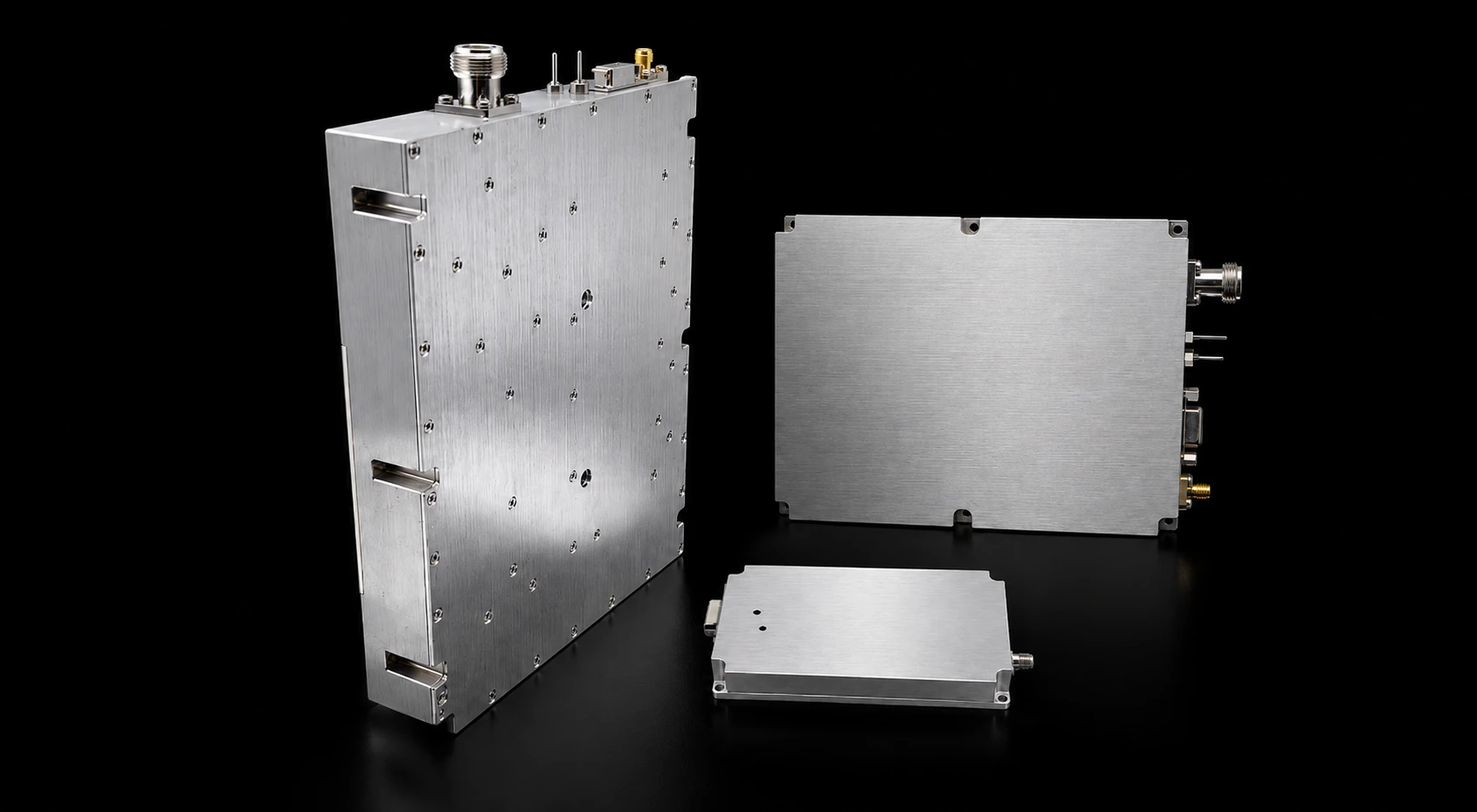
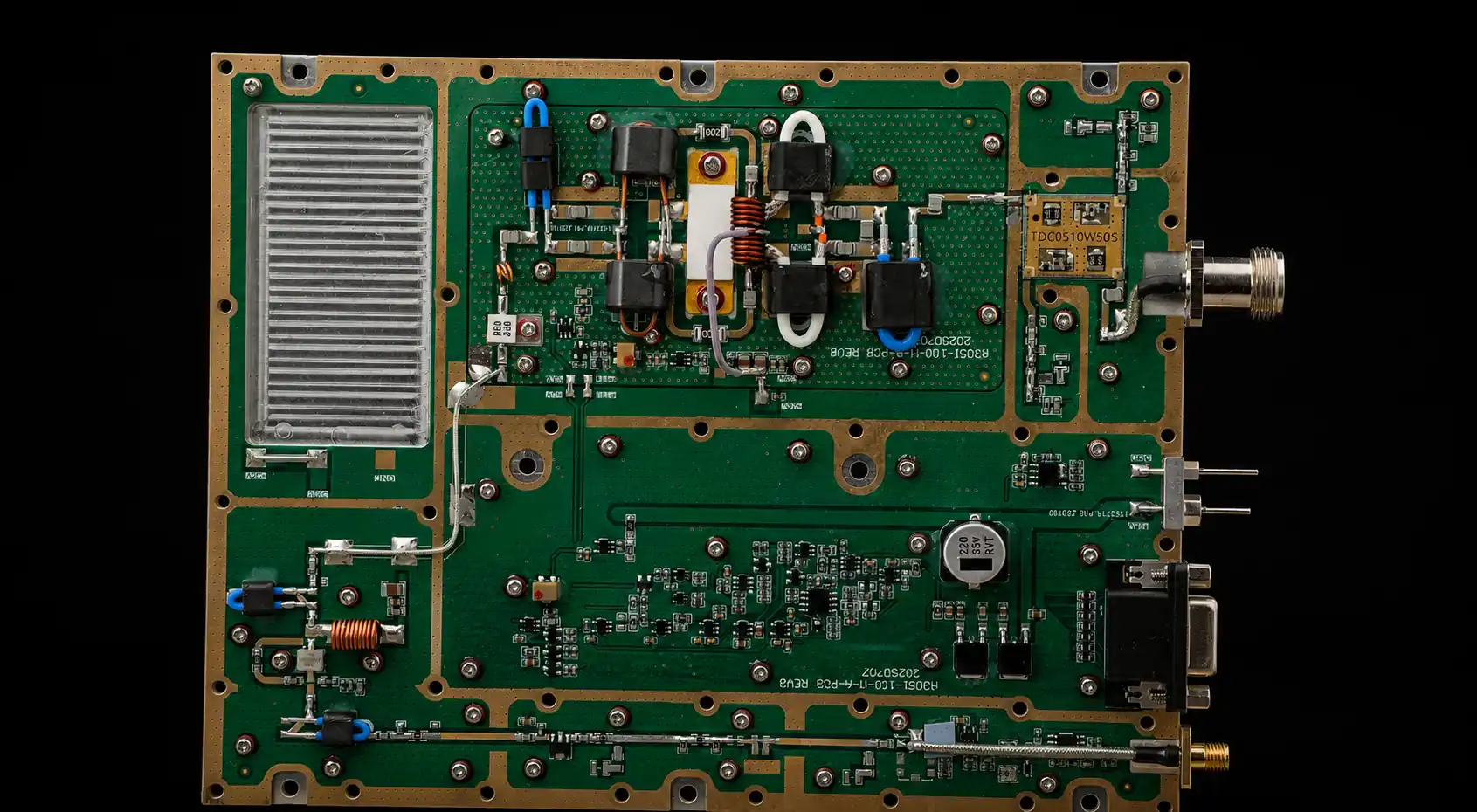
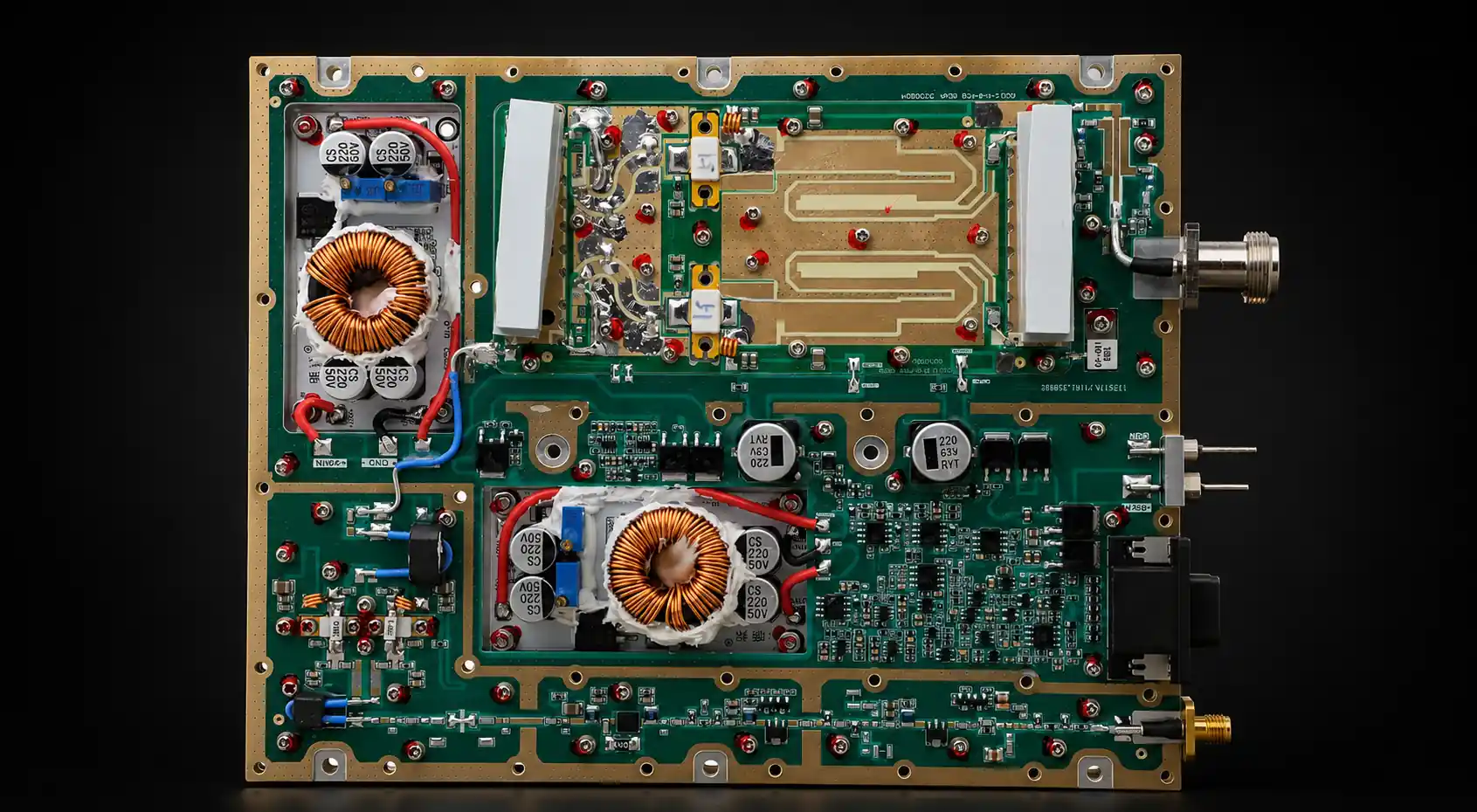
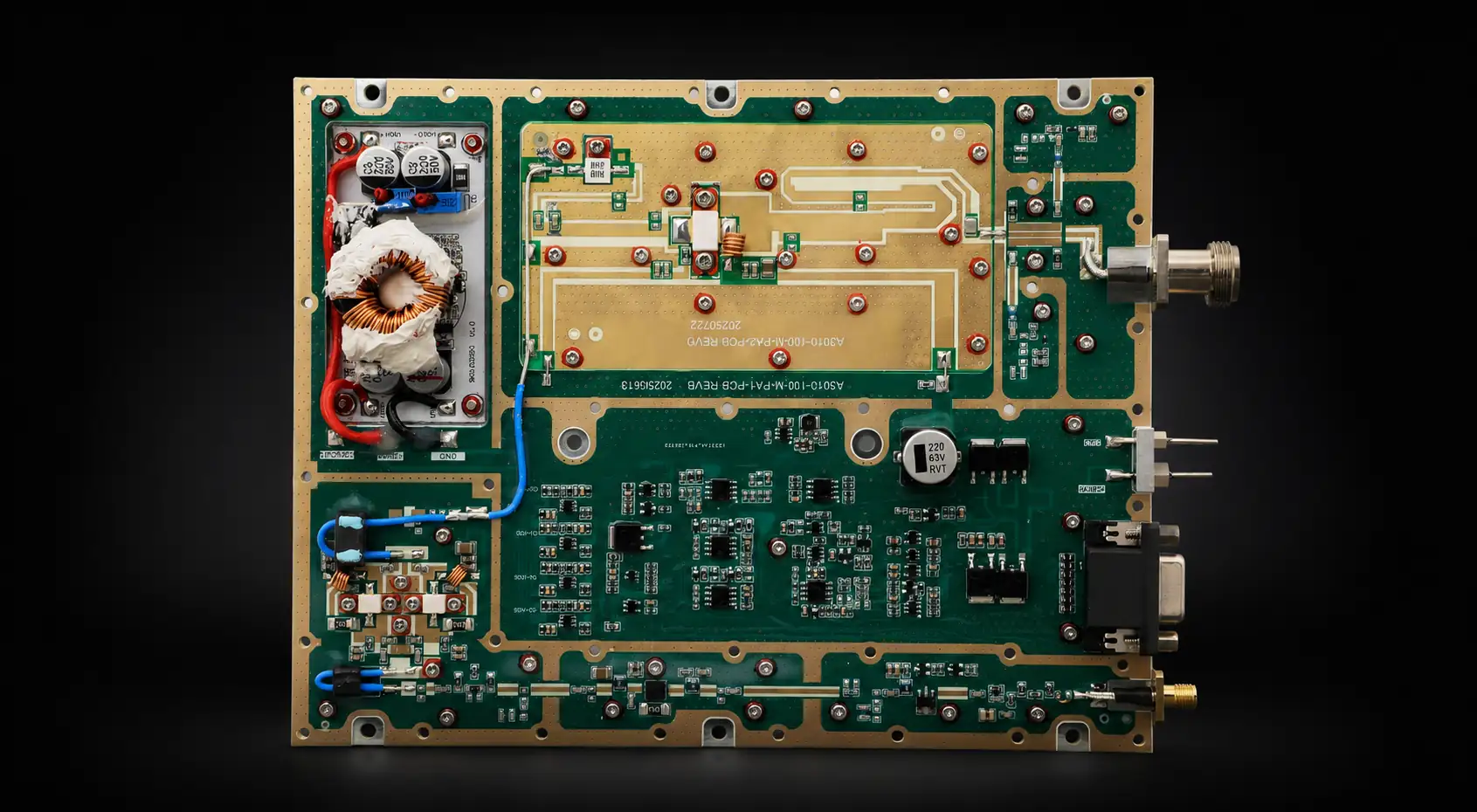
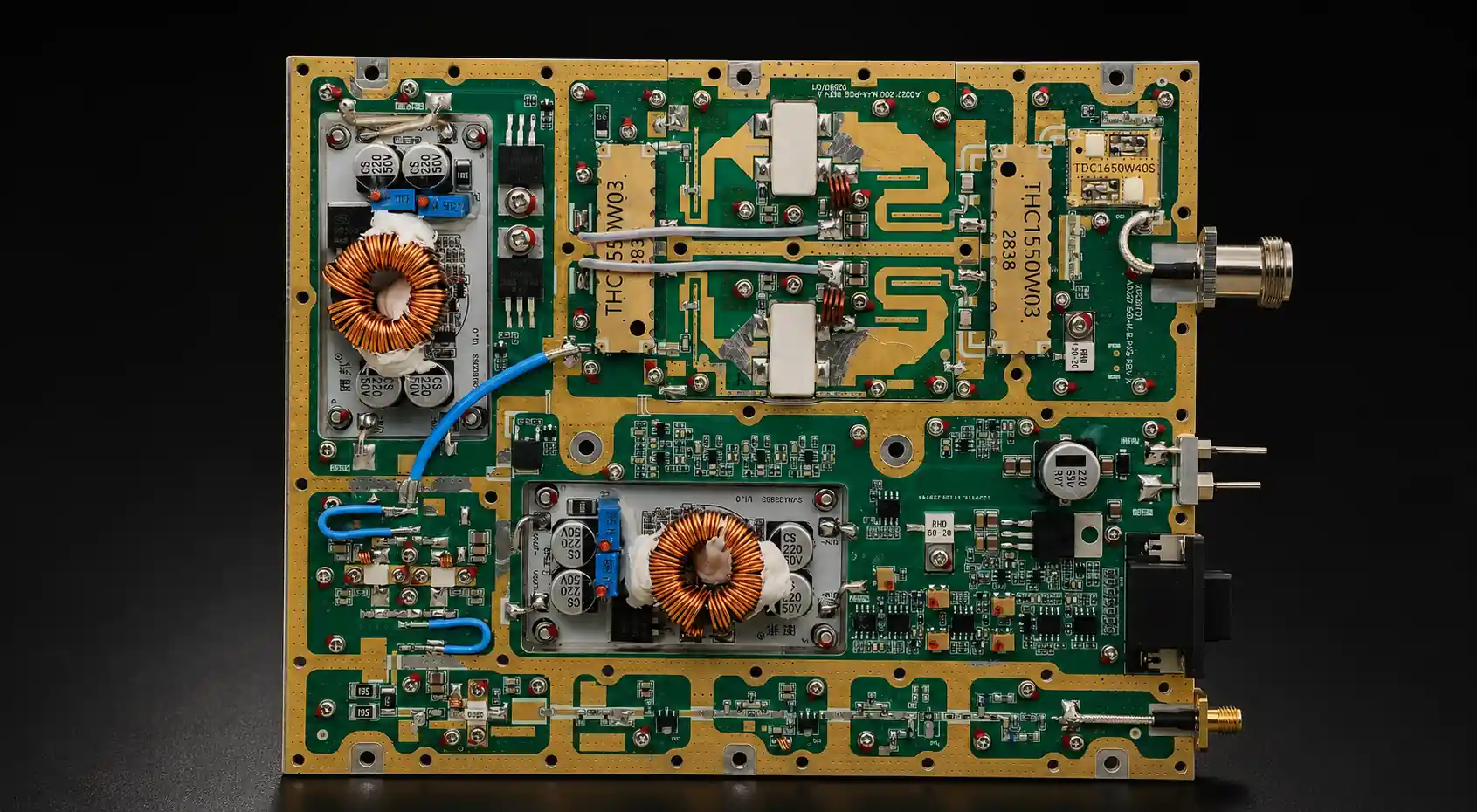
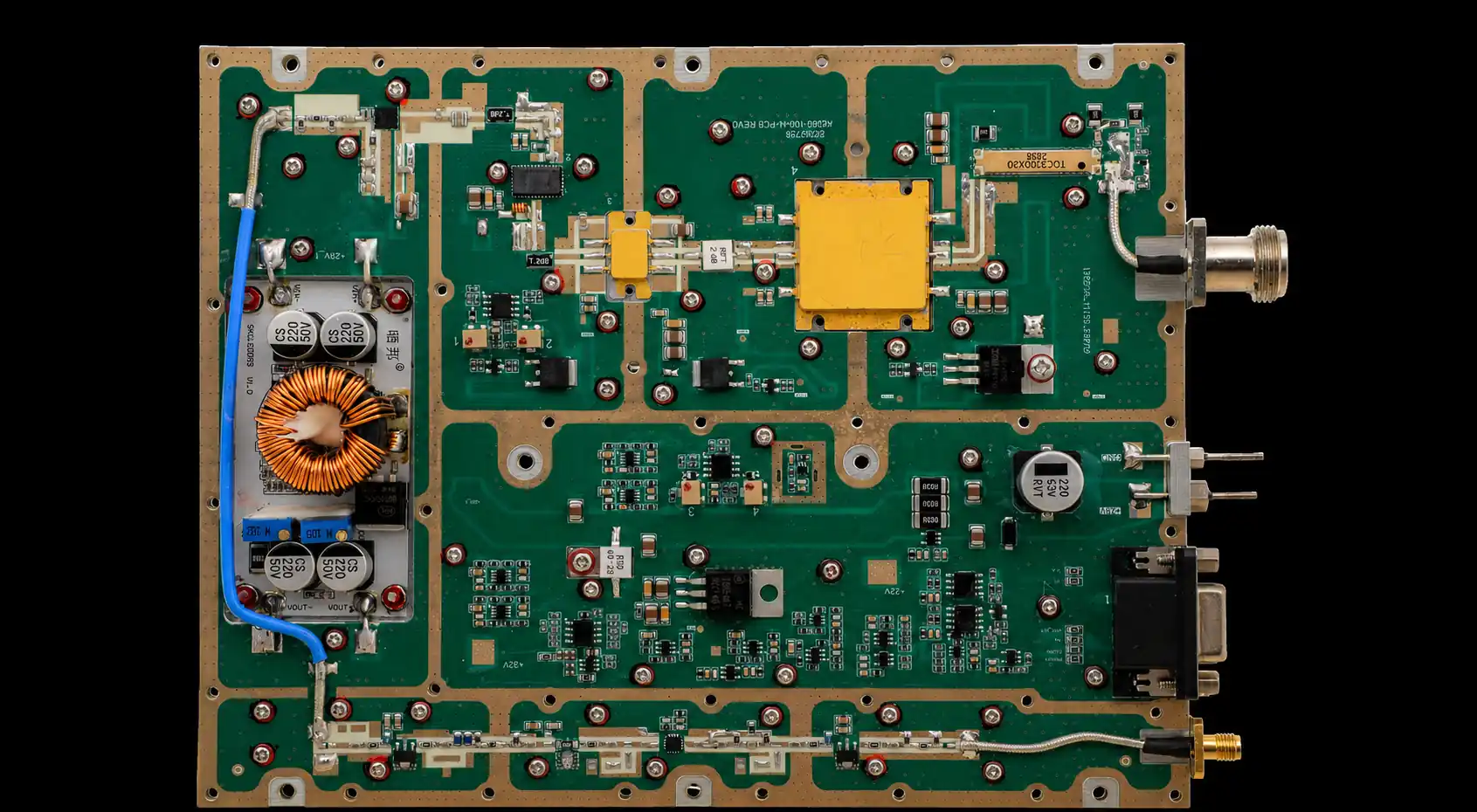
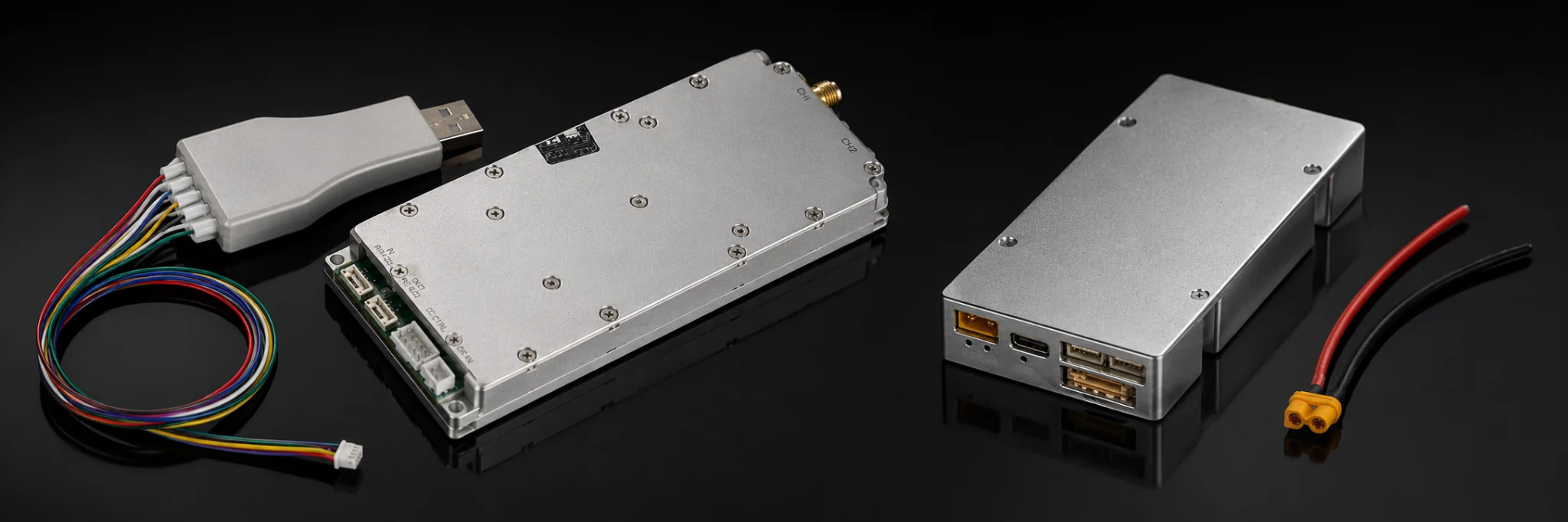
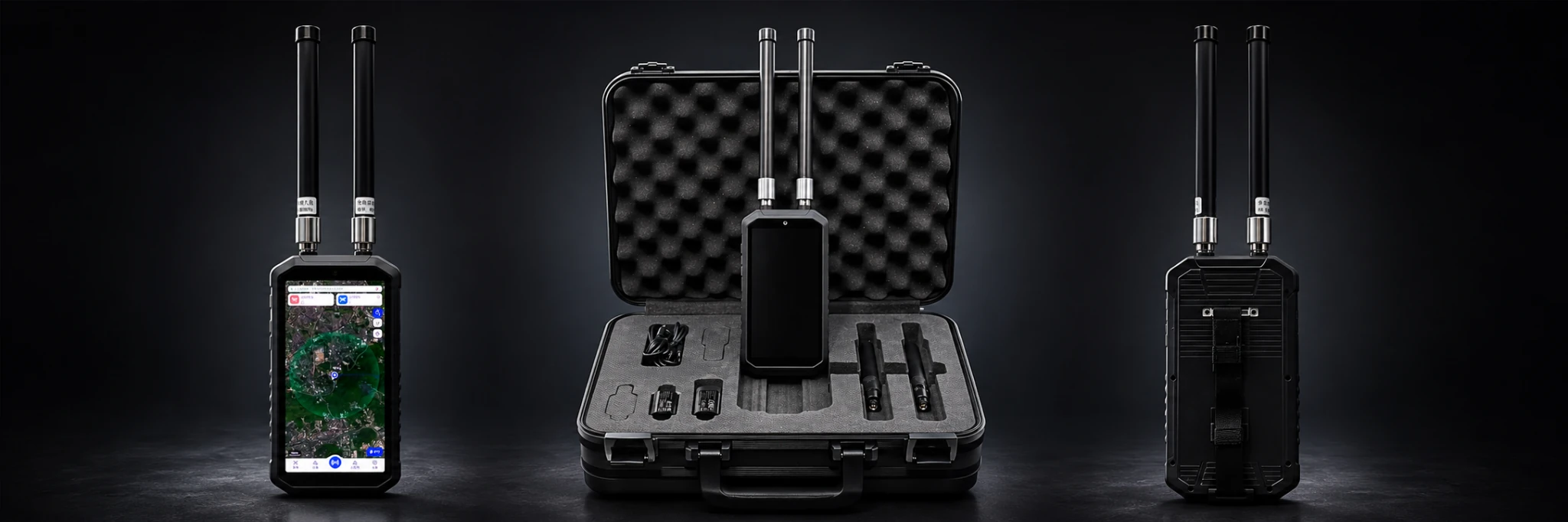

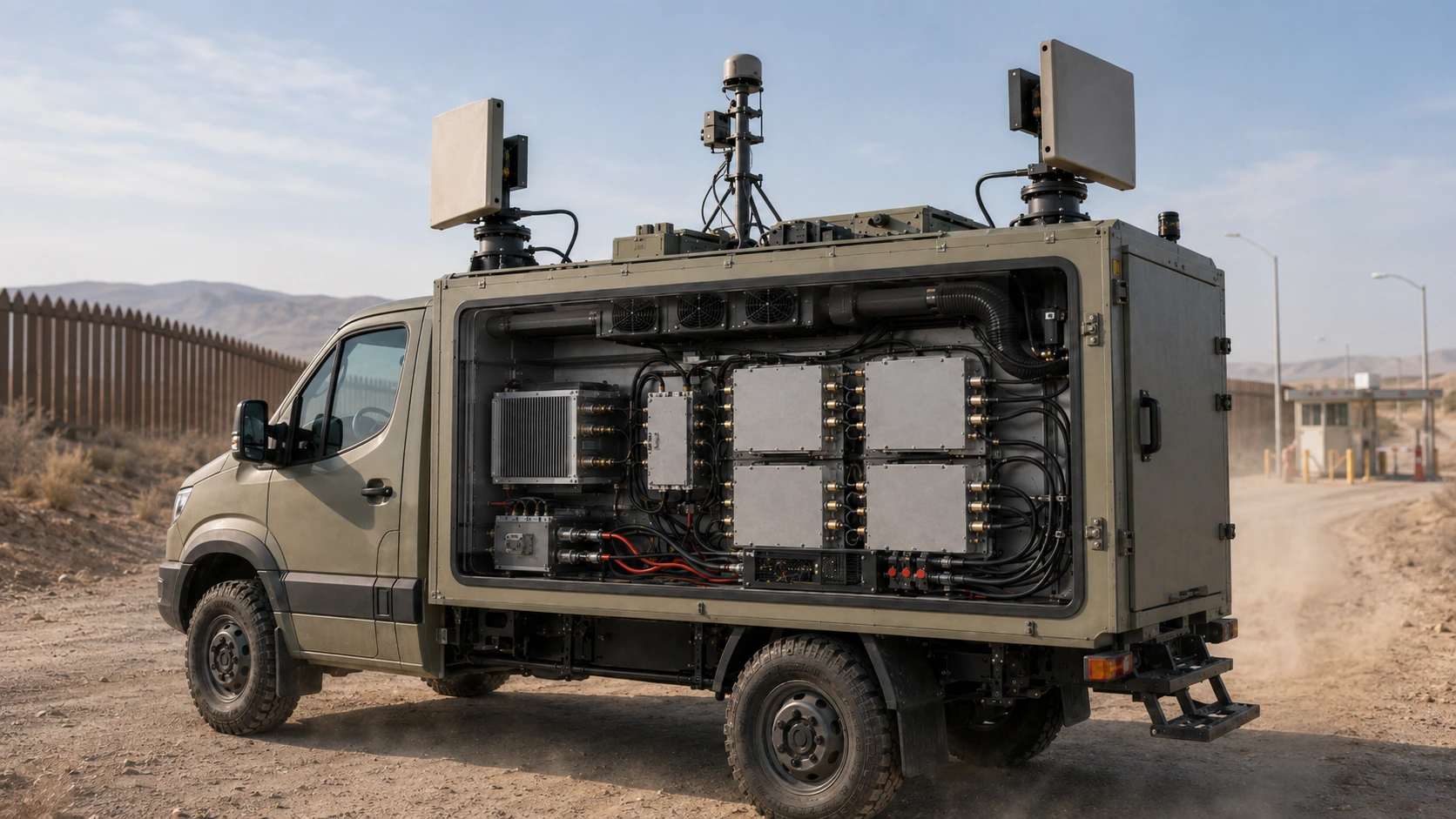
A buyer can request a 100 W drone jammer module and still receive a quotation that does not match the intended system. The offer may cover only the RF power amplifier, while the buyer expects a signal source, filtering, switching, cooling, control interfaces, an antenna path, and shipment evidence.
In a professional C-UAS RF system, a drone jammer module normally refers to the controlled RF power assembly that connects the signal source to a defined output path. Its suitability depends on more than frequency range and headline wattage.
When the requirement concerns the RF power stage, RF Power Amplifier Modules should be reviewed against the project’s actual frequency points, output target, input drive, operating duty, cooling method, control interface, load condition, and test requirements.
Before RFQ, the buyer needs to establish what hardware is included, where RF output is measured, which interfaces remain the integrator’s responsibility, and what evidence will be supplied with each delivered unit.
All deployment and operating requirements must follow the customer’s lawful authority and approved spectrum plan.
1. What a Drone Jammer Module Actually Does
A drone jammer module receives a controlled RF input, raises it to the required power level, and delivers that power through a specified RF output path. Its performance depends on the PA stage, input drive, DC supply, cooling, load condition, control logic, and protection response.
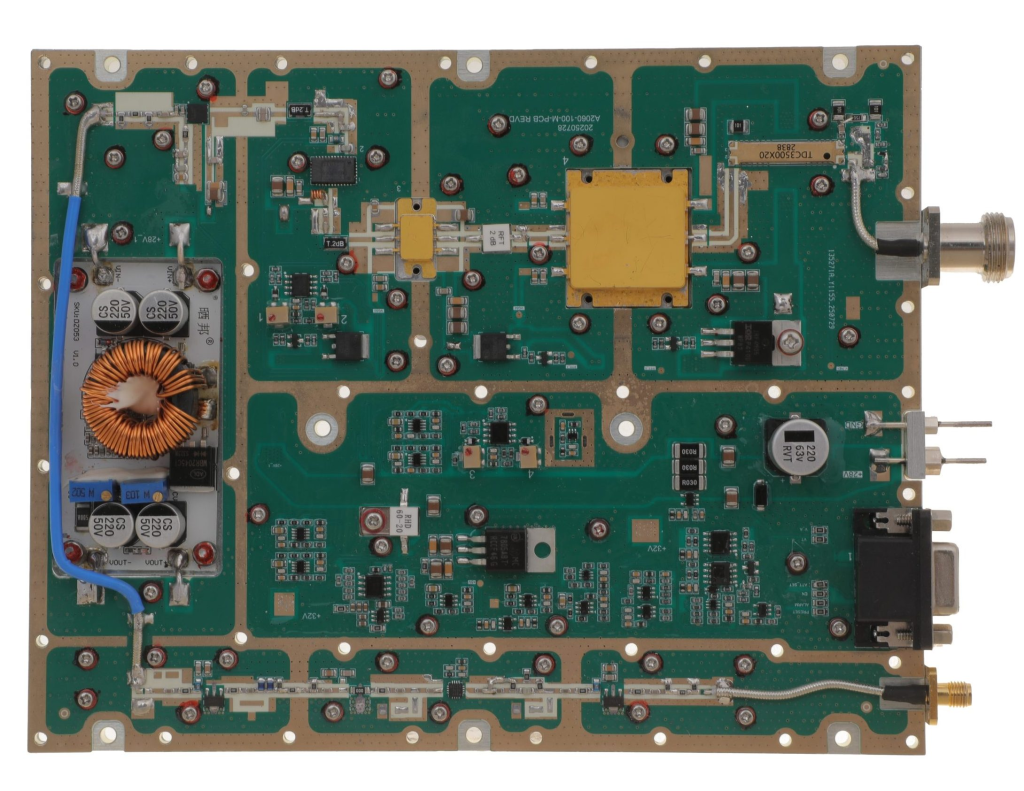
Depending on the quoted configuration, the module may be:
- a standalone RF power amplifier;
- an RF PA with internal filtering or switching;
- a signal-source and PA assembly;
- one RF path inside a multi-band subsystem;
- or a larger RF assembly with cooling, control, and alarm interfaces.
These products may share the same general name, but they do not represent the same deliverable.
A buyer may assume that a quoted drone jammer module includes the SDR, filters, antenna feeder, cabinet cooling, system control, and acceptance package. The supplier may be quoting only the RF PA.
That difference affects cost, lead time, mechanical design, system integration, and testing responsibility.
The first review question should therefore be:
What exactly is included between the RF input connector and the quoted RF output point?
A useful supplier block diagram should identify:
- the RF input;
- the RF PA stage;
- internal filters, switches, or couplers;
- the rated RF output point;
- the DC input;
- the cooling interface;
- the control connection;
- and the available alarm or protection feedback.
Without this information, two quotations with the same frequency and wattage may describe completely different products.
2. Drone Jammer Module Scope vs Complete C-UAS System
A drone jammer module is not a complete anti-drone platform.
It provides the RF power function inside a larger C-UAS architecture. The complete system may also require detection sensors, target assessment, command software, operator authorization, signal generation, antennas, power distribution, cooling, installation design, and system-level acceptance.
This distinction matters because module-level evidence does not automatically prove complete system performance.
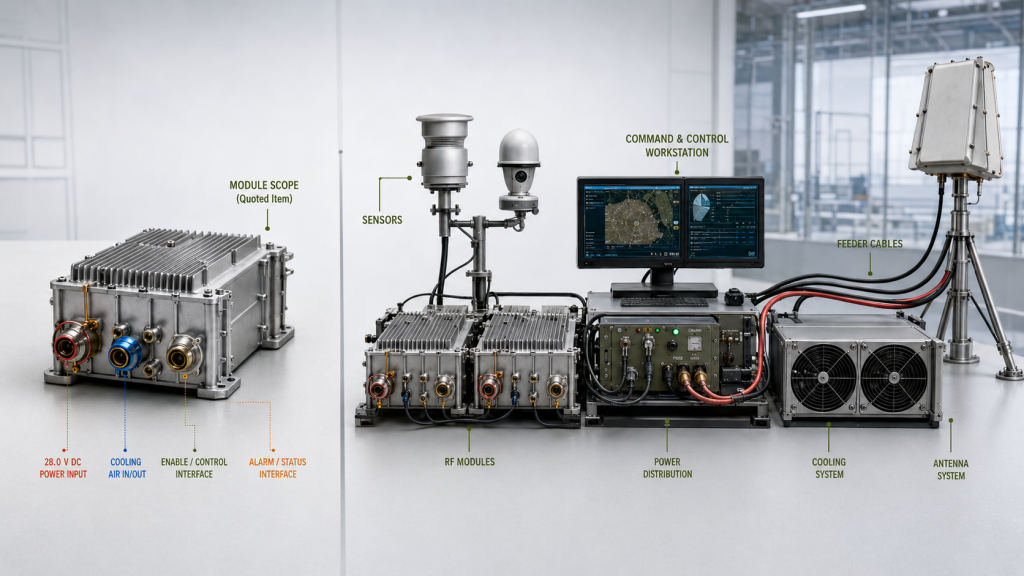
Drone Jammer Module Scope vs Complete C-UAS System
| Area | Module-Level Scope | Complete System Scope |
|---|---|---|
| Signal source | External, included, or project-defined | Connected to command and system logic |
| RF output | PA connector or RF assembly output | Controlled output through the installed RF path |
| Frequency plan | Supported hardware frequencies | Approved operating bands and system band plan |
| Antenna interface | Defined RF output connection | Antenna selection, placement, feeder, and coverage |
| DC power | Module-input voltage and current | Platform power generation and distribution |
| Cooling | Heatsink, cold plate, or stated cooling requirement | Cabinet airflow, liquid cooling, and ambient control |
| Protection | Module alarm, derating, foldback, or shutdown behavior | System fault response, logging, and operator action |
| Testing | Module-level performance and protection evidence | Integrated RF-path and platform acceptance |
Ask the supplier to identify which items are included, optional, or outside the quoted scope.
A bare RF PA should not be compared with an integrated RF assembly as though they were equivalent. The same principle applies to test results: power measured at the PA connector cannot automatically be treated as power available after the installed feeder and antenna path.
3. Which Hardware and Interfaces Define the Quoted Module
A drone jammer module should be reviewed as one part of a controlled RF chain rather than as an isolated metal enclosure.
One simplified RF path may be:
Signal Source or SDR → RF PA → Project-Defined Filtering or Switching Path → RF Output → Feeder and Antenna
The actual order of filters, switches, couplers, isolators, and protection components depends on the system architecture.
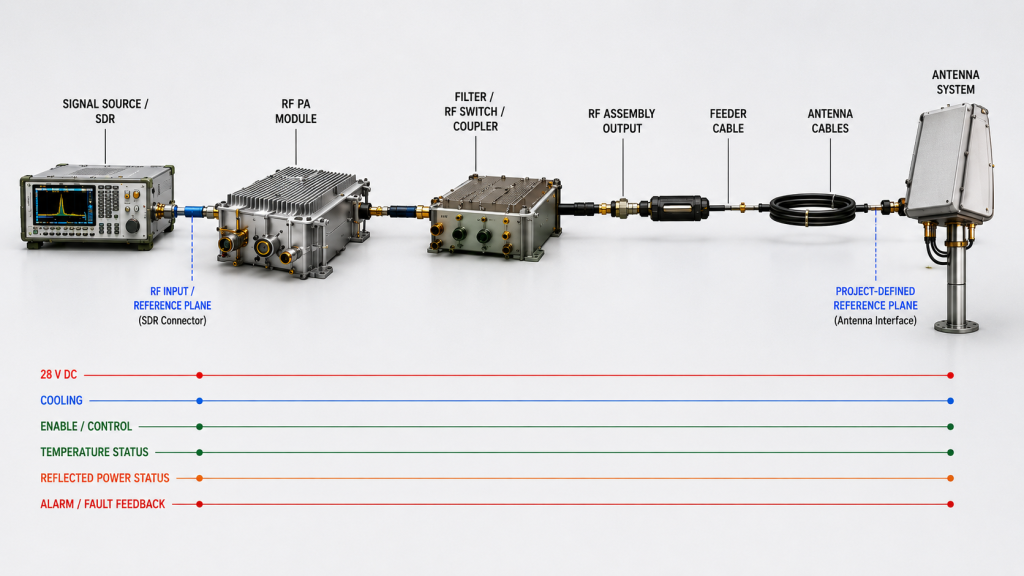
Signal Source and RF Input
The signal source provides the RF drive required by the PA.
A quotation is incomplete unless it identifies:
- whether the signal source is included;
- the required RF input range;
- the expected PA input power;
- the input connector and impedance;
- and the enable or timing relationship.
Two amplifiers can produce different output results when they are tested with different input drive. Output wattage should therefore never be reviewed without the corresponding PA input power.
RF Power Stage
The RF PA is the power stage between the controlled RF input and the quoted module output.
Its quotation should identify the PA input, RF output, DC input, cooling interface, control connection, and available protection feedback.
This keeps the hardware description separate from the project operating conditions, which must be defined before final selection.
Filters, Switches, and Internal RF Loss
Internal filters, RF switches, couplers, isolators, connectors, and cables can reduce power between the PA connector and the assembly output.
A buyer may compare two 100 W quotations without noticing that one supplier rates output directly at the PA connector while another includes filter and switch loss.
Define the measurement point before comparing the offers.
The quotation should show:
- the order of the internal RF path;
- which RF components are included;
- where rated output is measured;
- and whether internal path loss is included in the stated result.
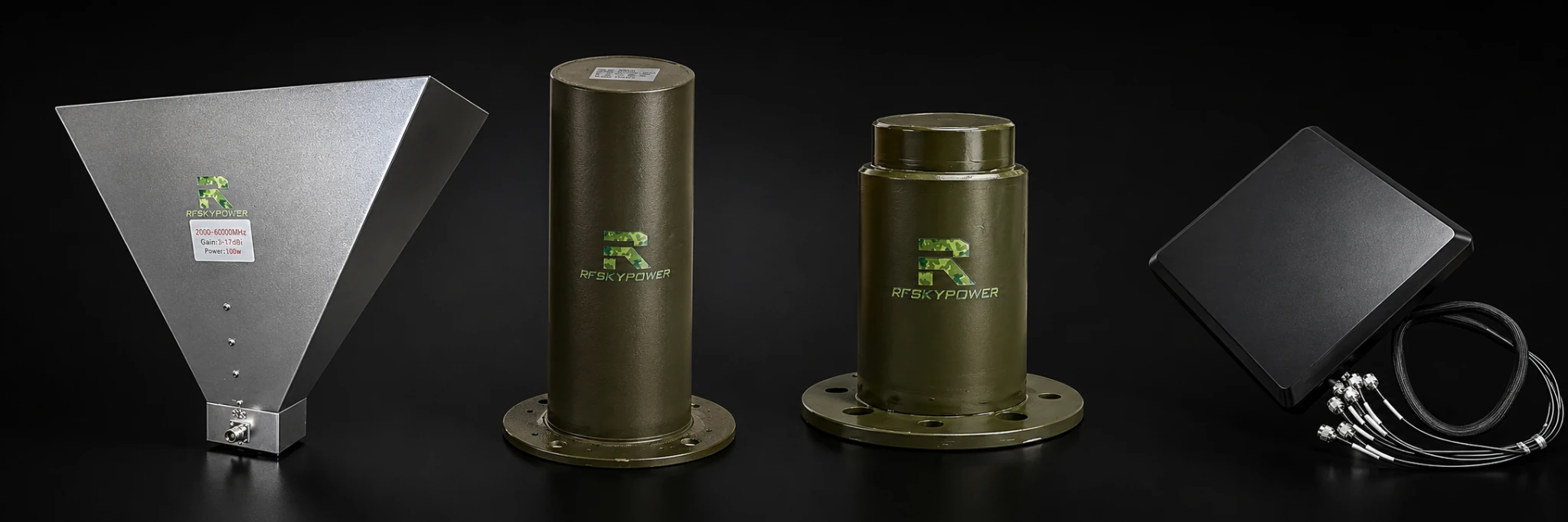
Antenna and Feeder Interface
The module output connector is not the same as the antenna-end measurement point.
Feeder length, connectors, adapters, filters, switches, and antenna mismatch can reduce delivered power or increase reflected power.
A dummy load establishes the module baseline under a controlled load. It does not reproduce every installed antenna-path condition.
When output, current, temperature, or protection behavior changes after the real feeder and antenna are connected, dummy-load and real-antenna checks provide the correct comparison between PA-port performance and installed-path behavior.
DC Power, Cooling, and Control Interfaces
The quoted scope should also identify:
- module-input voltage;
- continuous current demand;
- power connector requirements;
- heatsink or cold-plate responsibility;
- airflow or liquid-cooling requirements;
- enable logic;
- alarm outputs;
- temperature status;
- reflected-power status;
- and fault recovery behavior.
A module may reach the required output on a laboratory bench and still fail inside the final cabinet if the supply cable, airflow path, control timing, or alarm handling is not suitable.
For the narrower question of whether those operating conditions can create drone jammer module burnout risk, review the thermal/duty, RF-load/VSWR, PA-side DC, and control/recovery boundaries separately before concluding that the PA itself is at fault.
4. Which Operating Conditions Must Be Defined Before Selection
Frequency range and headline wattage only identify a possible candidate.
A comparable engineering selection requires the same frequency points, measurement point, input drive, operating duty, DC condition, cooling method, and load boundary.
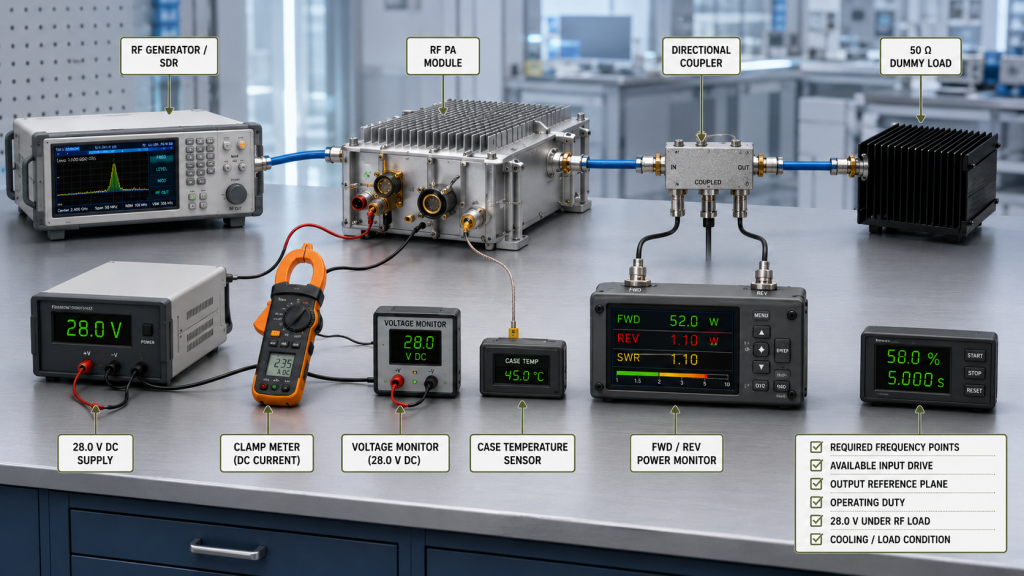
Frequency and Output Measurement Point
Buyers often compare two output claims without checking where the power was measured.
One result may apply at the PA output connector. Another may apply after a filter, switch, internal cable, or cabinet RF path.
The RFQ should identify:
- the required frequency range;
- priority frequency points;
- band-edge points;
- simultaneous or mutually exclusive operation;
- and the required output location.
The output target should be tied to one of the following:
- PA output connector;
- RF assembly output;
- cabinet output;
- or antenna end.
A 100 W result at the PA connector does not prove 100 W at the antenna after RF path losses.
Input Drive and Operating Duty
Output power is not comparable unless the report records the actual PA input drive.
A supplier may achieve the target by using more input power than the customer’s signal source can provide. The result can be valid in the laboratory but unusable in the final system.
Operating duration creates a second risk.
A short measurement may show the expected output before the PA reaches thermal stability. Continuous or long-duty operation may produce a different output, current, case temperature, or protection state.
Define:
- the available input drive;
- the expected operating duration;
- continuous or intermittent duty;
- sequential or simultaneous path operation;
- and the thermal state required for acceptance.
DC Power and Cooling
A nominal 28 V supply does not guarantee 28 V at the module input under RF load.
Cable resistance, connector loss, supply capacity, and current demand can reduce the voltage available to the PA. If the supply path is undersized, the module may lose output or behave differently under protection conditions.
The project input should identify:
- available DC voltage;
- continuous current capacity;
- power cable and connector conditions;
- cooling method;
- airflow or cold-plate responsibility;
- ambient condition;
- and required operating duration.
The useful result is the voltage, current, temperature, and RF output measured while the module is operating—not the unloaded supply rating.
Antenna Mismatch and Protection Response
The phrase “VSWR protected” does not explain what the module actually does.
Possible responses include:
- alarm only;
- output derating;
- protection foldback;
- RF shutdown;
- automatic recovery;
- or manual reset.
Ask the supplier to state:
- what activates the protection;
- what happens to RF output;
- which alarm or status is available;
- how recovery occurs;
- and whether the response is included in the supplied test evidence.
Where system-level fault handling depends on this behavior, the relevant alarm or status must be available to the controller.
Detailed PA architecture and performance selection should continue with the C-UAS RF PA selection workflow rather than being decided from the widest catalog frequency label.
5. What Evidence Should Support the Module Claim
A supplier claim becomes useful only when it is linked to a defined test condition and a specific delivered unit.
A product photo, typical datasheet curve, or selected power-meter screenshot does not prove that every module meets the project requirement. For the narrower question of whether the RF output claim itself is sufficiently proven, use the anti-drone signal quality verification criteria to align the reference plane, operating conditions, and evidence scope before a pass/fail judgment.
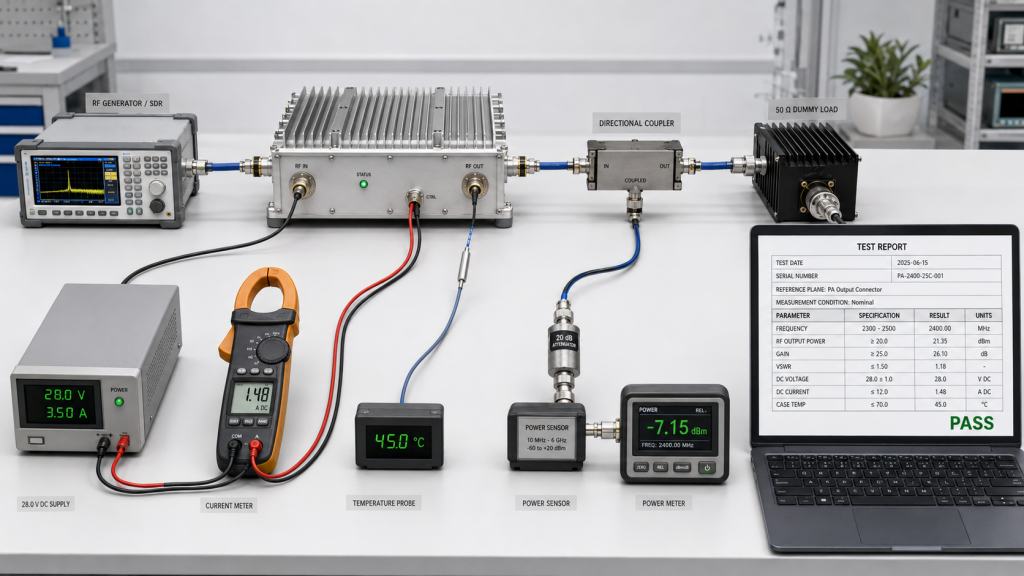
At minimum, the test record should identify:
- module model and serial number;
- tested frequency points;
- actual PA input power;
- RF output and stated reference plane;
- applied cable, connector, attenuator, and measurement-path corrections where relevant;
- DC voltage and current under RF load;
- load and cooling conditions;
- operating duration or thermal state;
- forward and reflected power where required;
- VSWR or mismatch condition;
- protection status;
- the applicable pass-or-fail limit;
- and the final acceptance conclusion.
Shipment approval should be based on S/N-linked RF PA acceptance evidence rather than a generic report that cannot be connected to the delivered module.
Why One Frequency Screenshot Is Weak Evidence
A module may meet the output target at one center frequency and lose margin at another required point.
The weakest result may appear:
- near a band edge;
- after thermal stabilization;
- under a different input drive;
- after internal RF path loss;
- or when the load condition changes.
For projects that depend on several required frequencies, full-power swept testing provides stronger evidence than one selected measurement.
The report should show enough information to answer:
Which required frequency produces the lowest usable output margin under the agreed operating conditions?
Why Measurement Corrections Matter
A power sensor may not be connected directly to the PA output.
The test path can include cables, connectors, couplers, attenuators, adapters, or splitters. The displayed meter value therefore may not equal the corrected output at the stated reference plane.
The report should record the applicable RF path correction so the buyer can distinguish:
- the raw instrument reading;
- the total path correction;
- and the corrected RF output.
Without that information, two apparently similar test reports may use different calculation boundaries.
Why Serial-Number Traceability Matters
A generic report may prove that one engineering sample once reached the target.
It does not prove that the shipped unit produced the same result.
Where project acceptance requires traceability, the test conditions, corrected measurements, applicable limits, and pass-or-fail result should be connected to the delivered serial number.
The buyer does not need access to confidential circuit details. The buyer does need enough evidence to confirm what was tested, where it was measured, how the result was corrected, and whether the record applies to the delivered module.
6. What to Include in a Drone Jammer Module RFQ
A useful RFQ replaces the broad product name with a defined engineering requirement.
The buyer does not need to design the supplier’s internal circuit. The buyer does need to provide enough project information for the supplier to select the correct RF architecture, PA stage, interface arrangement, protection behavior, and test scope.
Drone Jammer Module RFQ and Evidence Checklist
| RFQ Field | Project Input to Provide | Evidence to Request |
|---|---|---|
| Included scope | PA, signal source, filters, switches, cooling, and control requirements | RF block diagram and included-item list |
| Frequency | Required range, priority points, and band-edge points | Results at the agreed test frequencies |
| Output | Minimum output and required measurement point | Corrected RF output data with reference plane |
| Input drive | Available signal-source output | Recorded PA input power |
| Operating mode | Continuous, long-duty, sequential, simultaneous, or mutually exclusive operation | Operating sequence, test duration, and thermal state |
| DC power | Available voltage, current capacity, cables, and connectors | Module-input voltage and current under RF load |
| Cooling | Heatsink, airflow, cold plate, liquid cooling, and ambient condition | Temperature trend and hot-state output |
| RF path | Internal components, feeder, connectors, and antenna condition | Path-loss basis, measurement correction, and FWD/REV/VSWR data |
| Protection and control | Alarm, foldback, shutdown, recovery, and interface requirements | Protection-state and interface test record |
| Traceability | Quantity and shipment acceptance requirement | S/N-linked test report and pass-or-fail conclusion |
A quotation becomes comparable only when each supplier responds to the same frequency points, output location, input drive, operating duty, DC condition, cooling boundary, RF path, and evidence requirement.
Conclusion
A drone jammer module is suitable for integration only when its included hardware, RF interfaces, operating conditions, protection behavior, and acceptance evidence are clearly defined.
RF SKYPOWER can support an early engineering review of the authorized frequency range, priority frequency points, required PA-port or antenna-end output, available input drive, operating duty, antenna and feeder path, 28 V DC capacity, cooling method, control and alarm requirements, VSWR boundary, quantity, and required test evidence.
Submit your RFQ so the frequency architecture, RF power stage, included interfaces, protection response, and shipment evidence can be reviewed before quotation.