
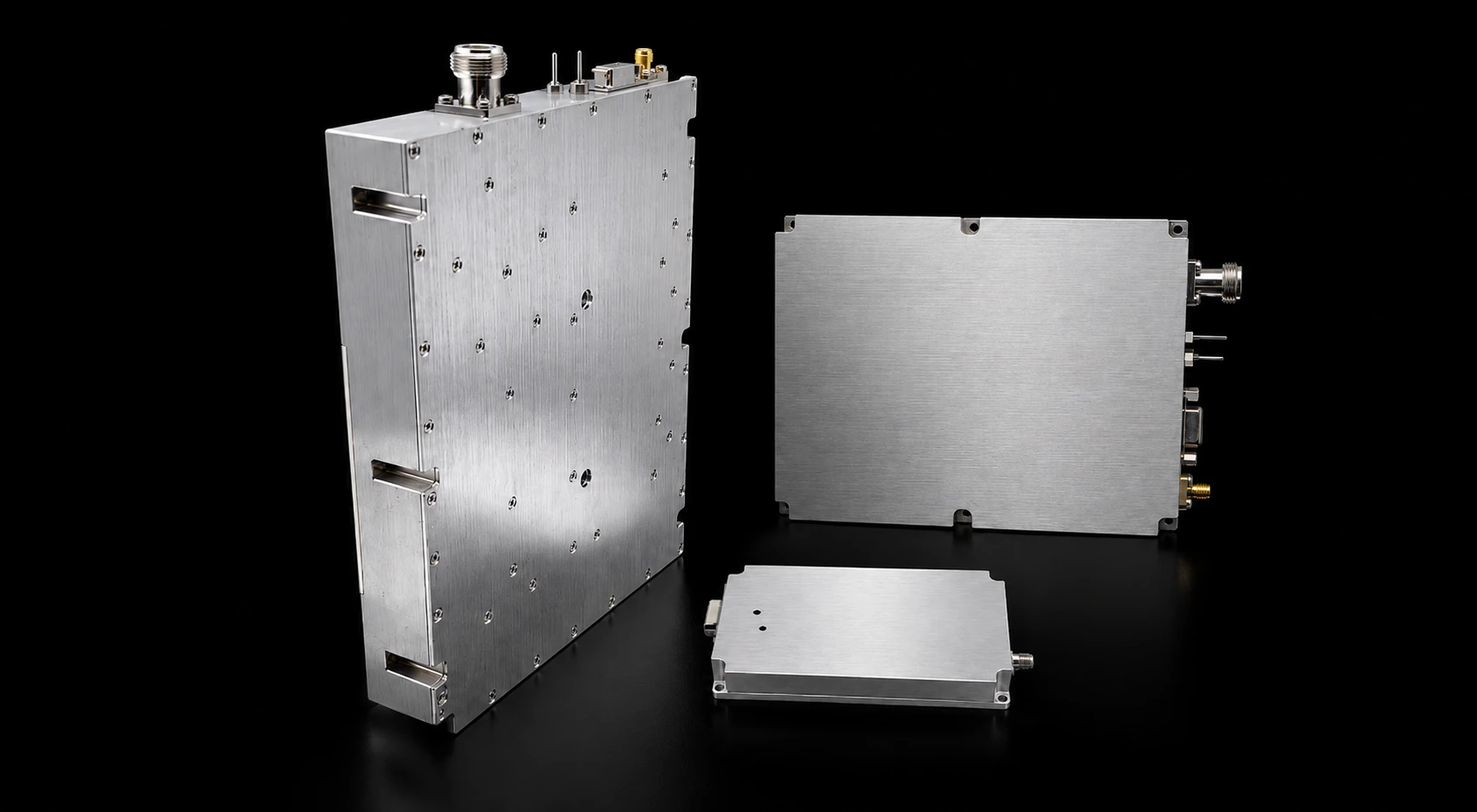
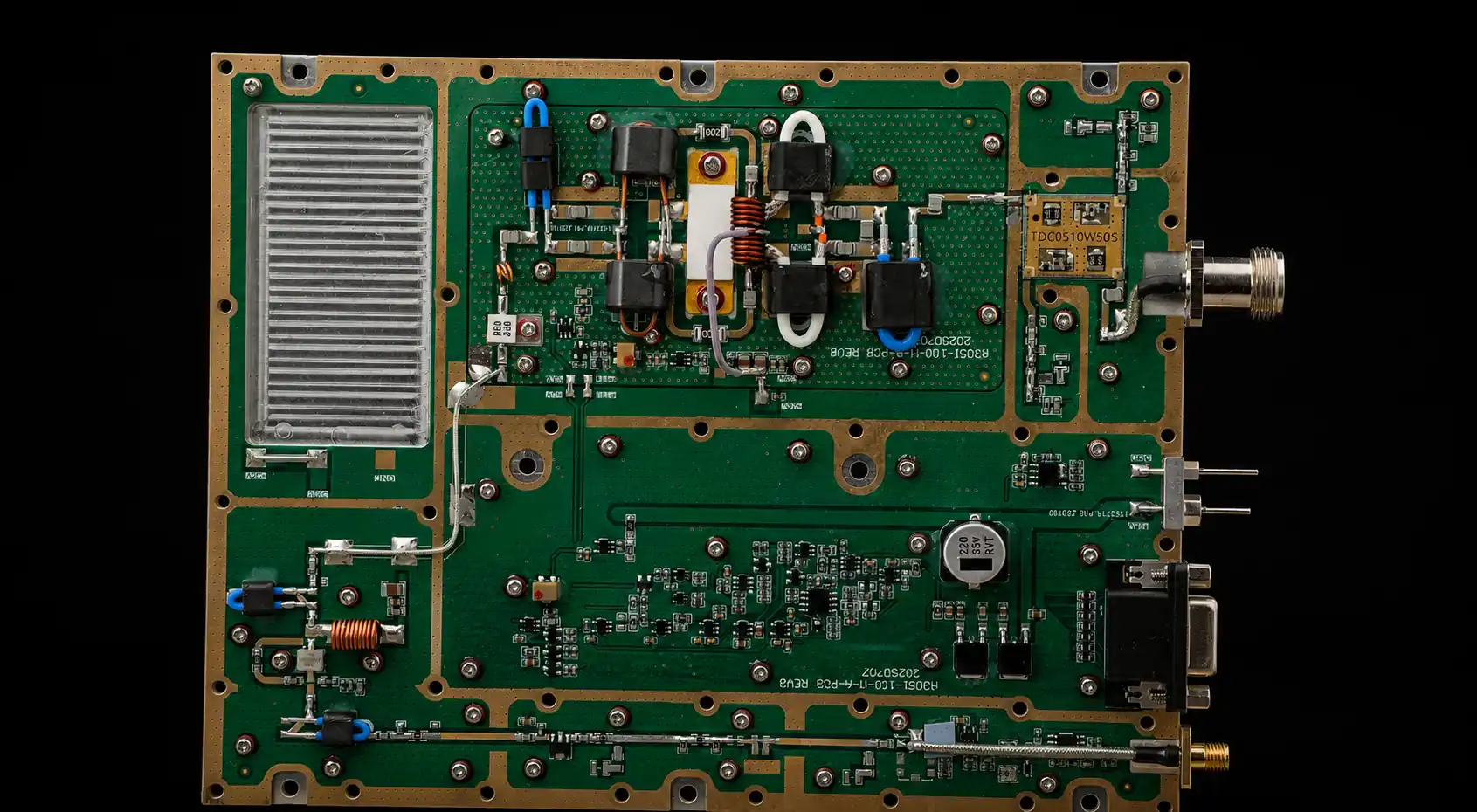
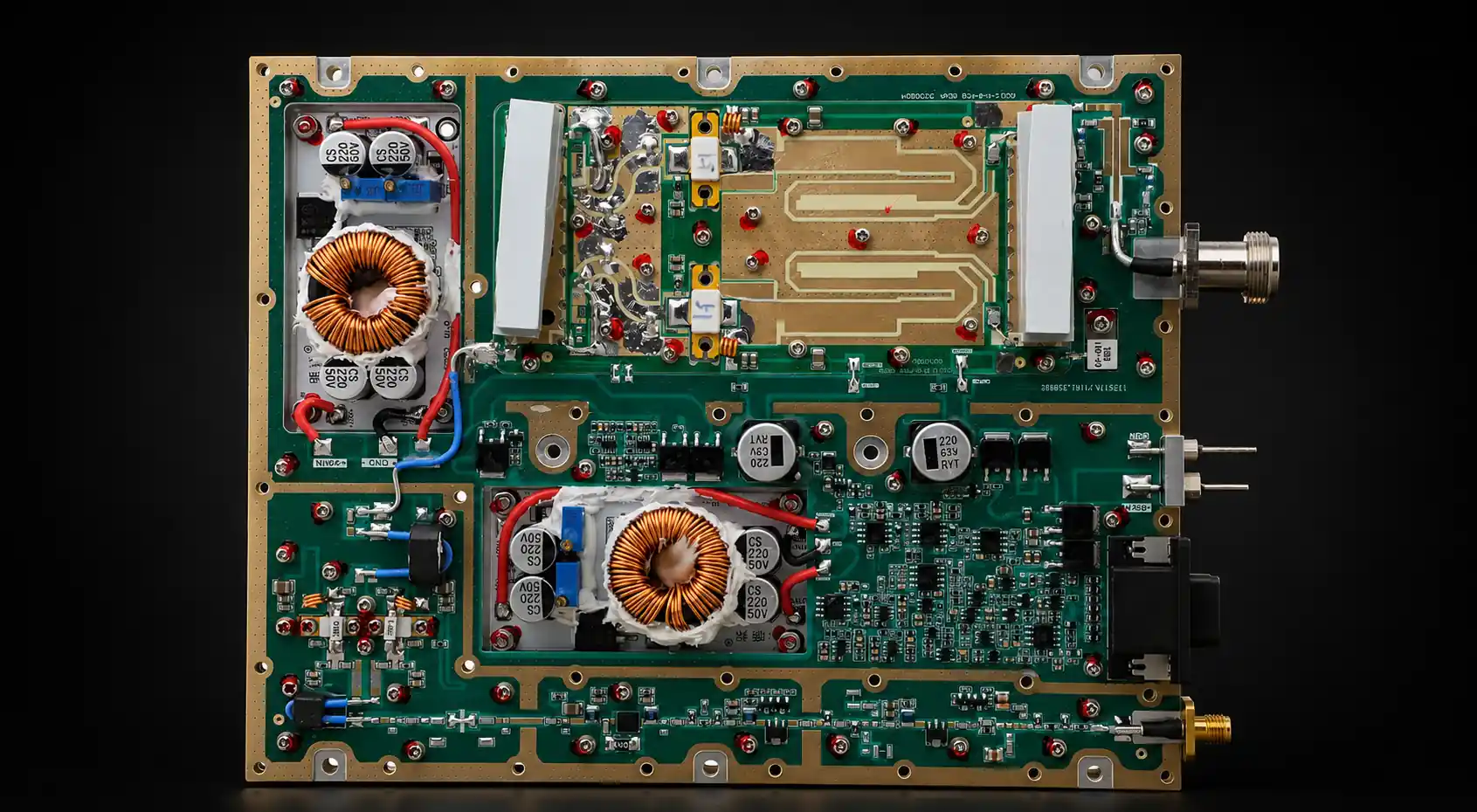
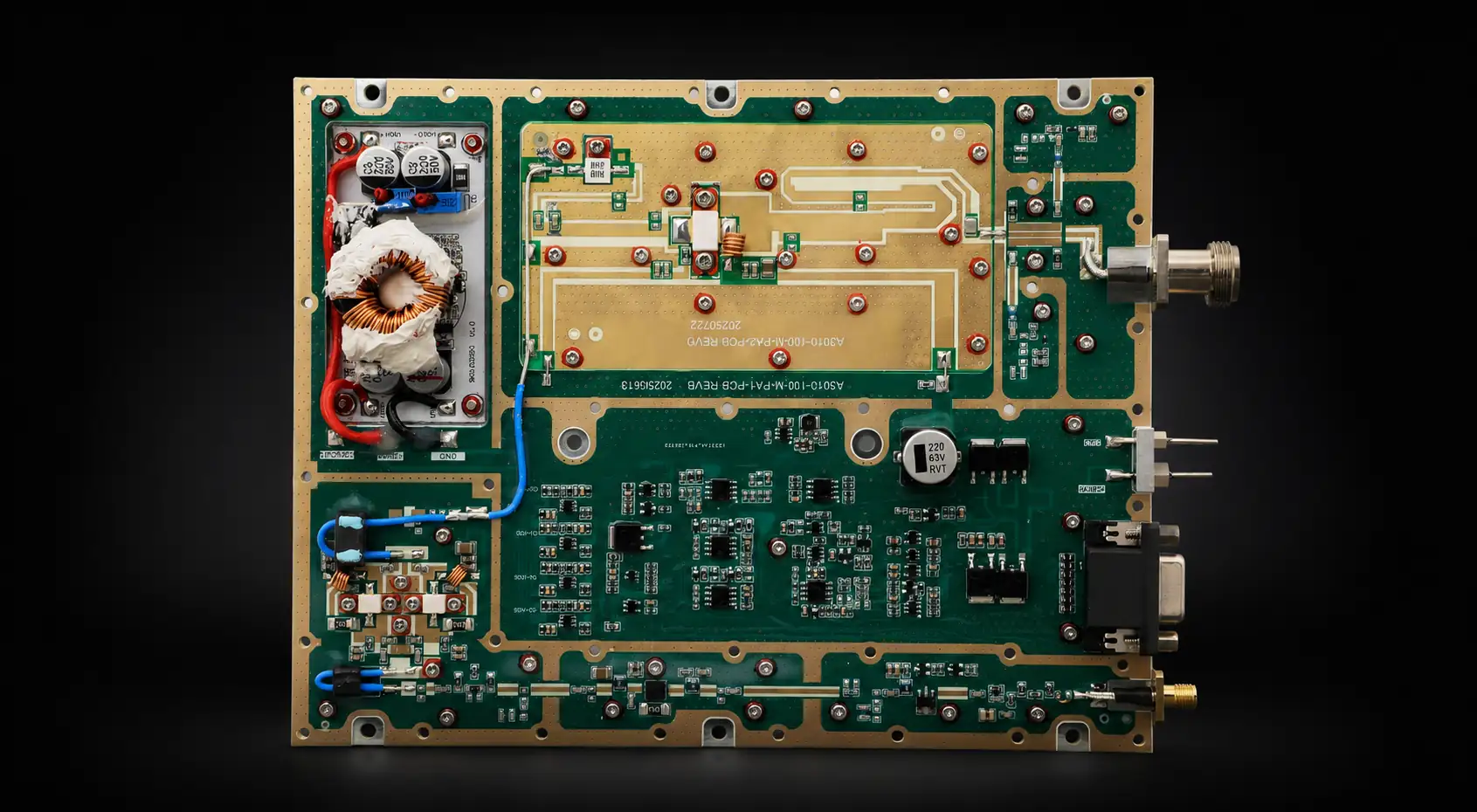
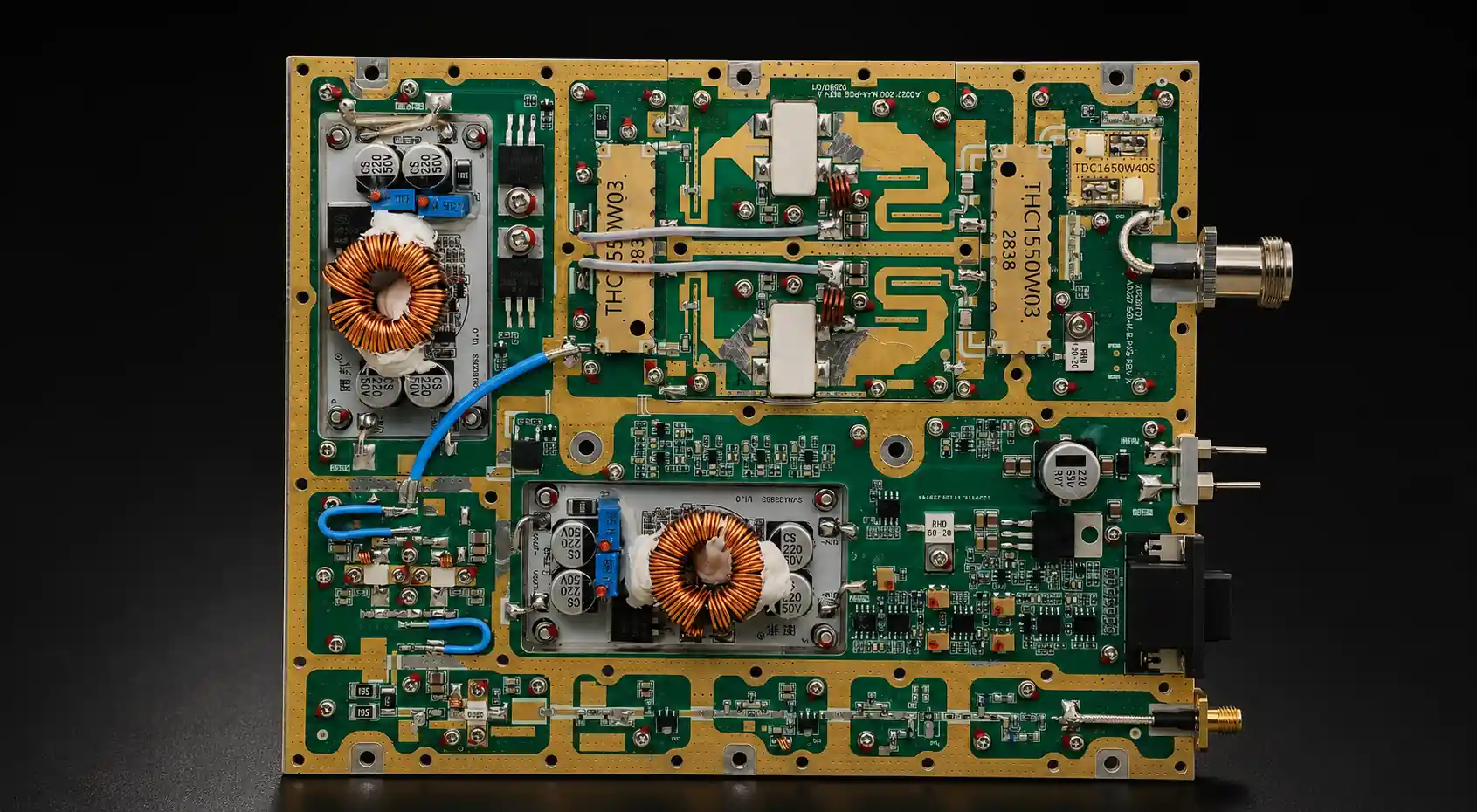
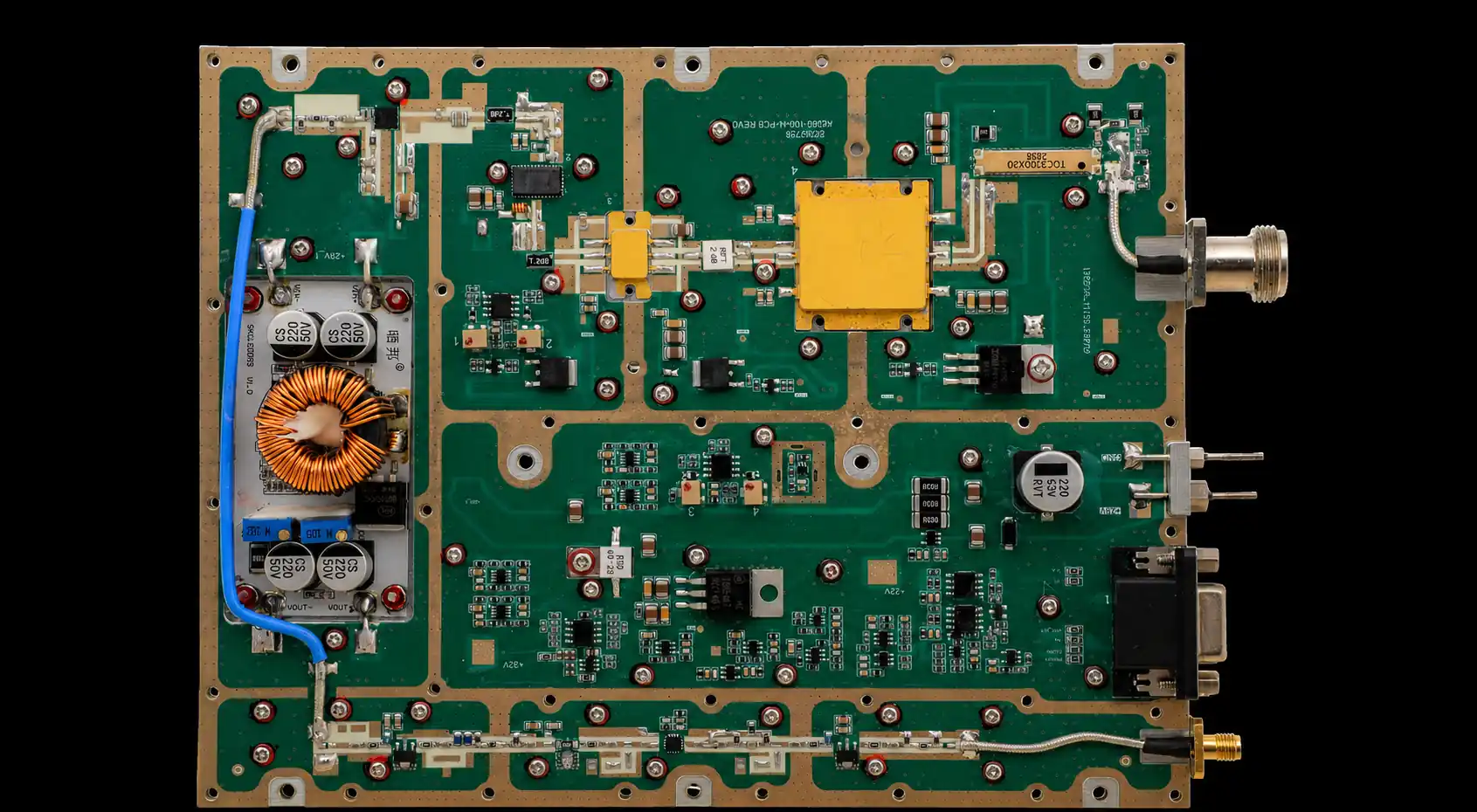
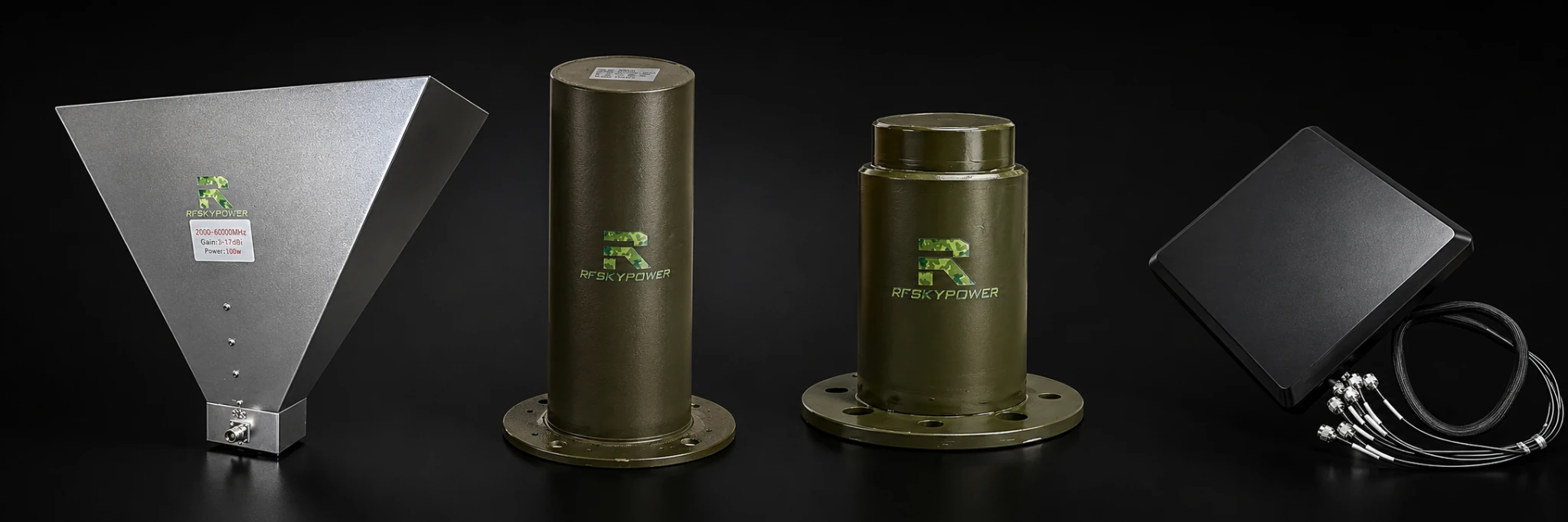
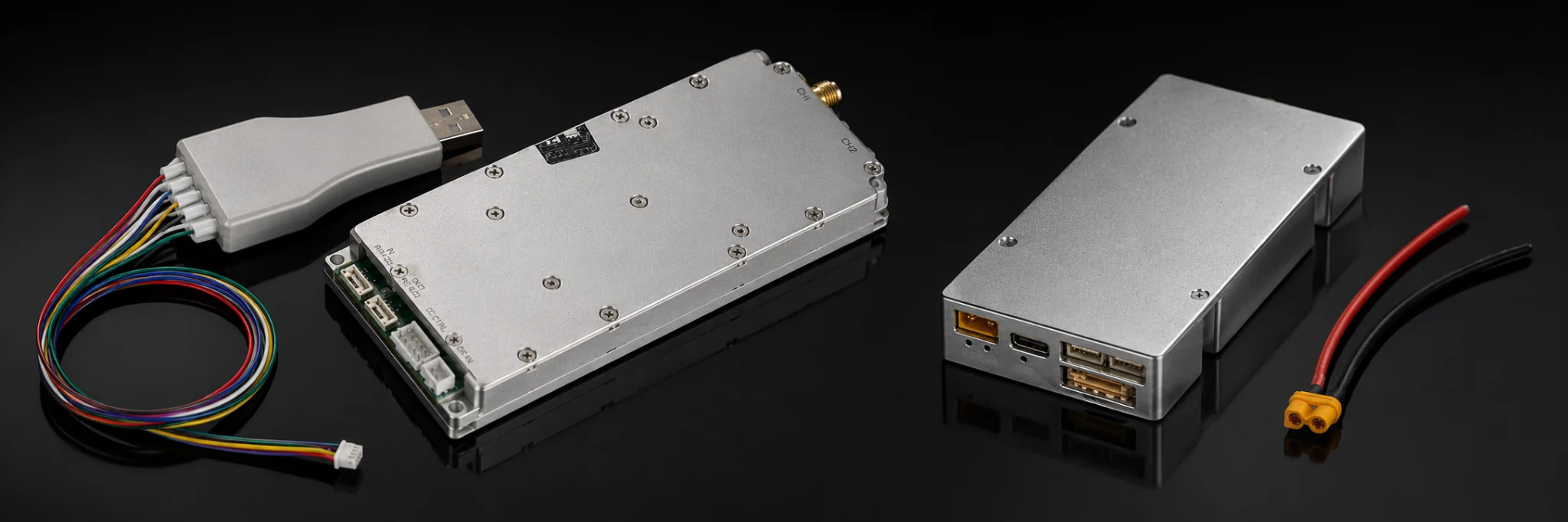
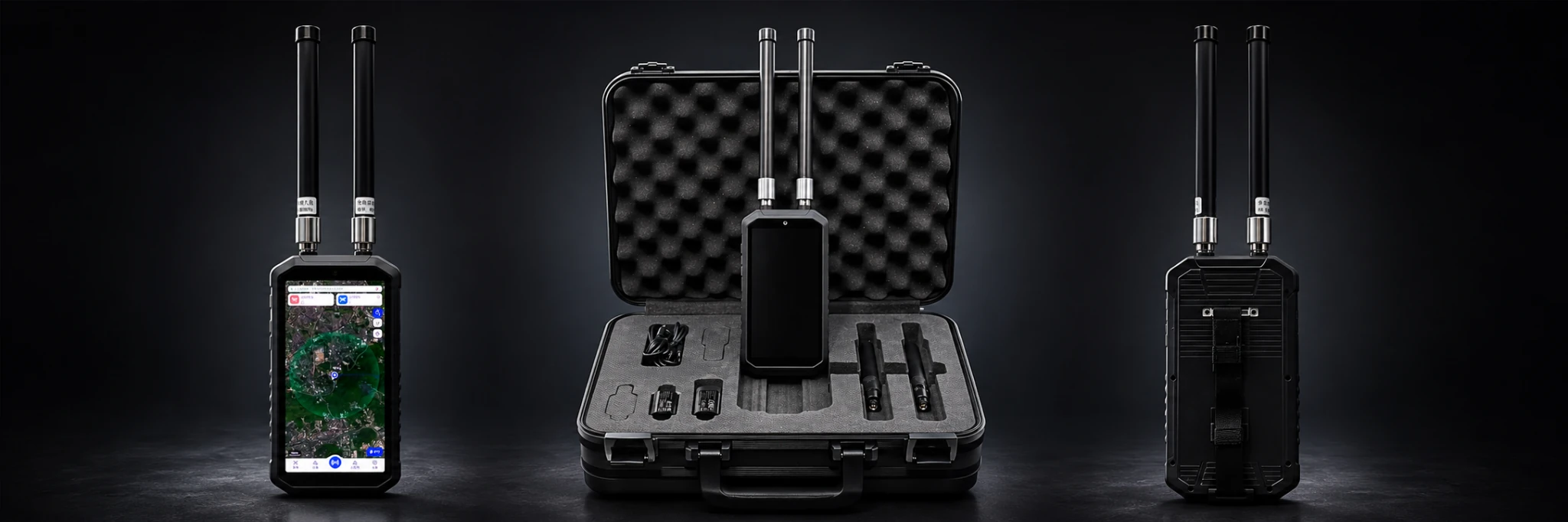

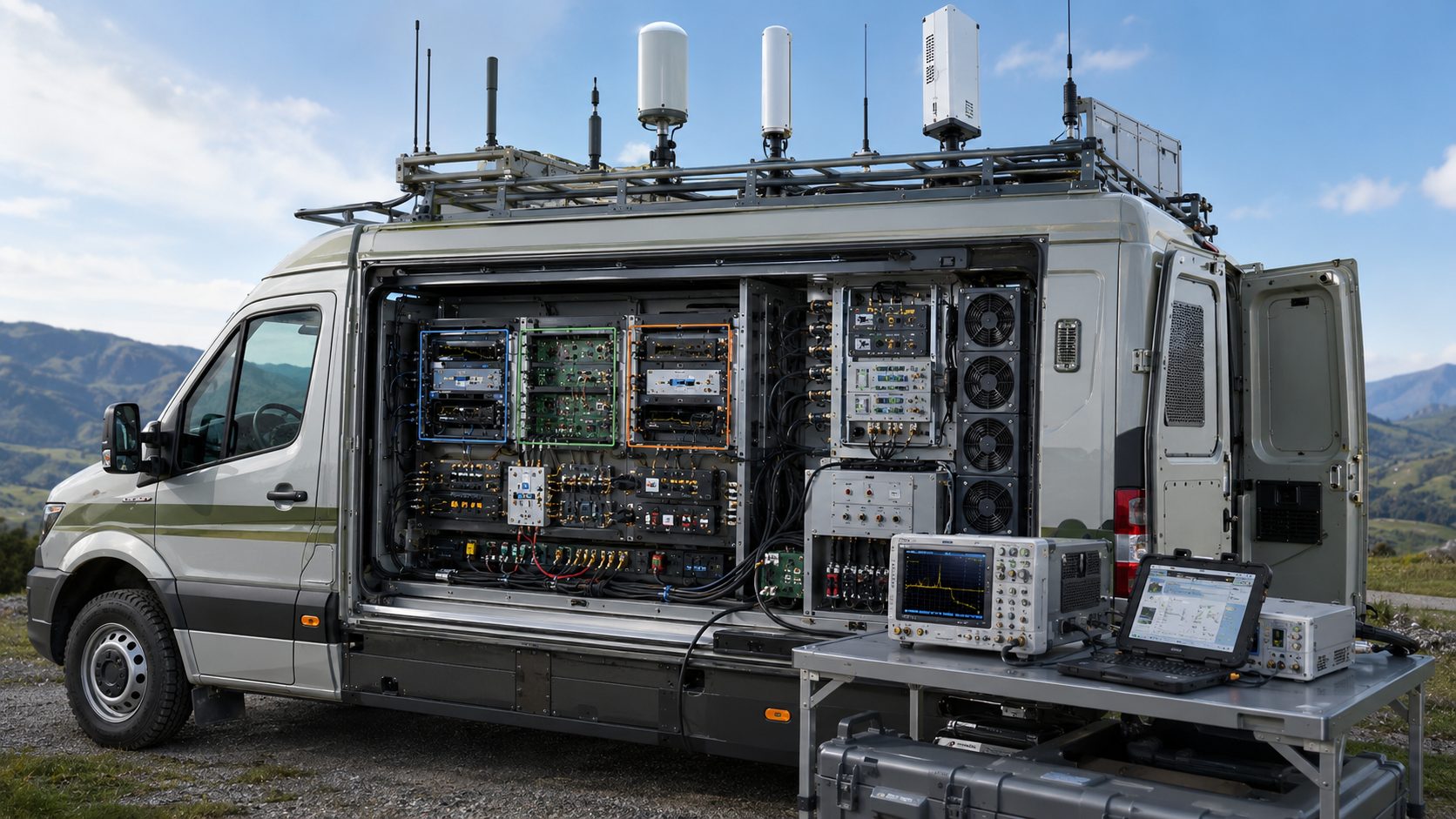
RF PA frequency blocks can look correct on paper, while the completed vehicle-mounted C-UAS cabinet still fails system review.
The problem often appears after module selection. Two PA paths may depend on the same antenna route without a clear switching rule. Several paths may exceed the available 28 V DC capacity when enabled together. A high-power module may restrict airflow around nearby electronics. Individual test reports may prove each PA separately while leaving the combined cabinet architecture unverified.
An RF PA frequency-block map exposes these gaps before the layout is frozen. It assigns every required frequency group to a PA module or controlled RF branch, together with its antenna route, operating rule, DC load, cooling responsibility, control state, and acceptance reference.
RF Power Amplifier Modules should therefore be reviewed as controlled building blocks inside the cabinet—not as isolated frequency labels.
Before layout approval, the project must answer one question:
Does every required frequency group have a clear RF path, operating rule, cabinet interface, and acceptance record?
All deployment and operating requirements must follow the customer’s lawful authority and approved spectrum plan.
1. What an RF PA Frequency Block Must Define
An RF PA frequency block is more than a low-, mid-, or high-band label.
It is a controlled cabinet-level definition that assigns a group of required frequencies to one PA module or controlled RF branch. The same definition connects that branch to its RF path, operating rule, power load, cooling responsibility, control state, and acceptance evidence.
This distinction matters because one frequency block does not always equal one standalone PA.
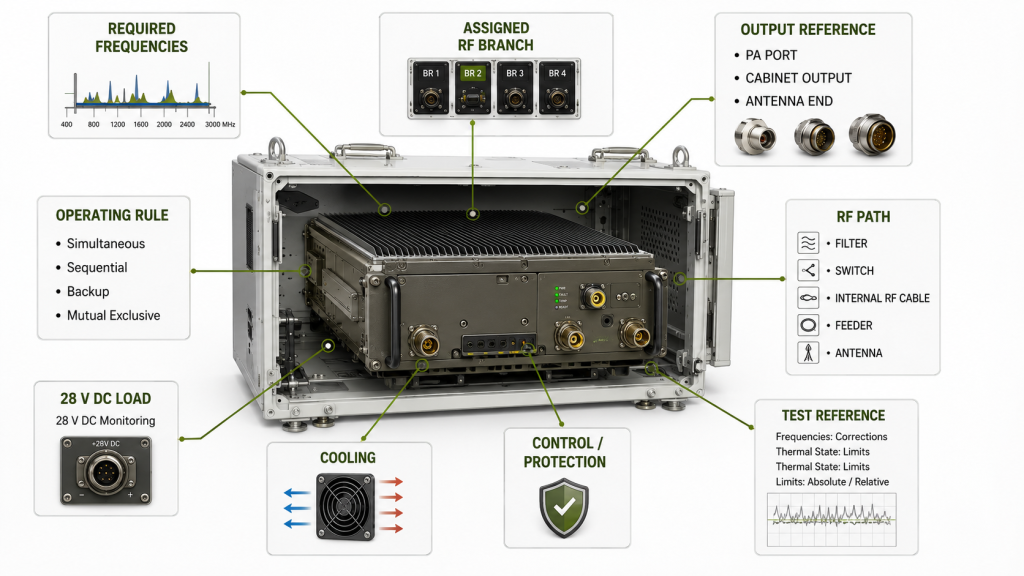
Depending on the architecture, a block may include:
- one dedicated narrowband PA;
- one assigned operating range within a controlled wideband PA path;
- a PA connected through an internal filter or switch;
- a switched branch connected to several antenna routes;
- or primary and backup paths with separate control rules.
The cabinet RF map needs to make that ownership visible before mechanical and electrical design begins.
RF PA Frequency Block Definition Fields
| Field | What to Record | Why It Matters |
|---|---|---|
| Block ID | Approved block name and revision | Connects drawings, control logic, and test records |
| Required frequencies | Operating range, priority points, and band edges | Prevents unassigned frequencies and coverage gaps |
| Assigned RF branch | PA module or controlled RF path | Identifies the hardware responsible for the frequency group |
| Output reference | PA port, cabinet output, or antenna end | Prevents invalid power comparisons |
| Operating rule | Simultaneous, sequential, backup, or mutually exclusive | Defines combined DC and thermal demand |
| RF path | Filters, switches, internal cables, feeder, and antenna | Establishes loss and VSWR boundaries |
| DC and cooling | Module-terminal Vdc/Idc and cooling responsibility | Connects the RF branch to cabinet limits |
| Control and protection | Enable, alarm, protection, and recovery requirements | Defines system-level visibility and fault handling |
| Test reference | Frequencies, corrections, thermal state, and limits | Connects the branch to acceptance evidence |
A usable block definition allows engineering, purchasing, production, and acceptance teams to identify the same RF path without relying on informal labels.
2. Why the Block Map Must Come Before Cabinet Layout
Vehicle-mounted C-UAS cabinets have limited space, finite DC capacity, fixed cable routes, and restricted cooling area.
When the PA map is created after the enclosure layout begins, the project may discover that the selected modules cannot be integrated without reopening the cabinet design.
Typical late-stage conflicts include:
- two PA branches competing for the same mounting position;
- an RF connector placed too far from its assigned antenna route;
- several active paths sharing an undersized DC branch;
- a high-heat module blocking airflow to adjacent electronics;
- switching or filter hardware added after the internal RF cables are fixed;
- or additional control lines required after the harness is released.
Each late change can force the project to revise the module layout, DC distribution, cooling path, RF routing, or control harness.
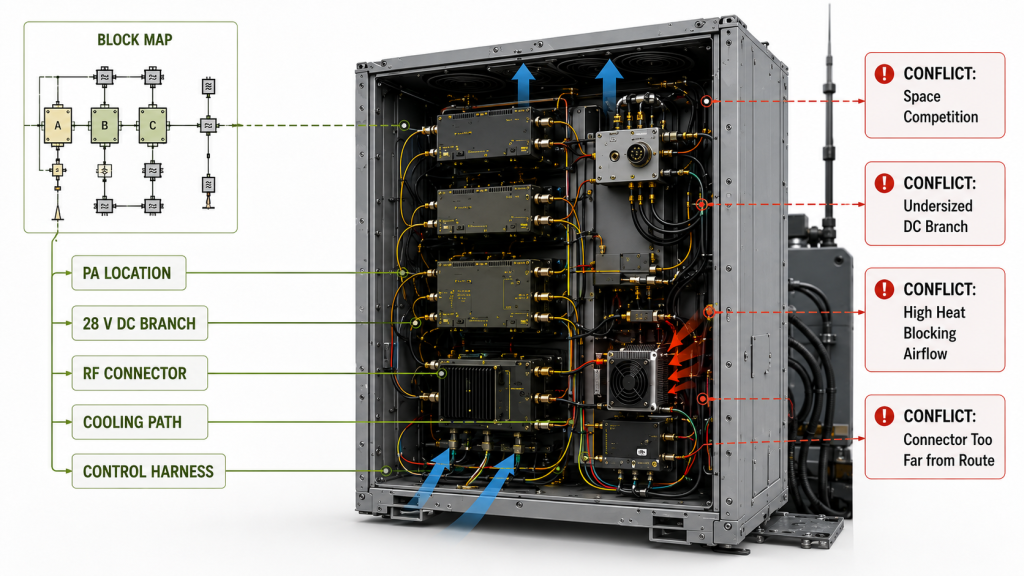
The frequency-block map needs to be reviewed before:
- cabinet dimensions are frozen;
- mounting holes and service clearances are approved;
- 28 V DC branches are released;
- cooling interfaces are selected;
- RF connectors are assigned;
- and the control harness is manufactured.
The map does not replace mechanical or electrical design. It gives those teams one approved RF architecture to design around.
3. How to Assign Required Bands to RF PA Blocks
Block planning should begin with the project frequency list—not with a supplier’s catalog categories.
First identify:
- required operating frequencies;
- priority frequency points;
- band-edge points;
- required output location;
- operating duration;
- simultaneous-operation rules;
- and any intentional overlap or backup requirement.
These conditions can then be allocated to defined RF branches.
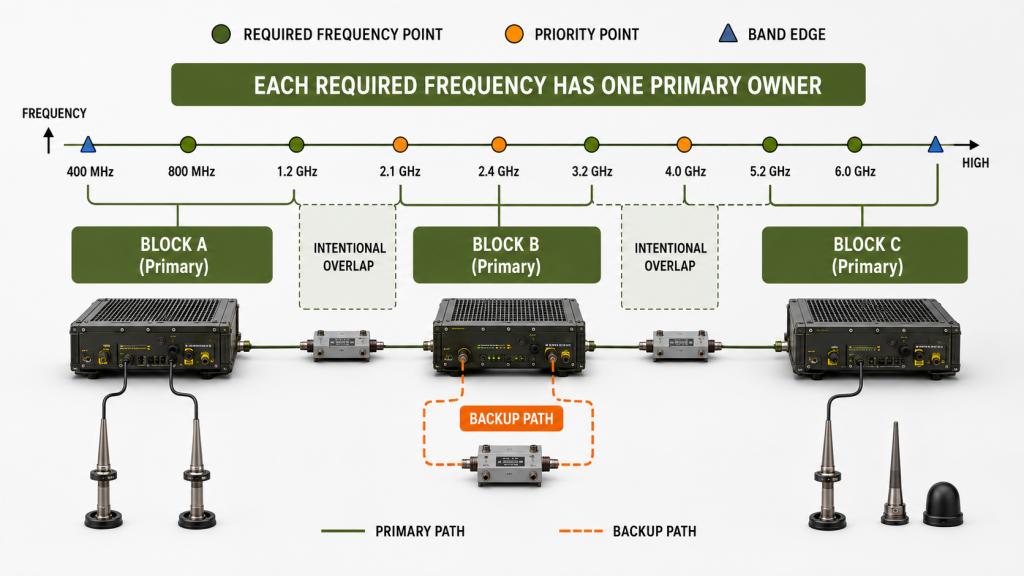
Do Not Treat Low, Mid, and High as Fixed Boundaries
Low-, mid-, and high-band labels can help communication, but they are not universal engineering divisions.
One project may group several operating windows into one wideband branch. Another may divide a similar range because the windows require:
- different output levels;
- separate antenna routes;
- different filters or switches;
- different duty conditions;
- or simultaneous operation.
The division needs to follow the project architecture rather than a generic frequency label.
Give Every Required Frequency One Primary Owner
Each required frequency point needs one identified owner unless redundancy is intentional.
Common planning gaps include:
- the same point appearing under two paths without a primary owner;
- one priority point sitting between two catalog ranges;
- a band-edge requirement being assumed rather than assigned;
- or an overlap being shown without a defined switching rule.
Where primary and backup branches are planned, document:
- which path is primary;
- which path is backup;
- whether both can operate together;
- and which acceptance evidence applies to each route.
The PA map defines what each RF branch must accomplish. Detailed frequency range, output, input drive, duty, cooling, control, and protection selection should continue with the C-UAS RF PA selection workflow.
4. When to Consolidate or Separate RF PA Paths
A wideband RF PA can reduce module count and cabinet interfaces. That does not automatically make it the lowest-risk architecture.
The real question is whether one branch can meet all project-critical frequencies under the agreed output, antenna, and operating conditions.
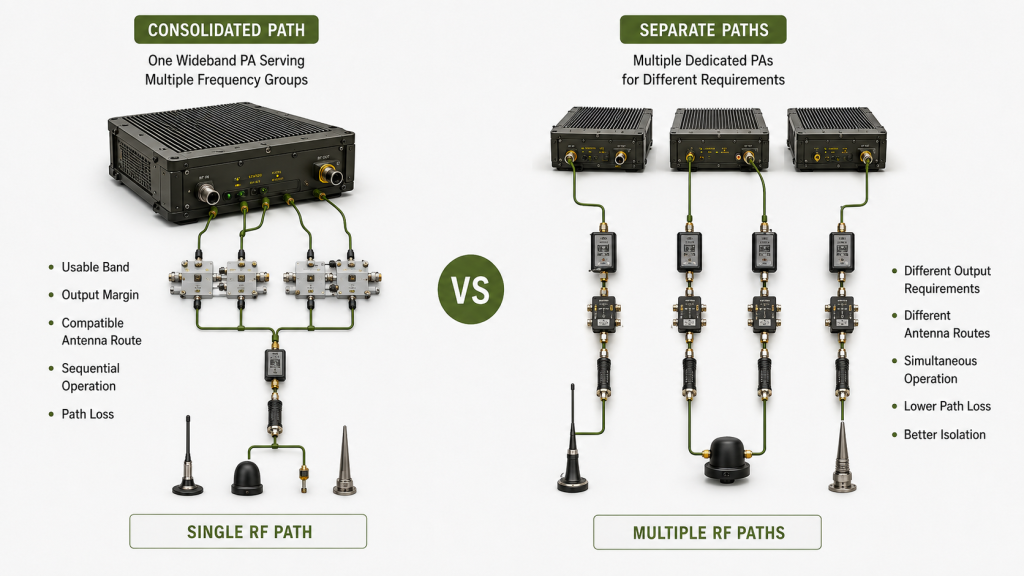
Consolidate When One Branch Can Own the Requirement
Combining several frequency groups into one wideband path may be practical when:
- every priority point remains inside the usable frequency range;
- the required output is available at the agreed reference point;
- one RF path can support the grouped frequencies;
- simultaneous transmission between those frequency groups is not required;
- and the consolidated branch remains compatible with the cabinet limits defined in the block map.
Consolidation can reduce module count, but only when the remaining RF branch still satisfies every specified condition.
Separate When the Blocks Have Different Responsibilities
Separate paths are usually safer when:
- different bands require different output levels;
- one priority point loses too much margin in a wideband path;
- separate antenna routes are required;
- simultaneous operation is needed;
- internal switching or filtering creates excessive loss;
- or one grouped branch would dominate the cabinet’s power or thermal budget.
The correct comparison is not simply one module versus several modules.
It is:
Which architecture meets the required frequencies, output references, antenna paths, operating rules, cabinet limits, and acceptance criteria with the lowest integration risk?
RF SKYPOWER can review mixed wideband and band-specific PA paths against the project’s 28 V DC capacity, cooling boundary, control requirements, and block-level test plan before the cabinet layout is released.
5. How Cabinet Limits Change the Block Plan
A frequency allocation that looks correct on paper may fail after cabinet limits are applied.
The PA map needs to connect each RF branch to four cabinet conditions: power, cooling, RF routing, and control.
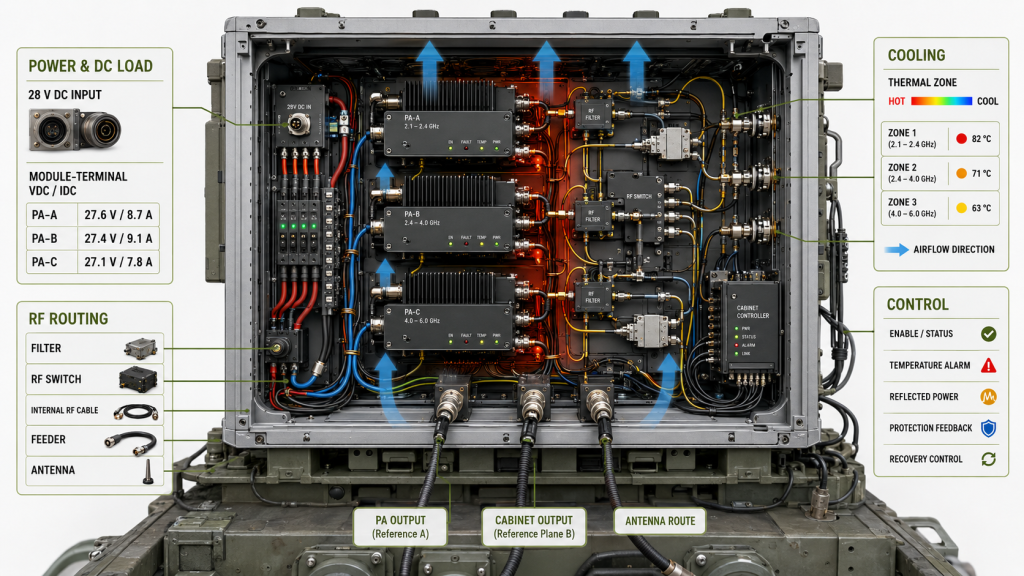
Power and Simultaneous Load
The cabinet power budget needs to use module-terminal voltage and current under RF load.
For each RF branch, document:
- expected Vdc at the module input;
- continuous operating current;
- cable and connector limits;
- and which other paths may be enabled at the same time.
A nominal 28 V source does not prove that 28 V reaches every PA under load. Cable resistance, connector loss, and shared distribution branches can reduce the voltage available at the module.
The critical condition is often the permitted combination of active paths—not the largest PA tested alone.
Thermal Zone and Cooling Responsibility
Each PA path needs an identified mounting position and cooling responsibility.
Document:
- the cooling interface;
- airflow or cold-plate direction;
- nearby heat sources;
- expected operating duty;
- and the required hot-state result.
Restricted airflow or shared cooling capacity can change RF output, current, temperature, and protection behavior after thermal stabilization.
A module that performs correctly on an open bench may not retain the same operating margin inside a compact vehicle cabinet.
Antenna and Feeder Path
Each frequency group needs a defined RF route.
The cabinet RF map should include:
- internal filters and switches;
- connector location;
- feeder type and length;
- antenna assignment;
- output reference point;
- and the applicable VSWR boundary.
The PA output connector is not the same as the cabinet output or antenna end.
Where several branches share switches, filters, or antennas, the map also needs to state which combinations are allowed and which paths are mutually exclusive.
Enable, Status, and Protection Feedback
The cabinet controller needs a clear operating rule for every PA path.
Define:
- enable and disable behavior;
- permitted startup sequence;
- required temperature or protection status;
- reflected-power status where required;
- fault response;
- and recovery behavior.
Do not assume that every PA provides the same control interface or alarm set. The project needs to identify the states required by the system controller and compare them with the interface available from the selected module.
6. What Evidence Proves the Blocks Work Together
Individual PA reports prove individual modules under the conditions stated in those reports.
They do not automatically prove the completed cabinet architecture.
Cabinet approval needs to connect three evidence levels:
- module-level acceptance;
- block-level RF-path acceptance;
- simultaneous-operation acceptance.
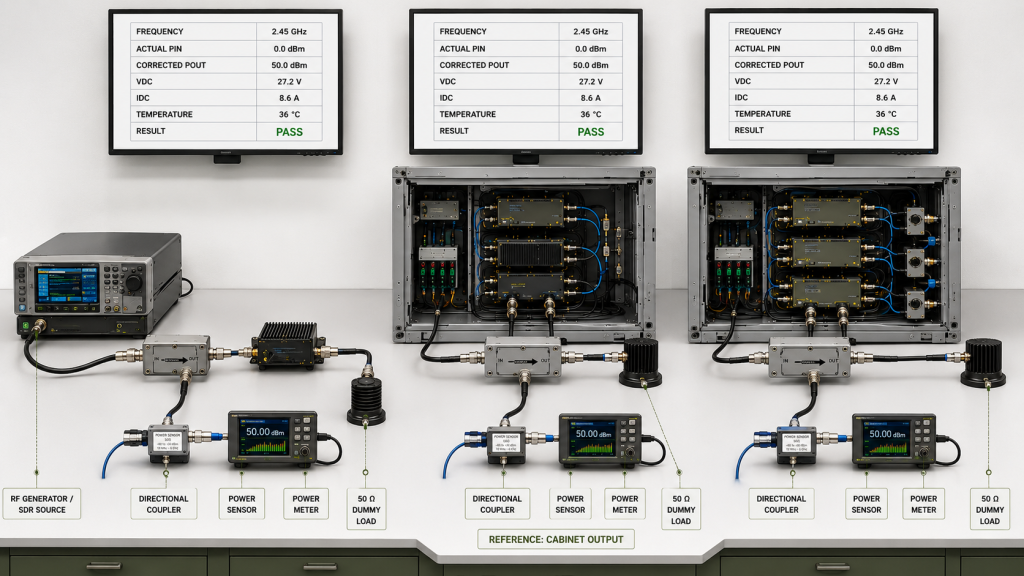
Module-Level Acceptance
Each delivered PA record should identify:
- model and serial number;
- controlled module and block-map revision;
- assigned block ID;
- tested frequency points;
- actual PA input power;
- corrected RF output and reference plane;
- applied measurement-path correction;
- module-terminal Vdc and Idc;
- load and thermal condition;
- and the applicable acceptance limits and conclusion.
Additional FWD, REV, VSWR, or protection records can be included where required by the acceptance plan.
Shipment approval should rely on S/N-linked RF PA acceptance evidence rather than representative data that cannot be connected to the delivered modules.
Block-Level Acceptance
The block-level record needs to prove that the assigned RF branch meets the cabinet requirement after its internal path is included.
It should identify:
- the tested block;
- the tested cabinet and RF-path configuration revision;
- the output reference point;
- the active filter, switch, or internal cable path;
- the applied path correction;
- the operating state;
- and the applicable pass-or-fail limit.
This distinction prevents a PA-port result from being mistaken for cabinet-output or antenna-end performance.
Simultaneous-Operation Acceptance
Where several blocks may operate together, test the permitted combination.
Record:
- which blocks were enabled;
- operating duration;
- module-terminal Vdc and Idc;
- relevant module or cabinet temperatures;
- corrected output at the agreed reference points;
- and alarm or protection status.
When channels share DC power, cooling, control, or RF hardware, the final test needs to show whether enabling one path changes another. The project can then verify RF power consistency across channels under the combinations it will actually use.
A cabinet should not be approved only because every PA passed an isolated bench test.
7. What to Put in the Cabinet RFQ Before Layout Approval
A useful RFQ defines the block architecture before the enclosure layout, harness, cooling system, and RF routing are released.
The customer does not need to design the supplier’s PA circuit. The customer does need to provide enough project information for the block grouping, module requirements, interfaces, and acceptance scope to be reviewed.
Vehicle C-UAS Cabinet RFQ and Acceptance Checklist
| RFQ Field | Project Input to Provide | Evidence to Request |
|---|---|---|
| Cabinet boundary | Size, mounting, access, and service limits | Approved module and connector layout |
| Frequency blocks | Required points and block ownership | Approved block map and revision |
| Output | Target per block and measurement point | Corrected output at the stated reference |
| Operating sequence | Simultaneous, sequential, backup, or mutually exclusive | Operating-sequence test |
| DC power | Available 28 V capacity, cables, and distribution limits | Module-terminal Vdc and Idc |
| Cooling | Airflow, heatsink, cold plate, liquid cooling, and ambient condition | Hot-state temperature and output record |
| RF path | Filters, switches, cables, feeder, connectors, and antenna assignment | Path correction and FWD/REV/VSWR evidence where required |
| Control | Enable, alarm, protection, status, and recovery needs | Block-level interface record |
| Acceptance | Frequencies, duration, thermal state, revisions, and limits | S/N-linked reports and cabinet-level conclusion |
A comparable supplier response should show:
- how the required frequencies are grouped;
- which module or controlled branch owns each group;
- where RF output is measured;
- which PA paths may operate together;
- how DC and cooling capacity are allocated;
- which antenna route belongs to each branch;
- which control states are available;
- and what evidence will be supplied before shipment.
Conclusion
An RF PA frequency-block map turns a multi-band requirement into a cabinet architecture that engineering, purchasing, production, and acceptance teams can review against the same conditions. Each required frequency group is assigned to a PA module or controlled RF branch, together with its output reference, antenna route, operating rule, DC load, cooling responsibility, control state, and acceptance record.
RF SKYPOWER can support an early review of your vehicle-mounted C-UAS cabinet block plan. Send the required frequency points, proposed block ownership, output target per block, simultaneous-operation rules, available 28 V DC capacity, cabinet size, cooling method, antenna and feeder paths, control and alarm requirements, quantity, and required acceptance evidence.
Submit your cabinet RFQ before layout approval so the PA grouping, power budget, thermal zones, RF paths, control states, configuration revisions, and test boundaries can be reviewed together.