
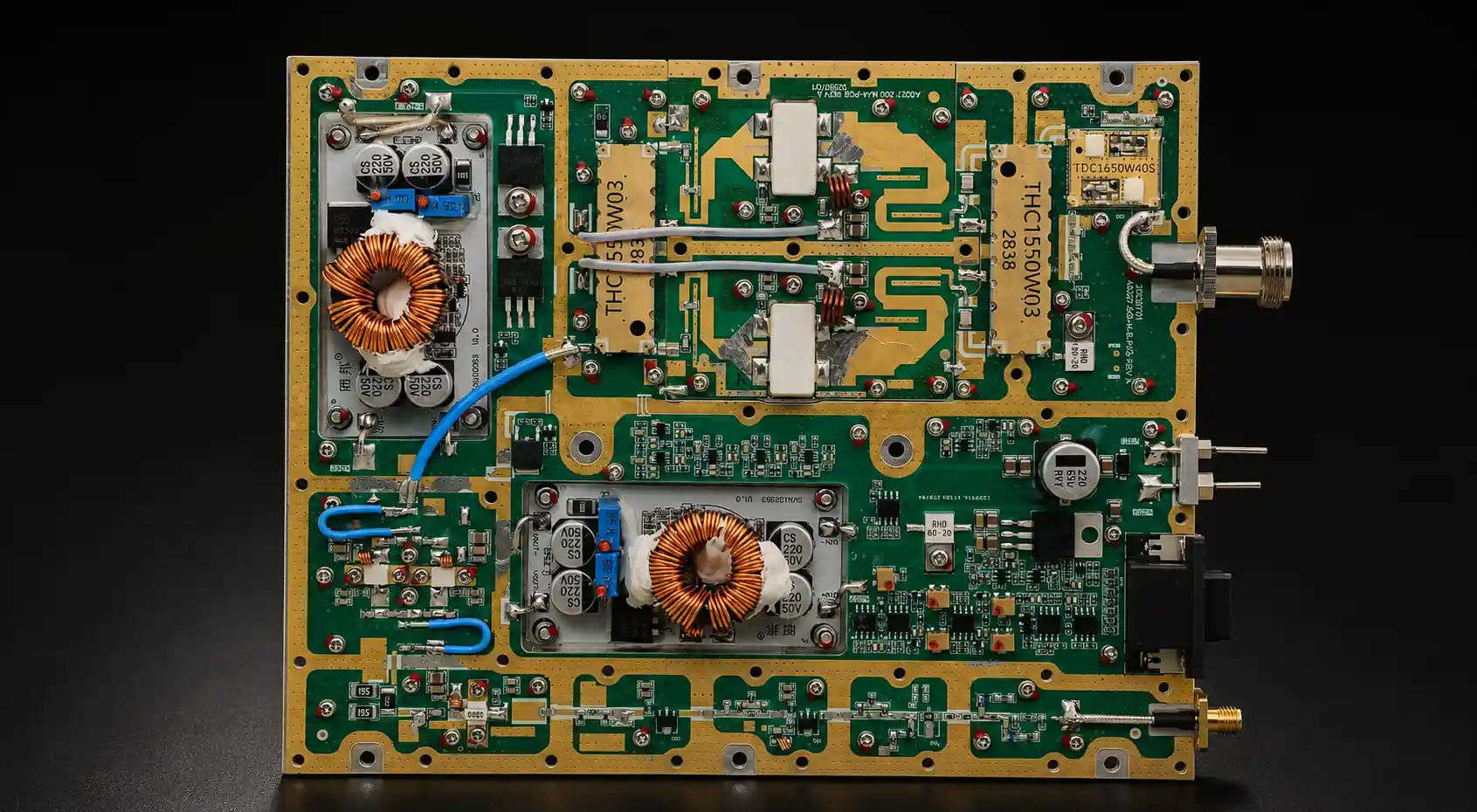
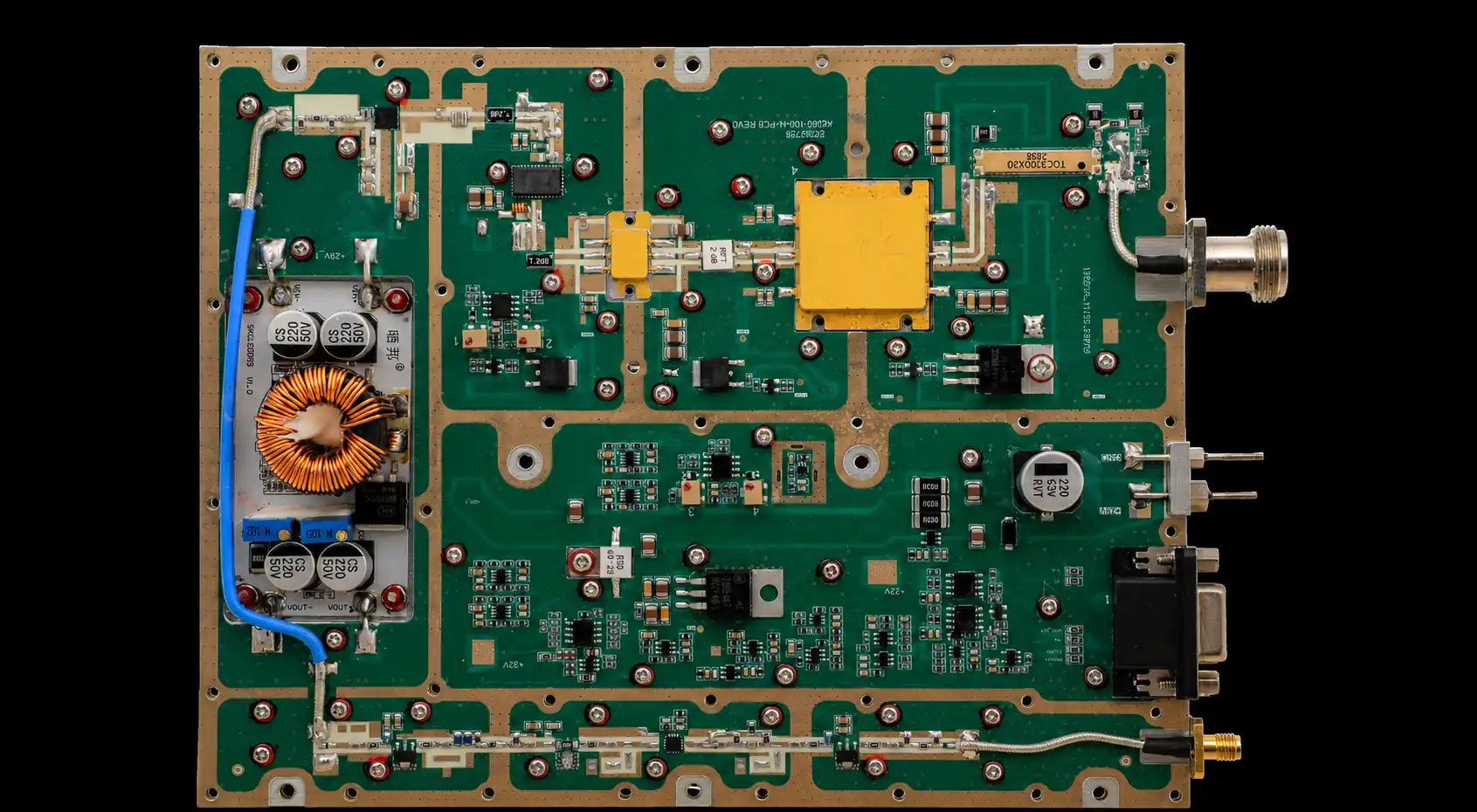

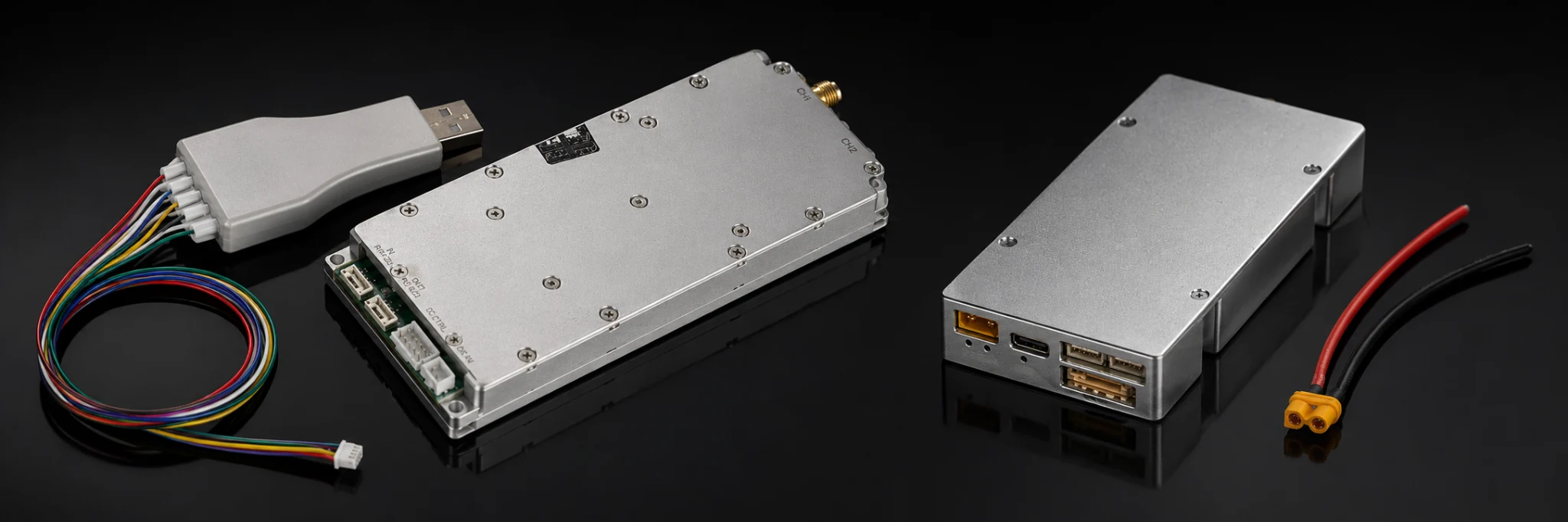



For an RF power amplifier module, the datasheet states product claims and operating conditions, the interface control document (ICD) defines the agreed interfaces, the test report records verification results, and the acceptance plan defines or references the tests and decision rules. Their authority comes from the project’s approved document references, revisions, clauses, and precedence agreement—not a universal ranking of the four file names.
One controlled document may cover several of these responsibilities. Procurement problems arise when the catalog specification, ordered configuration, and tested hardware describe different scopes, while the buyer and supplier assume the attachments agree.
Take one requirement, such as output power at the agreed PA output reference plane under specified operating conditions. Before accepting it as an order requirement, establish where it is defined, which other documents reference it, and who can approve a change.
1. Assign a Controlling Source to Every Requirement
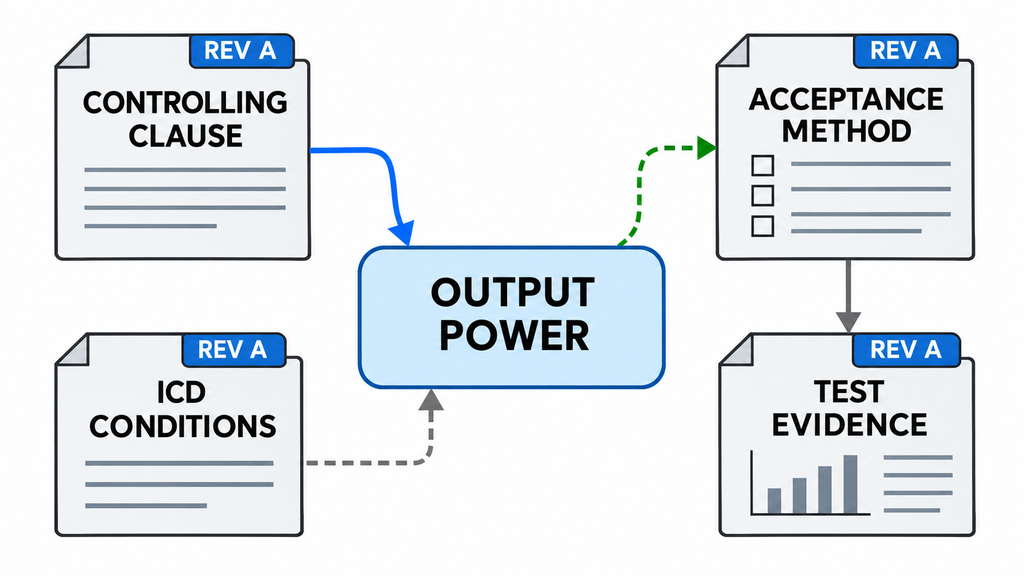
For each requirement, identify the controlling document, revision, and clause among the files incorporated into the purchase agreement. Other documents can reference that requirement, explain how to verify it, or record the result.
The agreed order of precedence governs conflicts between incorporated documents; the requirement map identifies where each requirement is controlled. Keep the map consistent with that agreement.
Illustrative requirement-to-evidence mapping. Replace the source descriptions below with the actual document names and clause references agreed for the project. These rows show what to record; they are not approved project records or test results.
| Requirement | Controlling document and exact clause | Applicable revision and configuration | Acceptance-plan reference or verification method | Evidence required and scope | Confirmation responsibility and open points |
|---|---|---|---|---|---|
| Output power under agreed operating conditions | Adopted datasheet power clause or approved project amendment; exact clause reference | Adopted revision; ordered RF configuration | Plan clause: power requirement, conditions, and method | Results for agreed test objects, frequencies, and operating conditions | Buyer and supplier technical approvers; unclear limits or conditions |
| Mounting and connector interfaces | ICD or referenced drawing clauses: dimensions, tolerances, connectors, and pin assignments | Agreed ICD and drawing revisions; selected hardware | Dimensional or interface checks against controlled definitions | Inspection or verification records; agreed hardware scope | Module and system interface owners; drawing and responsibility gaps |
| Control states and timing, where applicable | ICD or referenced control specification; exact state and timing clauses | Applicable hardware and control revisions | Functional checks against agreed interface behavior | State or timing records; agreed units or configuration | Module and controller owners; undefined states or timing |
| Inspection scope and decision rules | Approved acceptance-plan clauses; technical limits retain their own source references | Plan revision; covered configurations and test objects | Methods, sampling scope, and measurement decision rules | Test records and acceptance decisions for the defined scope | Named technical and quality approvers; method or decision-rule disputes |
| Report delivery and traceability | Approved order documentation clause or referenced deliverables schedule | Applicable order, configuration, and document revisions | Review of report identity, content, and delivery milestone | Agreed unit-, sample-, batch-, or configuration-linked records | Buyer and supplier document owners; report scope and delivery responsibility |
Before treating two clauses as contradictory, check whether they define the same parameter for the same configuration and conditions. If a critical requirement still has no agreed controlling source, revision, or approval owner, leave that item open and hold its technical approval.
2. Define the Datasheet Baseline for the Ordered Configuration
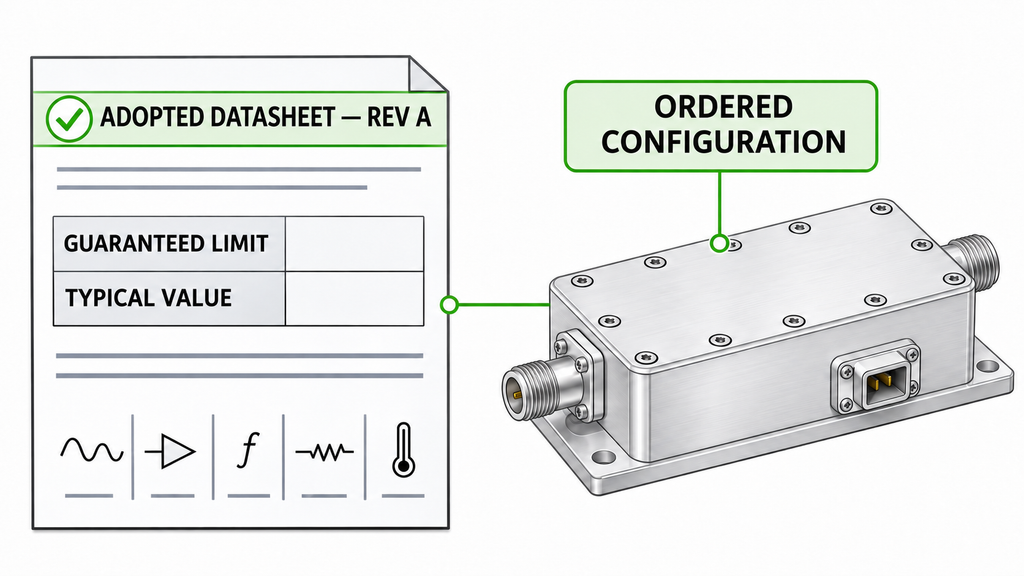
Adopt an RF amplifier datasheet for a defined configuration and revision. When reviewing RF power amplifier modules, record the selected model and options alongside that reference; a product-family description alone does not establish the requirements for a particular order.
For output power, identify whether the adopted clause states a guaranteed limit, a typical value, or a project target requiring agreement. A datasheet can form part of the purchasing basis when incorporated into the agreed documents. Its typical curves do not automatically become acceptance limits.
In the acceptance plan, reference the adopted power clause and its applicable datasheet operating conditions. Frequency, waveform, drive at the PA input, output reference plane, load, and thermal state can change what the power statement means. Compare statements only where the relevant conditions and value status align.
Record the adopted datasheet revision, selected configuration, and any approved amendments in the order references. Until those references and the status of the power requirement are confirmed, keep the item open for technical clarification.
3. Use the ICD to Control Module-to-System Interfaces
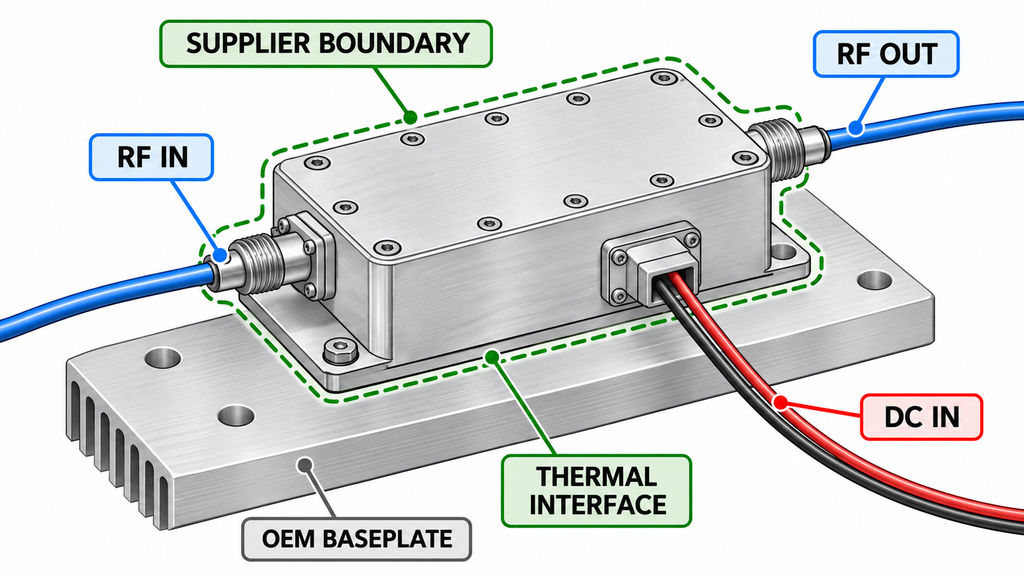
An ICD should define, or explicitly reference, the interfaces on which the module supplier and system integrator must agree. Both parties need the same interface definitions, a controlled revision, and clear responsibility for changes.
Depending on the module, the ICD may cover mounting dimensions and tolerances, connectors and pin assignments, electrical levels, control and status behavior, and the thermal contact surface. Include software or remote-control interfaces only where the module has them. The ICD can hold the details directly or reference separate drawings and interface specifications, provided each reference identifies the applicable revision.
The adopted output-power specification may depend on agreed DC supply, cooling-interface, or control-state conditions. The ICD should define or reference those conditions and identify which party provides them. Keep the RF performance limit tied to its adopted source clause.
Name the owners on both sides of each interface and the people authorized to approve changes affecting it. A matching connector name alone does not establish compatibility: compare the applicable definitions, pin assignments, electrical states, and drawing revisions before confirming compatibility.
The buyer should obtain an agreed set of interface references and responsibilities. If a critical mounting, electrical, cooling, or control definition is missing or contradictory, pause the affected integration and order approval until it is resolved; otherwise, the module and host may be built to different assumptions.
4. Tie Each Test Report to the Configuration It Verifies
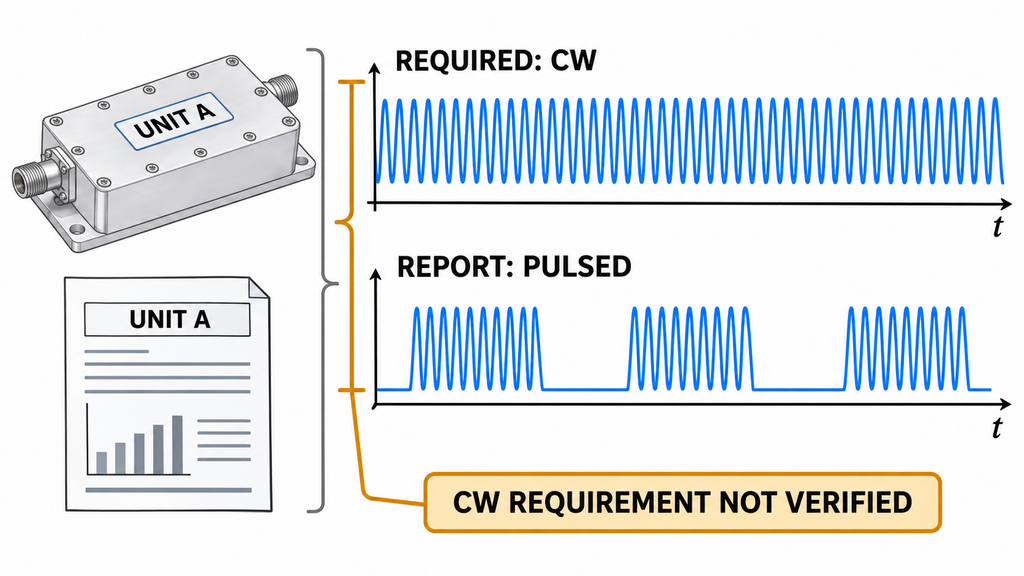
A test report supports an order requirement only to the extent that its requirement reference, tested object, configuration, and conditions apply. Trace the adopted clause and revision through the test method to the result, and identify any recorded deviation and its approved disposition.
For output power, compare the relevant frequency, waveform, drive at the PA input, PA output reference plane, load, and thermal state. Check whether results are raw readings or corrected values and whether the methods, uncertainty treatment, and evidence scope permit comparison. Partially aligned conditions support only a limited comparison.
Where the project requires per-unit verification, unit-linked test evidence should connect the delivered unit’s serial number (S/N) to its dataset, report, and agreed test scope. Sample, batch, and configuration-level records retain their respective coverage. Per-unit verification applies only to the checks the project requires on every unit.
For a hypothetical order requiring continuous-wave (CW) output after agreed thermal stabilization, a pulsed-drive report alone leaves that requirement unverified. Keep the requirement unchanged while assessing the report’s applicability and agreeing any supplemental evidence or testing. If the parties expressly adopt a report section into the technical baseline, identify that section and its approved role separately from the recorded results.
Record which requirements the report supports and which remain open. If identity, revision, or test conditions that affect applicability cannot be matched, request the missing evidence before concluding that the order requirement is met. An inapplicable report is an evidence gap, not by itself a product failure.
5. Set Acceptance Conditions and Decision Rules Before Testing
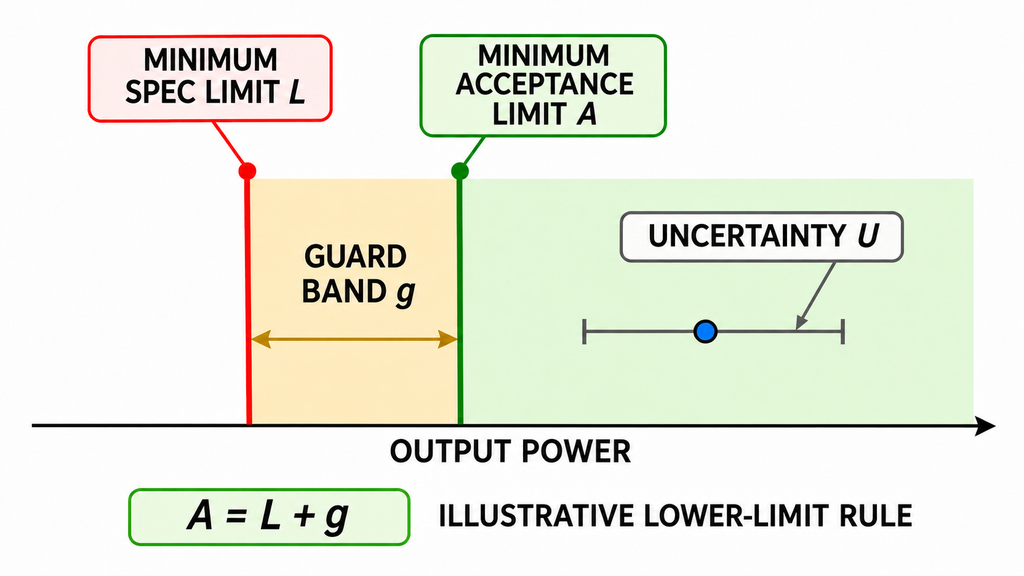
The acceptance plan turns agreed requirements into executable verification. Each test should define or reference its technical limit, identify the source clause, and state the conditions and method used to evaluate it. A plan can contain approved project requirements, but its title alone does not authorize a change to the technical baseline.
For the output-power requirement, reference the agreed RF conditions and measurement planes, then define the applicable supply, cooling, stabilization, and measurement arrangements. Use the conditions relevant to that parameter; a dimensional inspection does not need the operating conditions of a full-power RF test.
Keep the specification limit and the measurement decision rule separate. The limit states the technical requirement. The decision rule states how the measured result is evaluated against it, including measurement uncertainty where relevant. An agreed guard band may affect the acceptance boundary without changing the underlying specification limit. Record uncertainty separately; it is not a correction to add to the measured power.
The plan should specify which checks apply to every unit, a sample, a batch, or a configuration, and the required report content. Name the acceptance decision-maker and the approvers for retesting or deviations.
Define when retesting is permitted, retain both the original and repeat results, and state how they enter the final acceptance decision. Define how deviations affecting acceptance are recorded against the relevant requirement and referred for an approved disposition, including any further evidence required and the effect on the acceptance decision.
For a C-UAS project, shipment acceptance requirements should reference the same approved baseline, so the later release decision uses the criteria agreed before testing. If a limit source, a test condition that affects the acceptance decision, or a decision rule remains unresolved, hold approval of that part of the plan rather than deciding its meaning after results are available.
6. Resolve Document Conflicts Before Placing the Order
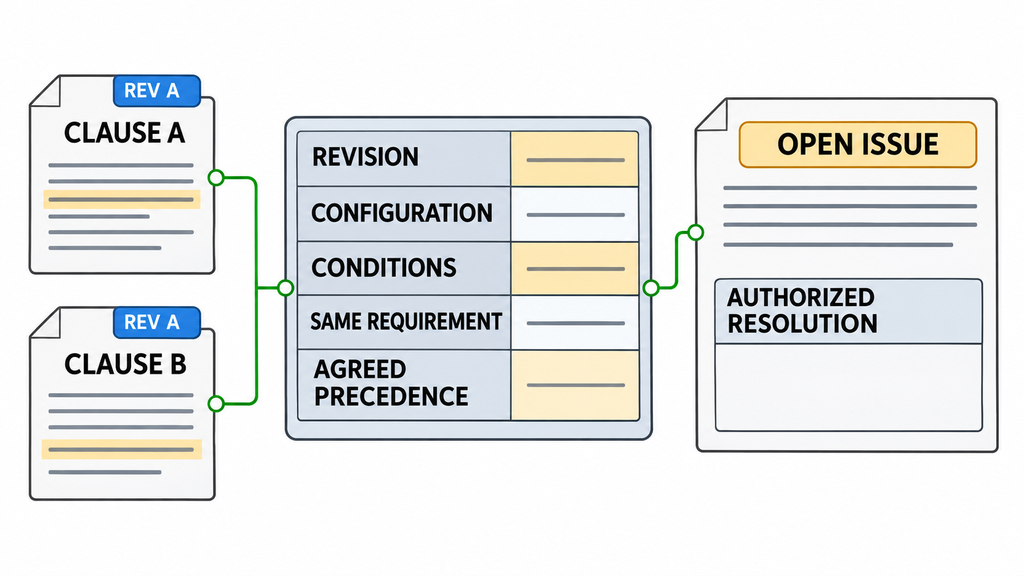
Classify the difference before choosing the remedy. Two documents may contain conflicting requirements, describe different operating conditions, or provide evidence for different configurations.
Before deciding whether clauses or results conflict, identify each source’s revision and its applicability to the order, then check whether they address the same requirement and configuration under relevant conditions. If only some conditions align, limit the comparison accordingly and request the missing information. Neither the newest file, the strictest number, nor the most favorable measured result automatically controls the order.
Illustrative cross-document conflict handling. These are generic review situations, not records of a customer project.
| Discrepancy | Conditions to align first | Controlling basis to confirm | Action | Closure record and approval scope |
|---|---|---|---|---|
| Two incorporated specifications state different requirements | Parameter definition, applicable revisions, configuration, and operating conditions | Agreed precedence provisions and controlling technical clause | Obtain written clarification of the adopted requirement; update affected references through the agreed approval process | Original clauses, adopted wording, approving parties, and affected configuration, order, or batch |
| A report covers a different configuration or operating condition | Tested hardware, waveform, drive, reference planes, load, thermal state, method, and evidence scope, as relevant | Order requirement and agreed verification scope | Assess applicability; obtain supporting evidence or retest where needed, without presuming product failure | Applicability assessment, new evidence or the approved disposition of any remaining gap, and approval for the stated order scope |
| An acceptance plan introduces an unapproved change | Whether the technical limit changed or only the measurement decision rule | Approved technical requirement and separately agreed decision rule | Restore the agreed basis or obtain approval for the changed requirement or rule | Exact change, approval authority, updated references, and affected tests, configurations, orders, or batches |
The closure record should preserve the original clauses and conditions, the decision, who approved it, and where it takes effect. A response such as “use the latest file” leaves the order’s applicable revision unresolved unless that revision and its effect are explicitly confirmed.
Hold approval of the affected order requirement until the authorized parties resolve any critical difference involving configuration, interfaces, or acceptance. Keep the unresolved item visible in the requirement map and difference record. This is not a verdict that the product has failed.
7. Freeze the Approved Document Package and Its Change Rules
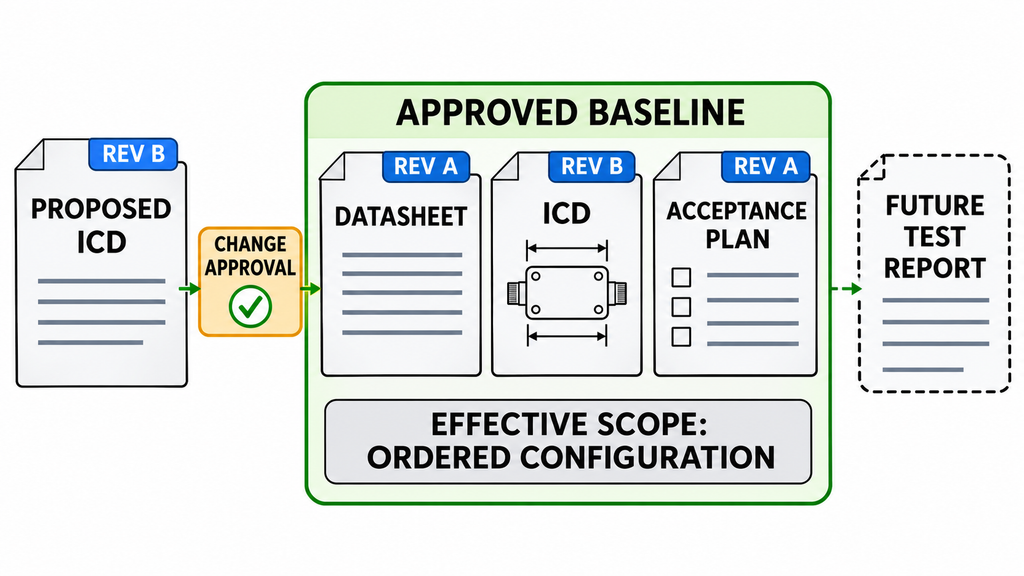
A document baseline is the set of files, revisions, and references approved for a defined configuration at a particular point in the project. Before ordering, identify the applicable specifications, interface documents, acceptance plan, and incorporated references, together with their approval status and the disposition of open items. Give manufacturing and acceptance teams the same approved references.
Define future production reports as deliverables before ordering: agree their format, test and traceability scope, responsible party, and delivery milestone. Add the actual records when they are generated.
For later changes, record what changed, why, who approved it, and which configurations, orders, or batches are affected. Assign responsibility for notifying the other party and reviewing whether existing evidence still applies. Depending on the change, that review may call for clarification, supplemental evidence, or re-verification.
Confirm how a newly issued revision applies to an existing order through the agreed change process. A concession approved for one batch stays within that approval’s scope; it does not automatically amend the product baseline for future deliveries.
Keep the affected approval pending while a critical revision, effective scope, or future evidence-delivery responsibility remains undefined. The approved document package should tell both parties what to build against, what to verify, and what must be delivered.
Conclusion: Agree the Document Baseline Before Ordering
Assign product claims to adopted specifications, interfaces to the ICD or referenced drawings, test results to reports, and verification methods and decision rules to the acceptance plan. Connect those roles through approved clauses, revisions, the ordered configuration, and the agreed precedence provisions. The basis for ordering is clear when critical differences are closed and the required evidence, including future reports, has a defined scope and delivery arrangement.
That establishes a procurement basis, not proof that a module has passed acceptance. Specific limits, configuration applicability, and acceptance results still require the applicable project documents and verification evidence. A newer file, a stricter number, a higher measured output, or a document called an acceptance plan does not automatically override an approved requirement.
Before ordering, complete the requirement map, close the differences that affect configuration, interfaces, or acceptance, and freeze the applicable revisions and change rules. Leave unresolved critical items open for agreement rather than treating the attachment package as complete.
For document clarification with RF SKYPOWER, send the existing files and revisions, candidate model or configuration, key requirements and operating conditions, interface concerns, and unresolved differences. Include the quantity, required unit-, sample-, batch-, or configuration-level evidence, report content, and delivery milestones. Ask for confirmation of the applicable document set and the evidence still needed to complete the technical agreement.