
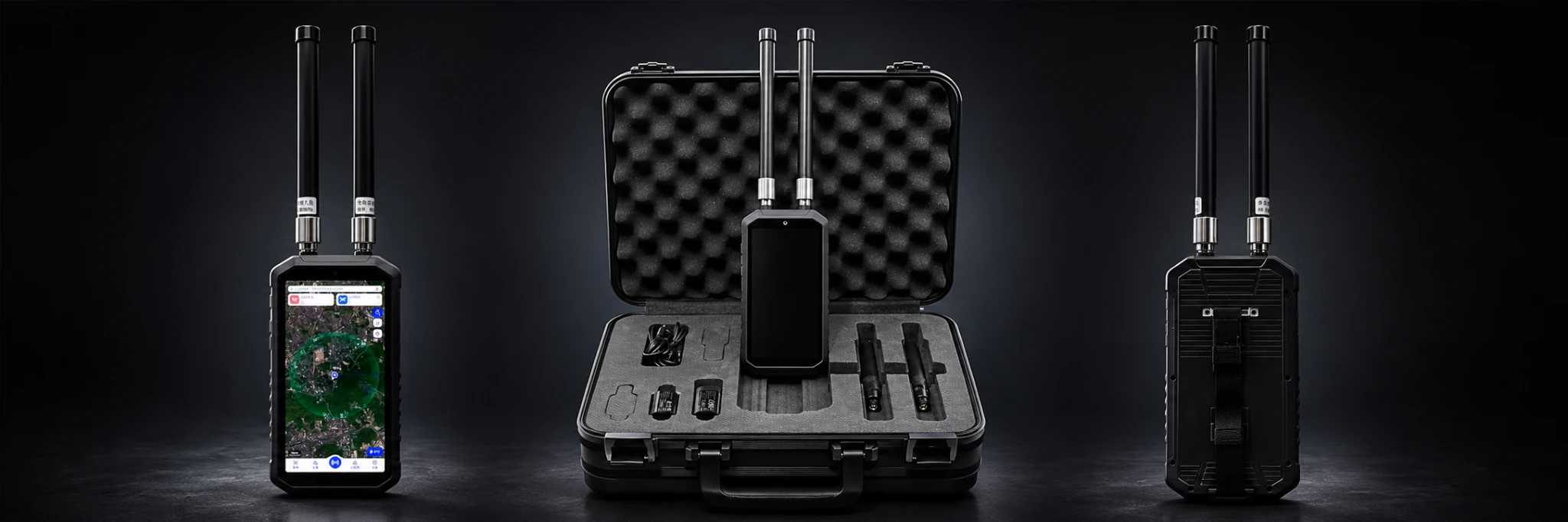

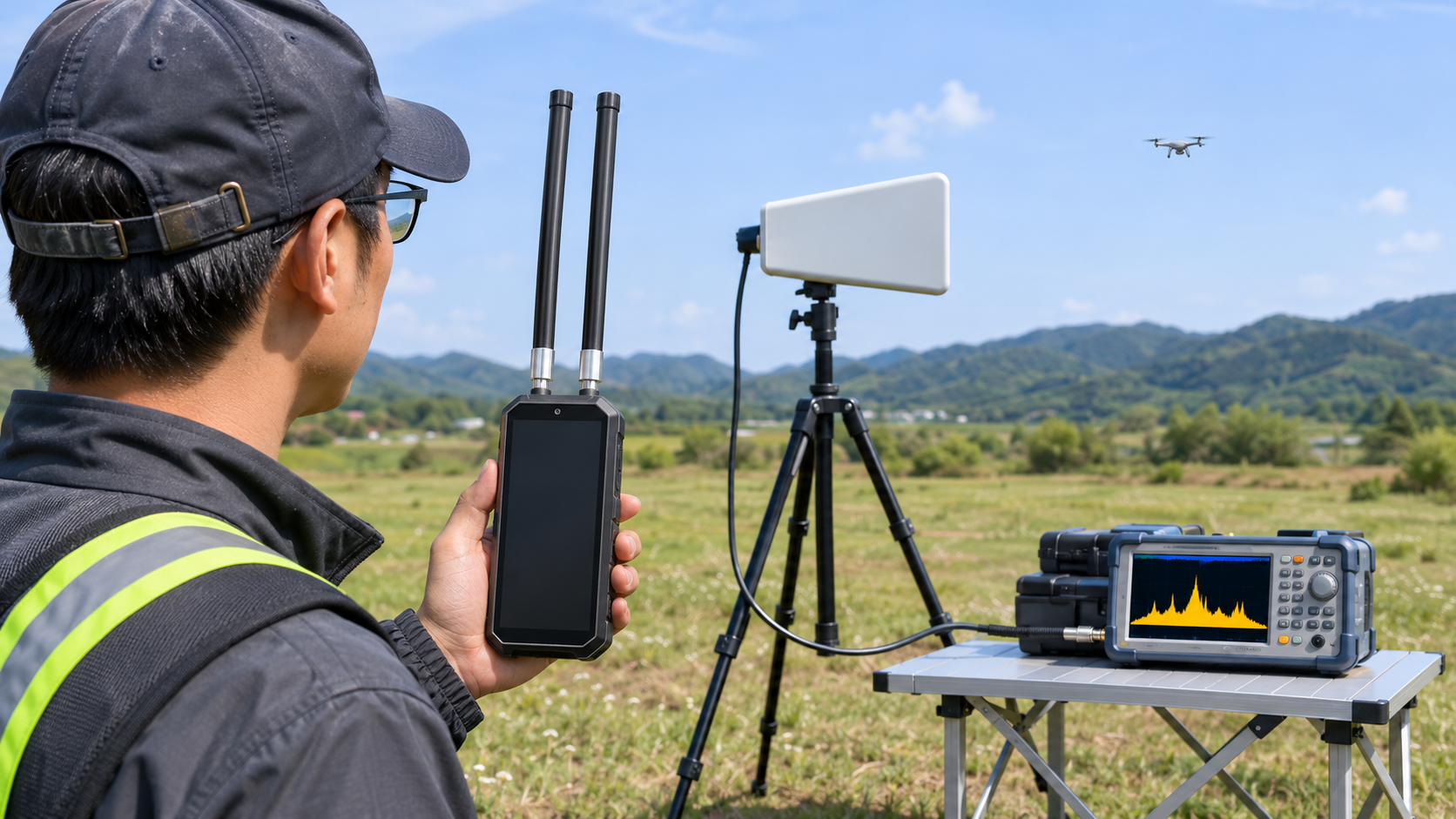
RF drone detection frequency coverage depends on the signals available to receive, the receiver’s ability to capture them, and what its software can recognize. A detector’s stated frequency range shows where it can listen. Whether it detects or identifies a drone depends on the transmission, receiver settings, and processing support.
Two detectors may both cover 2.4 GHz yet produce different results. One may raise an RF alert. Another may identify a supported drone model.
Engineers need to know the target, its active radio links, and the required output before comparing those claims.
1. What Does Frequency Coverage Actually Mean in RF Drone Detection?
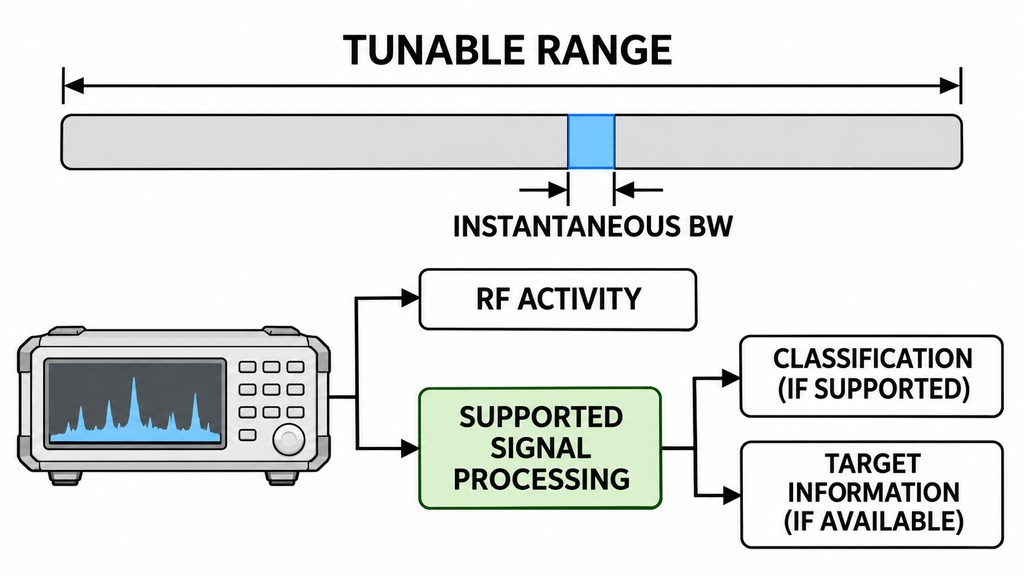
Frequency coverage spans several receiver capabilities. Each calls for different evidence.
| Capability level | What the claim means | Evidence to request | What it does not establish |
|---|---|---|---|
| Tunable RF range | The receiver front end can operate at the stated frequencies. | Frequency specification, antenna coverage, and receiver configuration. | Simultaneous monitoring, signal acquisition, or a drone alert. |
| Signal capture | The receiver acquires sufficient signal during its observation window for the stated task. | Time-stamped detector acquisition or event evidence linked to a known reference transmission; receiver trace where available. | Classification of the signal as drone-related. |
| Signal classification | Processing assigns a signal class or inferred target family using supported RF features. | Labeled target test, processing version, and observed classification result. | Verified identity fields or recognition of every target model. |
| Protocol recognition | Processing recognizes a supported communication format and may interpret accessible messages. | Protocol revision, target configuration, and observed recognition or decoding result. | Compatibility with every firmware version or access to all message fields. |
| Target information output | The detector presents specific inferred labels or information obtained from received signals. | Actual output fields, their source, timestamps, and independent target evidence. | Identical information across all targets, modes, and reception conditions. |
These levels describe evidence, not a fixed sequence of processing steps. An RF signature classifier can identify a signal family without decoding message contents. A protocol decoder uses a different approach to interpret supported transmissions.
Receiver bandwidth matters as well.
A tunable frequency range describes the frequencies a receiver can select. Instantaneous bandwidth describes how much spectrum it can process at once.
A receiver that scans several frequency spans in sequence gives each span a separate observation window. It may support a frequency without monitoring it continuously.
Signal acquisition also differs from recording. A detector can process a waveform internally without storing or exporting raw I/Q samples.
The choice between RF, radar, and multi-sensor detection comes first; frequency coverage is a receiver-level question within the passive RF approach.
2. Which Drone Signals and Frequency Bands Should a Detector Cover?
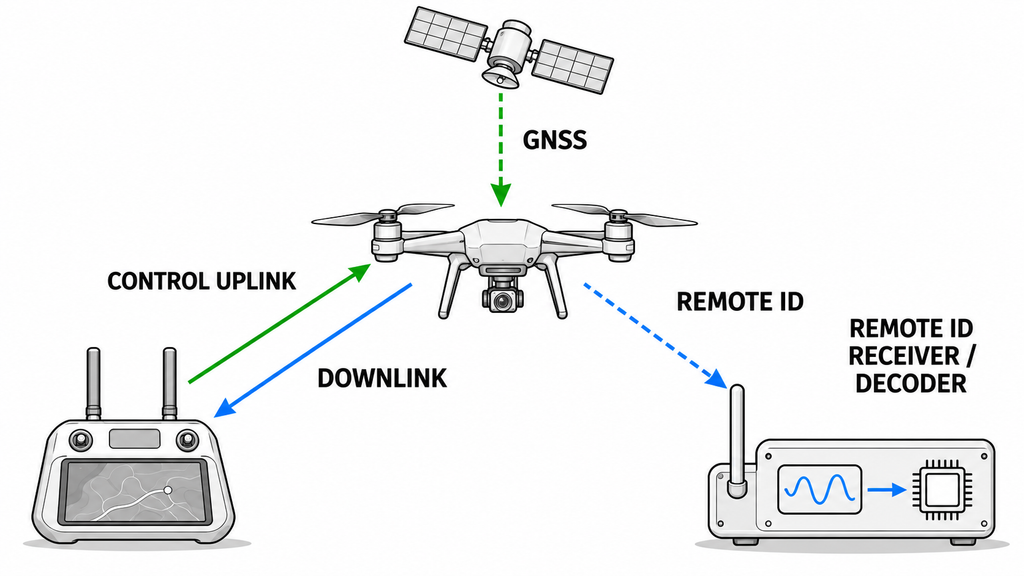
Start with the transmitter.
A control uplink generally carries commands from a controller toward an aircraft. Telemetry and video typically travel from the aircraft toward a ground device.
These functions may share one managed bidirectional RF link rather than occupy separate radio channels. A single communication system can carry control, telemetry, and video through coordinated transmissions.
Engineers should therefore identify the transmitting devices, signal directions, and link behavior. A passive detector may observe a controller transmission, an aircraft transmission, or both.
A controller-related signal provides evidence of RF activity associated with the controller. Aircraft location and identity require their own supporting information.
Remote ID offers another possible signal source. Compatible drones or attached broadcast modules transmit identification and location-related data through supported wireless methods. A detector needs the appropriate receiving and processing support to recognize those broadcasts.
GNSS works in the opposite direction. The aircraft normally receives satellite-navigation signals. Those incoming signals are separate from transmissions generated by the aircraft or controller.
Common drone communication frequencies include 433 MHz, region-dependent 868/915 MHz links, 2.4 GHz, and 5.8 GHz.
3. How Do Protocol Libraries Affect Drone Detection and Identification?
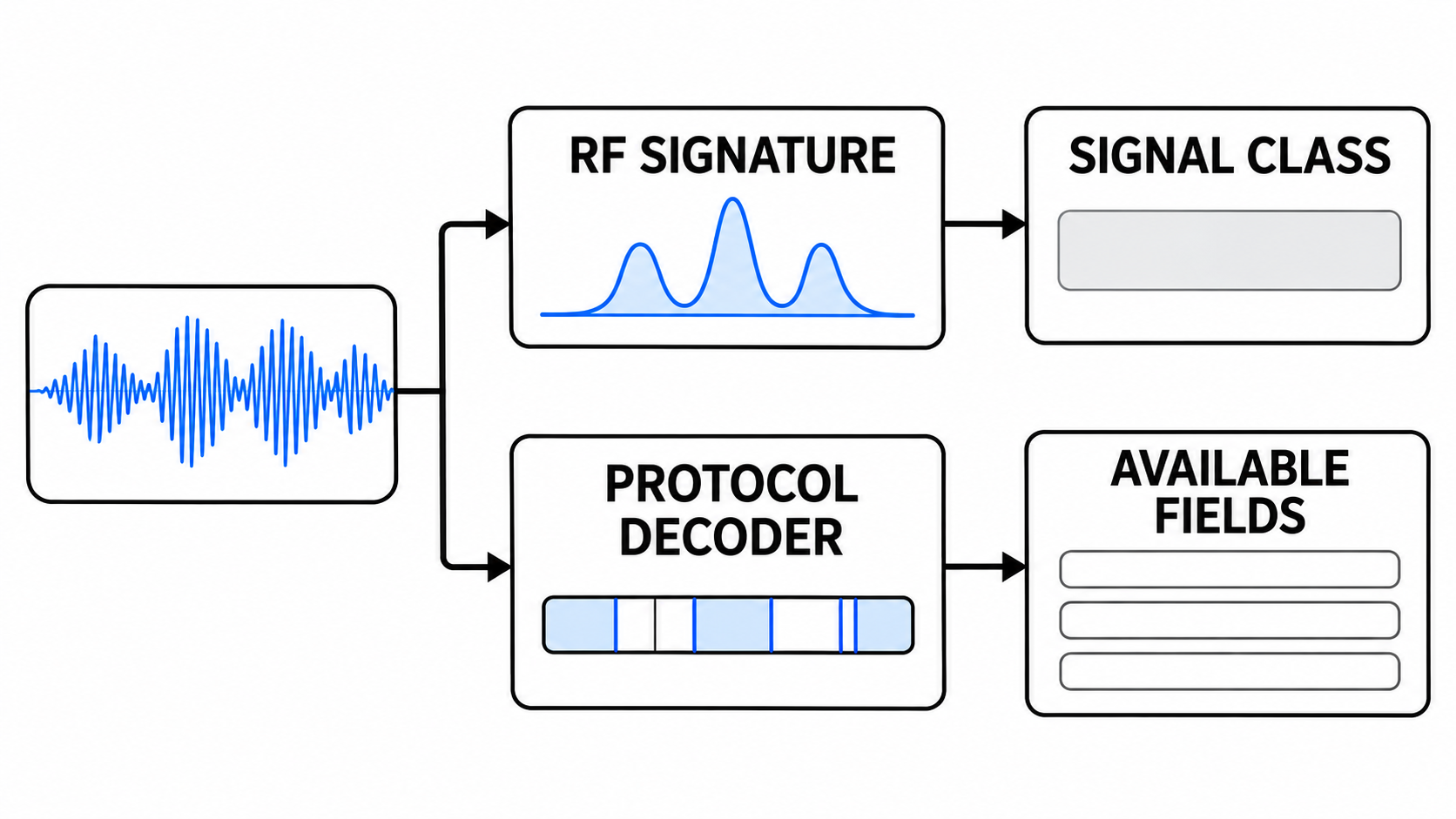
RF signature classification examines characteristics such as spectral shape, transmission timing, and frequency behavior. A validated classifier may infer a drone-related class or target family without decoding the message bits.
Protocol recognition and decoding rely on knowledge of supported signal formats. Compatible processing can extract particular fields when the received messages contain accessible information.
A model-family label inferred from RF characteristics differs from an identifier or location field carried in a message. Engineering records should show which method produced each result.
A useful compatibility record identifies the aircraft model, communication firmware, detector processing version, and observed output. Recognition of one aircraft generation says little about an untested communication revision from the same manufacturer.
HZ-HD03 uses passive RF reception. During detection, it does not actively transmit an RF probing signal.
For a target-specific HZ-HD03 review, record the tested aircraft configuration, detector software version, and the alert or information displayed during the trial.
A time-matched screen recording or event record can support the result when it clearly links the output to the tested target.
4. How Does FHSS Affect Detection Bandwidth, Dwell Time, and Revisit Time?
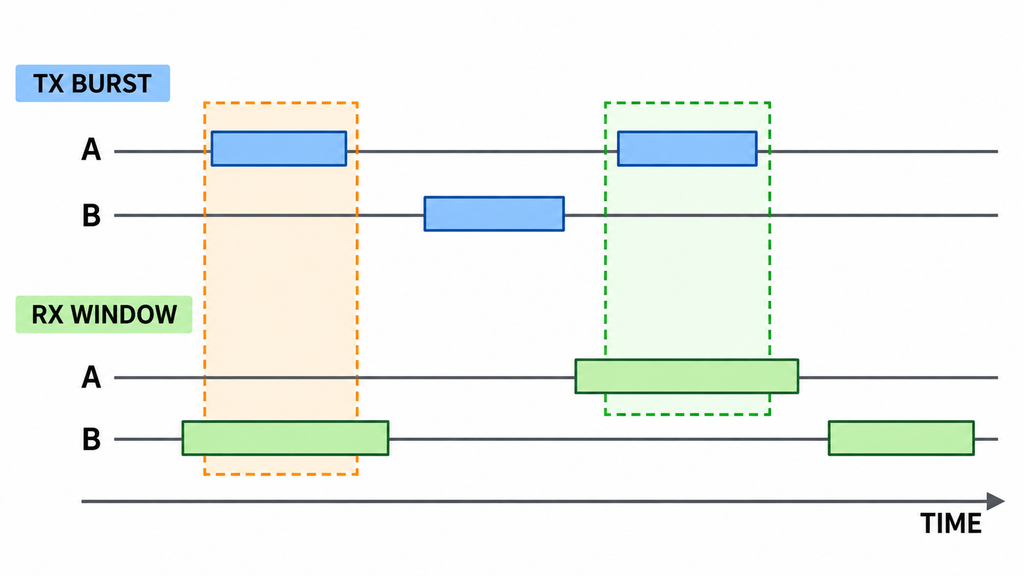
Frequency-hopping spread spectrum (FHSS) moves a transmission among carrier frequencies over time.
A passive receiver needs to encounter the transmission during a suitable observation window. Its total frequency range alone cannot describe that timing relationship.
Instantaneous Bandwidth vs. Sequential Scanning
Instantaneous bandwidth is the frequency span a receiver can observe at one time.
Sequential scanning covers a wider range by visiting separate spans in turn.
Suppose a receiver alternates between frequency spans A and B. It leaves A to observe B just before the transmitter sends a short burst on A.
The burst passes while the receiver is listening elsewhere.
A later transmission may overlap the receiver’s next visit to A.
A receiver that processes the entire hopping span simultaneously avoids this particular scanning gap. Its software still needs enough usable signal to produce the required detection or identification result.
Dwell Time, Revisit Time, and Missed Bursts
Three timing parameters help explain whether a receiver can encounter a hopping signal.
Transmitter hop dwell time is how long the transmitter occupies a particular hop frequency.
Receiver dwell time is how long the detector observes a selected frequency span.
Receiver revisit time is the interval between successive observation windows for that span.
A short burst may fall between receiver visits. Another may partly overlap the observation window but provide too little content for classification.
Repeated hops create further opportunities for observation. The result depends on the transmitter’s hopping behavior, receiver timing, signal conditions, and processing requirements.
Keep two test outcomes separate:
- Signal capture: The receiver acquired a relevant transmission during an observation window.
- Detection result: The configured detection function produced the required alert or classification within the defined observation period.
An FHSS test record should identify the hopping span, burst behavior, receiver bandwidth, dwell and revisit times, signal conditions, and detection criterion.
5. Why Do Receiver Sensitivity and RF Noise Matter Across Bands?
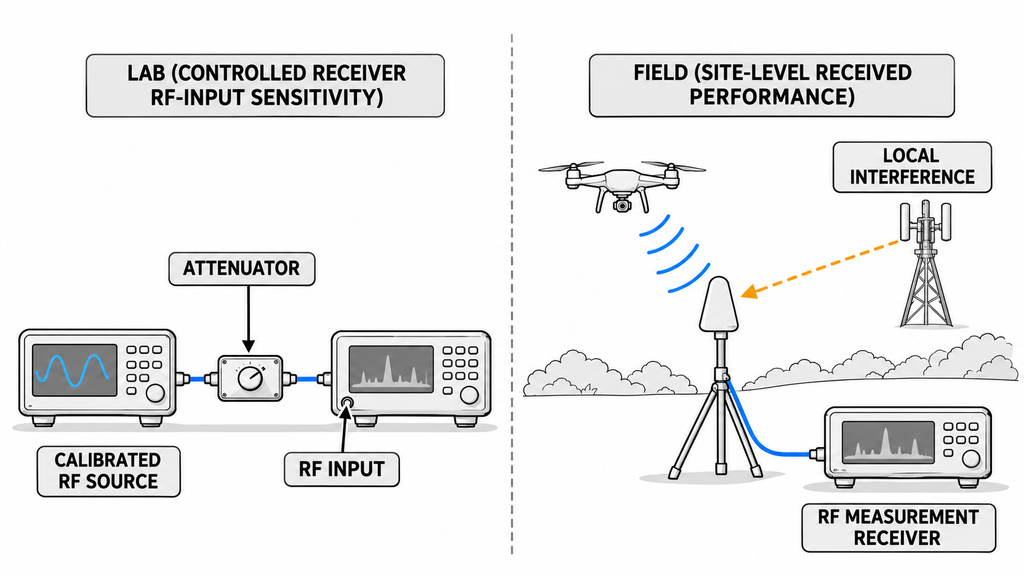
Receiver sensitivity describes the signal level needed to achieve a specified detection result under defined conditions.
An input-sensitivity measurement typically uses a known signal applied at the receiver’s RF input. In the field, the signal first passes through the receiving antenna and any connecting hardware.
Antenna gain, polarization, cable loss, orientation, and propagation conditions affect the signal that reaches the receiver. Local RF noise and interference affect how clearly the receiver can distinguish the target transmission.
A receiver may meet its input-sensitivity specification in a controlled test while receiving a weaker signal through an installed antenna.
Strong nearby transmissions can also reduce usable performance through interference or front-end blocking.
Sensitivity should therefore be tied to the frequency, waveform, bandwidth, receiving conditions, and required output.
An RF energy-detection threshold may differ from the signal level needed for model classification.
For supplier comparisons, use the same frequency, waveform, receiver bandwidth, input condition, and detection criterion. Record the output obtained under those conditions.
6. Can Passive RF Detection Identify Drones During Autonomous Flight?
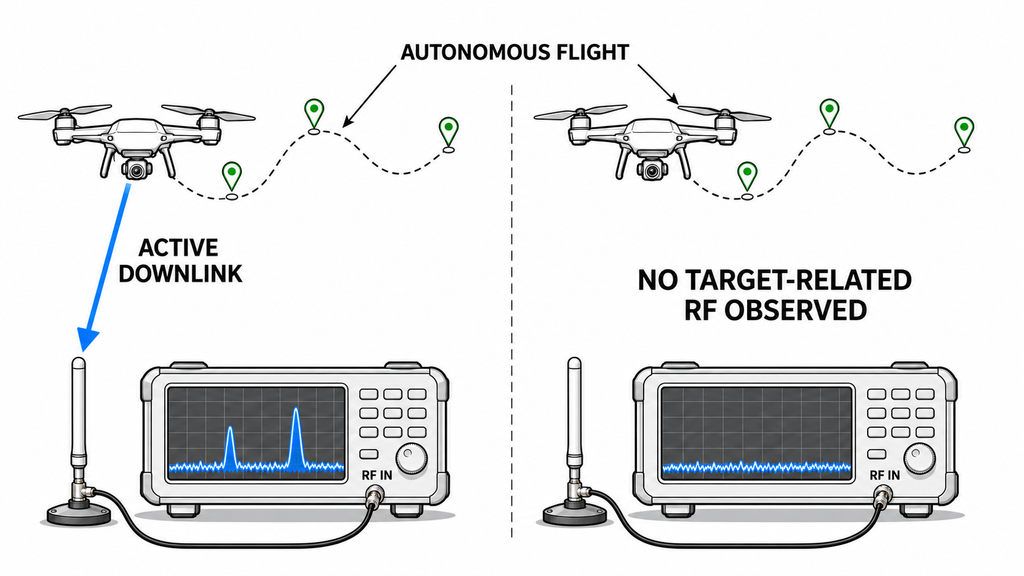
Autonomous flight describes how an aircraft follows its mission. The radio functions that remain active determine what a passive RF detector can observe.
An autonomous drone may continue transmitting telemetry, video, or other broadcasts even when its control traffic changes.
Four cases matter:
- Autonomous flight with an active downlink: The aircraft continues transmitting telemetry or video. Detection depends on the received signal and supported processing.
- Reduced control traffic with continuing broadcasts: Remote ID or another broadcast may remain observable while command-link activity decreases.
- No observable target-related transmission: A passive RF detector has no target-related signal to classify during the observation window. A project that must detect such flights needs a method that does not depend on the aircraft transmitting.
- Observable RF activity with unsupported recognition: The receiver may acquire relevant RF activity without producing the required class, model, or information fields.
An independent reference receiver helps determine which case occurred.
If the reference instrument records a target-related signal while the detector produces no corresponding event, examine the detector’s settings, received signal conditions, and processing support.
If the reference instrument records no target-related activity, its frequency coverage, sensitivity, and observation timing define the limits of that finding.
For an autonomous-flight trial, align the aircraft’s flight-mode log, known transmitting links, independent RF observations, and detector event record.
7. How Should Drone Protocol and Firmware Updates Be Verified?
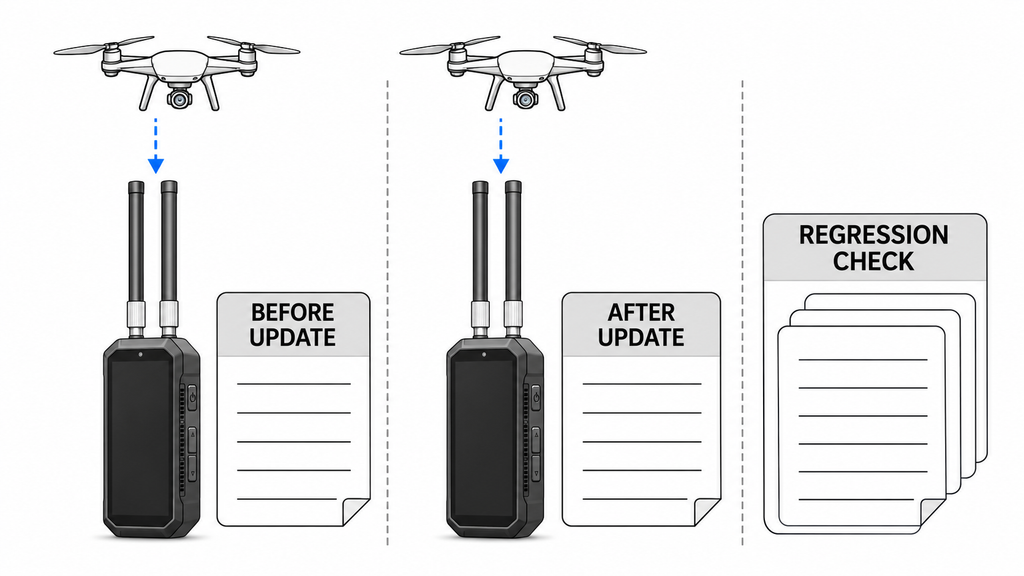
Protocol support can change when detector software or the aircraft’s communication system changes.
Relevant versions may include detector firmware, a separately versioned recognition library, a companion application, and the aircraft’s communication firmware.
An update may add a target family, revise recognition of an existing waveform, or change the information the detector displays. The release note should identify the affected protocol or target family.
For HZ-HD03, pair the installed detector version with the tested drone model and firmware, receiver configuration, and observed output. Where a previous detector version is available, compare the results and check representative previously supported targets for changes in recognition.
8. What Evidence Should Engineers Request Before Approving RF Detection Coverage?
For each required drone and flight mode, record the active transmitting link, receiver conditions, expected output, and observed result.
| Target and flight mode | Actual transmitting link | Receiver conditions | Independent RF evidence | Detector output | Finding and next action |
|---|---|---|---|---|---|
| [Model and firmware; pilot-controlled mode] | [Controller or aircraft transmission; observed band and link state] | [Detector version, antenna, position, bandwidth or scan mode] | [Time-matched reference RF record and verified target identity] | [Required output: alert, class, model, or fields; actual event time and observed output] | [Compare requirement with observed result; identify demonstrated level and remaining evidence] |
| [Model and firmware; autonomous mode] | [Active downlink or broadcast; documented link-state changes] | [Receiver settings and software version; relevant configuration changes] | [Reference RF observation linked to flight mode and time] | [Required output and actual event or no-event record] | [State what was observed, which requirement remains open, and the next verification condition] |
Use the following distinctions when reviewing the record.
RF observed means a time-aligned reference record links the signal to the tested target or its documented transmitting link.
Classified means the detector produced a supported signal-class result, including a validated target-family classification.
Model identified means the detector reported the correct specific model, verified against an independent target record. A family-level match remains a classification result.
Target information obtained means the specified information fields appeared in the detector’s output.
Each status describes an observed result under recorded conditions. Project-level performance acceptance requires its own criteria.
When a required signal, configuration, or output record is missing, mark that requirement as pending.
Supplier comparisons should use matching target models and firmware, flight modes, active links, receiver arrangements, signal conditions, software versions, and output requirements.
Use the completed evidence record to evaluate the HZ-HD03 handheld RF drone detector against the required drone models, flight modes, and output fields.
Conclusion
Useful RF drone detection frequency coverage depends on an observable transmission, suitable receiver conditions, and processing that produces the required output.
The frequency specification defines where a receiver can operate. Target-specific tests establish what it can capture, classify, recognize, or extract from the received signal.
Support for 2.4 GHz or 5.8 GHz does not establish identification of every drone using those bands.
For an HZ-HD03 compatibility review, send the RF SKYPOWER engineering team the drone model and firmware, operating region, active RF links and bands, FHSS or autonomous behavior, and required output.
Include the receiver settings and time-matched RF and detector records so the team can define the next verification step.