

Drone detection false alarm rate is usually reported as confirmed incorrect alarm events per valid active monitoring hour. In a verified drone-absent baseline, count only the hours when independent evidence supports target absence.
An operational study may use all eligible active monitoring hours, including periods with genuine drone activity. That produces a different measure of false alarm workload. The report should identify which rate it uses.
Even zero recorded false alarms may fall short of an acceptance limit when monitoring time is short. Before testing, define what each alarm claims, how notifications become events, and what independent evidence will verify them.
1. What Counts as a False Alarm in Drone Detection?
A false alarm occurs when a detector reports a defined target event that independent evidence establishes was absent.
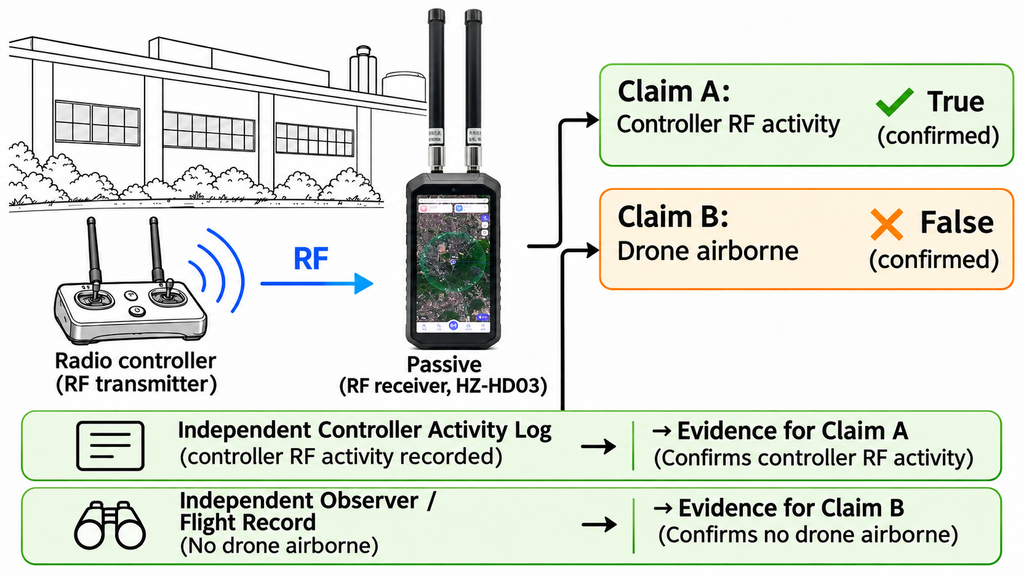
The target definition is essential. A passive RF detector may recognize a drone-related transmission, a supported controller signal, or another identifiable RF pattern. RF, Remote ID, and radar provide different kinds of detection evidence. A received transmission alone does not confirm that an aircraft is airborne.
Consider a controller operating on the ground while no drone is flying. An alert identifying controller RF activity may be correct. An alert claiming that a drone is airborne requires additional evidence.
Review alarms in three stages.
Group the notifications. Several alerts may come from one continuing RF event. Apply the agreed grouping rule and preserve the original notification count.
Classify each grouped event:
- Confirmed true alarm: Independent evidence supports the event described by the alarm.
- Confirmed false alarm: Independent evidence establishes that the defined event was absent.
- Unresolved alarm: Available evidence cannot establish whether the event occurred.
Record operational relevance separately. An authorized drone may trigger a correct detection without requiring a security response. It remains a true detection, even if the operator considers the alert a nuisance.
These records answer different questions. Notification grouping measures alert volume. Event classification measures detection accuracy. Operational relevance describes the response required.
Keeping those fields separate prevents operator inconvenience from being counted automatically as a detection error.
2. Which False Alarm Rate Metric Should You Use?
Teams use false alarm rate for several measurements. Check the denominator before comparing results.
| Metric | Numerator | Denominator | Unit | Decision use |
|---|---|---|---|---|
| False alarm event rate | Confirmed false alarm events | Valid active monitoring hours within the declared test condition | Events/hour | Estimate incorrect alarm events over time |
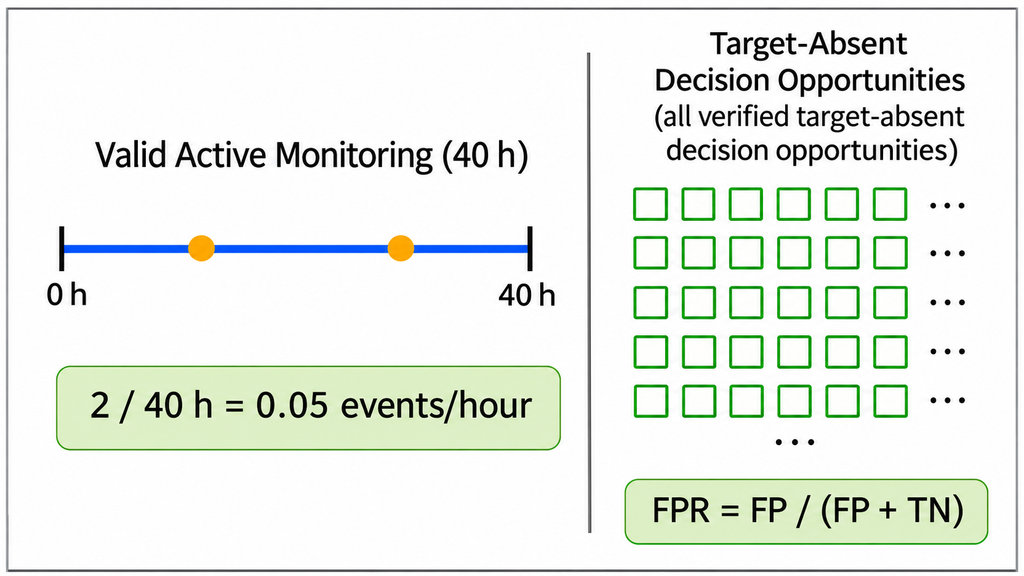
| False positive rate (FPR) | False positive decisions | Defined target-absent decision opportunities | Probability or % | Evaluate incorrect decisions when negative opportunities can be counted |
| False discovery proportion among adjudicated alerts | Confirmed false alarm events | Confirmed true + confirmed false alarm events after the same grouping rule | % | Measure the false share of classified alarm events |
| Detection probability | Detected, independently confirmed eligible target opportunities | All independently confirmed eligible target opportunities | % | Measure detection success for defined targets |
For staffing and response planning, confirmed false alarm events per hour is often the most useful starting point.
Two versions of that measurement serve different purposes.
Background false alarm event rate
Use verified target-absent observation time:
Background FAR = Confirmed false events during target-absent periods ÷ Valid active target-absent hours
This measures incorrect alarms during a controlled baseline.
Operational false alarm event rate
Use all eligible active monitoring time within the declared operating schedule:
Operational false-event rate = Confirmed false events during operation ÷ All eligible active monitoring hours
Genuine drone activity may occur during operational monitoring. Review each incorrect alarm against independent evidence before including it in the numerator.
Report background and operational rates separately. Their exposure conditions differ.
Why events/hour is different from a percentage
Suppose a detector produces two confirmed false events during 40 valid monitoring hours.
The observed event rate is:
2 ÷ 40 = 0.05 events/hour
It is not a 5% false positive rate.
A percentage-based FPR needs a known number of target-absent decisions. If a test evaluates the detector once per fixed time window, those windows may form the denominator when the decision rule is defined consistently.
The false discovery proportion uses a different denominator: classified alarm events.
A correct detection of an authorized drone remains a true event, even when no response is required. Unresolved events stay outside the adjudicated fraction and must appear separately in the report.
When there are no adjudicated alarm events, the false discovery proportion is undefined, rather than 0%.
Detection probability also needs its own measurement. Fix the target definition and detection window before testing. Otherwise, a lower false alarm rate may conceal a change in missed detections or warning time.
3. How Should Observation Time and Alarm Events Be Counted?
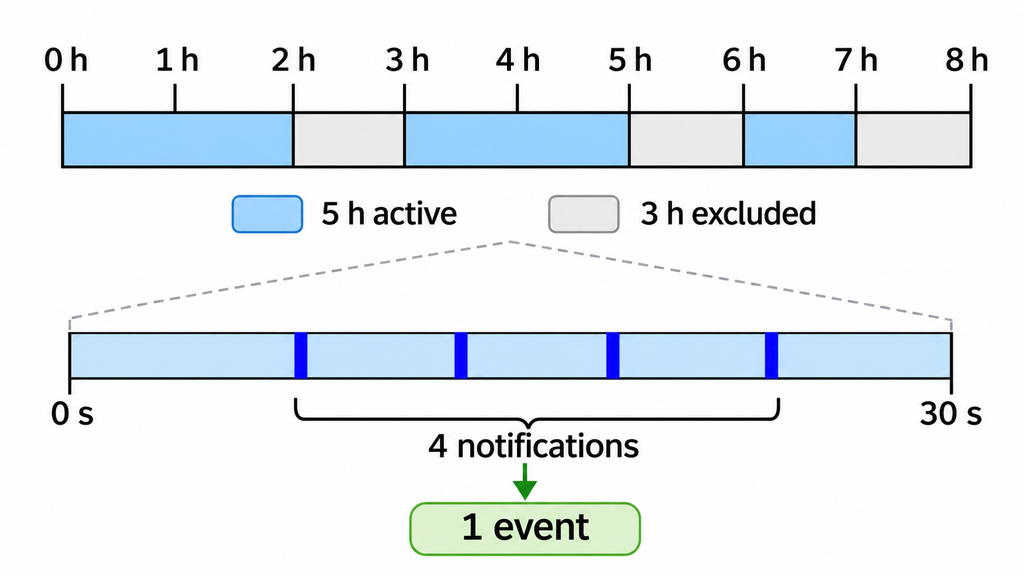
The observation clock should reflect time spent monitoring under the declared test conditions.
Calendar time, powered-on time, and active monitoring time are different.
An operator might carry a handheld detector for eight hours but actively scan for five. Breaks, shutdowns, and periods without valid observation records should stay out of the active monitoring denominator.
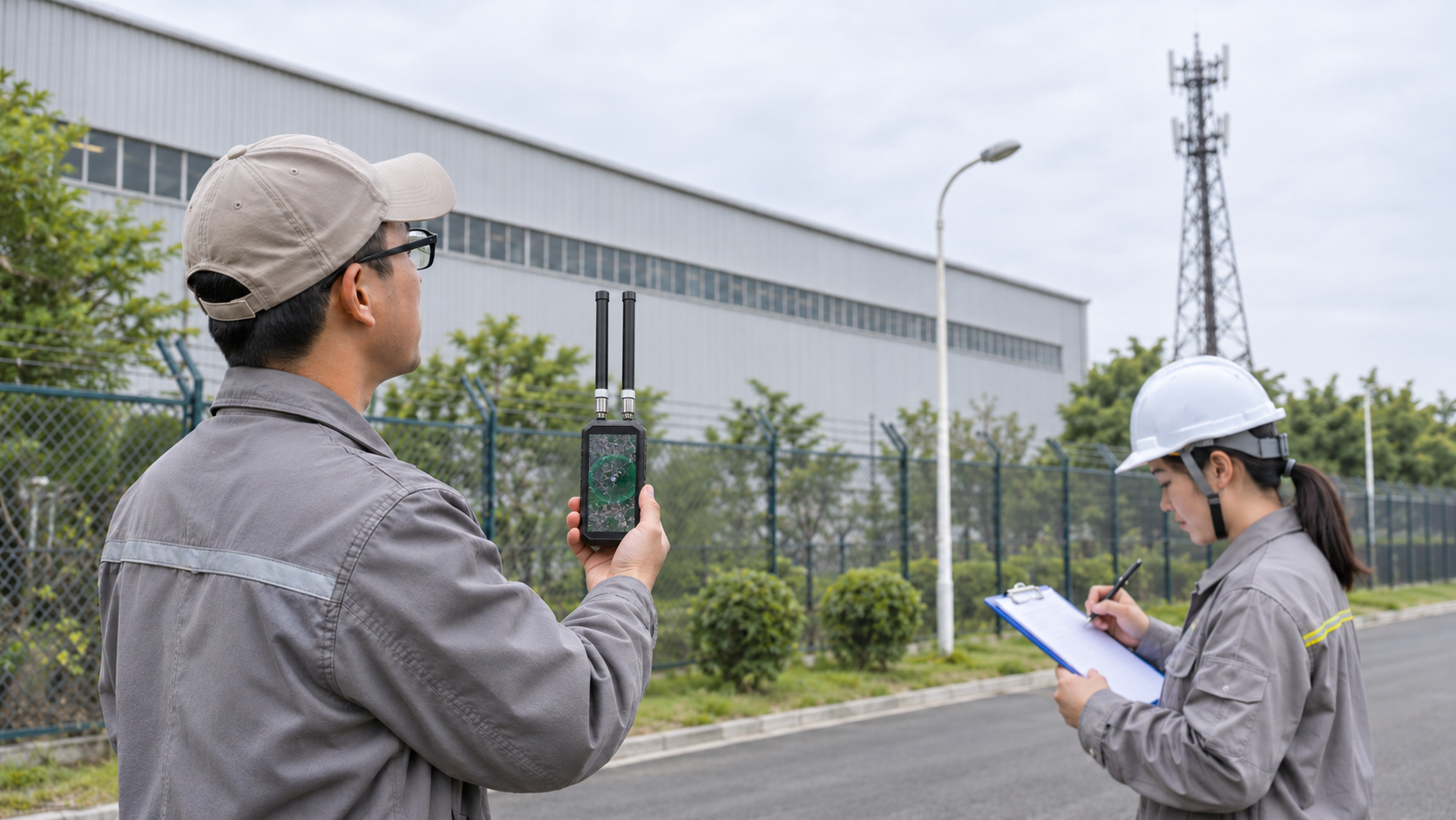
For an HZ-HD03 handheld RF detector field test, record the operator’s actual scanning periods, patrol positions, operating modes, and interruptions.
Each test segment needs a start time, end time, equipment configuration, operating condition, and valid active hours. Record excluded intervals with their reasons.
If interruptions occur frequently, calculate monitoring availability as a separate measure.
Count distinct events consistently
One RF source may trigger several notifications.
Imagine four alerts during a continuous 30-second RF episode. If the predefined grouping rule identifies one underlying event, record one grouped event and four raw notifications.
The 30-second episode is an example, not a standard grouping window.
Use the agreed separation rule to determine when a new event begins. If evidence identifies independent sources or targets, count their events separately even when their timestamps overlap.
Preserve both numbers:
- Raw notifications describe the alert volume seen by the operator.
- Grouped events supply the numerator for the event-based false alarm metric.
The grouping rule should remain unchanged throughout a comparable test segment.
4. How Do You Establish a Drone-Absent RF Baseline?
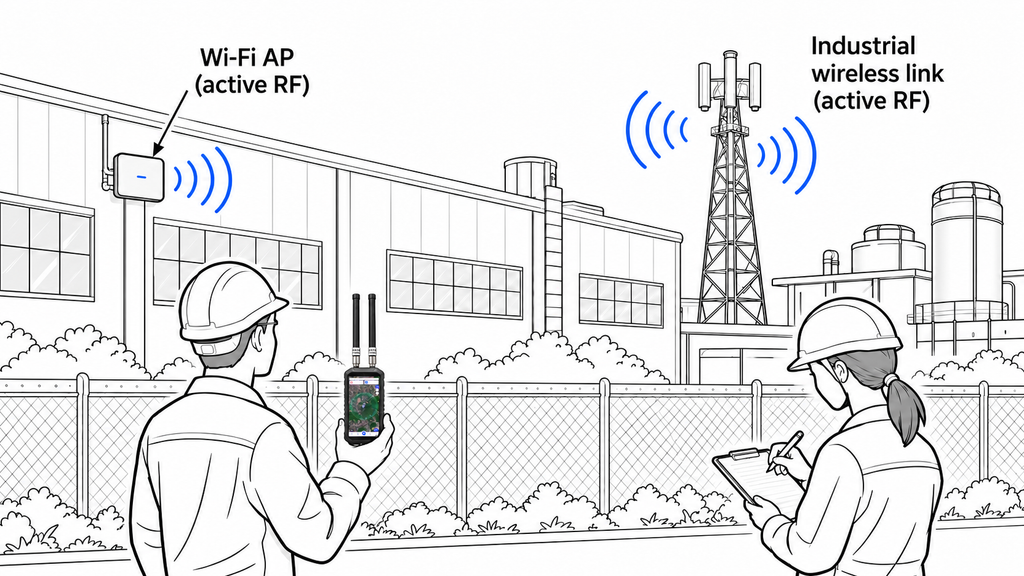
A drone-absent baseline measures detector behavior while the defined target event is absent.
Keep the site’s normal RF environment in the test. Wi-Fi networks, industrial wireless links, nearby controllers, and other transmitters may affect the alarms an operator encounters.
Select a monitored area and schedule that represent the planned use. Include periods with meaningful changes in background RF activity, not only the quietest hours.
Build a target-activity record independent of the detector’s classifications. Depending on the site, it may combine flight records, observer notes, controller activity logs, and independent RF observations.
For every alarm, review that evidence and assign one of three outcomes: target present, target absent, or unresolved.
A scheduled no-drone period is a useful test condition, but the event review still needs evidence. If an alarm cannot be checked adequately, retain it as unresolved.
Pay close attention to lookalike signals. Drone control, telemetry, video, and Remote ID links have different RF characteristics, so record the suspected link type. The review should distinguish:
- Confirmed drone-related RF activity.
- Non-drone emitters that trigger an alarm.
- RF activity for which airborne aircraft presence cannot be established.
This distinction matters in passive RF testing. A receiver may correctly identify a transmission even when the available evidence cannot establish whether an aircraft is flying.
5. How Do You Run and Review a False Alarm Test?
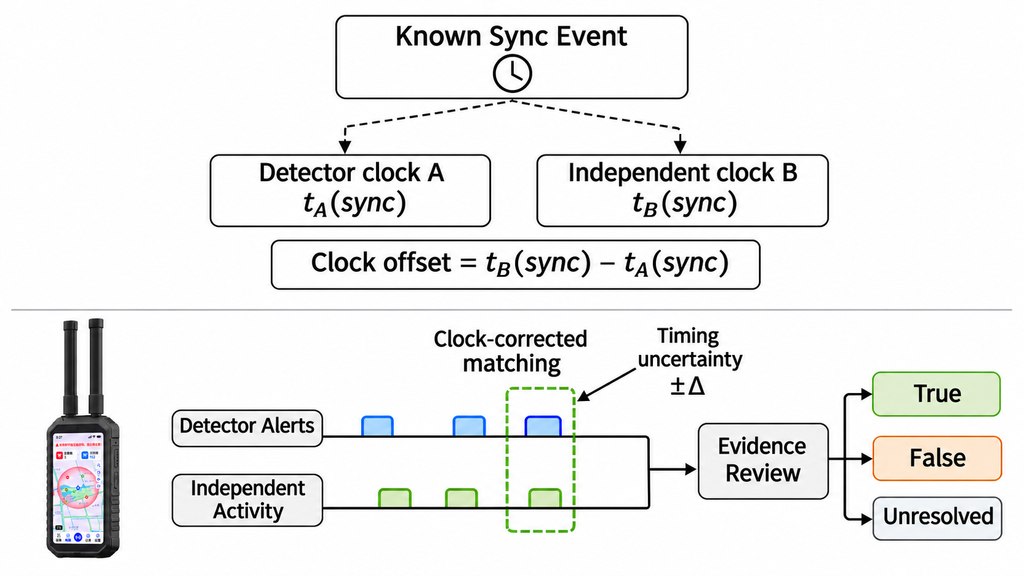
A repeatable field test needs a fixed configuration, reliable event timing, and an independent review record.
1. Fix the configuration and counting rules.
Record the detector model, firmware, scanning settings, alarm rules, and relevant filters. Agree on the target definition and event-grouping method before collecting data.
2. Align the observation records.
Identify the time basis used by the detector, operator log, flight records, and independent measurements.
Measure or document clock offsets where possible. Set a timestamp-matching tolerance and record timing uncertainty separately from clock offset.
3. Preserve the original alerts.
Capture available timestamps, event identifiers, displayed alarm information, and operator actions.
Use exported records, screenshots, or a planned external observation log according to the equipment’s available functions.
4. Review each grouped event.
Apply the event-grouping rule. Compare each event with the independent activity record. Save the evidence supporting its true, false, or unresolved classification.
Follow the same review path for every event:
Raw notification → Grouped event → Evidence review → True / False / Unresolved
Record authorized activity and operational relevance as separate attributes.
5. Calculate the result for each valid segment.
Report confirmed false events, active monitoring hours, and the resulting event rate.
When a setting changes, begin a new segment. Check whether incorrect alarms cluster around certain RF conditions, patrol locations, or times of day.
A field demonstration video can show how the detector responded during a particular event. Calculating a false alarm rate requires the complete observation record and event classifications.
6. How Long Should You Test to Estimate False Alarm Rate?
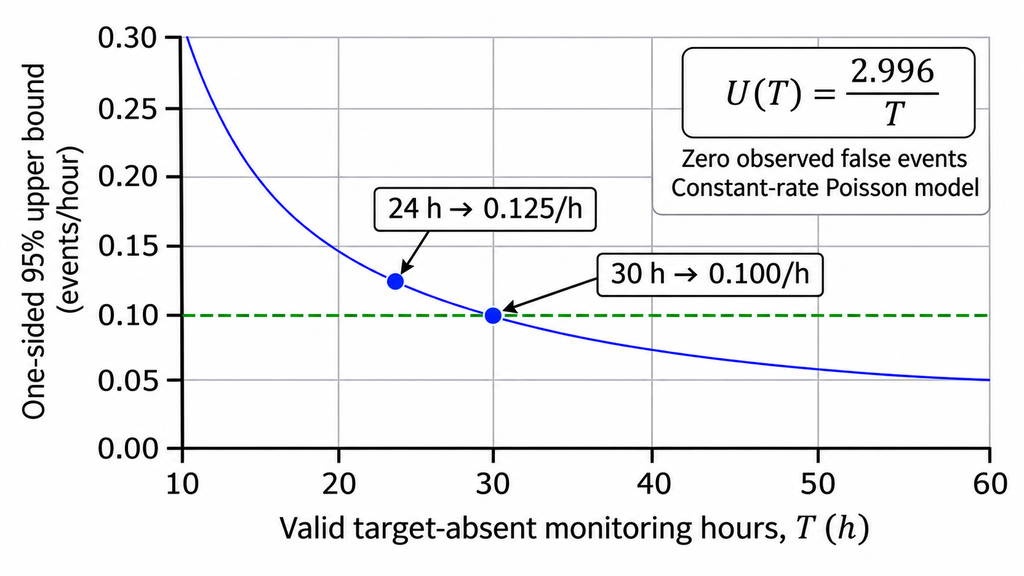
Test duration depends on the project’s rate limit, expected event frequency, and required confidence.
The observed event rate is a point estimate. A confidence bound describes the uncertainty that remains after the observation period.
Example: Zero false alarms in 24 hours
Assume a hypothetical detector completes 24 valid hours of target-absent monitoring.
Independent review finds:
- Zero confirmed false events.
- Zero unresolved events.
- No missing observation intervals within the reported 24 hours.
The observed event rate is:
0 ÷ 24 = 0 events/hour
For this example, assume false alarm events follow a Poisson process. That assumes an approximately constant event rate and independent event occurrence.
The one-sided 95% upper confidence bound for zero observed events is:
Upper rate = −ln(0.05) ÷ Observation hours
Therefore:
Upper rate = 2.996 ÷ 24 ≈ 0.125 events/hour
The test observed zero false events. Under the stated Poisson assumptions, its one-sided 95% upper confidence bound is approximately 0.125 events/hour.
That upper bound corresponds to an underlying mean of roughly three events per 24 hours. No such events were observed during the test.
The figures are hypothetical and are not HZ-HD03 performance data.
What if some events remain unresolved?
Suppose the same 24-hour test records zero confirmed false events and three unresolved events.
The unresolved classifications affect what the test can establish about the underlying false alarm rate.
A basic sensitivity check calculates two classification cases:
Lower classification case = Confirmed false events ÷ Active hours
Upper classification case = (Confirmed false events + Unresolved events) ÷ Active hours
The example produces a range from 0 to 0.125 possible false events/hour.
This range describes possible classification outcomes. It is not a statistical confidence interval.
Report unresolved events explicitly and investigate them when they could change the acceptance decision.
Estimate the required observation time
For zero observed false events, using the same Poisson assumptions:
Required hours ≥ 2.996 ÷ Target rate limit
If the project requires a one-sided 95% upper confidence bound of no more than 0.1 events/hour, the test needs approximately 30 valid hours with zero observed false events.
When the acceptance rule permits nonzero events, plan the duration and allowable event count together. Account for the selected confidence level and decision risk.
The zero-event formula does not determine the duration of a test that permits nonzero false alarm counts.
For k observed false events over T valid hours, the exact one-sided 95% Poisson upper bound is:
Upper rate = χ² quantile(0.95, 2(k + 1)) ÷ (2T)
Here, χ² quantile is the chi-square distribution quantile at the stated probability and degrees of freedom.
State the interval method in the report and use it consistently.
If events cluster or the RF environment changes sharply, a constant-rate Poisson model may fit poorly. Review the results by segment and choose a statistical method that accounts for the observed variation.
7. When Are Two False Alarm Results Comparable?
Two reports are directly comparable when they use the same metric, target definition, grouping rule, observation-time basis, and verification method. Their operating conditions must also be sufficiently similar.
Compare duration and confidence bounds alongside the observed event rates. Zero events during four hours provides much weaker evidence about a low underlying rate than zero events during a substantially longer test.
Some results support only a qualified comparison. The main metric may match while firmware settings, RF conditions, patrol routes, or other operating details differ. Document those differences before interpreting the numerical gap.
A comparison needs further work when essential test information is missing. The same applies when one report uses verified target-absent hours and another uses all operational monitoring hours.
Check detection probability and alarm latency as well. More aggressive filtering may lower false alarms but increase missed detections or warning delay. A supplier comparison should weigh all three against the project’s detector selection requirements.
8. What Should a False Alarm Test Report Include?
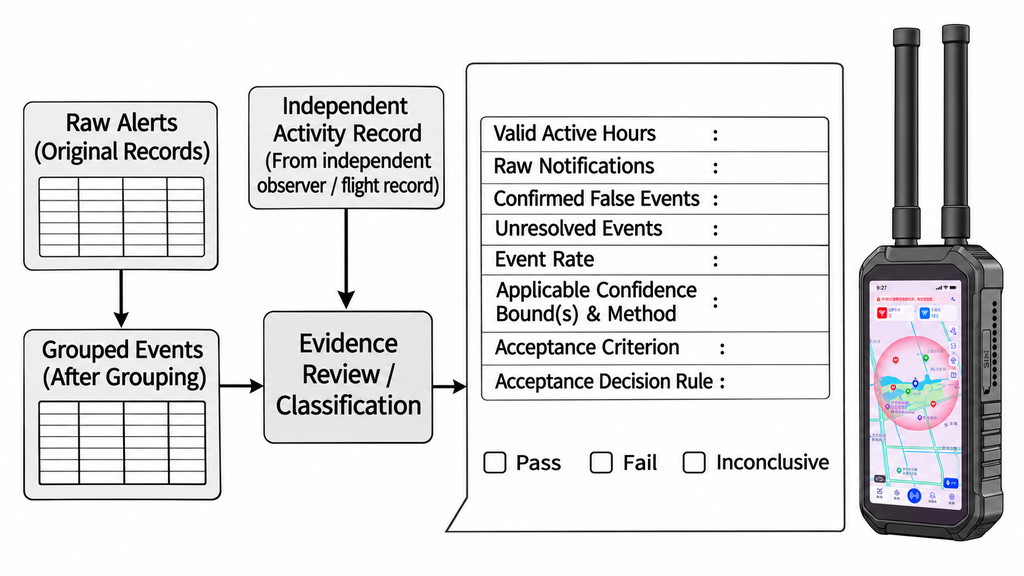
A useful report lets an engineer trace the final rate back to active observation hours, original alerts, grouped events, and independent evidence.
It should also show the acceptance requirement agreed on before the test.
False Alarm Test Record and Result Summary
| Report field | Required entry | Decision use |
|---|---|---|
| Test segment and equipment configuration | Segment ID, site, detector model, firmware, scanning mode, and alarm settings | Identify the tested configuration |
| Active observation hours | Valid hours, time basis, operating scope, exclusions, and reasons | Verify the denominator |
| Raw alert count | Notifications before event grouping | Preserve original alert volume |
| Confirmed false event count | False events after grouping and evidence review | Establish the numerator |
| Unresolved event count | Unclassified events and outstanding evidence | Show classification uncertainty |
| False alarm event rate | Confirmed false events divided by corresponding valid hours | Report the observed KPI |
| Confidence bound and method | Confidence level, model, method, and calculated bound | Quantify sampling uncertainty |
| Project acceptance limit | Rate threshold, time unit, monitoring scope, and decision rule | Define the requirement |
| Result judgment | Pass, fail, or inconclusive, supported by the calculation | Document the decision |
Link each grouped event to its source notifications and supporting evidence. Include the event-grouping rule and timestamp-matching tolerance in the test record.
Keep detection probability and alarm latency in separate performance records.
Interpret the acceptance result
Suppose the project requires a one-sided 95% upper confidence bound at or below an agreed false alarm rate limit.
The statistical interpretation is:
- Meets the criterion: The calculated one-sided 95% upper confidence bound is at or below the limit.
- Evidence supports exceeding the limit: The pre-agreed one-sided lower confidence bound, calculated with the stated method and confidence level, is above the limit.
- Inconclusive: The applicable confidence bounds support neither conclusion. The test needs more evidence.
Some contracts use a binary pass/fail rule. Define that rule before testing. A result that fails to demonstrate compliance is not automatically statistical evidence that the underlying false alarm rate exceeds the limit.
Match the acceptance limit to the observation-time basis.
For example, a requirement expressed per 24 hours of continuous monitoring cannot be applied directly to a handheld detector tested for only a few active scanning hours each day.
The project’s staffing and response plan also affect its acceptable alarm workload. Set the limit before reviewing the results.
Applying the method to HZ-HD03
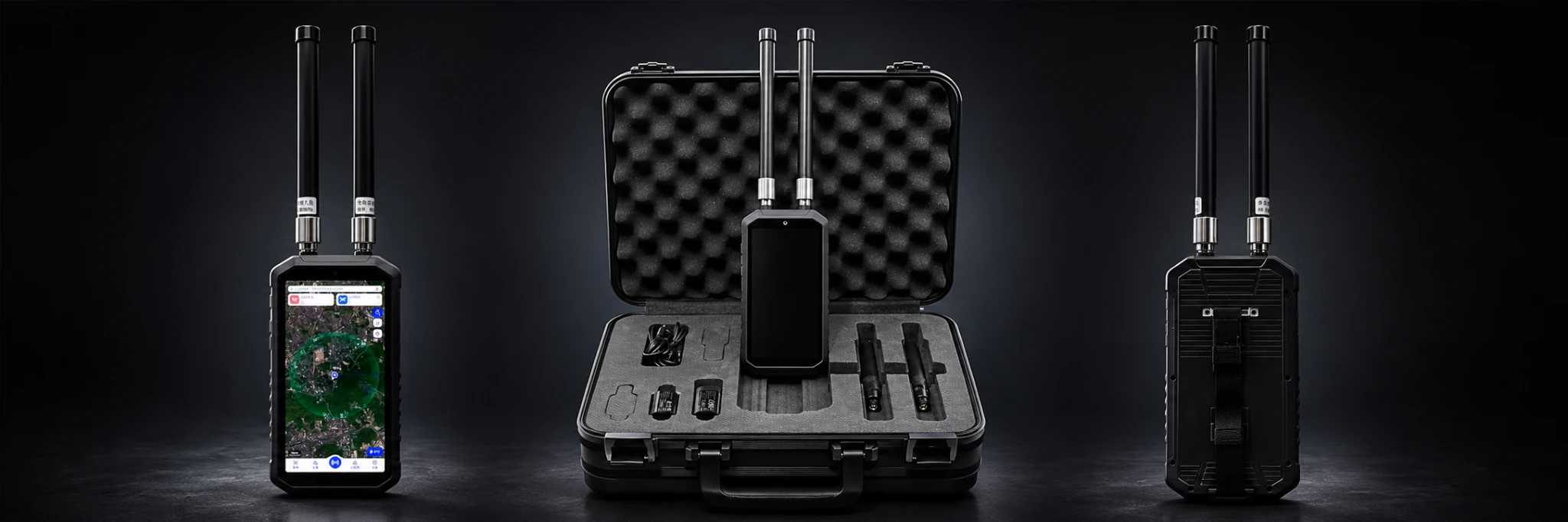
The HZ-HD03 handheld RF drone detector uses passive RF/SDR reception to detect drone-related RF activity. Its detection process does not actively transmit an RF signal.
For an HZ-HD03 field evaluation, record actual handheld scanning time, relevant RF conditions, and the meaning of each alarm.
Review the grouped events against an independent activity record. The confirmed false event count and valid scanning hours then provide the observed rate.
Compare the result with the project’s agreed limit, observation-time basis, and confidence requirement.
Conclusion
Zero recorded false alarms do not, by themselves, prove that a detector meets the project’s rate limit. Acceptance depends on valid monitoring hours, independent event review, and a confidence bound calculated under stated conditions.
Keep background and operational results separate. Preserve raw notifications, grouping decisions, and unresolved cases so another engineer can verify the result.
For an HZ-HD03 field evaluation, send your site RF conditions, target definition, planned scanning hours, alarm classification rules, and acceptable false alarm rate to the RF SKYPOWER engineering team. These details provide a starting point for reviewing the field-test procedure.