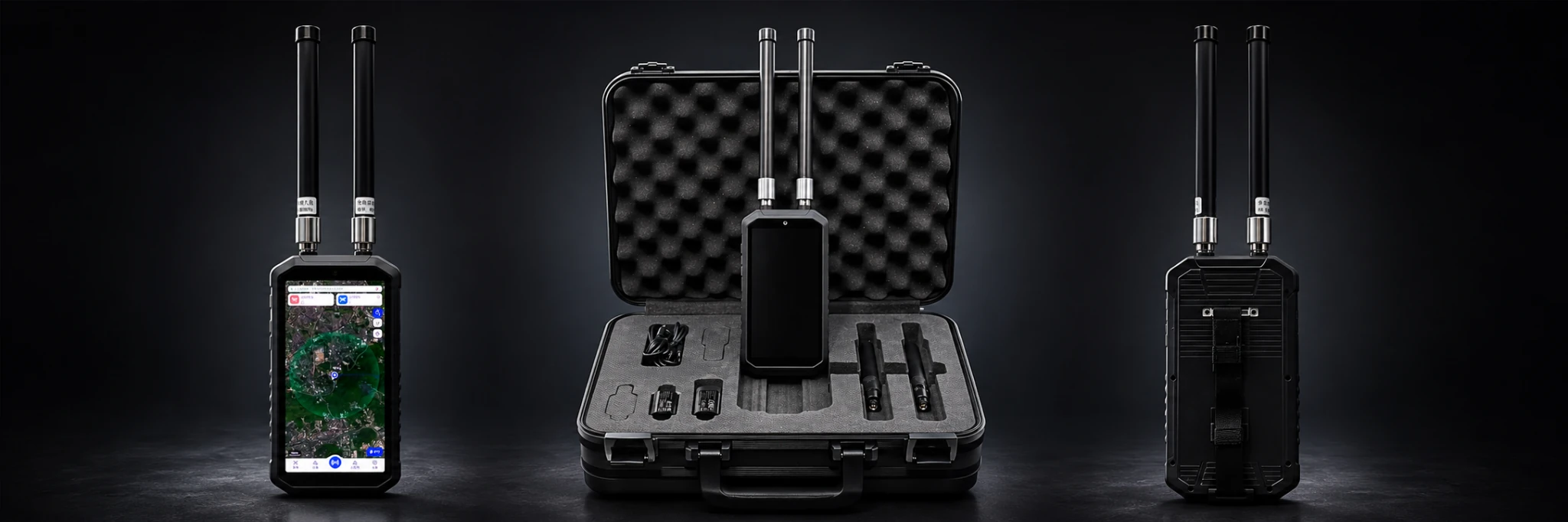
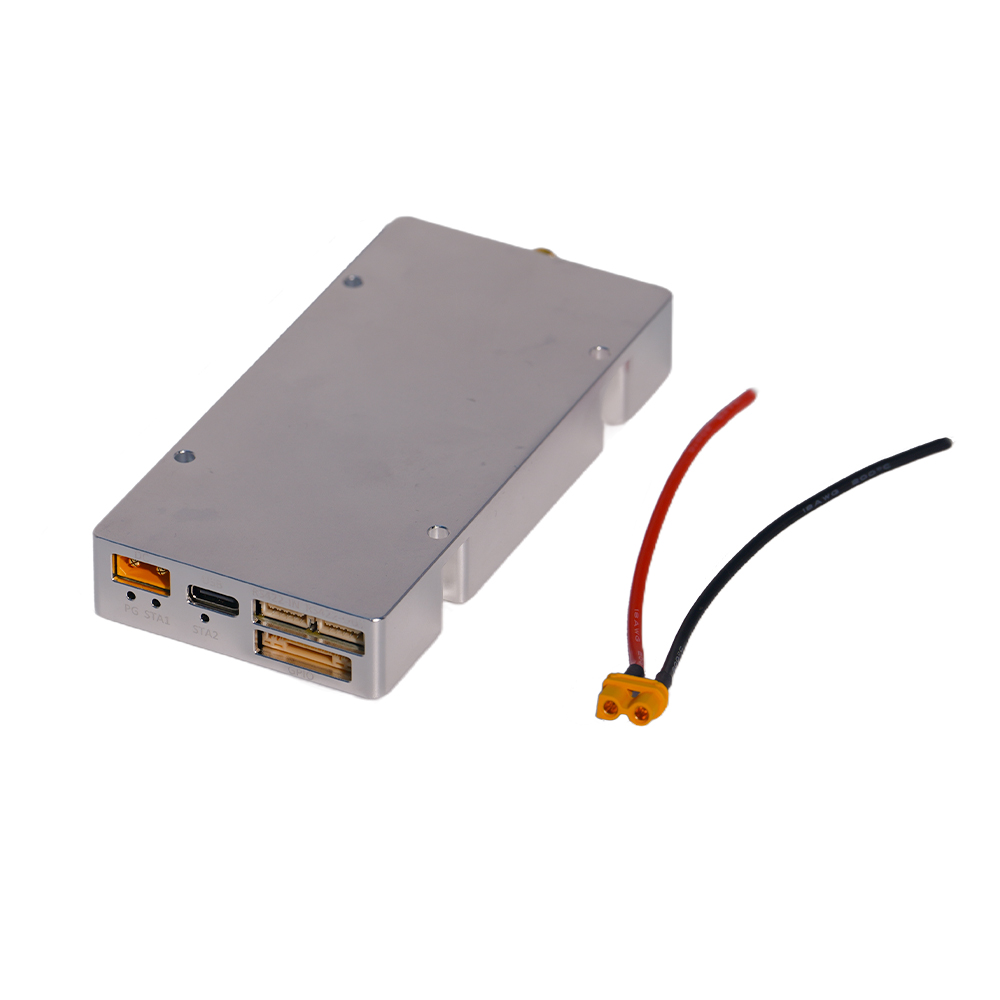
ONE RF OUTPUT / CUSTOM IQ ROUTE
Best when one RF path needs custom IQ playback, up to 200 MHz bandwidth, or scalable multi-unit control.


High-performance systems engineered for consistent, dependable operation under critical conditions.
See It in Action
High-performance systems engineered for consistent, dependable operation under critical conditions.
See It in Action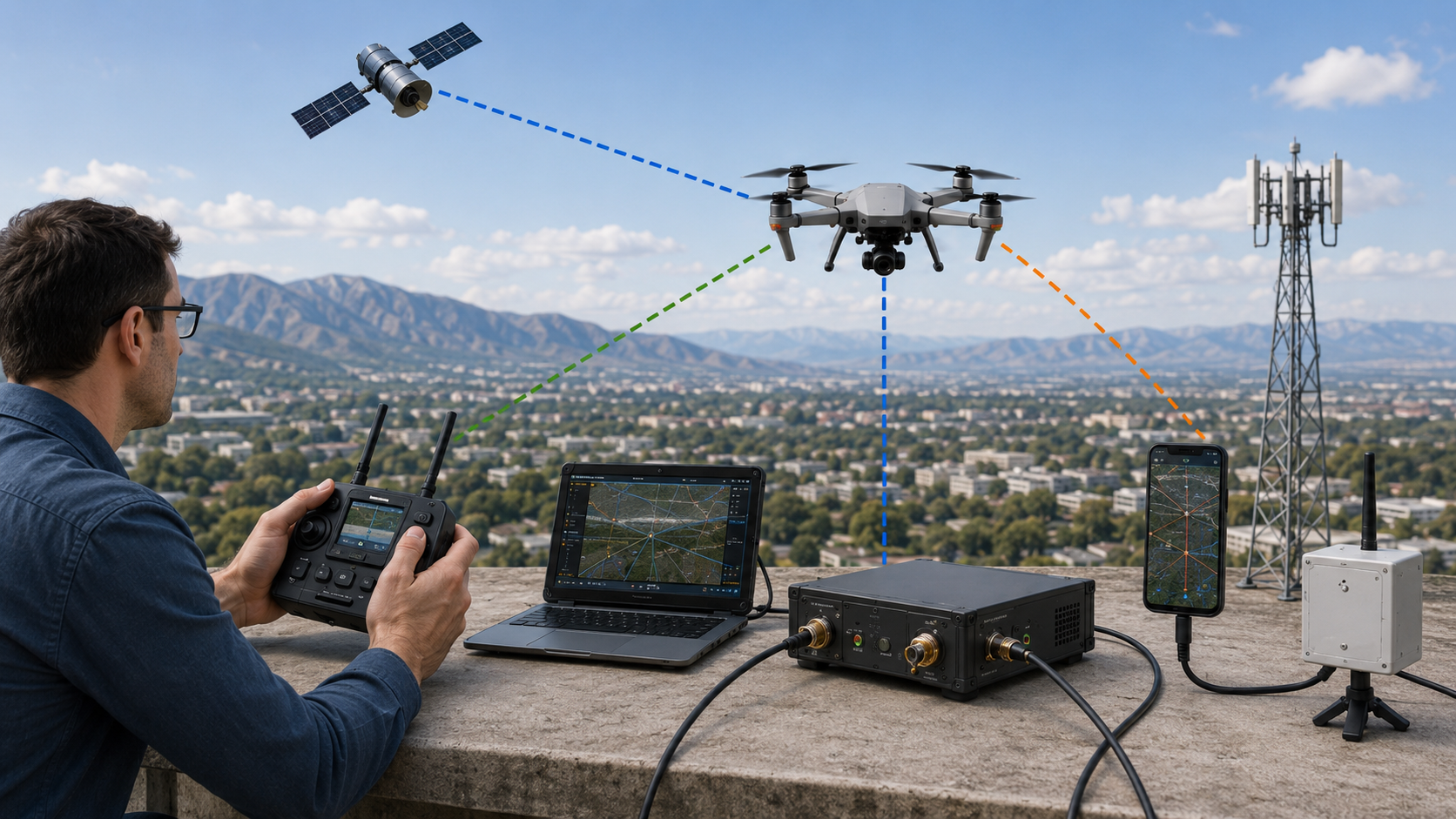
Drone frequencies are not limited to a single band. A drone may receive flight commands, return telemetry and video, listen to GNSS satellite signals, and broadcast Remote ID through several RF links.
Many consumer drones commonly operate in licence-exempt 2.4 GHz and 5 GHz spectrum. Other systems may use regional sub-GHz bands, cellular networks, satellite services, or proprietary links.
The better question is therefore not only:
What frequency does a drone use?
It is:
Which drone link are we discussing, what does it do, and how does it behave?
Frequency is only one part of a drone communication system. Protocol, signal direction, occupied bandwidth, frequency-hopping behavior, and channel architecture are equally important.
One drone may depend on several wireless functions during the same flight.
The pilot or ground station sends commands through a control link. The drone may return position, battery level, and flight-status data through telemetry. A camera may transmit video through a higher-data-rate downlink.
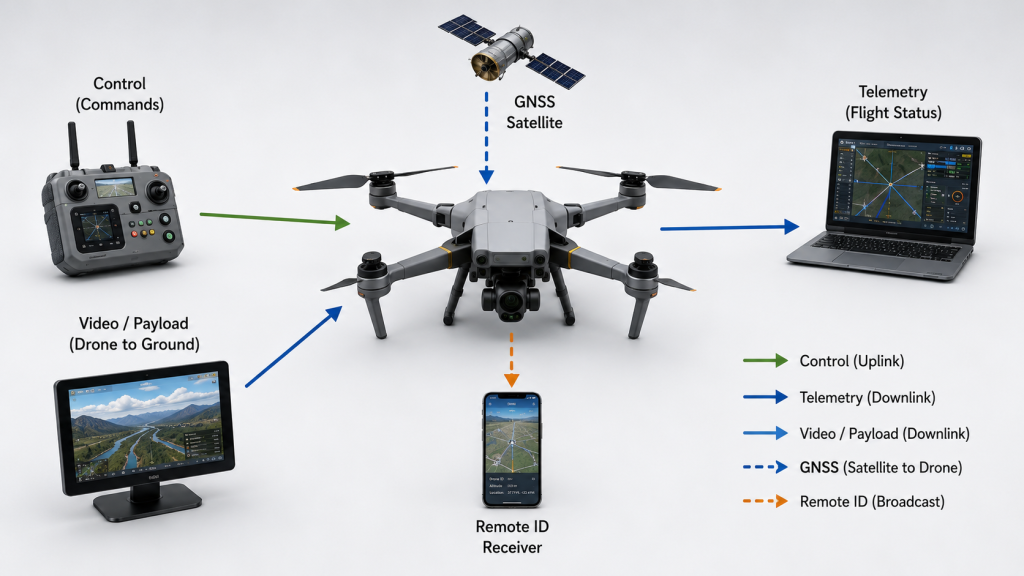
At the same time, the aircraft may receive navigation signals from GNSS satellites and broadcast Remote ID information to nearby receivers.
Some drones use separate radios for these functions. Others combine control, telemetry, and video inside one managed digital link.
This means that identifying a broad frequency such as 2.4 GHz does not fully describe how the drone communicates. Two systems operating in the same band may use different:
A buyer may ask, “Which frequency should our system cover?” However, that question is incomplete.
A useful RF review should consider five layers:
Readers who first need to understand the wider counter-drone RF chain can review how a drone jammer works.
A drone may use several RF links for different purposes. These links should not be treated as interchangeable signals.
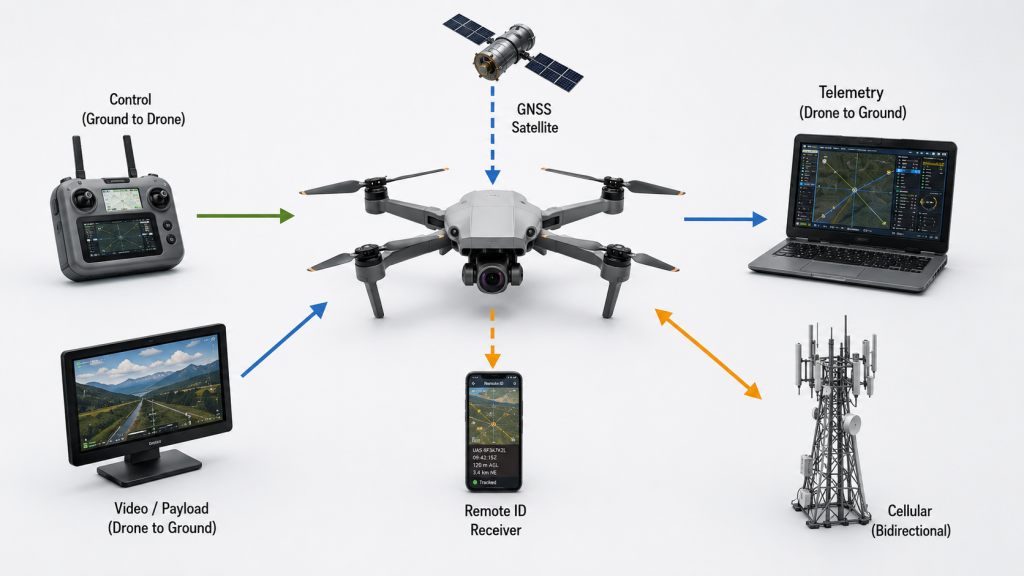
| Link type | What it does | Signal direction | Common spectrum family | Important limitation |
|---|---|---|---|---|
| Control | Sends flight commands | Ground to drone | Often 2.4/5 GHz or regional sub-GHz | Varies by region and protocol |
| Telemetry | Returns flight status | Drone to ground | May share the control link | Not always a separate frequency |
| Video or payload | Sends camera or sensor data | Drone to ground | Often 2.4/5 GHz | Higher data rates usually require more bandwidth |
| GNSS | Provides navigation and timing reference | Satellite to drone | L-band navigation signals | Not a controller link |
| Remote ID | Broadcasts identity and location | Drone to nearby receivers | Commonly Bluetooth or Wi-Fi broadcast | Not used to pilot the drone |
| Cellular or satellite | Supports network or long-range communication | Bidirectional | Operator-assigned spectrum | Depends on external infrastructure |
The control link carries commands from the pilot, remote controller, or ground station to the drone.
These commands may include:
A control link may remain on one channel, adapt between channels, or use frequency-hopping communication.
Telemetry mainly travels from the drone back to the controller or ground station. It may contain:
Telemetry does not always use a separate frequency. Many modern drones carry control and telemetry through the same bidirectional digital connection.
A video or payload link sends camera imagery and sensor data from the drone to the ground.
Video usually needs more data capacity than basic flight commands. It may therefore require:
However, 5 GHz or 5.8 GHz should not automatically be labelled “the drone video frequency.” Control, telemetry, and video may share one managed digital link.
GNSS includes GPS, Galileo, BeiDou, and other satellite-navigation systems.
Its signal direction is:
Satellite → drone
It is not:
Controller → drone
GNSS may support position estimation, route following, hover stability, navigation, timing, and return-to-home functions. It does not normally carry the pilot’s flight commands.
Common civilian GPS signals include L1 around 1575 MHz, L2 around 1227 MHz, and L5 around 1176 MHz. These are navigation signals received from satellites, not normal drone-control frequencies.
Remote ID is another separate RF function.
It allows a compatible drone to broadcast identity and location information to nearby receivers. Standard systems may provide information related to the drone and control station, while a broadcast module may provide drone and take-off-location information.
Remote ID commonly uses Bluetooth or Wi-Fi broadcast methods. It is an identification and compliance broadcast, not the communication link used to pilot the aircraft.
RF SKYPOWER recommends identifying the link function before selecting a frequency range. Control, telemetry, video, GNSS, and Remote ID should not be treated as one interchangeable signal.
Several frequency families are common in consumer and professional drone systems. None of them should be treated as universal.
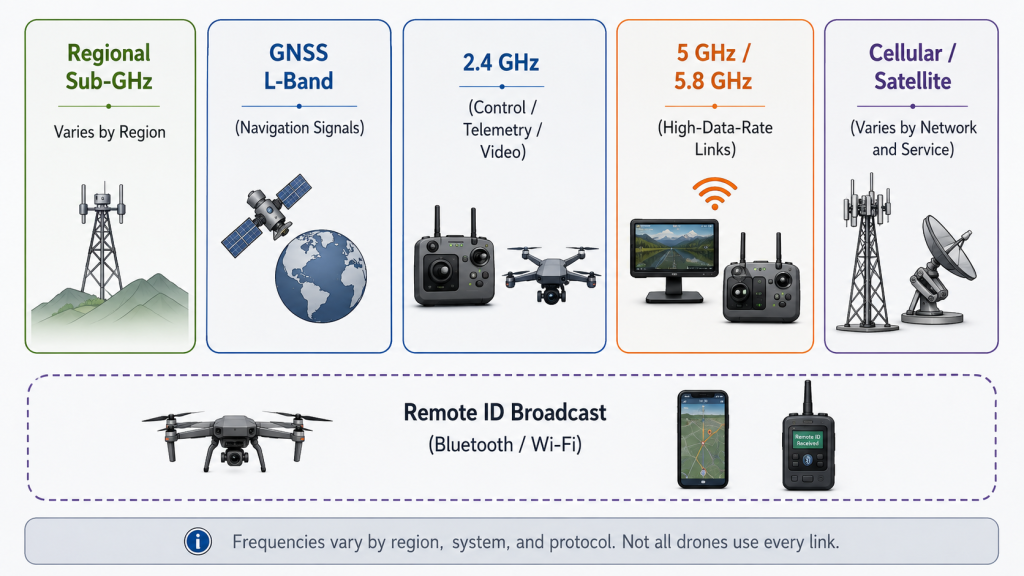
The 2.4 GHz region is commonly used for:
However, the same spectrum also contains Wi-Fi, Bluetooth, and many other devices.
Finding energy in the 2.4 GHz band does not prove that the signal belongs to a drone.
The 5 GHz family is often used by digital links that need higher data capacity, including video transmission.
However:
Some drone systems use regional sub-GHz frequencies for control, telemetry, or longer-range communication.
The exact frequency depends on:
A frequency available in one country may be restricted or organized differently elsewhere.
GNSS signals occupy L-band navigation spectrum.
These signals travel from satellites to the drone. They should not be confused with the pilot-control or telemetry links.
A simple 2.4 GHz and 5.8 GHz model becomes less useful when a drone uses cellular, satellite, or autonomous operation.
A cellular-connected drone may exchange data through a mobile network. Its operating frequencies then depend on:
Satellite communication may support long-range control, data, tracking, or backup links. Its performance depends on the selected satellite service and allocated spectrum.
An autonomous drone may also continue part of a mission without a continuous pilot-control link. It may still emit telemetry, Remote ID, video, or other signals, but the absence of a familiar control signal does not prove that no drone is present.
Common does not mean universal.
A frequency list limited to 2.4 GHz and 5.8 GHz cannot describe every consumer, FPV, enterprise, cellular-connected, satellite-connected, or autonomous drone.
A frequency-hopping link does not remain at one carrier position throughout operation.
Instead, it changes between channels according to an organized sequence or algorithm.
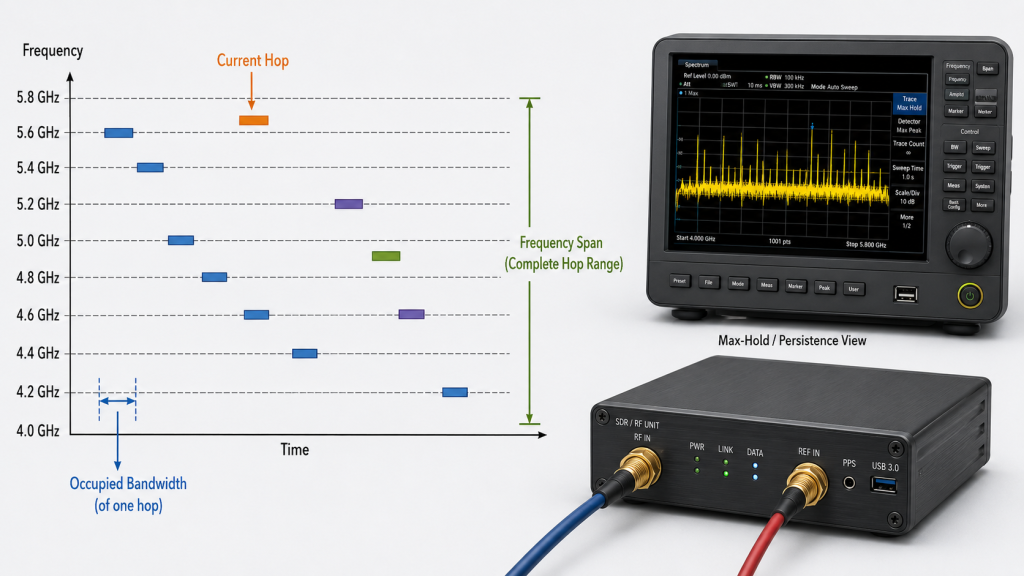
For a hopping system, the “current frequency” describes only one moment. The complete link may need to be described by:
This also changes the meaning of center frequency.
A center-frequency setting may show where a signal is placed at one moment, but it does not describe:
Wide tuning coverage is therefore only one part of SDR selection.
An SDR covering 100 MHz to 6 GHz does not automatically generate, process, or support every waveform or protocol within that range.
Engineers must also review:
For an authorized C-UAS RF chain, the drone-frequency question should be converted into a complete engineering requirement.
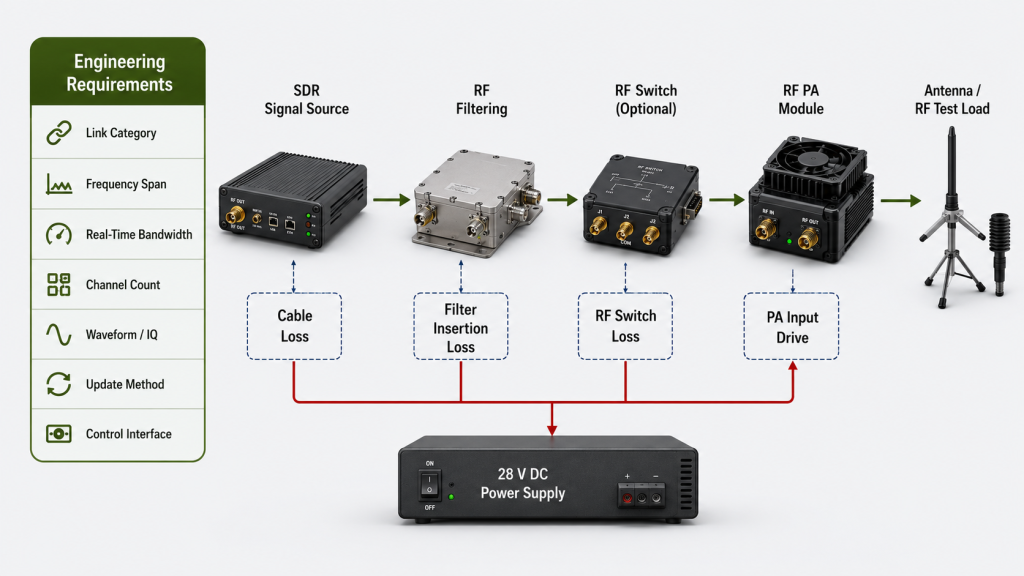
Start by identifying whether the project concerns:
Spectrum use and regulations differ between countries.
The operating country or region should be confirmed before selecting the frequency plan or SDR configuration.
Do not provide only one center frequency.
Specify:
Frequency range and real-time bandwidth are not the same specification.
Frequency range describes where the SDR can tune.
Real-time bandwidth describes how much spectrum the SDR can generate or process at the same time.
A tuning range of 100 MHz–6 GHz does not mean that the entire span is available simultaneously.
The architecture may require:
The integrator should specify:
The SDR output must match the PA input-drive requirement after accounting for:
Insufficient drive may prevent the PA from reaching its intended output. Excessive drive may move the amplifier into compression or an unsuitable operating condition.
The SDR and amplifier should therefore be reviewed as one signal chain. See how to match SDR output with RF PA input drive.
The complete architecture should also consider filters, switching, power amplification, control, and antennas. Review the wider drone jammer module RF chain when defining these system boundaries.
Once the link, bandwidth, channel, waveform, and control requirements are defined, engineers can compare SDR architectures instead of relying on frequency-range labels alone.
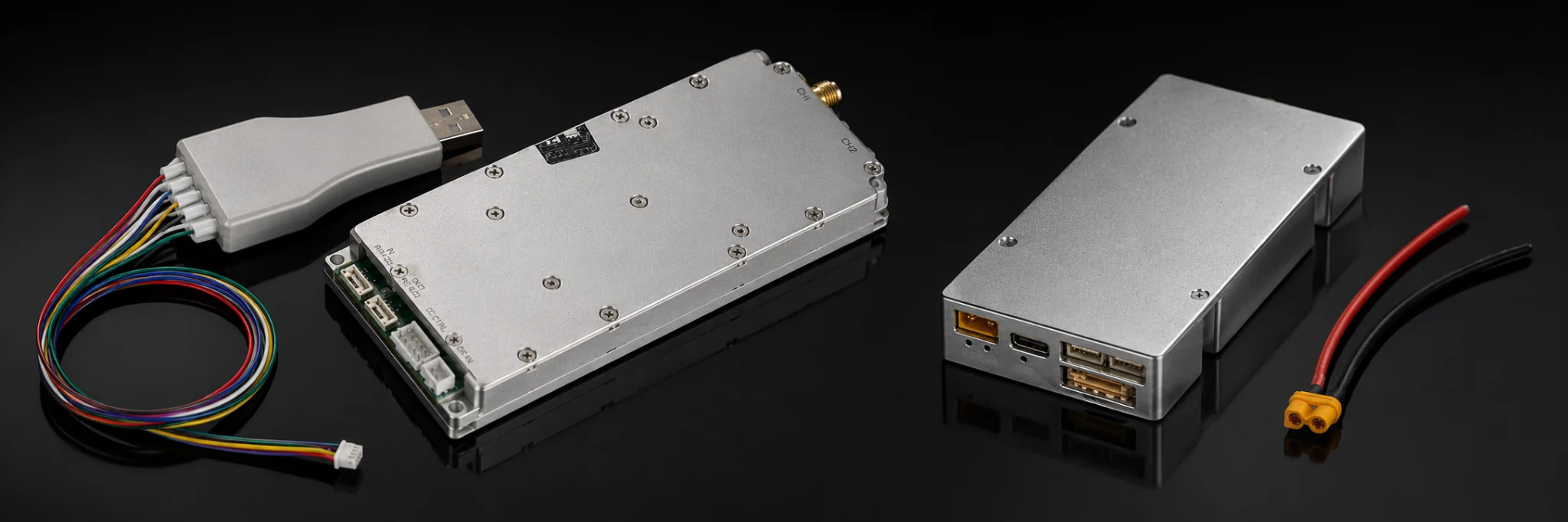
RF SKYPOWER provides two 100 MHz–6 GHz SDR signal-source options for different integration requirements.
ONE RF OUTPUT / CUSTOM IQ ROUTE
Best when one RF path needs custom IQ playback, up to 200 MHz bandwidth, or scalable multi-unit control.
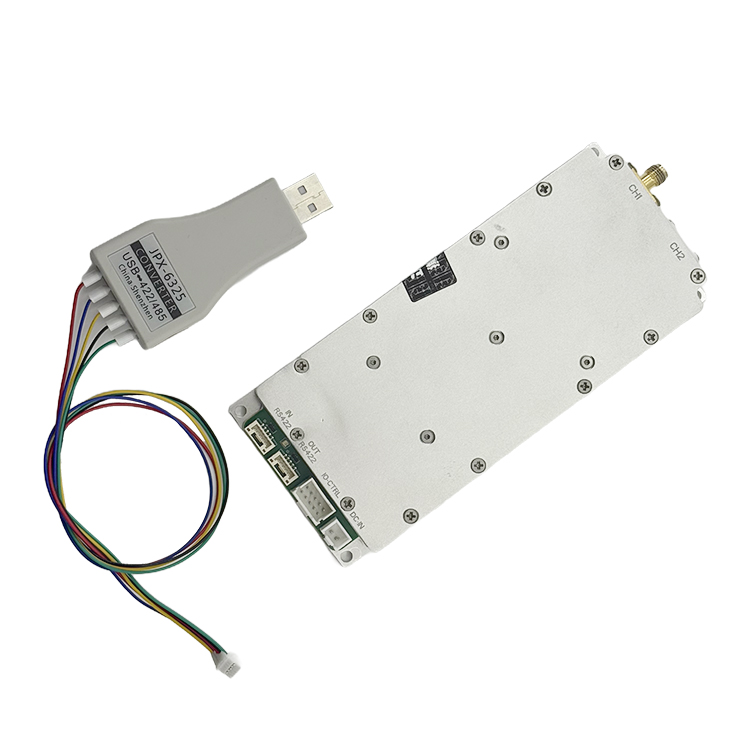
TWO RF OUTPUTS / FIELD-INTEGRATION ROUTE
Best when the system needs two physical RF outputs, flexible 9-32 V input, or extended-temperature operation.
| Integration Question | HZS1006000-F1 | HZSDR1006000-A01 |
|---|---|---|
| Frequency & Bandwidth | 100 MHz-6 GHz; up to 200 MHz real-time bandwidth | 100 MHz-6 GHz; up to 100 MHz per channel, 200 MHz combined |
| Physical RF Outputs | One documented external SMA output; dual-PHY does not mean two connectors | Two independent SMA RF outputs |
| Custom Waveform | Documented USB upload of 16-bit complex IQ files | Customer IQ upload is not documented; confirm by RFQ |
| Control & Expansion | RS422 AT commands; cascading of up to 10 units | RS422 host control; multi-module limits confirm by RFQ |
| Deployment Envelope | 28-32 V DC; 0°C to 50°C | 9-32 V DC; −40°C to +70°C |
| Best Fit | Custom IQ, wider bandwidth, or scalable single-path integration | Dual RF paths, vehicle power, or wider temperature coverage |
Note: Frequency coverage alone does not confirm protocol or hopping-pattern compatibility.
Before requesting an SDR quotation, define:
A complete RFQ allows the engineering team to review frequency, bandwidth, waveform, channel architecture, control, PA drive, and environmental requirements together.
Planning an authorized C-UAS RF chain? Share the operating region, required link categories, frequency span, real-time bandwidth, channel count, control interface, SDR-to-PA drive requirement, and environmental conditions.
RF SKYPOWER can compare the HZS1006000-F1 and HZSDR1006000-A01 against the integration boundary.
No. Many consumer drones use 2.4 GHz, but other systems may use 5 GHz, regional sub-GHz, cellular, satellite, or proprietary links.
No. It is often associated with video because video requires higher data capacity, but control, telemetry, and video may share one digital link.
No. GPS and other GNSS signals travel from satellites to the drone. The controller normally uses a separate control link.
No. Remote ID broadcasts identity and location information to nearby receivers. It is not the normal flight-control link.
No. Frequency coverage only describes where the SDR can operate. Protocol support also depends on waveform capability, bandwidth, channel architecture, IQ handling, and update method.
What frequency do drones use? There is no single universal answer.
A drone may use separate or combined links for control, telemetry, video, GNSS reception, Remote ID, cellular communication, or satellite connectivity. Frequency-hopping and adaptive digital protocols also mean that one center frequency cannot describe the complete RF behavior.
For SDR integration, frequency range is only the first requirement. Link function, protocol behavior, real-time bandwidth, channel count, waveform support, update method, control interface, and SDR-to-PA drive must be reviewed together.