

To choose a drone detector, do not start with range, price, or product specifications. One system may alert you without identifying the aircraft, while another may track a flying object but provide no drone model or controller information. First define what the security team must know after an alert.
A detector that looks strong on a datasheet can still be the wrong choice if it provides the wrong type of evidence, depends on an operating model the site cannot support, or leaves target blind spots the project cannot accept.
So before comparing handheld RF, radar, or multi-sensor equipment, what must the operator actually be able to detect, identify, track, locate, or record under the real deployment conditions?
For the underlying differences between RF, radar, Remote ID, acoustic, optical, and thermal detection, use our complete guide to drone detection methods.
1. What Results Should a Drone Detector Provide?
The word “detection” is too broad to use as a complete purchasing requirement.
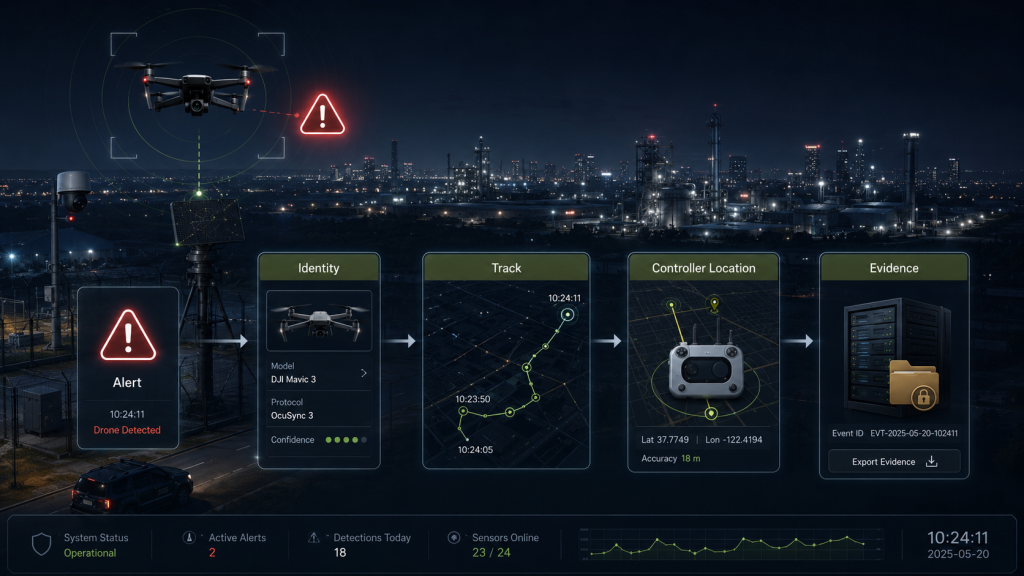
Different systems may provide different levels of information:
- Detection: Indicates that a possible target or drone-related signal is present.
- Identification: Provides available model, serial number, ID, or supported protocol information.
- Tracking: Shows the target’s position and movement over time.
- Controller-related location: May display controller, take-off, or pilot-related information for supported targets.
- Evidence: Preserves alerts, tracks, screenshots, timestamps, or event records for later review.
These capabilities should not be treated as interchangeable.
A system that produces an alert may not identify the target. A radar may track an airborne object without showing its digital identity. An RF detector may provide supported drone and controller information but cannot be assumed to identify every autonomous, unsupported, or radio-silent target.
The first selection question should therefore be:
What must the operator see, record, or confirm after the alert?
A mobile patrol may prioritize supported-target identity and event records. A prison or airport may require continuous tracking, central alarms, and visual confirmation. An investigation team may place more value on controller-related location data.
Define the required result before comparing detection distance or product price.
2. How to Choose Between Handheld and Fixed Detection
The deployment model should be selected before comparing individual products.
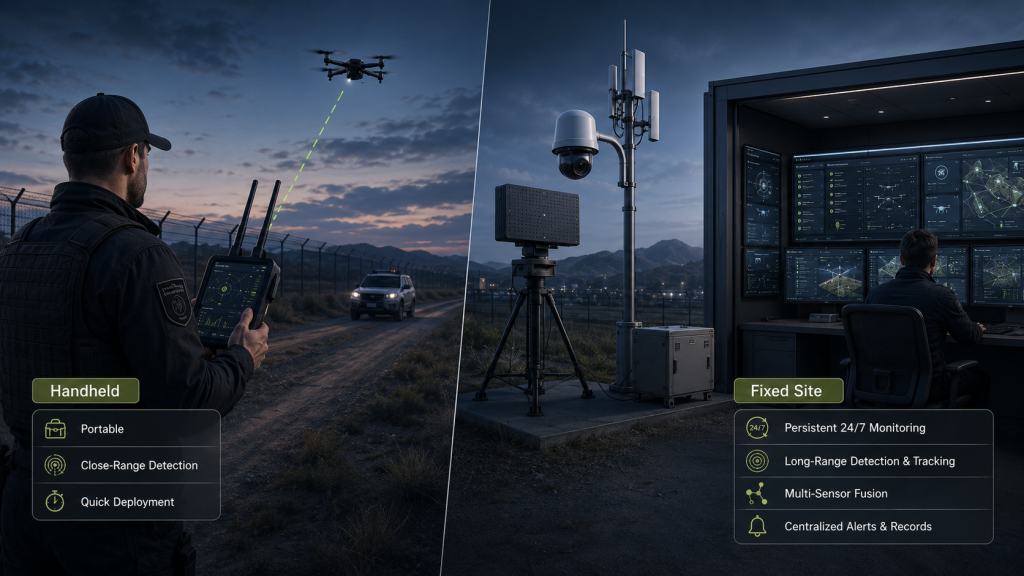
Choose a Handheld Detector When
A handheld detector is usually appropriate when:
- Operators patrol several locations
- The task is temporary or event-based
- Rapid deployment is required
- Fixed power and networking are unavailable
- The monitoring position must change
- Passive RF detection is preferred
- Supported-target identification is required
- Event records are useful
- Equipment must be carried by one operator
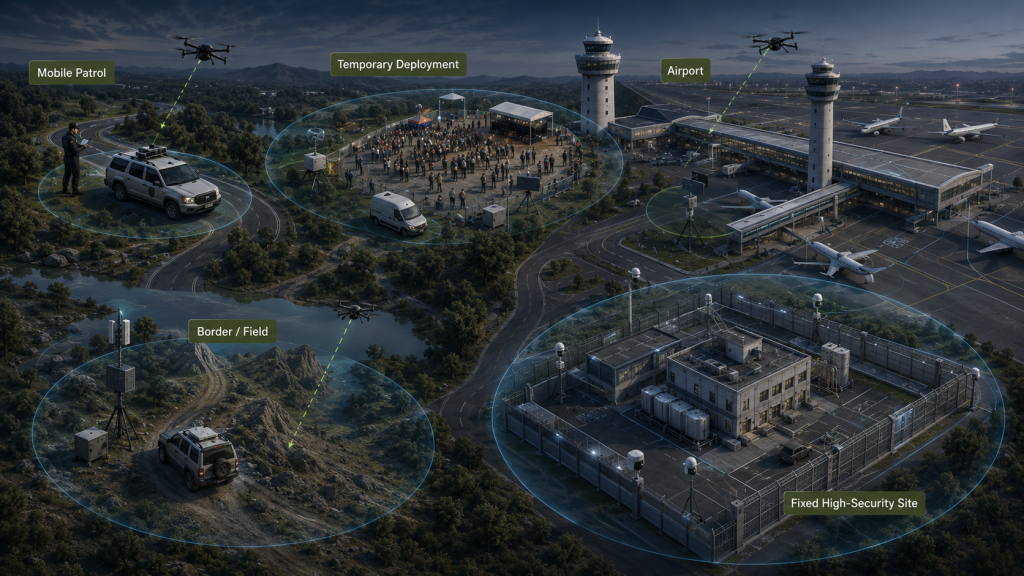
Typical applications include mobile security patrols, temporary public events, VIP protection, border teams, field investigations, and temporary checkpoints.
A handheld detector is less suitable as the only detection layer when:
- Monitoring must continue without an operator
- Several directions require simultaneous coverage
- The protected area is too large for one patrol position
- Radio-silent or unsupported targets are a primary concern
- Radar and camera coordination are required
- Alerts must feed a permanent command center
Example: HZ-HD03 for Mobile Passive RF Detection
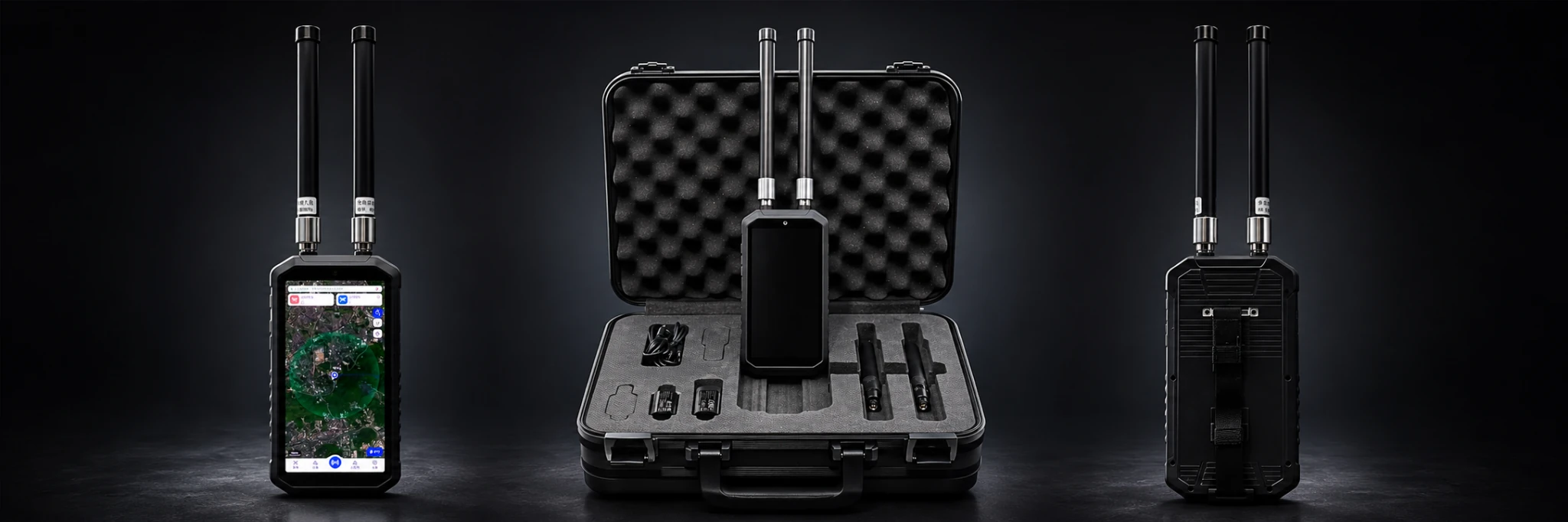
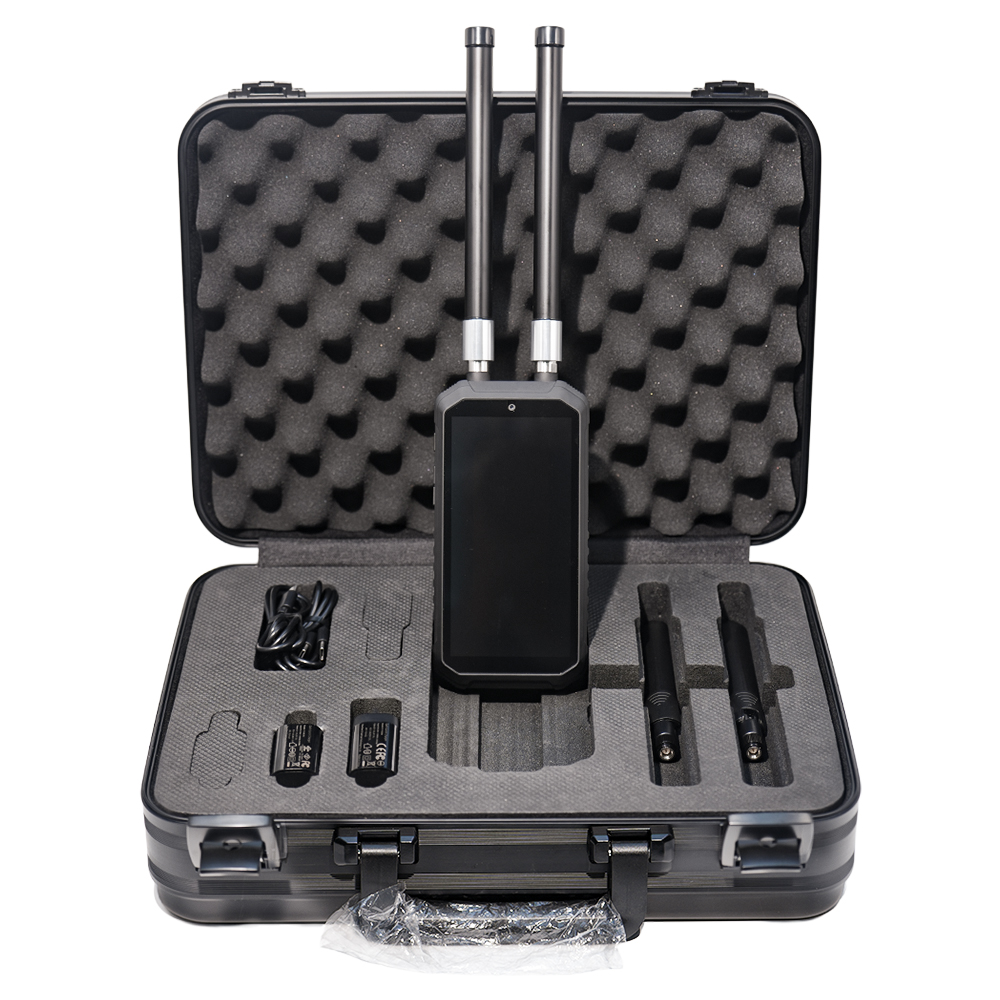
When the project requirement has already narrowed to mobile passive RF detection, the HZ-HD03 handheld drone detector is one possible option.
PORTABLE PASSIVE RF DETECTION
HZ-HD03 Handheld Drone Detector
The HZ-HD03 is designed for mobile patrols, temporary security deployments, and field investigations where permanent sensor infrastructure is not practical. It passively analyzes supported drone signals and can display available aircraft, pilot, and event information.
Portable hardware: Approx. 580g | 6.0-inch display | Operating temperature: -25°C to +60°C
| Selection Factor | HZ-HD03 Handheld Fit |
|---|---|
| Best Fit | Mobile patrols, temporary event security, border or perimeter inspection, and field investigations that require rapid relocation. |
| Detection Approach | Passive RF detection and protocol analysis of supported drone and FPV signals, without transmitting an active detection signal. |
| Available Information | Supported aircraft identity and flight data, drone and pilot location where available, FPV signal analysis, and event records. |
| Confirm Before Deployment | Target drone and protocol list, required detection distance under site conditions, RF interference, terrain and obstruction, firmware-update path, and reporting or data-export requirements. |
The HZ-HD03 should not be treated as the default solution for every airport, prison, border, or permanent site. It fits projects where mobility and supported RF target information are priorities.
Choose a Fixed System When
A fixed system is usually more appropriate when:
- Monitoring must continue without a walking operator
- The site has a permanent perimeter
- Stable power and network connections are available
- Several directions need continuous coverage
- Alerts must reach a control room
- Multiple detection nodes are required
- Long-term records must be stored
- Cameras or other sensors must respond automatically
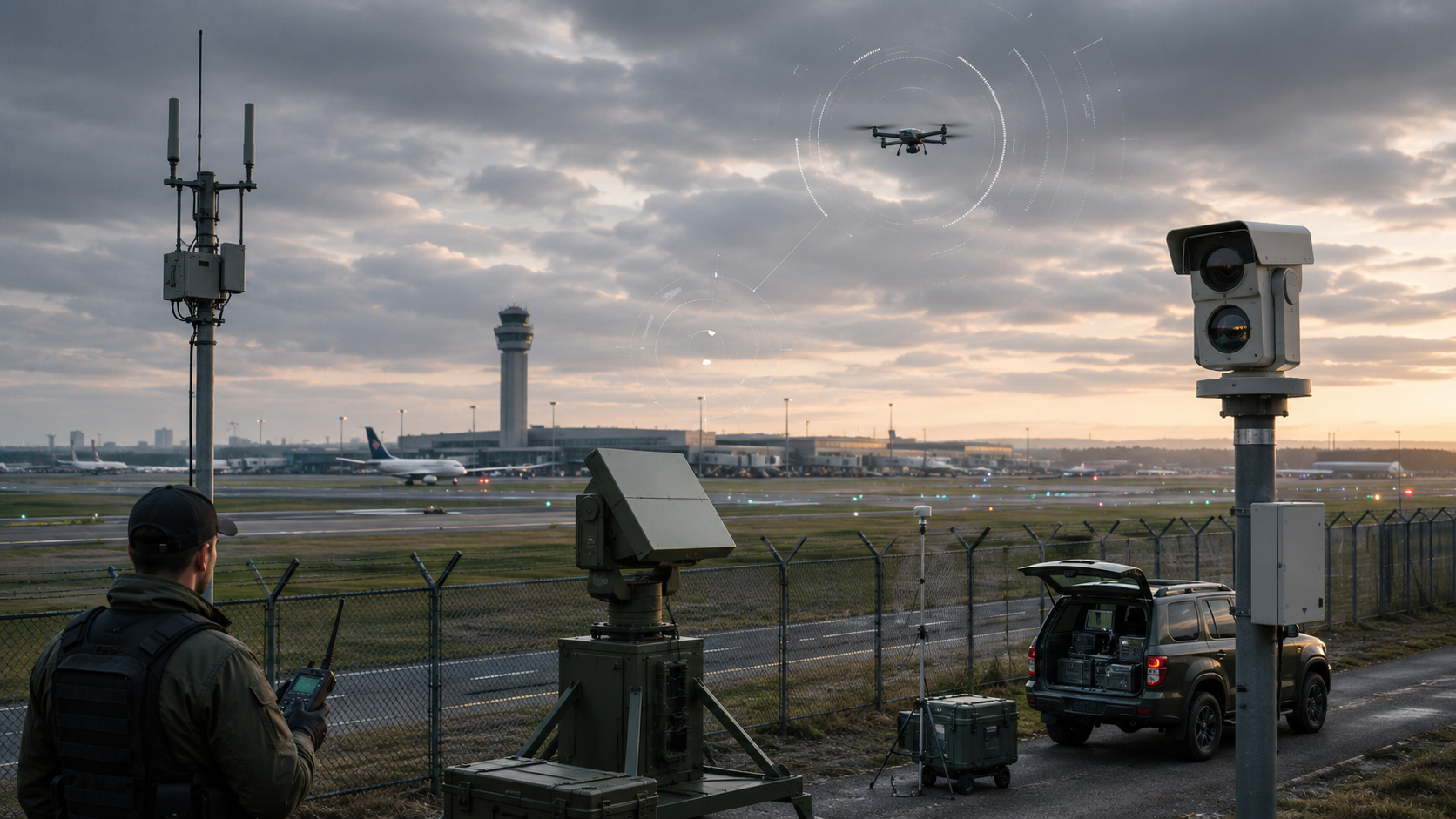
Typical fixed-site applications include airports, correctional facilities, energy infrastructure, industrial parks, government compounds, and critical communications sites.
Fixed does not automatically mean radar.
A fixed system may use RF detection, Remote ID reception, radar, optical or thermal cameras, or several technologies together. The correct option depends on the required result and expected target—not only on how the equipment is mounted.
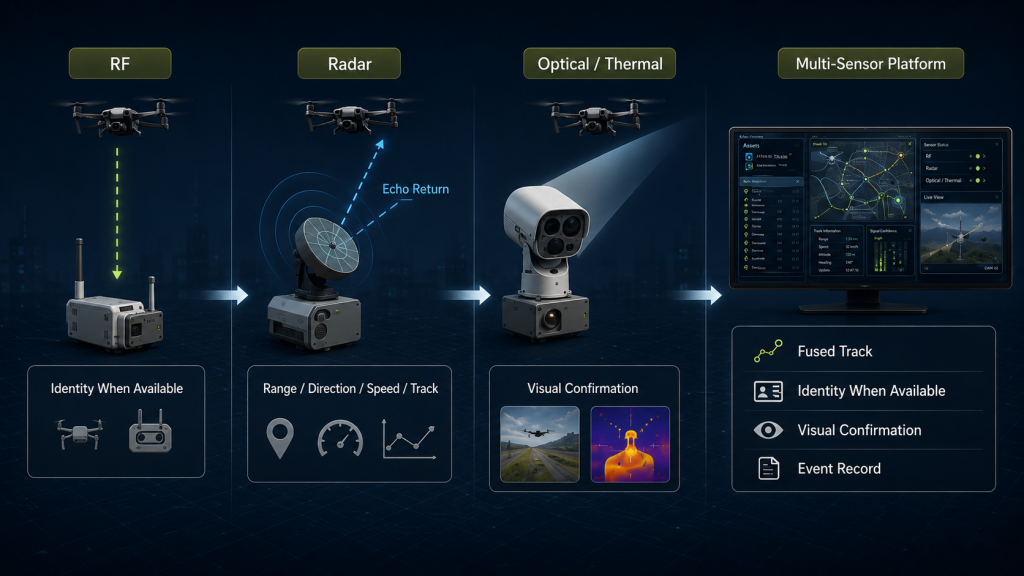
3. How to Compare RF, Radar, and Multi-Sensor Detection
After choosing the deployment model, determine which detection technology can provide the required information.
Choose RF Detection When
RF detection is a strong starting point when the project needs:
- Passive signal reception
- Supported drone identity
- Model, serial number, or protocol information
- Available controller-related location data
- Analysis of command, telemetry, or FPV activity
- Mobile or rapidly deployable equipment
RF may provide digital target information that radar normally cannot.
However, RF performance depends on the target transmitting a detectable signal that the system can receive or interpret. Protocol support, antenna position, buildings, terrain, metal structures, local interference, and the surrounding RF noise level can all change the result.
A product that detects supported RF targets should not be presented as a universal detector for all autonomous, unsupported, or radio-silent aircraft.
Choose Radar When
Radar is more appropriate when the project needs:
- Continuous monitoring of a fixed area
- Detection independent of supported drone protocols
- Physical target tracking
- Range, direction, speed, or trajectory
- Coverage of targets that may not transmit a recognized RF signal
- Coordination with fixed cameras or a command platform
Radar may detect an airborne object without knowing its digital identity.
Its practical limits may include birds, moving vegetation, buildings, terrain, installation height, calibration, false-alarm management, power requirements, networking, and specialist integration.
Choose Multi-Sensor When
A multi-sensor system is justified when one technology’s blind spots are unacceptable.
It may be necessary when:
- Target types cannot be predicted
- Supported and unsupported RF targets must both be considered
- Wide-area tracking and visual confirmation are required
- Identity, trajectory, and imagery are all needed
- One sensor produces too many uncertain alerts
- Several sites must report to one platform
- High-security coverage must continue around the clock
A typical workflow may be:
RF or radar alert → target track → identity data when available → optical or thermal confirmation → event record
Multi-sensor systems also require more infrastructure:
- Higher purchase cost
- More complex installation
- Network and time synchronization
- Alarm-correlation logic
- Operator training
- Integration testing
- More demanding maintenance
Multi-sensor should be selected because the project requires complementary evidence—not because the term sounds more advanced.
4. Which Option Fits Each Security Scenario?
The following table provides a practical starting point. Final selection still depends on the protected area, expected targets, site conditions, and evidence requirements.
| Scenario | Practical starting point | Main reason |
|---|---|---|
| Mobile security patrol | Handheld passive RF | Mobility and supported-target information are priorities |
| Temporary event | Handheld RF with visual confirmation | Rapid deployment without permanent infrastructure |
| Border or field team | Handheld, portable, or vehicle-mounted RF | Monitoring positions may change with the patrol route |
| Prison or industrial site | Fixed RF or multi-sensor assessment | Continuous perimeter awareness and event records may be required |
| Airport | Fixed multi-sensor assessment | Large area, varied targets, tracking, and confirmation requirements |
| Critical infrastructure | Fixed RF, radar, optical, or multi-sensor | Long-term monitoring and platform integration are common |
Mobile and temporary tasks usually prioritize rapid deployment and operator flexibility. Permanent high-security sites normally require continuous coverage, stable infrastructure, central alarm handling, and system integration.
The scenario provides a starting architecture, but it does not prove that one product will meet the full requirement. Target concerns and evidence needs must still be verified.
If the concern is only an occasional sighting near a home, yard, or event, start with our guide to detecting drones nearby before comparing professional equipment.
5.What Evidence Should You Verify Before Buying?
Advertised detection range is not meaningful unless the test boundary is clear.
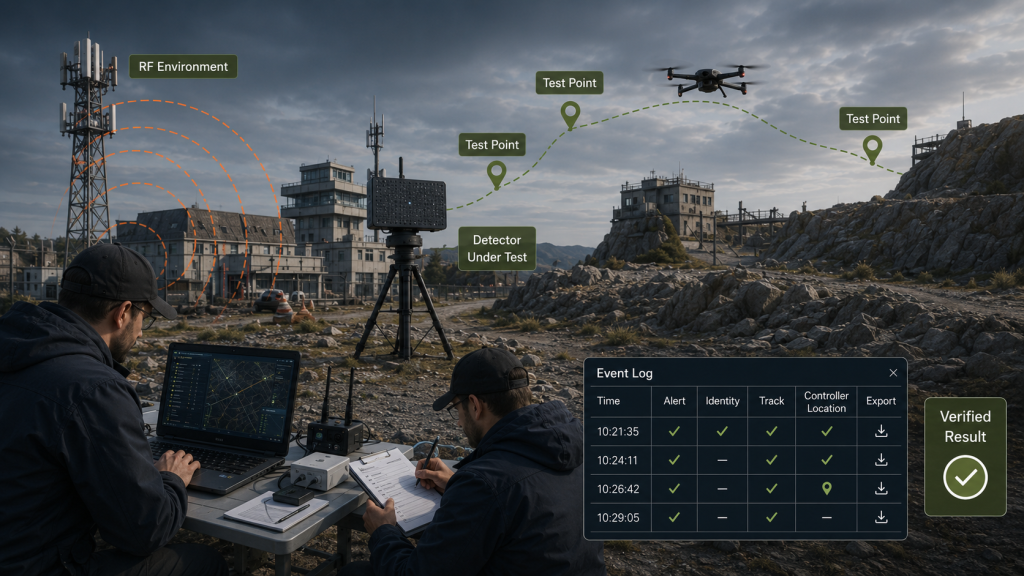
Before accepting a distance claim, ask:
- Which target, frequency, and protocol were tested?
- Does the result mean an alert, identification, or stable track?
- What terrain, antenna height, line-of-sight, and interference conditions were used?
- Which identity, controller-location, trajectory, and event data are actually available?
- Can the supplier provide repeatable test records, demonstrations, or field-trial evidence?
A long open-field range may not predict performance around buildings, metal structures, communication towers, Wi-Fi systems, industrial equipment, hills, vegetation, or dense urban RF activity.
Also confirm how the system handles unknown signals, unsupported protocols, multiple simultaneous targets, temporary network loss, and unavailable controller data.
Drone Detection RFQ Checklist
| RFQ item | Information to provide |
|---|---|
| Required result | Detection, identification, tracking, controller location, or evidence |
| Deployment model | Handheld, portable, vehicle-mounted, fixed, or networked |
| Site environment | Urban, open terrain, industrial, coastal, airport, prison, or border |
| Protected area | Approximate dimensions, perimeter, and important directions |
| Target concerns | Commercial drones, FPV, Remote ID, autonomous, or unknown targets |
| Operating requirement | Staff-operated, scheduled, or continuous monitoring |
| Infrastructure | Available power, network, mounting, vehicle, or control room |
| Integration | Cameras, radar, platform, API, or multi-device coordination |
| Evidence | Logs, screenshots, tracks, exports, and retention period |
| Verification | Test report, demonstration, field trial, or acceptance criteria |
| Procurement | Quantity, destination country, and delivery schedule |
Send RF SKYPOWER the deployment environment, protected area, target concerns, and required detection results. The project can then be reviewed as a handheld RF, fixed detection, radar, or multi-sensor requirement rather than being forced into one product category.
Discuss Your Detection Requirements
FAQ
Is RF or radar better for drone detection?
Neither is universally better. RF may provide supported-target identity and controller-related information. Radar may track airborne objects that do not provide a recognized RF signal. The required result determines which is more appropriate.
Can one detector identify every drone?
No. Identification depends on the target signal, protocol, database, and sensor method. Unknown, autonomous, unsupported, or radio-silent targets may require another sensor.
Can a handheld detector replace a fixed system?
Usually not when the site requires continuous unattended monitoring, several permanent directions, wide-area coverage, or command-center integration.
Can an RF detector locate the pilot?
Some RF or Remote ID systems may provide controller, take-off, or pilot-related location information for supported targets when the required data are available. This capability is not universal.
What Should a Drone Detector Field Trial Include?
A field trial should use representative targets, realistic terrain, actual installation positions, expected interference, defined success criteria, and repeatable test runs. It should separately record alerts, identification, tracking, controller-related data, and event exports rather than combining them into one pass or fail result.
Conclusion
The right drone detector is determined by the required result, expected target, environment, and deployment model—not by the largest advertised range. Handheld RF fits mobile supported-target detection, fixed systems support continuous monitoring, radar tracks physical targets beyond supported RF signals, and multi-sensor systems cover requirements that one technology cannot meet.
Before approval, define what operators must know after an alert and verify the proposed equipment against representative targets, realistic site conditions, and the required event evidence.
Contact us with your deployment environment, protected area, target concerns, required detection results, operating model, integration needs, and field-test requirements. RF SKYPOWER can help determine whether your project should begin with handheld RF detection, a fixed system, radar, or a multi-sensor architecture.