

Hearing a buzzing sound or seeing a small object in the sky does not immediately tell you whether it is a drone, who is operating it, or whether the event requires a professional security response. To detect drones nearby, the first challenge is not simply finding a sensor—it is deciding what level of confirmation you actually need.
A visual sighting, a phone with no Remote ID result, or unexplained RF activity can each leave important questions unanswered. The right next step changes when the requirement moves from simple presence confirmation to identification, localization, tracking, or an incident record.
So when a possible drone appears nearby, what should you check first—and at what point are ordinary observation methods no longer enough?
1. What Does It Mean to Detect a Nearby Drone?
Before choosing a method, decide what information you actually need.
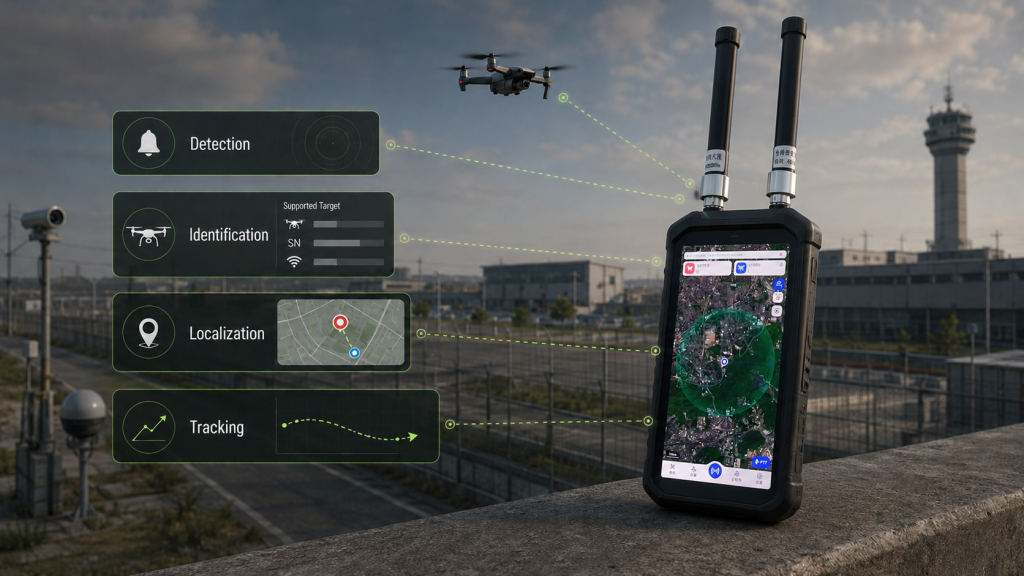
Detection means receiving an indication that a possible drone is nearby. This may come from a visual sighting, sound, Remote ID broadcast, RF signal, or radar track.
Identification means determining what the target is. Depending on the method, this may include its type, model, serial number, broadcast identity, or supported RF protocol.
Localization means estimating or displaying the position of the drone. Some systems may also provide control-station, take-off, or remote-controller location data when that information is available.
Tracking means following the target over time rather than receiving a single alert. A track may show position changes, direction, speed, altitude, or trajectory.
These levels matter because different users need different outcomes.
A homeowner may only want to confirm whether a distant object is a drone. Event security may need identification and an incident record. A fixed high-security site may need continuous localization, tracking, and visual confirmation.
For a broader overview of equipment types and system architecture, read our complete guide to drone detection.
2. Five Ways to Detect Drones Nearby
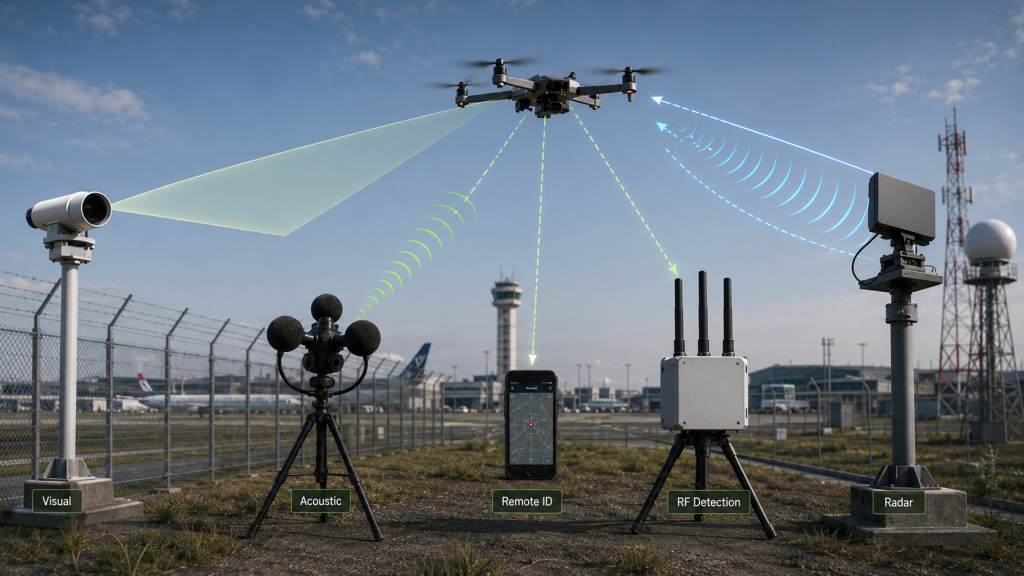
1. Visual Observation
Visual observation is the most accessible method when the object is already visible.
Look for:
- Stable hovering
- Sudden stops or direction changes
- Repeated movement around one area
- A compact or symmetrical shape
- Navigation lights at dusk or night
- Movement that does not resemble a bird or conventional aircraft
Binoculars or a long-zoom camera may help with confirmation.
The main limitations are distance, target size, darkness, glare, weather, trees, buildings, and line of sight. Visual observation is useful for confirmation, but it is not a reliable professional early-warning method by itself.
2. Listen for Drone Sound
Multirotor drones often create a persistent buzzing or high-frequency rotor sound. In a quiet environment, sound may provide the first indication before the object becomes visible.
Acoustic checks work best away from:
- Road traffic
- Crowds
- Machinery
- Ventilation systems
- Strong wind
- Reflective walls
Sound alone usually cannot identify the model, show a flight path, or locate the operator. In cities, stadiums, industrial sites, and other noisy environments, it can be difficult to separate drone noise from the background.
Use sound as an initial warning, then confirm the target through another method.
3. Check Remote ID
Remote ID allows a compatible drone to broadcast identification and location information. In the United States, the FAA describes it as broadcast information that can be received by other parties.
A suitable receiver or phone application may show information such as:
- Drone identity
- Aircraft location
- Control-station location
- Take-off location
The exact information depends on the broadcast type and receiving equipment. A Standard Remote ID drone may broadcast information about the drone and control station, while a broadcast module provides information about the drone and its take-off location.
A blank app screen does not prove that no drone is nearby. The target may not be sending a compatible broadcast, reception may be poor, or the application and hardware may not support the signal.
Remote ID is useful for checking compatible broadcasts. It is not a universal drone radar. See the FAA Remote ID guidance for the current U.S. framework.
4. Use RF Drone Detection
Many drones exchange radio signals with a controller for command, telemetry, identification, or video. RF detection equipment listens for and analyzes this wireless activity.
A basic spectrum scanner may show that radio energy is present. It usually cannot prove that the signal belongs to a drone because Wi-Fi equipment, communication devices, and other transmitters can create similar activity.
A professional RF detector may provide more information for supported signals and protocols, including:
- Drone detection
- Model or identity information
- Serial number
- Drone location
- Flight data or trajectory
- Remote-controller location when available
- Analog FPV video activity
- Event records
RF detection does not depend on daylight and can be used passively without transmitting a detection signal.
However, it still has limits. Results depend on the target signal, supported protocol, antenna position, buildings, terrain, metal structures, interference, and the local RF environment. Radio-silent, autonomous, obstructed, or unsupported targets may require radar or other sensors.
5. Use Radar or a Multi-Sensor System
Radar detects flying objects from reflected signals. It does not depend on the drone broadcasting Remote ID or using a supported RF protocol.
This makes radar useful for permanent sites that need continuous airspace monitoring. Radar may provide range, direction, speed, position, or trajectory, depending on the system.
Radar can also detect birds, moving vegetation, and other background objects. Site surveying, installation, calibration, false-alarm management, and trained operation may therefore be required.
Professional fixed sites often combine several sensors:
- Radar for initial detection and tracking
- RF for supported-target information
- Remote ID for compatible broadcasts
- Optical cameras for visible confirmation
- Thermal cameras for low-light confirmation
A multi-sensor system is usually a system-engineering project, not a substitute for a handheld detector.
3. Which Drone Detection Method Fits Your Situation?
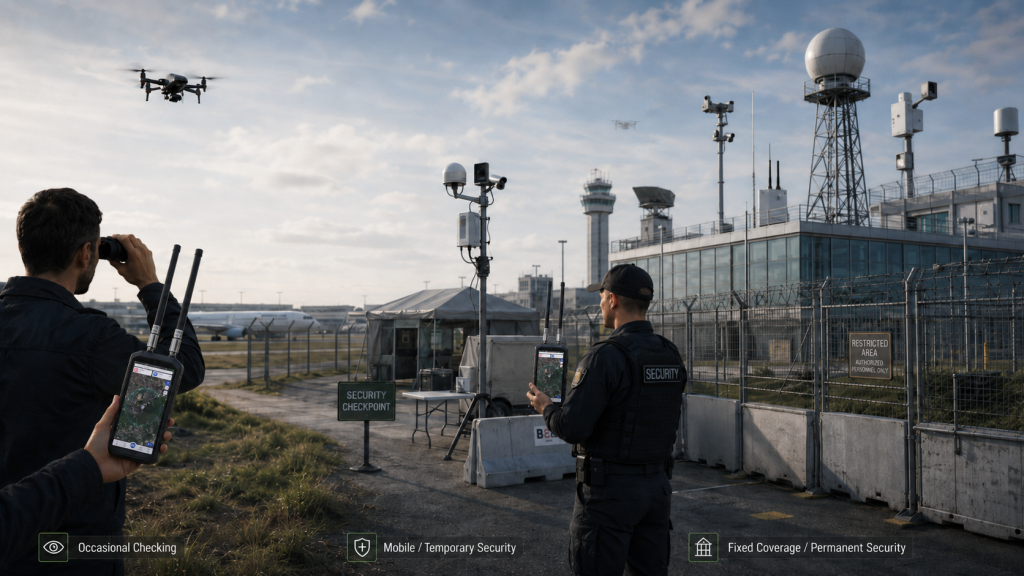
| Method | What It Can Tell You | Best For | Main Limitation |
|---|---|---|---|
| Visual observation | Confirms a visible flying object | Occasional sightings | Requires visibility and line of sight |
| Acoustic detection | Indicates a possible nearby drone | Quiet, short-range environments | Noise limits reliability and identification |
| Remote ID | Compatible broadcast identity and location data | Checking compliant broadcasts | Requires a usable compatible broadcast |
| Handheld RF detection | Supported-target detection, identification, tracking, and available controller data | Mobile patrols, events, and field investigations | Depends on signal, protocol, placement, and interference |
| Radar or multi-sensor system | Persistent detection, localization, and tracking | Permanent protected sites | Higher cost and deployment complexity |
For a one-time concern near a home or event, start with sight and sound. Check Remote ID if a suitable receiver is available.
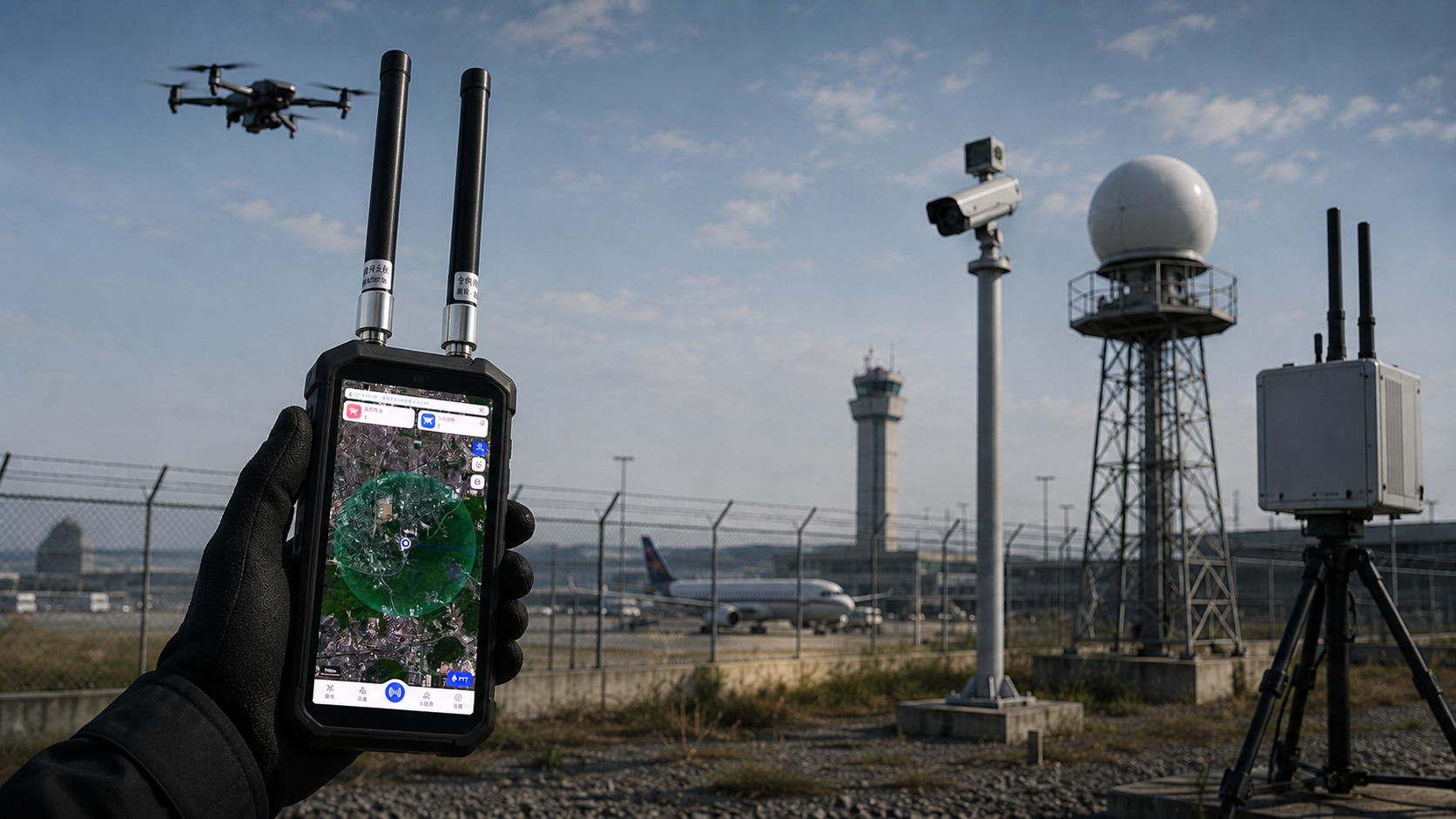
For mobile patrol or temporary security, consider handheld RF detection when the team needs more information than a visual sighting or basic scanner can provide.
If the project has moved from a nearby sighting to professional equipment procurement, use our guide to choose a drone detector by RF, radar, or multi-sensor architecture before comparing individual products.
4. When Does a Nearby-Drone Concern Justify a Handheld RF Detector?
A handheld RF detector becomes useful when ordinary observation no longer answers the operational questions.
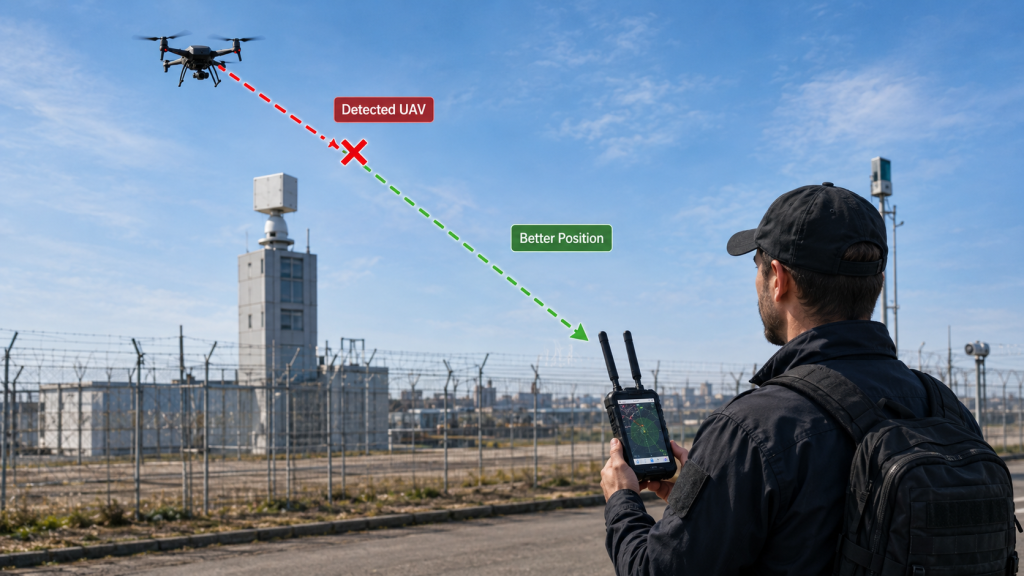
It may be appropriate when the team needs:
- Mobile patrol between several locations
- Rapid deployment without fixed infrastructure
- Passive monitoring
- Supported-target identification
- Drone or controller location data when available
- Flight tracks or event records
- Temporary event security
- Field investigation after a reported sighting
It is particularly useful when operators need to move around obstructions or search for a clearer RF position.
A handheld detector may not be sufficient by itself when the requirement includes:
- Continuous unattended monitoring
- A very large permanent perimeter
- Detection of radio-silent targets
- Coverage behind major terrain or structures
- Radar-level airspace surveillance
- Optical or thermal evidence
- Central monitoring across several fixed sensors
A handheld RF detector is therefore a mobile professional tool. It should not be presented as a smaller replacement for every fixed detection system.
5. A Mobile Option for Professional Security Teams
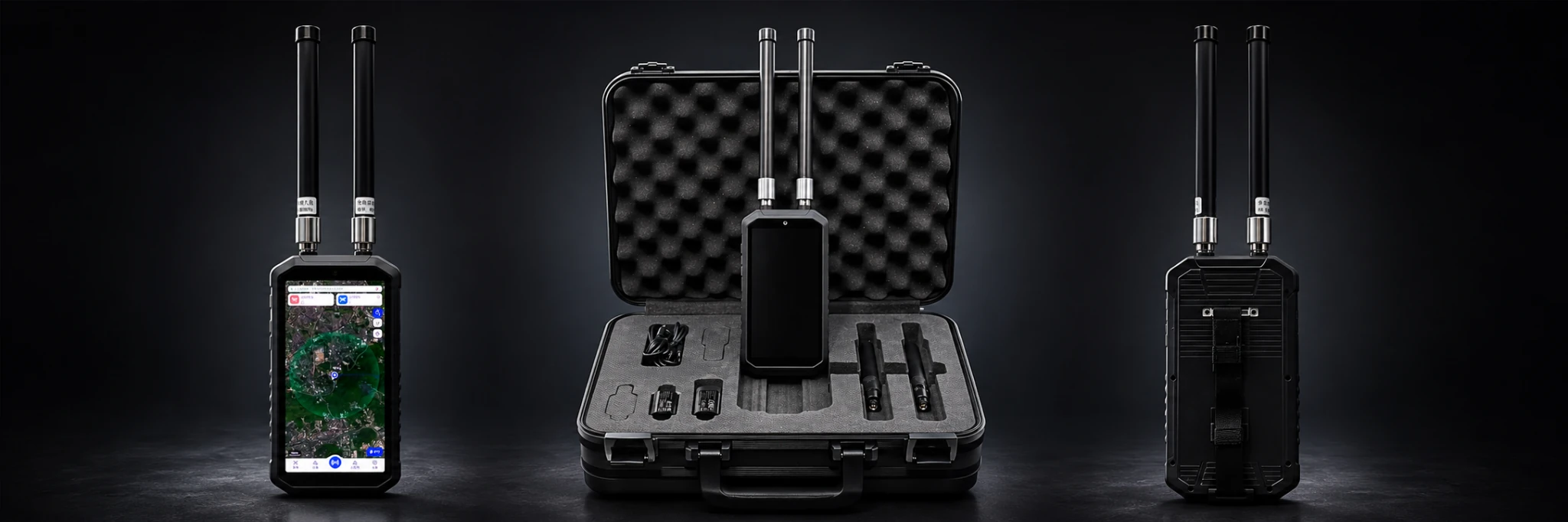
For teams that have already determined that mobile RF detection fits their operating model, the HZ-HD03 handheld drone detector provides one possible route.
For supported targets and under suitable deployment conditions, it is designed to help operators:
- Passively detect and identify available drone signals
- Display supported aircraft and controller information
- Review target movement and FPV activity
- Record events and apply whitelist or blacklist rules
The main unit uses a 6-inch touch display and weighs approximately 580 g. These hardware details support mobile use, but they should not replace a proper deployment review.
Before selecting any handheld detector, confirm:
- Target drone and protocol requirements
- Expected RF interference
- Buildings and terrain
- Required identity and location data
- Event-record and export needs
- Whether one device or coordinated devices are required
Detailed product capabilities, supported targets, deployment boundaries, and procurement information belong on the HZ-HD03 product page rather than in this detection guide.
6. What Can Affect Detection Performance?
Real detection performance depends on the target, environment, equipment, and operator position.
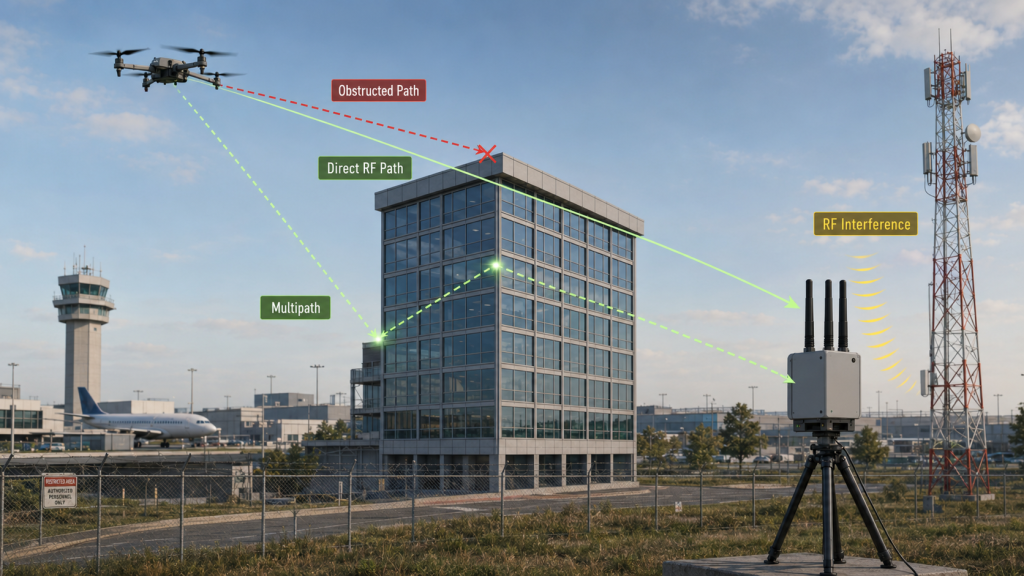
Buildings, hills, roofs, and dense structures can block visual paths and weaken or reflect RF signals. Stadium roofs, vehicles, towers, industrial equipment, and metal façades may create signal shadowing or multipath.
Strong radio activity from base stations, communication towers, electrical equipment, or nearby wireless systems may make RF analysis more difficult. Holding a detector too low, inside a vehicle, close to the body, or beside a large metal object may also reduce reception.
Weather and light affect visual methods. Traffic, crowds, wind, and machinery affect acoustic methods. Remote ID depends on receiving a compatible broadcast. RF detection depends on detectable supported signals. Radar has its own clutter and installation limits.
No responsible supplier should promise to detect every drone, locate every operator, or work through every obstruction.
Handheld Drone Detector Requirement Checklist
| Requirement | Information to provide |
|---|---|
| Deployment type | Patrol, event, investigation, border, or protected site |
| Operating model | Mobile, temporary, fixed, or mixed |
| Environment | Urban, rural, open terrain, coastal, or industrial |
| Expected targets | Commercial, FPV, custom, or unknown drones |
| Required information | Presence, model, identity, location, trajectory, or controller data |
| Monitoring scale | Approximate area and number of simultaneous targets |
| Records | Event history, screenshots, export, or reporting needs |
| Procurement | Quantity, destination country, and required timeline |
Teams with a permanent-site requirement should also explain whether they need radar, fixed RF sensors, optical confirmation, or command-center integration.
FAQ
Can a phone detect a nearby drone?
A phone may receive a compatible Remote ID broadcast through suitable software and hardware. It cannot detect every drone, and no result does not prove that the area is clear.
Can every drone be detected through Remote ID?
No. Remote ID only helps when a compatible broadcast is transmitted and received. Other targets may require RF detection, radar, cameras, thermal sensors, or acoustic confirmation.
Can an RF detector locate the drone operator?
Some professional systems can display remote-controller, control-station, take-off, or pilot-related location information for supported targets when the required data are available. This capability is not universal.
Does RF drone detection work at night?
Yes. RF detection does not depend on visible light. Nighttime visual confirmation may still require low-light or thermal cameras.
Does detecting a drone mean it can be disabled?
No. Detection and mitigation are separate functions. Detecting or identifying a drone does not automatically provide the legal authority or technical capability to interfere with it.
Conclusion
To detect drones nearby, begin with the least complex method that can answer the immediate question, then move to Remote ID, RF detection, radar, or multi-sensor coverage when the required evidence goes beyond a visual or acoustic indication. The correct method depends on whether the team needs presence confirmation, identification, localization, tracking, controller-related information, or an event record.
The correct next step is not to buy the most complex detector. It is to define what must be detected, identified, located, tracked, and recorded.
Tell RF SKYPOWER about your operating environment, expected targets, required information, deployment model, and event-record needs to discuss an appropriate drone detection approach.