


How to detect drones depends on what information the security team needs after the first alert. Seeing a flying object may confirm that something is in the sky, but it may not identify the aircraft, track its movement, locate the operator, or preserve evidence for later review.
Drones may be detected through visual observation, sound, Remote ID, RF analysis, radar, optical cameras, thermal imaging, or several sensors working together. But these methods do not answer the same operational question, and their limits change with the target, environment, protocol support, visibility, and deployment conditions.
So before comparing detection range or equipment price, what does your team actually need to know after the first alert?
1. How Can Drones Be Detected?
Drones can be detected by observing the aircraft, receiving information it broadcasts, analyzing its RF activity, detecting radar reflections, or confirming it through optical and thermal sensors.
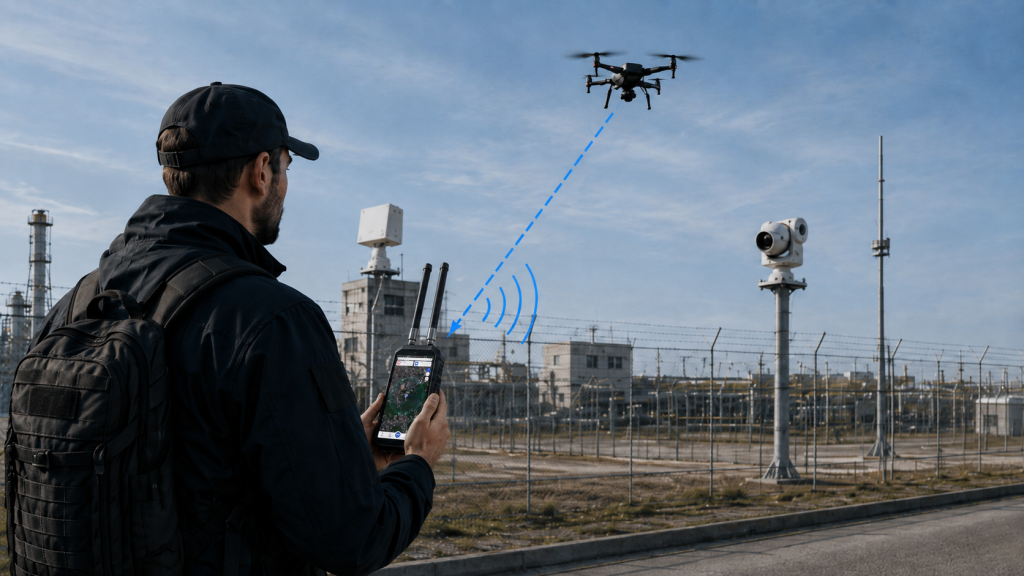
Use handheld RF detection when mobility, rapid deployment, passive operation, and supported identity information are important. Use fixed RF, radar, or multi-sensor systems when the site requires continuous monitoring of a larger protected area.
Before choosing equipment, define whether the project needs:
- Basic presence detection
- Drone identification
- Position, trajectory, or pilot location
- Event evidence
- Continuous unattended monitoring
The detector should be selected by the information and coverage the site requires—not only by its longest claimed detection range.
2. What Information Do You Need from Drone Detection?
The term “drone detection” can describe several different results. Buyers should define which results are required before comparing sensor type, range, or equipment price.
| Capability | What it answers |
|---|---|
| Detection | Is there evidence that a possible drone is present? |
| Classification | Is the target likely to be a drone rather than a bird or another object? |
| Identification | What model, serial number, protocol, or digital identity is available? |
| Tracking | Where is the target moving over time? |
| Pilot location | Where is the controller or operator, when supported? |
| Event logging | What information can be reviewed after the event? |
Not every detector provides all six capabilities. A presence alert does not automatically prove identity, trajectory, or pilot location.
For example, radar may detect and track an airborne object without providing its serial number. A Remote ID or protocol-capable RF receiver may provide identity information for a supported target but cannot be assumed to detect every drone.
If the concern is an occasional local sighting rather than a professional detection-system project, start with practical methods to detect drones nearby before comparing dedicated equipment.
3. What Are the Main Drone Detection Methods?
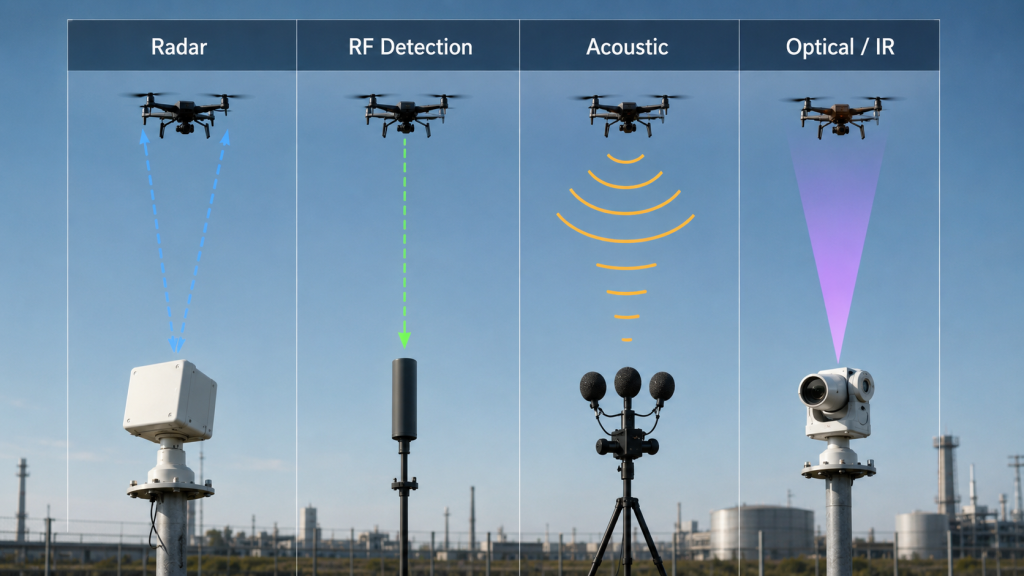
Each detection method observes a different part of the problem. Some depend on detectable RF activity. Others depend on sound, visibility, heat, or reflected radar energy.
Visual Observation
Visual observation includes the naked eye, binoculars, and standard cameras.
It is simple and useful for confirming a nearby target in clear conditions. However, small drones can be difficult to distinguish from birds or other objects, especially at distance, at night, or in poor weather.
Visual observation also provides limited identity or pilot-location information.
Acoustic Detection
Acoustic sensors listen for motor and propeller sounds.
They may support short-range detection in quiet areas, but their usefulness decreases in cities, industrial zones, airports, and crowded venues. Traffic, machinery, wind, and aircraft can mask or imitate drone sounds.
Acoustic detection is generally more useful as a supporting sensor than as the only identification method.
Remote ID Receivers
Remote ID receivers capture identity and flight data broadcast by compatible drones.
Depending on the applicable standard and target, available information may include identity, position, altitude, speed, and controller-related data.
Remote ID can help distinguish authorized aircraft from unknown targets, but it only detects compatible broadcasts within reception conditions. It should not be treated as a universal detector for every drone.
Remote ID requirements, formats, and availability also vary by country and aircraft category.
RF Signal Detection
RF detection monitors activity associated with drone control, telemetry, and video transmission.
A basic RF detector may only indicate that suspicious activity is present. A protocol-capable system may interpret supported signals and provide information such as:
- Drone model
- Serial number
- Position
- Height
- Speed
- Flight direction
- Controller or pilot position
- Flight history
Available information depends on the target signal, supported protocol, RF environment, terrain, obstruction, and detector configuration.
Passive RF detection receives and analyzes signals without transmitting a detection signal. It can therefore be useful for mobile patrol, temporary deployment, field investigation, and sites without permanent sensor infrastructure.
Drones operating without a detectable supported RF link, as well as targets using unsupported protocols, modified links, or very low-power transmissions, may reduce detection or identification capability. Dense RF environments can also make classification more difficult.
Radar Detection
Radar transmits a signal and analyzes reflections from airborne objects.
It does not depend on a target broadcasting Remote ID or using a supported control protocol. This makes radar suitable for persistent fixed-site monitoring.
Radar may provide position, direction, speed, and trajectory, but it does not normally provide digital identity or pilot location by itself.
Performance depends on small-target sensitivity, installation height, terrain, buildings, clutter, target altitude, and system configuration. Radar also normally requires more installation, power, networking, and calibration than a handheld detector.
Optical and Thermal Detection
Optical cameras help operators visually confirm a suspected target.
Thermal cameras can support low-light or nighttime observation by detecting heat contrast. Their performance still depends on target size, weather, background temperature, lens selection, and distance.
Optical and thermal systems often work best when another sensor provides the target direction. They are usually confirmation tools rather than the only early-warning method.
Multi-Sensor Detection
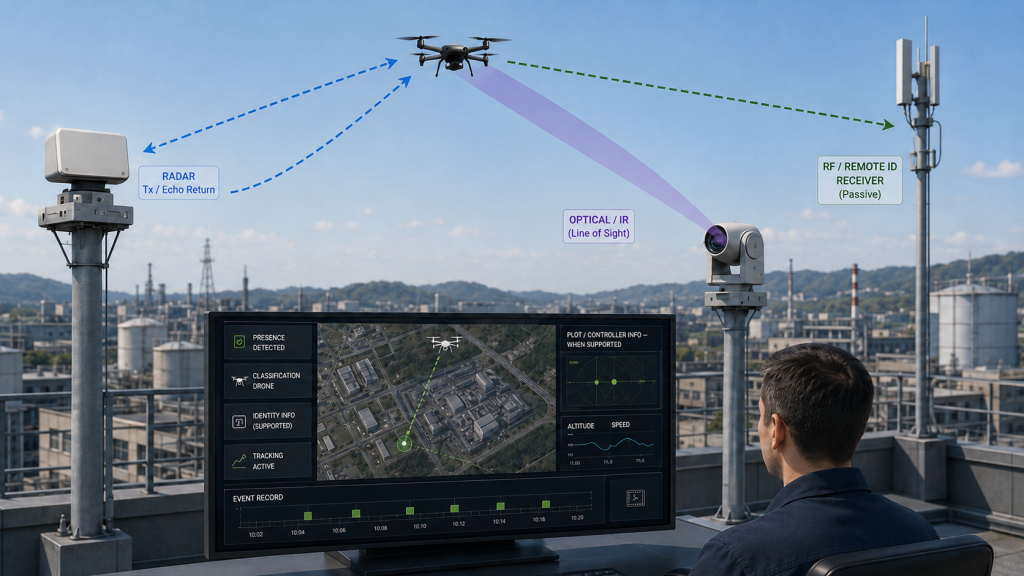
Multi-sensor systems combine technologies such as RF, radar, Remote ID, optical cameras, and thermal imaging.
One sensor may provide the first alert while another confirms the object or supplies additional information.
For example, radar may provide a track, RF analysis may provide identity information, and a camera may visually confirm the target.
This approach reduces dependence on one method, but it also increases integration, networking, maintenance, and operator-training requirements.
4. How Do Drone Detection Methods Compare?
The table below provides a practical starting point. Actual capability depends on the equipment, target, environment, installation, and test conditions.
| Method | Depends on Detectable Target RF Activity | Can Provide Identity | Can Locate Pilot | Mobile Use | Continuous Fixed Coverage | Main Limitation |
|---|---|---|---|---|---|---|
| Visual Observation | No | Usually no | No | Strong | Limited | Distance, light, weather, and obstruction |
| Acoustic Detection | No | Usually no | No | Possible | Limited | Noise and short practical range |
| Remote ID | Yes, compatible Remote ID broadcast | Often, when broadcast | Sometimes | Strong | Possible | Only compatible broadcasts within reception conditions |
| RF Detection | Usually | Possible with supported protocols | Possible for supported targets | Strong | Strong with fixed sensors | Signal type, protocol support, interference, and placement |
| Radar | No | Usually no digital identity | No | Limited | Strong | Cost, clutter, installation, and classification |
| Optical / Thermal | No | Visual classification only | No | Possible | Strong when correctly installed | Line of sight, weather, direction, and target size |
| Multi-Sensor | Depends on sensor combination | Potentially | Potentially | Usually limited | Strong | Cost, integration, networking, and maintenance |
The choice should follow the project priority:
- Use handheld RF detection when mobility and supported identity information matter.
- Use fixed RF or radar when continuous monitoring is the priority.
- Use optical or thermal equipment when target confirmation is required.
- Use a multi-sensor system when the site must cover several target types and one method is not sufficient.
- Use Remote ID alone only when compatible Remote ID targets are the defined concern.
5. When to Use Handheld, Fixed, or Multi-Sensor Detection
The equipment category should follow the operating model of the security team.
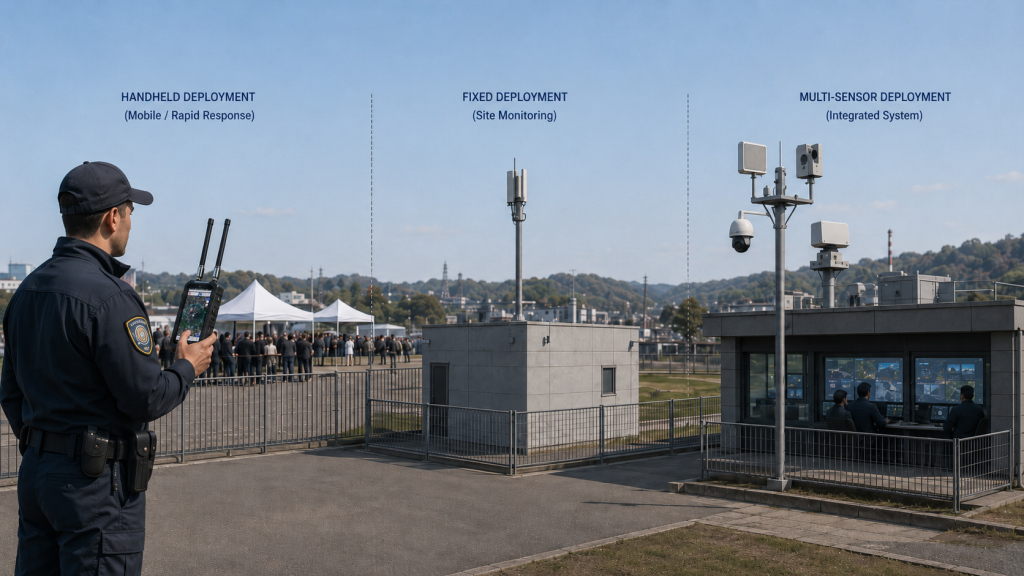
Handheld Detection
Handheld detectors are appropriate when operators need to move between locations or deploy quickly without permanent infrastructure.
Typical applications include:
- Mobile patrol
- Temporary events
- Field investigation
- Border or remote-site inspection
- VIP security
- Rapid response after a visual report
- Short-term monitoring from different positions
A handheld unit allows the operator to change position, avoid obstruction, and search for a clearer RF environment.
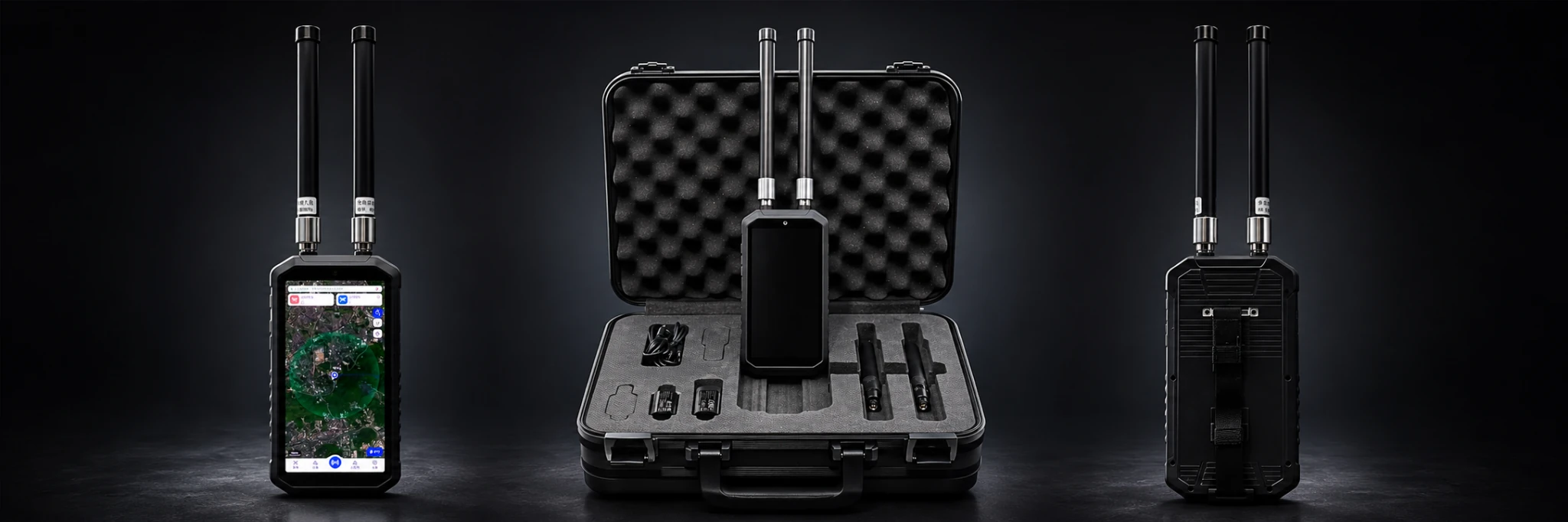
For teams that need a portable, passive RF option, the HZ-HD03 provides a practical example of how a handheld detector fits this operating model. Its role and deployment considerations are summarized below.
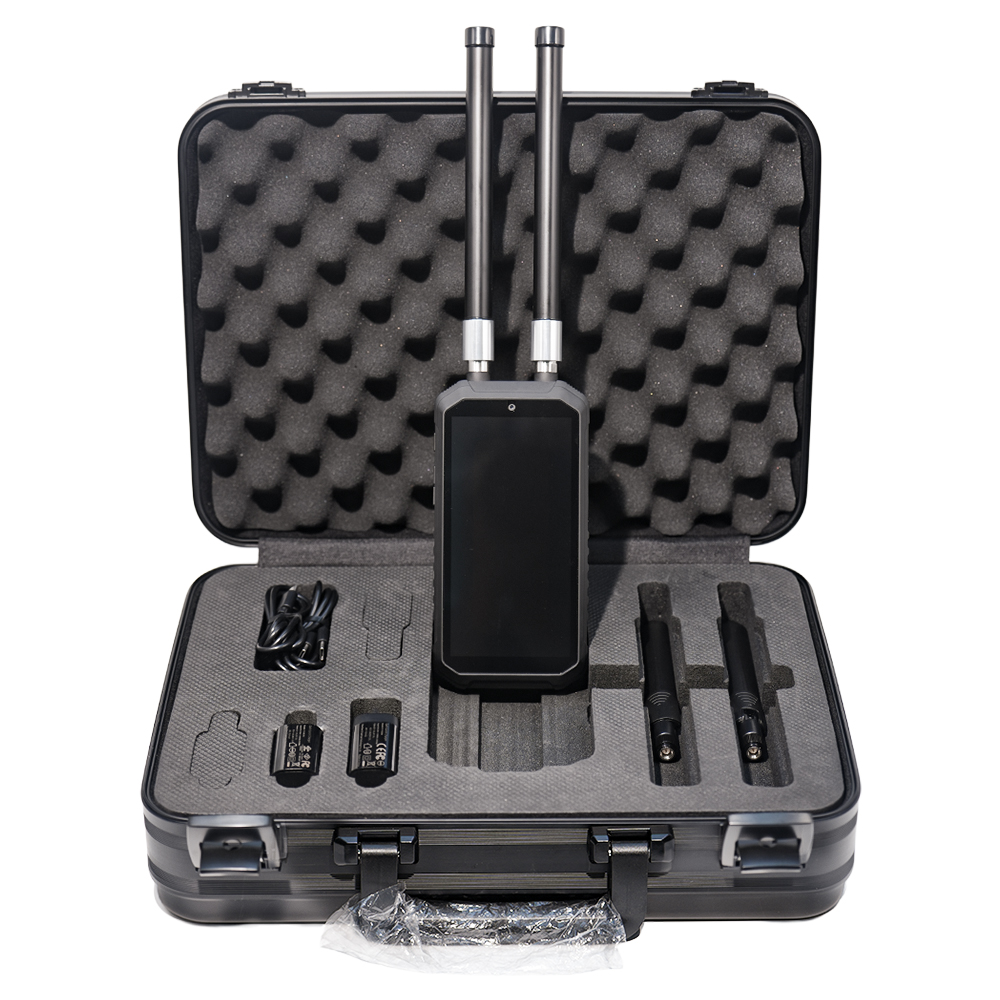
PORTABLE PASSIVE RF DETECTION
HZ-HD03 Handheld Drone Detector
The HZ-HD03 is designed for mobile patrols, temporary security deployments, and field investigations where permanent sensor infrastructure is not practical. It passively analyzes supported drone signals and can display available aircraft, pilot, and event information.
Portable hardware: Approx. 580g | 6.0-inch display | Operating temperature: -25°C to +60°C
| Selection Factor | HZ-HD03 Handheld Fit |
|---|---|
| Best Fit | Mobile patrols, temporary event security, border or perimeter inspection, and field investigations that require rapid relocation. |
| Detection Approach | Passive RF detection and protocol analysis of supported drone and FPV signals, without transmitting an active detection signal. |
| Available Information | Supported aircraft identity and flight data, drone and pilot location where available, FPV signal analysis, and event records. |
| Confirm Before Deployment | Target drone and protocol list, required detection distance under site conditions, RF interference, terrain and obstruction, firmware-update path, and reporting or data-export requirements. |
Fixed Detection
Fixed systems are more suitable when a site needs continuous monitoring without relying on an operator carrying the equipment.
Common applications include:
- Airports
- Prisons
- Power facilities
- Industrial sites
- Critical infrastructure
- Large venues
- Long-term border monitoring
- Command-center integration
Fixed systems may use RF sensors, radar, cameras, thermal imaging, or several sensor types together.
A site survey is still required. Sensor height, terrain, buildings, RF interference, network availability, blind zones, and weather protection can all affect the result.
Multi-Sensor Detection
Multi-sensor systems are appropriate when one technology cannot provide enough coverage or confirmation.
They may be justified when the project needs:
- Persistent wide-area monitoring
- Detection of targets without supported RF broadcasts
- Identity information when available
- Visual or thermal confirmation
- Cross-checking between sensors
- Integration with a larger security platform
or equipment procurement, the next step is to choose a drone detector by RF, radar, or multi-sensor architecture based on the required result, deployment model, target concerns, and site conditions.
6. What Limits Drone Detection Performance?
Detection performance is shaped by the target, the environment, the sensor, and its installation. A distance number without these conditions is not a complete comparison.
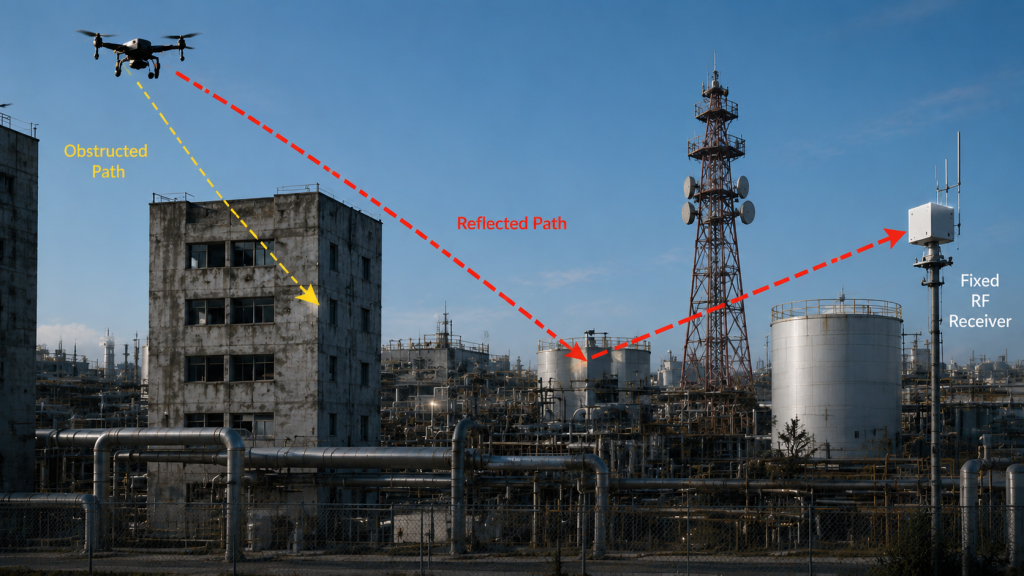
Target and Protocol
Different drones use different communication methods, transmit powers, protocols, flight modes, and physical designs.
A detector tested against one consumer drone should not automatically be expected to provide the same result against every enterprise, FPV, autonomous, or modified aircraft.
RF and Remote ID systems can only interpret signals and data they are designed to support. The supplier should distinguish between general RF activity detection, signal classification, protocol recognition, identity information, and pilot-location capability.
Terrain and Obstruction
Buildings, terrain, metal structures, vehicles, reinforced walls, glass façades, and vegetation can block or reflect signals.
An open or elevated position may improve RF reception. Radar and cameras also depend on suitable installation height, direction, and line of sight.
RF Environment
Base stations, Wi-Fi networks, broadcast systems, microwave links, event communications, and industrial equipment can create a dense RF environment.
This may affect alert quality, classification, protocol analysis, and usable range.
Sensor Placement
A capable detector can still perform poorly if it is installed or operated from the wrong position.
Sensor height, antenna orientation, nearby obstruction, cable loss, coverage direction, and blind zones should be reviewed before deployment.
Weather and Visibility
Visual and thermal systems are affected by weather, light, visibility, and background temperature.
RF and radar do not depend on visible light, but their performance still depends on the target, environment, and installation.
Test Conditions
Range claims should be reviewed together with:
- Target model
- Signal type
- Flight height
- Terrain
- Local interference
- Sensor position
- Antenna configuration
- Test method
A maximum range measured against one target in an open field should not be treated as guaranteed performance for every site.
Local regulations may also affect Remote ID use, RF monitoring, identity-data handling, and system deployment.
7. What Basic Information Should a Drone Detection RFQ Include?
A useful RFQ gives the supplier enough information to decide whether the project needs handheld RF detection, fixed sensors, radar, or a multi-sensor architecture.
| RFQ item | Information to provide | Why it matters |
|---|---|---|
| Deployment environment | Urban, rural, coastal, industrial, airport, prison, venue, border, or critical infrastructure | Identifies likely obstruction, clutter, and RF conditions |
| Deployment type | Mobile patrol, temporary, vehicle-based, rooftop, tower, or fixed installation | Determines the equipment category |
| Monitoring area | Approximate area, perimeter, directions, heights, and critical zones | Helps define coverage and sensor placement |
| Required result | Presence alert, classification, identity, tracking, pilot location, or event logging | Defines what the system must provide |
| Target concern | Consumer drones, enterprise drones, FPV, Remote ID targets, or an unknown mix | Helps determine sensor and protocol requirements |
| Operating schedule | Temporary, event-based, daytime, nighttime, or continuous monitoring | Affects equipment and infrastructure requirements |
| Simultaneous targets | Expected number of drones or alerts | Influences processing and display requirements |
| Power and network | Available AC/DC power, network, cellular connection, or standalone operation | Determines whether a fixed installation is practical |
| Integration requirement | Standalone device, alarm output, API, command platform, or multi-device operation | Defines the system boundary |
| Evidence requirement | Live alert, event history, screenshots, exportable data, or formal reports | Determines logging and data-management needs |
| Quantity and timeline | Evaluation quantity, project quantity, and expected schedule | Supports technical and commercial planning |
The RFQ should not begin only with:
What is the maximum detection range?
A stronger request explains the environment, target concern, required information, deployment model, and evidence expectations.
FAQ
Can a Phone Detect a Nearby Drone?
A phone may receive compatible Remote ID broadcasts through a suitable application and supported hardware. It cannot detect every drone.
The result depends on whether the target broadcasts compatible Remote ID data, reception conditions, the phone, and the application.
Can Drones Be Detected Without Remote ID?
Yes. Radar, RF detection, optical cameras, thermal imaging, acoustic sensors, and visual observation may detect drones without depending only on Remote ID.
Each method covers different targets and provides different information.
Can a Drone Detector Locate the Pilot?
Some RF and Remote ID systems may display the pilot or controller location for supported targets when the required data are available.
This capability is not available for every drone, protocol, or operating mode.
Does RF Drone Detection Work at Night?
Yes. RF detection does not depend on visible light.
Nighttime visual confirmation may still require thermal imaging, low-light cameras, or another sensor.
What Is the Difference Between RF and Radar Detection?
RF systems receive activity associated with the drone, controller, telemetry, or video link. They may provide identity or pilot information for supported targets.
Radar detects objects through reflected radar energy and does not require a compatible target broadcast. It is generally more suitable for persistent fixed-area monitoring.
What Affects Drone Detection Range?
Range can be affected by the target, transmit power, protocol, flight height, terrain, buildings, local RF noise, sensor height, antenna placement, weather, and detector configuration.
A claimed range should always be reviewed together with its test conditions.
Conclusion
Drones can be detected through visual, Remote ID, RF, radar, optical, thermal, and multi-sensor methods, but these methods do not provide the same information or share the same operating limits. The useful approach is the method—or sensor combination—that matches the required detection result, target type, site conditions, and deployment model rather than simply the longest advertised range.
For mobile patrol, temporary deployment, or passive supported-signal analysis, a handheld RF detector may be the appropriate starting point.
For continuous monitoring of a fixed protected area, fixed RF or radar is usually more suitable.
For sites that need broad detection, identity information, and visual confirmation across different target types, a multi-sensor system may be required.
Contact RF SKYPOWER with your deployment environment, monitoring area, target concerns, required information, infrastructure, quantity, and project schedule to review the appropriate drone detection approach.