


Frequency-specific VSWR can remain inside the project limit at one frequency and trigger a reflected-power alarm at the exact frequency the project depends on.
A clean center-frequency result—or even a successful dummy-load test—may not reveal which part of the installed path creates the mismatch. The physical cause may sit in the antenna, feeder, connector stack, filter transition, lightning protection device, or PA output interface. An unclear measurement reference plane can then make the fault appear to belong to the wrong part of the system.
That creates a dangerous replacement decision. The PA may be blamed even though the fault belongs to the installed RF path. The path may also be blamed when the same problem remains at the PA output under a verified load.
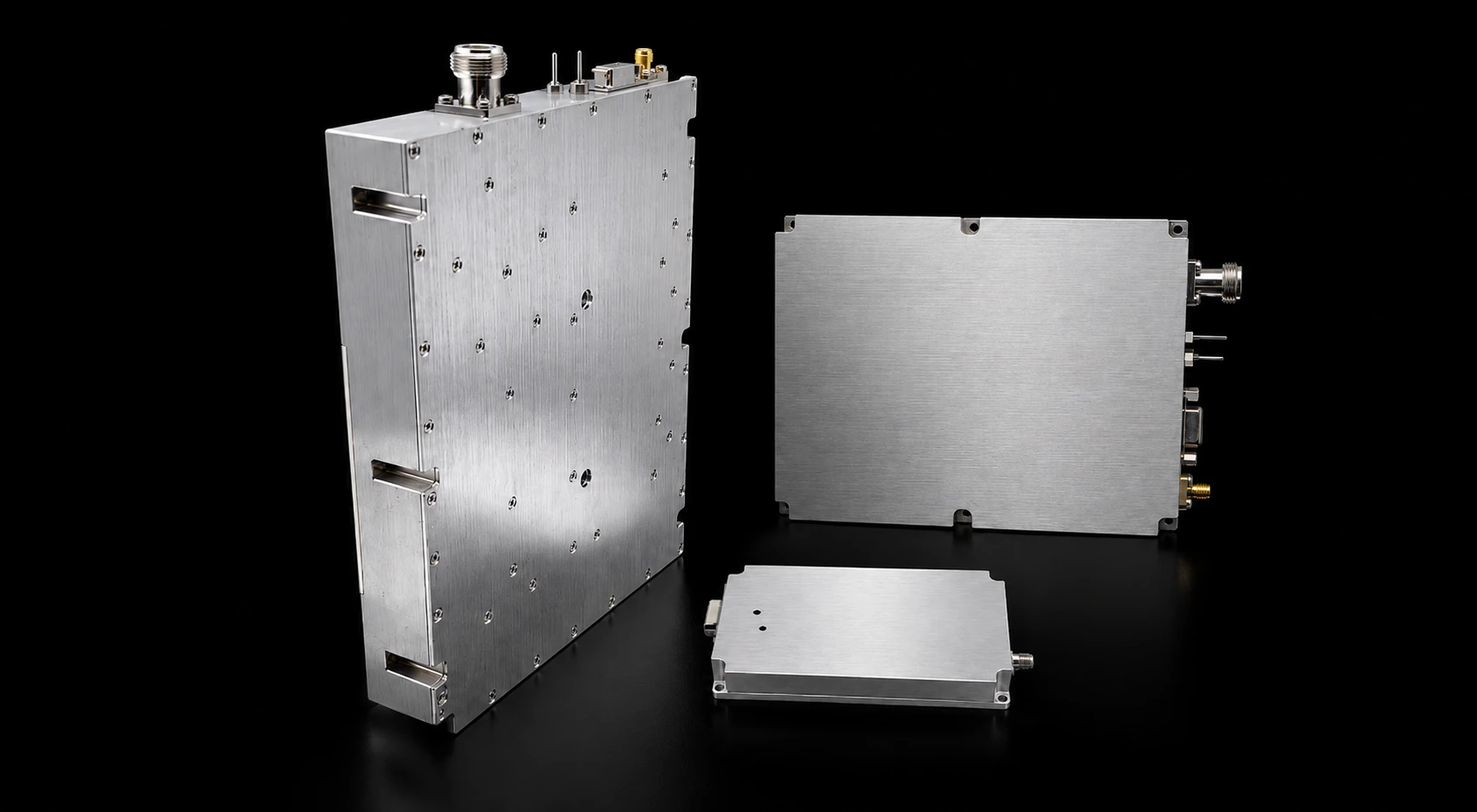
When selecting RF Power Amplifier Modules, review reflected power at the target frequencies together with operating output, real load conditions, protection response, and the defined measurement reference plane.
Before approving or replacing the PA, the project must answer one question:
What changes at the failing frequency—and what evidence proves whether the mismatch follows the PA or the installed RF path?
1. Why VSWR Can Be Normal at One Frequency and High at Another
VSWR is not one fixed value for an entire RF system.
The impedance presented to the PA changes with frequency because the antenna and every component between the PA and antenna have frequency-dependent electrical behavior. The installed path is therefore not perfectly matched at every point inside its stated operating band.
At one frequency, reflections from several interfaces may remain small. At another, their magnitudes and phases may combine and create a larger mismatch at the PA output.
This can happen even when no single component appears severely defective.
A broad antenna range, cable frequency rating, or filter bandwidth does not prove that the complete installed path presents an acceptable impedance at every project frequency.
Small Reflections Can Combine at One Frequency
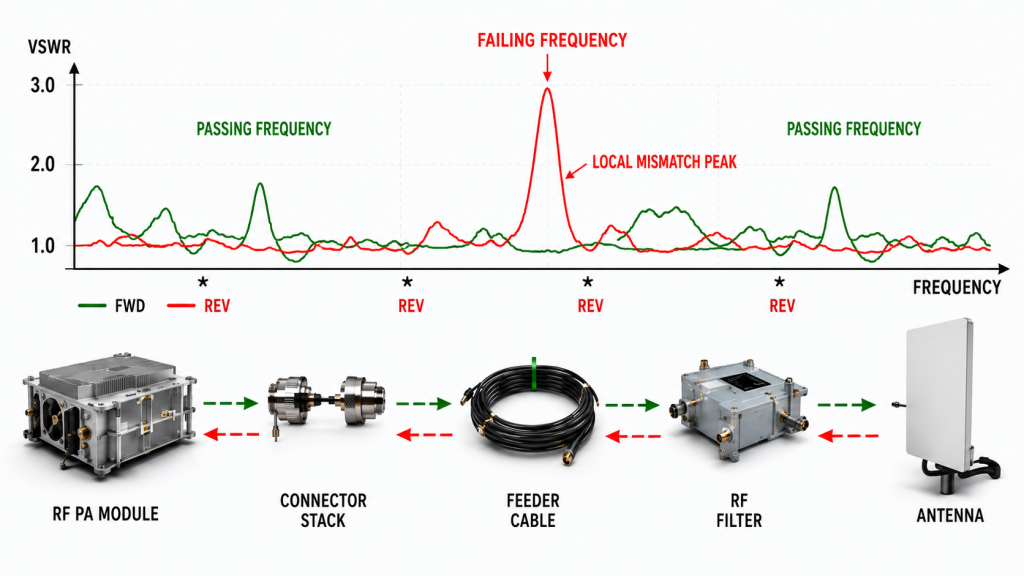
The installed RF path contains several impedance transitions. Each transition may produce only a small reflection, but the combined result depends on frequency, electrical length, loss, and phase.
Several moderate discontinuities can therefore create a local reflected-power peak even when no single part appears severely defective.
This is why a system may operate normally at the center frequency but alarm at a lower band edge, upper band edge, or project-specific point. The physical locations that commonly produce these effects are examined in Section 3.
Read FWD and REV at the Same Reference Plane
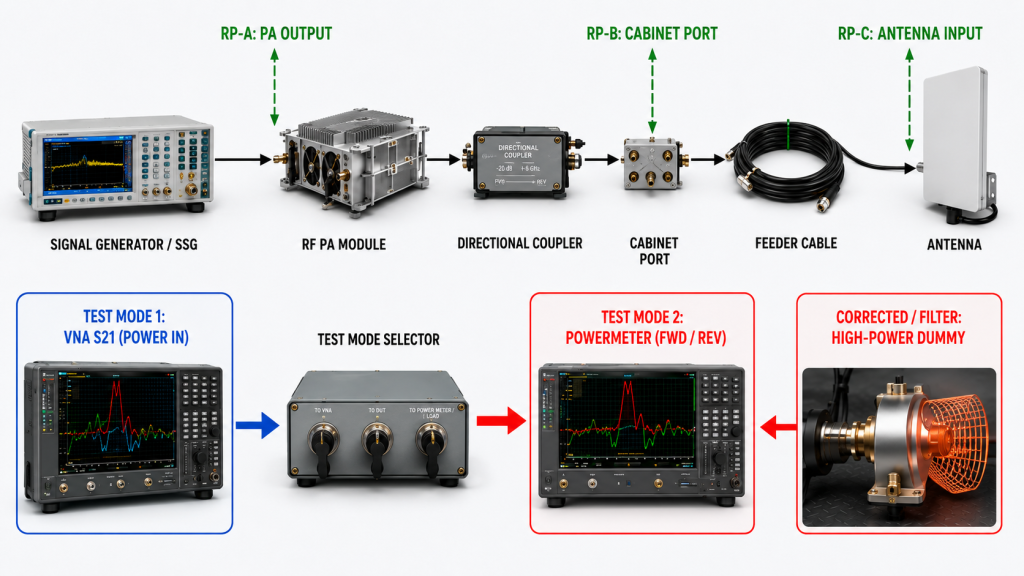
During a powered test, forward power and reflected power should be measured or corrected to the same defined reference plane.
VSWR can then be calculated or reported from their relationship.
These are not three unrelated measurements. The report should make clear:
- where FWD and REV apply;
- how VSWR was derived;
- which frequency-specific corrections were used;
- whether the results represent the PA output or another point in the RF path.
The same VSWR ratio represents more absolute reflected power when forward power is higher.
A mismatch that appears minor during a reduced-power test may return much more power toward the PA at full operating output. That higher reflected power may trigger foldback, increase device stress, raise temperature, or disturb recovery behavior.
2. Why a Dummy-Load Pass Does Not Clear the Installed RF Path
A verified 50 Ω dummy load helps establish the PA baseline.
The load should have:
- suitable frequency coverage;
- adequate continuous or pulsed power rating;
- known VSWR at the failing frequency;
- sufficient cooling;
- a documented connector and adapter boundary.
A label showing “50 Ω” is not enough if the load is outside its frequency range, overheats during the test, or is connected through an unknown adapter path.
If the PA produces the expected corrected forward output into the verified load without abnormal REV or protection activity, that result supports the PA-side baseline under the stated conditions.
It does not approve the installed antenna path.
The real path may add feeder loss, connector transitions, RF switching, filtering, lightning protection, cabinet feedthroughs, and antenna mismatch.
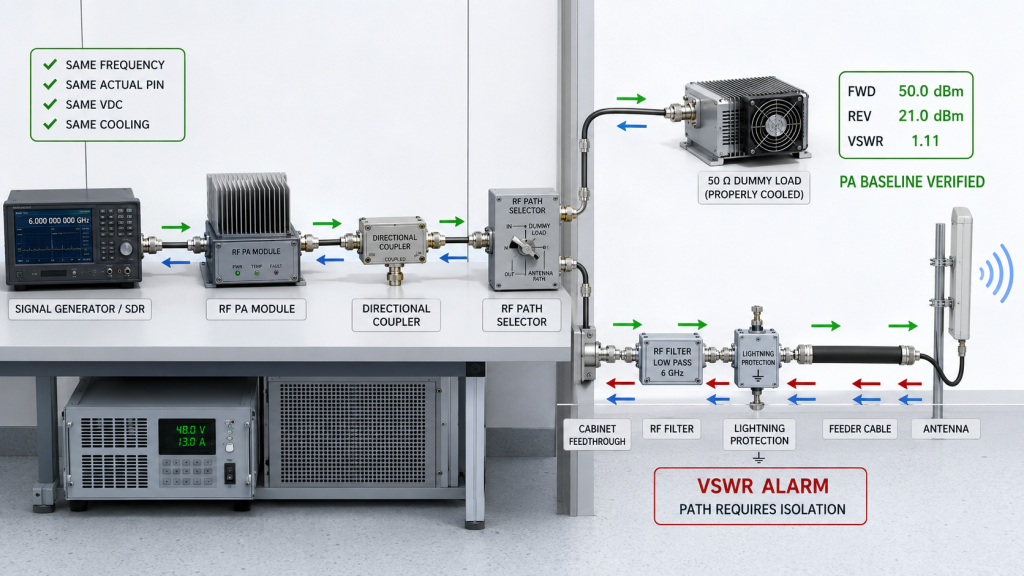
Dummy-load and real-antenna checks therefore answer different questions:
- the verified dummy load shows PA behavior under a controlled load;
- the installed path shows how the complete RF chain behaves at the required frequencies.
Use a Fixed-Input Comparison
For a fixed-input comparison, keep these conditions consistent:
- frequency;
- actual Pin at the PA input;
- voltage measured at the PA during RF operation;
- duty cycle;
- cooling condition;
- operating duration.
Then record the resulting:
- corrected forward output power at the defined reference plane;
- REV at the same reference plane;
- current;
- temperature where relevant;
- protection state.
Do not force both the dummy-load and installed-path tests to reach the same output while also claiming that Pin remained fixed. A mismatch or protection event may naturally change the output produced from the same input drive.
If the test controls output rather than Pin, the method must state that clearly. It should also record how much input drive was required to reach the controlled output.
A Dummy-Load Pass Narrows the Fault Boundary
When the PA passes on the verified dummy-load setup but fails through the installed path, the evidence points outside the verified PA-side test boundary or toward a component that changed between the two configurations.
The next step is to divide the installed path into smaller sections and identify where the mismatch begins.
If abnormal REV remains on the verified load, the investigation should return to the PA-side boundary, including:
- PA output connector;
- output matching;
- directional coupler;
- adapter stack;
- calibration;
- correction data;
- measurement reference plane.
A dummy-load test is an isolation step. It is not final acceptance evidence for the complete installed RF path.
3. Which RF-Path Elements Can Create a One-Frequency Mismatch
Frequency-specific VSWR often appears because one part of the installed path behaves differently at the failing frequency.
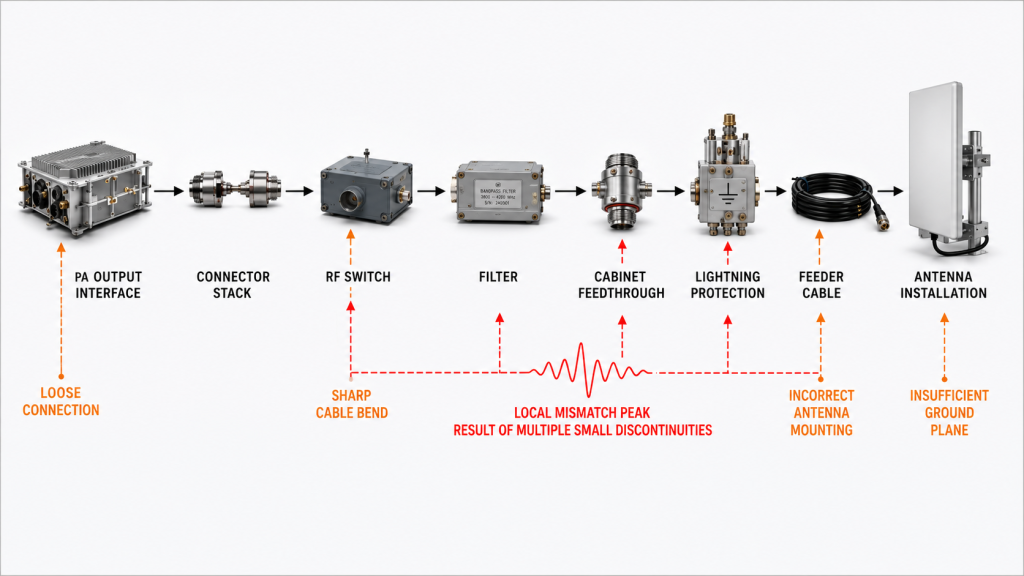
The most likely areas are the antenna installation, feeder assembly, connector stack, filters, switches, couplers, lightning protection, and PA-side output interface.
Antenna Match and Installation
An antenna may cover a broad catalog range while still showing local impedance peaks or weaker matching at specific frequencies.
Its installed behavior can change because of:
- insufficient ground plane;
- nearby conductive structures;
- incorrect mounting orientation;
- close antenna spacing;
- enclosure or radome effects;
- damage, water entry, or an incorrect antenna model.
A bench measurement may not reproduce the final rooftop, mast, cabinet, or vehicle installation.
The antenna should therefore be checked in its actual mechanical environment or in a representative setup.
Feeder Electrical Length and Loss
A feeder does more than reduce forward power.
When the antenna is mismatched, feeder electrical length changes the complex impedance presented at the PA end. Cable loss also changes how much reflected power returns to the PA. Damaged sections, poor connectors, or other discontinuities can introduce additional reflections.
This means the PA-end result may differ from a measurement taken directly at the antenna connector.
It also means that a single PA-port VSWR value cannot be used to calculate the exact antenna mismatch unless the intervening path is known.
Check the feeder for:
- unexpected insertion loss;
- crushed or sharply bent sections;
- water ingress;
- damaged dielectric;
- incorrect cable type;
- unstable connector termination.
A cable can pass a DC continuity test and still fail at one RF frequency.
Connectors and Adapter Stacks
Every connector and adapter creates an impedance transition.
One transition may have little effect. Several adapters in series can create a more visible frequency-dependent response.
Inspect for:
- loose or contaminated interfaces;
- damaged center contacts;
- incorrect torque;
- worn mating surfaces;
- mixed impedance standards;
- components not rated for the operating power.
Temporary test adapters must also be included in the documented measurement boundary. Otherwise, the test setup itself may be mistaken for a fault in the installed system.
Filters, Switches, Couplers, and Lightning Protection
Filters, diplexers, RF switches, couplers, and lightning protection devices have stated frequency ranges, but their return loss and power behavior are not perfectly flat.
A critical frequency may sit near:
- a filter transition;
- an internal resonance;
- a switching-network weak point;
- a coupler limitation;
- a response change in a lightning protection device;
- a component power-handling boundary.
These parts should be evaluated inside the complete installed path rather than approved from their frequency labels alone.
Band-Edge Conditions Can Reduce Margin
A frequency near the PA or antenna band edge may combine several risks:
- lower PA gain or output margin;
- weaker antenna match;
- greater feeder loss;
- filter-transition effects;
- higher reflected-power sensitivity.
When the failing point sits near a rated limit, band-edge output behavior should be reviewed with actual Pin, corrected forward output, Vdc, Idc, load condition, REV, and the measurement reference plane.
The band edge should not be blamed automatically. It should be treated as a condition that may reduce the remaining system margin.
4. How Power Level and Reference Plane Change the Diagnosis
A low-power VNA measurement and a powered RF PA test do not provide identical evidence.
A VNA can measure S11 or return loss and reveal impedance variation, resonances, and path discontinuities under small-signal conditions.
That result is useful, but it may not reproduce:
- connector heating;
- component power limitations;
- voltage breakdown;
- thermal movement;
- protection foldback;
- load behavior at full operating output.
A path that looks acceptable during a low-power S11 measurement may behave differently when the PA produces its required output.
Increase Power in Controlled Steps
A practical sequence may include:
- low-power S11 or return-loss measurement;
- PA verification on the controlled dummy-load boundary;
- installed-path testing at reduced RF output;
- gradual increase toward the operating requirement;
- stabilized testing at the failing frequency.
Do not continue increasing power when REV, temperature, or protection status already indicates an unsafe load.
The test plan should define component power limits, protection boundaries, and safe stop conditions before high-power testing begins.
Confirm the Reverse-Power Measurement Floor
An apparent REV peak may come from the measurement chain rather than the RF load.
Directional-coupler directivity, forward-to-reverse leakage, coupling-factor variation, sensor range, and frequency-specific correction errors can limit how accurately low reflected power is measured.
This matters most when FWD is high and the true REV level is close to the coupler or sensor measurement floor.
Before treating a small frequency-specific REV increase as a real mismatch, confirm:
- directional-coupler directivity across the tested band;
- forward and reverse channel calibration;
- frequency-specific coupling corrections;
- sensor range and noise floor;
- the REV result on a verified load at the same frequency and FWD level.
If the apparent REV remains close to the measurement floor, the reported VSWR should not be treated as strong fault evidence without additional verification.
Define the Measurement Reference Plane
The reference plane states where the reported result applies.
Possible locations include the PA output connector, coupler output, cabinet RF port, feeder input, or antenna input.
A result measured at the PA output should not be called antenna-input VSWR unless the loss and mismatch of the path between those points have been accounted for.
Likewise, return loss measured directly at the antenna connector does not equal the complete mismatch seen by the PA through the installed feeder, filters, switches, and adapters.
The report should state:
- where the measurement was taken;
- which cables and adapters were included;
- which calibrated measurement chain was used;
- what corrections were applied;
- whether the data represents the PA port or antenna end.
An unclear reference plane does not create the physical mismatch. It creates an attribution error that can cause the wrong component to be replaced.
5. What to Check When a VSWR Alarm Appears at One Frequency
A one-frequency alarm should be investigated in a fixed sequence. Random component replacement can hide the fault and introduce new variables.
1. Confirm the Failing Frequency and Operating Condition
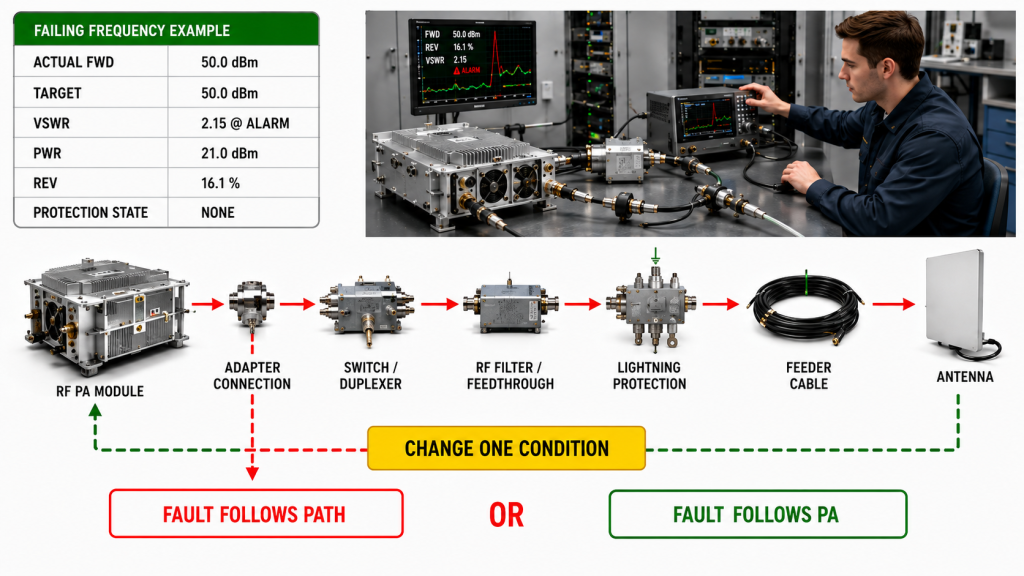
Record the exact frequency, actual Pin, corrected FWD, REV, resulting VSWR, voltage at the PA, current, duty cycle, operating duration, and protection state.
Do not rely only on a report that “one channel alarms.”
2. Confirm the Measurement Reference Plane
Identify whether the reported data applies at the PA output, cabinet port, feeder input, or antenna input.
Confirm which cables, couplers, adapters, calibration data, and correction values are included.
3. Repeat the Failing Point on the Verified Load
Repeat the failing frequency on the verified dummy-load boundary described in Section 2.
If abnormal REV remains, inspect the PA-side measurement boundary and module output path.
If it disappears, continue through the installed RF path.
4. Verify Actual Pin and Voltage at the PA
The signal-generator setting is not always the power reaching the PA.
Cables, attenuators, switches, adapters, or driver stages can change actual Pin by frequency.
The power-supply display also does not prove that the same voltage reaches the PA under RF load. Measure voltage at the module input while output is being produced.
5. Compare the Failing Frequency with a Passing Frequency
Record powered FWD and REV, with the resulting VSWR, at:
- the failing frequency;
- at least one passing frequency;
- a nearby frequency where useful.
This comparison can reveal whether the change follows the antenna, feeder, filter transition, connector stack, PA band edge, or protection threshold.
6. Remove or Bypass One Path Element at a Time
Where the system design and safety conditions allow, isolate one component or path section at a time.
Possible boundaries include adapters, filters, switches, couplers, lightning protection, feeder sections, and the antenna assembly.
Change only one condition per test. Otherwise, the team cannot identify which action corrected the mismatch.
7. Check Whether the Fault Follows the PA or the Path
Where two equivalent channels are available, a controlled swap may help isolate the fault.
Keep frequency, Pin, supply, cooling, and load boundaries consistent.
A fault that remains with the installed path points away from the PA. A fault that follows the same PA under a controlled boundary requires further module-side investigation.
8. Review Alarm Validity, Threshold, and Recovery
Confirm whether the event is:
- a warning;
- power foldback;
- shutdown;
- a sensor or reporting error.
The review should include the REV or VSWR threshold, operating FWD level, action taken by the PA, and recovery behavior after the mismatch is removed.
Also confirm whether VSWR is considered valid only above a defined minimum forward-power level.
At very low FWD, sensor resolution and noise can make the calculated ratio unstable. The alarm logic may therefore require a forward-power qualification, a minimum valid measurement level, or a separate absolute REV limit.
Record whether the alarm is instantaneous or requires a defined persistence time, debounce period, or hysteresis before foldback or shutdown.
Repeated high-reflection exposure, installation errors, and protection behavior should also be reviewed as part of the wider RF PA VSWR field-failure risk.
A one-frequency alarm should not trigger PA replacement until the fault boundary has been demonstrated.
6. What Evidence Should Be Required Before Approval
A statement such as “VSWR passed” is not enough for a multi-frequency RF PA system.
The evidence should compare the failing frequency with at least one passing frequency and, where useful, a nearby point or relevant band edge.
For each tested frequency, record:
- actual Pin at the PA;
- powered FWD and REV at the defined reference plane;
- resulting VSWR;
- voltage and current at the PA;
- RF load;
- path configuration;
- calibrated measurement chain and applied corrections;
- protection threshold and response;
- pass-or-fail conclusion.
Low-power S11 or return-loss data may also be included, but it should be identified separately from powered FWD and REV results.
Define the Acceptance Boundary Before Testing
The RFQ or test plan should identify:
- target and edge frequencies;
- required operating output;
- PA-port or antenna-port reference plane;
- antenna model and installation;
- feeder type and length;
- filters, switches, connectors, adapters, and lightning protection;
- required low-power and powered mismatch evidence;
- alarm qualification and protection response;
- dummy-load and installed-path comparison requirement.
The supplier and integrator should agree on these conditions before testing begins.
Where alarm records form part of acceptance, documented VSWR alarm thresholds should match the tested forward power, reflected-power boundary, minimum valid FWD level, persistence condition, and protection action.
Conclusion
Frequency-specific VSWR means that one passing frequency cannot approve the complete installed RF path.
The diagnosis should reproduce the failing frequency, define the reference plane, establish the PA baseline on a verified load, confirm the reverse-power measurement floor, and isolate the installed path one section at a time.
The evidence must separate low-power S11 or return loss from powered FWD and REV data. It must also show whether the fault follows the PA, the measurement boundary, or the installed RF path.
Send the passing and failing frequencies, actual Pin, operating output, reference plane, antenna and feeder configuration, powered FWD and REV data, alarm threshold, and protection response.
RF SKYPOWER’s engineering team can review the fault boundary before module replacement, sample approval, or field acceptance.