
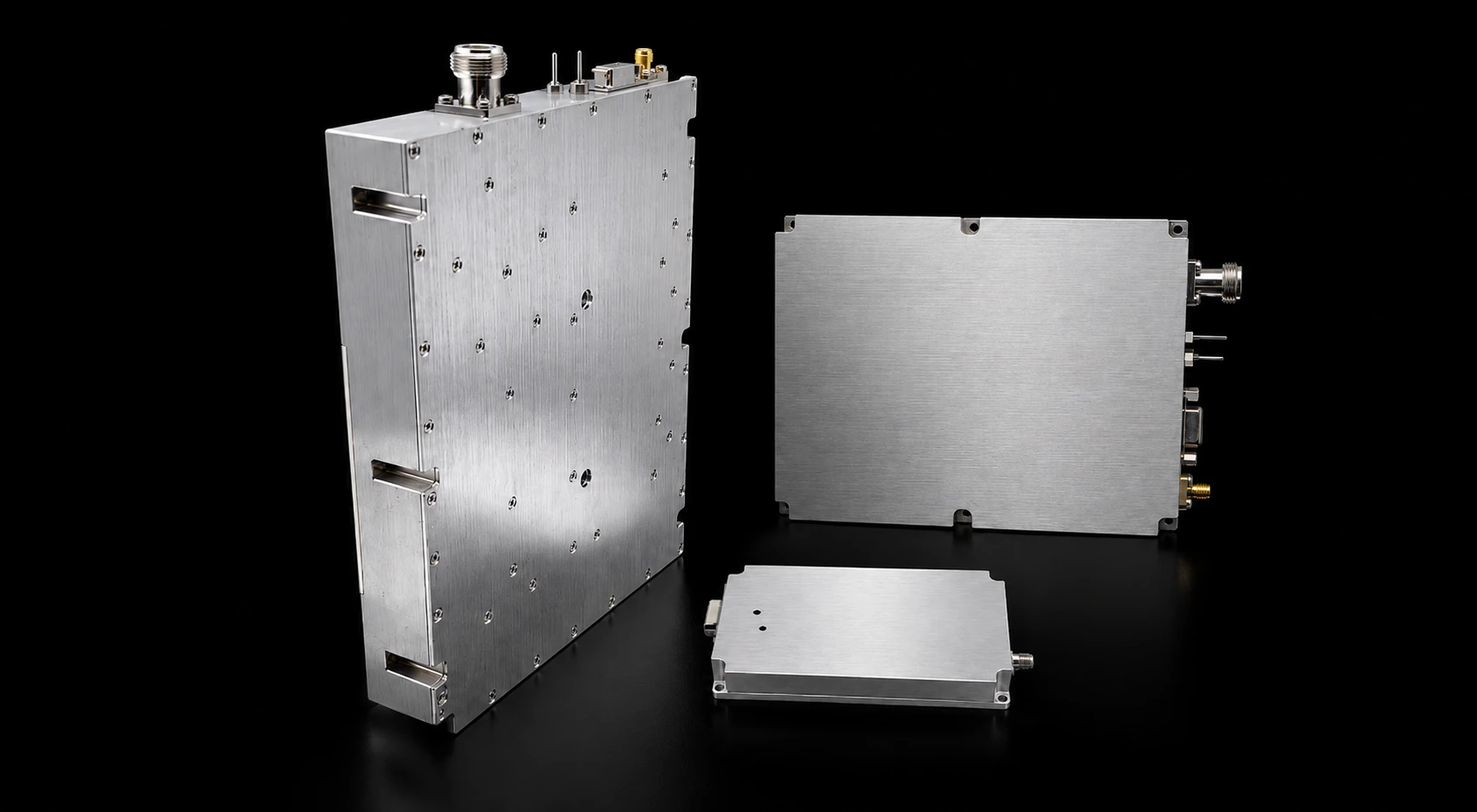
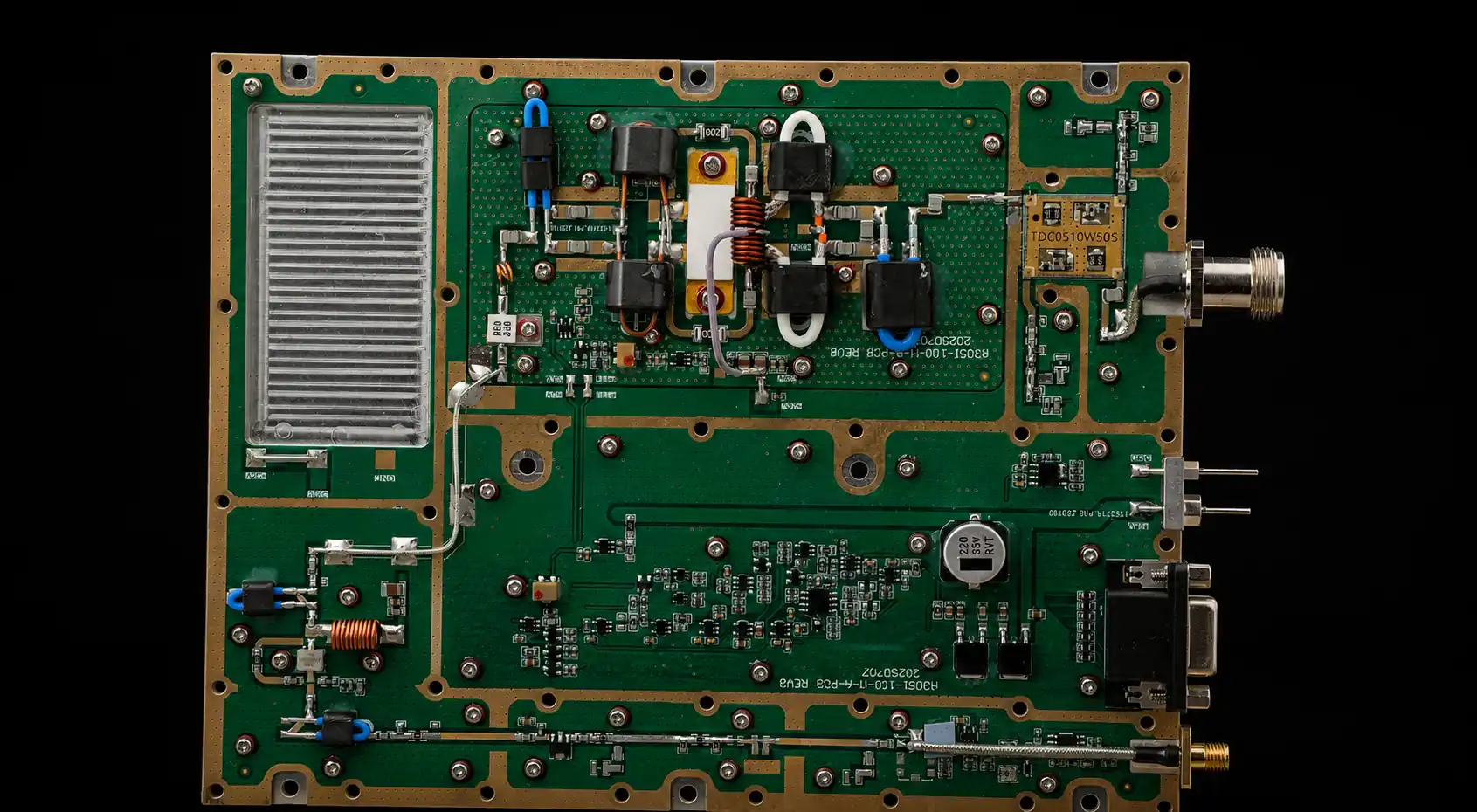
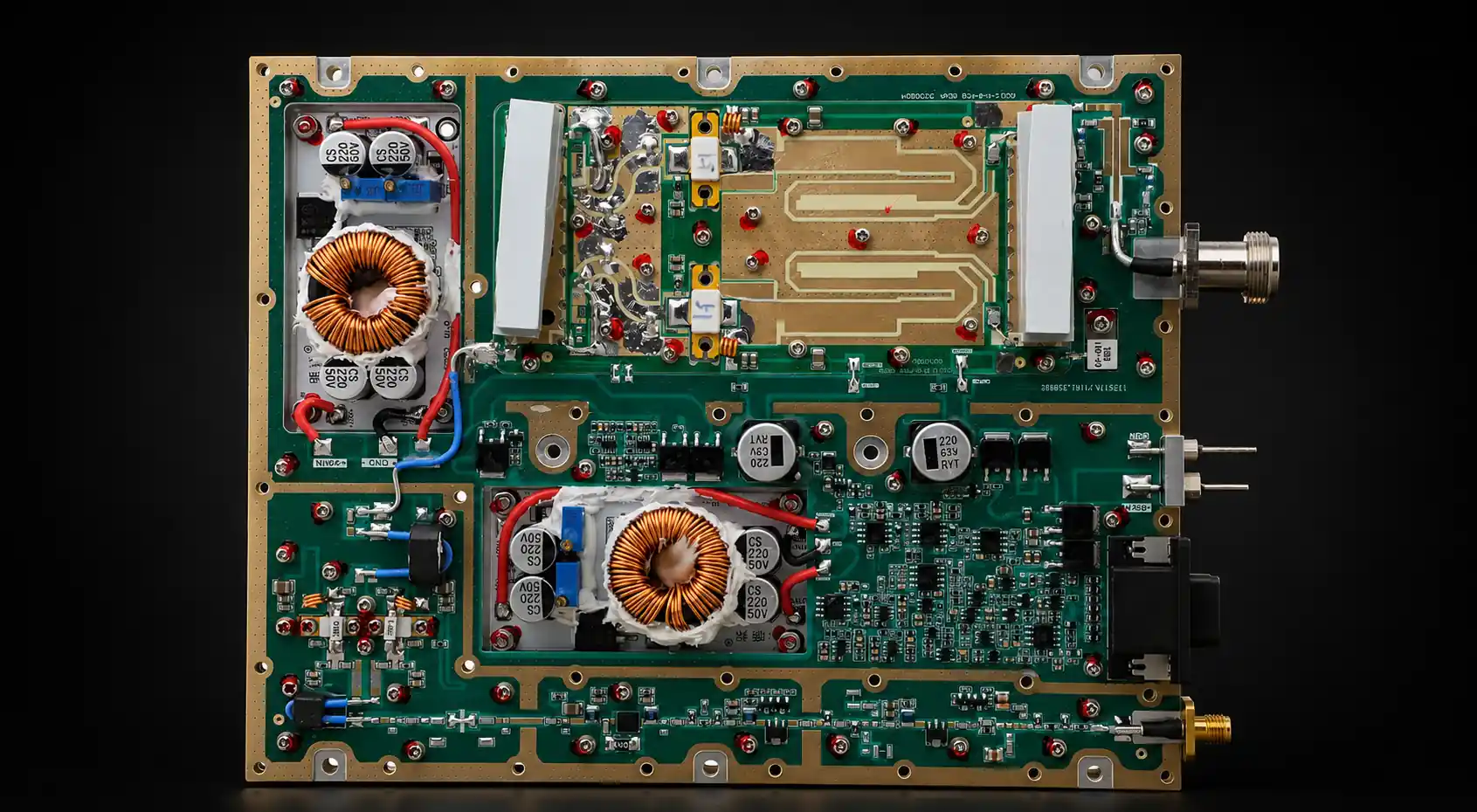
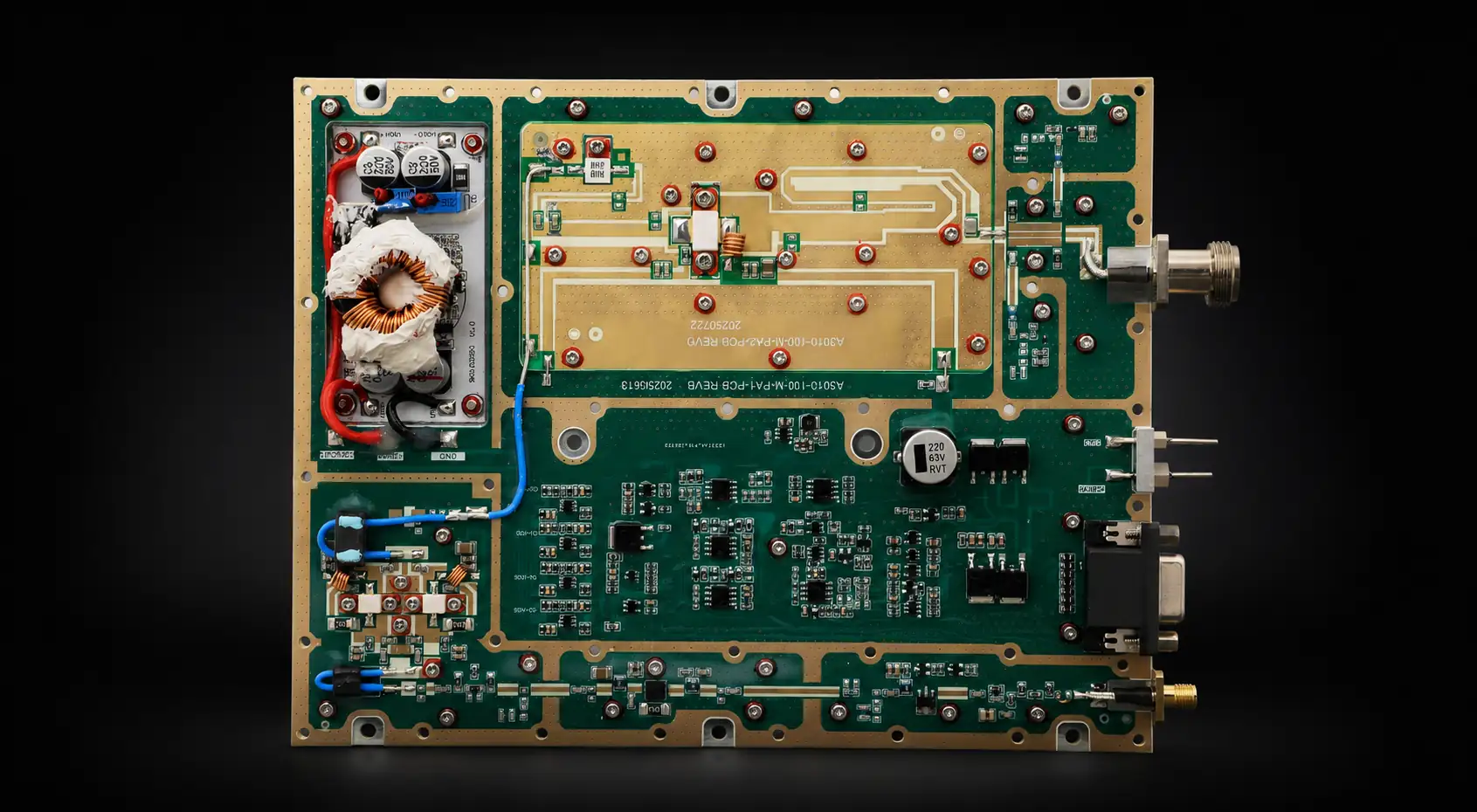
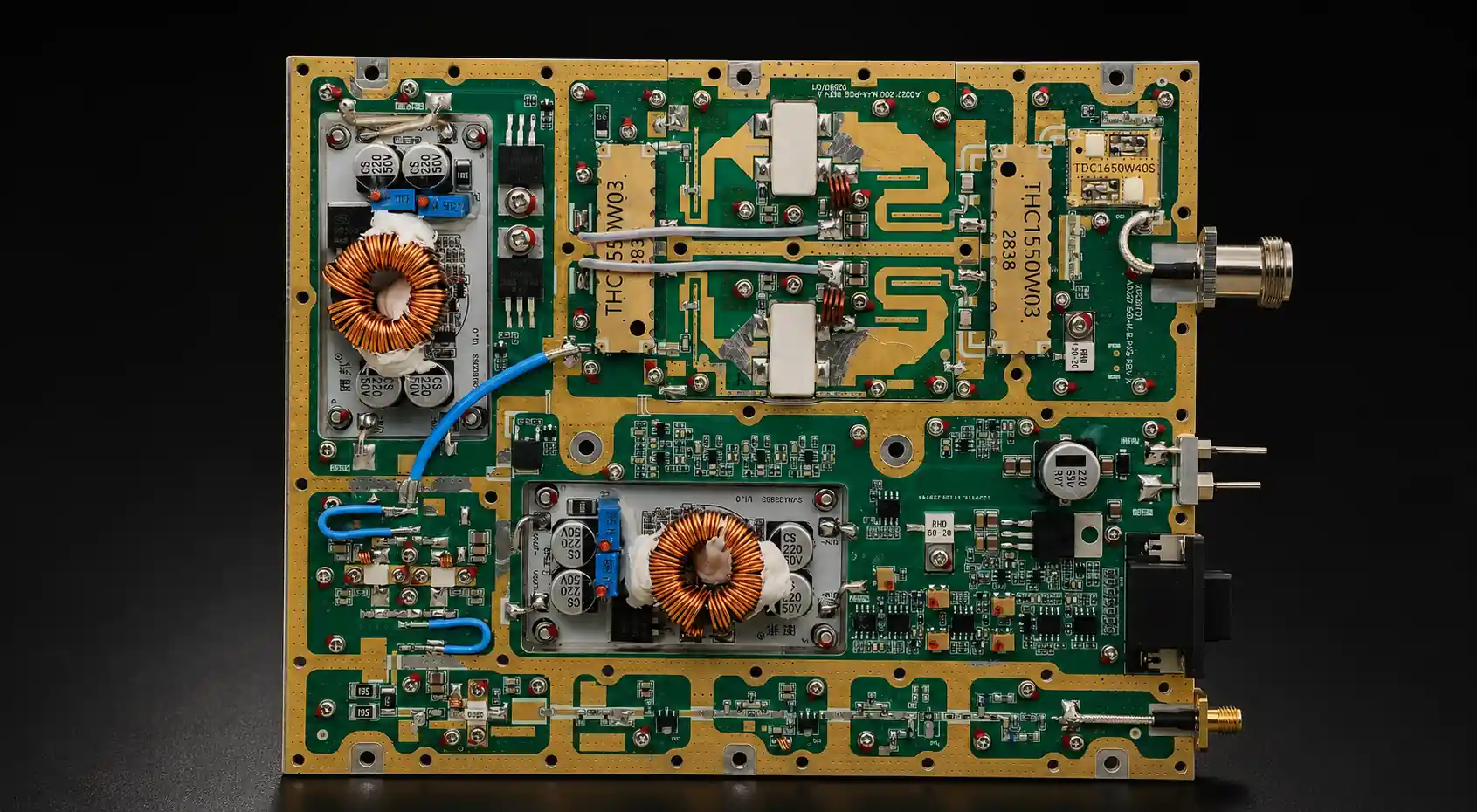
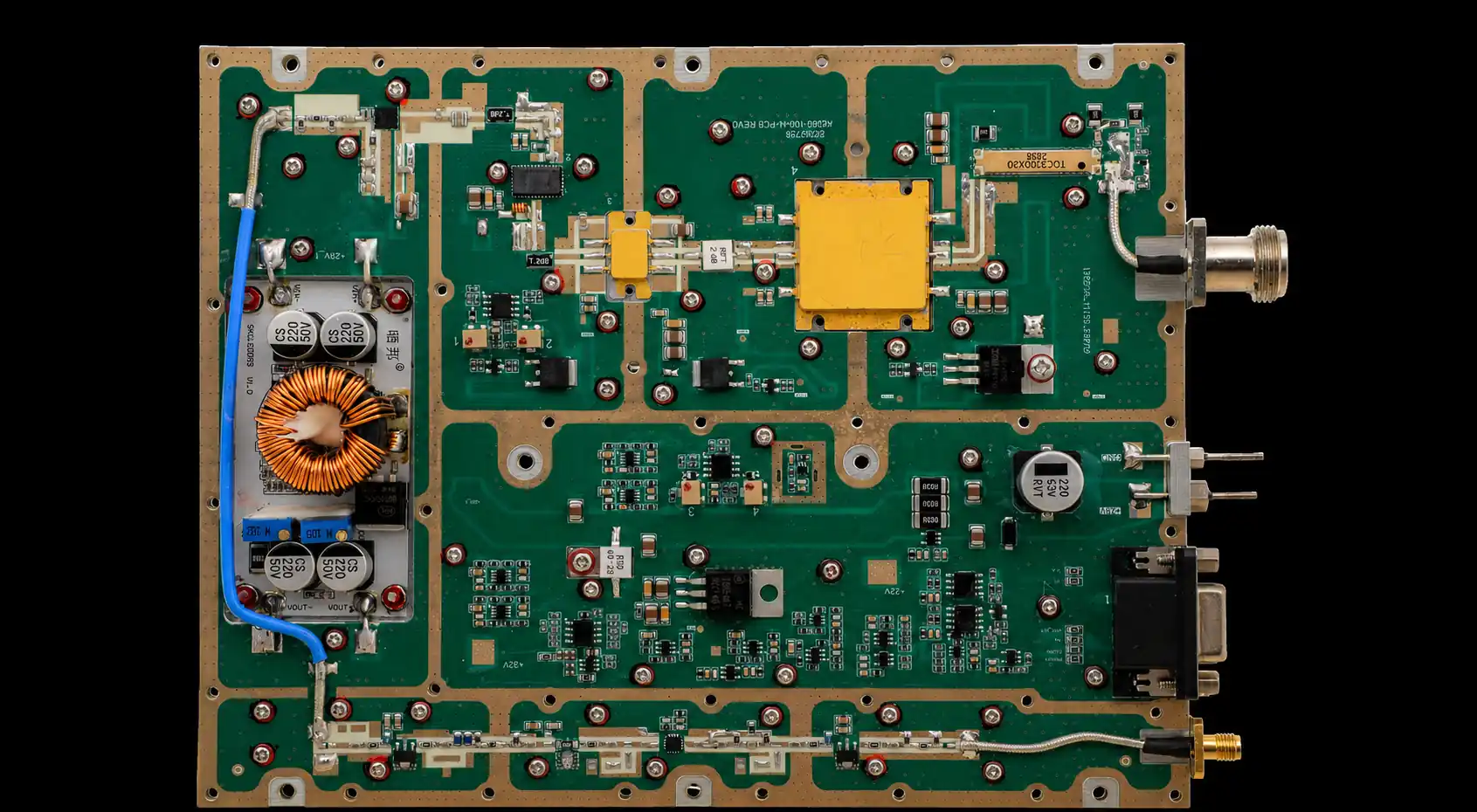

An RF PA frequency range can look fully qualified at room temperature—and still fall below the required output at the exact frequency the project depends on after heat builds.
The center frequency may remain stable. A band-edge or project-critical point may not. Even a clean cold-state sweep can hide which frequency loses margin first, whether the change comes from the PA, the DC supply, the RF path, the load, or protection foldback.
That creates a dangerous approval gap. The module appears to cover the required band, but the available evidence may not show which frequencies still meet the target output after thermal stabilization.
RF Power Amplifier Modules should therefore be reviewed at the frequencies the project will actually use—not only at the easiest point on the datasheet or test curve.
Before approving the PA, the project must answer one question:
Which required frequency loses usable margin first after heat builds—and what evidence proves why?
1. Why Heat Changes RF PA Margin Unevenly Across the Band
As device temperature rises, several operating conditions may change:
- active-device gain;
- bias behavior;
- internal matching;
- conductor and matching-network loss;
- efficiency;
- current demand;
- compression behavior;
- reflected-power sensitivity;
- thermal and VSWR protection margin.
These changes do not act on a perfectly flat amplifier.
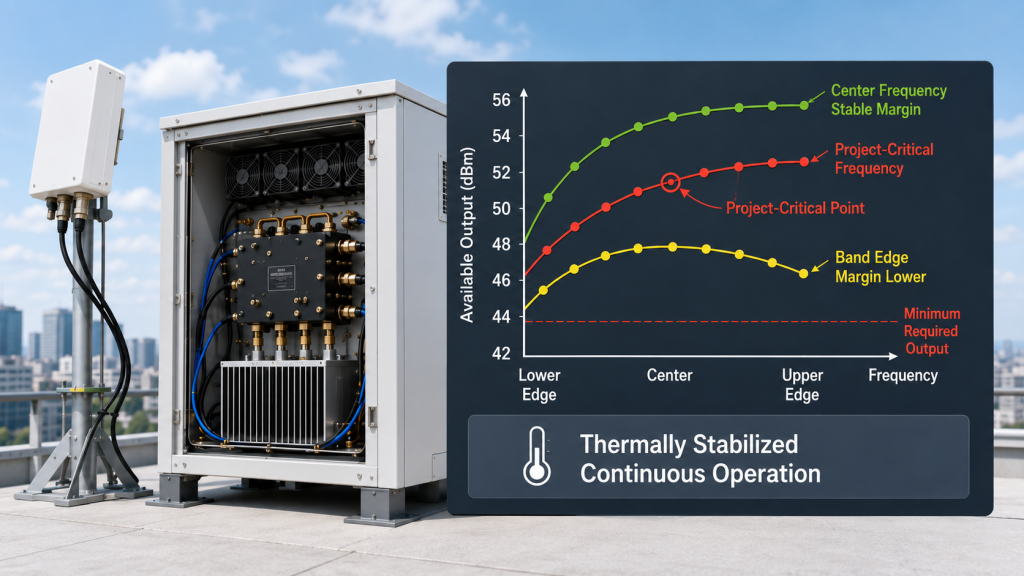
Each frequency begins with its own combination of gain, matching, efficiency, output, and protection margin. A center frequency may have more available margin than a lower band edge, upper band edge, or project-specific point.
The same thermal change can therefore produce different results across the band.
At one frequency, output may remain almost unchanged. At another, the PA may require more input power, draw more current, or deliver less stabilized output. A third point may approach protection foldback sooner under the same load.
This frequency-dependent behavior is the central risk.
Published Coverage Does Not Prove Equal Hot-State Margin
A datasheet frequency range shows where the PA is designed to operate under stated conditions. It does not prove that every point inside that range provides identical performance during continuous operation.
For each required frequency, the project may need to confirm:
- stabilized RF output;
- gain;
- actual input power;
- voltage measured at the PA input;
- operating current;
- case or baseplate temperature;
- reflected power or VSWR;
- protection status;
- cooling condition;
- operating duration.
Heat must also leave through the complete thermal path.
That path may include the device package, copper base, thermal interface, module baseplate, heatsink, airflow, and surrounding cabinet. A weakness in any part of the path can increase stabilized temperature and reduce the RF margin that remains available.
For cabinet-level review, RF PA efficiency and heat generation should be considered together with RF output, current, duty cycle, airflow, and operating duration.
“PA Temperature” Must Refer to a Real Measurement Point
Temperature data has little value unless the measurement point is identified.
A test report may refer to:
- chamber or ambient temperature;
- cabinet inlet temperature;
- heatsink temperature;
- PA case temperature;
- PA baseplate temperature.
These values are related, but they are not interchangeable.
Device junction temperature is also not normally measured directly during a standard module test. Case, baseplate, heatsink, and ambient readings should not be described as junction temperature.
The test record should state:
- which temperature was measured;
- where the sensor was placed;
- when the value was recorded;
- how thermal stability was judged.
Hot-state data should be recorded only after the defined temperature point and RF output have reached a stable condition.
Without this boundary, two tests described as “hot-state” may represent very different operating conditions.
2. Which Frequency Points Need Hot-State Verification
Testing every possible frequency may not be necessary. Testing only one center frequency is often not enough.
The test plan should reflect the project band plan and the available margin at each important point.
At minimum, consider:
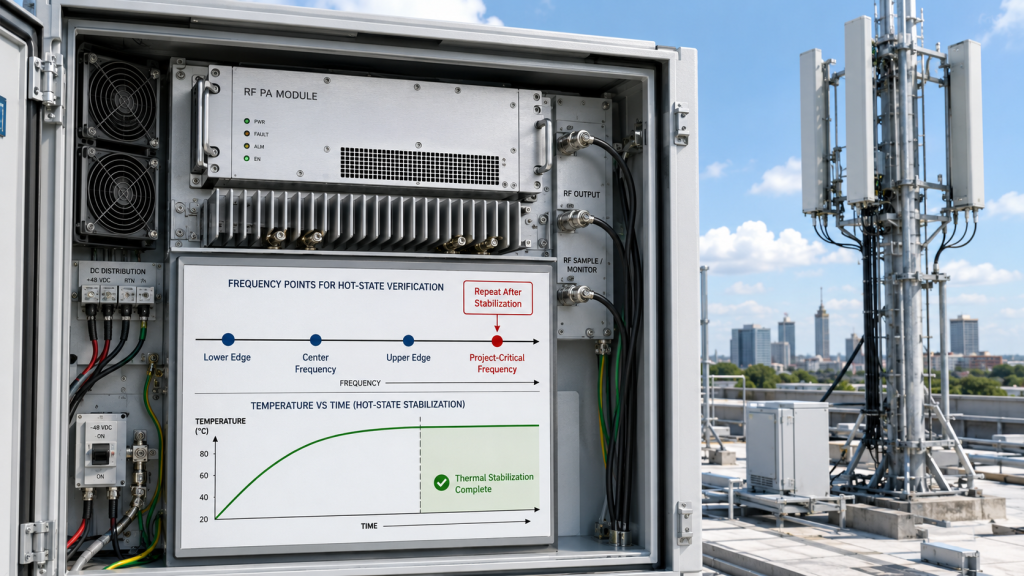
Why Band Edges Often Need More Attention
Band-edge frequencies may begin with less gain, output, matching, or efficiency margin than the center of the band.
A smaller cold-state margin gives temperature less room to act before the project limit is reached.
Possible hot-state symptoms include:
- lower stabilized output;
- higher required input power;
- increased current;
- greater gain variation;
- greater reflected-power sensitivity;
- earlier protection intervention.
These symptoms do not prove that every band edge is weak. They show why center-frequency data should not be used to approve a required edge frequency.
When a project depends on a point close to the rated limit, band-edge output behavior should be reviewed together with Pin, Pout, Vdc, Idc, temperature, RF load, and the output reference plane.
Project Frequencies Matter More Than a Neat Sweep Pattern
An evenly spaced sweep is useful for showing the general band response. It may still miss the points that carry the greatest project risk.
A critical frequency may be:
- close to a band edge;
- close to a local gain dip;
- assigned a tighter output limit;
- operated for longer periods;
- connected to a higher-loss RF path;
- exposed to a more difficult antenna match.
The final test plan should combine general band coverage with the frequencies the project will actually use.
Scan Order Can Distort the Comparison
A swept test has a thermal history.
When the sweep begins at the lower band edge, the PA may be cooler at the first point than at the last. Reversing the sweep may change the apparent frequency response even when the hardware remains the same.
The test record should identify:
- scan direction;
- frequency order;
- dwell time;
- measurement timing;
- stabilization method;
- separately repeated critical points.
A difference caused by test sequence should not be reported as a frequency-specific weakness.
For important frequencies, a separate stabilized measurement is often more useful than relying only on one continuous sweep.
3. How to Separate PA Thermal Drift from Supply, RF-Path, and VSWR Effects
A hot-state output drop does not automatically prove that the PA module is responsible.
Similar symptoms can be caused by:
- thermal drift inside the PA;
- inadequate cooling;
- reduced input drive;
- DC voltage drop;
- feeder or connector loss;
- antenna mismatch;
- increased reflected power;
- protection foldback;
- incorrect path correction;
- a changed measurement reference plane.
The test should separate these causes before a corrective action is selected.
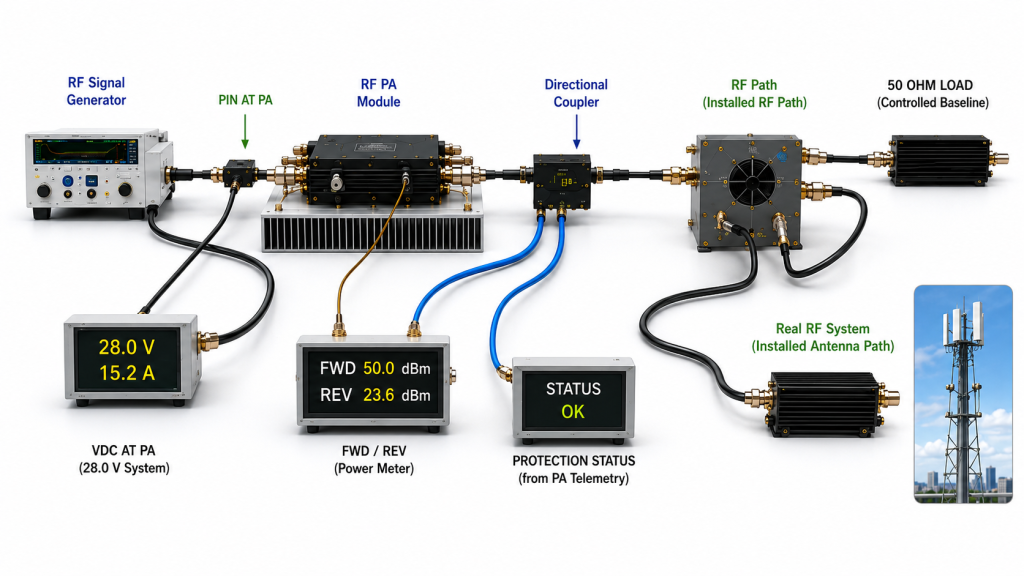
Measure Pin at the PA Input
The signal generator setting is not always the power reaching the PA.
Cables, adapters, switches, attenuators, driver stages, and connectors can change the actual input level. Some of these losses may also vary by frequency.
The report should therefore record actual Pin at the PA input reference plane.
Without this measurement, a lower Pout may be incorrectly blamed on temperature when the amplifier received less drive.
Measure Voltage at the PA During RF Operation
A power supply display does not prove that the same voltage reaches the module.
High current can create voltage loss through:
- supply cables;
- connectors;
- relays;
- fuses;
- distribution boards;
- internal harnesses.
The useful value is the voltage measured at the PA input while RF power is being produced.
A supply-path voltage drop may reduce output or change current behavior. It may become more visible at frequencies where the amplifier already has less gain or efficiency margin.
Equal Pin Does Not Guarantee Equal Compression
Using the same Pin at every frequency improves comparability. It does not guarantee that the PA operates at the same compression level across the band.
At one frequency, the PA may remain below compression. At another, the same Pin may place it close to saturation, current limiting, or protection foldback.
The report should record both Pin and Pout.
It should also compare current, temperature, reflected power, and protection status. These values help explain whether output changed because of normal gain variation, thermal drift, compression, supply limitation, or protection action.
A gradual reduction may indicate gain or thermal drift.
A sudden or controlled reduction may suggest protection foldback. This conclusion should be checked against alarm status, current, temperature, VSWR, and recovery behavior.
Establish the PA Baseline Before Testing the Installed Path
A controlled 50 Ω load helps establish PA behavior at the module output.
If the PA remains stable on the controlled load but changes after the installed RF path is connected, the investigation should include:
- directional couplers;
- switches;
- filters;
- adapters;
- feeder cables;
- connectors;
- lightning protection;
- antennas.
Dummy-load and real-antenna testing serve different purposes.
The dummy load establishes a controlled PA-port baseline. The installed path shows how the complete RF chain behaves by frequency.
Results must also use a consistent reference plane. PA-port power and antenna-end power should not be compared without clearly stated path corrections.
4. What Cold-State and Hot-State Data Must Be Compared
Cold-state and hot-state results are useful only when they share the same test boundary.
The comparison should use the same:
- PA module and serial number;
- required frequency points;
- input waveform and bandwidth;
- actual Pin at the PA input;
- voltage at the PA input;
- RF load;
- duty cycle;
- cooling configuration;
- measurement path;
- path corrections;
- output reference plane.
Where gain controls approval, hot-state gain acceptance must use the same required frequencies, measured Pin, output reference plane, waveform, load, PA-terminal voltage, cooling boundary, and measurement corrections in both states.
Hot-state data should be recorded only after the defined temperature point and RF output have stabilized.
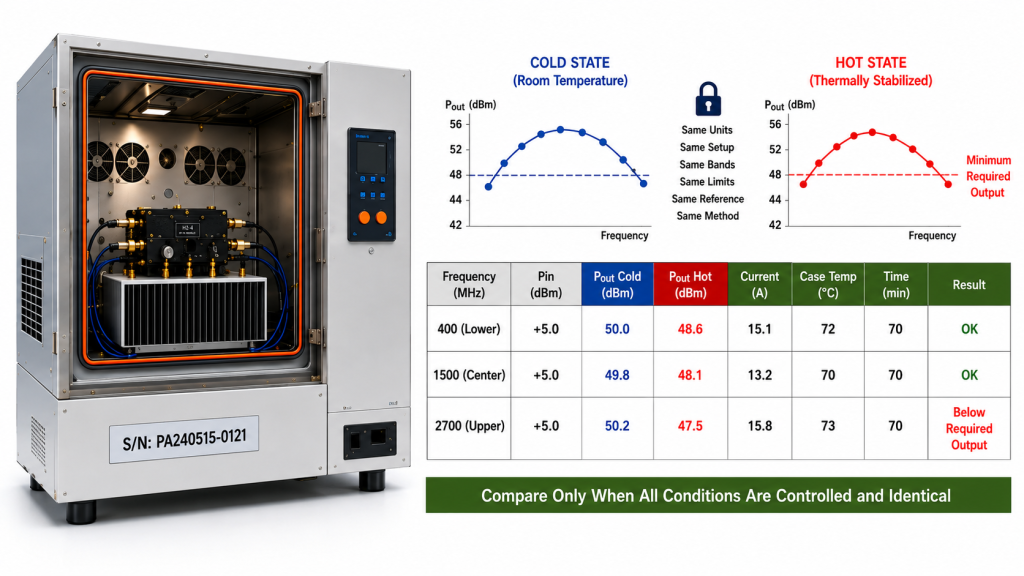
A short peak reading proves that the PA reached a value. It does not prove that the value can be maintained after heat builds.
A swept-frequency full-power RF PA test can show the general band response. Project-critical frequencies may still require separate stabilized measurements.
For each required frequency, the test record should show:
- actual Pin at the PA input;
- cold-state Pout;
- hot-state Pout;
- cold-state gain;
- hot-state gain;
- voltage and current at the PA during RF operation;
- the measured case or baseplate temperature;
- reflected power or VSWR;
- protection status;
- pass-or-fail conclusion.
The report should also identify the cooling condition, operating duration, scan order, dwell time, RF load, path corrections, and output reference plane.
Actual values matter more than statements such as “stable,” “normal,” or “passed.”
Measured data allows the reviewer to determine:
- which frequency is closest to the minimum output limit;
- whether current rises while output falls;
- whether gain changes before protection activates;
- whether reflected power changes at the same time;
- whether a reported hot-state result was recorded under a consistent test boundary.
A pass-or-fail conclusion remains necessary, but it should not replace the evidence behind the decision.
Where shipment-level evidence is required, the result should also be tied to the tested module serial number.
5. What the RFQ Should Define
A request that states only frequency range and wattage leaves the thermal test boundary incomplete.
For example, “2–6 GHz, 100 W” does not define:
- which frequencies require 100 W;
- whether the requirement applies after thermal stabilization;
- whether output is measured at the PA port or antenna end;
- what input drive is available;
- what voltage reaches the PA;
- what load and cooling conditions apply.
A practical RFQ should define the minimum conditions needed for a comparable test.
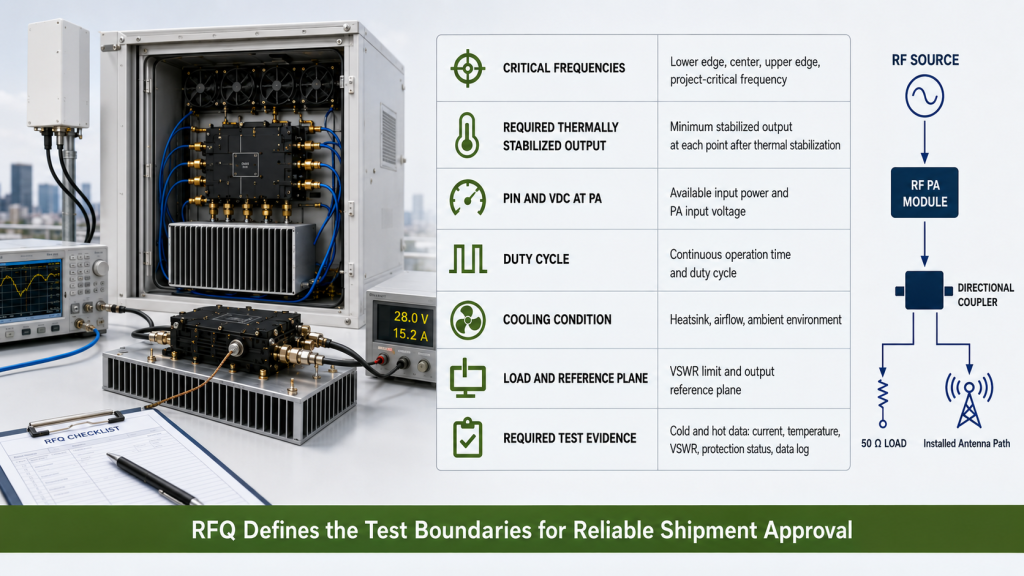
Minimum RFQ Checklist
- Required operating frequency range
- Project-critical frequency points
- Minimum stabilized output at each critical point
- Available Pin, input waveform or bandwidth, and voltage at the PA input
- Duty cycle and operating duration
- Ambient, cabinet, case, or baseplate temperature boundary
- Heatsink, airflow, or water-cooling condition
- RF load, VSWR limit, and output reference plane
- Required cold-state and hot-state evidence by frequency point
The supplier should then define the detailed test method, including:
- frequency order;
- dwell time;
- stabilization condition;
- measurement-path corrections;
- monitored protection states;
- report format;
- serial-number traceability where required.
A useful supplier response should not stop at confirming frequency coverage.
It should show how the required frequencies will be tested. It should also define the thermal, electrical, load, and measurement conditions used for acceptance.
Conclusion
A published RF PA frequency range does not prove equal hot-state margin at every required point.
Project approval should compare the lower band edge, center frequency, upper band edge, and project-critical frequencies under consistent electrical, thermal, load, and measurement conditions.
When output changes after heat builds, the evidence should separate PA thermal behavior from input-drive variation, voltage drop, RF-path loss, VSWR, compression, and protection foldback.
RF SKYPOWER can support early engineering review for standard and custom RF PA projects. Send the required frequencies, minimum stabilized output, Pin and DC conditions, waveform or bandwidth, duty cycle, thermal boundary, cooling method, load and VSWR limits, output reference plane, and required test evidence.