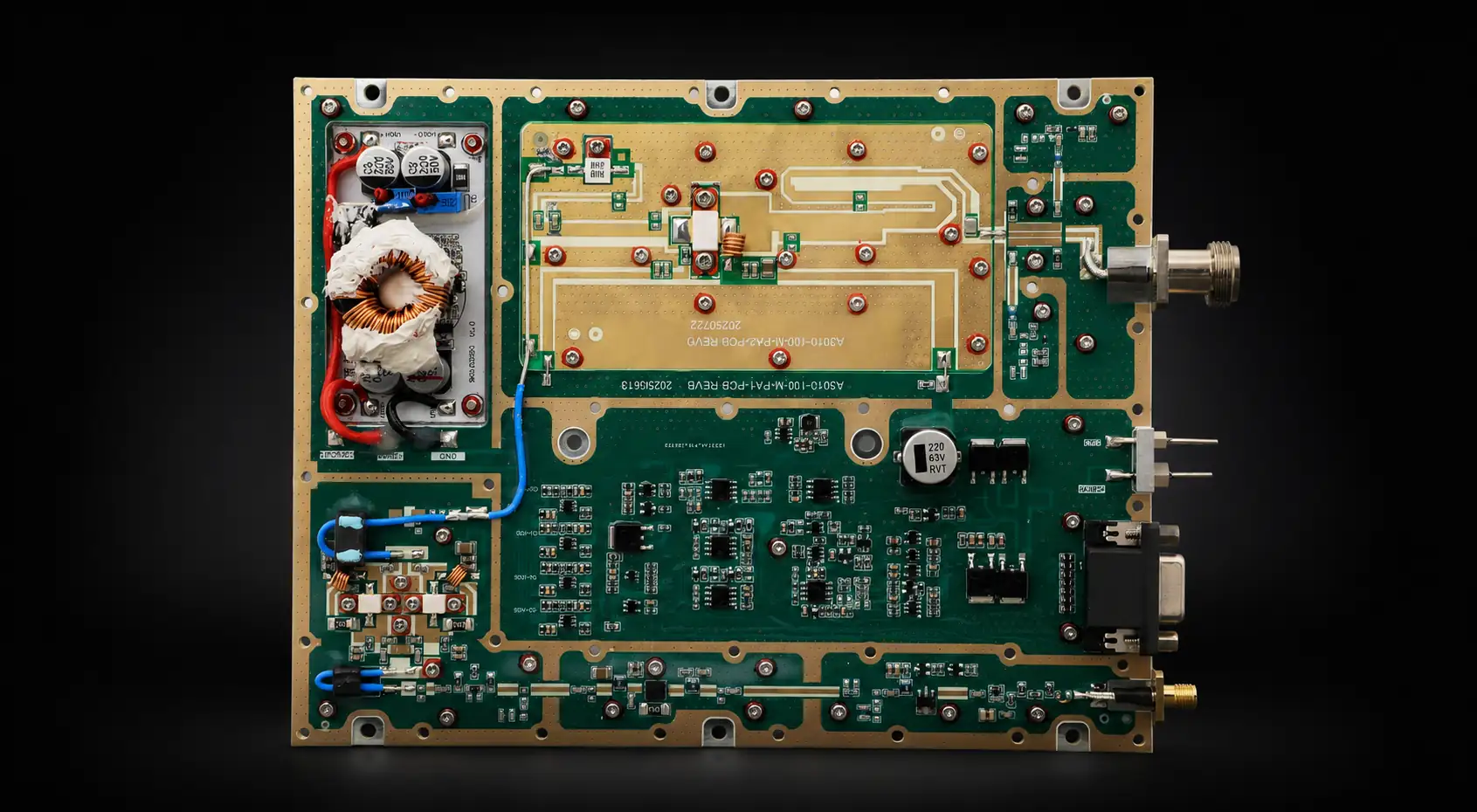
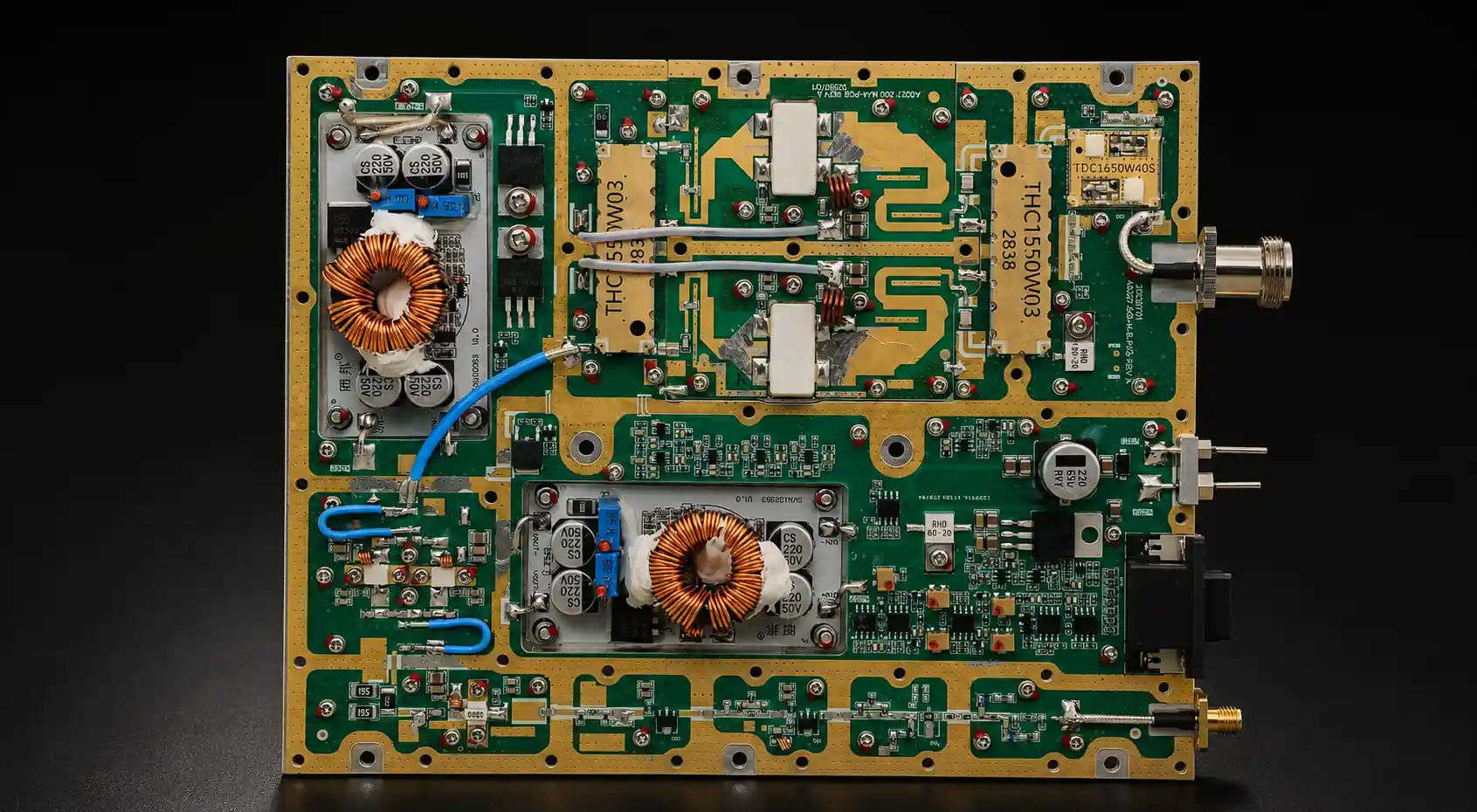
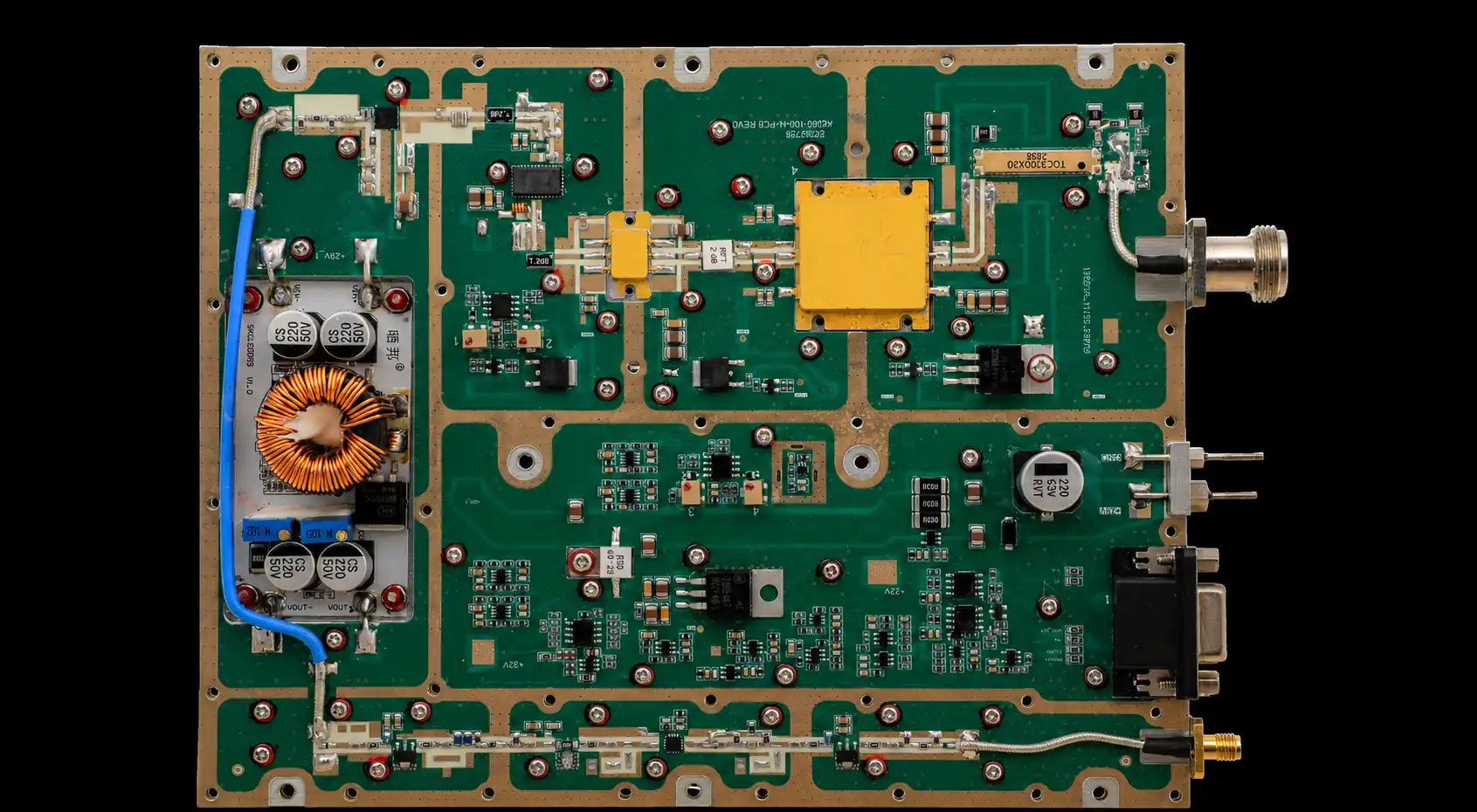

A supplier cannot substantiate a drone jammer module’s protocol coverage from a frequency-range specification alone. That specification identifies an RF hardware boundary under defined conditions. Claims about available waveforms, a named on-air protocol, or a complete system need evidence for the corresponding source, configuration, and evaluation scope.
When a quote lists “protocol support” beside a power amplifier’s frequency specification, ask what equipment is included and which part was evaluated.
1.What Does a Drone Jammer Module Frequency Range Actually Prove?
A published range first identifies which component the frequency rating applies to. Buyers then need the performance conditions behind that rating.
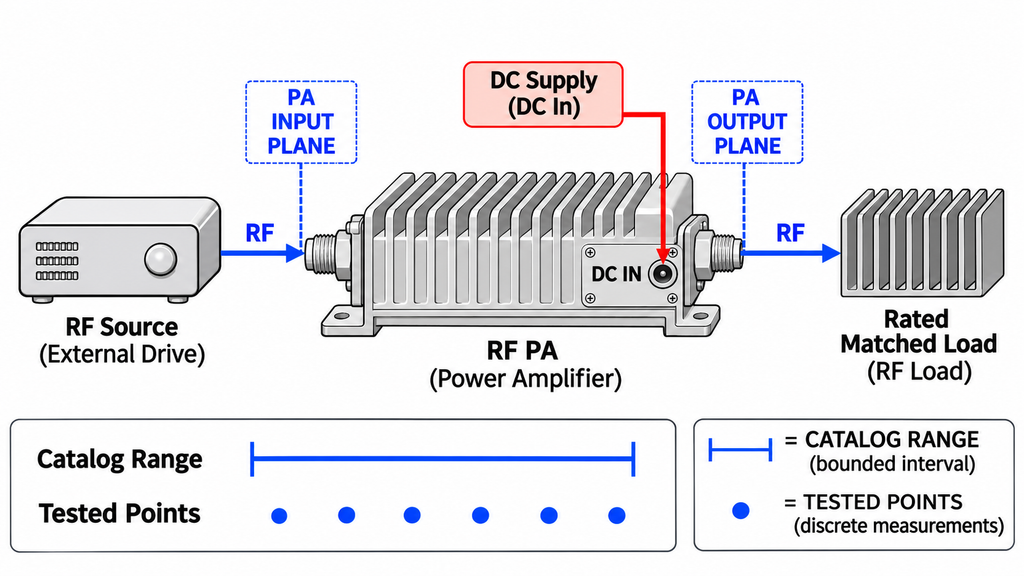
For an RF power amplifier module, the stated band identifies where the manufacturer specifies operation. The applicable rating or test record must establish whether output power, gain, or other limits hold across that band. A catalog range, results at selected test points, and a conditional full-band rating support different statements.
The reference plane matters as much as the frequency figures. RF output measured at the PA connector depends on actual drive at the PA input, load, supply, thermal state, and stated test conditions. It is not a measurement at an antenna port or for a complete assembly. An SDR source’s tuning range is likewise a hardware specification; waveform availability depends on its configuration and software or firmware revision.
A supplier may reasonably state “PA operation within the specified band, subject to the documented conditions.” The stronger statement “named protocol verified” requires an applicable source configuration and evaluation record. Buyers should keep those statements separate before comparing offers.
2.Is the Quoted Module a PA, a Signal Source, or an Integrated Assembly?
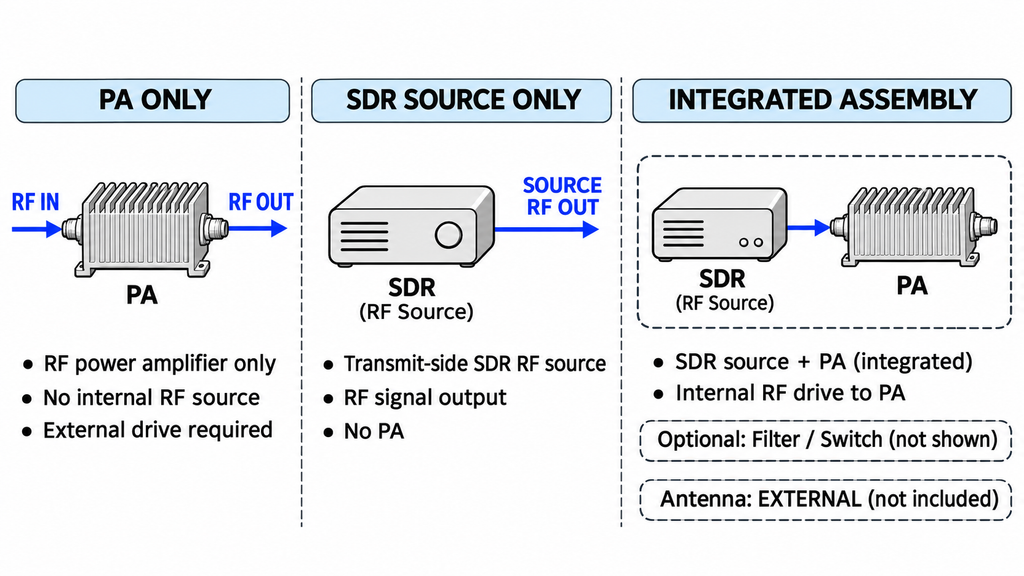
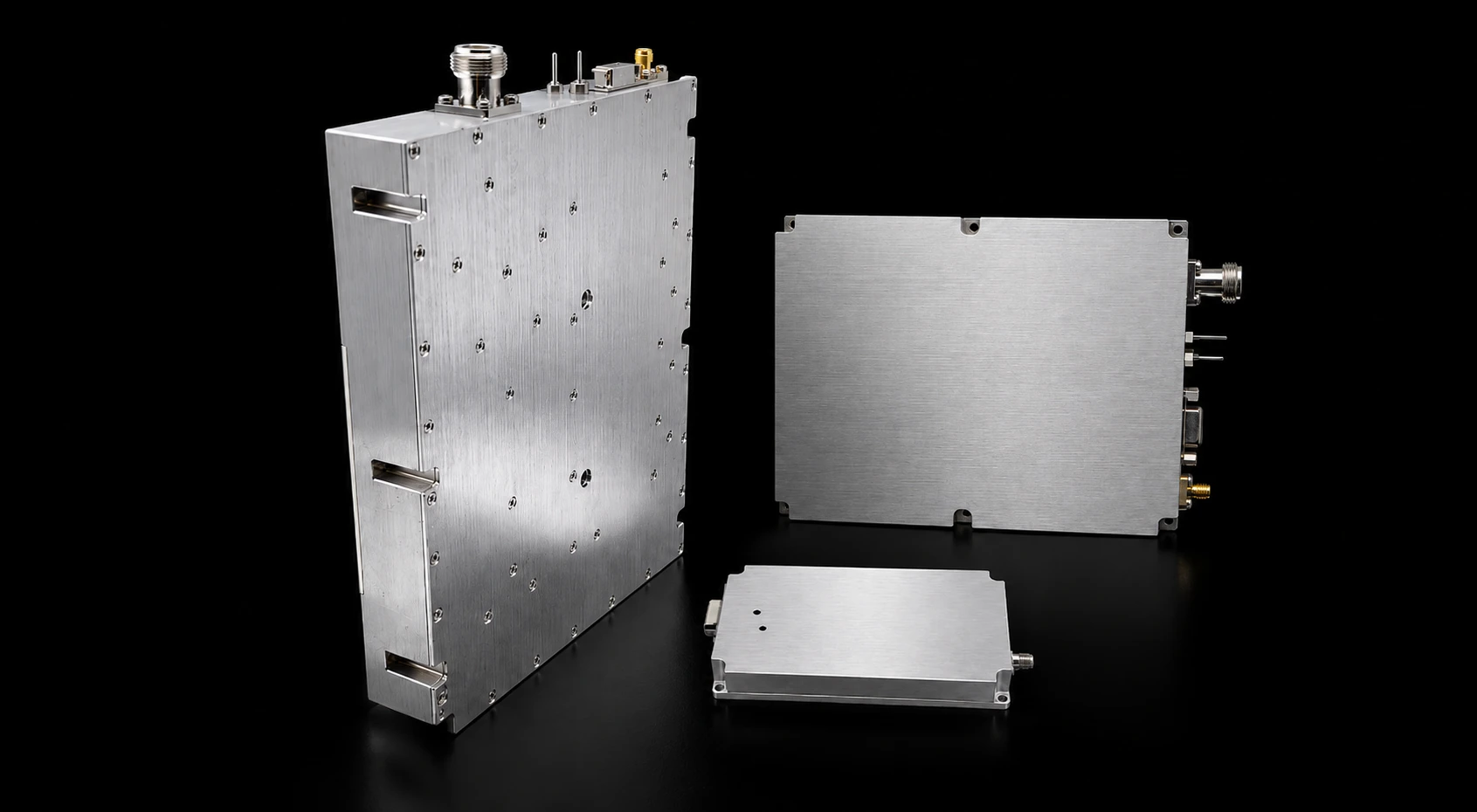
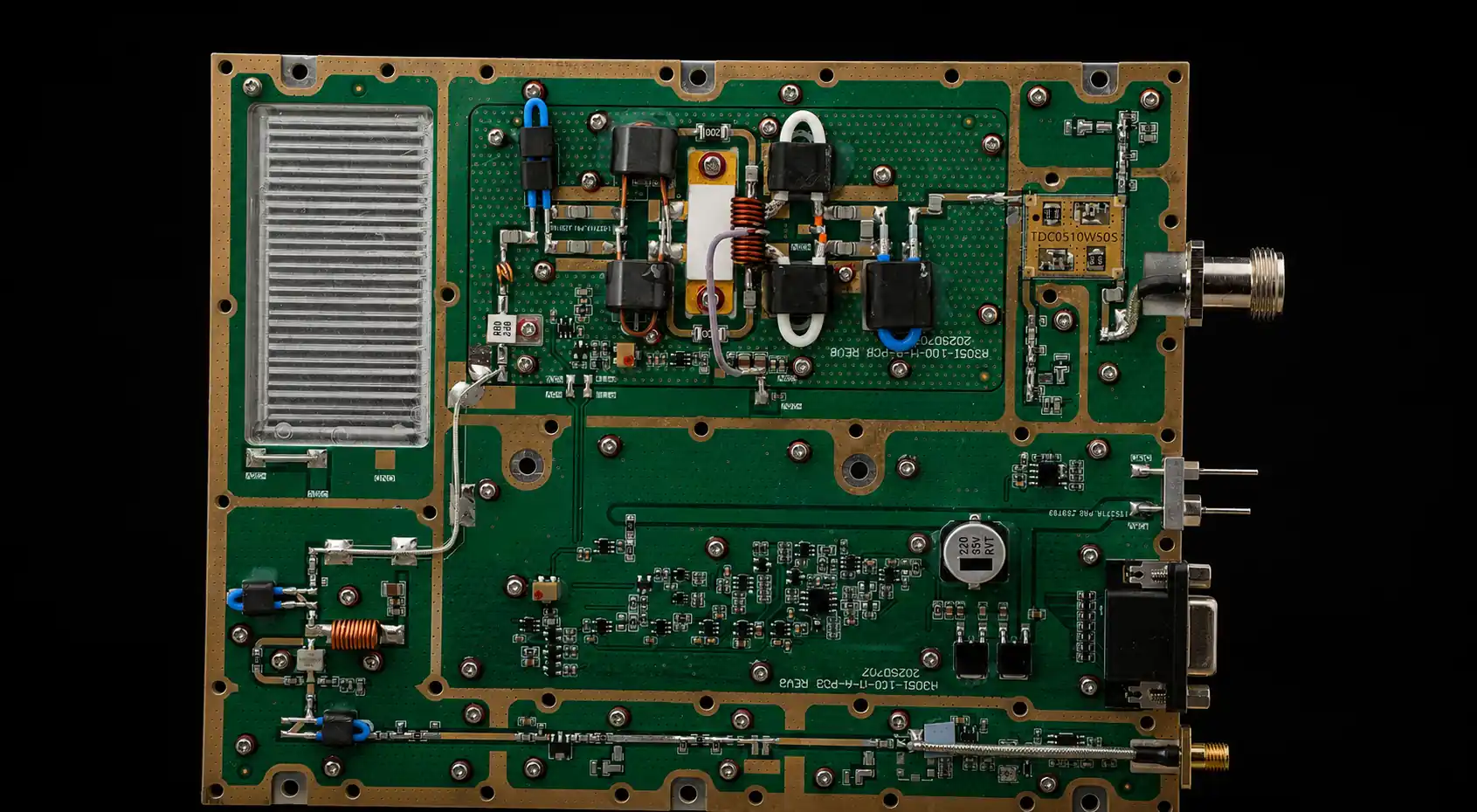
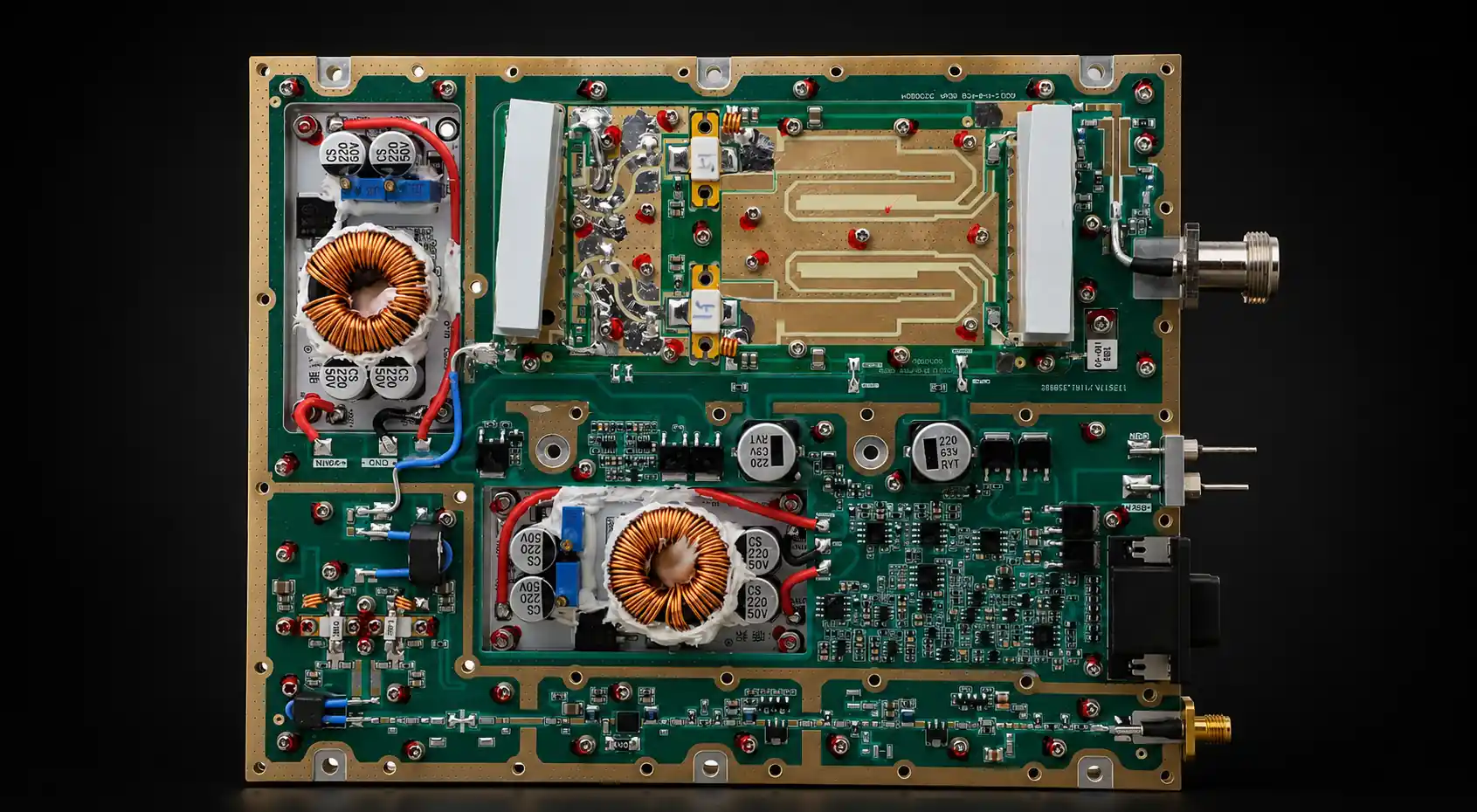
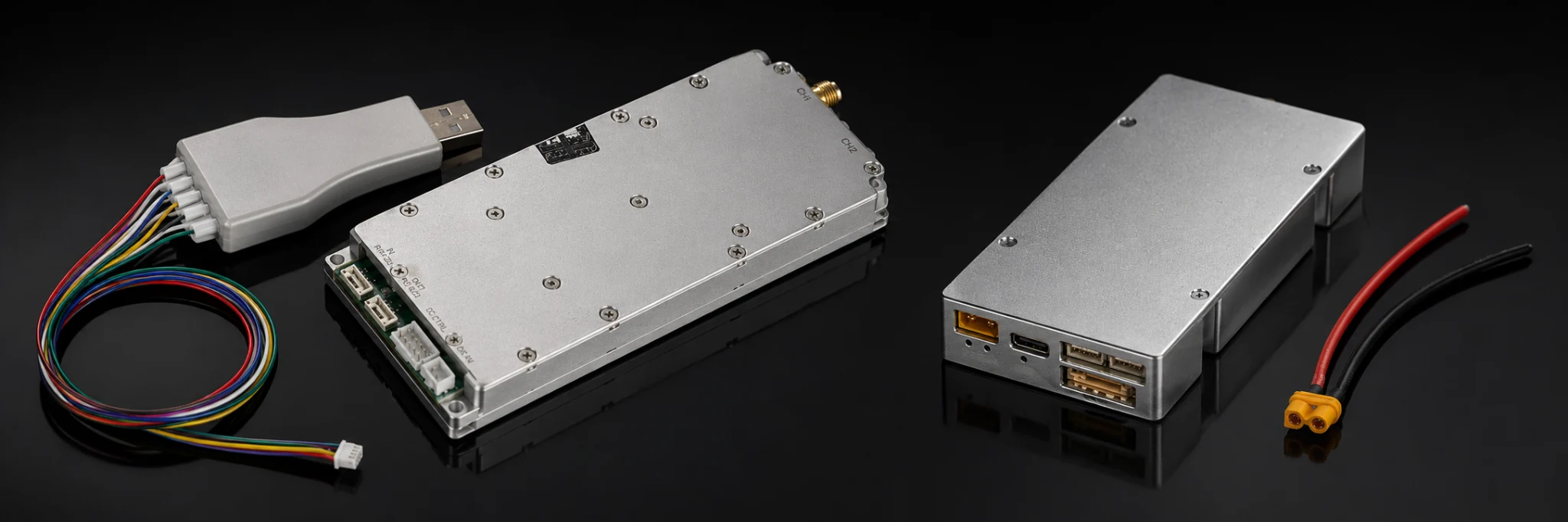
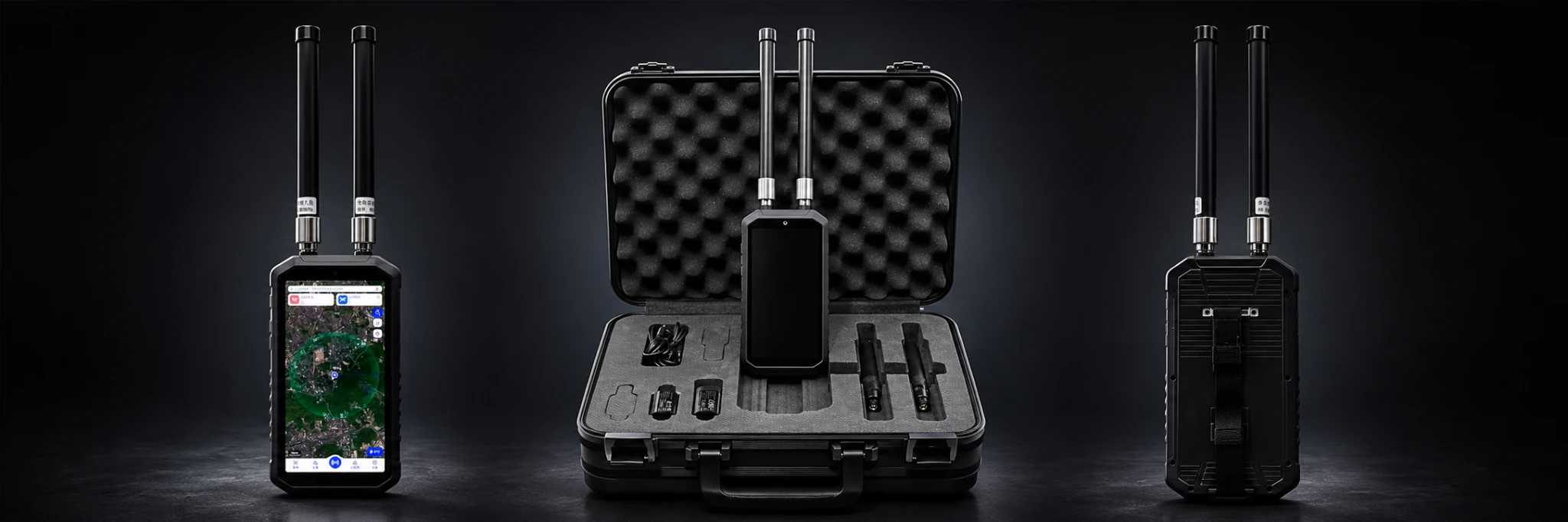
Suppliers use drone jammer module for different deliverables. A PA-only module amplifies an applied RF input within its specified conditions. A signal-source module provides source-side RF functions. An integrated assembly may include both, plus control, switching, or filtering functions.
A PA-only supplier may document amplifier performance without owning a waveform claim. A source supplier may document software-dependent functions without proving output at a downstream PA. An integrated supplier may supply more of the RF path, but its component records still do not establish system acceptance.
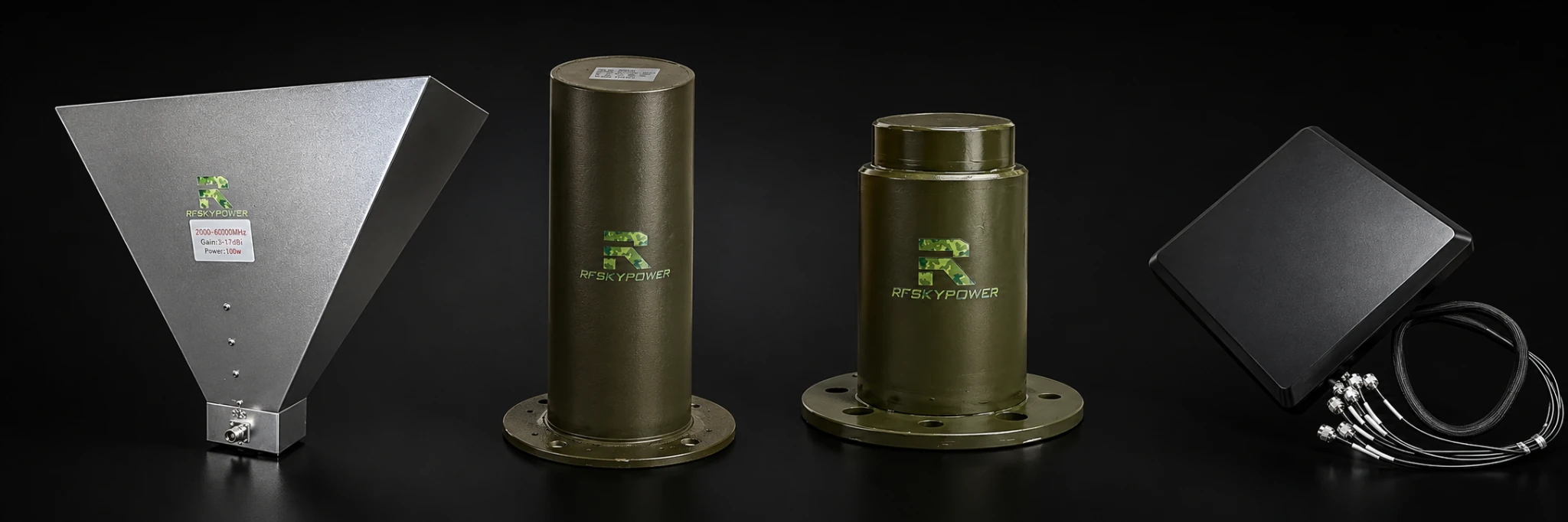
Ask for a clear statement of which source, PA, control, switching, filtering, RF output interface, and antenna-related items are included, optional, or external to the quoted unit. The antenna and any further RF path should not silently be treated as part of the tested module.
Two offers with the same label can cover different equipment. Establish the scope of the quoted drone jammer module before interpreting either supplier’s protocol claim.
3.What Does “Protocol Coverage” Mean in a Supplier Claim?
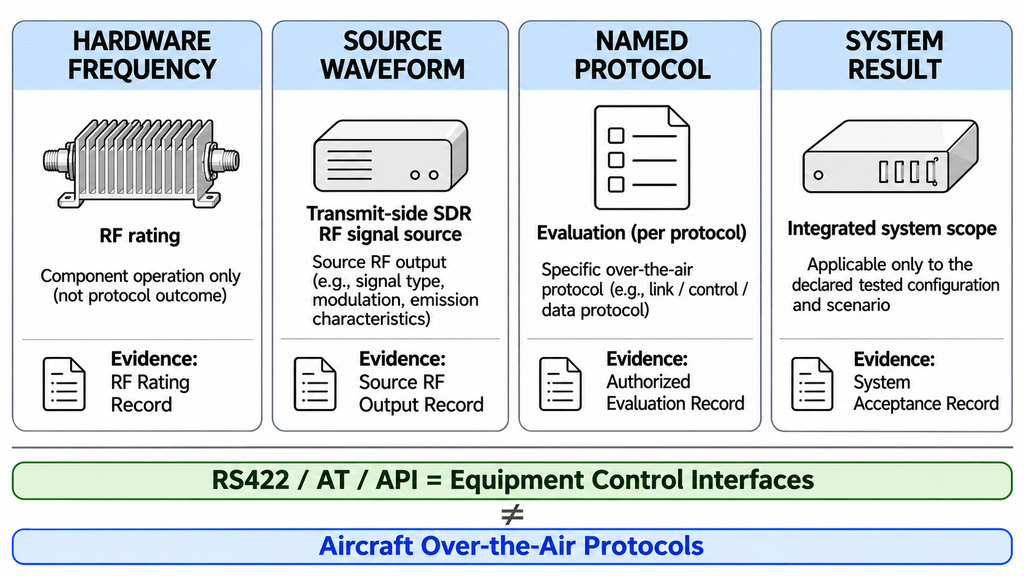
A supplier sheet may use protocol coverage for any of four different claims.
Hardware frequency capability. A component is rated or tested for an RF range under specified conditions. That supports a bounded hardware statement; frequency overlap with a communication link does not establish protocol behavior.
Source-side waveform capability. A specified signal source and software or firmware revision provide particular waveform-related functions at a defined RF output. A feature list may document availability within that configuration; a separate record is needed for any claimed effect on external equipment.
Named-protocol verification. The supplier must define the observable outcome behind a named on-air protocol claim. A lawfully authorized evaluation must test that outcome, with an identified object, configuration, method, acceptance criteria, conditions, and recorded result. A waveform option or RF spectrum image answers a narrower question.
Integrated system result. A result attributed to a complete system applies to the configuration, scenario, and conditions actually evaluated. It cannot be extended without evidence to different hardware revisions, installations, or operating environments.
RS422, AT commands, and an API may also appear under “supported protocols” in a supplier sheet. They describe equipment-control interfaces, not an aircraft’s over-the-air communication protocol. The supplier should name which meaning it intends.
For waveform capability, request records at the source’s physical RF output. The SDR source’s role in the RF chain is separate from PA input/output performance. The supplier should identify which claim level each document supports.
4.Which RF Chain Component Owns Each Part of the Claim?
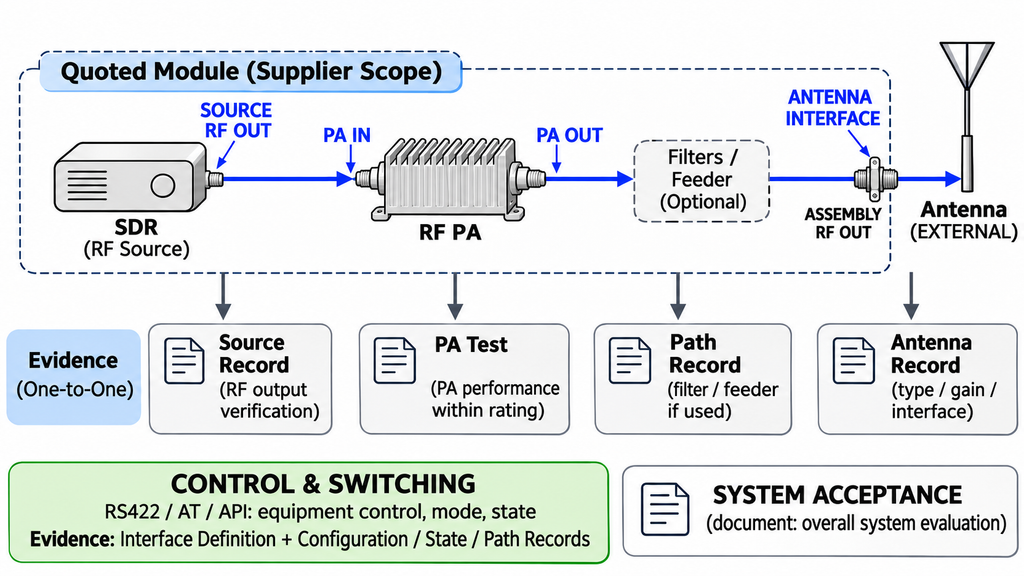
Once the claim level is clear, request evidence from the party responsible for that function. The matrix assigns each claim to a hardware or acceptance boundary.
| Function | Responsible Boundary | Evidence to Request | What It Cannot Prove Alone |
|---|---|---|---|
| SDR signal source | Waveform functions and physical source RF output for a specified configuration | Model, software/firmware revision, function scope, source-output records | Named-protocol outcome or system acceptance |
| RF power amplifier | Gain and RF output at the PA output plane for stated drive, load, supply, and thermal conditions | Ratings; tests identifying actual PA input/output planes and conditions | Waveform availability or protocol results |
| Control and switching | Interface functions, RF path selection, and reported states within the supplied unit | Interface definition, configuration and state/path records | Aircraft on-air protocol verification |
| Filters and feeder | RF path characteristics between defined reference planes | Path specification and applicable loss/response records | Protocol effects or output beyond the tested path |
| Antenna | Antenna interface and performance under defined installation or test conditions | Antenna specifications and supporting measurements with conditions | Named-protocol or complete-system results |
| Complete system and acceptance | System results for a declared configuration in authorized evaluation scenarios | Approved test plan, configuration, criteria, results, and sign-off | Untested revisions, scenarios, or installations |
A supplier may deliver several functions. The buyer still needs records for each claimed boundary, including a separate acceptance record when the claim concerns the integrated system.
5.What Evidence Can Support a Named-Protocol Claim?
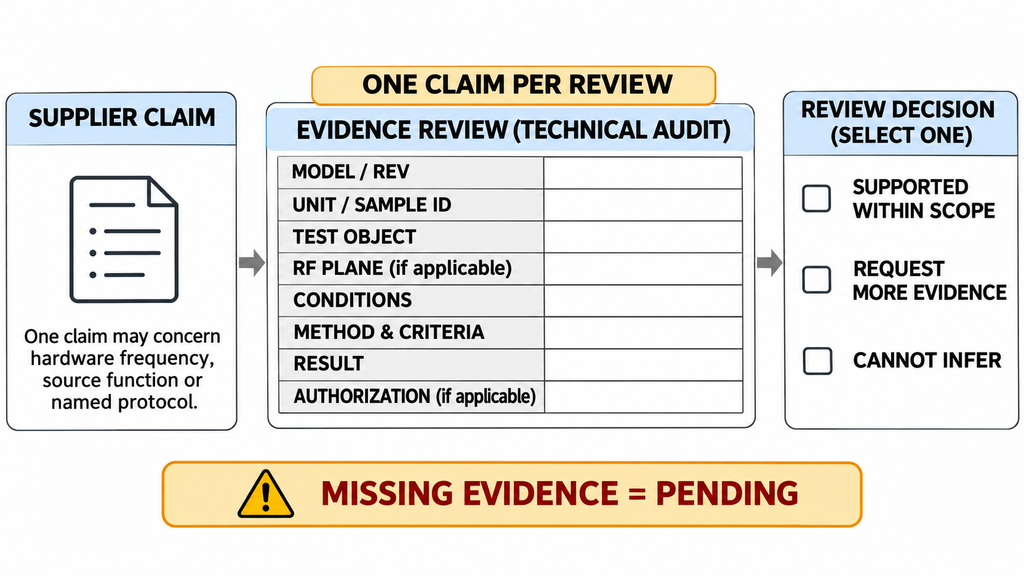
Match the supplier’s exact wording to its records. Hardware ratings, source feature lists, authorized named-protocol evaluations, and system acceptance reports support different claims. A screenshot or video may document an observed state without establishing the complete test conditions.
| Claim Level | Evidence Needed | Scope to Check | Buyer Verdict |
|---|---|---|---|
| Hardware frequency coverage | Conditional rating and frequency-specific RF measurements where performance is asserted | Component; rated vs. tested points; PA input/output planes; drive, load, supply, and thermal conditions | Supported within scope for documented hardware; cannot infer protocol coverage |
| SDR waveform capability | Source model/revision documents, feature description, and source-output records | Software/firmware version, enabled configuration, physical source output, limitations | Supported within scope if records match; otherwise request more evidence |
| Named-protocol verification | Applicable authorized evaluation record with method, criteria, and results | Named claim, tested object/version, conditions, authorization, and result boundaries | Supported within scope if the authorized method and criteria directly test the claim and recorded results meet those criteria; request more evidence for gaps; cannot infer from frequency or waveform lists |
| Complete system result | Authorized integrated-system test or acceptance record | Tested assembly, scenario, criteria, results, and revision control | Supported within scope if recorded results meet criteria; cannot infer untested outcomes |
These verdicts apply to the claim, not to the product as a whole. Missing evidence means the buyer must hold that decision; it is not a failed performance test.
Check the tested model, revision, unit or sample, reference plane, conditions, criteria, and recorded outcome. Where a claim is tied to a delivered unit, require traceability to its serial number or equivalent identifier. For RF measurements, distinguish raw readings from corrected results and selected test points from a documented operating range. Prototype data must retain its sample limitation.
If the question concerns measured RF output quality, signal-quality verification before the RFQ is the relevant next step. Named-protocol verification still needs its own record with a defined test object and outcome.
6.When Are Two Supplier Claims Actually Comparable?
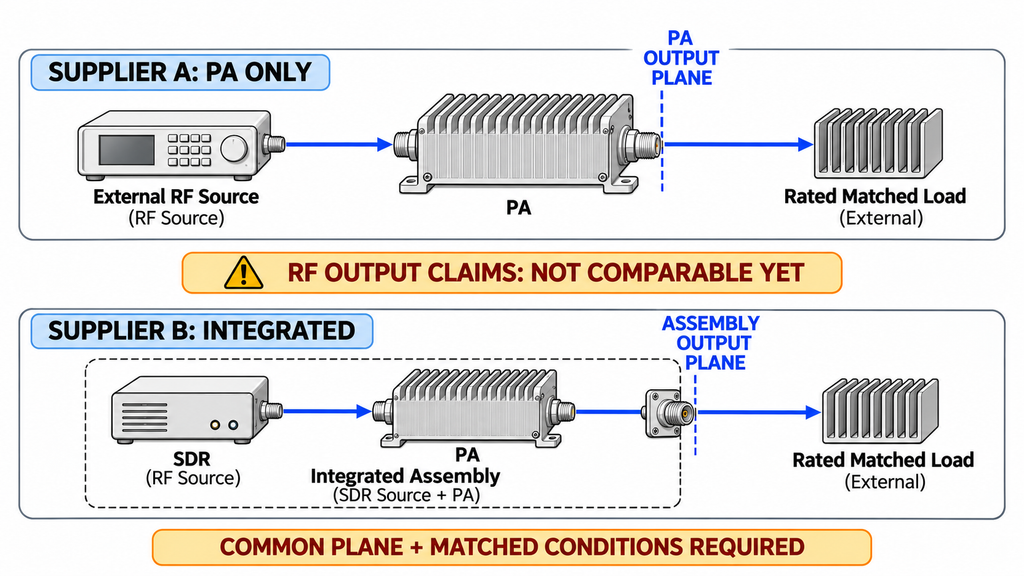
Supplier claims become comparable only when the purchased scope and the evidence scope are aligned. Start with the same claim level, then compare the included hardware, model and revision, measured object, RF reference planes where relevant, conditions, and acceptance criteria.
Comparable means both offers document the same claimed capability at matching boundaries and conditions. This permits a comparison at that level, not a ranking of complete systems.
Partially Comparable means some functions can be assessed while others remain open. For example, two PAs may have comparable hardware frequency evidence even if source-side documentation differs.
Not Comparable Yet means a decisive boundary is missing: one quote may be PA-only while another includes a source, or a protocol claim may lack an identified test object. Hold the affected comparison and request the missing record.
Consider two hypothetical offers. Supplier A provides a PA-only module with test records at the PA output connector. Supplier B quotes an integrated source-and-PA assembly with source-version documentation and measurements at the assembly output.
The RF output claims are Not Comparable Yet because the records refer to different reference planes. Ask for comparable records at a common plane under aligned conditions. Supplier B’s source-version documents also leave any named-protocol performance claim pending until applicable protocol-level evidence is supplied.
7.What Should the RFQ Require Before Accepting Protocol Coverage?
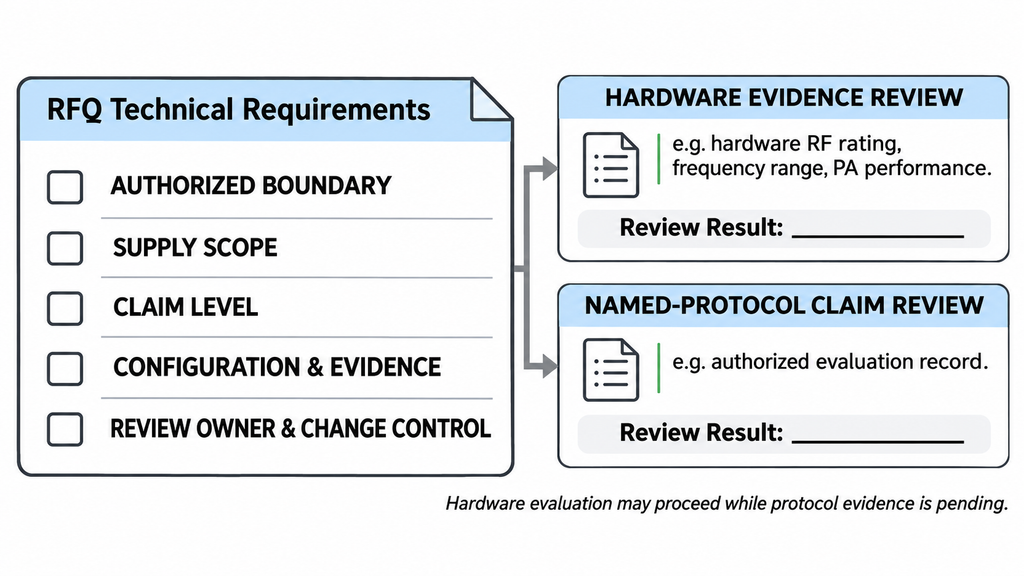
Ask each supplier to replace the phrase “protocol coverage” with a statement tied to a specific deliverable and record. The RFQ needs five items:
- Authorized project boundary. Identify the applicable jurisdiction, responsible project authority, and approved evaluation context. Keep sensitive operational settings outside an open supplier inquiry.
- Actual supply scope. State whether the quote covers PA hardware, a source module, or an integrated assembly, with included, optional, and externally supplied functions clearly separated.
- Exact claim level. Ask whether “coverage” means hardware frequency operation, source-side waveform availability, a named-protocol evaluation, or a complete-system result. Require the supplier to qualify any proposed or unverified statement.
- Configuration and evidence. Request applicable part and revision identifiers, software/firmware versions if relevant, interface information, test object and reference planes, conditions, methods, criteria, and traceable records appropriate to the claimed level.
- Review ownership and changes. Identify who supplies each record, who assesses it, which decision remains pending if it is absent, and which configuration changes would require renewed verification.
Hardware evaluation may proceed while protocol-level evidence is pending. Record those as separate decisions in the supplier review.
Conclusion.
A frequency range supports the RF hardware claim documented for its specified conditions. Named-protocol coverage becomes supportable when an authorized evaluation directly tests the stated outcome and records a result meeting the applicable criteria for the defined configuration. Integrated-system results require separate evidence for the tested assembly and scenario. This framework identifies which supplier claim has support and what evidence is missing; it cannot set model-specific limits, project acceptance values, or outcomes for untested conditions.
Before ranking offers, ask each supplier to state its claimed level, delivered model and revision, test scope, and evidence owner in writing. Mark unsupported levels as pending and compare only matching claims.
For a PA-only purchase scope, RF SKYPOWER can review standard and custom RF power amplifier modules against the required operating range, PA input/output reference planes, interfaces, and available RF documentation. Include the authorized project boundary, exact supply scope, claim level, and acceptance evidence requirements in your technical RFQ.