
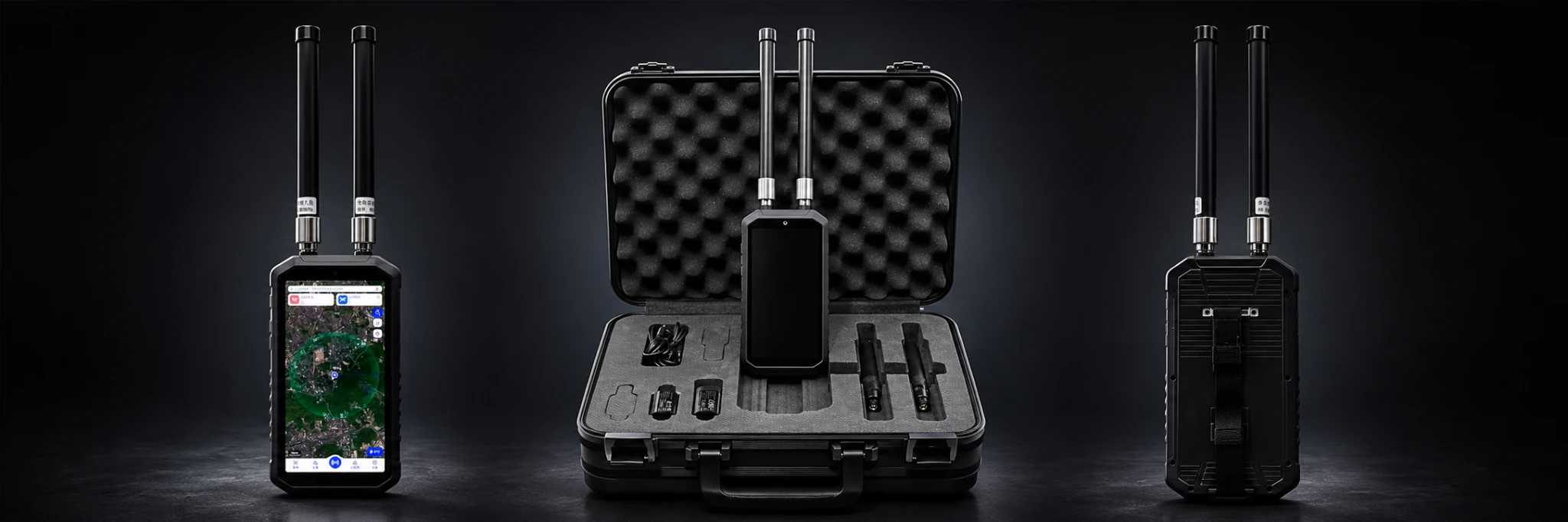


Drone detection system acceptance is justified only when measured performance meets the agreed requirements under defined conditions. The evidence must include independent ground truth, valid samples, and records another reviewer can check.
A demonstration can hide important gaps. Operators may know when the drone will appear, the flight may follow an easy route, and the report may list successful alerts without counting misses. The same system could still fail a required coverage or false-alarm criterion.
1. What Must Be Defined Before Acceptance Testing?
Agree on the acceptance scope before the first trial. Without a written scope, a supplier and buyer can observe the same result and still disagree about whether it passes.
Three activities serve different purposes:
- Factory functional testing checks specified equipment functions before delivery.
- Site acceptance testing evaluates the installed configuration against project requirements under defined site conditions.
- Operational monitoring records performance as traffic, interference, weather, and operating conditions change over time.
A factory test may support acceptance. It cannot replace a site test when the contract requires field performance.
Define the system boundary as well. A requirement may cover only the sensor or extend to processing, networking, and the operator display. A sensor may detect a target while the control-room alert arrives too late.
Separate the required functions:
- Detection: Reports a qualifying target or target-related event.
- Tracking: Maintains the target association over time.
- Classification: Assigns an observed target to a defined category.
- Identification: Provides a more specific identity when the system and available evidence support it.
These functions require different acceptance criteria. A detector that was never specified to provide target coordinates should not be judged against an uncontracted localization requirement.
Required functions, including whether tracking or target identity is needed, should guide drone detector selection. Once contracted, test those functions on the installed configuration.
Before testing, agree on a baseline for installed hardware, firmware, software, sensor positions, enabled functions, target classes, operating conditions, and interfaces.
Each mandatory requirement also needs a measurable limit, a measurement method, and a decision rule.
“Long-range detection” is too vague to score. A requirement tied to a target class, coverage area, operating condition, and measurable limit can be tested.
If the parties cannot agree on the required capability or pass criterion, performance testing should pause. Collecting more data will not resolve an undefined acceptance requirement.
2. Which Test Scenarios Represent the Real Site?
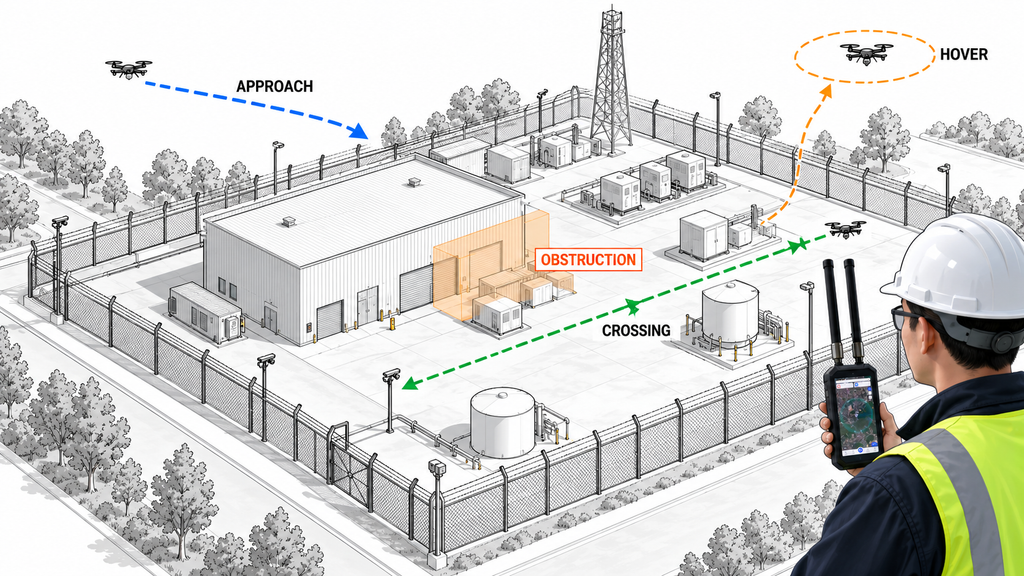
Build scenarios around conditions that could change the acceptance result.
For a perimeter installation, that may mean an approaching target, a crossing route, a hover near a structure, or a partially obstructed area. A mobile detector may require different conditions, including operator movement and changing antenna orientation.
For each target trial, record its class, operating mode, route, altitude, speed, distance, and relevant site conditions.
Radar may see a drone that emits no signal a passive RF detector can recognize. The drone detection methods used on site therefore affect which scenarios apply, although the contract still controls acceptance.
| Scenario and target | Test conditions | Required system capability | Pre-agreed criterion | Independent ground truth and record requirement | Repeats or observation time |
|---|---|---|---|---|---|
| Authorized target approaching the monitored area | Define target, route, altitude, speed, distance intervals, and sensor configuration | Detect within the required coverage | Apply the approved detection criterion for each condition | Record independent trajectory, timestamps, and detector events | Specify valid passes for each condition |
| Crossing / hovering / departing — separately scored | Define one movement pattern per trial; record orientation and dwell time | Detect or maintain a track, as contracted | Apply the relevant detection or tracking limit | Match target movement to event or track records | Record valid trials and results for each pattern |
| Target near clutter or partial obstruction | Record terrain, structures, visibility, and sensor position | Meet any contracted performance requirement for the condition | Apply the approved condition-specific limit | Preserve target position and site observations | Repeat each required condition |
| No qualifying target present | Record normal site activity and monitored operating periods | Avoid reportable false target alerts | Apply the agreed false-alarm definition and rate limit | Match independent observations with complete alert logs | Record valid target-free hours |
| Simultaneous targets, if contracted | Define target count, separation, movement, and operating modes | Detect or track the required simultaneous targets | Apply the approved multi-target criterion | Keep independent identity and trajectory records for each target | Specify valid multi-target trials |
| Degraded operation, if contracted | Define the permitted fault or degraded condition | Maintain the specified functions or report the required fault state | Apply the separate degraded-mode criterion | Record system status, imposed condition, and event history | Specify trials or observation time |
The test team should assign each scenario a stable identifier. Every valid trial should have its own ID, linked to the target record and system output.
Control what the monitoring operator knows about launch times and approach directions when advance information could affect the result. Safety personnel still need the information required for authorized flights.
Record any cues provided to the operator. Assisted demonstrations and unaided detection trials must not be combined into one unexplained performance result.
Only conduct live flights under the necessary authorization and site safety controls. If a scenario cannot be performed safely or legally, document the agreed substitute method and its limitations.
3. How Do You Establish Ground Truth for Each Trial?
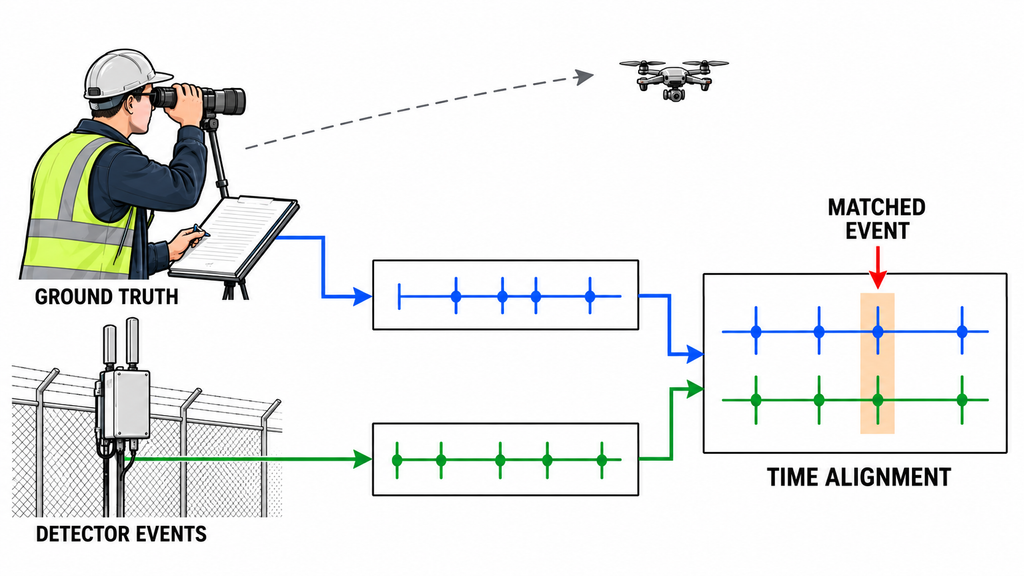
Acceptance needs a separate record of the target’s identity, position, activity, and timing. This independent reference is the ground truth used to check detector results.
Ground truth must be independent of the measurement being checked. Verified flight logs can establish target activity and timing. They cannot independently validate position accuracy if the detector derives its reported coordinates from the same onboard GNSS source. For contracted localization accuracy, use a separate position reference and document its uncertainty and time alignment.
Record reference update intervals and missing data because they can affect whether a trial supports the intended metric.
Before the first trial, assign responsibility for flight coordination, independent ground-truth recording, system operation, and result scoring. One person may hold more than one role if the evidence remains independent and the safety plan permits it.
Target identity and position. The independent record must identify the intended target and establish its movement through the approved test area. Where position error matters, record the uncertainty.
Time synchronization. Target records and detector events need a common time reference. Document clock offsets, synchronization methods, and timing uncertainty. Otherwise, a correct alert may appear late or be matched to the wrong event.
Event matching. Agree on the allowed time window and, where relevant, spatial tolerance for matching an alert to the target. A generic alert during a flight does not automatically count as a successful detection of that target.
Trial eligibility. Define what makes a trial valid before collecting results. The target must follow the required scenario, and the independent evidence must support the intended measurement.
The test coordinator should record invalid trials and their reasons before performance scoring. Exclusion decisions must not depend on whether the detector succeeded.
A valid missed detection remains a miss. It cannot be removed because it lowers the reported detection probability.
Keep the original ground-truth data separate from detector output. The matched-event dataset should reference both sources through the scenario ID, trial ID, and event ID.
If independent target evidence or timestamp alignment is inadequate, the affected trial cannot support an acceptance claim. Repeat it under valid conditions rather than estimating the missing result.
4. Which Metrics Should Decide Acceptance?
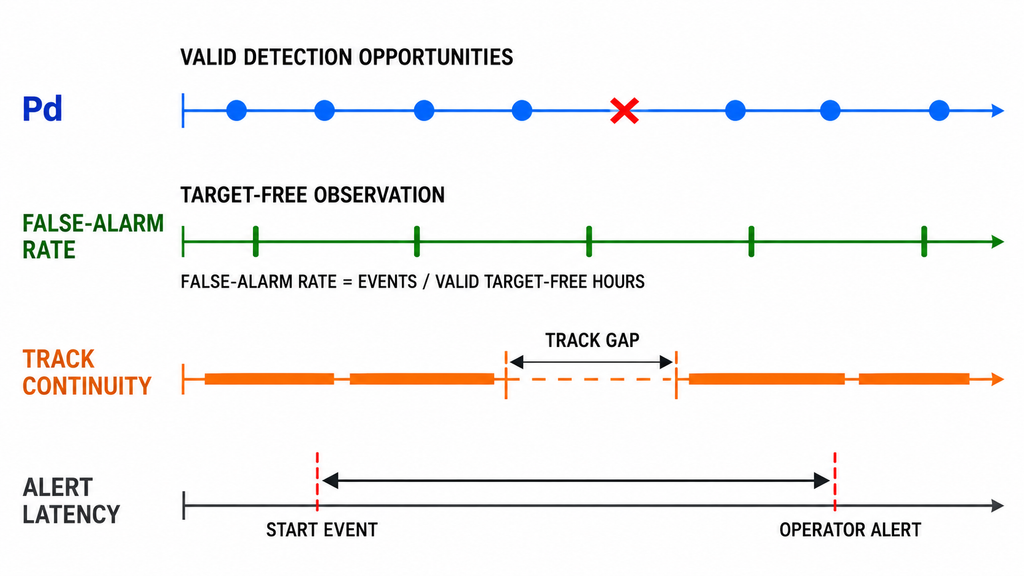
Each metric must describe a contracted function, a defined test condition, and a measurable result.
The acceptance team should avoid collapsing different capabilities into one score. A system may detect most approved targets but produce too many false alerts. Another may detect targets promptly but lose their tracks.
Detection Probability and Effective Range
Detection probability measures the share of valid detection opportunities that produced a qualifying, independently matched detection.
Detection probability (Pd) = valid opportunities with a matched detection ÷ total valid detection opportunities.
The denominator must be defined before testing.
For passive RF detection, the team should record whether the target produced relevant signals and whether the operating mode falls within the approved requirement. For radar or optical detection, the valid opportunity depends on the applicable observation conditions.
Do not automatically remove an RF trial because the target used an unsupported signal or produced no recognizable emission. If the contract requires detection in that condition, the result remains relevant to acceptance. The system’s technical limitation cannot silently narrow the buyer’s requirement.
Likewise, repeatedly sampling the same target pass does not create hundreds of independent trials. The test plan must define whether one opportunity means a target pass, a qualified observation window, or another justified unit.
Measure effective range across the agreed distances, target classes, and site conditions. The farthest successful alert is one observation, not proof of dependable coverage at that distance. When the contract covers a defined zone, score that zone directly instead of relying on a maximum-range demonstration.
False Alarms and Nuisance Events
False-alarm performance measures the burden of unwanted alerts during the specified operating conditions.
Before testing, define which output counts as a reportable false alarm: a sensor event, processed detection, fused alarm, or operator-visible alert. Use the same reporting level and duplicate-event rule throughout the test.
For the target-free false-alarm rate, count only reportable alerts occurring within the same valid target-free intervals used in the denominator. Non-target activity may cause these alarms, but repeated notifications from one underlying event follow the approved grouping rule. Record unmatched alerts during target-present trials separately unless the contract specifies another metric and exposure basis.
Independent site observations must also support the absence of qualifying targets during scored target-free periods. If target status cannot be established for an interval, record the uncertainty and exclude or resolve that interval under the pre-agreed validity rules.
False-alarm rate = confirmed reportable false-alarm events ÷ valid target-free observation hours.
Report the event count and valid observation time alongside the calculated rate.
An hourly event rate is not the same as the probability of a false alarm. The two measures require different definitions and should not be exchanged when comparing suppliers.
No-target observation should include relevant routine site activity, not only a quiet period chosen for convenience. If the system operates across different shifts or environmental conditions, the test plan should reflect the contracted operating exposure.
Tracking, Identification, and Alert Latency
Test the tracking functions included in the contract. For continuous tracking, set the allowed track-gap duration or the minimum correctly associated share of the test interval, as applicable. Score interruptions, wrong associations, and duplicate tracks against that rule. A detection followed by immediate track loss does not establish continuous tracking.
Classification and identification need separate criteria. A system that reports “possible drone” should not be judged as though it had identified an exact aircraft model unless that capability was specified.
For contracted classification functions, compare reported categories with independent target labels. Record correct, incorrect, and unclassified events.
Where identification is contracted, compare each reported aircraft or controller identity with an independently verified reference. Record correct, incorrect, and unidentified results separately. A correct class label does not establish a correct identity.
The start event must match the contracted sensing function and the available ground truth. For passive RF testing, a drone entering the monitored area and beginning a relevant transmission may occur at different times.
Specify whether the measured endpoint is the sensor event, processing output, network message, or operator-visible alert. Record clock offsets and timing uncertainty before judging the result.
A fast sensor response does not establish fast control-room notification if the project requirement includes downstream processing and display.
5. How Many Trials and False-Alarm Hours Are Enough?
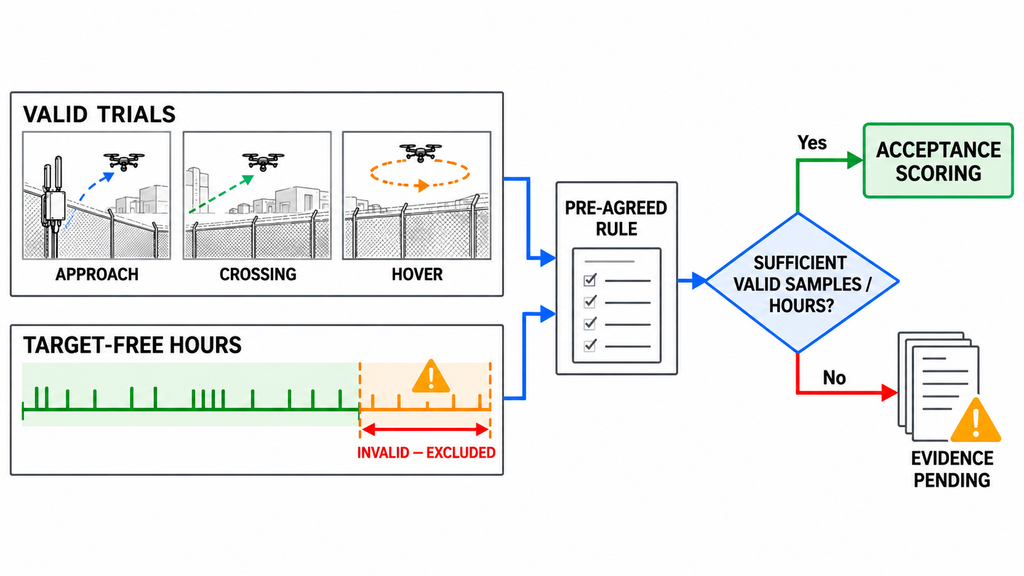
Set trial counts and target-free observation hours according to the agreed acceptance criteria and required strength of evidence.
For each mandatory detection condition, the acceptance team should define:
- The minimum detection probability that must be demonstrated.
- The confidence level and statistical method, if confidence-based proof is required; otherwise, the approved fixed-sample decision rule.
- The permitted missed detections under the agreed decision method.
- The number of sufficiently independent trials needed to support that decision.
If the contract requires confidence-based proof, select the one-sided method and its assumptions before testing. Compare the approved lower confidence bound for Pd with the minimum required detection probability. Otherwise, apply the agreed fixed-sample acceptance rule without adding a statistical requirement after testing.
When a statistical bound is required, an observed detection percentage above the target may still fail.
For illustration, under independent binomial trials, 29 detections in 29 valid opportunities produce a one-sided 95% exact lower Pd bound just above 90%. Neither that probability nor that trial count is a default drone-detector acceptance requirement.
Sampling must also represent the required conditions. Repeating one favorable route many times may establish repeatability for that route. It cannot replace trials against other contracted target classes or difficult coverage areas.
Keep the results separated where conditions materially affect performance. A high overall average must not conceal failure in a mandatory scenario.
For false-alarm testing, start with the maximum acceptable event rate and the agreed scoring rule. If the contract requires confidence-based acceptance, specify the confidence level, statistical model, and upper-bound method before testing. The approved upper bound on the false-alarm rate must meet the contracted limit. Determine the required target-free observation time under the selected rule.
A test that records zero false alarms does not prove the true rate is zero.
For example, under an independent, constant-rate Poisson event model, observing zero events over T hours gives an approximate one-sided 95% upper rate bound of 3/T events per hour.
This is a statistical illustration, not a universal acceptance threshold. The approximation may not describe clustered alarms or changing site activity.
The team must also record the actual monitored duration. Planned hours do not count when the system was unavailable or when the observation record is invalid.
Testing may stop once the required valid samples and observation hours are complete. An early failure decision is appropriate only when the approved rule already makes the contracted requirement unattainable.
If the available sample is too small to support a pass or fail decision, classify the requirement as evidence pending. Do not report a pass merely because the observed percentage exceeds the target.
6. What Evidence Must the System Export?
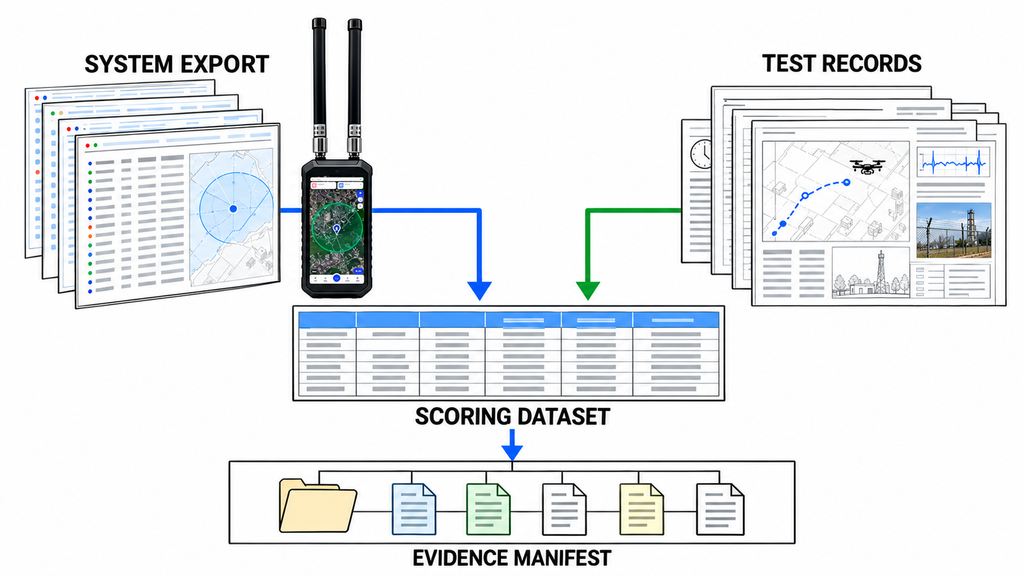
An acceptance report must allow another reviewer to reconstruct the result.
A dashboard screenshot can show that an alert appeared. It generally cannot establish how many valid opportunities occurred, which events were missed, or whether the underlying data are complete.
Separate system exports from test-team records. The system must supply the event, status, and configuration outputs required by the contract. The test team supplies ground truth, matching rules, calculations, and review decisions.
System identity and configuration. Record the model or equipment identity, relevant serial numbers, firmware, software, enabled functions, sensor positions, and configuration revisions.
Independent test records. Preserve scenario and trial IDs, target information, ground-truth data, timestamps, timing references, and relevant site conditions.
Detector output. Retain the available original events and processed records. Depending on the contracted system, these may include alerts, track histories, classifications, status messages, and operator notifications.
Result calculations. Keep the matching rules, valid opportunities, misses, false alarms, exclusions, calculated metrics, and the acceptance limits used.
Review and change history. Record file IDs, report revisions, reviewer decisions, corrective actions, and links between original and repeated trials.
The export requirements must match the purchased system. A detection-only device should not be assumed to generate continuous tracks or detailed coordinates.
Likewise, an interface that displays event history does not necessarily provide raw-data export. If exportable records are contractually required, confirm the actual interface and output format before acceptance.
Original files should remain available alongside processed summaries. A spreadsheet with calculated percentages is useful, but it should not replace the underlying event records.
Keep a stable mapping between scenario, trial, and event IDs across the source files and scoring dataset.
For a mobile passive-RF trial involving the HZ-HD03, check the documented functions and available event records before finalizing the acceptance criteria. The following resources can support that review.
| HZ-HD03 Resources | Reference Link |
|---|---|
| Technical Manual (PDF) | View HZ-HD03 Technical Manual |
| Product Information | View HZ-HD03 Handheld Drone Detector |
| Technical Documentation & Inquiry | Contact RF SKYPOWER |
Product documentation helps establish the test scope. Final acceptance still depends on the delivered configuration, independent ground truth, and verified trial records.
If a mandatory record cannot be produced, document the gap. The affected requirement remains unverified until the parties obtain adequate evidence or formally resolve the contractual requirement.
7. When Should Testing Stop, Repeat, or Pass?
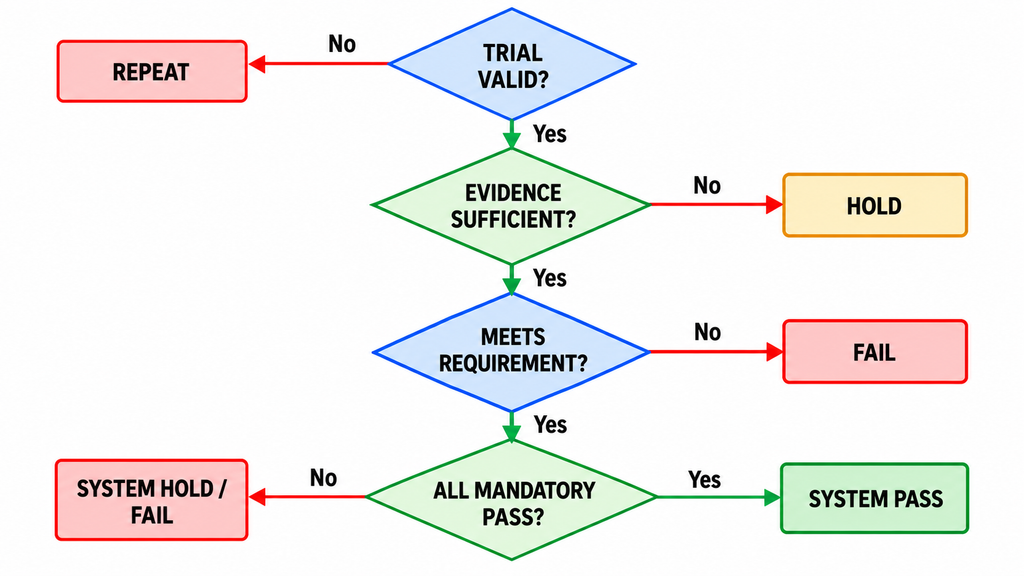
Decide trial validity, requirement compliance, and final system acceptance separately. A valid trial follows the approved scenario and has adequate independent evidence. An invalid trial fails an agreed eligibility rule; document it and repeat it where necessary.
A failed requirement has valid evidence showing its acceptance criterion was not met. An evidence-pending requirement lacks enough valid information for a defensible decision. That does not automatically mean the product failed.
Complete the acceptance record below with project-specific criteria, measured results, and supporting evidence before sign-off.
| Acceptance requirement | Tested condition | Pre-agreed criterion | Measured result and valid sample | Evidence file ID | Decision and next action |
|---|---|---|---|---|---|
| Target detection | Record target class, scenario, and operating configuration | Enter the minimum required Pd and the approved statistical or fixed-sample decision rule | Record matched detections, valid opportunities, observed Pd, and any required lower confidence bound | Ground-truth and detection-log IDs | Mark pass, fail, or hold; record the action |
| Effective coverage | Record tested coverage zones and distance intervals | Enter the applicable coverage criterion | Record results and valid trials for each required interval | Position and event-log IDs | Identify any unmet coverage requirement |
| False-alarm performance | Record target-free site conditions and valid monitoring period | Enter the event definition, rate limit, valid exposure basis, and any required upper-bound rule | Record false-alarm count, valid hours, calculated rate, and approved upper confidence bound when required | Observation and alert-log IDs | Mark the decision or extend observation |
| Tracking, if contracted | Record target movements and enabled tracking mode | Enter the tracking-continuity criterion | Record valid tracks, interruptions, and eligible trials | Ground-truth and track-log IDs | Record tracking decision and action |
| Classification, if contracted | Record target classes and enabled classification mode | Enter the classification criterion | Record correct, incorrect, and unclassified events with valid total and per-class counts | Target-label and classification-log IDs | Record classification decision and action |
| Alert latency, if contracted | Record the approved start event and output endpoint | Enter the latency limit | Record valid timing results and uncertainty | Time-reference and alert-log IDs | Record the decision or repeat invalid timing trials |
| Evidence and configuration traceability | Record installed versions, identifiers, and export method | Enter the evidence-delivery requirements | Record received original files, missing fields, and revisions | Evidence manifest and configuration IDs | Accept the evidence package or hold the affected requirement |
If identification is contracted, create a separate requirement record using the same six fields. Compare reported identities with an independent reference, and keep that decision separate from classification.
Do not reduce final acceptance to one aggregate score. System-level PASS requires every mandatory requirement to meet its approved criterion with sufficient valid evidence. Handle failed or unresolved mandatory requirements under the contract’s nonconformity or hold procedure.
An invalid trial cannot be counted as a pass. After documented corrective action, an approved retest may support acceptance, but the original failure and the new evidence must remain linked.
Retest scope depends on what changed. A sensor relocation may affect coverage. A firmware or target-library update may affect detection or classification. A sensitivity adjustment may change both detection and false-alarm behavior.
After a change, determine which previous results remain applicable and which require new evidence. Do not automatically reuse an earlier pass for a materially different configuration.
The final sign-off should identify the tested configuration, approved scenarios, applicable limits, evidence files, unresolved exceptions, and responsible reviewers.
Conclusion
To run drone detection system acceptance tests, define the requirements and acceptance limits first. Then conduct representative trials, compare the results with independent ground truth, and retain enough valid evidence to support each decision.
A system passes only when all mandatory requirements are met under the agreed test conditions and the supporting records are complete.
This method establishes compliance for the tested configuration and approved scope. It does not create universal detection-range guarantees, false-alarm limits, or performance claims for untested targets. Those requirements and results must come from project-specific specifications and verified evidence.
A successful demonstration cannot replace controlled acceptance testing.
Before signing, reconcile every mandatory requirement with its criterion, measured result, valid sample, and evidence file. Resolve failed, invalid, and evidence-pending items through documented corrective action or retesting.
For a passive-RF or handheld detection project, send the target classes, site conditions, required functions, proposed acceptance limits, and export requirements through RF SKYPOWER’s contact form. These details support an initial product-scope and evidence review.