
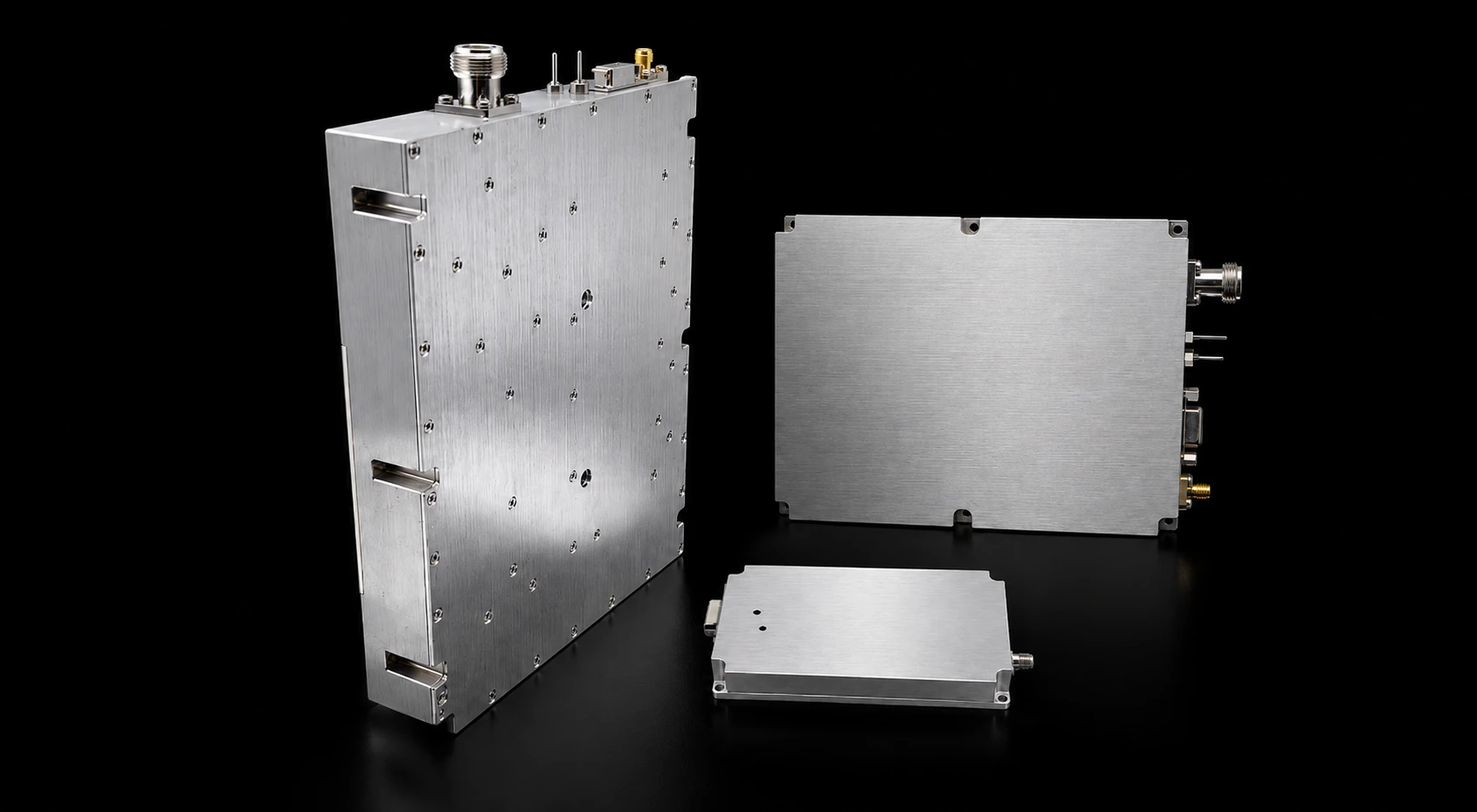
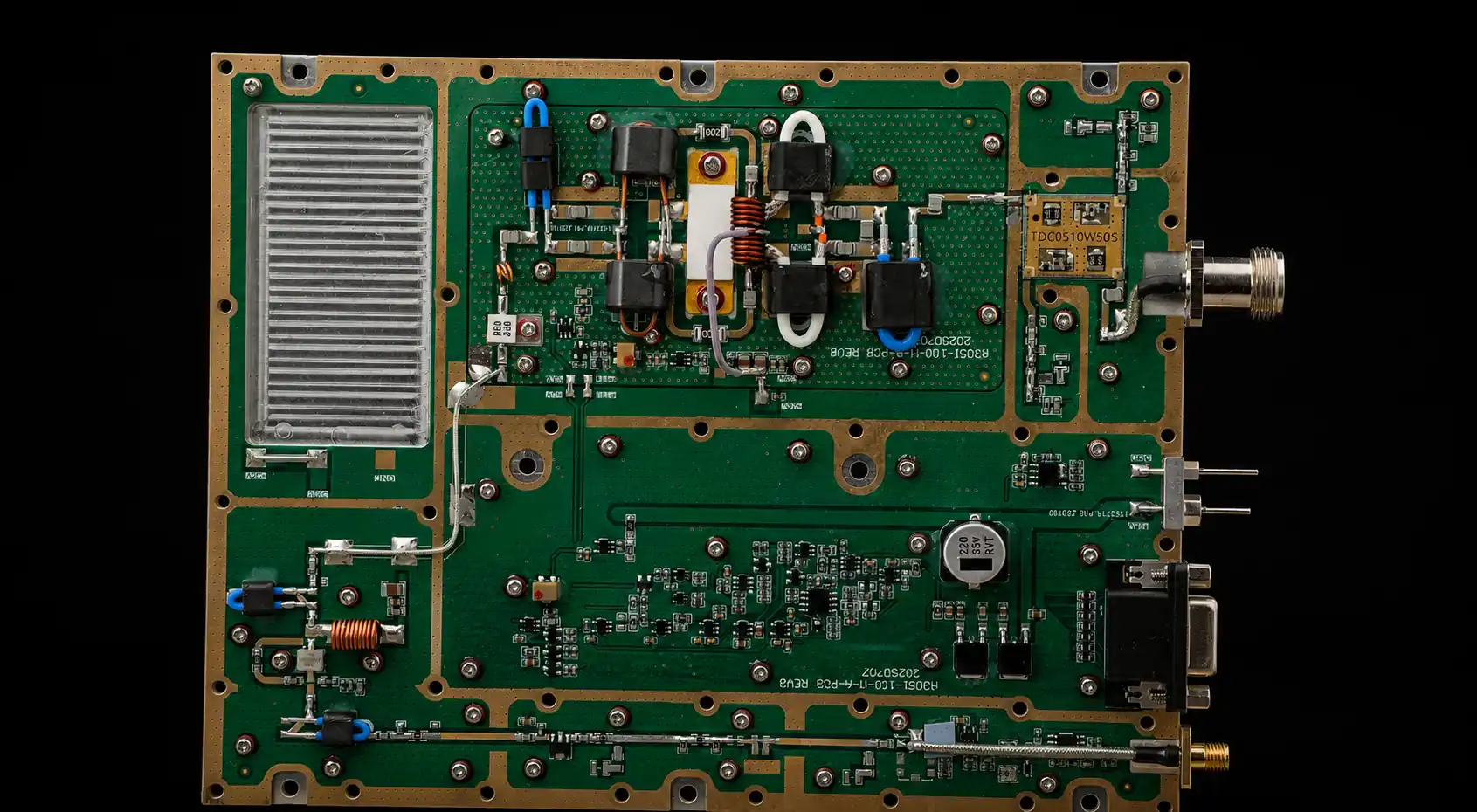
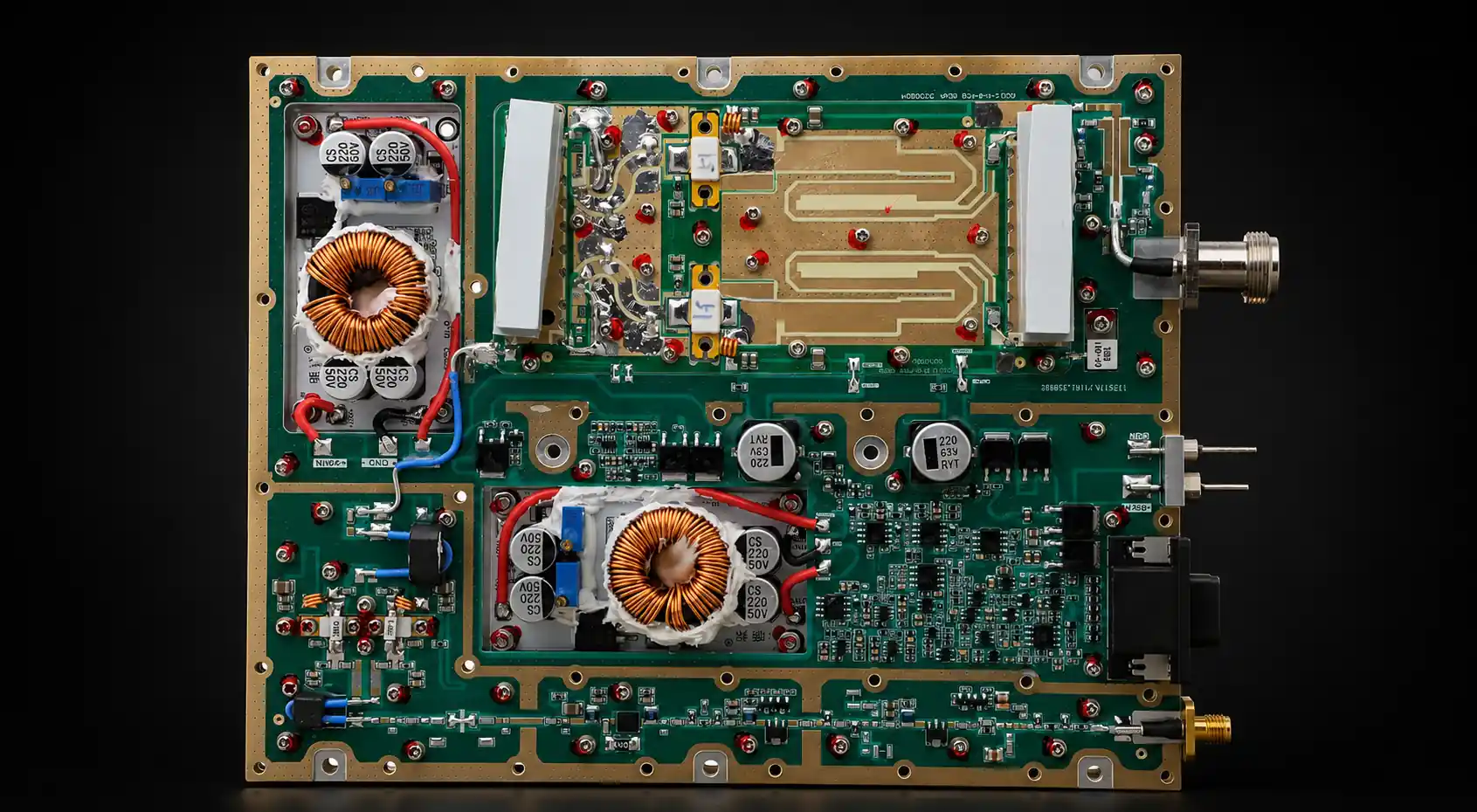
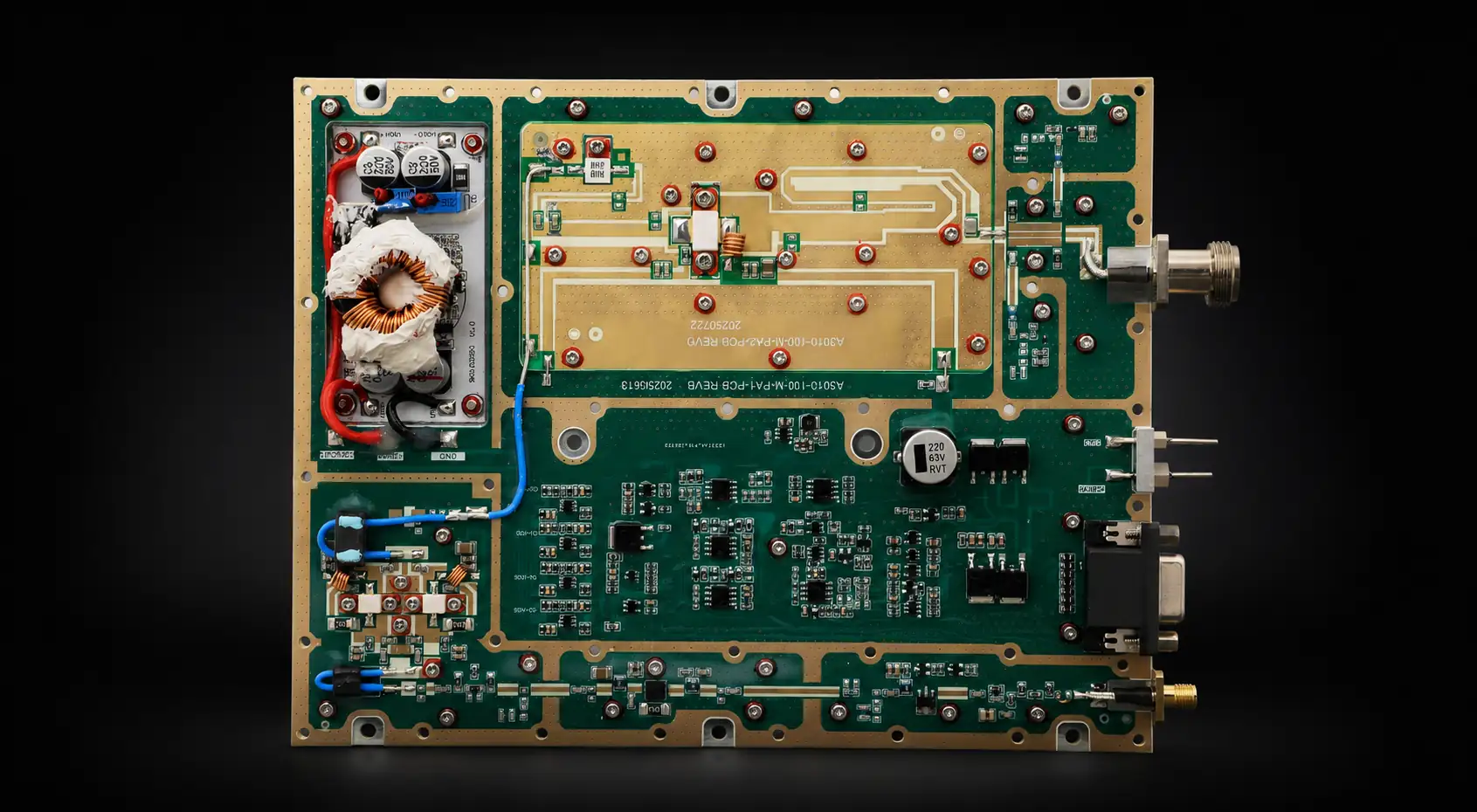
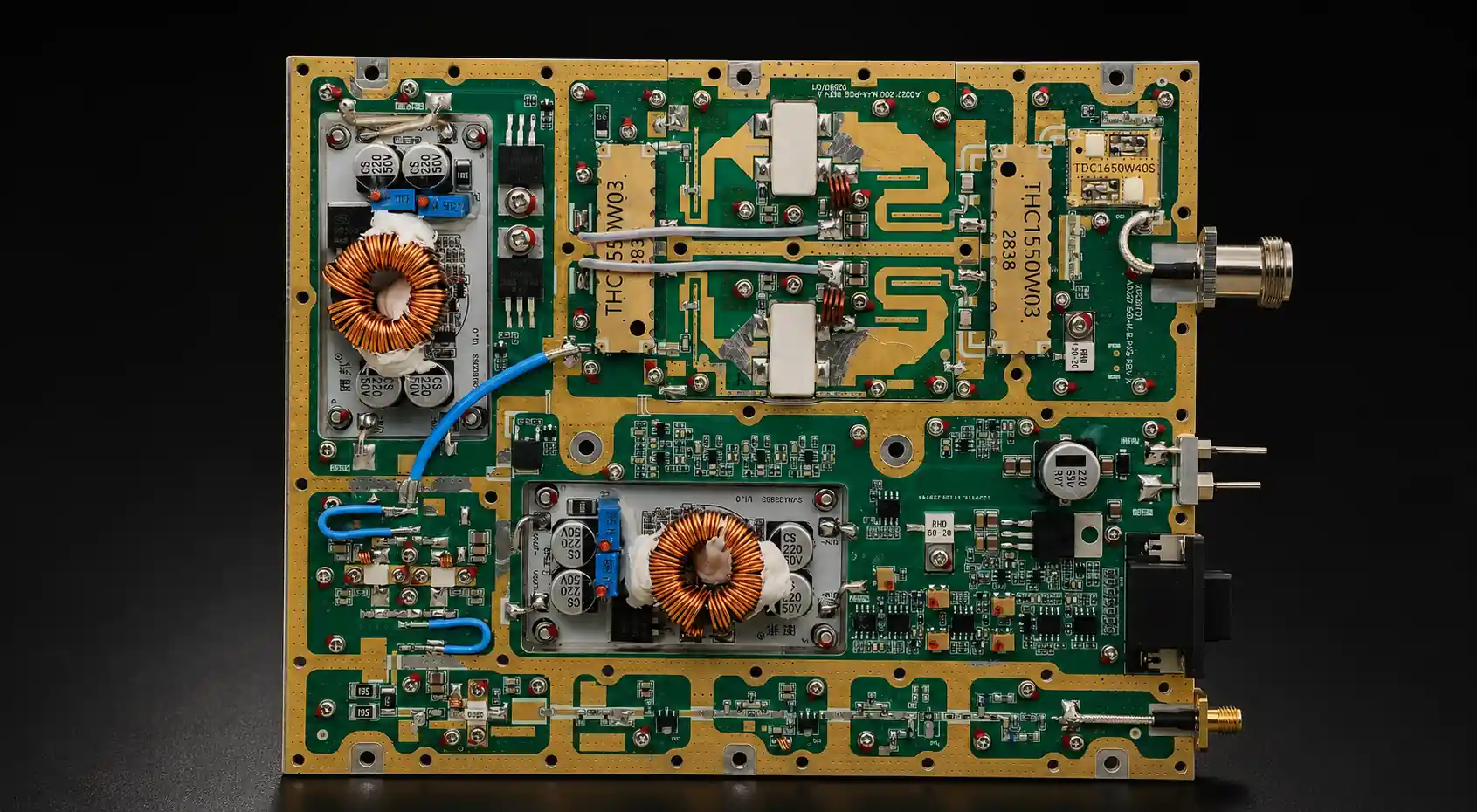
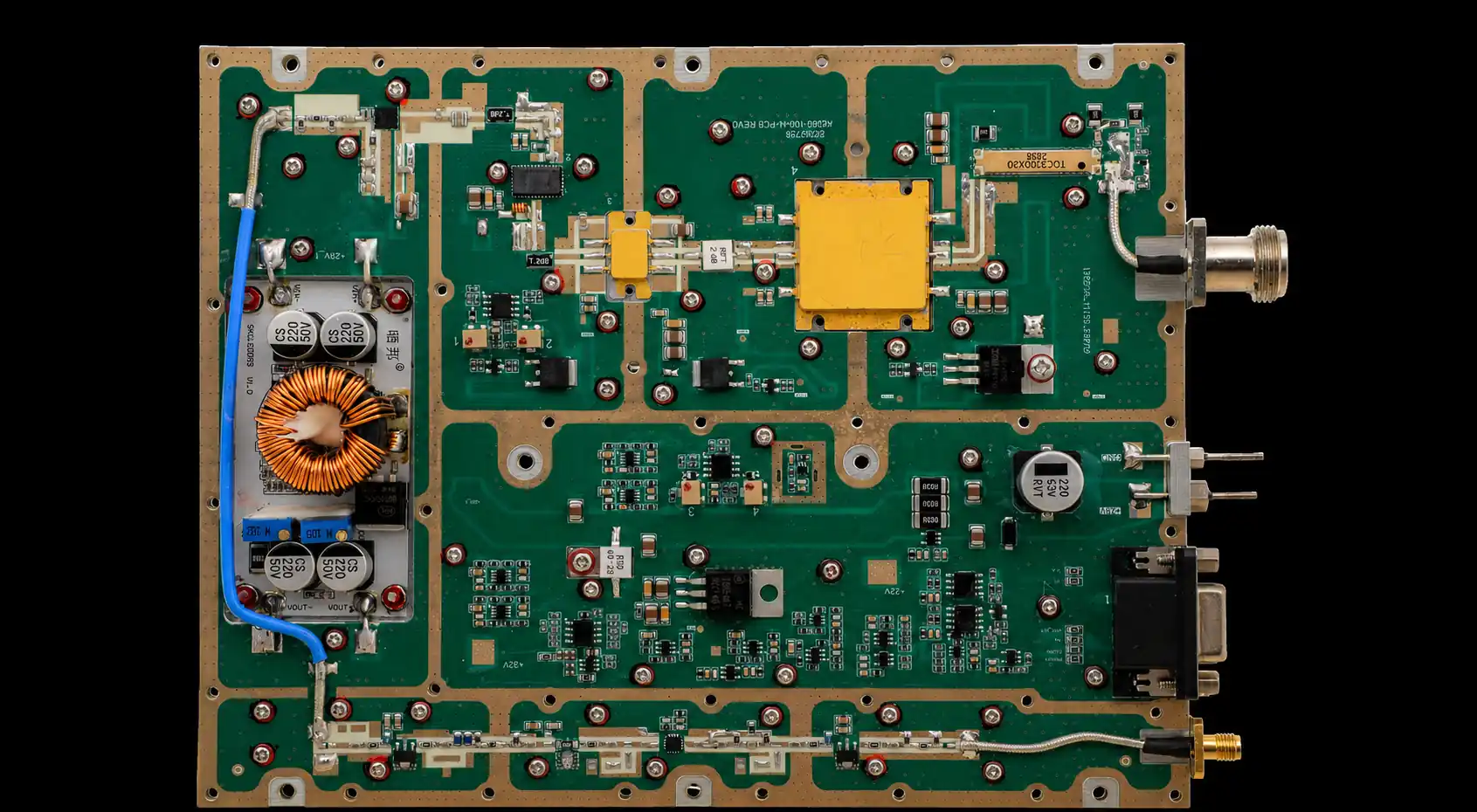
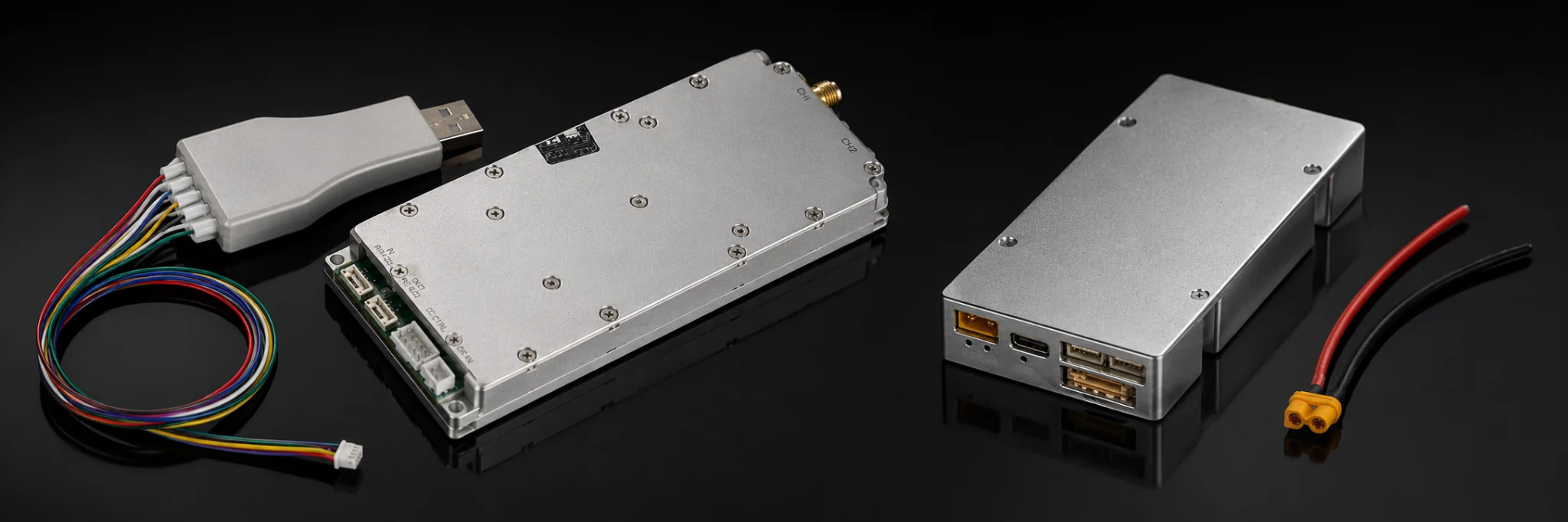
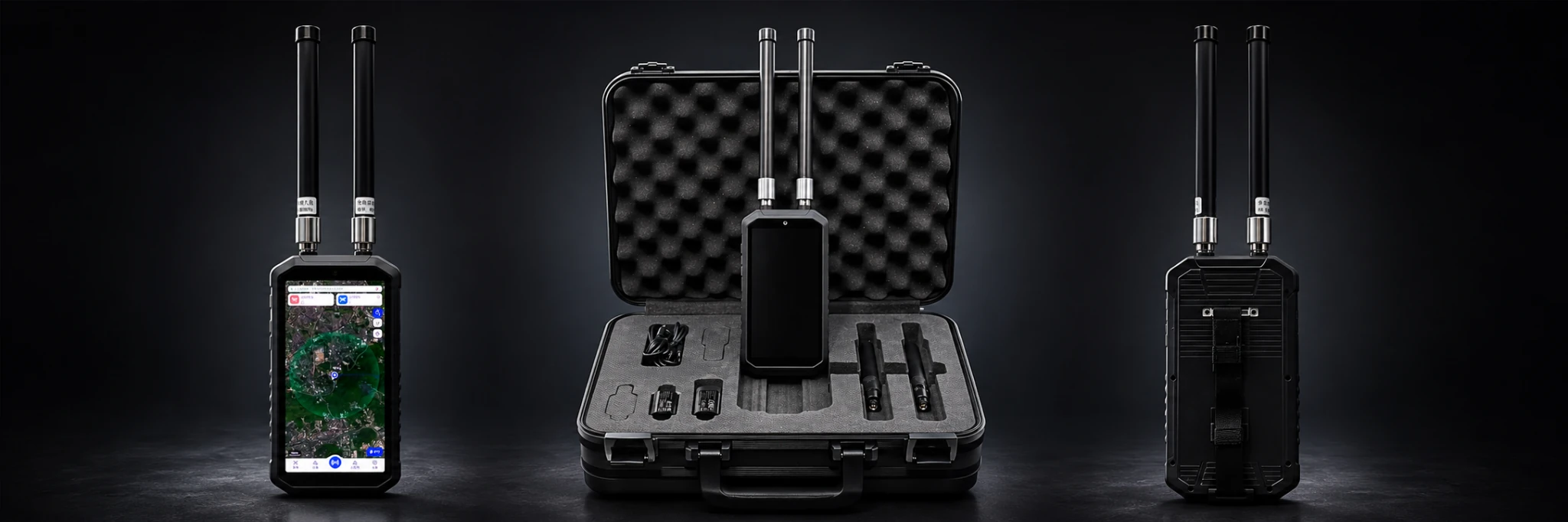

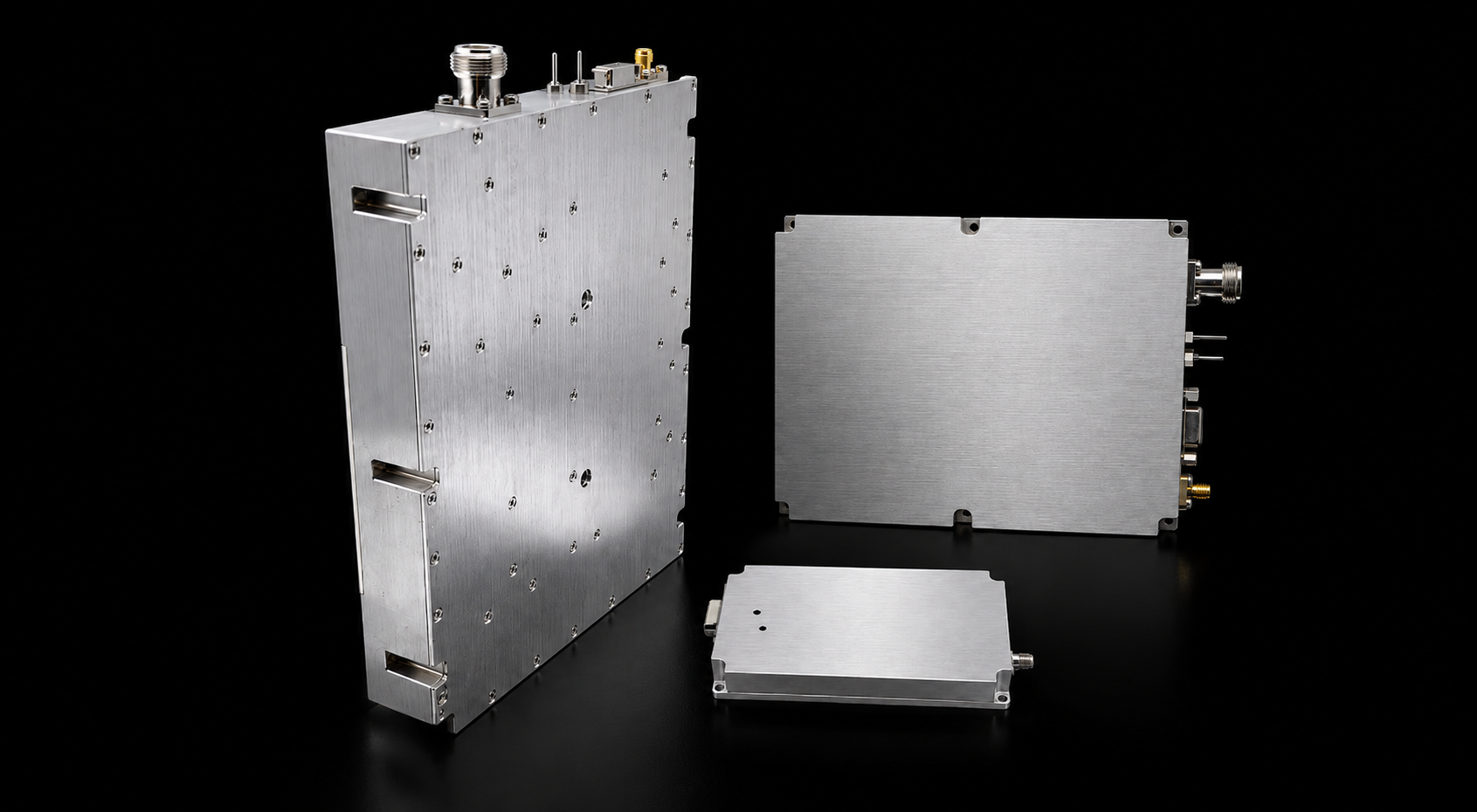
Choosing an RF power amplifier module for C-UAS cannot be completed from a datasheet alone. A frequency range, gain figure, and rated output do not prove that the module will meet the project’s input-drive condition, waveform, measurement reference plane, hot-state duty cycle, 28 V DC boundary, installed RF path, control and protection requirements, or acceptance evidence.
All frequency and operating requirements must be derived from the customer’s lawful operating authority, applicable spectrum rules, and approved deployment plan.
RF Power Amplifier Modules are only one part of the complete C-UAS RF chain. A suitable module must fit the signal source, driver stage where required, filters, switches, feeder path, antenna system, DC distribution, thermal design, control logic, and test boundary used by the project.
This page coordinates the complete selection workflow. It explains which decisions must be made first and when a separate engineering review is needed for frequency range, RF PA architecture, input drive, power margin, thermal design, control, protection, or acceptance evidence. Once those requirements are fixed and supplier responses arrive, a condition-matched RF PA quote comparison should keep the reference plane, drive, waveform, thermal, DC, load, and evidence scope aligned before any candidate enters the shortlist.
1. Define the C-UAS Selection Boundary Before Comparing Modules
A module comparison is unreliable when the project has not defined what the RF path must do.
At minimum, establish:
- authorized operating frequencies;
- fixed, conditional, and documented future frequency groups;
- signal type and instantaneous bandwidth;
- expected RF input drive, required gain, and maximum allowable input level;
- platform type and number of RF paths;
- sequential, multi-carrier, and independent simultaneous modes;
- required RF power and measurement reference plane;
- duty cycle and hot-state duration;
- available 28 V DC capacity;
- cabinet, cooling, feeder, and antenna assumptions;
- control and protection requirements;
- supplier and system-integrator responsibility boundaries;
- quantity, delivery phase, and required evidence.
These inputs can change the module architecture before any datasheet comparison begins.
Define the application boundary
A rooftop site, vehicle platform, portable cabinet, airport perimeter, border installation, or temporary venue may require different frequency groups, antenna sectors, feeder lengths, operating periods, environmental limits, cooling capacity, and control states.
The same PA module may therefore be suitable for one platform and unsuitable for another.
For large venues and temporary high-density sites, the project should first establish a documented C-UAS frequency strategy covering authorized frequencies, protected or conditional frequencies, venue zones, antenna sectors, operating modes, and evidence responsibilities.
Define the signal and drive boundary
The PA input condition must be defined before the required output is approved.
The project should identify:
- signal type;
- instantaneous bandwidth;
- single-carrier or multi-carrier operation;
- expected source output;
- input-cable loss;
- required PA gain;
- maximum allowable input level;
- required operating backoff;
- whether a separate driver stage is needed.
Two modules may provide similar output capability but require very different input-drive levels. A signal source that can directly drive one module may require an additional driver stage for another.
The input boundary should therefore be verified across the required frequencies and operating states, not only at one favorable point.
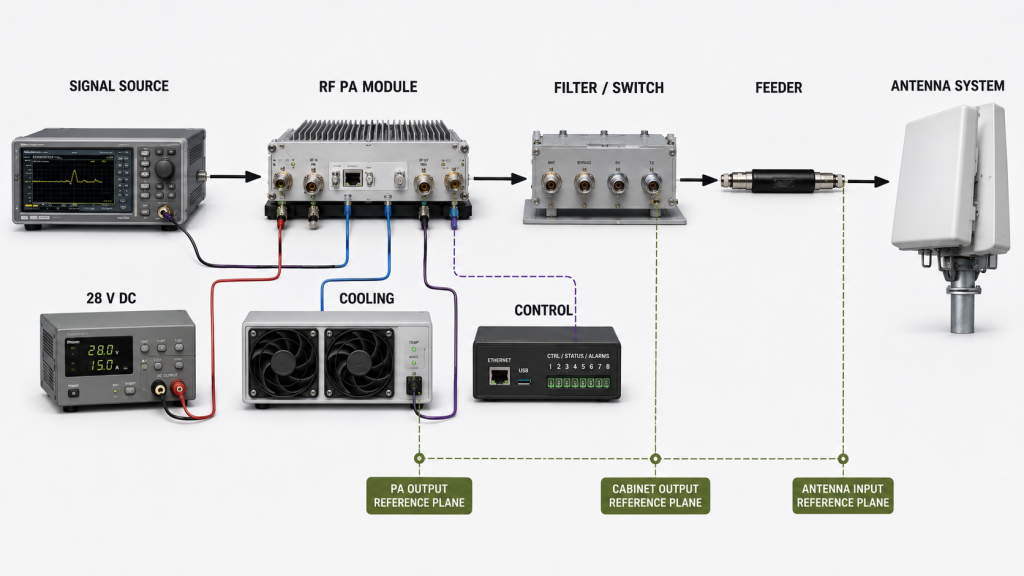
Define the measurement reference plane
An RF power requirement is incomplete unless it identifies where the result must be measured.
Common reference planes include:
- PA output connector;
- cabinet RF output;
- feeder end;
- antenna input.
A requirement defined at the PA output connector is not equivalent to the same power delivered to the antenna input.
Filters, switches, connectors, bulkheads, feeder cables, and load mismatch can reduce the RF power available at later points in the path. The measurement reference plane must therefore be fixed before PA output is selected.
Define the operating state
The project should distinguish among:
- frequency-agile or sequential operation;
- multiple carriers sharing one PA path;
- independent RF channels operating simultaneously;
- standby, active, restricted, and protection states.
These modes create different requirements for output power, gain, linearity, isolation, DC current, cooling, filtering, control, and evidence.
C-UAS RF PA Selection Workflow
| Decision Stage | Project Input | Common Approval Error | Required Output |
|---|---|---|---|
| Frequency | Required and documented future bands | Selecting the widest catalog label | Approved frequency architecture |
| Signal and drive | Waveform, bandwidth, source capability, input level, and gain | Assuming every source can drive every PA | Defined PA input boundary |
| RF power | Power type, required result, and reference plane | Selecting by rated wattage alone | Usable output and margin |
| Operating profile | Duty cycle and simultaneous states | Approving a short cold test | Hot-state operating boundary |
| Platform | 28 V DC, cabinet, airflow, and environment | Treating all installations alike | Electrical and thermal boundary |
| RF path | Filter, switch, feeder, antenna, and VSWR | Judging the PA in isolation | Installed RF-path requirement |
| Control and protection | Interface, response, alarm, and recovery | Accepting “full protection” | Defined module and system behavior |
| Evidence | Frequency, drive, waveform, load, heat, control, and traceability | Accepting the datasheet alone | Approval evidence plan |
This workflow should be completed before individual module models are ranked.
2. Choose the Frequency Range and RF PA Architecture
Frequency comes before wattage.
A module that cannot support the required frequency points under the approved operating conditions is unsuitable, regardless of its rated output.
The integrator should identify:
- fixed frequencies;
- project-critical band edges;
- frequencies that may operate together;
- filter or switch transition regions;
- difficult antenna-load points;
- documented future frequencies.
The complete RF PA frequency-range selection should use actual project frequencies rather than broad catalog labels.
Nominal range is not usable range
A catalog frequency range does not prove identical performance at every assigned frequency.
Output, gain, efficiency, thermal behavior, mismatch tolerance, spectral behavior, and control behavior may vary across the required points.
The project should therefore request evidence at:
- the lower required edge;
- the center or representative frequency;
- the upper required edge;
- critical operating points;
- relevant filter transitions or difficult load points.
A center-frequency result should not approve the entire assigned band.
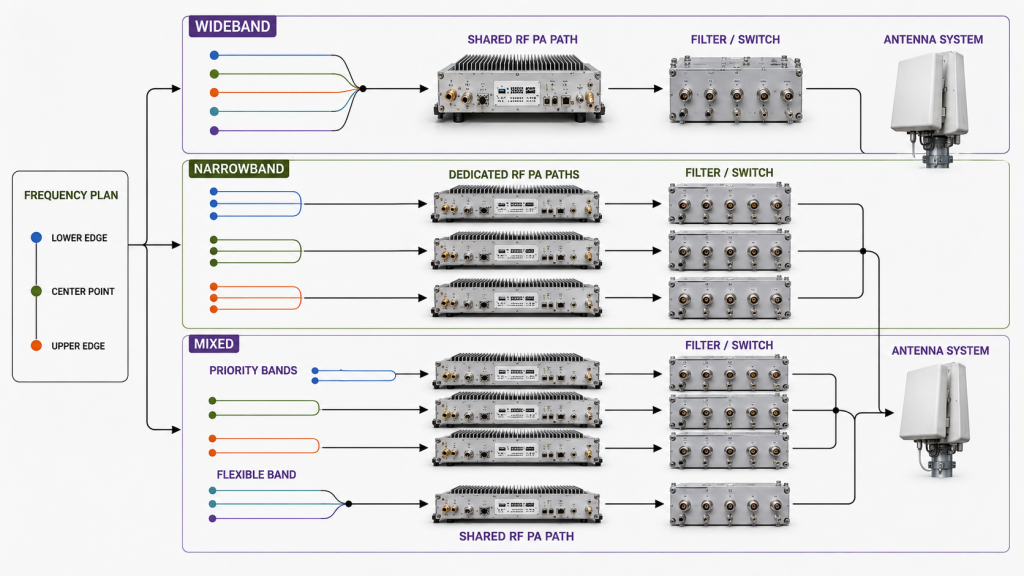
Choose wideband, narrowband, or mixed architecture
A wideband architecture may reduce hardware fragmentation when several frequencies can share a compatible PA platform, filtering strategy, antenna plan, operating mode, and cooling boundary.
A narrowband architecture may provide more room to optimize matching, efficiency, filtering, thermal margin, and output behavior around fixed critical frequencies.
A mixed architecture may assign dedicated narrowband paths to fixed priority frequencies while reserving a wideband path for changing or secondary requirements.
The detailed wideband, narrowband, and mixed RF PA architecture decision should be based on frequency assignment, simultaneous operation, RF-path consolidation, output margin, thermal capacity, and required evidence.
Possible future frequencies should affect the current architecture only when the project has a realistic and documented expansion requirement. Undefined future possibilities should not automatically force every channel into the widest available platform.
If the approved operating windows still do not fit a verified standard route, the project should compare additional verification, an adjusted standard platform, split-band paths, and a custom RF PA frequency range before approving a new PA design.
3. Calculate Usable Output and RF Power Margin
Rated wattage is not the final installed result.
The required RF power must first be defined as one of the following:
- CW output power;
- average RF output power;
- composite multi-carrier power;
- peak-envelope power.
It must then be tied to a defined measurement reference plane and converted into the necessary PA-port output.
For modulated or multi-carrier signals, the RFQ should also define:
- peak-to-average power ratio;
- required operating backoff;
- gain-compression limit;
- applicable linearity and spectral boundary.
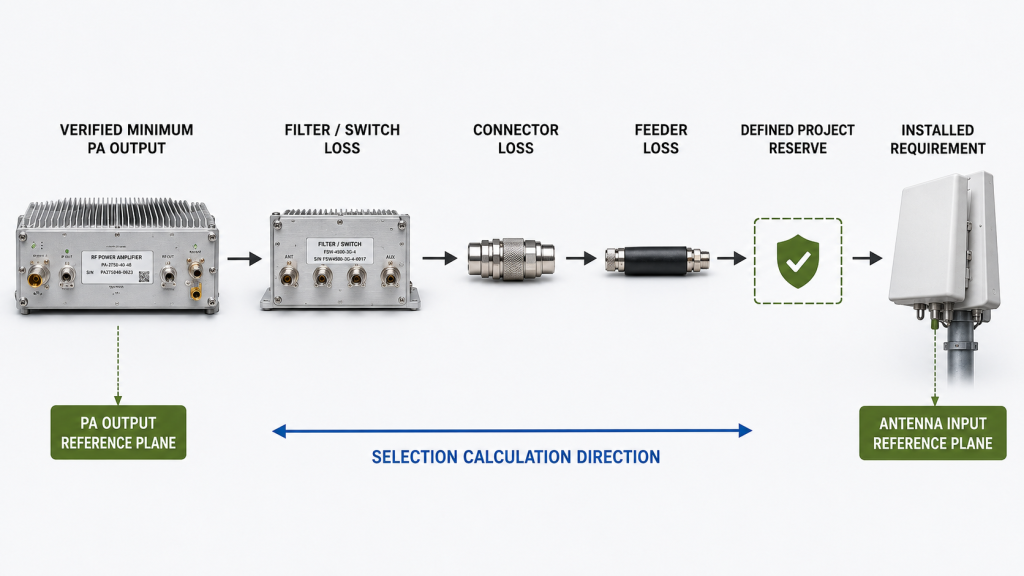
The power calculation may include:
- filter and switch loss;
- connector, bulkhead, and feeder loss;
- mismatch loss or reflected-power foldback under the agreed load boundary;
- temperature-related output variation not already included in the guaranteed minimum;
- loaded module-input voltage;
- production variation not already included in the guaranteed output;
- defined project reserve.
The detailed RF PA power-margin calculation should begin with the required installed result and work backward through the RF path.
Avoid double-counting margin
Use one consistent worst-case calculation method.
Do not add production tolerance, thermal derating, loaded-voltage variation, and supplier minimum-output margin twice when those effects are already included in a guaranteed hot-state result.
For example, a supplier’s verified minimum output may already include normal production variation, a defined loaded voltage, a specified temperature condition, and an agreed test duration. Those same effects should not be added again as separate losses unless the guaranteed result does not cover them.
Use verified minimum output
The project should distinguish between:
- typical output;
- minimum verified output;
- cold-state output;
- thermally stabilized output;
- CW, average, composite, or peak-envelope output;
- PA-port output;
- output at the required installed reference plane.
If the requirement is defined at the antenna input, the PA-port result must be combined with verified or calculated RF-path loss.
If the requirement is defined at the PA output connector, the system integrator still owns the calculation and verification of the downstream installed result unless another responsibility boundary is agreed.
Do not use arbitrary wattage upgrades
Moving to the next catalog power class does not automatically solve an RF-path problem.
Higher rated power may also increase DC current, heat, cabinet size, airflow demand, feeder stress, filtering requirements, mismatch consequences, and cost.
The correct module is the one that meets the required result and reserve at the defined reference plane without creating an unacceptable electrical, thermal, spectral, or RF-path burden.
4. Match Duty Cycle, 28 V DC, Platform, and Cooling
Duty cycle can change the correct module even when the frequency and rated power remain unchanged.
The RFQ should identify whether each path operates in short bursts, intermittently, for repeated long periods, continuously, or simultaneously with other channels.
Define the hot-state boundary
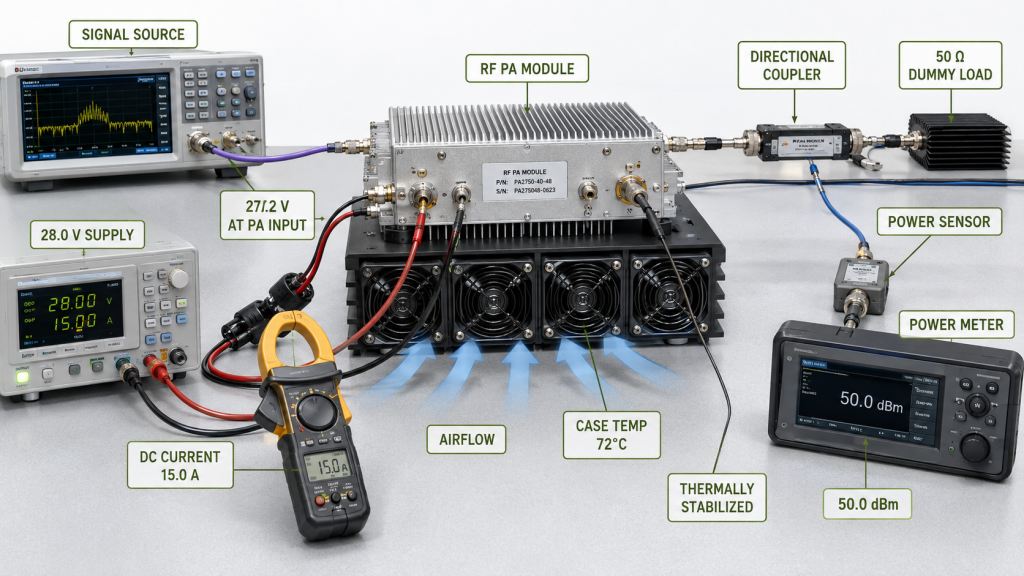
A short cold-state result does not prove stable long-duration performance.
The project should define:
- required operating duration;
- ambient and cabinet conditions;
- cooling configuration;
- thermally stabilized measurement point;
- acceptable output variation;
- required temperature and protection evidence.
The complete RF PA thermal design should address the path from the active device through the baseplate, thermal interface, heatsink, airflow, and cabinet exhaust.
Verify the actual 28 V DC condition
A nominal 28 V DC supply does not prove that the module receives the same voltage while producing RF power.
The test should record:
- supply setting;
- voltage at the module input;
- actual DC current;
- active RF state;
- RF output;
- temperature.
Cable resistance, connectors, fuses, relays, distribution boards, and shared current paths can reduce the loaded module-input voltage.
For steady-state comparison over the same measurement interval, average RF output power cannot exceed the combined DC input power and RF drive power. For a high-gain PA, a practical first check is that average RF output remains below the measured DC input power.
The DC power budget must include realistic conversion efficiency, distribution loss, simultaneous-channel demand, and project reserve.
For simultaneous operation, evaluate the combined current demand, thermal load, and supply drop rather than testing only one channel at a time.
Match the module to the platform
Platform review should cover:
- installation space and mounting;
- cooling and airflow responsibility;
- ambient and environmental conditions;
- 28 V DC distribution;
- vibration and maintenance boundaries.
Cooling responsibility must be explicit. A module supplier may provide only the PA, while the system integrator owns the heatsink, fans, ducting, cabinet airflow, and environmental margin.
5. Define RF Path, Protection, and Control Requirements
The PA cannot be selected independently of the filter, switch, feeder, antenna, load condition, and system control architecture.
Define the load boundary
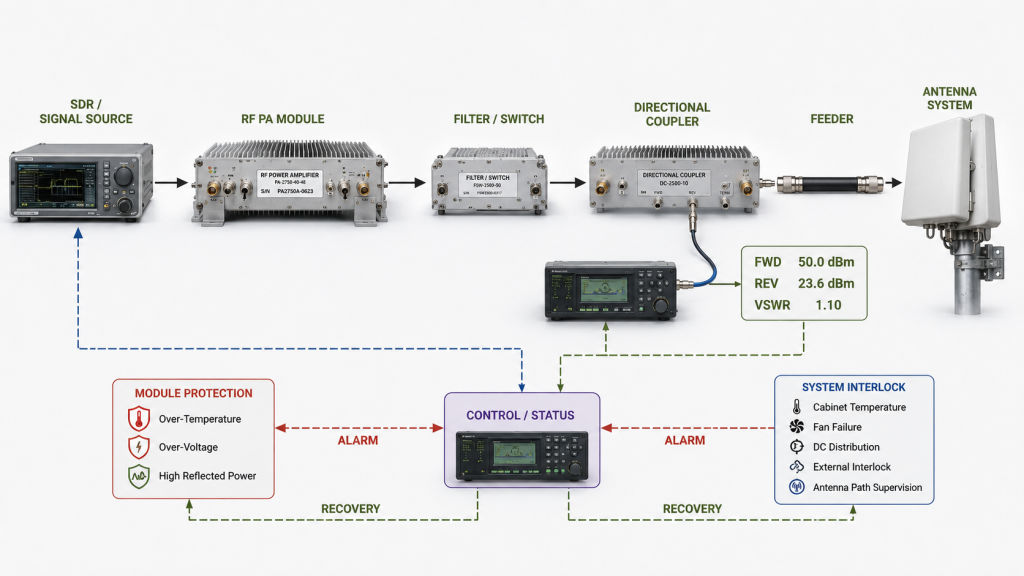
The RFQ should state:
- expected antenna frequency range;
- normal and maximum agreed VSWR;
- reflected-power boundary;
- feeder and connector assumptions;
- whether approval uses a dummy load, representative load, or installed antenna path.
Protection does not replace a suitable antenna and feeder path.
A module may survive a poor load while still reducing output, increasing temperature, entering foldback, or producing an unacceptable system result.
Define protection behavior
The project should define the required system behavior and require the supplier to disclose the module protection boundary.
The supplier should identify, where applicable:
- over-temperature threshold and tolerance;
- temperature sensor location or defined thermal reference point;
- over-voltage threshold and tolerance;
- voltage measurement point at the module input boundary;
- reflected-power or VSWR operating boundary;
- response delay;
- foldback, shutdown, or latch behavior;
- alarm and status condition;
- reset and recovery requirements;
- RF output state during the event.
A threshold is meaningful only when its sensor location or measurement point, tolerance, response delay, resulting RF state, and recovery condition are defined.
The customer does not need to define the internal design threshold directly. However, the supplier-declared threshold and the resulting behavior must be visible and testable before approval.
System-level protection remains a separate responsibility. Cabinet temperature, DC distribution, fan failure, external interlocks, antenna-path conditions, and supervisory control may require additional logic outside the PA module.
Define the control boundary
The RFQ should define the interface and addressing method, enable or inhibit behavior, gain or power control, status and alarm feedback, protection reset, and startup or timing boundary.
The detailed RF PA control interface review should confirm that the system can command, observe, and recover each required operating state.
Module behavior and system behavior must remain separate.
The supplier is responsible for documenting the module interface and internal response. The system integrator is responsible for supervisory logic, external interlocks, RF-path coordination, and cabinet-level recovery unless the contract assigns those functions differently.
6. Decide What Evidence Is Required Before Approval
A datasheet is suitable for initial screening. It is not sufficient for final module approval.
All suppliers should be compared against the same frequencies, signal conditions, input-drive levels, reference planes, operating states, load conditions, and evidence boundaries.
Evidence that can change module selection
Request evidence for:
- gain and output at required and critical frequencies;
- input-drive requirement and maximum input boundary;
- minimum verified output at the supplier-agreed module reference plane;
- hot-state output, voltage, current, and temperature;
- agreed load or VSWR condition;
- multi-carrier or simultaneous-channel operation, where required;
- gain compression, harmonics, spurious emissions, intermodulation, occupied bandwidth, or spectral regrowth where required by the waveform and RF architecture;
- protection behavior that may change usable output or availability.
Downstream installed-path verification should be assigned separately unless the supplier is contracted to deliver the complete RF assembly or cabinet.
A short cold-state screenshot should not approve a continuous, long-duty, modulated, or multi-carrier system.
Evidence required for delivery approval
Delivery evidence should remain traceable to the model, serial number, hardware or control version where applicable, test date, report revision, supplier-agreed module reference plane, verified control state, protection-test condition, and agreed responsibility boundary.
The complete C-UAS RF PA acceptance checklist should define which evidence is required before shipment and which installed-path checks remain the system integrator’s responsibility.
Supplier capability should be judged by whether the required engineering evidence, interface documentation, protection behavior, and unit-level traceability can be provided and explained.
RF PA Approval Boundary Matrix
Use the following status values: Not Reviewed, Pending, Pass, Conditional, Fail, or N/A.
| Selection Item | Project Boundary | Required Evidence | Responsibility Boundary | Status |
|---|---|---|---|---|
| Frequency | Required points and architecture | Frequency-specific results | Integrator defines; supplier proves | — |
| Signal and drive | Waveform, bandwidth, input level, gain, and backoff | Gain, compression, and spectral evidence | Integrator defines source; supplier proves module input boundary | — |
| Output | Required power type, result, and reference plane | Verified minimum output | Integrator defines plane; supplier proves agreed module output | — |
| Operating profile | Duty cycle and simultaneous states | Hot-state RF, DC, and thermal data | Integrator defines profile; supplier proves module behavior | — |
| RF path | Load, feeder, antenna, and VSWR assumptions | Module-port and installed-path evidence | Supplier: module port; integrator: installed path | — |
| Control and protection | Required interface and system response | Command, status, alarm, protection, and recovery evidence | Shared: module behavior vs system logic | — |
| Delivery | Model, S/N, versions, and report | Unit-level traceability | Supplier delivery responsibility | — |
The final matrix should replace these generic entries with actual project frequencies, signal conditions, limits, operating states, statuses, and contracted responsibilities.
RFQ Checklist: What to Send Before Quotation
Provide:
- Authorized required, conditional, and documented future frequencies
- Signal type, instantaneous bandwidth, expected input drive, required gain, and maximum input level
- Wideband, narrowband, or mixed architecture and simultaneous operating assumptions
- Required CW, average, composite, or peak-envelope RF power and measurement reference plane for each path
- Duty cycle and hot-state duration
- Worst-case module-input voltage, expected current demand, and available supply capacity
- Platform, cabinet, ambient, and cooling boundary
- Filter, switch, feeder, connector, antenna, and VSWR assumptions
- Control, alarm, protection, reset, and recovery requirements
- Required frequency, hot-state, spectral, load, and simultaneous-operation evidence
- Quantity, delivery phase, and unit-level traceability requirements
- Supplier and system-integrator responsibility boundary
A request containing only a frequency range and wattage does not define enough information for engineering approval.
Conclusion
C-UAS RF PA selection should follow a controlled sequence.
Define the lawful system boundary first. Then define the signal and drive condition, select the frequency architecture, calculate usable output and margin, confirm duty cycle and 28 V DC conditions, match the module to the platform, define RF-path and control responsibilities, and require comparable evidence.
The correct module is not necessarily the one with the widest frequency range or highest rated wattage. It is the one that meets the project’s frequency, drive, waveform, output, electrical, thermal, spectral, RF-path, control, protection, and evidence boundaries under the same defined operating conditions.
Send the approved frequency plan, signal and drive condition, required RF power and reference plane, operating profile, 28 V DC and platform limits, RF-path assumptions, control and protection boundary, quantity, and required acceptance evidence.
RF SKYPOWER can review whether a standard or custom RF Power Amplifier Module fits those same input, output, electrical, thermal, spectral, RF-path, control, and evidence conditions before the RFQ and cabinet design are locked.