


Broadband vs narrowband RF PA modules can be compared fairly only when the results describe the same engineering requirement. A broadband RF power amplifier may cover more frequencies, while a narrowband model may offer more room for band-specific optimization. Neither label proves better usable output, efficiency, linearity, or thermal performance. The test conditions and the evidence behind the numbers decide whether the comparison is valid.
A datasheet showing 100 W at one frequency cannot be ranked directly against another showing 100 W at a different input drive, reference plane, waveform, or temperature. The same applies when one figure is measured at a PA connector and another includes downstream cable or filter losses. Before shortlisting either module, define what must match and identify which supplier claims are not yet comparable.
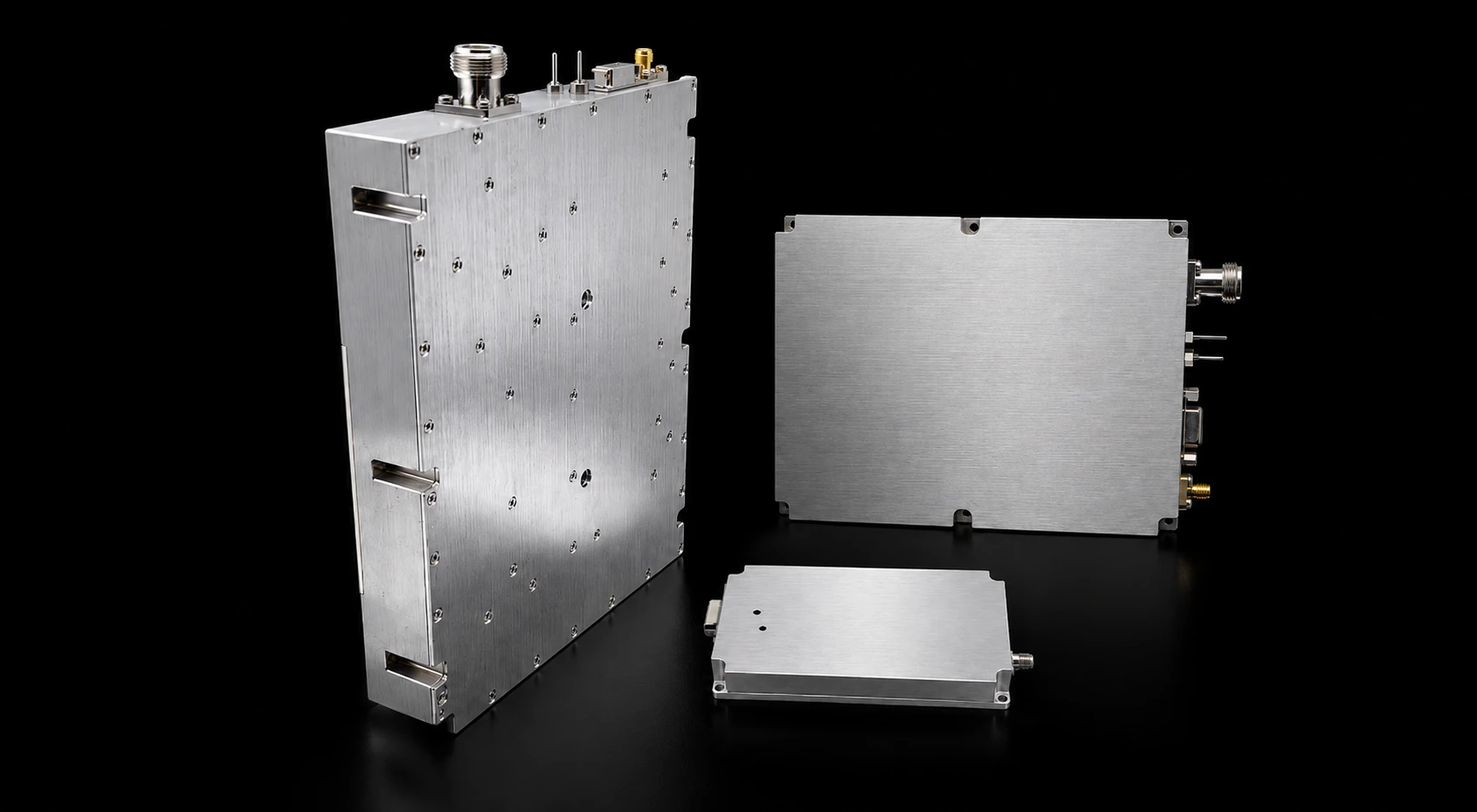
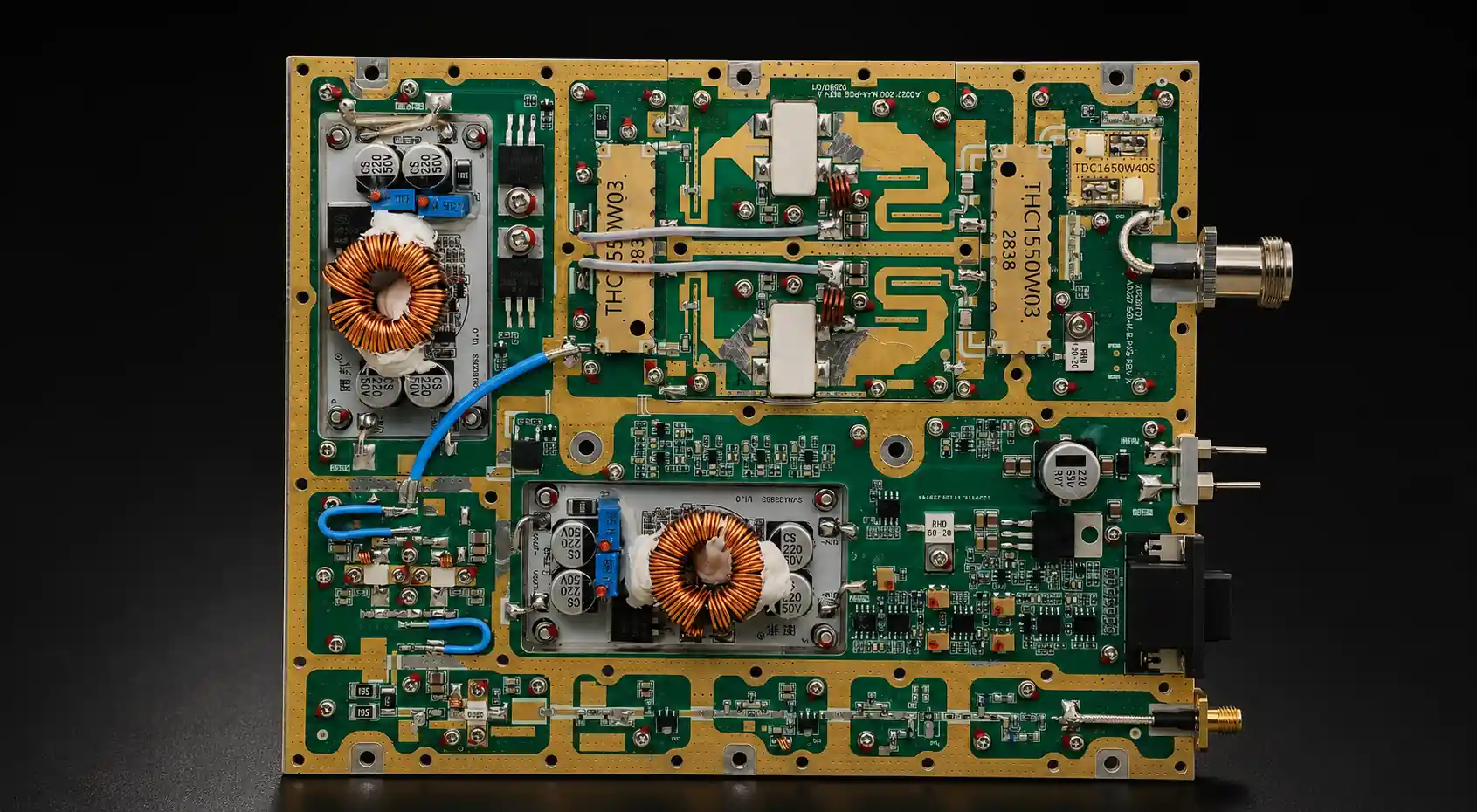
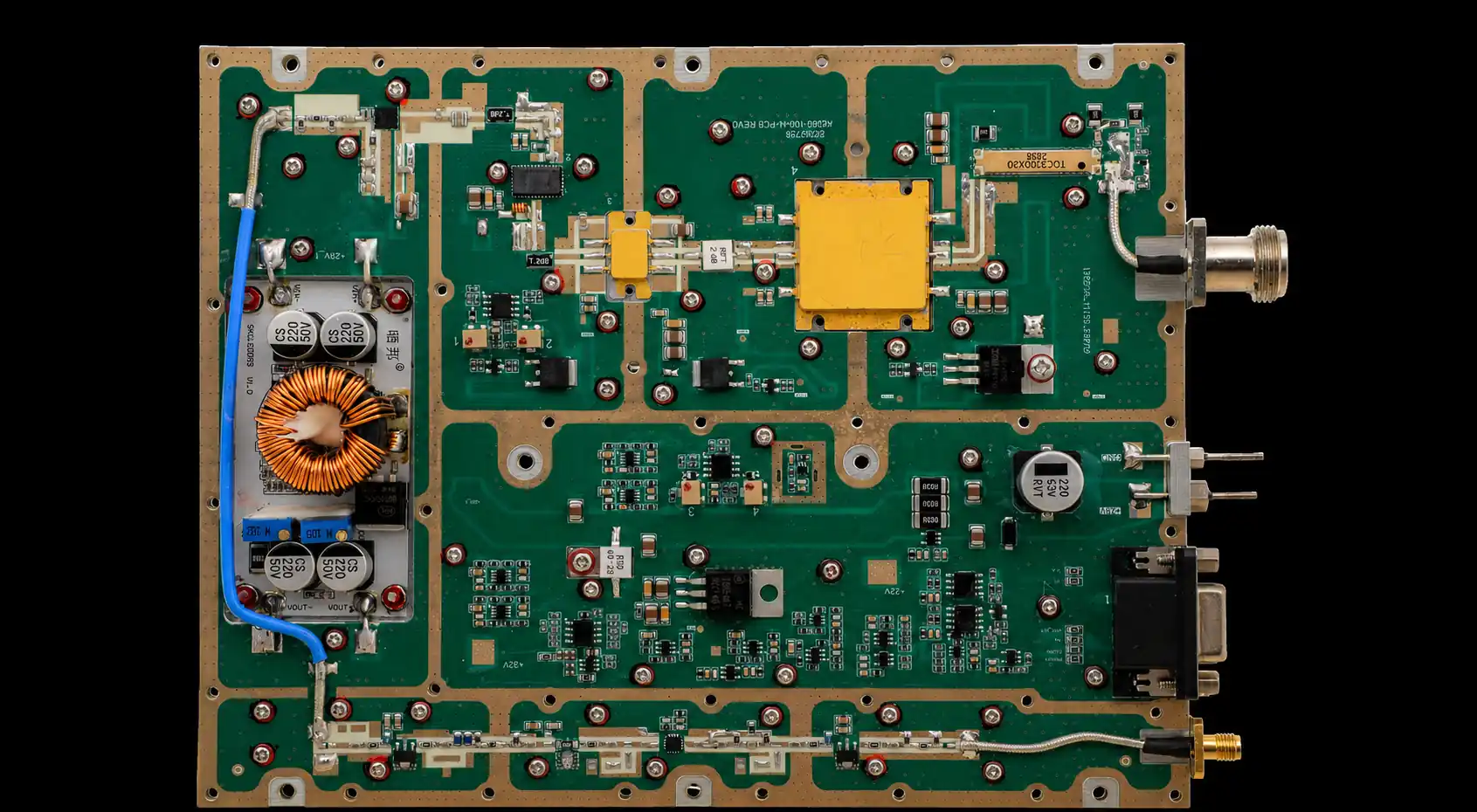
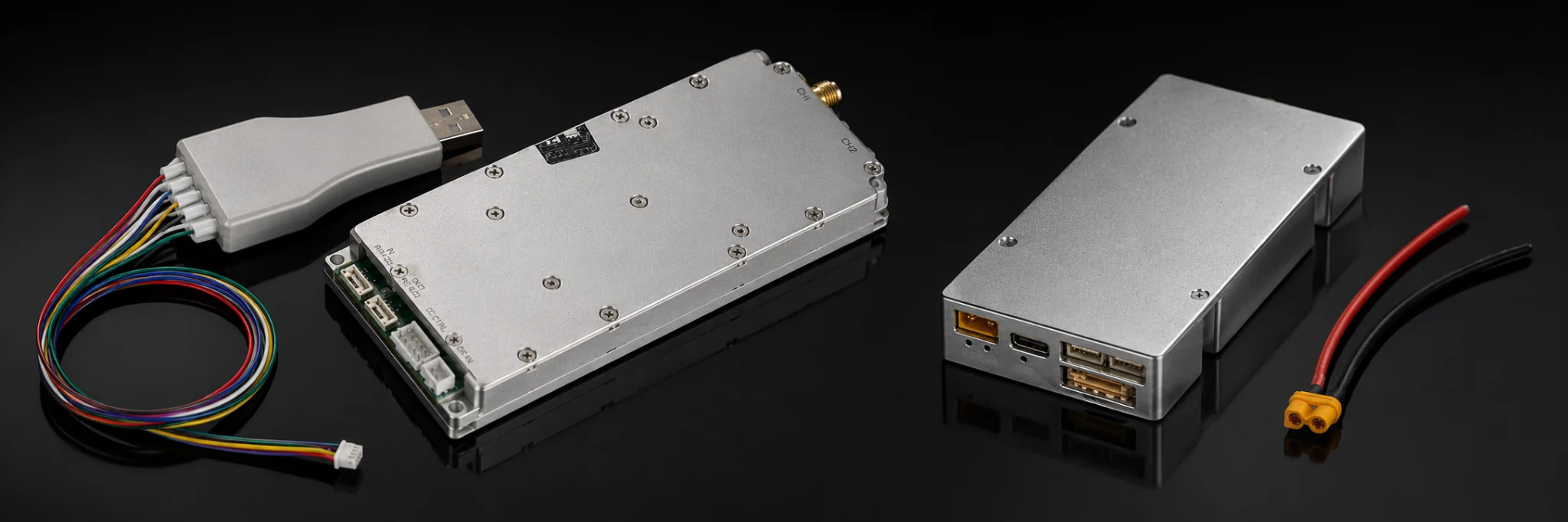
The RF Power Amplifier Modules product range provides a starting point for identifying standard or custom candidates. Model availability and published frequency coverage are discovery inputs; they do not replace condition-matched evidence.
What Must Match Before Broadband and Narrowband RF PA Ratings Can Be Compared?
Start with the application requirement, not a pair of maximum ratings. Record the project-critical frequencies, the signal that the module must amplify, the output needed at a named reference plane, the required operating duration, and the DC and cooling boundaries. Both candidates must be assessed against the same application requirement, even if their supported frequency ranges differ. A candidate covering only part of the mandatory frequency set cannot be called a full-range substitute; assess its supported portion separately. The modules need not have identical gain or RF input power.
Two suppliers can reach the same required output with different input drive and test arrangements. A sound comparison separates the common project conditions, each module’s capabilities, and the evidence used to verify the result:
- Common requirement: the same required frequency points, waveform or occupied bandwidth, usable output target, load assumption, ambient and cooling conditions, and pass/fail criteria.
- Candidate-specific capability: available gain, Actual Pin needed to reach the required output, maximum permitted drive, compression behavior, frequency response, DC consumption, and protection limits.
- Evidence condition: the measured or corrected reference plane, input state, load, temperature, duration, instrumentation and calibration method, and sample or unit covered by the result.
For example, suppose Candidate A needs more input drive than Candidate B to deliver the project’s required output. That alone does not disqualify A. Check whether the signal source can supply the required power with appropriate margin, whether an external driver is needed, and what that driver adds to DC input, heat, compression, and spectral behavior. Compare the system burden required to meet the same output, rather than rewarding a candidate merely because it was driven harder in a supplier’s test.
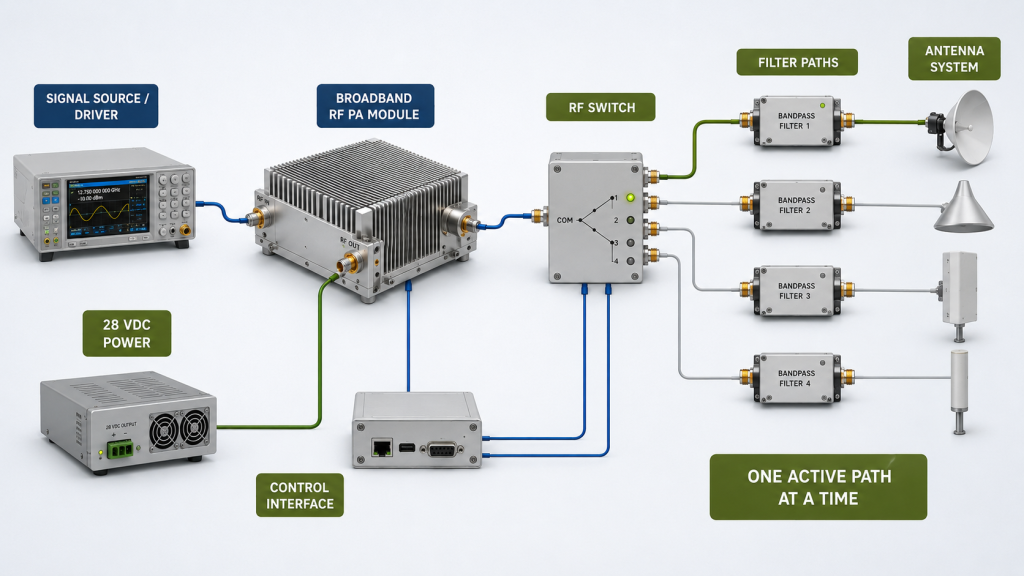
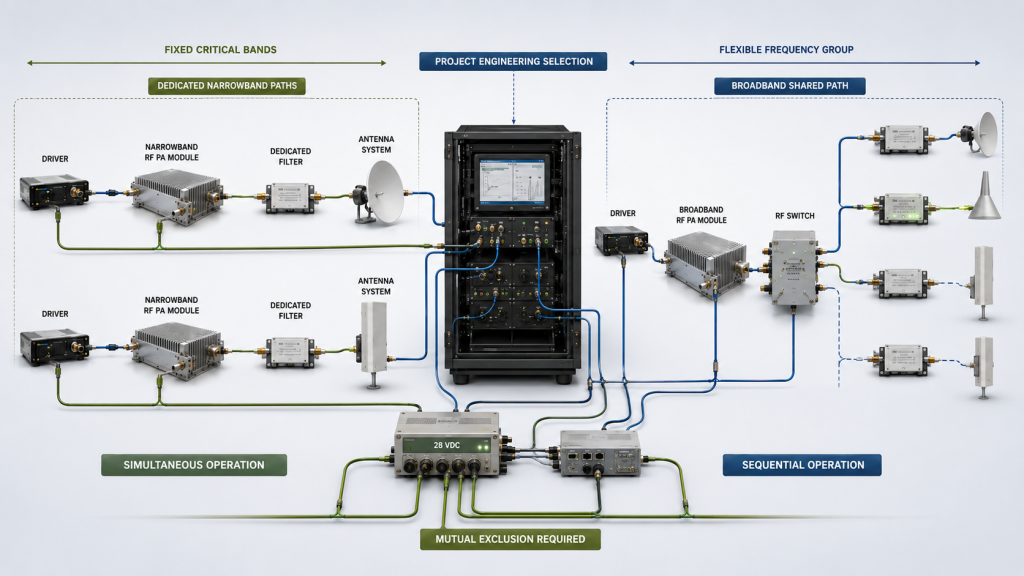
A switched broadband chain may reduce PA variants yet retain separate filters or antennas for distinct operating states. That architecture illustration is a boundary for system planning; it does not establish the performance of any individual amplifier. If the real decision is how to assign C-UAS frequencies to one path or several paths, the C-UAS frequency-range selection process should first define the approved windows and their operating relationship.
What Do Bandwidth Limits and Band-Edge Data Actually Show?
Broadband and narrowband are relative descriptions, not universal performance grades. The published lower and upper frequency limits tell you where a candidate is intended to operate. They do not guarantee the same gain, output, matching, stability, or efficiency at every point inside that range.
For a contiguous required band, fractional bandwidth can be expressed as:
Fractional bandwidth = (fH − fL) / fC
Here fH and fL are the upper and lower frequency limits, and fC is the agreed center frequency. Use one consistent center-frequency convention when comparing bands. For multi-octave coverage, also state the upper-to-lower frequency ratio or octave span; one fractional-bandwidth number does not describe every matching and filtering challenge. Separate an amplifier’s overall tunable or usable frequency coverage from the signal’s instantaneous bandwidth.
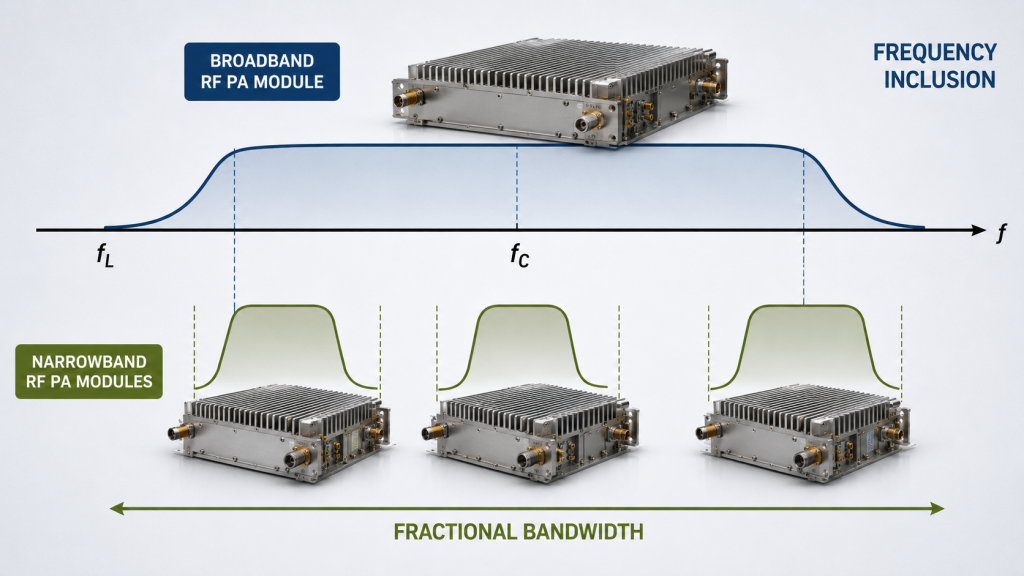
Check the exact operating points, not only the published range. For both candidates, request the corresponding gain and output at the mandatory frequencies, including difficult edges or transition regions. A continuous sweep is useful when the claim concerns the whole band, while results at a handful of points support only those points. Neither a favorable center-frequency result nor one golden-sample sweep establishes a minimum for every manufactured unit.
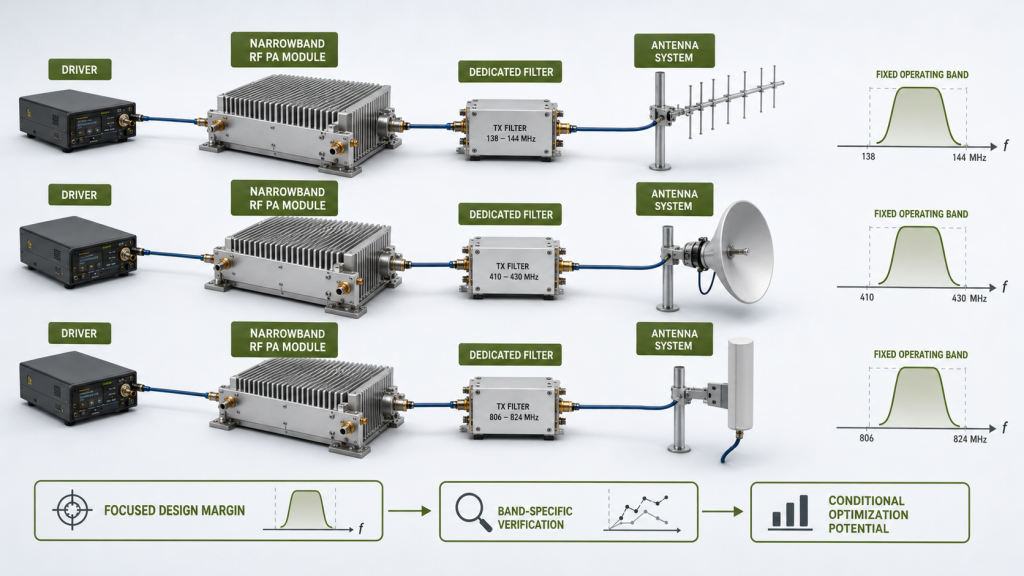
A narrowband module can make matching and band-edge optimization more focused. Its narrower frequency range alone does not prove higher efficiency, cleaner spectrum or stronger usable output under the required operating conditions. The buyer still needs measured data under the required signal and load conditions.
How Should Input Drive, Output Power, and Reference Planes Be Aligned?
Begin with the output the project needs, including whether it refers to CW power, average power for a specified modulated waveform, composite multi-carrier power, or peak-envelope power. A 100 W CW figure and a 100 W modulated average-power requirement are different claims when compression and linearity limits apply.
Drive cannot be normalized by demanding the same numerical Pin for every module. First test each candidate at the input level appropriate to achieve the same required usable output while respecting its permitted drive and backoff limits. Record Actual Pin delivered at the PA input reference plane, not just the signal generator setting; account for source-path loss or input mismatch where relevant, and list source power, gain, return loss or VSWR, waveform, drive margin and any external driver. If the comparison is specifically a fixed-drive characterization, say so and do not turn its raw Pout ordering into a project suitability ranking.
Next, define the measurement reference plane. Report whether output power was measured at the PA output connector, after a cabinet filter or switch, at the end of a feeder, or at the antenna input. A narrowband candidate with a dedicated filter cannot be fairly ranked against a broadband candidate using an uncorrected result at a different point along the RF path.
Record raw versus corrected readings as separate fields. For each result, the correction record should name the calibration plane, raw instrument reading, cable/attenuator loss, coupler factor and its frequency-dependent calibration, applicable uncertainty and any directional-coupler directivity limit that affects interpretation of forward or reflected power. If the measurement chain cannot be traced to a comparable plane, mark the claimed power difference not comparable yet and request the missing setup or correction evidence.
Input match is also conditional. S11 under a declared bias and signal condition helps describe what the source sees, but it is not the same as guaranteed delivered drive through a real switching network. Keep the source baseline and the actual PA-input condition separate when interpreting gain or compression.
The RF power amplifier output-power reference-plane guidance explains how output changes when the reference plane moves downstream. For the module comparison, document the corrected plane for every reported power result.
How to Compare Efficiency, Driver Burden, and Hot-State Heat Fairly
A narrower operating band can give a designer more freedom to optimize matching, bias, or harmonic termination. Whether that produces better efficiency depends on the exact device, gain stage, drive level, waveform, output, voltage, load, and temperature. A broadband-versus-narrowband comparison must use efficiency figures with the same definition and equipment boundary.
Three common quantities must be kept distinct:
- Drain efficiency (ratio): RF output power ÷ DC power delivered to the active device drains.
- Module DC-to-RF efficiency (ratio): RF output power ÷ total DC power entering the defined module boundary.
- Power-added efficiency, PAE (ratio): (RF output power − RF input power) ÷ DC power entering the declared PAE boundary. A stage-level PAE denominator can differ from a module-level denominator.
Calculate Pout, Pin and Pdc using the same-scale linear powers in watts over the declared test condition and interval. Report the resulting dimensionless efficiency ratio, and multiply that ratio by 100% only when expressing it as a percentage. Do not subtract dBm values and divide that result by a DC watt figure. If suppliers use different drain, stage, or module DC boundaries, their published percentages must not be ranked as though they measure the same quantity. The detailed PAE versus drain-efficiency comparison covers those boundaries separately.
An external driver can change the apparent result. If a lower-gain PA needs an added driver, include the driver’s DC demand and cooling contribution in the installed comparison while keeping module-only results visible. Do not silently fold driver loss or heat into one candidate but exclude it from the other.
For both modules, ask for voltage at the specified supply terminal, current, RF output, input condition, temperature and cooling setup at each required operating point. A 28 V nominal supply specification is not proof that both devices saw the same voltage under load. Hot-state current and output after the agreed dwell time may differ from cold-start readings. A PA that briefly reaches a target wattage can still fall short of the application’s sustained output or cooling boundary.
Compare sustained usable output and thermal behavior at the specified operating state using compatible measurements. Neither bandwidth class has an inherent efficiency winner.
How to Compare Linearity, Matching, Mismatch, and Stability Evidence
Output at the required power level should be interpreted alongside the signal and spectral acceptance criteria. A CW sweep can establish gain and output trends, but it cannot by itself prove modulated-signal linearity. If the application depends on ACPR or ACLR, EVM, IMD, occupied spectrum, or multi-carrier composite behavior, request evidence for an appropriate representative waveform and power level. Preserve the signal-generator or SDR source baseline and the measuring chain’s contribution.
Two modules may show similar output on a 50 Ω dummy load but react differently to a real RF path. Input return loss, output return loss, and powered mismatch tolerance answer different questions. Small-signal S22 measured under a defined bias or small-signal state must not be presented as evidence that the amplifier can sustain a specified reflected-power condition at operating power.
Where mismatch behavior affects acceptance, define forward and reflected power at a stated reference plane, load VSWR or reflection boundary, drive state, duration, operating temperature, and expected protection and recovery response. If mismatch phase coverage is part of the project requirement, state that requirement separately; a single favorable load cannot prove all mismatch states.
RF stability also depends on voltage, drive, load, output frequency, temperature, startup/shutdown states and any attached driver or filtering. Request no-drive spectral checks or state-transition evidence where those conditions materially affect approval. Avoid claiming that a wider or narrower frequency span alone prevents instability.
Some systems use dedicated critical paths beside shared paths. Such a mixed configuration illustrates why the load, cooling, switching and simultaneous-operation state cannot be copied from one test to another. The separate wideband-versus-narrowband C-UAS architecture comparison covers when distinct RF paths are justified. Module-level comparisons must still use the actual PA candidates’ measurements.
What Does a Supplier’s Test Evidence Prove—and What Does It Not?
A datasheet and a test report establish different scopes. Measurements at a few listed frequencies support those points; a full-band claim needs the recorded swept range, frequency step, calibration, operating state and identified module. A cold reading also cannot establish sustained hot-state output without the matching dwell and cooling conditions. The operating window supported by the report determines which performance rows the buyer can compare.
Delivery coverage is a separate question. A golden or representative sample supports only its stated model, hardware/software revision and test conditions. An S/N-linked report can support the particular delivered unit under those conditions, but cannot guarantee every unit in a batch. Likewise, a calibrated 50 Ω load supports the defined PA test boundary; filters, switches, feeders and the antenna path require their own installed-chain evidence. A candidate remains conditional wherever a claim extends beyond that reported scope.
A side-by-side test arrangement is useful only when the instrumentation, applied corrections, RF load, cooling and reference plane are understood. A test-chain illustration identifies possible measurement connections; acceptance depends on the report for the specific sample or delivered serial number.

Where the RFQ requires delivered-unit traceability, request an S/N-linked One Report One Unit record with the exact model, revision and measurement conditions. A report format does not guarantee full-band, hot-state or batch performance; those claims require matching tests and acceptance limits.
What to Request Before the Broadband–Narrowband Module Comparison Is Accepted
A comparison based on cold CW output from one supplier and hot-state modulated power from another is misleading. The shared sheet below separates the project requirement, the measured module result and the evidence needed before the two claims can be ranked.
| Comparison item | Common decision boundary | Record separately for each candidate | Hold the comparison if… |
|---|---|---|---|
| Frequency and bandwidth | Approved operating points, signal bandwidth and coverage scope | Tested points or sweep, edges, model/revision | One claim covers only spot points while the other implies the whole band |
| Usable RF output | Required CW or specified waveform power at one defined plane | Actual output, gain, backoff, test waveform and operating state | Power definitions or reference planes differ without traceable correction |
| Input and driver | Same source constraints and required usable output | Actual Pin, source margin, input limits and driver needs | An external driver or source limit is ignored |
| Efficiency and DC | Same selected efficiency definition, power state and module boundary | Pout, Pin, Pdc in W; calculated ratio and percentage; voltage/current | PAE, drain and module figures use different denominators |
| Thermal operation | Same duration, ambient/cooling boundary and required duty | Stabilized output, current, temperature and protection status | Cold data are compared with stabilized hot-state data |
| Load and spectral behavior | Defined load/VSWR, waveform, spectral and stability criteria | S11/S22 context, mismatch response, ACPR/EVM/IMD where relevant | Small-signal or CW results are substituted for powered or modulated acceptance |
| Measurement method | Same named RF reference plane, traceable instrument state | Raw/corrected values, calibration and path-loss uncertainty | Correction factors or coupler limitations are missing |
| Evidence scope | Required model, revision, serial number, frequency and delivery coverage | Datasheet / sample / one-unit / batch record and limits | One unit’s limited results are generalized to all units or frequencies |
Mark each comparison row Comparable, Conditional, or Hold: missing evidence. Conditional means the remaining difference is understood and bounded; it does not convert an untested requirement into a pass. Once the comparable rows cover the critical requirements, the system integrator can make a separate architecture decision using the approved RF-path and operating-state plan.
Before contacting any supplier, send the same comparison sheet to each candidate and ask for a direct reply against the missing rows. For an RF SKYPOWER engineering review, include the critical frequencies, signal and occupied bandwidth, target output with reference plane, available RF input, module supply and cooling limits, load condition, duty and hot-state requirement, plus the exact unit or batch evidence expected.
Conclusion
Compare broadband and narrowband RF PA modules through measured, condition-matched performance, not the bandwidth label or the highest advertised wattage. The comparison is defensible when the required frequencies, signal and usable output are defined, each candidate’s Actual Pin and driver burden are recorded, efficiency uses compatible watt-based denominators, and raw or corrected RF results refer to the same reference plane.
If calibration, operating-state or sample-coverage evidence is missing, do not rank the candidates. Request the specific missing report or measurement before claiming either module is technically better. This module-level comparison does not qualify the installed RF path or decide whether the final C-UAS system should be broadband, narrowband, or mixed.
Complete the comparison sheet and identify every unsupported claim first. RF SKYPOWER can then review the defined module requirements and the evidence needed for a technically comparable RFQ.