


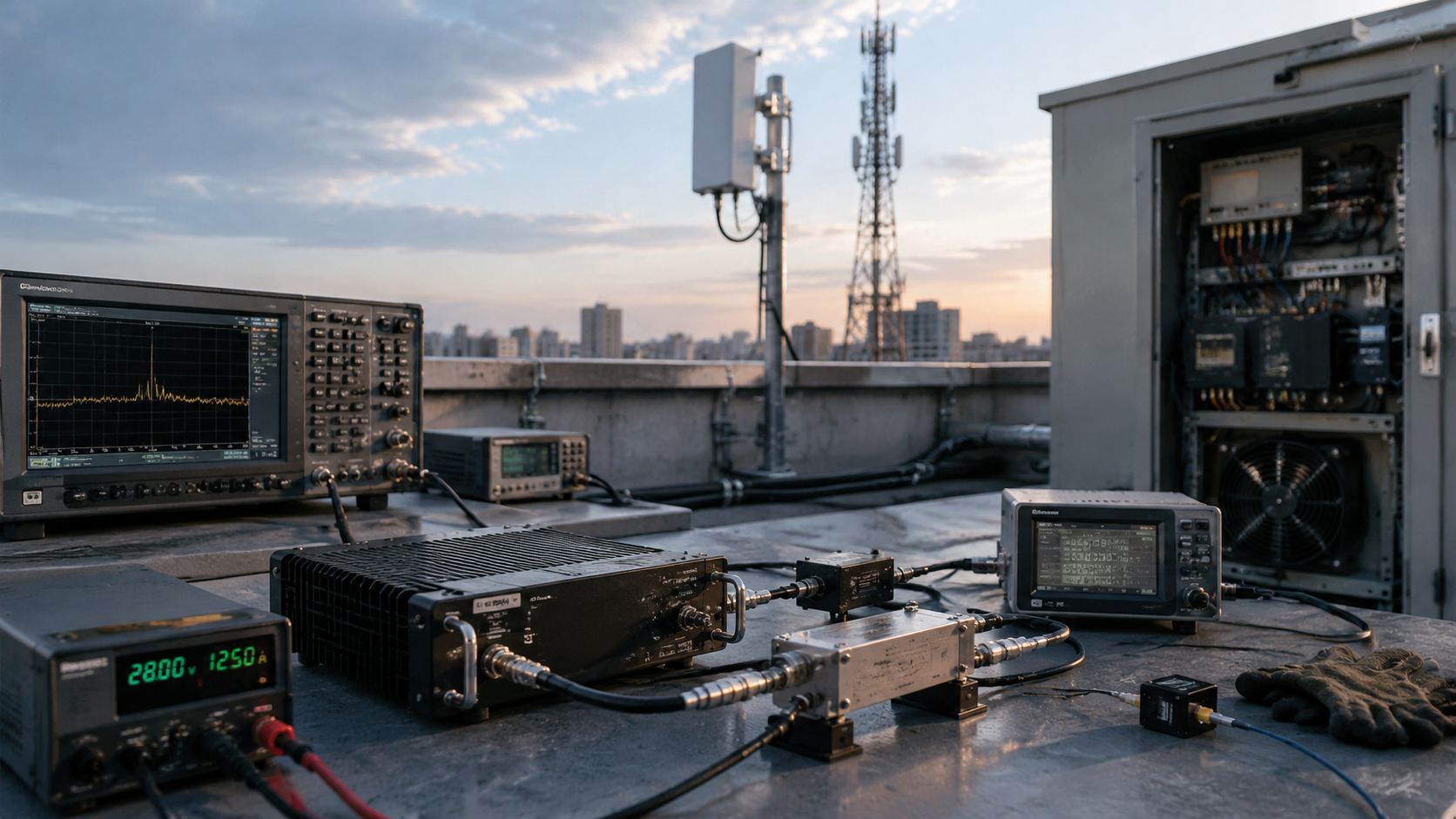
RF PA gain can look like one simple dB value—and still describe a completely different operating condition from the gain number shown in another quotation or test report.
Small-signal gain is normally measured at low input drive. Large-signal gain is calculated at a stated input and output condition, often closer to the output level the project will actually use.
Both results can be technically valid.
The risk begins when a typical low-drive gain value is used to predict target output, compare two modules, define SDR drive, or approve a PA that is already approaching compression.
At defined RF input and output reference planes:
Gain (dB) = Pout (dBm) − Pin (dBm)
The equation is simple. The evidence boundary is not.
Frequency, actual Pin, corrected Pout, reference planes, signal condition, supply voltage, load, temperature, and operating duration all affect whether two gain values are comparable.
RF Power Amplifier Modules should therefore be compared using condition-linked gain evidence—not one isolated typical value.
Before approving the PA, the project must answer one question:
Which gain number describes the operating point the system will actually use?
1. What RF PA Gain Actually Measures
RF PA gain describes the difference between RF output power and RF input power under a defined operating and measurement condition.
If the actual input at the PA input connector is 10 dBm and the corrected output at the PA output connector is 50 dBm, the module-level gain is 40 dB.
That calculation uses the PA’s own RF input and output reference planes.
If Pout is measured at a cabinet output, feeder output, or another downstream point, the result includes the effect of the installed RF path unless it is corrected back to the defined PA output plane.
This creates an important distinction.
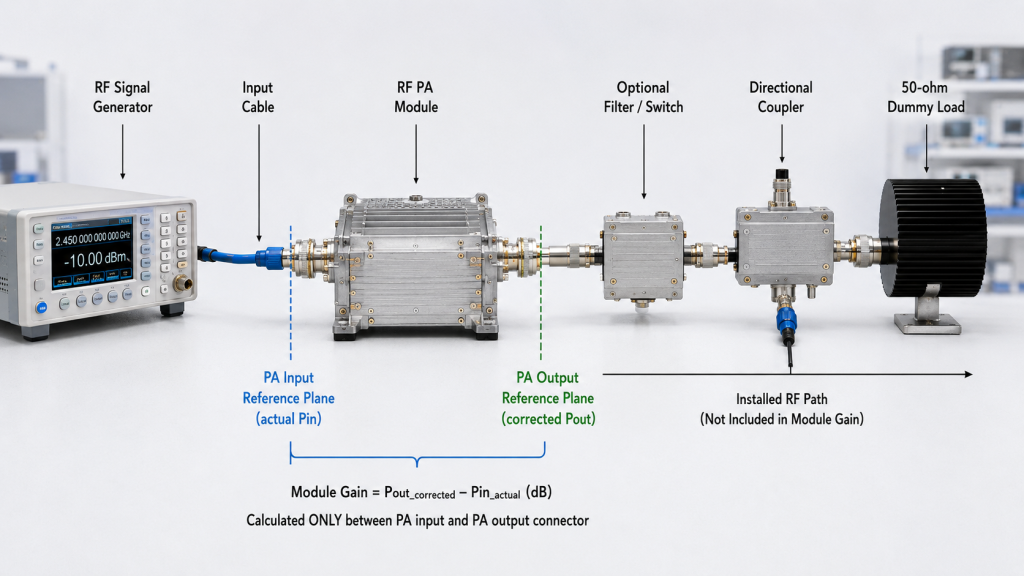
PA Module Gain
PA module gain normally compares:
- actual Pin at the PA input reference plane;
- with corrected Pout at the PA output reference plane.
This result describes the module-level input-to-output relationship.
PA-Plus-Path Gain
An installed-path result may compare PA input power with output measured after:
- a filter;
- a switch;
- a directional coupler;
- a cabinet cable;
- a feeder;
- or another downstream component.
This result may be useful for system integration, but it should not be presented as module gain unless the downstream path is corrected out.
A gain result is meaningful only when the record defines:
- frequency;
- actual Pin;
- corrected Pout;
- input and output reference planes;
- path corrections;
- supply condition;
- load;
- thermal state;
- and signal or waveform condition where relevant.
A signal-generator setting is not automatically the actual PA input.
Cable, connector, adapter, attenuator, filter, switch, or driver-stage loss may reduce the power reaching the PA connector. Gain calculations should therefore use the actual RF PA input power at the defined input plane.
Small-Signal Gain
Small-signal gain is measured using relatively low input power.
It can support:
- early frequency-response screening;
- signal-path verification;
- low-drive frequency comparison;
- initial matching or tuning;
- and broad gain-variation review.
It does not prove that the same gain will remain available near the project’s required output.
As output rises, the PA may experience greater current, temperature, compression, load sensitivity, supply drop, or protection interaction.
Large-Signal Gain
Large-signal gain is calculated at a defined operating point.
That point should identify:
- actual Pin;
- resulting Pout;
- frequency;
- module-terminal voltage;
- load condition;
- thermal state;
- and operating duration.
Large-signal gain does not have to mean gain at the absolute maximum rated output.
A project may need gain evidence at 30 W, 50 W, 100 W, or another specified output level.
The important question is not whether the result is labelled “full-power gain.” It is whether the result belongs to the operating point the project intends to use.
2. Why Small-Signal and Large-Signal Gain Differ
Small-signal and large-signal gain can differ even when both measurements are correct.
At low drive, the PA may operate in a region where output rises approximately in proportion to input.
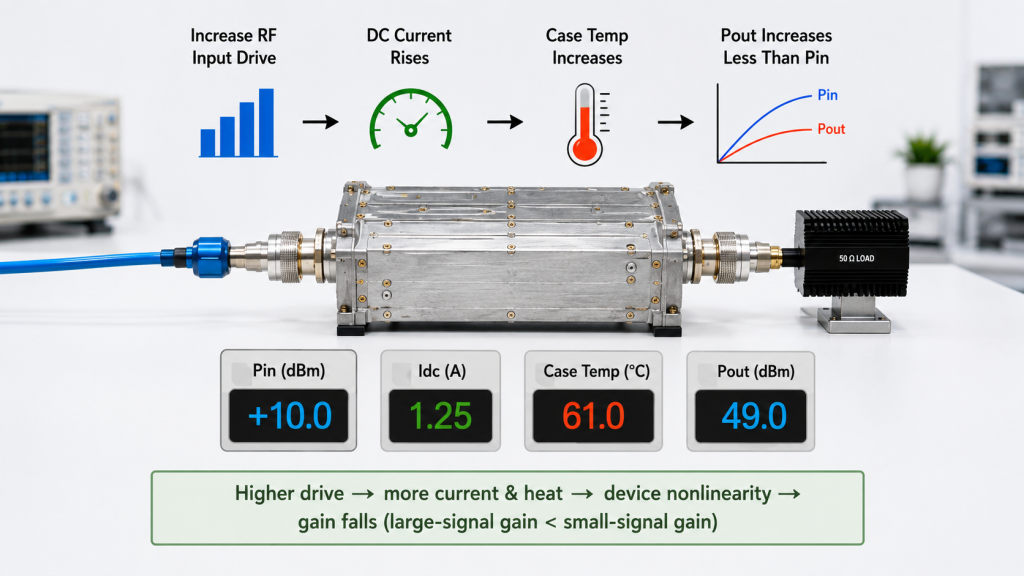
As Pin increases:
- the active device moves closer to compression;
- current rises;
- the module heats;
- matching behavior may change;
- loaded supply voltage may fall;
- and load or protection behavior may begin to influence the result.
Small-signal gain may therefore be higher than gain measured at the required output condition.
This does not automatically indicate a defective PA.
It may simply show that the two numbers describe different operating points.
Typical, Minimum, and Measured Gain Are Not Equivalent
A quotation or datasheet may present several kinds of gain evidence.
Typical Gain
Typical gain describes representative or commonly observed performance.
It may support preliminary selection, but it does not automatically define the minimum performance of every delivered unit.
Minimum Gain
Minimum gain defines an acceptance boundary only when the applicable:
- frequencies;
- input-drive condition;
- output operating point;
- reference planes;
- supply;
- load;
- and thermal state
are also stated.
A minimum value without defined conditions remains ambiguous.
S/N-Linked Measured Gain
Unit-level measured gain is connected to:
- one delivered module S/N;
- its controlled configuration;
- the actual Pin;
- the corrected Pout;
- and the applied test condition.
This proves what that individual unit achieved under the recorded boundary.
A typical value supports preliminary selection, a minimum value defines an acceptance boundary, and an S/N-linked measured value proves what the delivered unit actually achieved.
RF PA Gain Evidence Formats
| Evidence Format | Operating Boundary | What It Shows | Main Limitation |
|---|---|---|---|
| Small-signal gain | Low Pin at a defined frequency | Low-drive response | Does not prove target-output behavior |
| Large-signal gain | Defined Pin and Pout operating point | Gain at that stated point | Does not locate compression by itself |
| Pout-versus-Pin sweep | Multiple Pin values | Drive requirement and compression trend | Does not prove hot-state or installed-path behavior by itself |
| Swept gain / gain flatness | Multiple frequencies | Gain variation across the band | Does not prove usable Pout by itself |
A quotation that states only:
Typical Gain: 45 dB
does not reveal whether that value is representative, guaranteed, measured at low drive, measured near the target output, or linked to the delivered unit.
3. How Compression Changes the RF PA Gain Number
Gain compression begins when increasing Pin no longer produces the same proportional increase in Pout.
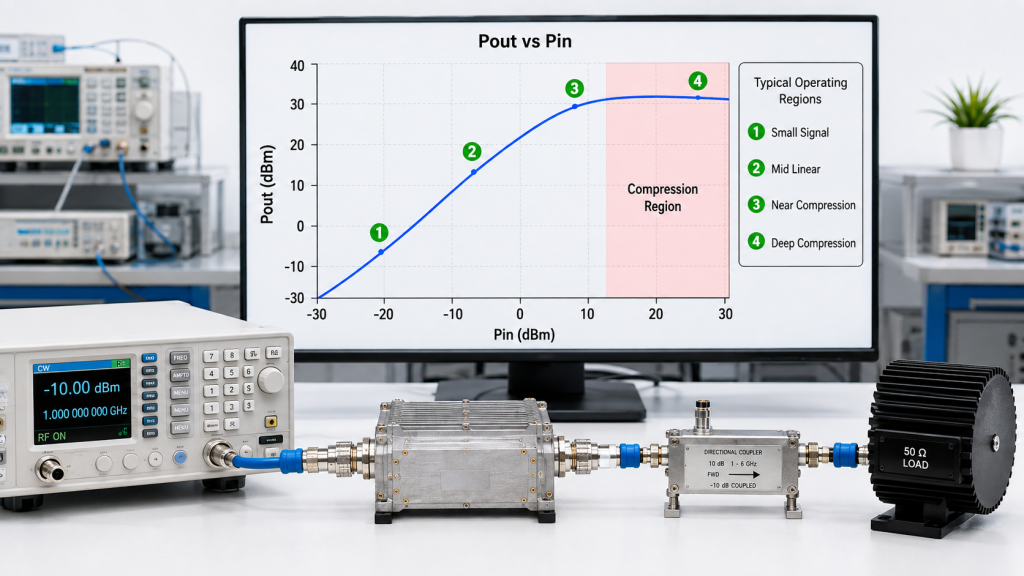
The following values are illustrative rather than specifications for a particular module:
| Actual Pin | Corrected Pout | Operating-Point Gain |
|---|---|---|
| 0 dBm | 42 dBm | 42 dB |
| 5 dBm | 47 dBm | 42 dB |
| 8 dBm | 49 dBm | 41 dB |
| 10 dBm | 50 dBm | 40 dB |
At lower drive, each additional dB of Pin produces a similar increase in Pout.
Closer to compression:
- output increases by less;
- operating-point gain falls;
- current and temperature may continue to rise;
- additional input produces limited useful output;
- and the PA may approach thermal or protection boundaries.
One Gain Point Does Not Show Remaining Margin
A single large-signal gain result proves only the input-to-output relationship at that operating point.
It does not show:
- where compression began;
- whether another 1 dB of Pin will produce another 1 dB of Pout;
- how close the PA is to saturation;
- whether protection will begin at the next drive step;
- or how much useful output margin remains.
This is why one large-signal gain value cannot replace Pout-versus-Pin data where drive margin matters.
When the source is an SDR, SDR drive margin should be checked against the Pin required for target Pout and the PA input boundary rather than inferred from one gain value.
Why Pout-versus-Pin Data Matters
A controlled drive sweep helps identify:
- the Pin required to reach target output;
- whether the available source provides enough drive;
- where gain begins to decline;
- whether more drive still creates useful output;
- and whether two modules are being compared at similar operating points.
A module with higher small-signal gain may require less drive at low output but still provide no additional usable Pout near the project target.
Another module may show lower typical gain while maintaining a more useful relationship between Pin and Pout at the required operating point.
The project should therefore compare:
Actual Pin, corrected Pout, operating-point gain, and compression trend together.
Modules should not be ranked by one gain number alone.
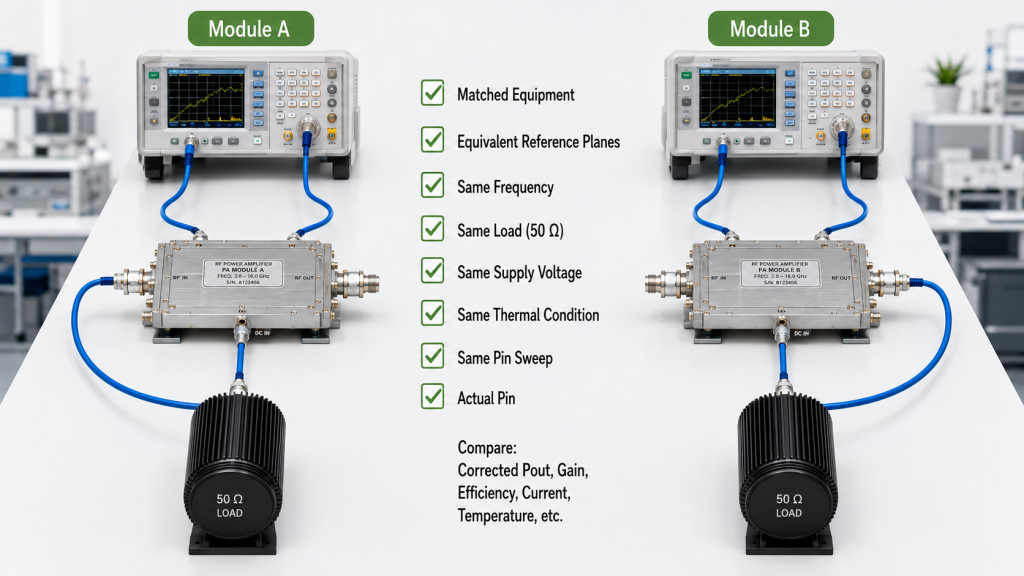
4. How to Compare RF PA Gain Data Without Mixing Conditions
Two gain values are not comparable merely because both are stated in dB.
The comparison boundary must be aligned or corrected.
Compare the Same Required Frequencies
Gain should be compared at the same project-required frequency points, including any critical band-edge point.
A favorable center-frequency result should not represent another part of the band.
Across-band behavior should be reviewed separately through RF PA gain flatness rather than hidden inside one typical value.
Use Actual Pin at a Defined Input Plane
The comparison should use actual power at the PA input reference plane—not only the signal-generator setting.
Source-path loss may include:
- cable;
- connector;
- adapter;
- attenuator;
- filter;
- switch;
- or driver-stage loss.
If one report uses generator setting while another uses corrected Pin at the PA connector, the gain values are not directly comparable.
Align the Output Reference Plane
A Pout value stated at the PA output connector cannot be compared directly with a Pout value stated after a cable, filter, or switch unless both results are corrected to the same agreed reference plane.
The comparison should use:
- the same physical reference plane;
- or clearly corrected equivalent reference planes.
The path correction and its source should remain part of the test record.
Compare Equivalent Operating Points
A small-signal value measured at low output should not be compared directly with large-signal gain near the required output.
The evidence should state both Pin and Pout.
Where signal type matters, the test condition should also identify whether the result uses:
- CW;
- another defined waveform;
- average power;
- or another project-agreed power convention.
Align Supply, Load, and Thermal State
Gain may change when:
- module-terminal voltage falls;
- current rises;
- temperature stabilizes;
- load mismatch changes;
- protection begins;
- or operating duration increases.
A cold-state result is not equivalent to a stabilized result under the required duty condition.
Detailed path corrections, hot-state conditions, and swept procedures should continue through swept-frequency full-power testing.
Consider Measurement Uncertainty
A small difference between two gain values may not represent a meaningful performance difference.
The review should consider:
- calibration and correction records;
- cable and attenuator tolerance;
- power-sensor uncertainty;
- instrument uncertainty;
- test repeatability;
- and correction uncertainty.
If the difference between two gain values is smaller than the combined measurement uncertainty, the data may not support a reliable conclusion that one module has higher gain.
Comparable RF PA Gain Evidence
| Comparison Field | Module A | Module B | Comparison Requirement |
|---|---|---|---|
| Frequency | Recorded | Recorded | Must match |
| Pin reference plane | Defined | Defined | Must match |
| Actual Pin | Recorded | Recorded | Must be stated |
| Pout reference plane | Defined | Defined | Same or corrected equivalent |
| Output operating point | Recorded | Recorded | Must be comparable |
| Signal condition | Recorded | Recorded | Must be comparable where relevant |
| Vdc and load | Recorded | Recorded | Must be stated |
| Thermal state and duration | Recorded | Recorded | Must be comparable |
| Correction and uncertainty | Recorded | Recorded | Must support the comparison |
| S/N and revision | Recorded | Recorded | Required for traceability |
RF SKYPOWER can review whether a quoted gain belongs to a small-signal screening condition or to the large-signal operating point required by the project.
5. What RF PA Gain Can—and Cannot—Prove
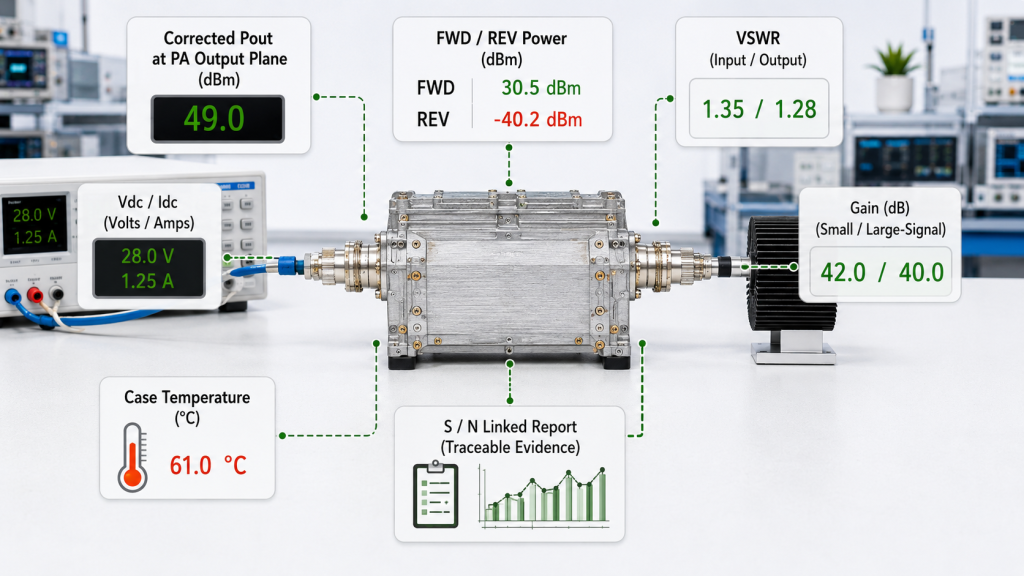
Gain is useful, but it is only one connected part of PA evaluation.
Gain Can Support
Condition-linked gain evidence can help show:
- required input drive;
- low-drive frequency response;
- compression trend;
- consistency between units or revisions;
- whether target output is plausible;
- and whether a configuration change altered the input-to-output relationship.
An unexpected gain result can also lead the test team to inspect:
- actual Pin;
- path correction;
- supply voltage;
- connector condition;
- load;
- thermal state;
- or the selected RF route.
Gain Does Not Prove Output Power
A high gain value does not automatically indicate a high-power PA.
The same 45 dB gain can describe:
- −5 dBm Pin and 40 dBm Pout;
- 0 dBm Pin and 45 dBm Pout;
- 5 dBm Pin and 50 dBm Pout.
The project should evaluate usable RF output power separately from gain.
Gain Does Not Prove Efficiency
Gain compares RF input with RF output.
Efficiency compares RF output with DC input.
A high-gain PA can still draw substantial DC power and generate significant heat. Gain cannot replace:
- Vdc;
- Idc;
- DC input power;
- heat dissipation;
- or efficiency evidence.
Gain Does Not Prove Across-Band or Installed-System Performance
One gain value does not prove gain flatness, output flatness, feeder-end power, antenna-end output, antenna match, or field performance.
Even a flat gain curve does not guarantee flat Pout when Pin varies across the frequency sweep.
The project should keep separate records for:
- actual Pin;
- gain;
- corrected Pout;
- path loss;
- and the applicable tolerance.
Gain Does Not Replace Acceptance Evidence
One engineering sample can characterize expected behavior, but it does not define production variation.
Where gain is used as an acceptance parameter, the supplier should distinguish:
- design-characterization data;
- qualification data;
- representative production data;
- and S/N-linked unit results.
Shipment acceptance should connect the large-signal gain result to:
- the delivered module S/N;
- required frequencies;
- actual Pin;
- corrected Pout;
- controlled configuration;
- applied operating condition;
- and pass-or-fail conclusion.
The complete shipment package may require additional power, thermal, load, protection, and traceability evidence beyond gain.
6. What to Put in an RF PA Gain RFQ
An RFQ should not state only:
Gain: ≥40 dB
That requirement remains incomplete until the gain type, operating point, reference planes, and acceptance boundary are defined.
Define the Gain Evidence
State whether the project requires:
- typical small-signal gain;
- minimum small-signal gain;
- minimum large-signal gain at the required output;
- Pout-versus-Pin data;
- swept gain;
- or gain flatness.
A supplier should not substitute a typical low-drive value for gain measured at the required output condition.
Define the Operating Point
Provide:
- required frequency points;
- available Pin range;
- required Pout;
- supply voltage;
- load condition;
- thermal state;
- signal condition where relevant;
- and duty or operating duration.
Define the Reference Planes
The RFQ should identify:
- Pin reference plane;
- Pout reference plane;
- required corrections;
- who owns the correction data;
- and whether results measured at equivalent planes must be converted to a common reference.
Define the Acceptance Limits
Avoid the vague phrase gain tolerance.
Separate the actual requirements:
- minimum small-signal gain at specified points;
- minimum large-signal gain at the required output;
- permitted across-band gain variation;
- permitted unit-to-unit variation, where required;
- and the treatment of measurement uncertainty.
Define the Evidence Package
A comparable response should provide:
- module model;
- individual S/N where unit-level evidence is required;
- configuration revision;
- actual Pin;
- corrected Pout;
- calculated gain;
- Pout-versus-Pin data where requested;
- operating condition;
- applicable limit;
- and pass-or-fail status.
The quotation should answer one direct question:
Is the stated gain a typical small-signal value, a guaranteed minimum, or an S/N-linked result measured at the required output condition?
Conclusion
RF PA gain is not one permanent module number.
Small-signal gain describes low-drive response. Large-signal gain describes the input-to-output relationship at a stated operating point. Both can be valid, but they cannot be substituted for each other.
A reliable comparison connects gain to actual Pin, corrected Pout, PA reference planes, frequency, supply, load, thermal state, signal condition, uncertainty, module identity, and acceptance limits.
RF SKYPOWER can support an early review of your RF PA gain requirement. Send the required frequency points, available input-drive range, target output, Pin and Pout reference planes, supply and load conditions, thermal state, quantity, and required unit-level evidence.
Submit your RF PA gain RFQ before comparing quotations so typical low-drive values are not mistaken for gain at the required output condition.