
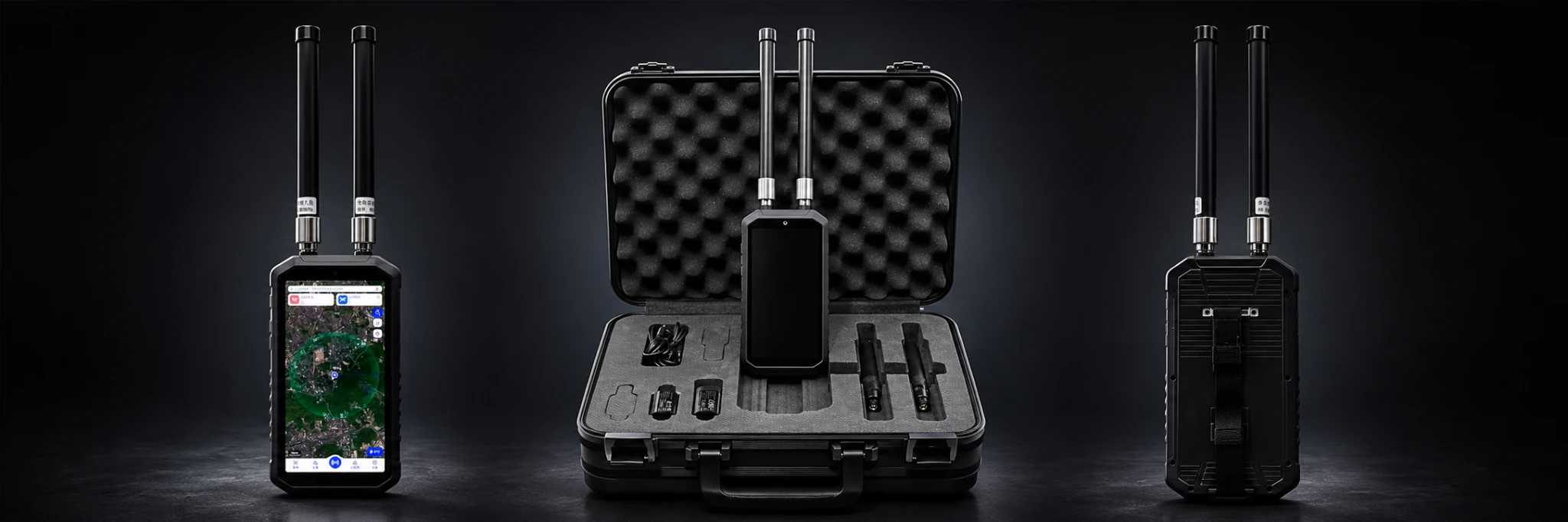

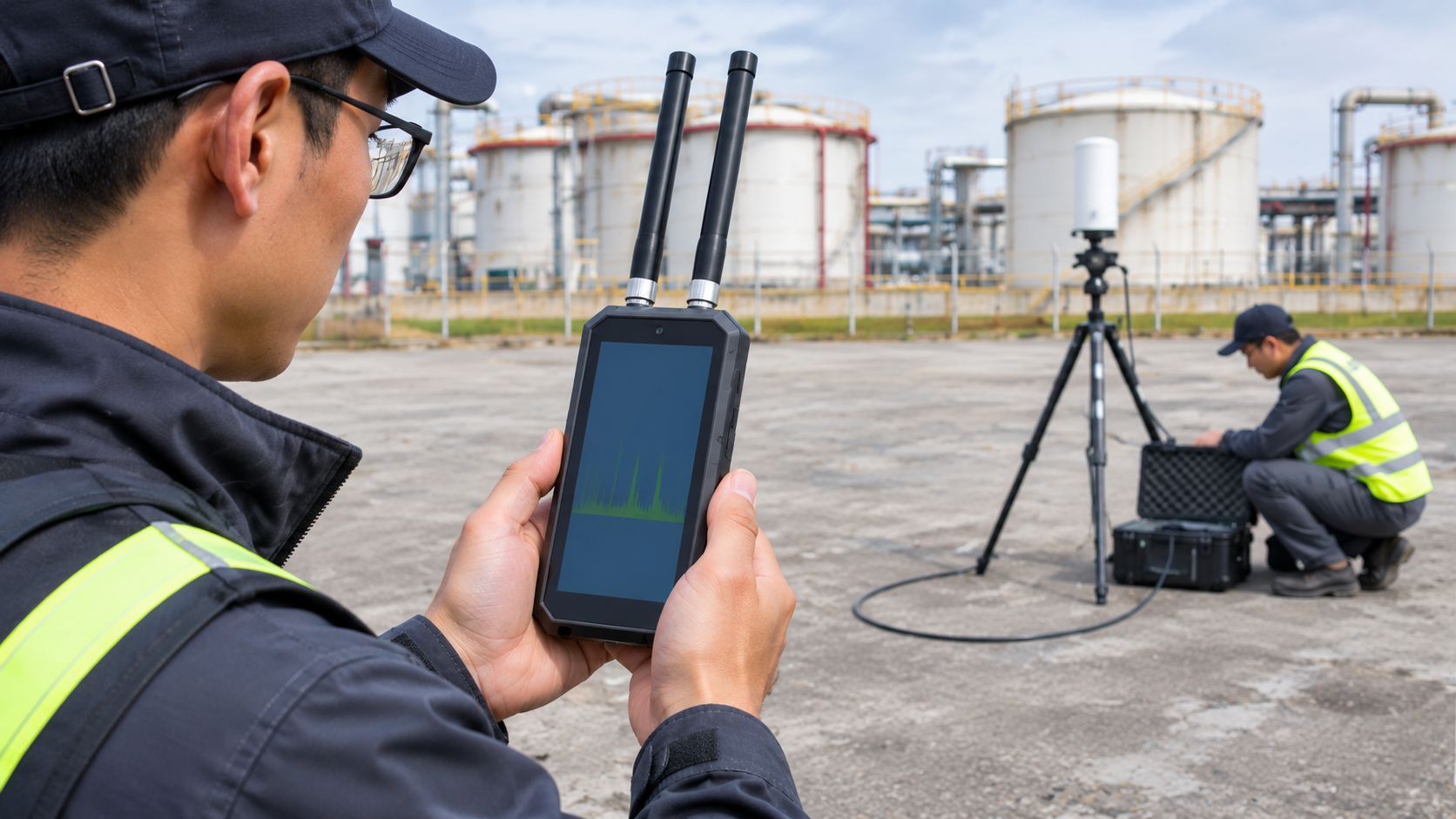
A handheld unit is usually the first portable drone detector format to evaluate for a one-person moving patrol. A field-deployable kit becomes a stronger candidate when a team needs a stable temporary observation point, more freedom to position receiving antennas, or separate power for a longer watch.
The choice is whether an operator carries the receiver throughout the task or sets it up at a temporary observation point. Check each proposed kit against staffing, watch duration, available power, and permitted receiving-antenna positions.
1. What Counts as a Portable Drone Detector?
“Portable” describes how equipment is transported and put into service. Sensing method, operating weight, detection capability, and staffing still require separate specifications.
A handheld detector combines the receiver and local controls in a unit carried and operated by one person. A backpack configuration carries part of the equipment on the operator, potentially with a separate display, battery, or antenna arrangement. A transportable case or tripod kit is moved to a site, assembled, and used from a relatively stable position. A vehicle-assisted configuration uses a vehicle for transport, power, or mounting; the actual receiving position still depends on how the equipment is installed.
If a supplier calls a system “portable,” ask for a configuration drawing or field photo showing how operators carry, power, and position it. The choice of RF, radar, or multi-sensor detection determines what the system can observe; the carrying arrangement determines how personnel can use it on site.
2. Which Deployment Format Fits the Field Mission?
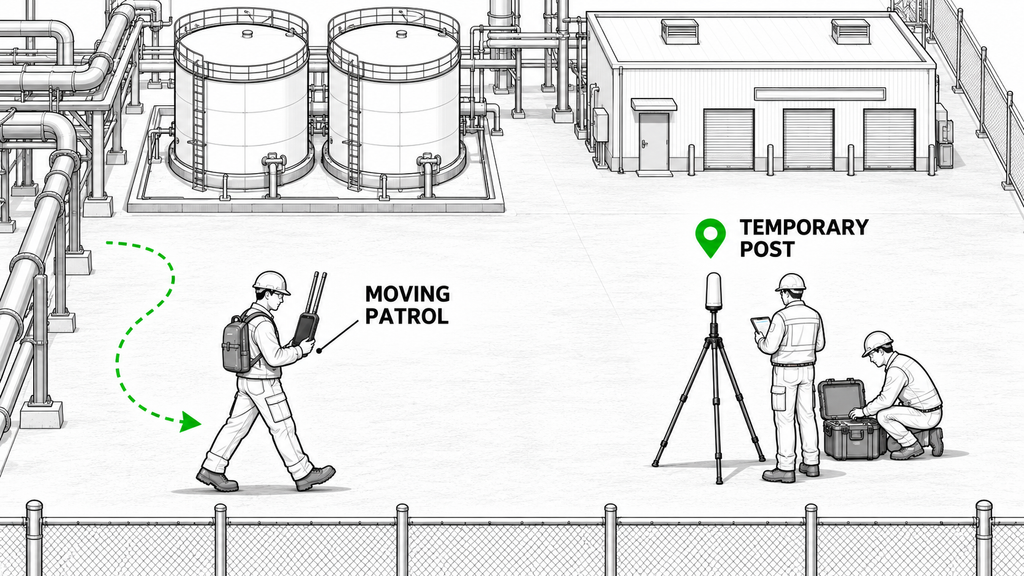
Start with the operator’s movement and observation duty. A patrol that walks between locations has different constraints from a team that can remain at one temporary lookout, even if both assignments call for equipment that fits in a vehicle.
| Field mission | Handheld | Backpack | Portable case / tripod kit | Conditions to verify |
|---|---|---|---|---|
| One-person moving patrol | First format to assess when alerts and controls must remain with the operator. | Consider if the carried payload or antenna arrangement requires it. | Less convenient when the operator must keep moving. | Walking workload, one-person operation, hands available, receiving-antenna position. |
| Frequent moves between short observation stops | Suitable when the measured arrival-to-ready interval fits the available observation time. | Possible if the equipment stays ready while carried. | Viable when repeated assembly and packing fit the available stop time. | Move-to-ready time, packing sequence, number of trips, accessories. |
| Multi-person mobile inspection | Suitable for a designated detector operator. | May distribute carried equipment across a team. | Possible if team members can transport and set up the kit. | Team roles, total load, alert sharing, handover between operators. |
| Temporary staffed observation point | Possible for intermittent checks, but requires an operator to manage the unit. | Consider if the operator must also move around the site. | First format to assess when a fixed receiving position and separate power are useful. | Watch duration, antenna mounting, shelter, power, staffing and teardown. |
| Vehicle-supported field team | Useful for personnel who leave the vehicle to inspect nearby areas. | Consider for excursions beyond the vehicle. | May use vehicle transport or power before being set up at a chosen location. | Vehicle obstruction, safe mounting, electrical supply, dismount workflow. |
For short stops, verify that the arrival-to-ready interval leaves enough time to observe. At a staffed post, an antenna stand and separate power may be worth the setup time. Record the watch duration, operator movement, and available personnel before choosing the format.
3. What Weight and Setup Time Must Be Measured?
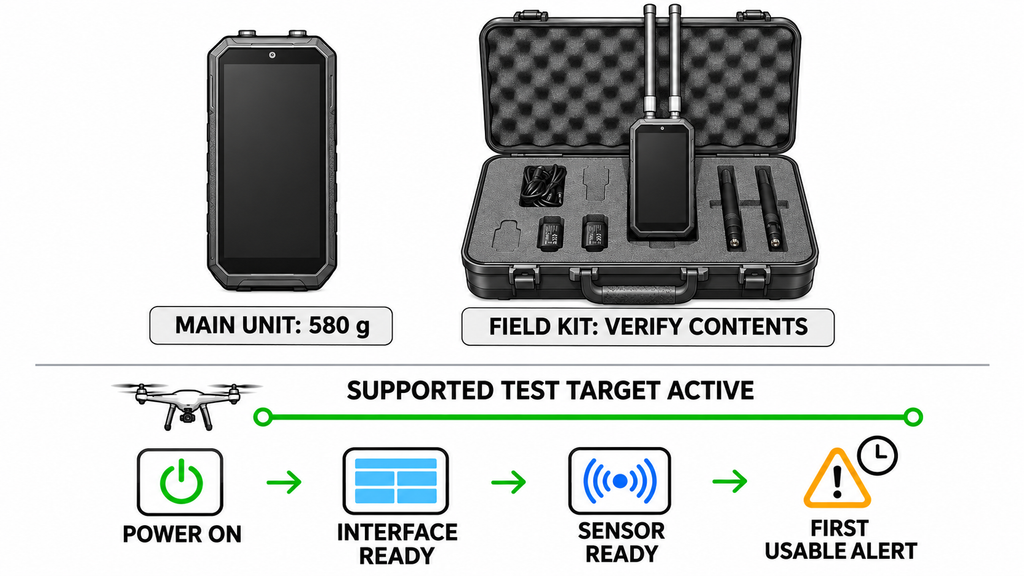
Measure the main unit and the complete field load separately. An operator may also carry receiving antennas, batteries or external power, cables, mounts, protective equipment, and a case. Request a weighed list of the complete transport set and the configuration actually carried or installed during observation. Specify whether batteries, antennas, and other accessories are included in each figure.
For startup time, define what starts and stops the clock. Record when power is applied, when the interface becomes usable, when the receiver or sensor reports ready, and when a supported test target produces the first usable detection output. Keep a supported test target transmitting when measuring time to first usable alert. For a kit that moves between posts, also time packing, transport, reassembly, and return to a usable observation state.
HZ-HD03 as an Operator-Carried RF Detector
RF SKYPOWER’s HZ-HD03 handheld RF drone detector is an example of an operator-carried passive RF/SDR receiver. Its drone-detection function receives RF signals and does not actively transmit RF signals. The published user manual specifies a 6.0-inch display, a 177 × 89 × 30 mm main unit, and a 580 g main-unit weight excluding the fiberglass antennas. Two receiving antennas are fitted for use, so the complete field-ready weight must be measured with the selected accessories.
The manual also describes approximately 20–30 seconds for sensor initialization and GPS searching after the interface loads. That description is not a measured cold-power-on-to-first-valid-alert time. A procurement comparison should record those events separately on the actual hardware and software configuration being evaluated.
4. How Should Battery Runtime Be Verified?
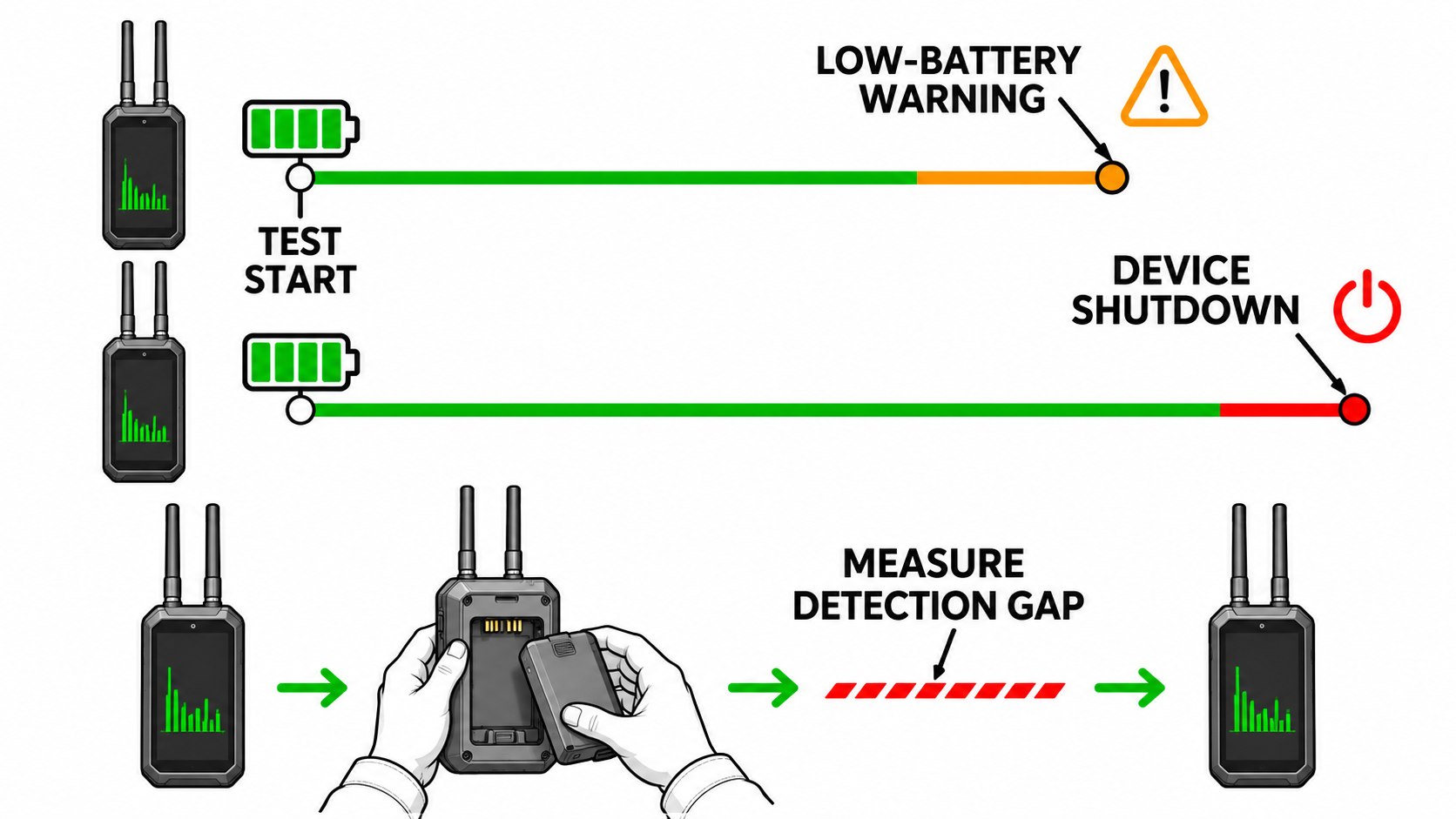
Compare battery runtime against the planned watch using the functions and settings operators will need. Ask for a continuous operating record that starts with a documented charge state and identifies the receiver mode, display brightness, enabled connections, ambient temperature, and the point at which the test ends. A run that ends at a low-battery warning answers a different operational question from one that ends when the device shuts down.
Charging, swapping batteries, or switching to external power may interrupt detection. Measure any gap and check whether events and settings remain available afterward. For a longer watch, identify who handles power changes and which supply arrangement the actual kit supports.
5. How Do Antenna Placement and RF Conditions Affect Field Use?
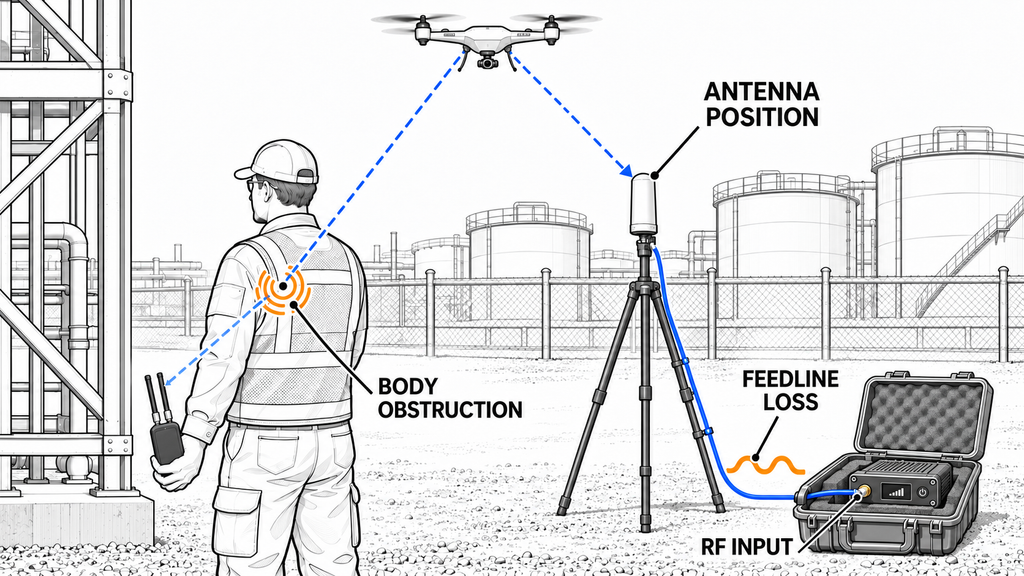
An operator-carried antenna changes position and orientation as the person walks, turns, or shelters behind a structure. A tripod can hold a receiving antenna at a repeatable position, potentially away from body obstruction, while a longer coaxial feedline and its connectors introduce loss between the antenna and receiver input. Backpack and vehicle-supported layouts introduce their own body, equipment, or vehicle obstruction.
For passive RF detection, record which radio links were active, their frequencies, and whether they carried control, telemetry, or video traffic. Antenna placement, line of sight, nearby metal, multipath, local RF noise, and feedline loss influence signal availability and quality at the receiver input. Test each proposed mounting arrangement against the site’s actual restrictions before drawing a field-coverage conclusion.
Compare receiver hardware with matched target transmissions, antenna and RF path, and local conditions. Compare deployment formats using each kit in its actual operating arrangement; record antenna height and orientation, cable loss, nearby emitters, and operator or vehicle obstruction. Better antenna placement can improve the deployed result without establishing higher intrinsic receiver sensitivity.
6. Can Operators Read Alerts and Preserve Usable Records?
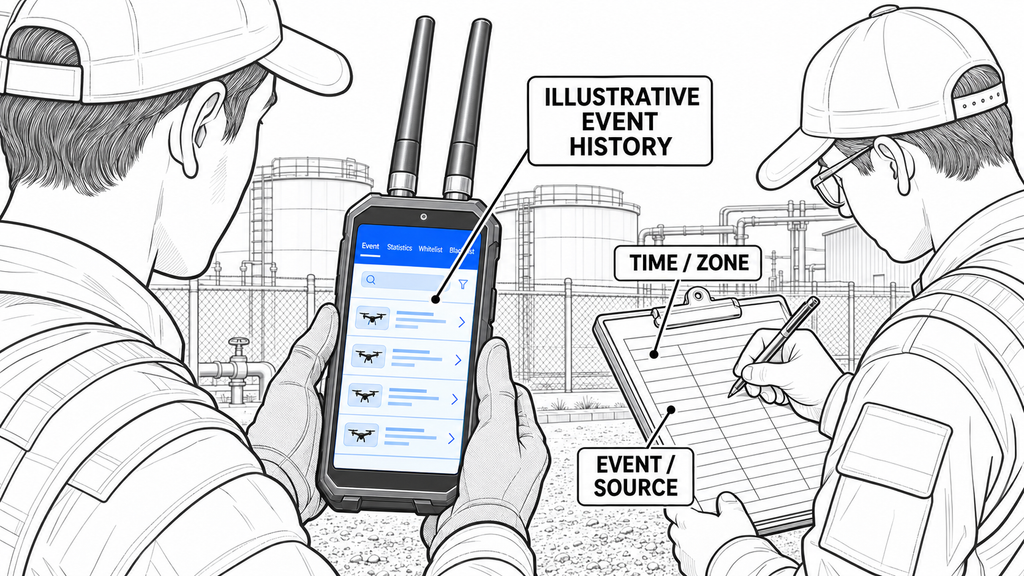
Ask an operator to notice an alert, interpret the screen, and pass a record to someone who did not witness the event. Test the display in the expected light, with the gloves or protective equipment operators actually use. Verify the available visual or audible notification modes on the candidate model and whether a user can acknowledge an event without losing useful context.
Set a minimum event record for the project. Typical requirements include an event time with a clear time zone, an event or target label, the reported observation, and enough source or device context to correlate the event with a duty log. If a screen shows a drone or controller position, the buyer should establish what that position represents and how it was derived before treating it as a measured ground-truth coordinate.
The HZ-HD03 manual documents on-device history and statistics views. Define the required handover format before evaluating that function. If the project needs machine-readable records, request an actual export sample from the relevant software version and verify its fields and time basis. If manual handover is acceptable, test whether the history view, an agreed screenshot, or a duty-log entry preserves the required information.
7. What Updates and Environmental Conditions Matter?
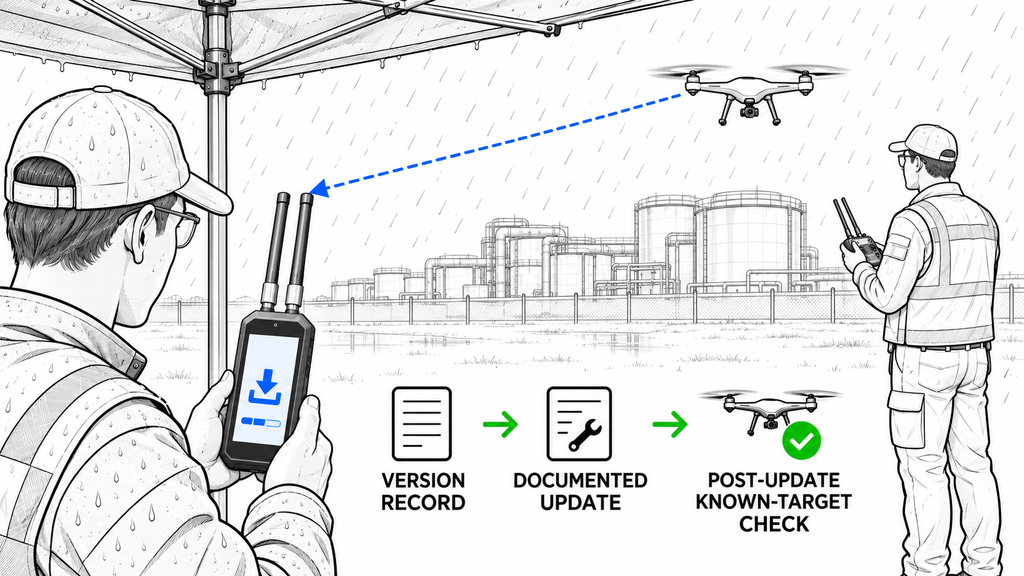
Record the firmware and recognition-library versions, follow a documented update, and repeat a defined known-target check afterward. Verify the resulting alerts and event records alongside the supported-target list for that installed version. The HZ-HD03 manual describes update operations; target compatibility still requires version-specific confirmation.
Set the operating environment in the procurement requirements: temperature, rain and dust exposure, transport vibration, connector protection, and antenna handling. Request specifications or reports covering the relevant configuration and test conditions. Keep any required ingress-protection rating or environmental limit open until matching evidence is available.
8. What Field Evidence Should Buyers Request Before an RFQ?
Ask each supplier to document its proposed kit under the same mission conditions and agreed measurement endpoints.
| Procurement requirement | Aligned conditions for review | Supplier evidence to request | Comparison or hold rule |
|---|---|---|---|
| Complete carrying and operating weight | Same mission and inclusion scope; count each candidate’s actual antennas, batteries, mounts, cables, and transport items. | Itemized carrying and operating configurations, with measured mass for both. | Compare matching carrying or operating scopes; hold main-unit-only figures. |
| Battery duty period and power continuity | Same duty and required functions; for battery tests, record charge, settings, temperature, and endpoint. For external power, document supply and backup conditions. | Time-stamped operating record plus charging or power-switching evidence, as applicable. | Compare task continuity across formats; compare battery-hour figures only under matched test conditions. |
| Startup and redeployment | Align power-on, interface-ready, sensor-ready, and usable-output events with an active supported target. For redeployment, start at site arrival in each kit’s actual transport state and end at usable observation. | Time-stamped startup and arrival-to-ready records; log packing, travel, assembly, and operator count separately. | Compare startup and arrival-to-ready intervals separately; hold records without documented timing endpoints or staffing. |
| Receiving antenna arrangement | Align the target and site baseline; record each deployed kit’s actual antenna position, orientation, feedline loss, and obstruction. Match the RF path for receiver-only tests. | Installation diagram, antenna and feedline details, loss data, and site observations. | Compare deployed configurations as used; attribute receiver differences only to matched-path tests. Hold unaligned range rankings. |
| Operator interface and alerts | Same event scenario, ambient light, operator equipment, and notification settings. | Live interface demonstration or recorded operator task showing alert recognition and response. | Judge usability for the specified task; do not infer log-delivery capability from the display. |
| Event history and handover | Required fields, time reference, software version, and agreed manual or file-based handover workflow. | On-device record and an example of the required handover; actual exported file if machine-readable output is specified. | Assess the agreed record format and fields; an on-screen history view alone does not verify export. |
| Software maintenance | Relevant firmware and recognition-library versions, update method, and post-update target check. | Version information, available release notes, successful update record, and functional check. | Compare documented current functions; request new evidence after a relevant update. |
| Environmental operation and transport | Required temperature, water and dust exposure, mounting, connectors, and transport conditions. | Applicable specifications, handling instructions, and test reports for the relevant configuration. | Hold any required rating or limit without evidence covering that condition. |
Evaluate a handheld unit first for a single-operator moving patrol. Consider a transportable field kit for a staffed temporary post when a stable receiving position, separate power, or team-supported setup better fits the duty. Format alone does not establish detection range or target compatibility; those results still depend on the supported signals, equipment configuration, and site conditions.
Mark each missing record or unmatched condition in the evidence table as pending before ranking that requirement. In the RFQ, describe the deployment: provisional format, operator count and movement, duty period, antenna and site conditions, and available power and network arrangements. Then state the expected targets, required alerts and outputs, record-handover format, and missing supplier evidence. For a one-person passive RF task, review the HZ-HD03 product configuration against that duty profile. To resolve outstanding configuration or evidence questions, send the requirements to RF SKYPOWER for an engineering review.