

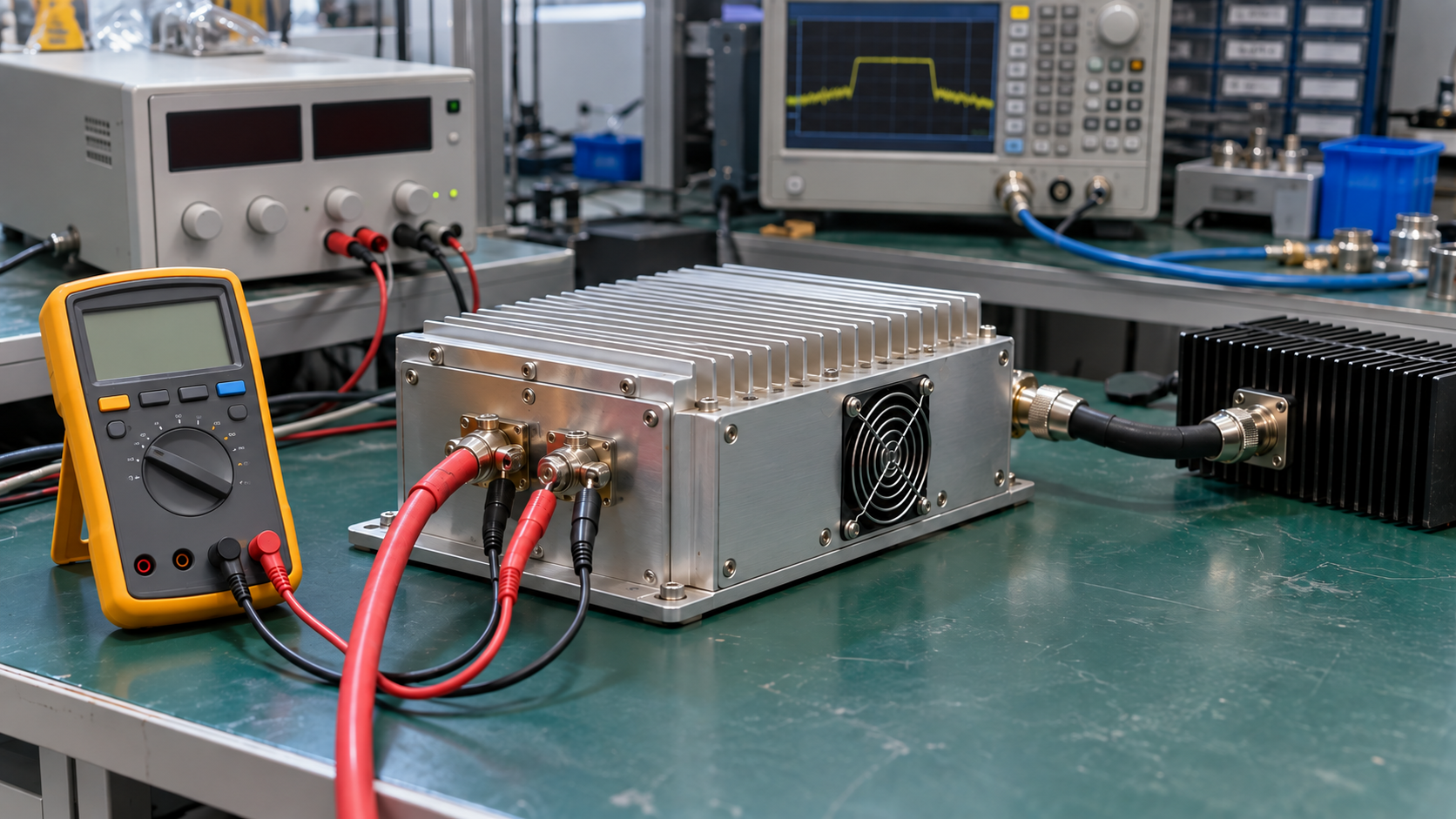
RF PA voltage drop can occur even when the power supply shows the expected voltage, because resistance anywhere along the complete DC path can reduce the voltage that actually reaches the amplifier input terminals.
Cable resistance is only one contributor. Connectors, fuse holders, relays, distribution blocks, terminals, PCB or bus connections, and the negative return can all add resistance. As load current rises, even a small amount of extra resistance can create measurable voltage drop and heat.
For acceptance, check whether the PA-terminal voltage remains within the project-defined operating boundary while the amplifier is producing the required RF output and drawing the corresponding current.
This page focuses on DC cable and connection-path voltage drop. Source capacity, ripple, startup events, shared-bus interaction, grounding architecture, and other DC-system problems require separate checks when the evidence points in those directions.
1. Why Supply Voltage Is Not the Same as PA-Terminal Voltage

Before interpreting a power-supply display or readback value, confirm how the supply senses and reports voltage.
With local sensing, the displayed or regulated value generally relates to the source-side measurement boundary. With remote sensing, the supply may regulate voltage using a separate sense point closer to the load. The exact readback behavior depends on the supply architecture and configuration.
Neither arrangement proves the voltage actually present at the PA input terminals unless the measurement or sense point is defined.
For the cable-path calculation:
PA-terminal voltage = source voltage − total DC path voltage drop
The complete path can include:
- the positive conductor;
- the negative return conductor;
- connector contacts;
- terminals and lugs;
- fuse holders;
- relays and switches;
- distribution blocks;
- PCB or bus conductors;
- intermediate connections.
Each resistive element adds to the total path drop.
When PA current changes with operating state, the source can remain stable at its own measurement boundary while voltage at the amplifier falls because of resistance in the cable or connection path.
A statement such as “the PA was tested at 28 V” therefore needs a defined measurement point.
A useful test record states:
- whether local or remote sensing was used where relevant;
- where source voltage was measured;
- where PA-terminal voltage was measured;
- which current boundary was used;
- which RF operating state was present;
- which cable and connection path was installed.
The voltage measured at the PA terminals is the electrical condition available to the amplifier at that measurement boundary.
2. How to Calculate RF PA DC Cable Voltage Drop from Complete Loop Resistance
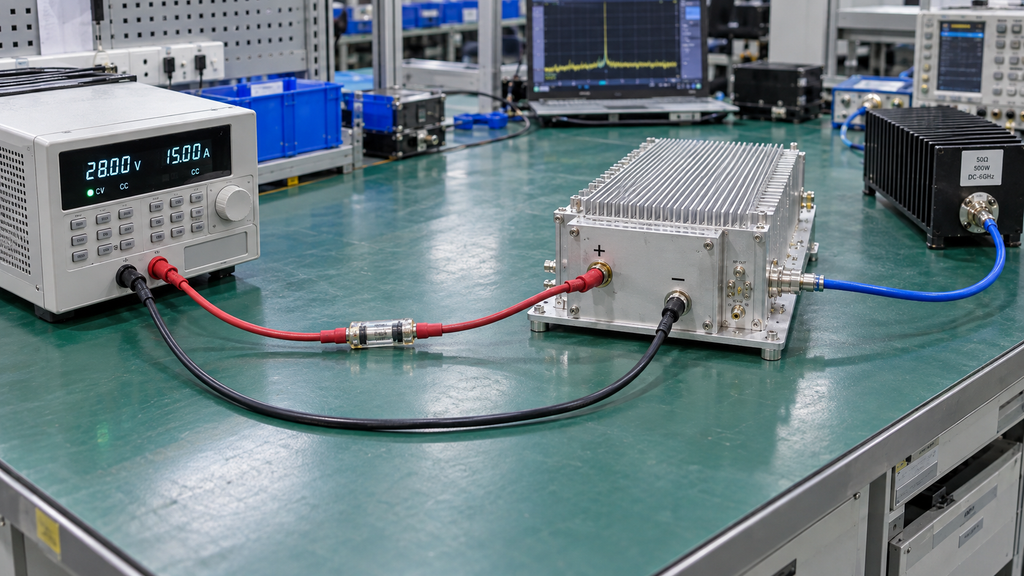
Size the DC path from the resistance of the complete electrical loop, not from one-way cable length or cable ampacity alone.
For a steady-state or sufficiently slow quasi-steady resistive model:
Vdrop = Iload × Rloop
VPA = Vsupply − Vdrop
Ppath = Iload² × Rloop
Where:
- Vdrop is the voltage lost across the defined DC path;
- Iload is the current corresponding to the operating state being evaluated;
- Rloop is the total resistance of the positive and negative path;
- VPA is the resulting voltage at the PA terminals;
- Ppath is the electrical power converted to heat in that path.
Use these equations when a resistive model adequately represents the event being evaluated.
For a fast transient, voltage behavior may also depend on:
- wiring or bus inductance;
- local capacitance;
- power-supply transient response;
- frequency-dependent distribution impedance;
- measurement bandwidth and time resolution.
Inserting a short-duration peak-current value into I × R captures only the resistive part of the event and does not provide a complete transient-voltage model.
Use the complete loop length
If the physical distance between the supply and the amplifier is 3 m, the electrical conductor length is longer than 3 m when separate positive and negative conductors are used.
For example:
3 m positive + 3 m negative = 6 m total conductor length
Connection resistance is then added to the conductor resistance.
Use the cable manufacturer’s resistance data in Ω/m or mΩ/m whenever available. Cable gauge alone does not fully define resistance because conductor material, construction, temperature, and manufacturing details can change the actual value.
Match the current value to the decision
The current used in the calculation must represent the condition being evaluated.
For sustained operation, that may be the current at the required RF output after the system reaches the defined operating state.
For a pulsed, switching, startup, or transient problem, an unrelated average-current value may not represent the event. The current boundary and time basis should match the voltage-drop question being investigated.
Separate current bases may be required for:
- continuous conductor heating;
- short-duration peak drop;
- startup behavior;
- simultaneous multi-module loading.
These decisions can require different current values and, for sufficiently fast events, a model beyond simple resistive drop.
Illustrative resistance example
For illustration only, consider an unwanted path resistance of 10 mΩ.
At 20 A:
Vdrop = 20 A × 0.010 Ω = 0.2 V
At 40 A:
Vdrop = 40 A × 0.010 Ω = 0.4 V
The corresponding path heating at 40 A is:
Ppath = 40² × 0.010 = 16 W
These are calculation examples, not RF SKYPOWER test results or universal acceptance limits. They show why milliohm-level resistance can matter in a high-current DC path.
DC Cable Voltage-Drop Worksheet
| Item | Required Value |
|---|---|
| Source voltage | Voltage at the defined source measurement point |
| Required PA-terminal voltage | Project-defined operating boundary |
| Relevant load current | Current for the operating state being evaluated |
| One-way cable length | Physical source-to-PA distance |
| Total conductor length | Positive and negative conductors combined |
| Cable resistance | Manufacturer value in Ω/m or mΩ/m |
| Connection resistance | Connectors, fuse holders, relays, switches, terminals |
| Calculated path resistance | Conductor plus connection resistance |
| Calculated voltage drop | Relevant current × total path resistance |
| Measured PA-terminal voltage | Voltage at the PA during the required RF condition |
| Cable / connection temperature | When thermal evidence is required |
| Acceptance result | Compared with the applicable project requirement |
Ampacity alone is not an acceptance criterion. The installed path must also preserve the required PA-terminal condition under the operating state being approved.
3. What Evidence Shows the DC Path Is Affecting RF Output?
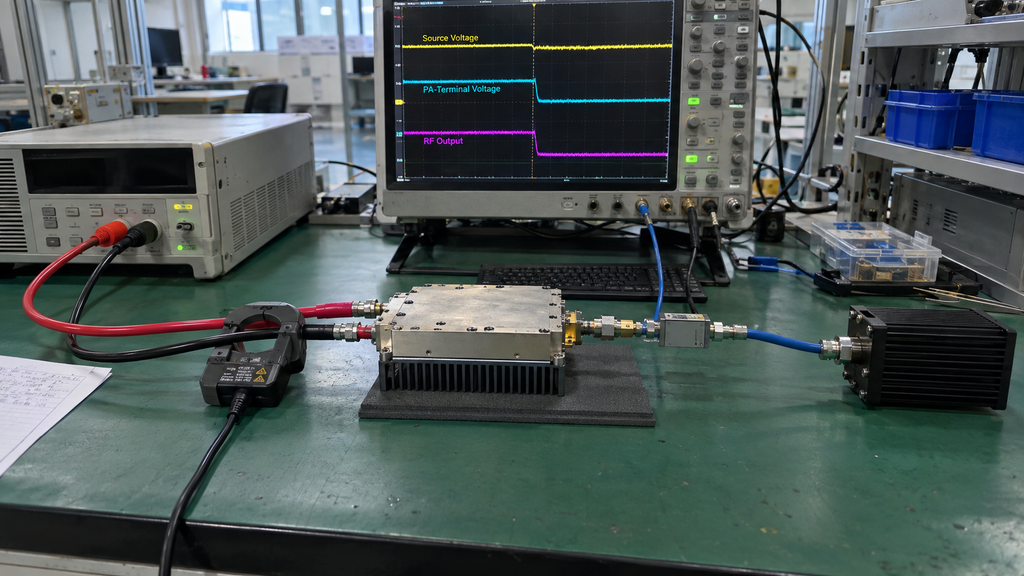
Low PA-terminal voltage can coincide with reduced RF output, earlier compression, current limiting, protection behavior, or other performance changes.
Those symptoms alone do not identify the cable as the cause. Correlate the electrical evidence with the RF symptom under the same or a defensibly comparable operating condition.
Record, as applicable:
- source-terminal voltage;
- PA-terminal voltage;
- relevant DC current;
- RF input condition;
- RF output;
- reflected power;
- operating temperature;
- duty or load state;
- protection or alarm state;
- measurement timing.
For a dynamic event, use sufficient time resolution and a common or otherwise correlated time reference so that voltage, current, RF output, and protection behavior can be associated with the same event.
A stable reading taken before or after a short disturbance does not describe what happened during the disturbance.
Evidence that strengthens the DC-path hypothesis
The DC distribution path becomes a stronger investigation path when:
- source voltage remains stable while PA-terminal voltage falls;
- the voltage difference increases with the relevant load current;
- the RF symptom occurs during the same or a time-correlated event;
- restoring the PA-terminal voltage also restores the expected operating condition under a comparable test boundary;
- a specific connection or branch shows measurable drop under current.
This evidence does not by itself identify whether the responsible element is the cable, terminal, fuse holder, relay, connector, return path, or another part of the distribution chain.
When to stop prioritizing the DC cable
Reduce the priority of cable voltage drop when, under the same or a defensibly comparable RF state:
- source voltage remains stable;
- PA-terminal voltage remains stable;
- the source-to-PA voltage difference does not change with the symptom;
- the relevant current boundary is understood.
At that point, the available voltage evidence does not support continuing to prioritize DC cable drop without new evidence.
Broaden the investigation to the relevant RF, thermal, protection, load, source, or measurement boundary.
For the wider DC attribution framework, use the RF PA output drops from DC power issues check rather than assigning every RF output change to cable sizing.
4. What Resistance Must Be Included in the DC Path?
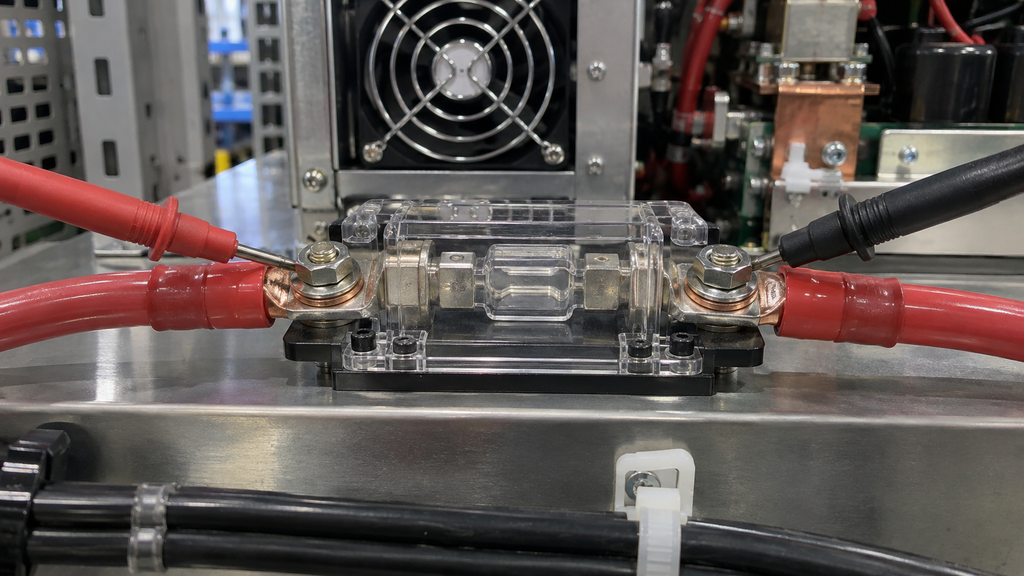
Conductor resistance is only one contributor to the source-to-PA path.
A larger cable does not compensate for excessive resistance at a connection elsewhere in the path.
Possible contributors include:
- cable conductors;
- crimped terminals;
- threaded power connections;
- connector contacts;
- fuse holders;
- relays and switches;
- distribution blocks;
- PCB or bus conductors;
- intermediate terminals;
- the negative return path.
Check connection resistance separately
Continuity alone does not prove that a connection has acceptably low resistance under high current.
To locate a suspect point, measure voltage directly across that individual connection while the relevant current is flowing.
Examples include measurements across:
- a connector pair;
- a crimped terminal;
- a fuse holder;
- a relay contact;
- a distribution joint;
- a return connection.
A measurable drop identifies resistance across the defined measurement points. Acceptance depends on the project requirement, current, thermal behavior, and effect on the PA-terminal condition.
If conductor size appears adequate but a termination remains suspect, inspect RF power amplifier harness crimping separately rather than treating all connection resistance as a cable-gauge problem.
Do not confuse the negative return with grounding architecture
Include the DC negative return in the electrical supply loop used for the voltage-drop calculation.
Keep it separate from:
- chassis bonding;
- RF grounding;
- signal reference;
- protective earth.
If those boundaries are unclear, handle RF amplifier grounding as a separate integration problem.
5. When Multiple PA Modules Change the Cable-Sizing Boundary

A cable path qualified with one amplifier may not remain acceptable when several modules operate at the same time.
Size the path for the maximum realistic simultaneous load represented by the path being evaluated.
Depending on the system, the calculation may need to account for:
- the number of active PA modules;
- current at the required RF operating state;
- shared controllers or cooling loads;
- branch-cable length;
- common feeder resistance;
- connection resistance;
- duty cycle;
- operating duration;
- relevant hot-state resistance.
Define which loads can occur together before adding their current values. Unrelated nameplate or peak-current values should not be combined into a simultaneous-load calculation.
A single-module test also does not qualify a common supply path when several modules may share the same conductor or distribution point during the intended operating condition.
Where each PA has its own branch, measure or calculate voltage drop at the branch level when acceptance depends on individual PA-terminal voltage.
A common source reading can hide a weak branch.
Cross-branch interactions and transient behavior on a shared DC bus require a separate shared-distribution investigation. A symptom that appears when another module switches, enables, or changes load should not be reduced to a single-cable calculation.
6. How to Measure PA-Terminal Voltage Under the Required RF Load
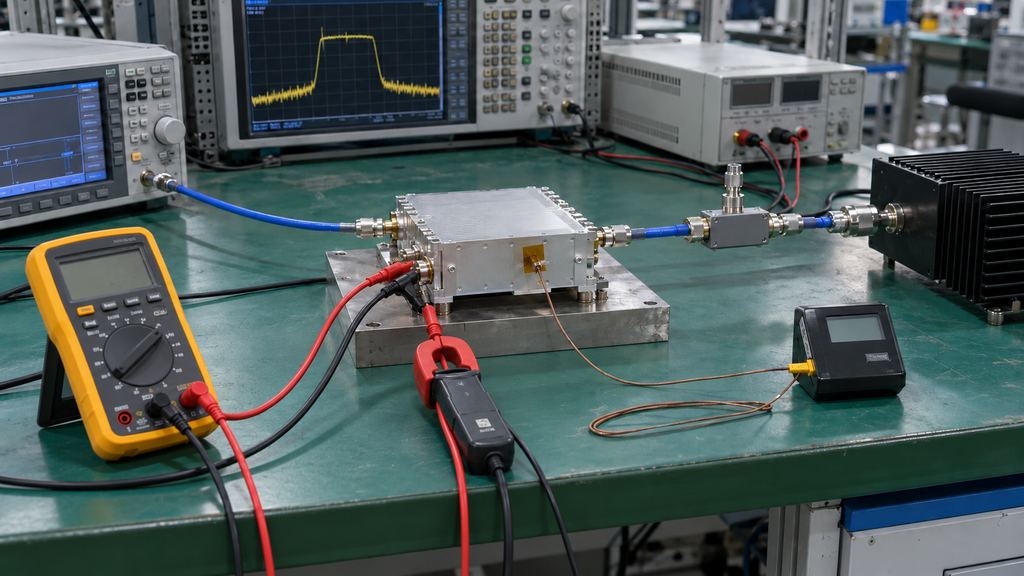
Voltage-drop verification should reproduce the operating condition that matters to the acceptance decision.
Use measurement equipment, probes, leads, and fixtures rated for the applicable DC voltage, current environment, and measurement category. Where practical, use approved test points or secured measurement fixtures instead of temporary contact with exposed high-current conductors.
De-energize the relevant circuit before changing probe connections, moving exposed high-current terminals, or modifying the DC path unless an approved test procedure defines a safe energized method.
Recommended measurement sequence
- Define the RF and DC condition being evaluated.
- Confirm the intended source-voltage measurement or sense point.
- Measure voltage at the defined source measurement point.
- Measure voltage directly across the PA positive and negative input terminals or approved equivalent test points.
- Record the relevant current at the defined module or branch boundary.
- Apply the RF input condition required by the test.
- Operate the PA at the specified RF output or other project-defined load state.
- Record PA-terminal voltage, current, RF output, reflected power, and relevant temperature or alarm data.
- Continue for the project-defined dwell or until the required stabilized condition has been reached.
- Repeat at other simultaneous-load states only when they are part of the acceptance requirement.
- Inspect cable and connection points for abnormal electrical or thermal evidence where required.
Use probe locations that represent the actual amplifier input boundary. A measurement at the distribution board excludes voltage drop in the final cable and termination path.
Match measurement time resolution to the event
A digital meter can be suitable for a sustained voltage-drop problem.
Startup sag, short pulses, fast switching events, and intermittent connection changes may require higher measurement bandwidth, sampling rate, or time resolution.
Where attribution depends on several signals, capture or correlate voltage, current, RF output, and protection state closely enough in time to determine whether they belong to the same event.
A stable average reading does not rule out a short-duration voltage drop.
Use thermal evidence as supporting evidence
Temperature can help locate a resistive connection, but it does not replace the electrical measurement.
When thermal evidence matters:
- define the RF load;
- define the duty cycle;
- define the dwell or observation period;
- record the electrical measurement boundary;
- compare the condition before and after corrective action when appropriate.
Infrared or contact-temperature measurements should support the voltage-drop measurement.
7. What Defines a DC Cable Pass or Fail Result?
There is no universal cable gauge, maximum voltage drop, or temperature rise that applies to every RF PA installation.
The pass/fail boundary must come from the applicable:
- RFQ;
- product requirement;
- system specification;
- contract requirement;
- approved test plan.
Cable ampacity and component ratings help determine whether the hardware is rated for the intended operating condition.
System acceptance should still be tied to the required PA-terminal condition and RF operating result.
A project-specific acceptance requirement can be organized around this logic:
At the required RF operating condition, duty state, environmental condition, and simultaneous-load state, the voltage measured at the defined RF PA input terminals shall remain within the approved operating boundary without an unacceptable RF output change, current-limit event, protection response, or DC-path thermal condition.
The actual limits must come from the applicable project requirement. This article does not establish universal voltage-drop or thermal limits.
Acceptance evidence should match the requirement
A useful test record may include:
- cable type and conductor size;
- one-way and total loop length;
- path resistance basis;
- source voltage and source measurement or sense point;
- PA-terminal voltage;
- relevant current;
- RF input and output condition;
- duty cycle;
- simultaneous-load state;
- test duration or dwell;
- cable and connection temperature where required;
- final acceptance basis.
An unloaded voltage check does not qualify the loaded condition.
A brief low-power test also does not qualify a sustained or higher-current operating state unless that is the condition defined by the acceptance requirement.
8. What DC Cable Evidence Belongs in RFQ and Acceptance?
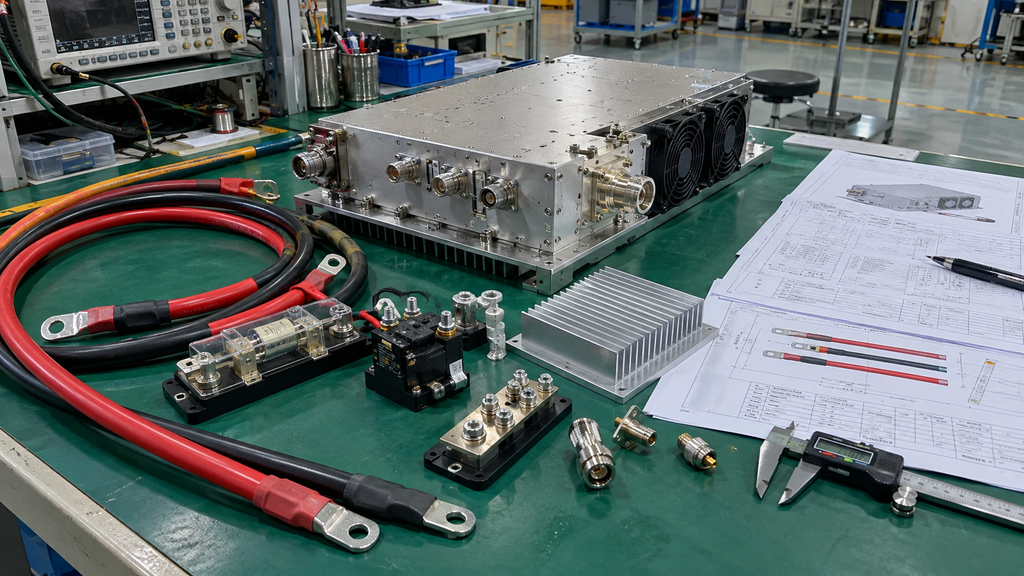
Define the DC path early enough to review the cable, connectors, distribution hardware, and PA operating requirement together.
Before quotation or integration, useful project inputs may include:
- RF frequency range;
- required RF output;
- required PA input-voltage range;
- continuous operating current;
- relevant peak, pulse, or startup current;
- one-way cable length;
- conductor size or resistance;
- positive and negative path architecture;
- connector and terminal path;
- fuse and relay path;
- number of simultaneous loads;
- duty cycle;
- environmental condition;
- cooling method;
- control requirements;
- reflected-power or VSWR boundary;
- required test duration;
- required test-report traceability.
| RFQ Item | Why It Matters |
|---|---|
| Required PA-terminal voltage | Defines the electrical condition that must reach the module |
| Relevant current states | Defines voltage-drop and conductor-stress calculations |
| Complete loop length | Prevents one-way-length sizing errors |
| Cable resistance | Supports calculated conductor drop |
| Connector / fuse / relay path | Captures resistance outside the cable itself |
| Simultaneous load state | Defines which shared load belongs in the calculation |
| Duty and environmental condition | Establishes the operating state used for verification |
| Acceptance evidence | Defines how the completed path will be judged |
Projects involving a custom RF power amplifier module should define the DC power path together with the RF operating requirements rather than selecting the amplifier first and treating the supply cable as an afterthought.
These inputs support engineering review and RFQ definition. Suitability of a specific RF PA model or DC distribution design still depends on the applicable project requirements and verification results.
Conclusion
Accept the DC path only when the complete source-to-PA path keeps the measured PA-terminal voltage within the project-defined boundary under the RF and electrical load state that matters.
Calculate the complete positive-and-negative loop resistance, include connection resistance, and match the current and measurement time basis to the event. For sufficiently fast transients, add time-resolved evidence instead of treating I × R as a complete voltage model.
If source-to-PA voltage drop changes with the RF symptom, continue isolating the cable or connection path. If PA-terminal voltage remains stable during the symptom, move the investigation to the relevant RF, thermal, protection, load, source, or measurement boundary.
For RFQ and acceptance, define the PA-terminal voltage requirement, current states, cable path, connection hardware, duty condition, simultaneous loads, cooling condition, RF operating requirement, and required evidence before finalizing the power-path decision.