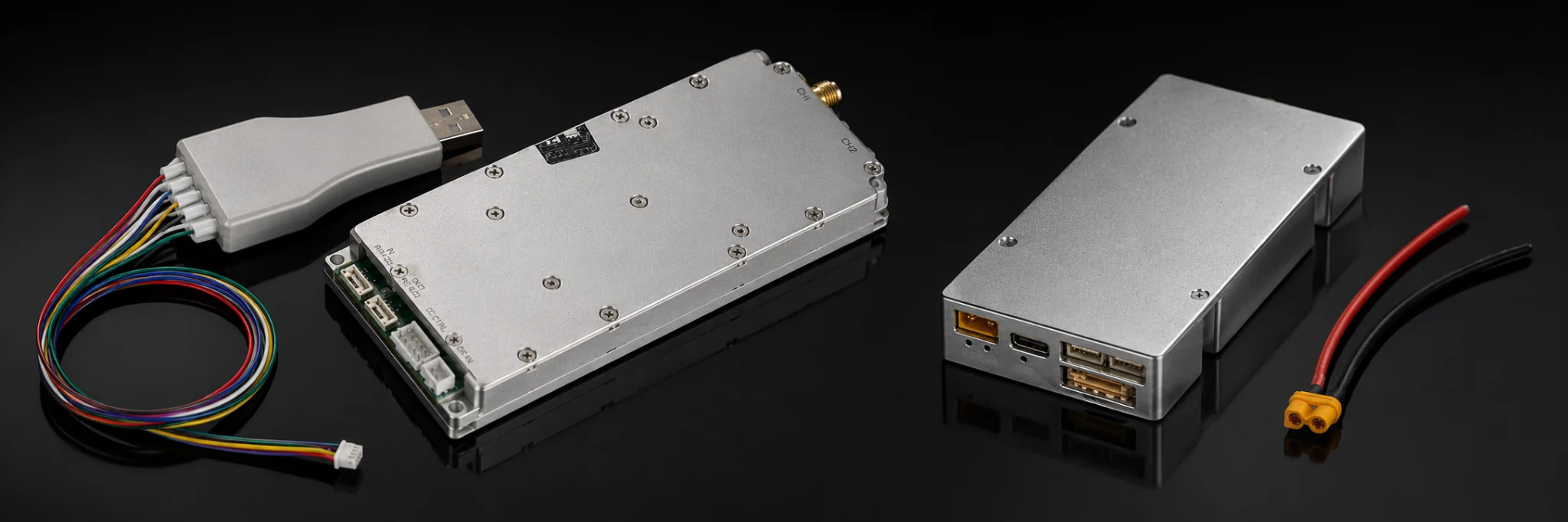

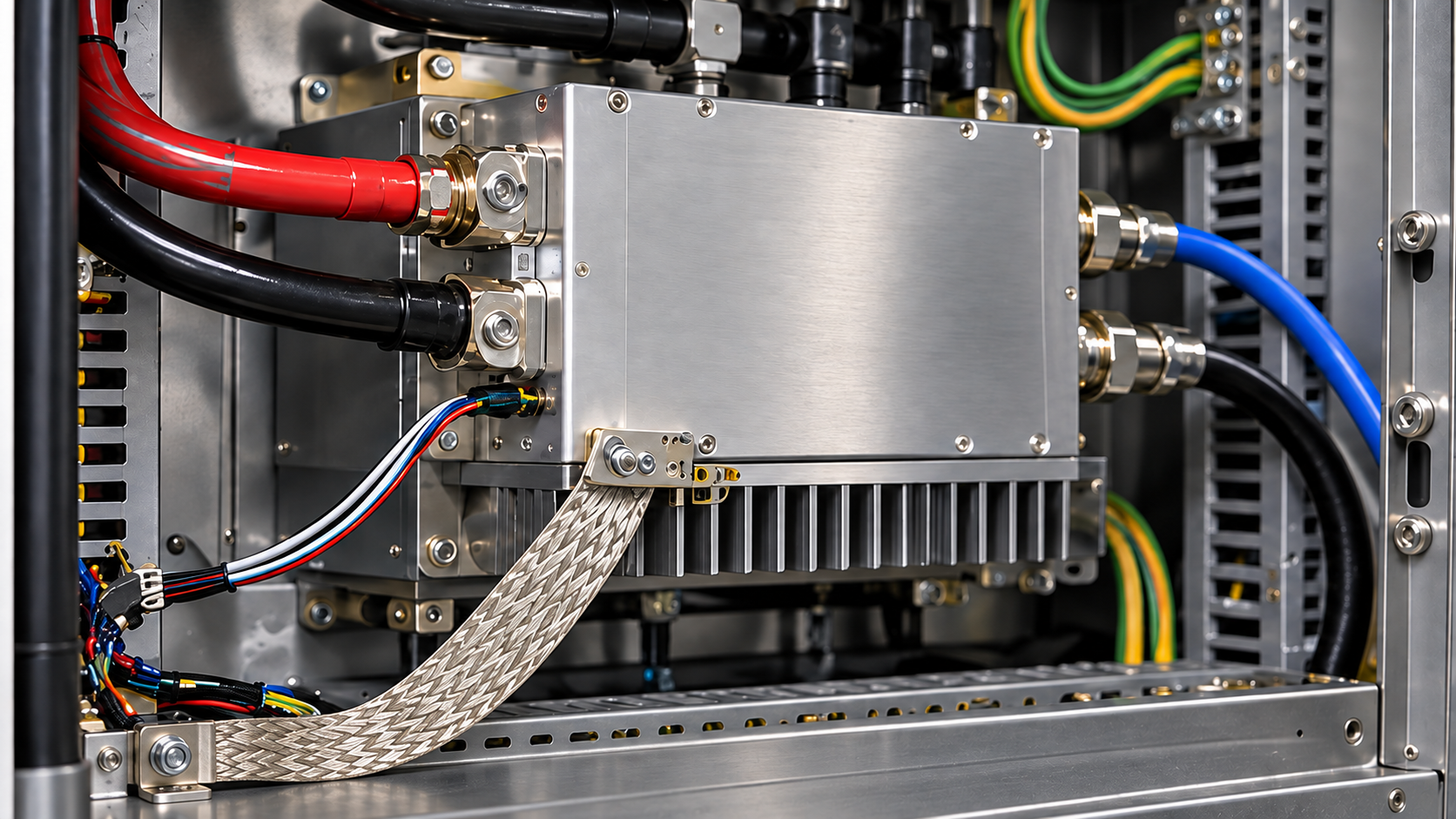
RF PA grounding problems often begin when several electrically different functions are grouped under one label: “ground.”
The DC negative return carries supply current. A signal reference defines the voltage used by control or monitoring circuits. A chassis bond connects conductive structures. RF shielding controls high-frequency current paths and field leakage. Protective earth serves an electrical-safety function. Test equipment can add another reference path through grounded ports.
These functions may be connected somewhere in the final system, but each still needs a defined role.
In one cabinet review, the team called the DC return, controller reference, chassis bond, and shield connection “ground.” During low-power checks, everything looked normal. After the PA current increased, the controller started reporting unstable alarm values. The RF output was still stable on an independent power meter, but the monitor signal moved with the module-to-controller reference voltage. The problem was not RF power drift. It was an undefined reference path.
Before cabinet integration, define which conductor or structure performs each function, where intentional bonds occur, and which measurements are needed to prove that the reference relationships remain stable under the RF and DC operating condition that matters.
The scope here is grounding architecture, reference stability, and controlled grounding diagnosis. Shared DC-bus interaction, detailed shielding faults, cable voltage drop, and control-interface logic need separate checks when the evidence points to those systems.
1. What Ground Paths Must Be Separated in an RF PA Cabinet?
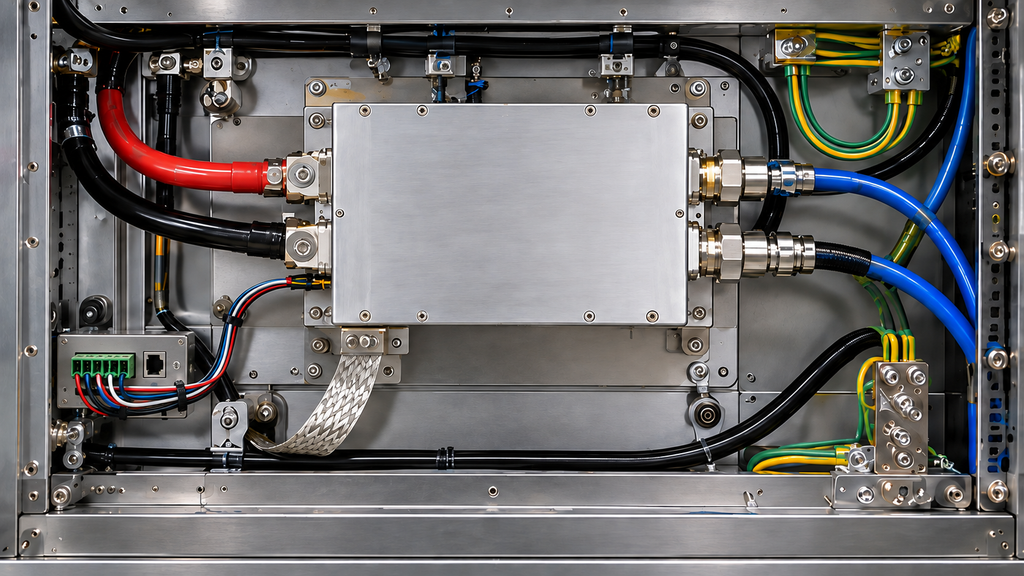
Start by naming each electrical function instead of calling every low-potential conductor “ground.”
| Electrical Function | Primary Purpose | Risk if Misidentified | What to Check |
|---|---|---|---|
| DC negative return | Carries operating current back to the supply | Shared impedance can shift local voltage references | Current path, conductor size, connection resistance, branch topology |
| Signal reference | Defines control and monitor voltage levels | Reference shift can change logic or analog interpretation | Reference relationship between module and controller |
| Chassis bond | Connects conductive structures at defined points | Poor bonding can increase potential differences or uncontrolled current paths | Bond location, continuity, mechanical integrity |
| RF shield / enclosure bond | Provides controlled high-frequency current path and field containment | Poor RF bonding can increase leakage or EMI sensitivity | Bond geometry, enclosure interface, RF continuity |
| Protective earth | Provides safety bonding according to the applicable electrical design | Improper modification can create a shock or fault-current hazard | Approved PE connection and applicable safety requirement |
| Instrument ground | Reference introduced by grounded test equipment | Test setup can create an additional return or bond | Instrument earth path, cable shields, probe references |
This table identifies electrical functions; it does not prescribe a universal topology.
A star connection can be useful in some low-frequency distribution architectures, but “use a star ground” is not a universal RF cabinet rule. At RF, physical geometry, conductor inductance, shield bonds, enclosure interfaces, cable routing, and frequency all affect current paths.
The correct grounding architecture must come from the actual electrical, RF, safety, and integration requirements of the system.
2. How to Define DC Return, Signal Reference, and Chassis Bond
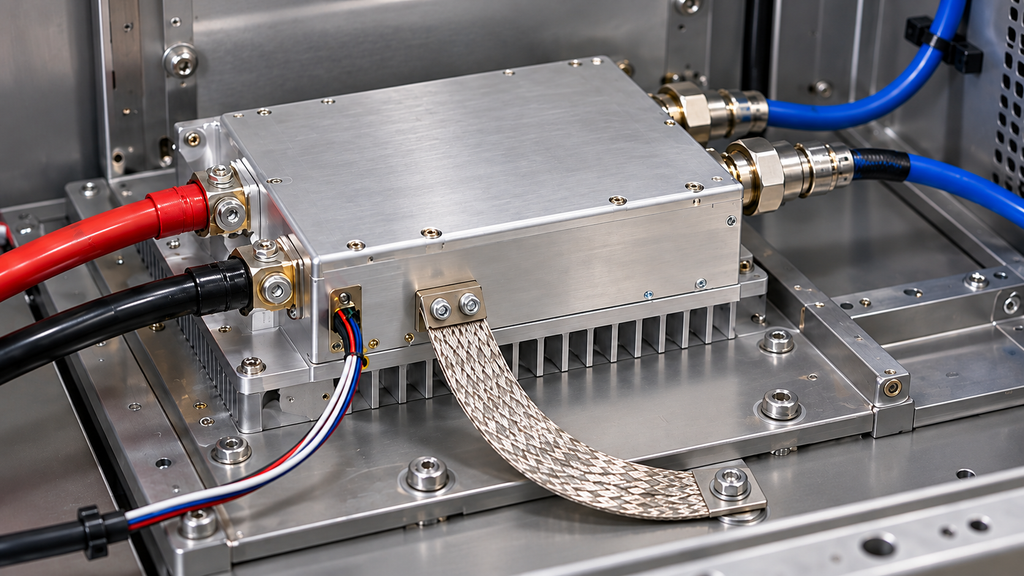
The first boundary is the DC operating return.
The PA positive and negative supply conductors form the electrical supply loop. If the question is whether resistance in the positive or negative supply path is reducing PA-terminal voltage, use the RF PA DC cable voltage-drop check rather than treating that as a grounding diagnosis. DC negative return
The DC negative return may carry substantial PA current. Resistance in that path creates voltage drop according to the current flowing through it.
If several circuits share part of the same return path, the resulting voltage developed across that shared impedance can shift the local reference seen by other circuits.
Treat the DC return as an operating-current path rather than an abstract zero-volt node.
A practical check is to measure voltage between the PA negative terminal and the controller reference while the PA operates at the required current. If the reading increases with PA current, the reference relationship is changing with load and should be investigated for shared-impedance or return-path effects before assigning the control behavior to the PA.
Signal reference
A control board may interpret enable, alarm, monitor, or analog-feedback signals relative to its own reference.
If the controller reference and module reference differ under load, the effective signal level seen by one side can change even when the source signal itself has not changed.
Measure the reference relationship that matters to the interface.
For example, a module-GND-to-controller-GND measurement can help determine whether that specific control-reference relationship shifts during operation. It does not by itself prove that the chassis bond, RF shield bond, or protective-earth connection is correct.
If the problem is primarily pin definition, voltage level, protocol, state behavior, or controller compatibility, treat RF PA control-interface behavior as a separate integration task.
Chassis bond
A chassis bond connects conductive structures at defined locations.
Depending on the equipment architecture, the chassis can participate in:
- safety bonding;
- enclosure continuity;
- RF shielding;
- EMC current paths;
- mechanical equipotential bonding.
Do not assume that the DC negative terminal, signal-reference terminal, and chassis are internally bonded in the same way on every PA module or controller.
That relationship should come from the actual module interface definition or verified hardware design.
3. How Reference Shift Can Create False Alarms and Feedback Drift
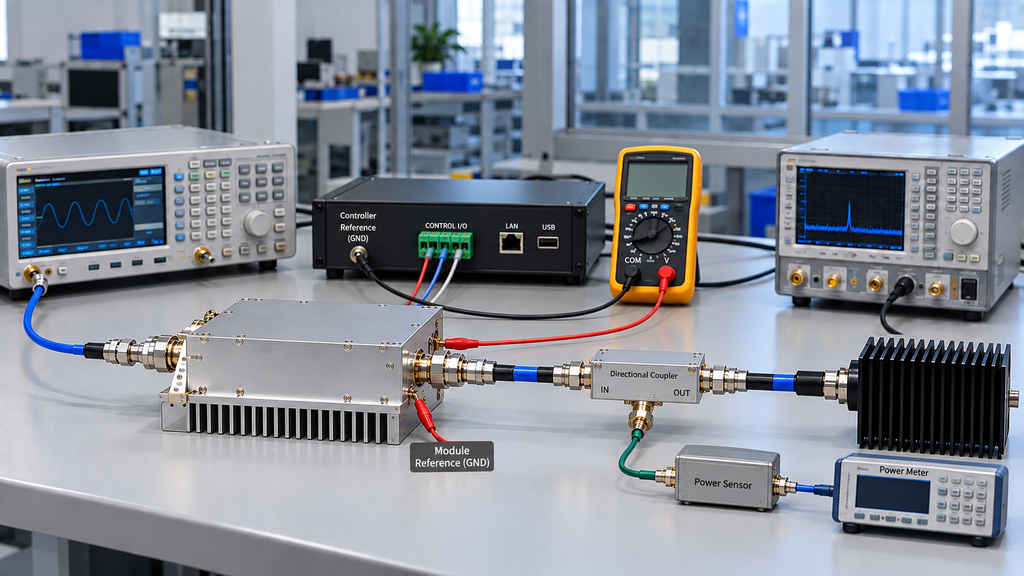
A reference shift occurs when current flowing through shared impedance creates a voltage difference between points that the system assumes are at the same reference potential.
For a steady or single-frequency component, a simplified relationship is:
Vshift = Ishared × Zshared
Where:
- Vshift is the voltage difference developed across the shared path;
- Ishared is the relevant current component flowing through that path;
- Zshared is the impedance of the shared path at the condition or frequency being evaluated.
For low-frequency or steady conditions, resistance may dominate the relevant impedance. At higher frequencies, conductor inductance, geometry, bonding structure, and other frequency-dependent effects can become important.
For broadband or fast transient behavior, do not treat one fixed scalar value of Zshared as a complete time-domain model.
A shifted reference changes how another signal is interpreted relative to that reference.
For example, an alarm input may be designed around a fixed logic threshold. If the controller reference shifts during high-current operation, the same alarm voltage from the PA can appear closer to the threshold. The controller may report an alarm even though the PA stage, RF output, and load condition have not changed.
Possible symptoms include:
- changing analog monitor values;
- apparent bias or feedback drift;
- false alarm thresholds;
- unstable enable or interlock interpretation;
- controller readings that change with PA current;
- behavior that changes when test equipment is connected;
- inconsistent reported forward or reflected-power monitor values when those readings depend on the affected reference relationship.
A shifting reference can distort RF power amplifier alarm monitoring and other controller-reported values when the monitor circuit, ADC, controller, or analog interface shares that reference. That does not automatically mean the true RF forward or reflected power changed.
Keep independent RF measurement separate from ground-referenced monitor or controller reporting.
If an independent RF measurement remains stable while a controller-reported value moves with the reference potential, investigate the monitor/reference path before assigning the change to the PA RF stage.
Correlate the reference shift with the symptom
For grounding diagnosis, record, where applicable:
- PA operating state;
- DC current;
- voltage between the relevant reference points;
- controller or monitor reading;
- RF input;
- RF output;
- reflected power;
- alarm state;
- measurement timing.
For a dynamic event, the measurements need enough time resolution to show whether the reference shift and symptom occurred during the same event.
A ground-potential difference measured at another operating state is weak evidence for a transient alarm.
4. How Test Instruments Can Change Ground Paths During RF PA Testing
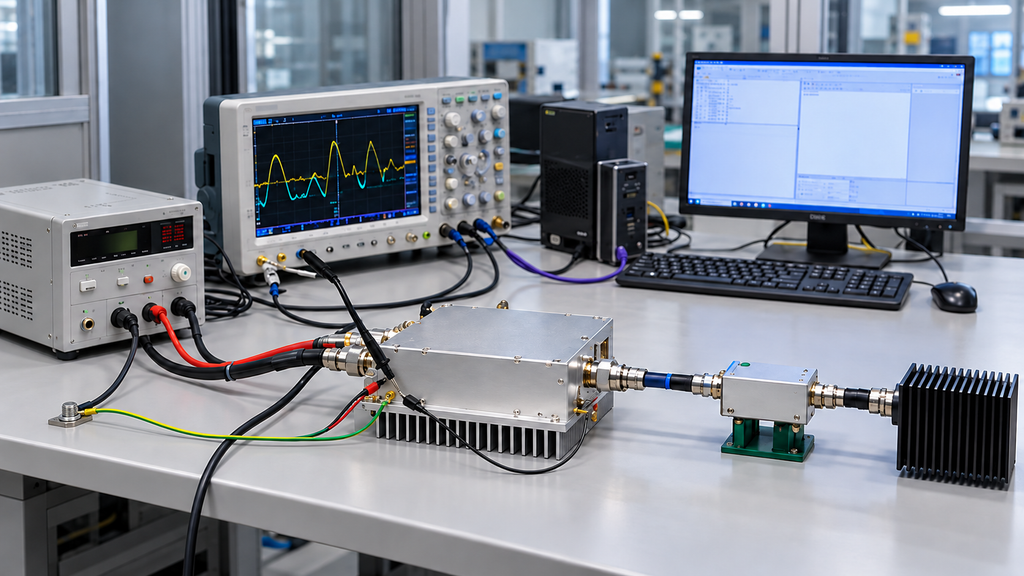
Test equipment can change the grounding network.
This often appears when an oscilloscope probe or PC-based controller cable is connected. The symptom may disappear or become worse after the instrument is attached, not because the PA repaired itself, but because the test setup added a new earth-referenced path. That result is useful for diagnosis, but it should not become the final cabinet grounding method.
An oscilloscope, signal generator, spectrum analyzer, power meter, PC, controller, or bench supply may connect to protective earth through its chassis or interface. When that equipment is connected to the DUT, the measurement cable can add another conductive path between points that were previously connected differently.
The resulting circuit may include:
- instrument earth;
- cable shields;
- controller ground;
- PA signal reference;
- chassis;
- DC negative return;
- rack or bench metalwork.
More than one connection does not by itself prove a harmful ground loop. Check whether the added path carries current or changes the relevant reference relationship enough to affect the measurement or system behavior.
Use controlled A/B comparison
If an instrument connection appears to change the symptom:
- Record the original test configuration.
- Define the PA, DC, RF, load, and thermal condition.
- Record the relevant reference-potential difference.
- Add or remove only the diagnostic connection when the approved test procedure allows it.
- Repeat the same operating condition.
- Compare the symptom and reference evidence.
Do not change several grounding connections together and then claim that one specific bond caused the problem.
Do not defeat protective earth for troubleshooting
Protective earth is a safety function.
Do not disconnect PE, float grounded equipment, remove an approved safety bond, or defeat instrument earth merely to see whether an RF symptom disappears unless a specifically engineered and approved test method provides equivalent protection.
If isolation is required for measurement, use equipment and methods designed for that purpose and appropriate to the applicable voltage, current, and measurement category.
A symptom that disappears during an unsafe or unapproved test must not be used as acceptance evidence or as justification for that grounding topology.
5. How to Ground Multi-Module RF PA Cabinets
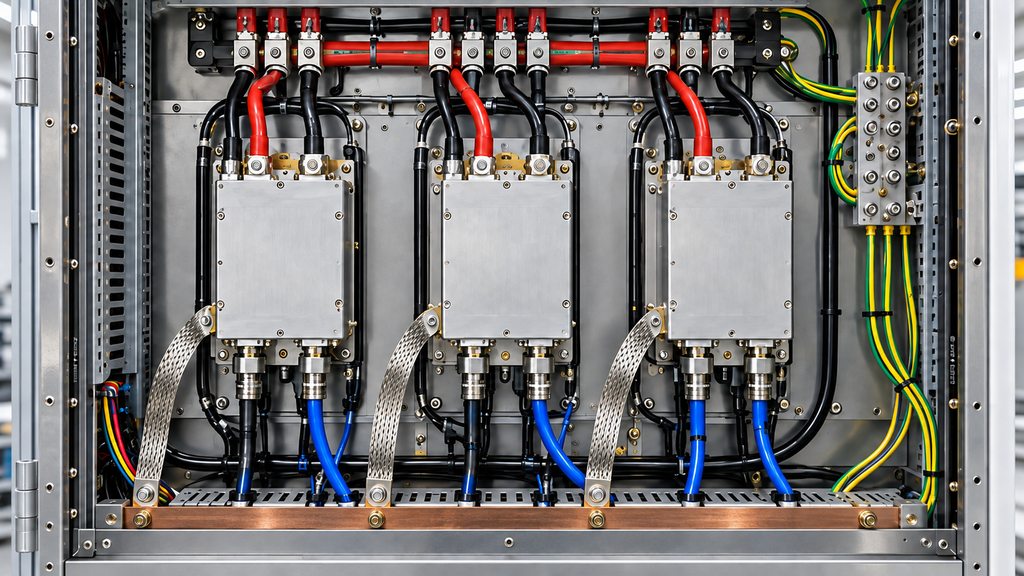
Multi-module cabinets add more current paths and more opportunities for shared impedance.
The grounding task is to define the return and reference architecture clearly enough that one module’s operating current does not unintentionally become another module’s signal-reference error.
Relevant design questions include:
- where each PA DC return connects;
- whether modules share a return conductor;
- where controller references connect;
- where chassis bonds are intentional;
- whether cable shields are bonded at defined interfaces;
- how protective earth is distributed;
- whether auxiliary loads share return impedance with sensitive references.
Avoid treating the cabinet frame as an undefined substitute for every return function.
Separate branch wires also do not automatically eliminate shared impedance. Branches can still share terminals, busbars, connectors, protection devices, or upstream conductors.
For grounding review, verify that the defined return and reference topology preserves the required reference relationships while the intended modules operate.
Bus-voltage sag and cross-branch transient interaction need separate diagnosis.
If the symptom appears specifically when another PA switches, enables, pulses, or changes current, use the shared DC bus check for the deeper distribution diagnosis rather than expanding the grounding page into a complete bus-interaction analysis.
6. How Grounding Supports RF Shielding and EMI Control

Grounding, bonding, and shielding are related, but they are not interchangeable terms.
Grounding
Grounding defines electrical reference and return relationships.
Examples include:
- DC return architecture;
- controller reference;
- chassis reference;
- protective-earth connection.
Bonding
Bonding creates an intentional low-impedance connection between conductive structures.
Its effectiveness depends on the frequency range and the physical connection.
A bond that shows low DC resistance may still have significant impedance at RF if it is long, narrow, poorly contacted, or geometrically unsuitable.
Shielding
Shielding controls electromagnetic field coupling and high-frequency current paths through enclosure and cable structures.
It can depend on:
- enclosure continuity;
- connector-shell bonding;
- cable-shield termination;
- seams;
- apertures;
- gaskets;
- panel interfaces.
Those detailed shielding mechanisms belong to the RF amplifier shielding diagnosis.
The grounding check is narrower: verify that the reference, return, and intentional bond relationships are defined and stable, so the shielding system is not compensating for an uncontrolled grounding architecture.
A shielding modification that reduces an EMI symptom does not automatically prove that the original problem was a DC-return fault.
Changing a ground wire and seeing an EMI change does not identify the enclosure leakage mechanism.
7. How to Test RF PA Grounding Under the Required Operating Condition
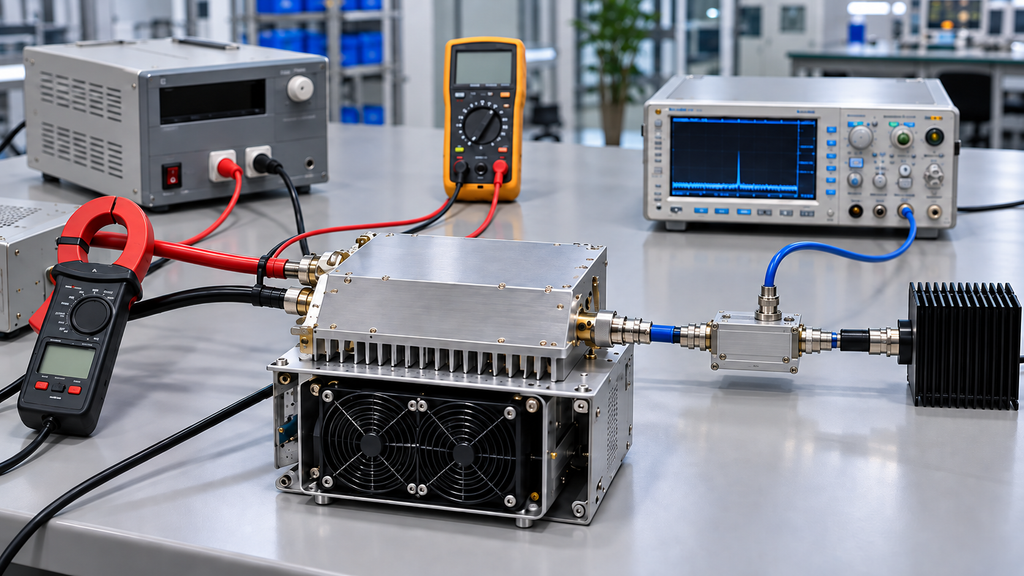
In an RF amplifier acceptance test, grounding should be evaluated under the operating condition that matters to the integration or acceptance decision.
For a 28 V PA cabinet, a no-load continuity check may pass before integration. The real question is different: what happens when the PA draws its normal current, the controller is connected, RF output is enabled, and the cabinet reaches the expected thermal state? That loaded condition is where a current-dependent reference shift may become visible even when a no-load continuity check looks normal.
An unloaded continuity measurement can confirm that two conductive points are connected. It does not establish the reference shift that appears when current flows.
Define the test condition
Record, as applicable:
- RF frequency;
- RF input condition;
- RF output;
- DC supply voltage;
- PA current;
- duty cycle;
- load condition;
- cooling condition;
- controller state;
- connected instruments;
- relevant ground / reference topology;
- test duration or dwell;
- thermal or stabilized condition required by the project.
Do not use an undefined phrase such as “after thermal stability” unless the project specifies what condition, dwell, or stabilization criterion is required.
Measure the relationships that matter
Use the measurements that match the suspected mechanism, such as:
- DC negative return drop;
- module reference to controller reference;
- module chassis to cabinet chassis;
- relevant bond-point voltage;
- monitor value;
- RF output;
- reflected power;
- alarm state.
Use measurement equipment and probing methods suitable for the electrical and RF environment.
A voltage measured between module GND and controller GND only describes that reference relationship. It does not substitute for separate verification of PE, shield bonding, or chassis bonding.
Change one grounding variable at a time
If a grounding modification is being evaluated:
- Record the original topology.
- Establish the defined RF and DC operating condition.
- Record the symptom and relevant reference measurements.
- Change one approved bond, reference connection, or routing variable.
- Repeat the same test condition.
- Compare both the symptom and the reference evidence.
- Restore or document the final approved topology.
Treat a symptom change as evidence only when the comparison conditions are sufficiently controlled.
Decision Stop: when to stop blaming grounding
Do not continue assigning a problem to grounding merely because several ground connections exist.
Reduce grounding priority when, under the same or a defensibly comparable RF, DC, thermal, controller, and instrumentation state:
- the relevant reference-potential difference remains stable;
- the reference evidence does not change with the symptom;
- an approved grounding-path change does not reproduce or remove the symptom;
- the symptom persists through a verified reference topology.
Without new evidence, move the investigation to the relevant RF path, DC distribution, shielding, control interface, thermal condition, load, or measurement system.
8. What Grounding Evidence Should Be Defined Before RFQ?
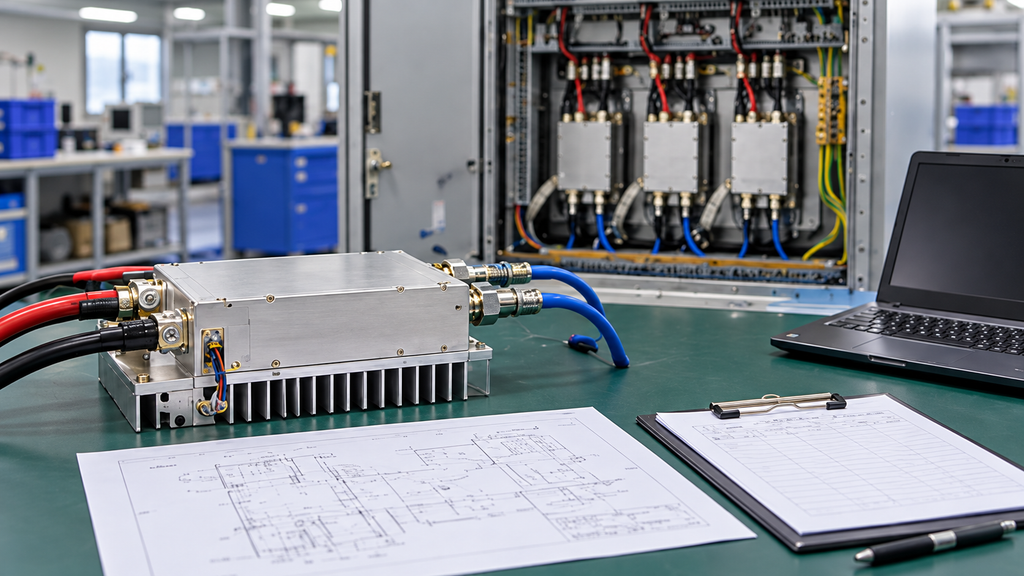
Grounding should be defined as part of RF amplifier system integration before final cabinet integration, not treated as a corrective detail after unexpected behavior appears.
RFQ or integration inputs may include:
- PA DC positive and negative terminals;
- expected DC current;
- chassis connection;
- protective-earth requirement;
- controller reference;
- analog monitor reference;
- digital interface reference where applicable;
- RF connector / shield relationship;
- cabinet bonding concept;
- instrument or service interface;
- multi-module return architecture;
- required operating state for grounding verification;
- required acceptance evidence.
Define the required evidence
Depending on project risk, grounding evidence may include:
- topology drawing;
- bond-point definition;
- DC-return path definition;
- continuity checks;
- loaded reference-potential measurements;
- module-to-controller reference measurements;
- alarm / monitor behavior under the required RF load;
- before-and-after evidence for an approved grounding change;
- final test configuration.
Unit-level or S/N-linked grounding records should be required only when the project requires unit-level traceability.
Engineering prototypes and laboratory setups do not automatically require a production-style S/N-linked grounding report.
Grounding requirements should state the decision boundary
Replace a vague requirement such as “Good grounding required” with the specific relationship that must remain controlled.
A better RFQ note would be: “During defined RF output and DC current operation, record the voltage between PA signal reference and controller reference, and confirm that alarm and monitor readings remain stable under the approved grounding topology.” This gives the supplier a testable requirement instead of a slogan.
For example, a project may require that the relevant control reference, chassis bond, or DC return relationship remain within an approved boundary during the defined RF and DC operating condition.
The actual limits and required test method must come from the applicable RFQ, specification, safety requirement, integration document, or approved test plan.
This article does not create universal grounding-resistance, bond-impedance, or ground-potential limits.
Conclusion
Before final integration, document the intended DC return, control reference, chassis / shield relationship, protective earth, and instrument-ground path. Then verify the relevant reference relationships under the RF and DC load state that matters.
A reference shift that tracks the symptom and changes repeatably when one approved grounding variable changes supports continued grounding diagnosis. Stable reference evidence lowers the priority of grounding; continue with the relevant RF path, DC distribution, shielding, control interface, thermal, load, or measurement checks instead.
For an RFQ involving RF power amplifier modules, define the module interfaces, DC return, control reference, chassis / shield relationship, protective-earth requirement, operating condition, and grounding evidence needed for engineering review.These inputs support RFQ definition and integration review but do not establish that a specific RF PA model or cabinet grounding design is suitable for the project.