
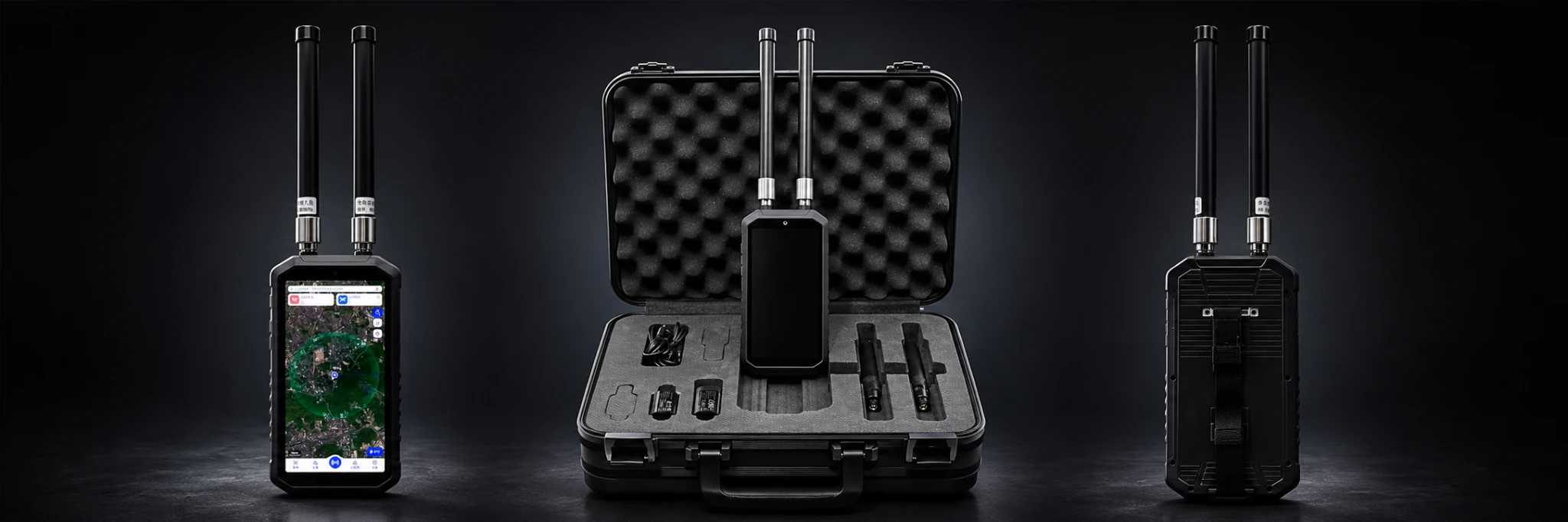


A drone detection system is ready for acceptance review when the buyer can match each required function to a representative test, a defined metric, independent ground truth, and a criterion agreed before the trial. One successful demonstration records what happened in that run. Repeatability at the buyer’s site requires more evidence.
An alert, a correct drone identity, reported coordinates, and a continuous track are different outputs. Test each separately. Target type, site conditions, configuration, and observation time affect the result. Specify what the system must prove before discussing a headline detection range.
1. What Does Drone Detection System Acceptance Actually Prove?
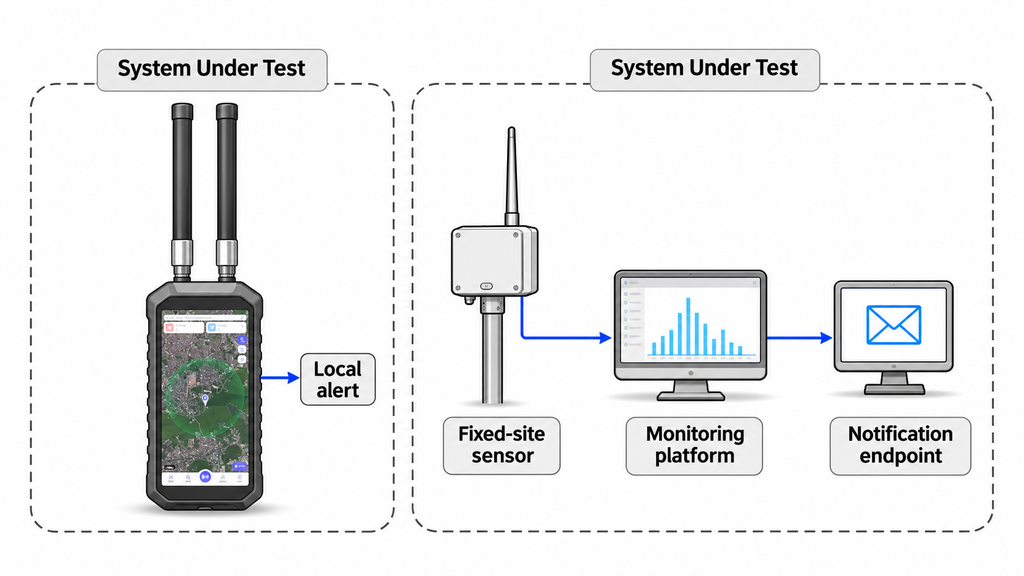
Acceptance testing checks a defined configuration against the buyer’s requirements under recorded conditions. The result must name the functions tested and the scope of the evidence.
Define the system under test first. It may be a standalone handheld receiver with its local display, a detector connected to a monitoring platform, or a fully integrated site installation. List the functions and interfaces inside that boundary. A device-level alert test cannot establish the delivery time or availability of an external notification chain that was not tested.
Four activities often get called a “test,” although they support different decisions:
- A demonstration shows that a selected function can operate in the observed situation.
- A pre-procurement field trial examines how a proposed configuration performs against buyer-relevant targets and conditions.
- A factory acceptance test checks the agreed functions and configuration at the supplier’s test location.
- A site acceptance test concerns the installed system and its contractual requirements. Its formal result belongs to the authorized project parties.
Records from early trials can support a later contractual review. They do not confer certification or replace the project’s signed site acceptance procedure.
Start with the outputs the operator actually needs. An RF receiver may recognize a supported drone signal and display identity-related information. Radar may detect and track a physical airborne object without knowing its digital identity. An integrated system may combine sensor alerts and maintain a consolidated track. Those are not interchangeable promises, so they should not share an undifferentiated pass/fail score.
For example, a mobile team may need a timely alert, supported drone identification, and a usable event record. A permanently monitored site may also require uninterrupted alarm delivery and continuous tracks. If the intended architecture is still undecided, first choose the detector type around the required operational result.
The CEN Workshop Agreement CWA 18150:2024 offers a scenario-based reference for testing integrated drone detection, tracking, and identification solutions. Its methods can inform a project-specific test of applicable handheld functions, but it is not a certification of any particular device or a source of automatic project pass limits. The buyer’s specification or approved test plan must state which outputs count and how they will be judged.
Without defined outputs and approved criteria, the exercise remains a characterization trial rather than formal acceptance.
2. Which Site Conditions and System Settings Must Stay Fixed?
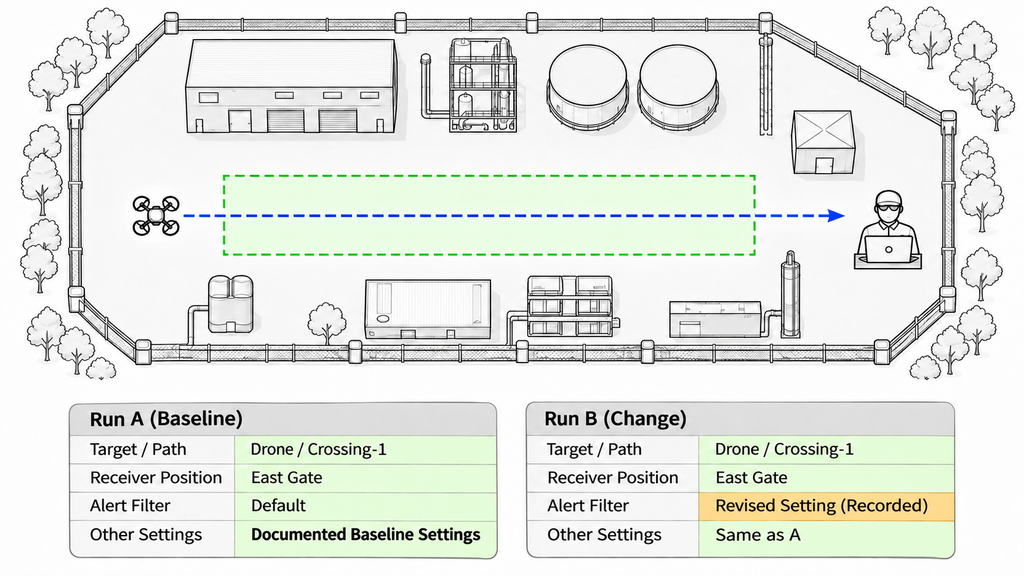
Record the system configuration before the first run. Without that baseline, a later performance change may be impossible to explain.
Capture four sets of conditions:
System and configuration. Identify the tested units, relevant serial numbers, hardware and firmware revisions, detection settings, software rules, active zones, and any whitelist or alert filtering. For a networked system, include the platform version, relevant interface settings, and the path used to deliver alerts.
Target conditions. Record the drone type, firmware or protocol where relevant, radio-link state, flight mode, and whether it belongs to the system’s declared support set. A result against one transmitting model cannot establish performance against an unsupported or RF-silent target.
Site geometry. Define the protected area, test routes, target altitude and direction, receiver position, mounting height, antenna orientation, and significant obstructions. A handheld trial should also record operator position and handling, since both shape normal use.
Environment and timing. Observe local RF activity, weather, visibility where relevant, background traffic, time source, and clock synchronization. Some conditions can be controlled. Others should be measured and retained with each run.
Configuration control also applies after testing begins. If a detection library, filter, sensor position, or software revision changes, identify the affected metrics and the need for retesting. A minor change may leave some evidence usable while invalidating other results.
Two runs with the same target and route but different alert settings may support a comparison of raw detections. They cannot support a fair comparison of operator alarm burden unless the alert policies also match.
If a key version, target state, or measurement condition is unknown, keep the observation in the record but hold the affected acceptance decision. A longer test does not repair an undefined baseline.
3. Which Test Scenarios and Ground Truth Are Needed?
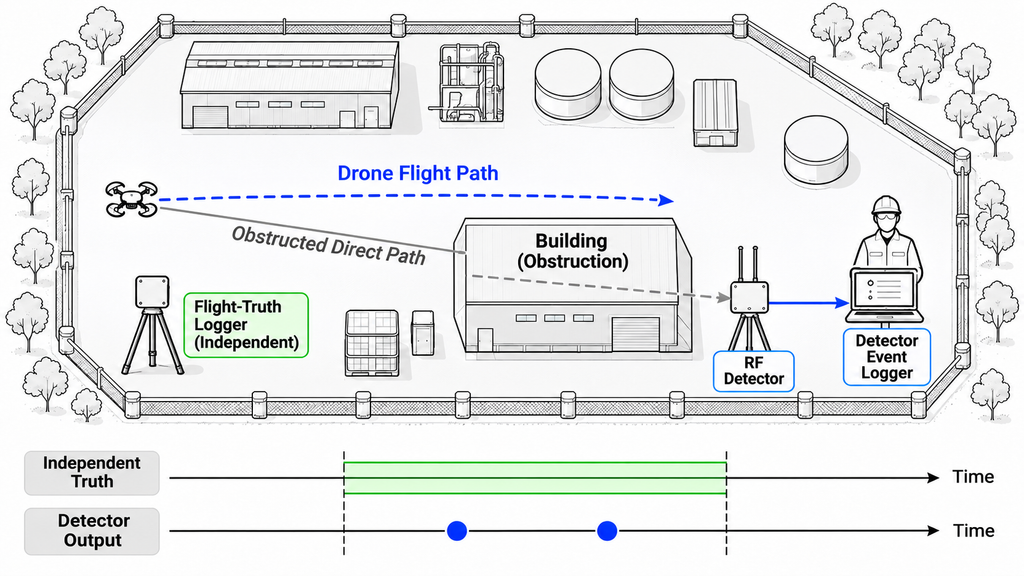
Each scenario needs a defined target, an observation window, an expected output, and independent evidence of what happened. A flight list without those fields cannot support acceptance.
Include routine and difficult situations that matter to the proposed use. These may involve approach, crossing, hover, departure, partial obstruction, and changes in local RF activity. A quiet monitoring period is equally important. Without it, the team may estimate detection success while learning almost nothing about false alerts.
The following matrix is a planning example, not completed tests or RF SKYPOWER performance results. Replace its criteria-source placeholders with actual approved document and clause references before use.
| Test scenario | Target and protocol | Path and environment | Required system output | Independent ground truth | Repeats or observation | Criteria source |
|---|---|---|---|---|---|---|
| Representative approach | Declared supported target and link state | Agreed sector, height, and RF background | First valid alert within agreed window | Independent flight and time record | Planned eligible approaches by sector | Approved project specification (first-alert criterion; clause ID TBD) |
| Crossing path | Target and operating state recorded | Defined crossing line, aspect, and altitude | Detection and applicable identity or track output | Timestamped path reference | Planned crossings by aspect and height | Approved project specification (detection or tracking criterion; clause ID TBD) |
| Hover and departure | Supported test target | Defined hover point and departure path | Required alert persistence or updates | Independent target-state timeline | Defined dwell duration and departure repeats | Approved project specification (persistence or update criterion; clause ID TBD) |
| Obstructed or high-RF-activity case | Target and RF behavior recorded | Documented obstruction or measured RF background | Project-defined supported output | Independent target log and site observations | Valid runs for each specified condition | Approved project specification (scenario-specific criterion; clause ID TBD) |
| No-target baseline | No intentional test drone | Representative monitoring conditions | False alerts within the agreed burden limit | Independent air/RF observations, target activity log, and monitoring limits | Agreed audited monitoring hours | Approved project specification (false-alert burden criterion; clause ID TBD) |
| Simultaneous targets, if supported | Defined target set and protocols | Agreed separation and route overlap | Required per-target outputs | Independent record for each target | Eligible per-target encounters | Approved project specification (multi-target criterion; clause ID TBD) |
The ground-truth team should maintain its own timestamped target record, such as a suitably collected flight log supported by independent observation. The detector’s own alert cannot serve as the sole proof that its detection was correct. Where no-target status cannot be fully established, document that uncertainty rather than treating every unexplained alert as a confirmed false positive.
Target and detector logs may both have timestamps but use different clocks. Record how they were synchronized, any measured offset, and remaining timing uncertainty. A small mismatch matters when testing alert latency in milliseconds or seconds.
The scenario is valid only if the agreed preconditions were met. Flight authorization, site safety, target state, and reference-record availability must be settled before an event is counted. Invalid runs should remain traceable, with the exclusion reason recorded. They should not disappear merely because the result was unfavorable.
The matrix supports scenario acceptance; sitewide coverage mapping is a separate task.
4. How Do You Score Detection Probability and Missed Events?
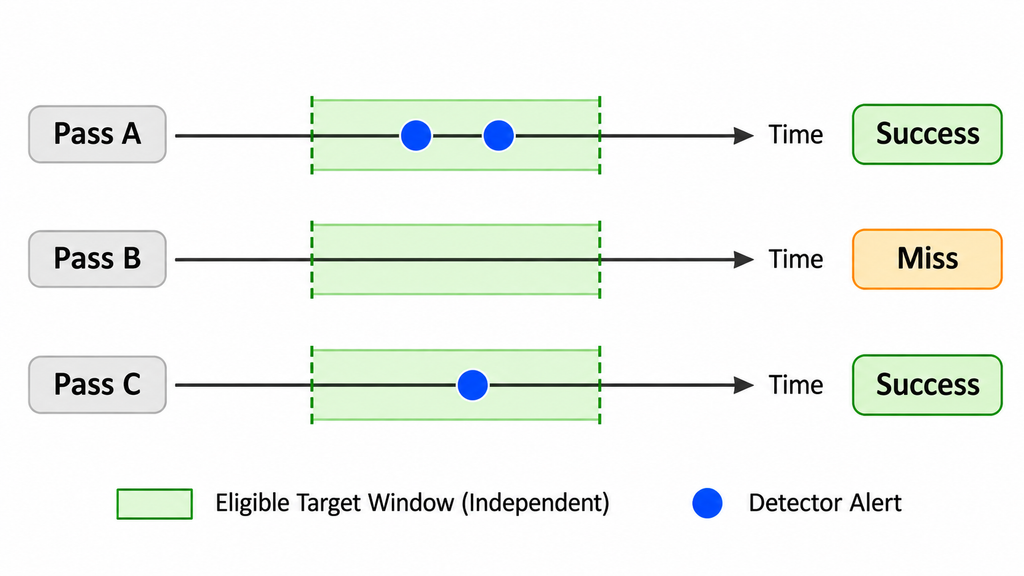
Choose the counting unit before testing: one flight, one pass through a defined area, or one eligible time window. Changing it after seeing the alerts changes the reported detection proportion.
For a pass-based test, an eligible opportunity may start when the target enters the agreed region under the specified conditions. In a passive RF trial, confirm independently that the target transmitted a supported signal during that opportunity. Record passes with no such transmission separately; do not exclude poor-reception cases if the agreed coverage requirement includes them. A success requires at least one associated valid alert within the agreed time window. Count that opportunity once, even if the detector generates several alerts for the same pass. The remaining eligible opportunities are missed detections under that rule.
The observed detection success proportion is:
An auditable result reports the percentage together with its numerator, denominator, target type, scenario, detection window, and exclusion rules.
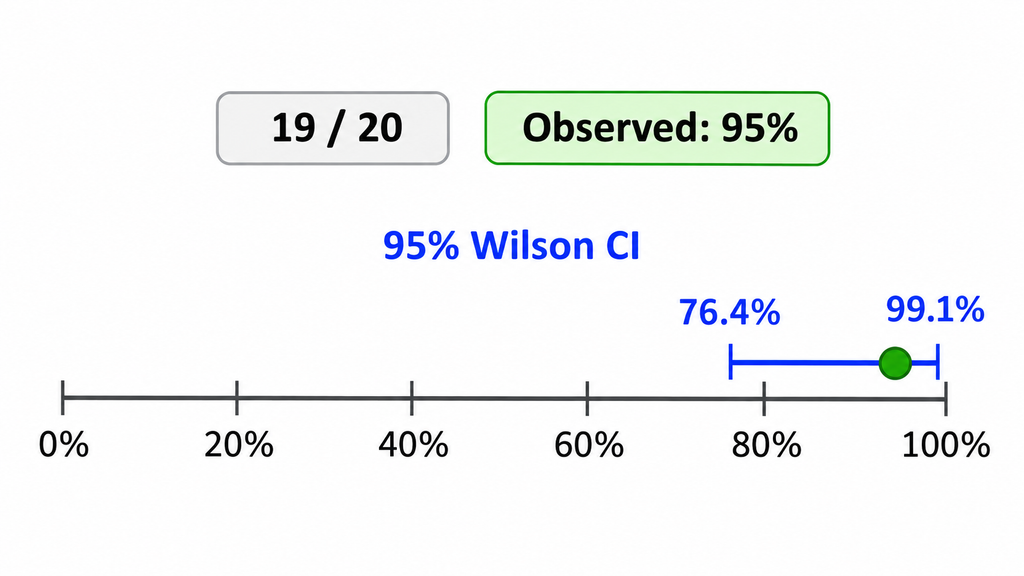
Suppose a system produces a valid alert in 19 of 20 eligible passes. The observed proportion is 95% for those passes. It does not establish that the system has at least a 95% detection probability across different targets, RF environments, seasons, or sites. Sample size and dependence between repeated passes still matter.
Do not silently remove runs in which the detector was offline, the operator missed a step, or a record was lost. An equipment outage during a required monitoring period is not automatically an invalid trial. Apply the agreed availability and missed-opportunity rules, retaining the outage’s effect on applicable acceptance metrics. Record procedural errors and genuinely invalid runs separately, with reasons.
Detection and identification should also be kept separate. A correct target alert without a correct model or identity field may count as a detection success and an identification failure, if the plan requires both. Conversely, an identity record cannot count as a timely alert if it appeared outside the allowed notification window.
If the target, clock, or event association cannot be verified, hold the affected metric and record an unresolved result.
5. How Do You Measure False Alarms and Alert Latency?
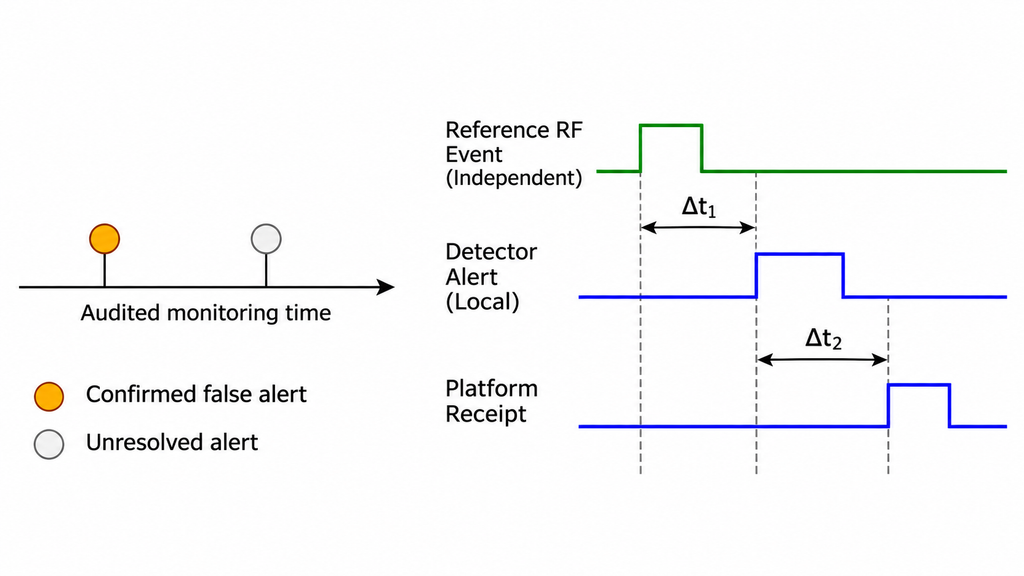
A detector can alert quickly and still overwhelm operators with unnecessary notifications. Another may generate few alerts but respond too late. Measure false-alarm burden and alert latency separately from detection success.
False alarms need a stated denominator
First separate confirmed false alerts from events that remain unmatched because the reference record is incomplete. An unmatched event is not automatically a false alarm. For field monitoring, one useful measure is the number of confirmed false drone alerts per audited monitoring hour, with an independent record of relevant air activity.
The false-alarm proportion instead divides confirmed false alerts by all generated alerts under the defined review rule. An opportunity-based false-positive rate counts eligible negative opportunities with at least one false alert, divided by all eligible negative opportunities. Define each observation window and whether repeated notifications belong to one alarm event or several. If no alerts occur, an alerts-based proportion has a zero denominator and cannot be reported as 0%; a zero-per-hour observation remains valid when audited monitoring time is known. State the measure and denominator, and list unresolved alerts separately. If unresolved alerts could change the acceptance outcome, hold the final false-alarm decision until they are adjudicated or the approved uncertainty rule is applied.
Keep sensor classification errors separate from alert-policy decisions. For example, a supported authorized drone may be correctly detected yet intentionally suppressed by a whitelist. That is not automatically a sensor miss. Likewise, a nuisance notification caused by filtering or escalation rules is not necessarily a false physical detection.
If a factory test records no false alerts, report that result with its monitoring time, configuration, and target environment.
Latency needs two identifiable timestamps
Define the start event before recording delays. Depending on the requirement, it might be target entry into the eligible region or another independently recorded event. For passive RF detection, confirm that it represents a valid opportunity to receive and recognize a supported signal; geographic entry and RF signal availability may occur at different times. Establish the start independently of the detector under test, using an agreed target-transmission record or time-aligned RF reference where appropriate. The device’s own first alert must not define its latency start. Then state the endpoint: detector alert, local screen update, central platform receipt, or notification delivery.
Device-screen, platform, and notification timestamps measure different delivery paths. A fast local alert cannot establish network dispatch latency. Account for clock offset, timestamp resolution, logging delay, and missing events.
Report latency for eligible opportunities that produced a matched alert, alongside the number of missed opportunities. A median and a slower-tail value can help if the sample count and calculation are stated. Under expected simultaneous traffic or network conditions, verify the actual endpoint the customer will use.
If the reference event, timebase, or endpoint is undefined, do not issue a formal latency pass/fail conclusion. Preserve the observed screen or log evidence and request the missing timing definition.
6. When Do Identification, Location, and Track Continuity Count?
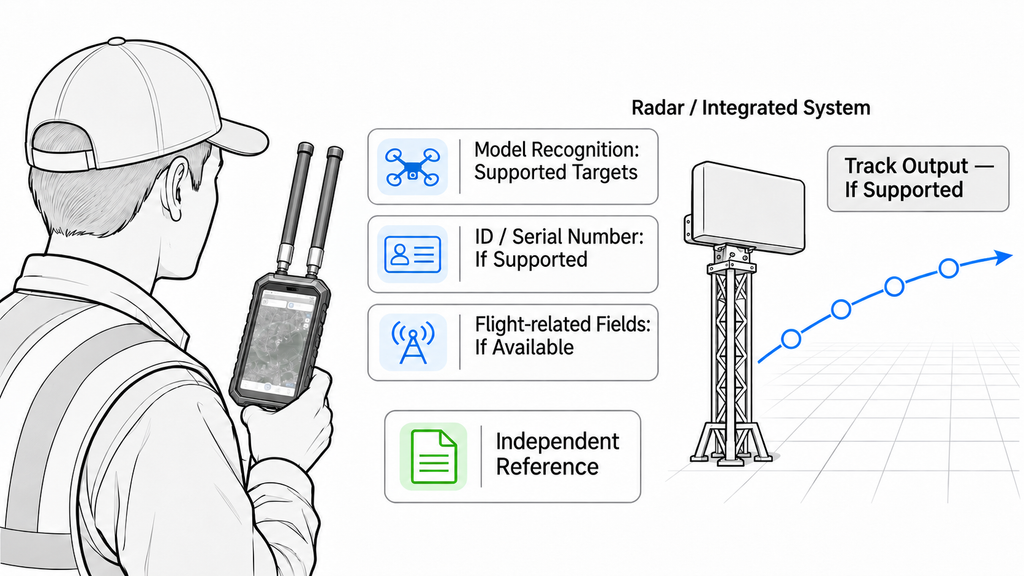
Test each product against the outputs it promises to deliver. A handheld RF receiver should not inherit radar tracking criteria outside its agreed scope.
For identification, define the expected fields. A valid RF detection might include a supported protocol, model, identifier, or flight-related data, depending on the target and device. The test should verify whether the required field is present and correct against a suitable independent reference. Report unsupported targets separately from errors on declared supported targets.
For location, identify what the displayed coordinate represents: aircraft, controller, launch point, or another derived location. Compare it with a time-aligned independent reference, using the same coordinate convention and altitude reference where relevant. Coordinates decoded from drone telemetry can be checked as displayed data, but they do not establish the detector’s own localization accuracy. A physical position-accuracy claim needs a reference measured independently of the transmitted coordinates.
For track continuity, the system must actually provide a sequence of associated target states. Then test gaps, reacquisition, duplicate tracks, and incorrect association against the independent target timeline. A single alert, a sequence of decoded telemetry fields, and a maintained radar or fused track do not automatically mean the same thing.
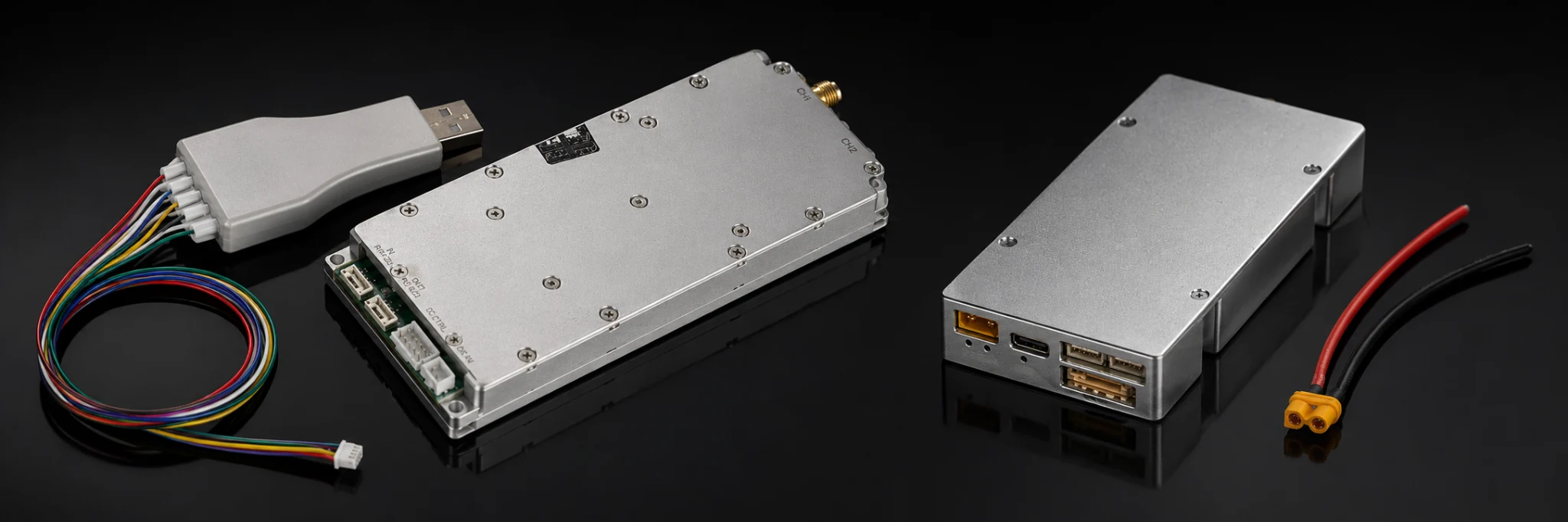
For mobile patrols, the HZ-HD03 combines passive RF reception with SDR-based analysis of supported drone signals. Its detection process does not actively transmit RF signals. For compatible targets, documented functions include model and serial-number decoding, available flight-related information, and an on-device field display. Security teams can relocate the handheld unit, investigate reported activity, and review available event records on site.
A relevant trial can check supported-target recognition, displayed identity or location-related fields, alert presentation, and record retrieval under actual patrol conditions. RF SKYPOWER’s published performance figures come from factory tests; the corresponding test conditions and planned video can help buyers review those results. The HZ-HD03 handheld drone detector is a practical product path for mobile passive RF detection.
Use the following fields to report each metric. Mark functions outside a product’s agreed scope as not applicable. Record a failure when a promised function misses its approved criterion.
| Metric | Applicable system capability | Success or event definition | Denominator or unit | Required raw evidence | What it cannot prove |
|---|---|---|---|---|---|
| Detection success | Valid target alert | At least one qualifying matched alert per eligible opportunity | Eligible target opportunities, counted once each | Independent target and detector event timelines | Success on untested targets or conditions |
| Missed detection | Valid target alert | Eligible opportunity without a matched alert | Eligible target opportunities | Complete truth log and alert record | Cause of a miss without investigation |
| False alarm burden | Drone alert and agreed policy | Confirmed false alert under the independent review rule | Audited hours, total generated alerts, or defined opportunities; reported separately | Alert log, reference context, and disposition of unresolved events | Universal absence of false alarms |
| Alert latency | Timestamped alert output | Defined endpoint time minus reference event time | Time, reported as a distribution | Synchronized reference and output timestamps | Latency of a different delivery path |
| Identification correctness | Supported identity or classification fields | Required field agrees with the reference | Eligible supported targets or detections, explicitly stated | Target reference and decoded field record | Correct identification of unsupported targets |
| Position or bearing error | Reported coordinates or bearing, when supported | Compare matched output with an independent reference for that quantity | Position error (metres) or bearing error (degrees), reported separately | Time-aligned reference and corresponding device output | Sensor-derived localization accuracy from decoded telemetry coordinates |
| Track continuity | Continuous target track output | Associated track coverage, gaps, and reacquisition | Agreed time or track-segment measure | Independent trajectory and track history | Continuous physical tracking from isolated alerts |
Compare results only when the capability, target set, operating conditions, reference, and metric definition align. Otherwise, report them separately rather than rank systems by superficially similar percentages.
7. How Much Testing Is Enough to Support an Acceptance Decision?
There is no single useful test count for every drone detection requirement. The sample plan should follow the decision risk, target set, scenario diversity, expected performance, and statistical confidence the buyer needs.
Twenty passes along one easy route provide different evidence from twenty passes spread across distinct target types and difficult sectors. Conversely, dividing one continuous flight into many short windows may create a large-looking sample without providing genuinely independent trials.
Set the sampling unit and minimum coverage of critical scenarios before testing. Keep results separated by target class, site sector, RF background, and other factors that materially change performance. A high overall average should not conceal repeated misses in a requirement-critical condition.
When a detection-probability claim supports acceptance, report the uncertainty as well as the observed proportion. For reasonably independent trials under a consistent sampling model, established binomial methods such as Wilson or exact intervals are more suitable for small samples than a simple symmetric normal approximation. Correlated passes or materially different scenarios may require a different analysis. The confidence level and decision rule belong in the approved test plan.
For the earlier 19-of-20 example, a two-sided 95% Wilson interval is approximately 76.4%–99.1%, if those opportunities meet the independent-trial assumptions. The interval does not apply automatically to other targets, routes, or sites.
Do not discard unsuccessful passes after seeing the data or increase the sample until a preferred percentage appears unless the pre-agreed sequential test rule allows that process. If a critical scenario has too few valid observations, collect more evidence for that scenario rather than borrow confidence from unrelated easy runs.
8. What Makes an Acceptance Report Defensible—and When Do You Retest?
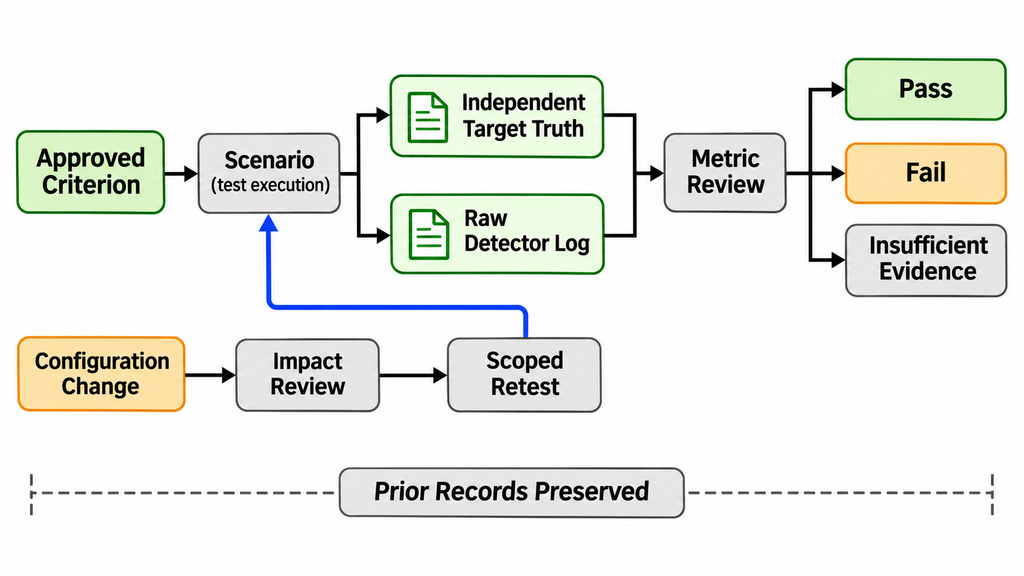
An acceptance report is useful when another qualified reviewer can reconstruct what was tested, which rule was applied, and how the conclusion followed from the evidence. A final “passed” label without its inputs is not enough.
The evidence package should retain at least:
- The approved test plan, requirement source, metric definitions, and acceptance criteria.
- Tested device identities, hardware and firmware versions, software settings, and relevant configuration changes.
- Scenario IDs, target models and protocols, routes, environmental observations, and validity conditions.
- Independent ground-truth records and the time synchronization or offset information needed to align them.
- Original detector alerts, identity or position fields, track data where applicable, and event exports in an agreed accessible format.
- Calculation details: matched successes, misses, confirmed false alerts, unresolved events, denominators, observation hours, latency distribution, and statistical treatment.
- A decision for each applicable requirement, linking its acceptance criterion and observed result to supporting evidence and a Pass, Fail, or Insufficient Evidence disposition.
- Invalid runs, exclusions, system outages, anomalies, and the reasons for each disposition.
- Corrective actions, retest scope, before-and-after configuration, and retained repeat measurements.
- Reviewer approval, unresolved limitations, and the exact function or project scope covered by the decision.
Retesting is not necessarily a full repeat of every flight. First identify what changed. A modified alert threshold may require another false-alarm and detection trial. A new target library can affect supported identification. Moving a receiver or changing antenna orientation may invalidate site-specific coverage evidence. An unrelated administrative change may not affect a measured sensing function.
The approved plan should say how such changes are assessed, who authorizes a retest, and whether prior results remain usable. Where original logs are unavailable, use the prescribed evidence-recovery or retest process; do not manufacture a statistical result from screenshots.
Three outcomes must stay distinct. Evidence may meet an approved requirement for the tested scope. It may show that a specified requirement was not met. Or it may be insufficient for a formal decision because a condition, reference, or test record is missing. Insufficient evidence is a reason to hold the decision, not automatic proof of product failure.
Conclusion
A drone detection system passes acceptance only for the functions and conditions tested against the buyer’s approved criteria. A timely alert does not by itself validate identification, position, or continuous tracking. This framework cannot set universal pass thresholds or establish suitability at an untested site. Missing evidence leaves the affected requirement undecided; a failed requirement calls for corrective action or retest.
Before committing to a formal acceptance decision, complete the scenario matrix, metric definitions, evidence list, and retest rules. Agree on the applicable limits with the authorized project parties, then check that every reported outcome can be traced to the corresponding evidence.
For mobile passive RF detection, send RF SKYPOWER your site type, monitored area, target models and protocols, RF environment, operator workflow, required identity and event fields, alert timing, and test evidence needs. We can review HZ-HD03 documentation, available factory results, and a trial plan matched to those requirements.