

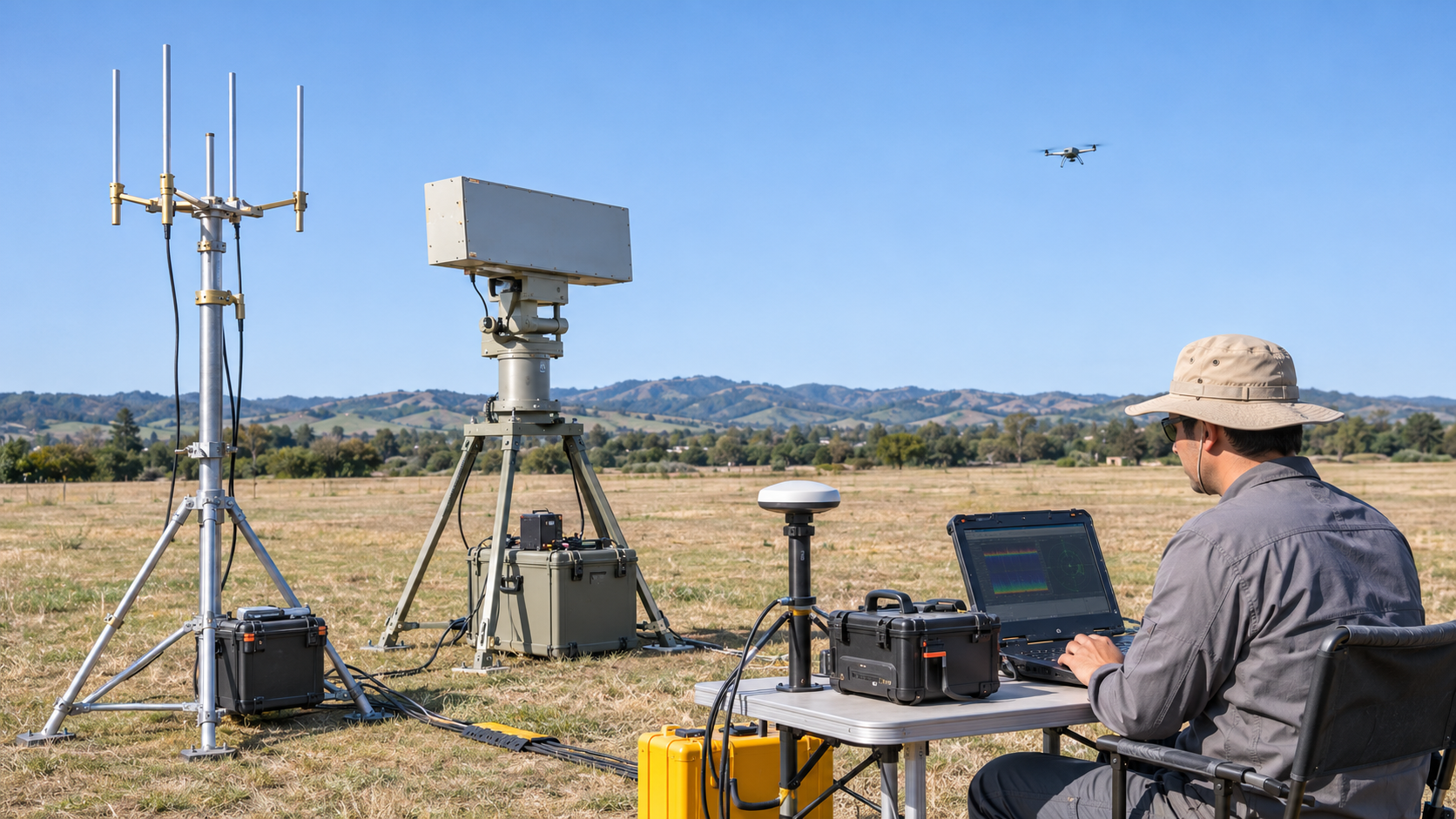
Multi-sensor drone detection needs more than simultaneous RF and radar alerts to prove a valid target association. Any accepted link between eligible observations must follow a documented rule. Independent ground truth records the test target’s identity, position, and time separately from the fusion output. It lets the evaluator check that link.
An RF receiver may report a signal event while a radar reports a moving track. The records may describe different objects or measurements. A fused symbol on the screen can hide a wrong association when the platform cannot explain the link. Establish what that displayed result means before scoring it.
1. What Does a Valid RF–Radar Correlation Actually Prove?
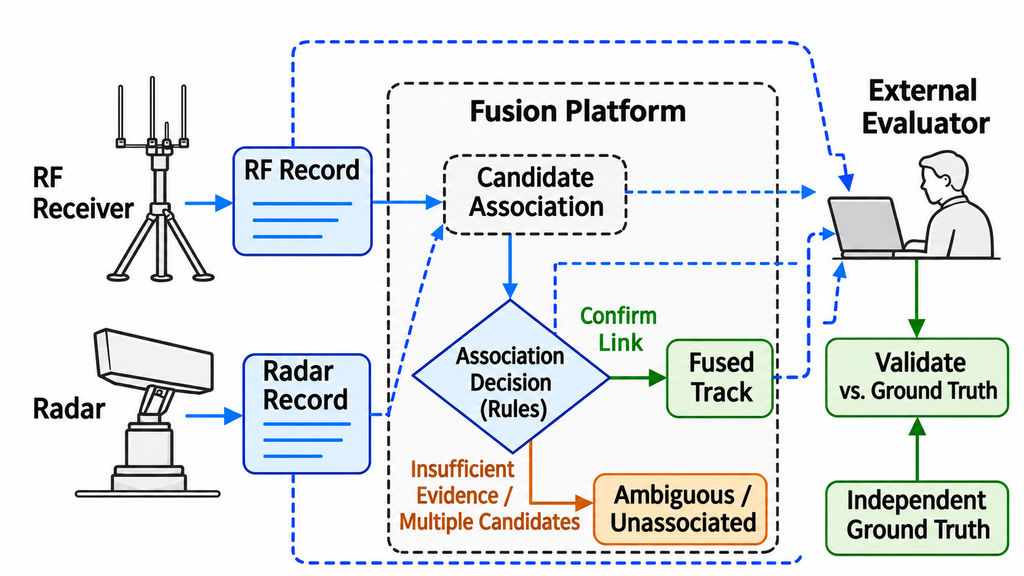
A valid RF–radar correlation pairs eligible observations under defined timing, data, and matching rules.
Distinguish four outputs:
- Simultaneous observation: Both sensors produced records during a similar period. No common target has been established.
- Candidate association: The records satisfy initial eligibility checks, such as a permitted time interval and, where available, a compatible geometric constraint.
- Acceptance-validated association: An evaluator reconstructs the platform’s decision from recorded rules and checks it against independent target evidence. This is a test finding, not necessarily a live platform status.
- Fused track: The system maintains a track or event history using information from more than one source. It may display that track before anyone has validated the association. Identity, continuity, and source records still need checking.
A valid correlation can support the conclusion that two eligible observations refer to the same test target under the tested conditions. It does not automatically authenticate a drone’s identity, validate every detection, or prove that an entire deployment meets its acceptance requirements. An RF-only alert or radar-only track may also be the correct output when the other sensor has no valid observation.
Before calculating an association rate, agree on what the platform’s labels mean: candidate, confirmed, single-source, unknown, and terminated, or their documented equivalents. If the vendor cannot explain what qualifies a track as “fused,” the displayed count is not a defensible measure of correct correlation.
If the project is still choosing between RF, radar, and multi-sensor detection architectures, settle that decision first. With both sensors selected, test whether their data support the same target.
2. How Should RF and Radar Timestamps Be Synchronized?
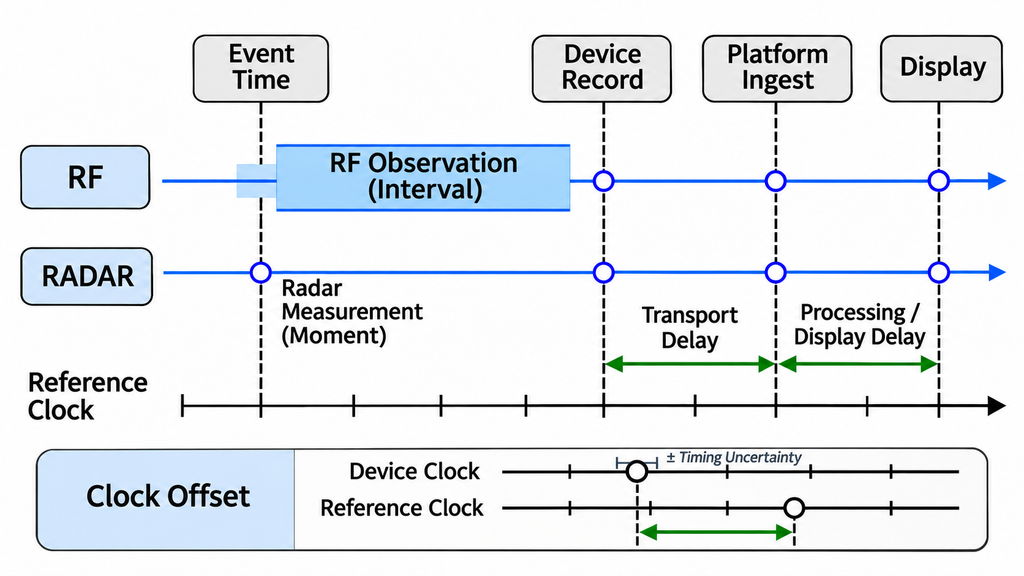
RF and radar records are comparable in time only when the meaning and uncertainty of their timestamps are known. A time shown on the operator display may be the time the platform received an alert, not the moment a sensor observed the target.
For each source, distinguish at least three events where the interface supports them: the measurement or event time, the device record time, and the platform ingestion time. Display time is a further processing stage. Differences between these fields include transport and processing delay; they must not be treated as target-motion evidence.
Record each device’s clock source and its offset from the project reference clock. Check whether that offset drifts during a run. Verify the time relationship at the beginning and end of each trial. Check again after a clock reset, network interruption, or sensor restart. Record update periods, buffering, and event-to-ingestion delays. An RF alert may also represent an observation interval rather than a single instant. If a source provides only receipt time, state that limitation. Do not silently treat it as measurement time.
The permitted association time window must account for the uncertainty in those observations and the dynamics of the scenario. There is no universal millisecond limit that makes two observations a match. A wide window may admit unrelated targets; a narrow one may reject legitimate observations from slower or intermittently reporting sensors.
Deliver a timestamp definition and timing-error record for both sources. If the time fields, clock offset, or drift cannot be established, hold the time-based correlation judgment until the evidence is available. Do not compare reported time differences between systems until their event definitions and error bounds are aligned.
3. Which RF and Radar Data Fields Can Actually Be Matched?
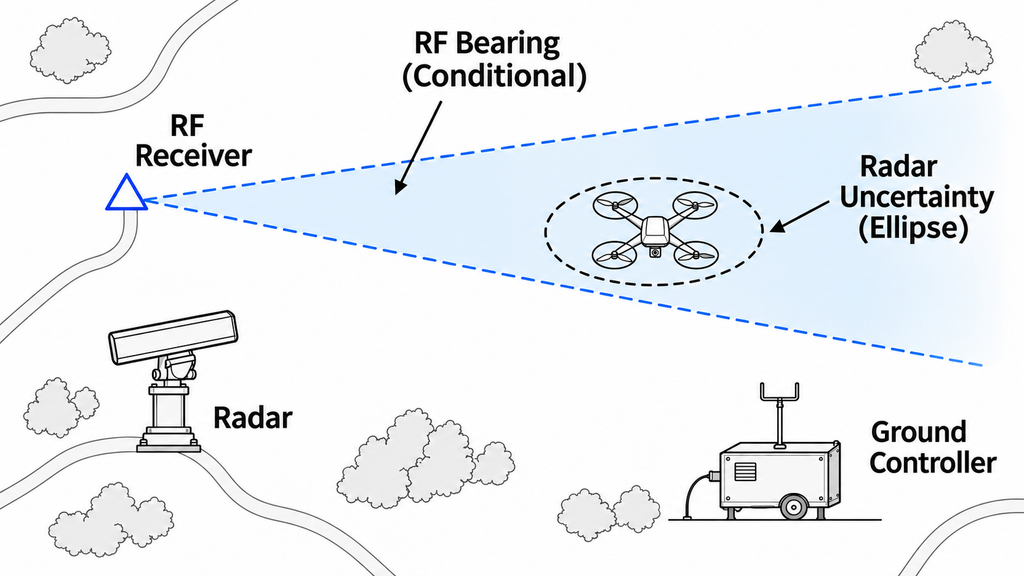
An association rule must compare fields that refer to compatible physical objects. A radar track may describe an estimated aircraft position and motion. An RF observation may describe only received radio activity. The latter cannot be converted into an aircraft position by labeling it a detection.
Check the actual data dictionary and a sample export from each sensor:
- RF event or signal classification: May support the timing of suspected drone-related activity, but by itself provides no spatial match.
- RF protocol or identity-related field: May help classify emissions if the device supports it. The identifier might refer to an emitter, controller, or protocol field rather than the aircraft itself. It is not automatically equivalent to a radar track ID.
- RF bearing or estimated position: Can constrain geometry only if the device provides that measurement or estimate. Its origin, reference direction, and uncertainty must be known.
- Controller or operator location: Describes a different object. It must never be substituted for the aircraft’s position in a spatial association test.
- Radar range, azimuth, elevation, velocity, and source track ID: May constrain airborne motion. Check the radar’s coordinate frame, update time, uncertainty, and track-management rules.
If both sources supply relevant geometry, align their coordinate systems, units, sensor locations, and orientations. Check altitude references, measurement times, and uncertainty as well. A radar position and an RF bearing may be compatible without providing two independent position fixes. If the RF source reports only a signal event, treat temporal co-occurrence as candidate evidence, not a confirmed aircraft-level match. A stronger association requires independent target evidence and a documented method for handling competing candidates.
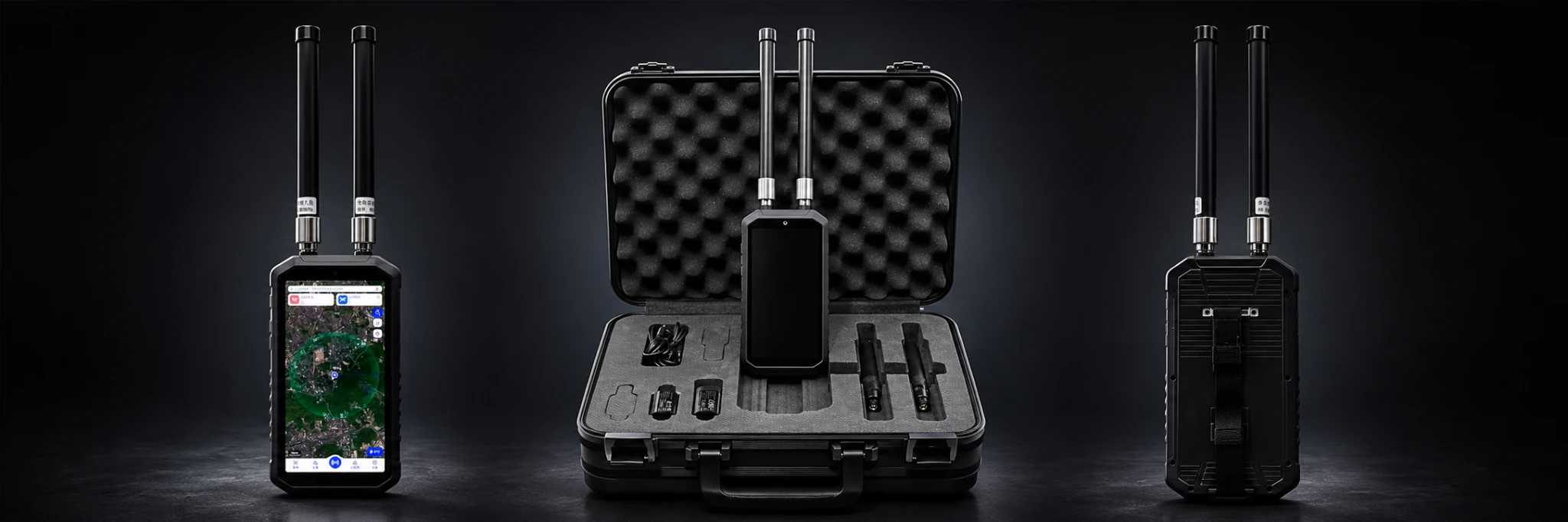
Obtain model-specific interface documentation before using an RF device in a correlation test. Its product category or marketing screen cannot establish the available timestamps, export fields, or third-party radar compatibility.
The field review should produce an explicit eligible / conditionally eligible / not directly comparable judgment for each proposed match. Stop the spatial or identity comparison wherever field meaning, target object, coordinate reference, or uncertainty remains unresolved.
4. How Should Correlation Windows and Track-ID Rules Be Defined?
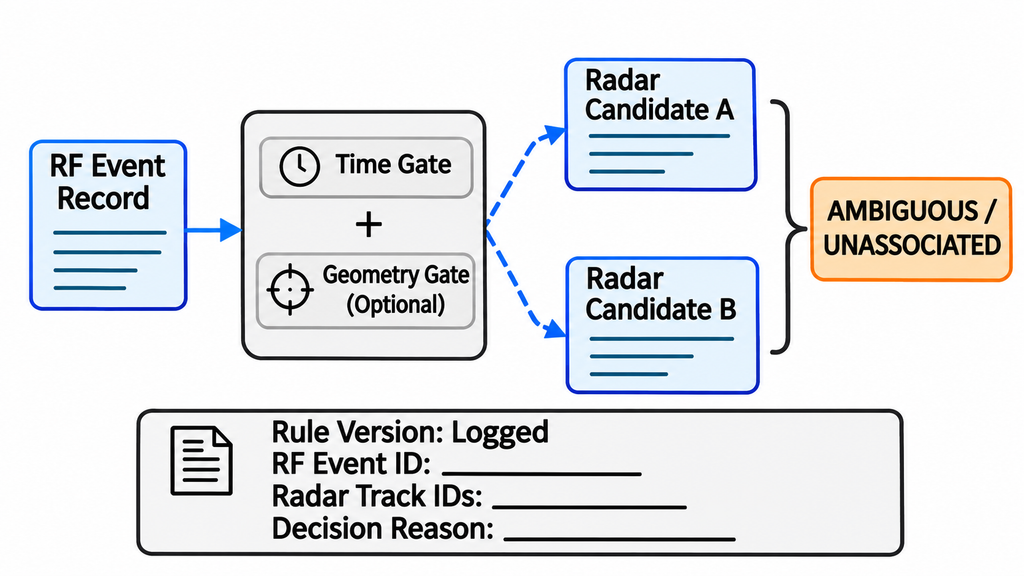
Define the association policy before the test flight. Otherwise, an integrator could change the time window, distance tolerance, or track-handling rule after seeing a difficult result and still describe the run as a pass.
The policy should separate candidate generation from association confirmation. A candidate may satisfy an allowed time difference. Eligible geometry may add a position or motion-consistency check. Confirmation must follow the project’s rule for competing candidates, source confidence, and ambiguity.
Set time and geometric tolerances from the actual sensor uncertainties, update rates, motion conditions, and required risk control. Record the rule and software/configuration version used in each run.
Track IDs need separate rules. Keep the RF event ID, radar source-track ID, and fused-track ID distinct. Record why each mapping was created, updated, rejected, split, or ended. Define whether one RF event can support several radar candidates, or whether several RF events can belong to one radar track. Do not assume a one-to-one mapping without a project rule.
Specify how IDs behave during loss, reacquisition, crossing tracks, and termination. Track fragmentation occurs when tracking of a reference target is interrupted and later resumes, whether or not the fused-track ID changes. A track-ID change assigns a different fused ID to a continuing target. Identity transfer occurs when a fused ID is incorrectly assigned to another reference target. Define which ID changes are unjustified and which are permitted after termination or reacquisition. One recovery may involve both fragmentation and an ID change. A new source ID does not necessarily mean a new aircraft; a reused ID cannot prove continuity.
Where two radar tracks are plausible matches for one RF event, an explicit ambiguous or unassociated state is often more defensible than a forced merge. Preserve rejected candidates and decision reasons in the log; the final chosen pair alone cannot reveal whether alternatives were ignored.
Keep the effective rule set and source-to-fused ID mapping for each run. Without the rule version and enough records to reconstruct a match, the evaluator can describe the display but cannot verify its correlation.
5. How Do You Establish Ground Truth for Correlation Testing?
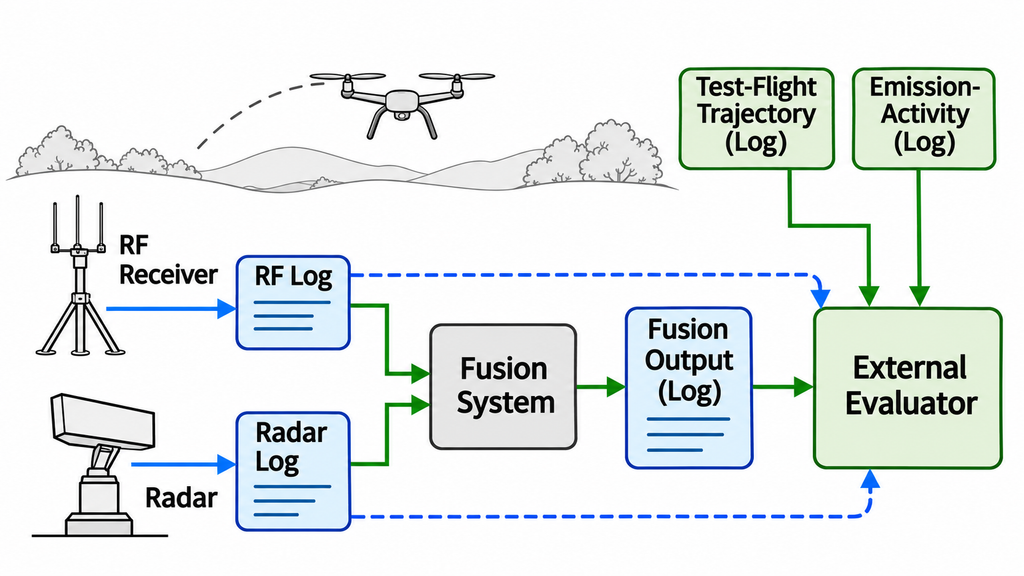
Independent ground truth records which test target was where and when, separately from the fusion output being evaluated. When its accuracy is sufficient, it establishes whether an accepted pair of RF and radar observations belonged to the same aircraft.
Assign each authorized aircraft and flight a unique reference identifier. Capture a time-aligned trajectory using a suitably validated source, such as test-aircraft telemetry or separate tracking equipment. Record its position reference, sampling interval, clock error, accuracy limits, and gaps. Record relevant transmitter activity separately when emission state matters. A position record alone cannot prove that an RF signal was available to receive.
For each scenario, record the aircraft, flight interval, path, target count, and operating conditions. Mark when each sensor had a valid opportunity to observe. An independent observer or recording may help explain an event. Video or a vendor dashboard alone cannot establish precise position and timing truth without validation.
Ground truth also has uncertainty. During close target crossings, it must be accurate enough to distinguish the aircraft for the interval being judged. If it cannot resolve their identity, label that interval indeterminate rather than counting an association as correct or wrong.
Confirm that the reference trajectory was not an input to the fusion algorithm being tested. If the reference and fusion system share a source, document that dependency. Determine whether the evidence remains independent enough for the intended acceptance claim.
Keep the reference record separate from RF logs, radar tracks, and fusion output. Deliver a target–flight–time record with stated error bounds. Without usable independent truth, do not report a verified correct-association percentage from the supplier’s display alone.
6. What Failure Cases Must a Multi-Sensor Test Include?
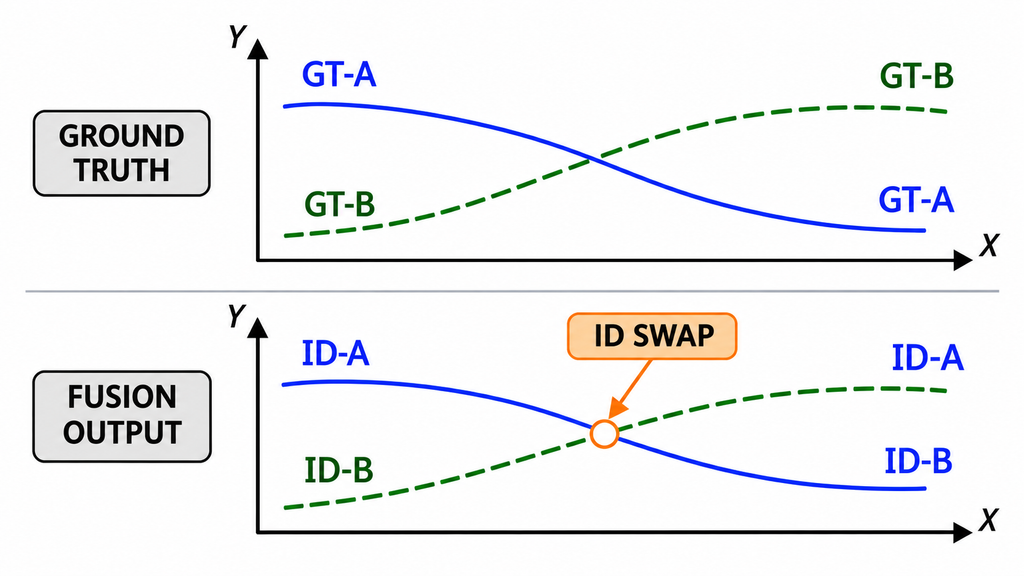
A successful one-target demonstration is not enough. The acceptance matrix must test whether the platform leaves observations unassociated when evidence is missing or contradictory, and whether it preserves target identity when the scene becomes ambiguous.
Agree on these test expectations before the trial. They are not results for any RF SKYPOWER product or fusion platform.
Swipe horizontally to view all columns.
| Test scenario | RF observation | Radar observation | Independent ground truth needed | Expected fusion behavior to check | Main error to flag |
|---|---|---|---|---|---|
| One target visible to both | Eligible event; bearing or position only if available | Valid track during the same truth interval | One aircraft ID, trajectory, and event timing | Associate only when the documented criteria are met; retain both source references | Wrong pair or missed valid association |
| RF-only observation | Valid RF event | No eligible radar observation | Actual aircraft/emission state and radar-observation conditions | Retain an RF-only or unresolved event; do not invent a radar source track | Unsupported merge or fabricated track |
| Radar-only observation | No eligible RF event | Valid radar track | Aircraft trajectory and RF emission/observability state | Retain the radar-only track without attaching unsupported RF identity | False RF attribution |
| Two targets crossing | Potentially overlapping RF events or bearings | Two close or crossing radar tracks | Distinct aircraft IDs and time-resolved paths | Preserve justified mappings; mark ambiguous candidates when evidence cannot separate them | Wrong pairing or ID swap |
| Duplicate fused tracks | Repeated events potentially belonging to one aircraft | One continuing source track, or repeated updates | One true aircraft and continuity interval | Avoid simultaneous excess confirmed fused IDs for one target under the agreed duplication rule | Extra fused IDs or duplicate intervals |
| Temporary sensor dropout and recovery | Event gap or reappearance | Continuing, interrupted, or reacquired track | Target presence, actual sensor gaps, and reference continuity | Mark single-source intervals; resume, reassign, or terminate IDs by the documented rule | False continuity or unjustified ID change |
| Conflicting source information | Event from an unrelated emitter, or a field incompatible with a candidate for the same object | Concurrent radar track from another target, or contradictory comparable motion/position | Separate emitter attribution, aircraft identity, path, and event timing | Preserve both source records; reject an unsupported link and flag genuine same-object conflicts | False association, forced merge, or false conflict |
Log raw inputs, source availability, candidate decisions, displayed output, and reference truth for each run. A missed sensor observation is not automatically a fusion error. Pairing two available but unrelated observations is an association error. Keep those causes separate when assigning responsibility.
If the source fields cannot distinguish between plausible target pairings, leaving the event unassociated may be correct. A forced confirmed link violates the agreed abstention rule even when it happens to agree with ground truth. If the forced link is wrong, record a false association as well.
Define the duplicate counting unit before testing. If it is the number of extra simultaneous fused IDs, two confirmed IDs for one true target represent one duplicate. A project may instead count the duration of overlapping duplicates, but must use the same definition across runs.
7. Which Metrics Reveal Incorrect Correlations and Track-ID Errors?
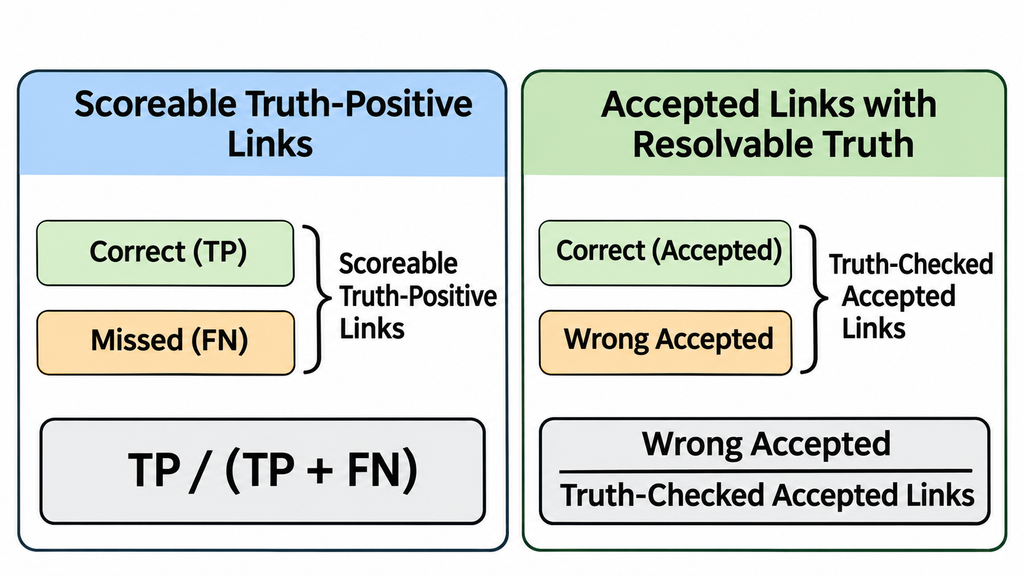
For multi-sensor drone detection, define the denominator before trusting an association rate. A scoreable association opportunity needs valid observations from both sensors, pre-agreed field-based eligibility, and enough target-discriminating evidence to support the decision being scored. Independent ground truth must also resolve the correct pairing. If several pairings remain indistinguishable from the sensor data, score the case against its abstention rule. Do not automatically count a justified refusal to link as a missed association.
Make eligibility testable from actual fields. For example, when an RF receiver reports a bearing to a verified airborne emitter, compare that bearing with the direction from the RF receiver to the radar-estimated target position, not directly with the radar’s local azimuth. Account for both sensors’ positions and orientations, observation times, and measurement uncertainty. The relationship becomes scoreable only when the agreed rule also resolves competing candidates. A generic RF alert with no target-discriminating field does not meet this spatial example. Freeze the permitted field combinations, tolerances, and tie-handling rules before the flight.
Fix the counting unit before testing: a target/time interval or a defined RF-event–radar-track relationship, including permitted one-to-many mappings. State the interval boundaries, candidate-gating criteria, and de-duplication rule. The independent evaluator first identifies eligible candidates from raw sensor observations using those frozen rules, without consulting the fusion platform’s decisions or ground truth. It then uses independent ground truth to label candidates as truth-positive, truth-negative, or indeterminate. Ground truth must not change candidate eligibility after the fact. Count each eligible relationship once. Ambiguous cases still require scenario testing, and the vendor cannot remove difficult cases after seeing the results.
Classify each eligible relationship using the frozen candidate set and independent ground truth. A wrong accepted pairing can produce both a false accepted link and a missed true association. Keep these link errors separate from sensor-detection failures.
Score link decisions, sensor detections, and track continuity separately. The link-level rates below are project-defined acceptance measures. They cannot replace standardized multi-object tracking metrics that use different trajectory and matching rules. Enter the project’s agreed limits and measured results; none are assumed product performance.
Swipe horizontally to view all columns.
| Metric | Applicable cases | Numerator / denominator or counting rule | Raw evidence required | Project-agreed limit | Measured result | Acceptance treatment |
|---|---|---|---|---|---|---|
| Correct association (true-link recall) | Scoreable truth-positive relationships | TP / (TP + FN); count each pre-agreed eligible relationship once | RF events, radar tracks, fused mappings, independent truth | Project-defined minimum | Pending test | Below minimum: not met; missing truth or required sample: hold |
| False associations among accepted links | All accepted links with resolvable truth, including ambiguous-source cases | Wrong accepted links / all truth-checked accepted links; use the agreed de-duplication rule | Accepted mappings, candidate records, truth IDs | Project-defined maximum | Pending test | Above maximum: not met; no accepted links: assess coverage before N/A |
| Missed true associations | Scoreable truth-positive relationships | FN / (TP + FN); eligible relationships without a correct accepted link, including wrong pairings | Both valid source observations, decisions, truth | Project-defined maximum | Pending test | Above maximum: not met; exclude non-detections and justified abstentions |
| Duplicate fused tracks | Single truth target in a defined interval | Excess simultaneous confirmed fused IDs: max(0, ID count − 1); or agreed duplicate duration | Fused-track lifecycle, source-ID map, truth timeline | Project-defined count or duration limit | Pending test | Compare excess IDs or duration using the agreed unit |
| Track fragmentation and ID errors | Continuous reference targets, recovery, and crossing intervals | Count tracking interruptions followed by resumption, unjustified fused-ID changes, and cross-target identity transfers separately; define any normalization | Fused-track lifecycle, ID history, source mappings, truth continuity, restart records | Project-defined maximum for each error type | Pending test | Assess each error type separately; exclude justified ID changes after reacquisition |
| Correlation latency and timeouts | Scoreable truth-positive relationships with valid timing | Time from agreed last-required observation to first correct confirmed link; report distribution plus deadline misses | Sensor event times, clock-error record, fusion decision times, unlinked opportunities | Project-defined deadline and latency statistic | Pending test | Check latency and missed deadlines; invalid clock: hold |
For the same scoreable truth-positive population, missed-link rate = 1 − true-link recall. The two rates describe complementary outcomes, not independent performance results. The false share among accepted links uses a different population: all accepted links with independently resolvable truth. Do not reuse the recall TP count if these populations differ. This accepted-link share also differs from the false-positive rate among negative candidates. The latter requires a separately frozen truth-negative candidate set and FP / (FP + TN) within that set. When a valid metric has a zero denominator, report N/A rather than zero.
Track fragmentation, ID changes, and identity transfers follow the lifecycle rules set in H2-4. A new ID after documented termination may be valid. Latency requires a common clock and a declared trigger time. Report missed deadlines alongside the latency distribution so fast successful links cannot hide unconfirmed opportunities.
Report raw counts and applicable metrics separately for single-target, crossing-target, dropout/recovery, and conflicting or unrelated-observation scenarios before pooling results. Include abstention-rule violations where applicable. A high overall percentage cannot override a failed scenario-specific requirement. If source validity, truth, sample counts, or de-duplication rules are missing, mark the metric not yet assessable. Compare projects only when their target sets, observation opportunities, limits, error definitions, and tested versions align.
8. When Should the Correlation Test Pass, Be Held, or Be Repeated?
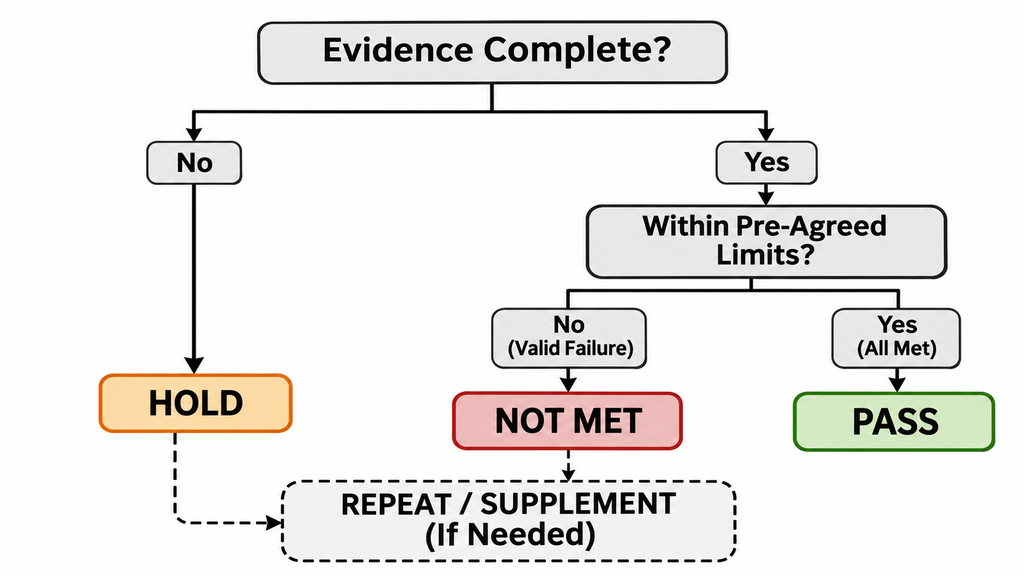
Base the result on pre-agreed acceptance criteria and a traceable test record. A dashboard screenshot, an operator’s account, or a high fusion percentage cannot replace that evidence.
Use Pass, Not met, or Hold for the acceptance decision. Repeat or supplement describes a follow-up action after Hold or Not met, not a fourth outcome.
- Pass: All required metrics and abnormal scenarios meet their pre-agreed limits. Each critical scenario has the agreed minimum number of valid samples, not merely a sufficient campaign total. Required scenario coverage is complete. Source logs, fused records, and independent truth support the decision. The tested configuration matches the approved scope.
- Not met: Valid evidence shows that a requirement failed under a valid test configuration. Record the metric, scenario, and failure mode. Do not relabel a demonstrated failure as an evidence gap.
- Hold: Missing or unreliable evidence prevents a decision. Examples include unknown timestamps, incomplete truth intervals, absent source logs, or an unverified rule version. A Hold is neither a pass nor an automatic product failure.
- Repeat or supplement (follow-up action): Retest the affected conditions after a clock fault, corrupted record, configuration change, insufficient sample, or unresolved anomaly. Keep the original disposition and explain which evidence the new run replaces. A full campaign repeat is necessary only when the change affects the wider test scope.
A zero denominator is N/A only if the approved scenario design contains no applicable opportunities for that metric. If a required scenario was not exercised, or too few valid observations were collected, the decision is Hold pending additional testing. An N/A entry cannot justify a Pass.
Record sensor models and firmware, fusion software, configuration, installation references, and time sources. Add scenario and flight IDs, the ground-truth method, raw-data versions, and the matching-rule version. Include agreed limits, sample counts, exclusions, and anomaly decisions. The buyer or authorized test authority signs the disposition against the project requirements.
A pass is limited to the tested configuration and scenarios. It is not a universal certification of RF–radar interoperability, site-wide coverage, target identity, or every future software release. Reassess the relevant correlation functions when interface fields, algorithms, time sources, or acceptance rules materially change. This method supports a project acceptance decision; it does not replace contractual approval or applicable regulatory processes.
Conclusion
A correct RF–radar association requires eligible observations, a verified time and coordinate basis, and a reproducible matching rule. Independent ground truth must then confirm that the paired observations refer to the same target.
The decision applies only to the tested scenarios, error bounds, software versions, and agreed limits. An absent observation from one sensor is not automatically an association failure, and missing evidence cannot support a pass. The method cannot supply project-specific thresholds or prove product performance without test data.
Before requesting equipment support, assemble the RF event examples, radar track fields, timestamp and coordinate definitions, independent target record, conflict and dropout scenarios, source-to-fused ID rules, and metric limits. That package gives the team a concrete basis for its own acceptance plan.
If a specific RF detector is under consideration, ask RF SKYPOWER to review its available detection data and interface documentation. Share the operating scenario, target types, and RF and radar models. Include versions, sample output fields, time and coordinate requirements, and expected exception behavior. Define log-delivery needs and proposed acceptance limits. Confirm any suitability or third-party radar compatibility from the exact model and interface evidence before testing.